

ASTM E1248-90(2017)
(Practice)Standard Practice for Shredder Explosion Protection
General Information
- Abstract
SIGNIFICANCE AND USE
4.1 Shredder explosions have occurred in most refuse processing plants with shredding facilities. Lessons learned in these incidents have been incorporated into this practice along with results of relevant test programs and general industrial explosion protection recommended practices. Recommendations in this practice cover explosion protection aspects of the design and operation of shredding facilities and equipment used therein.
4.2 This practice is not intended to be a substitute for an operating manual or a detailed set of design specifications. Rather, it represents general principles and guidelines to be addressed in detail in generating the operating manual and design specifications.
SCOPE
1.1 This practice covers general recommended design features and operating practices for shredder explosion protection in resource recovery plants and other refuse processing facilities.
1.2 Hammermills and other types of size reduction equipment (collectively termed shredders) are employed at many facilities that mechanically process solid wastes for resource recovery. Flammable or explosive materials (for example, gases, vapors, powders, and commercial and military explosives) may be present in the as-received waste stream. There is potential for these materials to be released, dispersed, and ignited within or near a shredder. Therefore, explosion prevention and damage amelioration provisions are required.
1.3 This standard does not purport to address all of the safety concerns, if any, associated with its use. It is the responsibility of the user of this standard to establish appropriate safety, health and environmental practices and determine the applicability of regulatory limitations prior to use.
1.4 This international standard was developed in accordance with internationally recognized principles on standardization established in the Decision on Principles for the Development of International Standards, Guides and Recommendations issued by the World Trade Organization Technical Barriers to Trade (TBT) Committee.
- Status
- Published
- Publication Date
- 31-Aug-2017
- Technical Committee
- D34 - Waste Management
- Drafting Committee
- D34.03 - Treatment, Recovery and Reuse
Overview
ASTM E1248-90(2017): Standard Practice for Shredder Explosion Protection provides comprehensive guidelines for the design and operation of explosion protection systems in shredding facilities within refuse processing plants and resource recovery operations. Developed by ASTM International, this standard is based on industry best practices and lessons learned from real-world incidents involving shredder explosions. It covers general explosion prevention principles and damage control strategies, focusing on safeguarding people, equipment, and plant operations from the risks posed by explosive incidents during the mechanical processing of solid waste.
Key Topics
ASTM E1248 addresses multiple aspects of explosion protection in shredding facilities, emphasizing both preventive measures and damage mitigation. Key topics include:
- Explosion Hazards in Refuse Shredding: Recognizes the risk of flammable or explosive materials (e.g., gases, vapors, powders, explosives) present in incoming waste streams.
- Definitions and Explosion Types: Clarifies important terms such as explosion, deflagration, detonation, explosion venting, explosion suppression, inerting, and shredder equipment.
- Design Practices:
- Selection of explosion prevention or damage control features based on waste types, shredder design, and plant layout.
- Isolation of shredders from vulnerable or occupied plant areas.
- Suitability of various design features for specific explosive risks.
- Inerting Systems: Guidance on installing systems to reduce oxygen concentration and prevent combustion within shredders and enclosures.
- Explosion Venting: Recommendations for explosion vent area sizing, vent duct design, vent cover selection, and appropriate venting locations to protect structural integrity and personnel.
- Explosion Suppression: Use of detection and rapid extinguishment systems to mitigate incipient explosions.
- Combustible Gas Detection: Implementation and maintenance of gas detection systems for early warning and process shutdown.
- Fire Protection and Water Spray Systems: Integration of sprinklers, water sprays, and other standard fire protection approaches.
- Protective Barriers and Personnel Safety: Use of blast mats, restricted access, and operator training to minimize injuries.
Applications
The practical application of ASTM E1248 is critical for:
- Resource Recovery Plants: Ensuring shredder operations safely process solid waste for material and energy recovery.
- Municipal Solid Waste Facilities: Reducing the frequency and impact of shredder explosions in plants handling mixed waste streams.
- Industrial Waste Processing: Managing combustible or explosive by-products in facilities utilizing hammermills or other shredders.
- Facility Design and Upgrades: Providing engineering teams with explosion protection best practices during shredder installation or retrofitting projects.
- Employee and Process Safety: Supporting operational procedures, employee training, and inspection programs to enhance workplace safety and regulatory compliance.
Facility managers, designers, and safety professionals benefit from implementing the standard’s recommendations, which contribute to reduced equipment damage, minimized downtime, improved regulatory compliance, and strengthened worker protection.
Related Standards
ASTM E1248-90(2017) should be used alongside additional, referenced standards that provide more detailed specifications for explosion prevention, electrical safety, and fire protection in hazardous environments:
- NFPA 68: Guide for Explosion Venting – Explosion vent provisions
- NFPA 69: Explosion Prevention Systems – System design and maintenance guidance
- NFPA 13: Sprinkler Systems – Fire suppression design criteria
- NFPA 497A: Classification of Hazardous Locations for Electrical Installations – Electrical safety in hazardous areas
- National Electrical Code (NEC) – Electrical installation requirements
Together, these documents deliver a holistic approach to explosion protection, ensuring shredder installations meet rigorous industry and international safety standards.
Keywords: shredder explosion protection, ASTM E1248, refuse processing safety, explosion prevention, inerting systems, explosion venting, explosion suppression, combustible gas detection, fire protection, resource recovery plant, solid waste management standards.
Relations
- Effective Date
- 01-Sep-2017
- Effective Date
- 01-Sep-2017
Get Certified
Connect with accredited certification bodies for this standard

CIS Institut d.o.o.
Personal Protective Equipment (PPE) certification body. Notified Body NB-2890 for EU Regulation 2016/425 PPE.

Kiwa BDA Testing
Building and construction product certification.
Kmetijski inštitut Slovenije
Agricultural Institute of Slovenia. Soil testing, plant health, agricultural product analysis.
Sponsored listings
Frequently Asked Questions
ASTM E1248-90(2017) is a standard published by ASTM International. Its full title is "Standard Practice for Shredder Explosion Protection". This standard covers: SIGNIFICANCE AND USE 4.1 Shredder explosions have occurred in most refuse processing plants with shredding facilities. Lessons learned in these incidents have been incorporated into this practice along with results of relevant test programs and general industrial explosion protection recommended practices. Recommendations in this practice cover explosion protection aspects of the design and operation of shredding facilities and equipment used therein. 4.2 This practice is not intended to be a substitute for an operating manual or a detailed set of design specifications. Rather, it represents general principles and guidelines to be addressed in detail in generating the operating manual and design specifications. SCOPE 1.1 This practice covers general recommended design features and operating practices for shredder explosion protection in resource recovery plants and other refuse processing facilities. 1.2 Hammermills and other types of size reduction equipment (collectively termed shredders) are employed at many facilities that mechanically process solid wastes for resource recovery. Flammable or explosive materials (for example, gases, vapors, powders, and commercial and military explosives) may be present in the as-received waste stream. There is potential for these materials to be released, dispersed, and ignited within or near a shredder. Therefore, explosion prevention and damage amelioration provisions are required. 1.3 This standard does not purport to address all of the safety concerns, if any, associated with its use. It is the responsibility of the user of this standard to establish appropriate safety, health and environmental practices and determine the applicability of regulatory limitations prior to use. 1.4 This international standard was developed in accordance with internationally recognized principles on standardization established in the Decision on Principles for the Development of International Standards, Guides and Recommendations issued by the World Trade Organization Technical Barriers to Trade (TBT) Committee.
SIGNIFICANCE AND USE 4.1 Shredder explosions have occurred in most refuse processing plants with shredding facilities. Lessons learned in these incidents have been incorporated into this practice along with results of relevant test programs and general industrial explosion protection recommended practices. Recommendations in this practice cover explosion protection aspects of the design and operation of shredding facilities and equipment used therein. 4.2 This practice is not intended to be a substitute for an operating manual or a detailed set of design specifications. Rather, it represents general principles and guidelines to be addressed in detail in generating the operating manual and design specifications. SCOPE 1.1 This practice covers general recommended design features and operating practices for shredder explosion protection in resource recovery plants and other refuse processing facilities. 1.2 Hammermills and other types of size reduction equipment (collectively termed shredders) are employed at many facilities that mechanically process solid wastes for resource recovery. Flammable or explosive materials (for example, gases, vapors, powders, and commercial and military explosives) may be present in the as-received waste stream. There is potential for these materials to be released, dispersed, and ignited within or near a shredder. Therefore, explosion prevention and damage amelioration provisions are required. 1.3 This standard does not purport to address all of the safety concerns, if any, associated with its use. It is the responsibility of the user of this standard to establish appropriate safety, health and environmental practices and determine the applicability of regulatory limitations prior to use. 1.4 This international standard was developed in accordance with internationally recognized principles on standardization established in the Decision on Principles for the Development of International Standards, Guides and Recommendations issued by the World Trade Organization Technical Barriers to Trade (TBT) Committee.
ASTM E1248-90(2017) is classified under the following ICS (International Classification for Standards) categories: 13.230 - Explosion protection. The ICS classification helps identify the subject area and facilitates finding related standards.
ASTM E1248-90(2017) has the following relationships with other standards: It is inter standard links to ASTM E1248-90(2009), ASTM D5681-22e1. Understanding these relationships helps ensure you are using the most current and applicable version of the standard.
ASTM E1248-90(2017) is available in PDF format for immediate download after purchase. The document can be added to your cart and obtained through the secure checkout process. Digital delivery ensures instant access to the complete standard document.
Standards Content (Sample)
This international standard was developed in accordance with internationally recognized principles on standardization established in the Decision on Principles for the
Development of International Standards, Guides and Recommendations issued by the World Trade Organization Technical Barriers to Trade (TBT) Committee.
Designation: E1248 − 90 (Reapproved 2017)
Standard Practice for
Shredder Explosion Protection
This standard is issued under the fixed designation E1248; the number immediately following the designation indicates the year of
original adoption or, in the case of revision, the year of last revision. A number in parentheses indicates the year of last reapproval. A
superscript epsilon (´) indicates an editorial change since the last revision or reapproval.
1. Scope 3. Terminology
1.1 This practice covers general recommended design fea- 3.1 Definitions:
3.1.1 deflagration—an explosion in which the flame or
tures and operating practices for shredder explosion protection
reaction front propagates at a speed well below the speed of
in resource recovery plants and other refuse processing facili-
sound in the unburned medium, such that the pressure is
ties.
virtually uniform throughout the enclosure (shredder) at any
1.2 Hammermills and other types of size reduction equip-
time during the explosion.
ment (collectively termed shredders) are employed at many
3.1.2 detonation—an explosion in which the flame or reac-
facilities that mechanically process solid wastes for resource
tion front propagates at a supersonic speed into the unburned
recovery. Flammable or explosive materials (for example,
medium, such that pressure increases occur in the form of
gases, vapors, powders, and commercial and military explo-
shock waves.
sives) may be present in the as-received waste stream. There is
potential for these materials to be released, dispersed, and 3.1.3 explosion—a rapid release of energy (usually by
ignited within or near a shredder. Therefore, explosion preven- means of combustion) with a corresponding pressure buildup
tion and damage amelioration provisions are required. capable of damaging equipment and building structures.
1.3 This standard does not purport to address all of the 3.1.4 explosion venting—the provision of an opening(s) in
the shredder enclosure and contiguous enclosed areas to allow
safety concerns, if any, associated with its use. It is the
responsibility of the user of this standard to establish appro- gases to escape during a deflagration and thus prevent pres-
sures from reaching the damage threshold.
priate safety, health and environmental practices and deter-
mine the applicability of regulatory limitations prior to use.
3.1.5 explosion suppression—the technique of detecting and
1.4 This international standard was developed in accor-
extinguishing incipient explosions in the shredder enclosure
dance with internationally recognized principles on standard-
and contiguous enclosed areas before pressures exceed the
ization established in the Decision on Principles for the
damage threshold.
Development of International Standards, Guides and Recom-
3.1.6 inerting—the technique by which a combustible mix-
mendations issued by the World Trade Organization Technical
tureisrenderednonflammablebyadditionofagasincapableof
Barriers to Trade (TBT) Committee.
supporting combustion.
3.1.7 shredder—a size-reduction machine that tears or
2. Referenced Documents
grinds materials to a smaller and more uniform particle size.
2.1 National Fire Protection Association Standards:
4. Significance and Use
National Electrical Code
4.1 Shredder explosions have occurred in most refuse pro-
NFPA 13 Sprinkler Systems
NFPA 68 Guide for Explosion Venting cessing plants with shredding facilities. Lessons learned in
these incidents have been incorporated into this practice along
NFPA 69 Explosion Prevention Systems
NFPA 497A Classification of Class I Hazardous (Classified) with results of relevant test programs and general industrial
explosion protection recommended practices. Recommenda-
Locations for Electrical Installations in Chemical Process
Areas tions in this practice cover explosion protection aspects of the
design and operation of shredding facilities and equipment
used therein.
4.2 This practice is not intended to be a substitute for an
This practice is under the jurisdiction of ASTM Committee D34 on Waste
Management and is the direct responsibility of Subcommittee D34.03 on Treatment,
operating manual or a detailed set of design specifications.
Recovery and Reuse.
Rather, it represents general principles and guidelines to be
Current edition approved Sept. 1, 2017. Published September 2017. Originally
addressed in detail in generating the operating manual and
approved in 1990. Last previous edition approved in 2009 as E1248 – 90 (2009).
DOI: 10.1520/E1248-90R17. design specifications.
Copyright © ASTM International, 100 Barr Harbor Drive, PO Box C700, West Conshohocken, PA 19428-2959. United States
E1248 − 90 (2017)
5. Design Practices gas conditioning is installed to maintain suitable temperature
(to prevent steam condensation or spontaneous ignition) and
5.1 Design Rationale:
flue gas composition (including dew point, oxygen, carbon
5.1.1 Each of the following design features is better suited
monoxide, soot, and contaminant concentrations).
for some types of combustible/explosive materials and shred-
5.2.4 Steamfromanon-siteboilercanbeasuitableinertgas
ders than for others. The selection of a particular combination
providing the temperatures of the shredder and contiguous
of explosion prevention features or damage control features, or
both, should be made with an understanding of the types of enclosures are sufficiently high (at least 180 °F (82 °C)) to
refuse entering the shredder, shredder operating conditions, the prevent steam condensation and the associated increase in
inherent strength of the shredder and surrounding structures, oxygen and flammable gas concentrations.
and the operating controls for screening input materials and
5.2.5 Oxygen concentrations in the shredder and all con-
restricting personnel access during shredding operations.
tiguous enclosures should be no higher than 10 % by volume,
5.1.2 Several of the following explosion protection design
unless test data for the particular inert gas employed and the
practices are effective for deflagrations but not for detonations.
variety of combustibles expected in the shredder demonstrate
Deflagrations usually result from accumulations of flammable
that a higher oxygen concentration can be tolerated without
gas-air, vapor-air, or powder (dust) air mixtures in or around
generating a flammable mixture. Test data for maximum
the shredder. However, commercial explosives and military
oxygenconcentrationsfornitrogenandcarbondioxideinerting
ordnance usually generate detonations.Afew flammable gases
are as listed in Appendix C of NFPA 69.
(for example, acetylene and hydrogen) are also prone to
5.2.6 Reliable oxygen concentration monitors should be
detonate when dispersed in highly turbulent, strong ignition
installed, calibrated, and maintained to verify that the maxi-
source environments such as exist inside a shredder. Because
mum oxygen concentration is not being exceeded in the
many explosion protection design practices are not applicable
shredder and contiguous enclosures. This will require multiple
to detonations, rigorous visual detection and removal of
monitors and sampling points, depending on the extent and
detonable material before it enters the shredder is particularly
uniformity of flow in the enclosed volume. Provision for
important (6.1).
cleaning and clearing sample lines, as recommended in 5.4.5,
5.1.3 Inviewofthedifficultiesinpreventingandcontrolling
are needed.
all types of shredder explosions, it is important to isolate the
5.2.7 The inert gas distribution system should be designed
shredder and surrounding enclosure from vulnerable equip-
in accordance with the provisions of Chapter 2 of NFPA 69.
ment and occupied areas in the plant. This is best achieved by
locating the shredder outdoors or, if indoors, in a location
5.3 Explosion Venting:
suitable for explosion venting directly outside. Locations in or
5.3.1 Explosion venting is intended to limit structural dam-
near the center of a processing building are not desirable. If the
age incurred during deflagrations by allowing unburned gas
shredderissituatedinanisolated,explosion-resistantstructure,
and combustion products to be discharged from the shredder or
the structure should be designed to withstand the explosion
contiguous enclosures, or both, before combustion and the
pressures specified in NFPA 68.
associated potentially destructive pressure rise is completed.
5.1.4 The shredder and all contiguous enclosures should be
The effectiveness of explosion venting for a particular explo-
equippedwithanexplosionprotectionsystemconsistingofone
sion depends on the rate of combustion versus the rate of
ormoreofthefollowing:inertingsystem(5.2);explosionvents
discharge of gases through the explosion vents. The rate of
(5.3); explosion suppression system (5.4). Water spray systems
combustionintheshredderoradjacentenclosuredependsupon
(5.5), combustible gas detectors (5.6), and industrial fire
the composition of the combustible gas-air, vapor-air, or
protection systems (5.7) should also be installed for additional
dust-air mixture, the size of the shredder/enclosure, and the
protection. Adjacent structures and personnel should be pro-
turbulencelevelasdeterminedbyairflowratesandhammertip
tected (5.8).
speed.
5.2 Inerting Systems:
5.3.2 In general, explosion venting is most effective with
5.2.1 An inerting system is intended to prevent combustion
large vent areas, low vent deployment pressures, low vent
explosions within a shredder (and contiguous enclosures) by
panel weight, and vent locations near the expected ignition
maintaining oxygen concentrations below the level required to
source (which is often hammer impact sparks within the
support combustion.
shredder). The following quantitative guidelines for these
5.2.2 The following factors must be accounted for in de-
factors are intended to protect against near worst-case flam-
signing a shredder inerting system: inert gas source and
mable gas-air mixtures occupying the entire shredder internal
distribution; operating controls and associated instrumentation;
volume.
leakage of inert gas from and entry of air into enclosures;
5.3.3 Explosion vent areas should be sufficiently large to
maintenance and inspection constraints in an oxygen deficient
atmosphere during normal operations; effect of inert gas on maintainexplosionpressuresunderthedamagethresholdvalue
for the particular shredder installation. Previously published
shredder materials and waste throughput; and contingency
plans for inert gas source supply interruption. guidelines relating peak pressure to vent area are not directly
5.2.3 Flue gas from an on-site furnace or boiler can be a applicable to municipal solid waste (MSW) shredders because
shredder hammer velocities can increase the combustion rate
suitableinertgas,providingthereisareliablemeanstoprevent
flamepropagationintotheshreddingsystemandprovidingflue well above that considered in establishing previous guidelines.
E1248 − 90 (2017)
The following recommended relationship is based on propane-
air explosion tests conducted in a full-scale large shredder
mock-up, including rotating hammers (1).
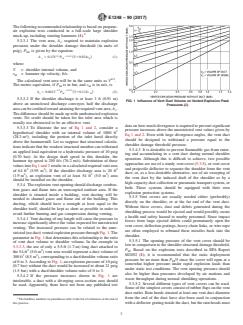
5.3.3.1 The vent area, A , required to maintain explosion
v
pressures under the shredder damage threshold (in units of
psig), P , is given by the equation:
M
2/3 20.435
A 5 0.13V P ~510.034v ! (1)
v M H
where:
V = shredder internal volume, and
v = hammer tip velocity, ft/s.
H
2/3
The calculated vent area will be in the same units as V .
The metric equivalent, if P is in bar, and v is in m/s, is
M H
2/3 20.435
A 5 0.041V P 510.112v (2)
~ !
v M H
5.3.3.2 If the shredder discharge is at least 3 ft (0.91 m)
FIG. 1 Influence of Vent Duct Volume on Vented Explosion Peak
above an unenclosed discharge conveyor, half the discharge
Pressures (2)
areacanbecreditedtowardattainingtherequiredventarea, A .
v
The difference should be made up with unobstructed explosion
vents. No credit should be taken for the inlet area which is
usually too obstructed to be an effective vent.
data on how much divergence is required to prevent significant
5.3.3.3 To illustrate the use of Eq 1 and 2, consider a
pressure increases above the unrestricted vent values given by
hypothetical shredder with an internal volume of 1000 ft
Eq 1 and 2. Even with large divergence angles, the vent duct
(28.3 m ), including the portion of the inlet hood directly
should be designed to withstand a pressure equal to the
above the hammermill. Let us suppose that structural calcula-
shredder damage threshold pressure.
tionsindicatethattheweakeststructuralmembercanwithstand
5.3.4.3 It is desirable to prevent flammable gas from enter-
an applied load equivalent to a hydrostatic pressure of 10 psig
ing and accumulating in a vent duct during normal shredder
(0.70 bar). At the design shaft speed in this shredder, the
operation. Although this is difficult to achieve, two possible
hammer tip speed is 250 ft/s (76.2 m/s). Substitution of these
approaches are use of a sturdy vent cover (5.3.5), or vent cover
values into Eq 1 and 2 results in a calculated required vent area
and projectile deflector to separate the shredder from the vent
2 2 2
of 64 ft (5.95 m ). If the shredder discharge area is 20 ft
duct; or, as a less desirable alternative, use of air sweeping of
2 2 2
(1.9 m ), an explosion vent of at least 54 ft (5.0 m ) area
the vent duct by the induced draft of the shredder or by a
should be installed on the shredder.
high-capacity dust collection or pneumatic transport system, or
5.3.4 The explosion vent opening should discharge combus-
both. These systems should be equipped with their own
tion gases and flame into an unoccupied outdoor area. If the
explosion protection systems.
shredder is situated inside a building, vent ducting will be
5.3.5 Vent covers are usually needed either (preferably)
needed to channel gases and flame out of the building. This
directly on the shredder, or at the far end of the vent duct.
ducting, which should have a strength at least equal to the
Without these covers, dust and debris generated during the
shredder itself, should be kept as short as possible in order to
shredding process would be ejected and would possibly create
avoid further burning and gas compression during venting.
a health and safety hazard to nearby personnel. Since impact
5.3.4.1 Vent ducting of any length will cause the pressure to
forces from large ejected debris could prematurely open the
increase significantly above the value expected for unrestricted
vent cover, deflection gratings, heavy chain links, or wire rope
venting. The increased pressure can be related to the unre-
are often employed to rebound these missiles back into the
stricted(noduct)ventedexplosionpressurethroughFig.1.The
shredder.
parameter in Fig. 1 that determines this relationship is the ratio
5.3.5.1 The opening pressure of the vent cover should be
of vent duct volume to shredder volume. In the example in
low in comparison to the shredder structural damage threshold,
5.3.3.3, the use of only a 5.5-ft (1.7-m) long duct attached to
P . Based on the explosion tests described in EPA Report
2 2
M
the 54-ft (5.0-m ) vent area would represent a duct volume of
3 3 M2052 (1), it is recommended that the static deployment
300 ft (8.5 m ), corresponding to a duct/shredder volume ratio
pressure be no more than P /5 since the cover will open at a
M
of 0 to 3.According to Fig. 1, an explosion pressure of 10 psig
somewhat higher pressure under rapid explosion loads than
(0.7 bar) without the duct would be increased to about 21 psig
under static test conditions. The vent opening pressure should
(1.5 bar) with a duct/shredder volume ratio of 0 to 3.
also be higher than pressures developed by air motions and
5.3.4.2 If the pressure increases shown in Fig. 1 are
waste throughput during normal shredding operations.
intolerable, a duct with a diverging cross-section area should
5.3.5.2 Several different types of vent covers can be used.
be used. Apparently, there have not been any published test
Some of the simplest covers consist of rubber flaps on the vent
duct outlet. Rain hoods situated at least one vent duct diameter
from the end of the duct have also been used in conjunction
The boldface numbers in parentheses refer to the list of references at the end of
this practice. with a deflector grating inside the duct, but the rain hoods must
E1248 − 90 (2017)
be restrained from being blown off during the explosion. Vent loads during an explosion and it should be strengthened or
cover construction and release mechanisms are described in explosion vented, or both, in accordance with 5.3.7.
NFPA 68.
5.3.7 Discharge Conveyor and Other Downstream
5.3.5.3 If explosion vent panels or doors are used, they Enclosures—Discharge conveyors, dust collectors, and other
should satisfy several criteria in addition to the vent area and enclosures downstream of the shredder require their own
explosion vents to cope with explosions initiated either in the
release pressure criteria cited previously. First, vent panel/door
inertia should be as low as possible, so as not to obstruct the shredder or downstream of the shredder. Discharge conveyor
and dust collector ducts and other elongated enclosures should
open vent. NFPA 68 specifies that the vent panel area density
2 2
have vents installed at regular intervals along the duct, with
be less than 2.5 lb/ft (12.5 kg/m ).Another important factor is
each vent having an area at least equal to the duct cross-
that a rugged and shock-resistant hinge or steel cable (of at
sectional area. The distance between vents depends on the
least 1-cm diameter) is required to prevent the panel/door from
strength of the duct, but should be no further than 15 vent
flying off during explosions. Finally, there is a need to
diameters. Detailed vent area and spacing requirements for
periodically inspect the vent actuation mechanism so that it
elongated pressure-resistant enclosures can be found in NFPA
will function when needed. Some explosion doors have not
68. If discharge conveyors are constructed of thin sheet metal
deployed at all during shredder explosions involving major
without any significant pressure resistance, adjacent equipment
damage. Therefore, an inspection and preventive maintenance
and personnel should be protected from metal sections torn
program is recommended.
asunder during the explosion.
5.3.6 During an explosion, flame and potentially damaging
5.3.8 Exposure to Vented Flames—Flames emerging from
pressure waves propagate out from the shredder explosion vent
shredder explosion vents can seriously injure nearby personnel
and from the inlet and discharge openings. Blast wave pres-
and can ignite other combustibles in the vicinity causing
sures can be estimated from the following hypothesized
secondary fires and explosions. Therefore, personnel and
generalization of test data. Thus, the peak overpressure, P,at
d
vulnerableequipmentshouldberestrictedfromtheareaaround
a distance, d, directly ahead of the vent opening is given by the
the shredder explosion vents during shredder operation. The
equation:
restricted area should also include the outlet of any explosion
P k
d
5 (3) vent ducting.
P
M
k1d=A
v
5.4 Explosion Suppression Systems:
where:
5.4.1 Explosion suppression systems are intended to detect
P = maximum pressure in shredder (same units as P ) (as
M d
and suppress an incipient deflagration before pressures reach
used in Eq 1 and 2, also),
the damage threshold and before flame is vented from the
A = area of shredder vent or other opening closest to target
v
shre
...