


ASTM D3776/D3776M-20
(Test Method)Standard Test Methods for Mass Per Unit Area (Weight) of Fabric
Standard Test Methods for Mass Per Unit Area (Weight) of Fabric
ABSTRACT
These test methods cover the measurement of fabric mass per unit area (weight) and is applicable to most fabrics. There are four approved options in the measurement of fabric mass per unit area: Option A, Option B, Option C, and Option D. Option A may be used for acceptance testing of commercial shipments since it has been used extensively in the trade. The second option is Option B which is applicable to a full-width sample cut from a full piece, roll, bolt, or cut. Unless otherwise specified, these results will include selvages and will be on the basis of conditioned fabric. Option C on the other hand is applicable when a small swatch of fabric is sent to the laboratory to be used as the test specimen. The results are considered to be applicable to the sample only and not necessarily to the lot from which the sample was taken. Measurements by this method do not include selvages and should be reported as such, unless a selvage allowance is specified. The last option is Option D which is intended for use with narrow fabrics as so designated by the trade.
SCOPE
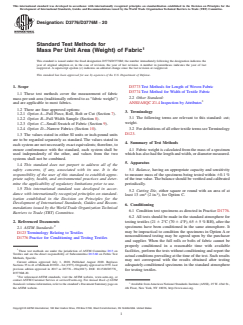
1.1 These test methods cover the measurement of fabric mass per unit area (traditionally referred to as “fabric weight”) and are applicable to most fabrics.
1.2 There are four approved options:
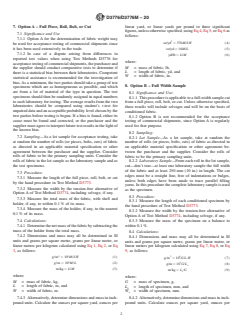
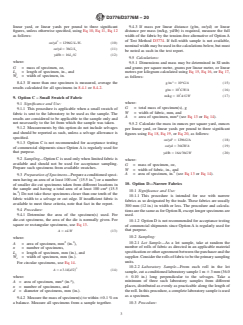
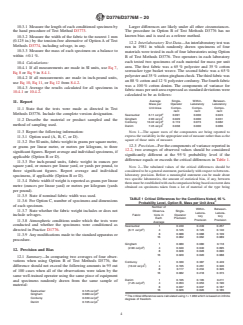
1.2.1 Option A—Full Piece, Roll, Bolt or Cut (Section 7).
1.2.2 Option B—Full Width Sample (Section 8).
1.2.3 Option C—Small Swatch of Fabric (Section 9).
1.2.4 Option D—Narrow Fabrics (Section 10).
1.3 The values stated in either SI units or inch-pound units are to be regarded separately as standard. The values stated in each system are not necessarily exact equivalents; therefore, to ensure conformance with the standard, each system shall be used independently of the other, and values from the two systems shall not be combined.
1.4 This standard does not purport to address all of the safety concerns, if any, associated with its use. It is the responsibility of the user of this standard to establish appropriate safety, health, and environmental practices and determine the applicability of regulatory limitations prior to use.
1.5 This international standard was developed in accordance with internationally recognized principles on standardization established in the Decision on Principles for the Development of International Standards, Guides and Recommendations issued by the World Trade Organization Technical Barriers to Trade (TBT) Committee.
General Information
- Status
- Published
- Publication Date
- 30-Jun-2020
- Technical Committee
- D13 - Textiles
- Drafting Committee
- D13.60 - Fabric Physical Test Methods B
Relations
- Effective Date
- 01-Mar-2017
- Effective Date
- 01-Jul-2016
- Effective Date
- 15-Sep-2015
- Effective Date
- 01-Sep-2015
- Effective Date
- 01-Apr-2015
- Effective Date
- 15-Jun-2013
- Effective Date
- 15-Jun-2013
- Effective Date
- 15-May-2013
- Effective Date
- 01-Jul-2012
- Effective Date
- 01-Feb-2012
- Effective Date
- 01-Feb-2012
- Effective Date
- 15-Jan-2009
- Effective Date
- 15-Jan-2009
- Effective Date
- 15-Jan-2009
- Effective Date
- 01-Aug-2008
Overview
ASTM D3776/D3776M-20: Standard Test Methods for Mass Per Unit Area (Weight) of Fabric provides established procedures for measuring the fabric mass per unit area, also known as fabric weight. Applicable to most textile fabrics, this standard supports quality assurance, product development, and commercial transactions in the textile industry. It offers four approved test options, each suited for different sample types and purposes, ensuring flexibility and reliability in fabric weight determination.
By specifying methodologies for both SI and inch-pound units, ASTM D3776/D3776M-20 ensures consistency and comparability in results, which is critical for manufacturers, suppliers, and end-users working with woven, nonwoven, and knit fabrics.
Key Topics
- Mass Per Unit Area Measurement: The core of this standard is the accurate determination of fabric weight, typically reported as grams per square metre (g/m²) or ounces per square yard (oz/yd²).
- Four Test Options:
- Option A: Full piece, roll, bolt, or cut - suitable for acceptance testing and commercial shipment verification.
- Option B: Full-width sample - used where conditioned, complete width samples are available, often excludes selvages.
- Option C: Small swatch of fabric - appropriate for limited material, with results applicable only to the tested sample.
- Option D: Narrow fabrics - intended for fabrics typically 300 mm (12 in.) or less in width.
- Sample Preparation & Conditioning: Guidelines for specimen conditioning and environmental controls ensure meaningful and repeatable results.
- Reporting Practices: Requirements for detailed reporting, including conditions, sample description, unit systems, and whether selvages are included.
Applications
ASTM D3776/D3776M-20 is widely recognized in the global textile industry for its practical value in:
- Quality Control: Provides reliable methods for confirming product specifications and meeting customer requirements.
- Product Development: Facilitates research and development by enabling textile engineers to assess fabric types and optimize properties.
- Regulatory Compliance: Supports compliance with contractual and regulatory standards in domestic and international trade.
- Commercial Transactions: Used for acceptance testing of commercial shipments, ensuring that buyers and suppliers have a consistent reference.
- Procurement and Supply Chain Management: Useful for sourcing, procurement, and supply chain verification processes.
- Laboratory Testing: Serves as a referee test method in case of disputed results and supports inter-laboratory consistency.
In practice, these test methods are utilized by textile manufacturers, converters, fabric finishers, quality assurance labs, and organizations specifying fabric weights for end users in apparel, furnishings, and technical textiles.
Related Standards
- ASTM D123: Terminology Relating to Textiles
- ASTM D1776: Practice for Conditioning and Testing Textiles
- ASTM D3773: Test Methods for Length of Woven Fabric
- ASTM D3774: Test Method for Width of Textile Fabric
- ANSI/ASQC Z1.4: Inspection by Attributes
These related standards complement ASTM D3776/D3776M-20 by providing additional guidance in sampling, measurement, and terminology for textile evaluation.
By adhering to the procedures in ASTM D3776/D3776M-20, organizations can ensure fabric mass per unit area is measured accurately and consistently, supporting greater quality, transparency, and comparability in the textile industry. This standard is fundamental for fabric weight testing and is referenced worldwide as a benchmark for textile mass measurement.
Buy Documents
ASTM D3776/D3776M-20 - Standard Test Methods for Mass Per Unit Area (Weight) of Fabric
REDLINE ASTM D3776/D3776M-20 - Standard Test Methods for Mass Per Unit Area (Weight) of Fabric
Get Certified
Connect with accredited certification bodies for this standard

Control Union Certifications
Global certification for agriculture and sustainability.

Bureau Veritas Bangladesh
Bureau Veritas certification services in Bangladesh.

ECOCERT France
Leader in organic and sustainability certification worldwide.
Sponsored listings
Frequently Asked Questions
ASTM D3776/D3776M-20 is a standard published by ASTM International. Its full title is "Standard Test Methods for Mass Per Unit Area (Weight) of Fabric". This standard covers: ABSTRACT These test methods cover the measurement of fabric mass per unit area (weight) and is applicable to most fabrics. There are four approved options in the measurement of fabric mass per unit area: Option A, Option B, Option C, and Option D. Option A may be used for acceptance testing of commercial shipments since it has been used extensively in the trade. The second option is Option B which is applicable to a full-width sample cut from a full piece, roll, bolt, or cut. Unless otherwise specified, these results will include selvages and will be on the basis of conditioned fabric. Option C on the other hand is applicable when a small swatch of fabric is sent to the laboratory to be used as the test specimen. The results are considered to be applicable to the sample only and not necessarily to the lot from which the sample was taken. Measurements by this method do not include selvages and should be reported as such, unless a selvage allowance is specified. The last option is Option D which is intended for use with narrow fabrics as so designated by the trade. SCOPE 1.1 These test methods cover the measurement of fabric mass per unit area (traditionally referred to as “fabric weight”) and are applicable to most fabrics. 1.2 There are four approved options: 1.2.1 Option A—Full Piece, Roll, Bolt or Cut (Section 7). 1.2.2 Option B—Full Width Sample (Section 8). 1.2.3 Option C—Small Swatch of Fabric (Section 9). 1.2.4 Option D—Narrow Fabrics (Section 10). 1.3 The values stated in either SI units or inch-pound units are to be regarded separately as standard. The values stated in each system are not necessarily exact equivalents; therefore, to ensure conformance with the standard, each system shall be used independently of the other, and values from the two systems shall not be combined. 1.4 This standard does not purport to address all of the safety concerns, if any, associated with its use. It is the responsibility of the user of this standard to establish appropriate safety, health, and environmental practices and determine the applicability of regulatory limitations prior to use. 1.5 This international standard was developed in accordance with internationally recognized principles on standardization established in the Decision on Principles for the Development of International Standards, Guides and Recommendations issued by the World Trade Organization Technical Barriers to Trade (TBT) Committee.
ABSTRACT These test methods cover the measurement of fabric mass per unit area (weight) and is applicable to most fabrics. There are four approved options in the measurement of fabric mass per unit area: Option A, Option B, Option C, and Option D. Option A may be used for acceptance testing of commercial shipments since it has been used extensively in the trade. The second option is Option B which is applicable to a full-width sample cut from a full piece, roll, bolt, or cut. Unless otherwise specified, these results will include selvages and will be on the basis of conditioned fabric. Option C on the other hand is applicable when a small swatch of fabric is sent to the laboratory to be used as the test specimen. The results are considered to be applicable to the sample only and not necessarily to the lot from which the sample was taken. Measurements by this method do not include selvages and should be reported as such, unless a selvage allowance is specified. The last option is Option D which is intended for use with narrow fabrics as so designated by the trade. SCOPE 1.1 These test methods cover the measurement of fabric mass per unit area (traditionally referred to as “fabric weight”) and are applicable to most fabrics. 1.2 There are four approved options: 1.2.1 Option A—Full Piece, Roll, Bolt or Cut (Section 7). 1.2.2 Option B—Full Width Sample (Section 8). 1.2.3 Option C—Small Swatch of Fabric (Section 9). 1.2.4 Option D—Narrow Fabrics (Section 10). 1.3 The values stated in either SI units or inch-pound units are to be regarded separately as standard. The values stated in each system are not necessarily exact equivalents; therefore, to ensure conformance with the standard, each system shall be used independently of the other, and values from the two systems shall not be combined. 1.4 This standard does not purport to address all of the safety concerns, if any, associated with its use. It is the responsibility of the user of this standard to establish appropriate safety, health, and environmental practices and determine the applicability of regulatory limitations prior to use. 1.5 This international standard was developed in accordance with internationally recognized principles on standardization established in the Decision on Principles for the Development of International Standards, Guides and Recommendations issued by the World Trade Organization Technical Barriers to Trade (TBT) Committee.
ASTM D3776/D3776M-20 is classified under the following ICS (International Classification for Standards) categories: 59.080.30 - Textile fabrics. The ICS classification helps identify the subject area and facilitates finding related standards.
ASTM D3776/D3776M-20 has the following relationships with other standards: It is inter standard links to ASTM D123-17, ASTM D3774-96(2016), ASTM D123-15b, ASTM D123-15a, ASTM D123-15, ASTM D123-13a, ASTM D123-13ae1, ASTM D123-13, ASTM D3774-96(2012), ASTM D123-12e1, ASTM D123-12, ASTM D123-09, ASTM D123-09e2, ASTM D123-09e1, ASTM D1776-08. Understanding these relationships helps ensure you are using the most current and applicable version of the standard.
ASTM D3776/D3776M-20 is available in PDF format for immediate download after purchase. The document can be added to your cart and obtained through the secure checkout process. Digital delivery ensures instant access to the complete standard document.
Standards Content (Sample)
This international standard was developed in accordance with internationally recognized principles on standardization established in the Decision on Principles for the
Development of International Standards, Guides and Recommendations issued by the World Trade Organization Technical Barriers to Trade (TBT) Committee.
Designation: D3776/D3776M − 20
Standard Test Methods for
Mass Per Unit Area (Weight) of Fabric
This standard is issued under the fixed designation D3776/D3776M; the number immediately following the designation indicates the
year of original adoption or, in the case of revision, the year of last revision. A number in parentheses indicates the year of last
reapproval. A superscript epsilon (´) indicates an editorial change since the last revision or reapproval.
This standard has been approved for use by agencies of the U.S. Department of Defense.
1. Scope D3773 Test Methods for Length of Woven Fabric
D3774 Test Method for Width of Textile Fabric
1.1 These test methods cover the measurement of fabric
2.2 Other Standard:
mass per unit area (traditionally referred to as “fabric weight”)
ANSI/ASQC Z1.4 Inspection by Attributes
and are applicable to most fabrics.
1.2 There are four approved options:
3. Terminology
1.2.1 Option A—Full Piece, Roll, Bolt or Cut (Section 7).
3.1 The following terms are relevant to this standard: cut;
1.2.2 Option B—Full Width Sample (Section 8).
weight.
1.2.3 Option C—Small Swatch of Fabric (Section 9).
1.2.4 Option D—Narrow Fabrics (Section 10).
3.2 FordefinitionsofallothertextiletermsseeTerminology
D123.
1.3 The values stated in either SI units or inch-pound units
are to be regarded separately as standard. The values stated in
4. Summary of Test Methods
each system are not necessarily exact equivalents; therefore, to
ensure conformance with the standard, each system shall be 4.1 Fabric weight is calculated from the mass of a specimen
used independently of the other, and values from the two whichhasalsohadthelengthandwidth,ordiametermeasured.
systems shall not be combined.
5. Apparatus
1.4 This standard does not purport to address all of the
safety concerns, if any, associated with its use. It is the 5.1 Balance, having an appropriate capacity and sensitivity
responsibility of the user of this standard to establish appro- to measure mass of the specimens being tested within 60.1 %
priate safety, health, and environmental practices and deter- of the true value.The balance should be verified and calibrated
mine the applicability of regulatory limitations prior to use. periodically.
1.5 This international standard was developed in accor-
5.2 Cutting Die, either square or round with an area of at
dance with internationally recognized principles on standard- 2 2
least 13 cm (2 in. ), for Option C.
ization established in the Decision on Principles for the
Development of International Standards, Guides and Recom-
6. Conditioning
mendations issued by the World Trade Organization Technical
6.1 Condition test specimens as directed in Practice D1776.
Barriers to Trade (TBT) Committee.
6.2 All tests should be made in the standard atmosphere for
2. Referenced Documents
testing textiles (21 6 2°C (70 6 4°F), 65 6 5 % RH), after the
specimens have been conditioned in the same atmosphere. It
2.1 ASTM Standards:
may be impractical to condition the specimens in Option A or
D123 Terminology Relating to Textiles
nonconditioned testing may be agreed upon by the purchaser
D1776 Practice for Conditioning and Testing Textiles
and supplier. When the full rolls or bolts of fabric cannot be
properly conditioned in a reasonable time with available
These test methods are under the jurisdiction of ASTM Committee D13 on
facilities, perform the tests without conditioning and report the
Textiles and are the direct responsibility of Subcommittee D13.60 on Fabric Test
actual conditions prevailing at the time of the test. Such results
Methods, Specific.
may not correspond with the results obtained after testing
Current edition approved July 1, 2020. Published August 2020. Replaces
Sections 35 to 41 of Methods D1910 – 64 (1975). Originally approved in 1979. Last adequately-conditioned specimens in the standard atmosphere
previous edition approved in 2017 as D3776 – 09a(2017). DOI: 10.1520/D3776_
for testing textiles.
D3776M-20.
For referenced ASTM standards, visit the ASTM website, www.astm.org, or
contact ASTM Customer Service at service@astm.org. For Annual Book of ASTM
Standards volume information, refer to the standard’s Document Summary page on Available from American National Standards Institute (ANSI), 25 W. 43rd St.,
the ASTM website. 4th Floor, New York, NY 10036, http://www.ansi.org.
Copyright © ASTM International, 100 Barr Harbor Drive, PO Box C700, West Conshohocken, PA 19428-2959. United States
D3776/D3776M − 20
7. Option A – Full Piece, Roll, Bolt, or Cut linear yard, or linear yards per pound to three significant
figures, unless otherwise specified, using Eq 4, Eq 5,or Eq 6 as
7.1 Significance and Use
follows:
7.1.1 Option A for the determination of fabric weight may
oz/yd 5 576M/LW (4)
be used for acceptance testing of commercial shipments since
it has been used extensively in the trade. oz/yd 5 16M/L (5)
7.1.2 In case of a dispute arising from differences in
yd/lb 5 L/M (6)
reported test values when using Test Methods D3776 for
where:
acceptance testing of commercial shipments, the purchaser and
M = mass of fabric, lb,
the supplier should conduct comparative tests to determine if
L = length of fabric, yd, and
there is a statistical bias between their laboratories. Competent
W = width of fabric, in.
statistical assistance is recommended for the investigation of
bias.As a minimum, the two parties should take a group of test
8. Option B – Full Width Sample
specimens which are as homogeneous as possible, and which
are from a lot of material of the type in question. The test
8.1 Significance and Use:
specimens should then be randomly assigned in equal numbers
8.1.1 This procedure is applicable to a full-width sample cut
to each laboratory for testing.The average results from the two
from a full piece, roll, bolt, or cut. Unless otherwise specified,
laboratories should be compared using student’s t-test for
these results will include selvages and will be on the basis of
unpaireddataandanacceptableprobabilitylevelchosenbythe
conditioned fabric.
two parties before testing is begun. If a bias is found, either its
8.1.2 Option B is not recommended for the acceptance
cause must be found and corrected, or the purchaser and the
testing of commercial shipments, since Option A is regularly
supplier must agree to interpret future test results in the light of
used for that purpose.
the known bias.
8.2 Sampling:
7.2 Sampling—As a lot sample for acceptance testing, take
8.2.1 Lot Sample—As a lot sample, take at random the
at random the number of rolls (or pieces, bolts, cuts) of fabric number of rolls (or pieces, bolts, cuts) of fabric as directed in
as directed in an applicable material specification or other
an applicable material specification or other agreement be-
agreement between the purchaser and the supplier. Consider tween the purchaser and the supplier. Consider the rolls of
rolls of fabric to be the primary sampling units. Consider the
fabric to be the primary sampling units.
rolls of fabric in the lot sample as the laboratory sample and as 8.2.2 Laboratory Sample—From each roll in the lot sample,
the test specimens.
cut—don’t tear—at least one laboratory sample the full width
of the fabric and at least 250 mm (10 in.) in length. The cut
7.3 Procedure:
edges must be a straight line, free of indentations or bulges,
7.3.1 Measure the length of the full piece, roll, bolt, or cut
unless both edges have been made to trace parallel filling
by the hand procedure in Test Method D3773.
yarns. In this procedure the complete laboratory sample is used
7.3.2 Measure the width by the tension-free alternative of
as the specimen.
Option A of Test Method D3774, including selvage, if any.
8.3 Procedure:
7.3.3 Measure the total mass of the fabric, with shell and
8.3.1 Measure the length of each conditioned specimen by
holder, if any, to within 0.1 % of its mass.
the hand procedure of Test Method D3773.
7.3.4 Measure the mass of the holder, if any, to the nearest
8.3.2 Measure the width by the tension-free alternative of
0.1 % of its mass.
Option A of Test Method D3774, including selvage, if any.
7.4 Calculations: 8.3.3 Measure the mass of the specimen on a balance to
within 0.1 %.
7.4.1 Determinethenetmassofthefabricbysubtractingthe
mass of the holder from the total mass.
8.4 Calculations:
7.4.2 Dimensions and mass may all be determined in SI
8.4.1 Dimensions and mass may all be determined in SI
units and grams per square metre, grams per linear metre, or
units and grams per square metre, grams per linear metre, or
linear metres per kilogram calculated using Eq 1, Eq 2,or Eq
linear metres per kilogram calculated using Eq 7, Eq 8,or Eq
3, as follows:
9, as follows:
2 3
2 6
g/m 5 10 M/LW (1)
g⁄m 5 10 G⁄L W (7)
s
g/m 5 10 M/L (2)
g/m 5 10 G⁄L (8)
s
m/kg 5 L/M (3)
m⁄kg 5 L ⁄G (9)
s
where:
where:
M = mass of fabric, kg,
G = mass of specimen, g,
L = length of fabric, m, and
L = length of specimen, mm, and
s
W = width of fabric, m.
W = width of specimen, mm.
s
7.4.3 Alternatively, determine dimensions and mass in inch- 8.4.2 Alternatively, determine dimensions and mass in inch-
pound units. Calculate the ounces per square yard, ounces per pound units. Calculate ounces per square yard, ounces per
D3776/D3776M − 20
linear yard, or linear yards per pound to three significant 9.4.3 If mass per linear distance (g/m, oz/yd) or linear
figures, unless otherwise specified, using Eq 10, Eq 11, Eq 12 distance per mass (m/kg, yd/lb) is required, measure the full
as follows: width of the fabric by the tension-free alternative of Option A
2 of Test Method D3774. If full-width sample is not available,
oz/yd 5 1296G/L W (10)
s s
nominal width may be used in the calculations below, but must
oz/yd 5 36G/L (11)
s
be noted as such in the test report.
yd/lb 5 16L /G (12)
s
9.5 Calculations:
where:
9.5.1 Dimensions and mass may be determined in SI units
G = mass of specimen, oz,
and grams per square metre, grams per linear metre, or linear
L = length of specimen, in., and
metres per kilogram calculated using Eq 15, Eq 16,or Eq 17,
s
W = width of specimen, in.
s as follows:
2 6
8.4.3 If more than one specimen is measured, average the
g/m 5 10 G⁄A (15)
results calculated for all specimens in 8.4.1 or 8.4.2.
g/m 5 10 GW⁄A (16)
m/kg 5 10 A⁄GW (17)
9. Option C – Small Swatch of Fabric
where:
9.1 Significance and Use:
G = total mass of specimen(s), g
9.1.1 This procedure is applicable when a small swatch of
W = width of fabric, mm, and
fabric is sent to the laboratory to be used as the sample. The
A = area of specimen, mm (see Eq 13 or Eq 14).
results are considered to be applicable to the sample only and
not necessarily to the lot from which the sample was taken.
9.5.2 Calculate the mass in ounces per square yard, ounces
9.1.2 Measurements by this option do
...
This document is not an ASTM standard and is intended only to provide the user of an ASTM standard an indication of what changes have been made to the previous version. Because
it may not be technically possible to adequately depict all changes accurately, ASTM recommends that users consult prior editions as appropriate. In all cases only the current version
of the standard as published by ASTM is to be considered the official document.
Designation: D3776/D3776M − 09a (Reapproved 2017) D3776/D3776M − 20
Standard Test Methods for
Mass Per Unit Area (Weight) of Fabric
This standard is issued under the fixed designation D3776/D3776M; the number immediately following the designation indicates the
year of original adoption or, in the case of revision, the year of last revision. A number in parentheses indicates the year of last
reapproval. A superscript epsilon (´) indicates an editorial change since the last revision or reapproval.
This standard has been approved for use by agencies of the U.S. Department of Defense.
1. Scope
1.1 These test methods cover the measurement of fabric mass per unit area (weight) and is(traditionally referred to as “fabric
weight”) and are applicable to most fabrics.
1.2 There are four approved options:
1.2.1 Option A—Full Piece, Roll, Bolt or Cut (Section 7).
1.2.2 Option B—Full Width Sample (Section 8).
1.2.3 Option C—Small Swatch of Fabric (Section 9).
1.2.4 Option D—Narrow Fabrics (Section 10).
1.3 The values stated in either SI units or inch-pound units are to be regarded separately as standard. The values stated in each
system mayare not benecessarily exact equivalents; therefore, to ensure conformance with the standard, each system shall be used
independently of the other. Combiningother, and values from the two systems may result in non-conformance with the
standard.shall not be combined.
1.4 This standard does not purport to address all of the safety concerns, if any, associated with its use. It is the responsibility
of the user of this standard to establish appropriate safety safety, health, and healthenvironmental practices and determine the
applicability of regulatory limitations prior to use.
1.5 This international standard was developed in accordance with internationally recognized principles on standardization
established in the Decision on Principles for the Development of International Standards, Guides and Recommendations issued
by the World Trade Organization Technical Barriers to Trade (TBT) Committee.
2. Referenced Documents
2.1 ASTM Standards:
D123 Terminology Relating to Textiles
D1776 Practice for Conditioning and Testing Textiles
D3773 Test Methods for Length of Woven Fabric
D3774 Test Method for Width of Textile Fabric
2.2 Other Standard:
ANSI/ASQC Z1.4 Inspection by Attributes
3. Terminology
3.1 The following terms are relevant to this standard: cut; weight.
3.2 For definitions of all other textile terms see Terminology D123.
4. Summary of Test Methods
4.1 Fabric massweight is calculated from the mass of a specimen which has also had the length and width of which have been
measured as directed in one of the procedures in Test Method width, or diameter measured.D3773 and D3774.
These test methods are under the jurisdiction of ASTM Committee D13 on Textiles and are the direct responsibility of Subcommittee D13.60 on Fabric Test Methods,
Specific.
Current edition approved July 15, 2017July 1, 2020. Published August 2017August 2020. Replaces Sections 35 to 41 of Methods D1910 – 64 (1975). Originally approved
in 1979. Last previous edition approved in 20132017 as D3776 – 09a(2013).(2017). DOI: 10.1520/D3776_D3776M-09AR17.10.1520/D3776_D3776M-20.
For referenced ASTM standards, visit the ASTM website, www.astm.org, or contact ASTM Customer Service at service@astm.org. For Annual Book of ASTM Standards
volume information, refer to the standard’s Document Summary page on the ASTM website.
Available from American National Standards Institute (ANSI), 25 W. 43rd St., 4th Floor, New York, NY 10036, http://www.ansi.org.
Copyright © ASTM International, 100 Barr Harbor Drive, PO Box C700, West Conshohocken, PA 19428-2959. United States
D3776/D3776M − 20
5. Apparatus
5.1 Scale, with a capacity and sensitivity sufficient to weigh the full piece, roll, bolt, or cut units to within 60.1 % of their gross
mass. The accuracy of the scale should be certified by a recognized authority.
5.1 Balance, having a an appropriate capacity and sensitivity to weigh within 60.1 % of the measure mass of the specimens
being tested.tested within 60.1 % of the true value. The balance should be verified and calibrated periodically.
2 2
5.2 Cutting Die, either square or round with an area of at least 13 cm or 2 (2 in. ), for Option C.
6. Conditioning
6.1 Condition test specimens as directed in Practice D1776.
6.2 All weighing tests should be made in the standard atmosphere for testing textiles (21 6 1°C (70 6 2°F), 65 6 2 % RH),
(21 6 2°C (70 6 4°F), 65 6 5 % RH), after the specimens have been conditioned in the same atmosphere. It may be impractical
to condition the specimens in Option A or nonconditioned testing may be agreed upon by the purchaser and supplier. When the
full rolls or bolts of fabric cannot be properly conditioned in a reasonable time with available facilities, perform the tests without
conditioning and report the actual conditions prevailing at the time of the test. Such results may not correspond with the results
obtained after testing adequately conditioned adequately-conditioned specimens in the standard atmosphere for testing textiles.
7. Option A—Full A – Full Piece, Roll, Bolt, or Cut
7.1 Significance and Use
7.1.1 Option A for the determination of mass per unit area of woven fabrics fabric weight may be used for acceptance testing
of commercial shipments since it has been used extensively in the trade.
7.1.2 In case of a dispute arising from differences in reported test values when using Test Methods D3776 for acceptance testing
of commercial shipments, the purchaser and the supplier should conduct comparative tests to determine if there is a statistical bias
between their laboratories. Competent statistical assistance is recommended for the investigation of bias. As a minimum, the two
parties should take a group of test specimens which are as homogeneous as possible, and which are from a lot of material of the
type in question. The test specimens should then be randomly assigned in equal numbers to each laboratory for testing. The average
results from the two laboratories should be compared using student’s t-test for unpaired data and an acceptable probability level
chosen by the two parties before testing is begun. If a bias is found, either its cause must be found and corrected, or the purchaser
and the supplier must agree to interpret future test results in the light of the known bias.
7.2 Sampling—As a lot sample for acceptance testing, take at random the number of rolls (or pieces, bolts, cuts) of fabric as
directed in an applicable material specification or other agreement between the purchaser and the supplier. Consider rolls of fabric
to be the primary sampling units. Consider the rolls of fabric in the lot sample as the laboratory sample and as the test specimens.
7.3 Procedure:
7.3.1 Measure the length of the full piece, roll, bolt, or cut by the hand procedure in Test Method D3773.
7.3.2 Measure the width by the tension-free alternative of Option A of Test Method D3774., including selvage, if any.
7.3.3 Weigh the Measure the total mass of the fabric, with shell and holder, if any, to the nearest within 0.1 % of its mass.
7.3.4 Weigh the Measure the mass of the holder, if any, to the nearest 0.1 % of its mass.
7.4 Calculations:
7.4.1 Determine the net weightmass of the fabric by subtracting the weightmass of the holder from the total weight.mass.
7.4.2 Dimensions and mass may all be determined in SI units and mass per unit area grams per square metre, grams per linear
metre, or linear metres per kilogram calculated using Eq 1, Eq 2, or Eq 3, as follows:
2 3
g/m 5 10 M/LW (1)
g/m5 10 M/L (2)
m/kg 5 L/M (3)
where:
M = mass of fabric, in kilograms,
L = length of fabric, in metres, and
W = width of fabric, in metres.
M = mass of fabric, kg,
L = length of fabric, m, and
W = width of fabric, m.
7.4.3 Calculate the mass per unit area, massAlternatively, determine dimensions and mass in inch-pound units. Calculate the
ounces per square yard, ounces per linear yard, or linear yards per pound to three significant figures, unless otherwise specified,
using Eq 4, Eq 5, Eq 6, oror Eq 6 Eq 7, as follows:
Mass per unit area:
D3776/D3776M − 20
oz/yd 5 576M/LW (4)
Mass per yard:
oz/yd 5 16M/L (5)
Linear yards per pound:
yd/lb 5 L/M (6)
yd/lb 5 16 oz/yd (7)
where:
M = mass of fabric, in pounds,
L = length of fabric, in yards, and
W = width of fabric, in inches.
M = mass of fabric, lb,
L = length of fabric, yd, and
W = width of fabric, in.
7.4.4 If preferred, convert the U.S. customary units to SI units using Eq 8, Eq 9, or Eq 10, as follows:
2 2
Mass, g/m 5 oz/yd 333.906 (8)
Mass, g/m5 oz/yd 331.000 (9)
m/kg 5 yd/lb 32.016 (10)
8. Option B—Full B – Full Width Sample
8.1 Significance and Use:
8.1.1 This procedure is applicable to a full-width sample cut from a full piece, roll, bolt, or cut. Unless otherwise specified, these
results will include selvages and will be on the basis of conditioned fabric.
8.1.2 Option B is not recommended for the acceptance testing of commercial shipments, since Option A is regularly used for
that purpose.
8.2 Sampling:
8.2.1 Lot Sample—As a lot sample for acceptance testing, sample, take at random the number of rolls (or pieces, bolts, cuts)
of fabric as directed in an applicable material specification or other agreement between the purchaser and the supplier. Consider
the rollrolls of fabric to be the primary sampling units.
8.2.2 Laboratory Sample—From each roll or piece in the lot sample, cut—don’t tear—at least one laboratory sample the full
width of the fabric and at least 250 mm (10 in.) in length. The cut edges must be a straight line, free of indentations or bulges,
unless both edges have been made to trace parallel filling yarns. In this procedure the complete laboratory sample is used as the
specimen.
8.3 Procedure:
8.3.1 Measure the length of theeach conditioned specimen by the hand procedure of Test Method D3773.
8.3.2 Measure the width by the tension-free alternative of Option A of Test Method D3774., including selvage, if any.
8.3.3 Weigh the specimen in grams on a scale or balance to the nearest 0.1 % of its mass (weight).Measure the mass of the
specimen on a balance to within 0.1 %.
8.4 Calculations:
8.4.1 Calculate the mass per unit area, mass per linear yard, or linear yards per pound to three significant figures, unless
otherwise specified, Dimensions and mass may all be determined in SI units and grams per square metre, grams per linear metre,
or linear metres per kilogram calculated using Eq 117, Eq 128, Eq 13, or Eq 149, as follows:
Mass per unit area:
oz/yd 5 45.72G⁄L W (7)
s
2 6
g⁄m 5 10 G⁄L W (7)
s
Mass per linear yard:
oz/yd 5 1.27G⁄L (8)
s
g/m 5 10 G⁄L (8)
s
Linear yards per pound:
yd/lb 5 16/oz per linear yd (13)
yd/lb 5 12.6L ⁄G (9)
s
m⁄kg 5 L ⁄G (9)
s
D3776/D3776M − 20
where:
G = mass of specimen, in grams,
L = length of specimen, in inches, and
s
W = width of specimen, in inches.
G = mass of specimen, g,
L = length of specimen, mm, and
s
W = width of specimen, mm.
s
8.4.2 If preferred, convert the U.S. customary units to SI units using Eq 4, Eq 5, or Eq 6 in 7.4.3.
8.4.2 Alternatively, determine dimensions and mass may all be determined in SI units and calculated in inch-pound units.
Calculate ounces per square yard, ounces per linear yard, or linear yards per pound to three significant figures, unless otherwise
specified, using Eq 1510, Eq 1611, or Eq 1712, as follows:
Mass per unit area:
2 6
g/m 5 10 G/L W (10)
s
oz/yd 5 1296G/L W (10)
s s
Mass per linear metre:
g/m5 10 G/L (11)
s
oz/yd 5 36G/L (11)
s
Linear metres per kilogram:
m/kg 5 L /G (12)
s
yd/lb 5 16L /G (12)
s
where:
G = mass of specimen, g
L = length of specimen, mm, and
s
W = width of specimen, mm.
G = mass of specimen, oz,
L = length of specimen, in., and
s
W = width of specimen, in.
s
8.4.3 If more than one specimen is measured, average the results calculated for all specimens in 8.4.1 or 8.4.2.
9. Option C—Small C – Small Swatch of Fabric
9.1 Significance and Use:
9.1.1 This procedure is applicable when a small swatch of fabric is sent to the laboratory to be used as the test specimen. sample.
The results are considered to be applicable to the sample only and not necessarily to the lot from which the sample was taken.
9.1.2 Measurements by this methodoption do not include selvages and should be reported as such, unless a selvage allowance
is specified.
9.1.3 Option C is not recommended for acceptance testing of commercial shipments since Option A is regularly used for that
purpose.
9.2 Sampling—Option C is used only when limited fabric is available and should not be used for acceptance sampling. Prepare
such specimens from small swatches as i
...
Questions, Comments and Discussion
Ask us and Technical Secretary will try to provide an answer. You can facilitate discussion about the standard in here.
Loading comments...