

ASTM A400-23
(Practice)Standard Practice for Steel Bars, Selection Guide, Composition, and Mechanical Properties
General Information
- Abstract
SIGNIFICANCE AND USE
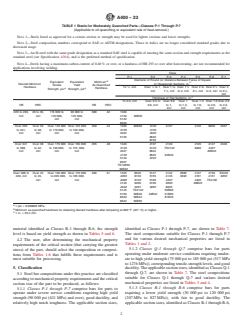
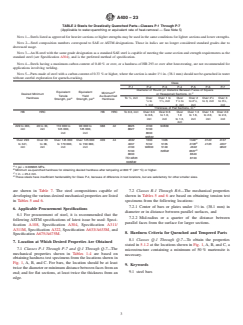
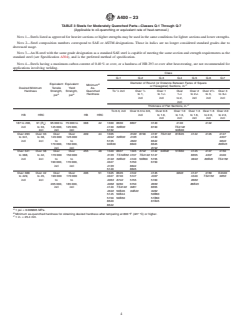
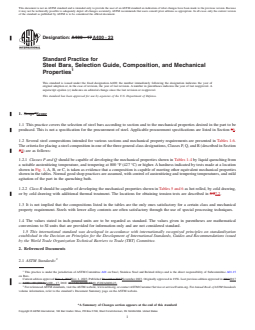
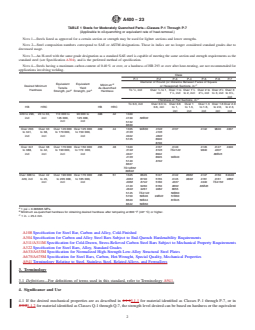
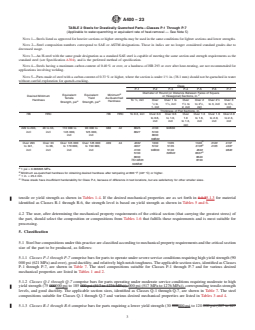
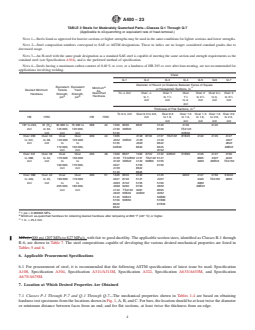
4.1 If the desired mechanical properties are as described in 5.1.1 for material identified as Classes P-1 through P-7, or in 5.1.2 for material identified as Classes Q-1 through Q-7, the strength level desired can be based on hardness or the equivalent tensile or yield strength as shown in Tables 1-4. If the desired mechanical properties are as set forth in 5.1.3 for material identified as Classes R-1 through R-6, the strength level is based on yield strength as shown in Tables 5 and 6.
4.2 The user, after determining the mechanical property requirements of the critical section (that carrying the greatest stress) of the part, should select the composition or compositions from Tables 1-6 that fulfills these requirements and is most suitable for processing.
SCOPE
1.1 This practice covers the selection of steel bars according to section and to the mechanical properties desired in the part to be produced. This is not a specification for the procurement of steel. Applicable procurement specifications are listed in Section 6.
1.2 Several steel compositions intended for various sections and mechanical property requirements are presented in Tables 1-6. The criteria for placing a steel composition in one of the three general class designations, Classes P, Q, and R (described in Section 5) are as follows:
1.2.1 Classes P and Q should be capable of developing the mechanical properties shown in Tables 1-4 by liquid quenching from a suitable austenitizing temperature, and tempering at 800 °F (427 °C) or higher. A hardness indicated by tests made at a location shown in Fig. 1, A, B, or C, is taken as evidence that a composition is capable of meeting other equivalent mechanical properties shown in the tables. Normal good shop practices are assumed, with control of austenitizing and tempering temperatures, and mild agitation of the part in the quenching bath.
FIG. 1 Locations in Typical Cross Sections of Steel Bars at Which Desired Properties Are Obtained
1.2.2 Class R should be capable of developing the mechanical properties shown in Tables 5 and 6 as hot rolled, by cold drawing, or by cold drawing with additional thermal treatment. The locations for obtaining tension tests are described in 7.2.
1.3 It is not implied that the compositions listed in the tables are the only ones satisfactory for a certain class and mechanical property requirement. Steels with lower alloy contents are often satisfactory through the use of special processing techniques.
1.4 The values stated in inch-pound units are to be regarded as standard. The values given in parentheses are mathematical conversions to SI units that are provided for information only and are not considered standard.
1.5 This international standard was developed in accordance with internationally recognized principles on standardization established in the Decision on Principles for the Development of International Standards, Guides and Recommendations issued by the World Trade Organization Technical Barriers to Trade (TBT) Committee.
- Status
- Published
- Publication Date
- 31-Oct-2023
- Technical Committee
- A01 - Steel, Stainless Steel and Related Alloys
- Drafting Committee
- A01.15 - Bars
Buy Documents
ASTM A400-23 - Standard Practice for Steel Bars, Selection Guide, Composition, and Mechanical Properties
REDLINE ASTM A400-23 - Standard Practice for Steel Bars, Selection Guide, Composition, and Mechanical Properties
Overview
ASTM A400-23: Standard Practice for Steel Bars, Selection Guide, Composition, and Mechanical Properties is an internationally recognized standard developed by ASTM. It provides a comprehensive guide for selecting steel bar compositions based on the required mechanical properties and section dimensions of the part to be manufactured. The standard assists engineers, manufacturers, and procurement specialists in identifying the most suitable grades and processing methods for steel bars intended for a variety of applications.
Key Topics
- Classification System: Steel bars are classified into three general classes:
- Classes P (P-1 to P-7): For parts requiring high yield strength and toughness. Selection is based on hardness or the equivalent tensile/yield strength, typically developed by liquid quenching and high-temperature tempering.
- Classes Q (Q-1 to Q-7): For parts subjected to moderate service, requiring moderate to high yield strength and good ductility. Properties are achieved through similar heat treatments as Classes P.
- Classes R (R-1 to R-6): For parts needing lower yield strength and fair to good ductility. These properties are achieved through hot rolling, cold drawing, or cold drawing with thermal treatment.
- Mechanical Properties: The standard provides guidance for matching section size and strength requirements (hardness, tensile, or yield strength), referencing detailed tables with properties for various steel compositions.
- Selection Guidance: Emphasizes evaluating the critical section (area under greatest stress) to determine property requirements, and choosing steel grades from the provided tables that best suit those needs and processing conditions.
- Processing Recommendations: Outlines heat-treatment practices such as austenitizing, tempering, quenching (oil or water), and cold finishing methods, ensuring mechanical properties are consistently achieved.
Applications
ASTM A400-23 is highly valuable in industries where mechanical performance and reliability of steel parts are critical. Typical applications include:
- Automotive Components: Axles, shafts, gears, and connecting rods requiring specified tensile and yield strengths.
- Machinery Manufacturing: Machine parts, tool holders, and fixtures where precise mechanical property control is essential.
- Structural Engineering: Steel bars for construction equipment, frames, and supports demanding toughness and high yield strengths.
- General Fabrication: Any application that requires the selection of steel bars tailored to specific mechanical criteria and processing routes.
By following ASTM A400-23, users ensure optimal performance, longevity, and safety of steel components across a range of sectors.
Related Standards
When procuring or specifying steel bars, ASTM A400-23 should be used in conjunction with relevant procurement standards. Notable related ASTM standards include:
- ASTM A108: Standard Specification for Steel Bar, Carbon and Alloy, Cold-Finished
- ASTM A304: Standard Specification for Carbon and Alloy Steel Bars Subject to End-Quench Hardenability Requirements
- ASTM A311/A311M: Standard Specification for Cold-Drawn, Stress-Relieved Carbon Steel Bars Subject to Mechanical Property Requirements
- ASTM A322: Specification for Steel Bars, Alloy, Standard Grades
- ASTM A633/A633M: Specification for Normalized High-Strength Low-Alloy Structural Steel Plates
- ASTM A675/A675M: Specification for Steel Bars, Carbon, Hot-Wrought, Special Quality, Mechanical Properties
Practical Value
- Consistent Selection: Provides clear guidelines for selecting steel grades based on final part requirements, improving procurement and manufacturing consistency.
- Efficiency: Reduces trial-and-error in material selection, shortening development cycles and minimizing costly rework.
- Compliance: Assists in meeting industry requirements, quality standards, and international trade regulations through standardized practices.
Keywords
Steel bars, ASTM A400-23, steel selection guide, mechanical properties, steel composition, steel bar classification, heat treatment, steel standards, steel procurement.
Relations
- Effective Date
- 01-Nov-2023
- Effective Date
- 01-Mar-2024
- Effective Date
- 01-Mar-2024
- Effective Date
- 01-Mar-2024
- Effective Date
- 01-May-2023
- Effective Date
- 01-Jun-2018
- Effective Date
- 01-Nov-2023
- Referred By
ASTM A576-23 - Standard Specification for Steel Bars, Carbon, Hot-Wrought, Special Quality - Effective Date
- 01-Nov-2023
- Effective Date
- 01-Nov-2023
Buy Documents
ASTM A400-23 - Standard Practice for Steel Bars, Selection Guide, Composition, and Mechanical Properties
REDLINE ASTM A400-23 - Standard Practice for Steel Bars, Selection Guide, Composition, and Mechanical Properties
Get Certified
Connect with accredited certification bodies for this standard

Element Materials Technology
Materials testing and product certification.

Inštitut za kovinske materiale in tehnologije
Institute of Metals and Technology. Materials testing, metallurgical analysis, NDT.
Sponsored listings
Frequently Asked Questions
ASTM A400-23 is a standard published by ASTM International. Its full title is "Standard Practice for Steel Bars, Selection Guide, Composition, and Mechanical Properties". This standard covers: SIGNIFICANCE AND USE 4.1 If the desired mechanical properties are as described in 5.1.1 for material identified as Classes P-1 through P-7, or in 5.1.2 for material identified as Classes Q-1 through Q-7, the strength level desired can be based on hardness or the equivalent tensile or yield strength as shown in Tables 1-4. If the desired mechanical properties are as set forth in 5.1.3 for material identified as Classes R-1 through R-6, the strength level is based on yield strength as shown in Tables 5 and 6. 4.2 The user, after determining the mechanical property requirements of the critical section (that carrying the greatest stress) of the part, should select the composition or compositions from Tables 1-6 that fulfills these requirements and is most suitable for processing. SCOPE 1.1 This practice covers the selection of steel bars according to section and to the mechanical properties desired in the part to be produced. This is not a specification for the procurement of steel. Applicable procurement specifications are listed in Section 6. 1.2 Several steel compositions intended for various sections and mechanical property requirements are presented in Tables 1-6. The criteria for placing a steel composition in one of the three general class designations, Classes P, Q, and R (described in Section 5) are as follows: 1.2.1 Classes P and Q should be capable of developing the mechanical properties shown in Tables 1-4 by liquid quenching from a suitable austenitizing temperature, and tempering at 800 °F (427 °C) or higher. A hardness indicated by tests made at a location shown in Fig. 1, A, B, or C, is taken as evidence that a composition is capable of meeting other equivalent mechanical properties shown in the tables. Normal good shop practices are assumed, with control of austenitizing and tempering temperatures, and mild agitation of the part in the quenching bath. FIG. 1 Locations in Typical Cross Sections of Steel Bars at Which Desired Properties Are Obtained 1.2.2 Class R should be capable of developing the mechanical properties shown in Tables 5 and 6 as hot rolled, by cold drawing, or by cold drawing with additional thermal treatment. The locations for obtaining tension tests are described in 7.2. 1.3 It is not implied that the compositions listed in the tables are the only ones satisfactory for a certain class and mechanical property requirement. Steels with lower alloy contents are often satisfactory through the use of special processing techniques. 1.4 The values stated in inch-pound units are to be regarded as standard. The values given in parentheses are mathematical conversions to SI units that are provided for information only and are not considered standard. 1.5 This international standard was developed in accordance with internationally recognized principles on standardization established in the Decision on Principles for the Development of International Standards, Guides and Recommendations issued by the World Trade Organization Technical Barriers to Trade (TBT) Committee.
SIGNIFICANCE AND USE 4.1 If the desired mechanical properties are as described in 5.1.1 for material identified as Classes P-1 through P-7, or in 5.1.2 for material identified as Classes Q-1 through Q-7, the strength level desired can be based on hardness or the equivalent tensile or yield strength as shown in Tables 1-4. If the desired mechanical properties are as set forth in 5.1.3 for material identified as Classes R-1 through R-6, the strength level is based on yield strength as shown in Tables 5 and 6. 4.2 The user, after determining the mechanical property requirements of the critical section (that carrying the greatest stress) of the part, should select the composition or compositions from Tables 1-6 that fulfills these requirements and is most suitable for processing. SCOPE 1.1 This practice covers the selection of steel bars according to section and to the mechanical properties desired in the part to be produced. This is not a specification for the procurement of steel. Applicable procurement specifications are listed in Section 6. 1.2 Several steel compositions intended for various sections and mechanical property requirements are presented in Tables 1-6. The criteria for placing a steel composition in one of the three general class designations, Classes P, Q, and R (described in Section 5) are as follows: 1.2.1 Classes P and Q should be capable of developing the mechanical properties shown in Tables 1-4 by liquid quenching from a suitable austenitizing temperature, and tempering at 800 °F (427 °C) or higher. A hardness indicated by tests made at a location shown in Fig. 1, A, B, or C, is taken as evidence that a composition is capable of meeting other equivalent mechanical properties shown in the tables. Normal good shop practices are assumed, with control of austenitizing and tempering temperatures, and mild agitation of the part in the quenching bath. FIG. 1 Locations in Typical Cross Sections of Steel Bars at Which Desired Properties Are Obtained 1.2.2 Class R should be capable of developing the mechanical properties shown in Tables 5 and 6 as hot rolled, by cold drawing, or by cold drawing with additional thermal treatment. The locations for obtaining tension tests are described in 7.2. 1.3 It is not implied that the compositions listed in the tables are the only ones satisfactory for a certain class and mechanical property requirement. Steels with lower alloy contents are often satisfactory through the use of special processing techniques. 1.4 The values stated in inch-pound units are to be regarded as standard. The values given in parentheses are mathematical conversions to SI units that are provided for information only and are not considered standard. 1.5 This international standard was developed in accordance with internationally recognized principles on standardization established in the Decision on Principles for the Development of International Standards, Guides and Recommendations issued by the World Trade Organization Technical Barriers to Trade (TBT) Committee.
ASTM A400-23 is classified under the following ICS (International Classification for Standards) categories: 77.140.60 - Steel bars and rods. The ICS classification helps identify the subject area and facilitates finding related standards.
ASTM A400-23 has the following relationships with other standards: It is inter standard links to ASTM A400-17, ASTM A633/A633M-24, ASTM A941-24, ASTM A108-24, ASTM A941-23, ASTM A633/A633M-18, ASTM A322-13(2018)e1, ASTM A576-23, ASTM A108-18. Understanding these relationships helps ensure you are using the most current and applicable version of the standard.
ASTM A400-23 is available in PDF format for immediate download after purchase. The document can be added to your cart and obtained through the secure checkout process. Digital delivery ensures instant access to the complete standard document.
Standards Content (Sample)
This international standard was developed in accordance with internationally recognized principles on standardization established in the Decision on Principles for the
Development of International Standards, Guides and Recommendations issued by the World Trade Organization Technical Barriers to Trade (TBT) Committee.
Designation: A400 − 23
Standard Practice for
Steel Bars, Selection Guide, Composition, and Mechanical
Properties
This standard is issued under the fixed designation A400; the number immediately following the designation indicates the year of
original adoption or, in the case of revision, the year of last revision. A number in parentheses indicates the year of last reapproval. A
superscript epsilon (´) indicates an editorial change since the last revision or reapproval.
This standard has been approved for use by agencies of the U.S. Department of Defense.
1. Scope 1.5 This international standard was developed in accor-
dance with internationally recognized principles on standard-
1.1 This practice covers the selection of steel bars according
ization established in the Decision on Principles for the
to section and to the mechanical properties desired in the part
Development of International Standards, Guides and Recom-
to be produced. This is not a specification for the procurement
mendations issued by the World Trade Organization Technical
of steel. Applicable procurement specifications are listed in
Barriers to Trade (TBT) Committee.
Section 6.
1.2 Several steel compositions intended for various sections
2. Referenced Documents
and mechanical property requirements are presented in Tables
2.1 ASTM Standards:
1-6. The criteria for placing a steel composition in one of the
A108 Specification for Steel Bar, Carbon and Alloy, Cold-
three general class designations, Classes P, Q, and R (described
Finished
in Section 5) are as follows:
A304 Specification for Carbon and Alloy Steel Bars Subject
1.2.1 Classes P and Q should be capable of developing the
to End-Quench Hardenability Requirements
mechanical properties shown in Tables 1-4 by liquid quenching
A311/A311M Specification for Cold-Drawn, Stress-
from a suitable austenitizing temperature, and tempering at
Relieved Carbon Steel Bars Subject to Mechanical Prop-
800 °F (427 °C) or higher. A hardness indicated by tests made
erty Requirements
at a location shown in Fig. 1, A, B, or C, is taken as evidence
A322 Specification for Steel Bars, Alloy, Standard Grades
that a composition is capable of meeting other equivalent
A633/A633M Specification for Normalized High-Strength
mechanical properties shown in the tables. Normal good shop
Low-Alloy Structural Steel Plates
practices are assumed, with control of austenitizing and tem-
A675/A675M Specification for Steel Bars, Carbon, Hot-
pering temperatures, and mild agitation of the part in the
Wrought, Special Quality, Mechanical Properties
quenching bath.
A941 Terminology Relating to Steel, Stainless Steel, Related
1.2.2 Class R should be capable of developing the mechani-
Alloys, and Ferroalloys
cal properties shown in Tables 5 and 6 as hot rolled, by cold
drawing, or by cold drawing with additional thermal treatment.
3. Terminology
The locations for obtaining tension tests are described in 7.2.
3.1 Definitions—For definitions of terms used in this
1.3 It is not implied that the compositions listed in the tables
standard, refer to Terminology A941.
are the only ones satisfactory for a certain class and mechanical
property requirement. Steels with lower alloy contents are
4. Significance and Use
often satisfactory through the use of special processing tech-
4.1 If the desired mechanical properties are as described in
niques.
5.1.1 for material identified as Classes P-1 through P-7, or in
1.4 The values stated in inch-pound units are to be regarded
5.1.2 for material identified as Classes Q-1 through Q-7, the
as standard. The values given in parentheses are mathematical
strength level desired can be based on hardness or the
conversions to SI units that are provided for information only
equivalent tensile or yield strength as shown in Tables 1-4. If
and are not considered standard.
the desired mechanical properties are as set forth in 5.1.3 for
This practice is under the jurisdiction of ASTM Committee A01 on Steel,
Stainless Steel and Related Alloys and is the direct responsibility of Subcommittee
A01.15 on Bars. For referenced ASTM standards, visit the ASTM website, www.astm.org, or
Current edition approved Nov. 1, 2023. Published November 2023. Originally contact ASTM Customer Service at service@astm.org. For Annual Book of ASTM
approved in 1956. Last previous edition approved in 2017 as A400 – 17. DOI: Standards volume information, refer to the standard’s Document Summary page on
10.1520/A0400-23. the ASTM website.
Copyright © ASTM International, 100 Barr Harbor Drive, PO Box C700, West Conshohocken, PA 19428-2959. United States
A400 − 23
TABLE 1 Steels for Moderately Quenched Parts—Classes P-1 Through P-7
(Applicable to oil-quenching or equivalent rate of heat-removal.)
NOTE 1—Steels listed as approved for a certain section or strength may be used for lighter sections and lower strengths.
NOTE 2—Steel composition numbers correspond to SAE or ASTM designations. Those in italics are no longer considered standard grades due to
decreased usage.
NOTE 3—An H-steel with the same grade designation as a standard SAE steel is capable of meeting the same section and strength requirements as the
standard steel (see Specification A304), and is the preferred method of specification.
NOTE 4—Steels having a maximum carbon content of 0.40 % or over, or a hardness of HB 293 or over after heat-treating, are not recommended for
applications involving welding.
Class
P-1 P-2 P-3 P-4 P-5 P-6 P-7
Diameter of Round (or Distance Between Faces of Square
B
Equivalent Equivalent
Minimum C
Desired Minimum or Hexagonal) Sections, in.
Tensile Yield As-Quenched
1 1 1 1
Hardness To ⁄2, incl Over ⁄2 to 1, Over 1 to Over 1 ⁄2 Over 2 to Over 2 ⁄2 Over 3
A A
Hardness
Strength, psi Strength, psi
1 1 1
incl 1 ⁄2, incl to 2, incl 2 ⁄2, incl to 3, incl to 3 ⁄2,
incl
C
Thickness of Flat Sections, in.
To 0.3, incl Over 0.3 to Over 0.6 Over 1 Over 1.3 Over 1.6 Over 2.0
HB HRC HB HRC 0.6, incl to 1, to 1.3, to 1.6, to 2.0, to 2.3,
incl incl incl incl incl
229 to 293, 20 to 33, 110 000 to 90 000 to 388 42 1330
incl incl 145 000, 125 000, 4130 50B30
incl incl 5132
Over 293 Over 33 Over 145 000 Over 125 000 409 44 1335 94B30 3140 4137 4142 9840 4337
to 341, to 38, to 170 000, to 150 000, 3135 4135
incl incl incl incl 4042 4640
5135 8640
Over 341 Over 38 Over 170 000 Over 150 000 455 48 1340 4137 4140 4145 4147 4340
to 388, to 42, to 190 000, to 170 000, 3140 6145 TS4140 9840 4337
incl incl incl incl
4047 8642 86B45
4135 8645 94B40
5140 8742
TS14B50
50B40
Over 388 to Over 42 Over 190 000 Over 170 000 496 51 1345 8645 5147 4142 8660 4147 4150 E4340
429, incl to 45, to 205 000, to 185 000, 4063 8740 5155 4145 9840 4161 4161 9850
incl incl incl 4068 8742 5160 4337 4340 TS4150
4140 9260 6150 8650 86B45
4640 9261 9262 8655
5145 TS4140 50B60
5150 50B46 94B40 51B60
8640 50B44 81B45
8642 50B50
A
1 psi = 0.006895 MPa.
B
Minimum as-quenched hardness for obtaining desired hardness after tempering at 800 °F (427 °C) or higher.
C
1 in. = 25.4 mm.
material identified as Classes R-1 through R-6, the strength identified as Classes P-1 through P-7, are shown in Table 7.
level is based on yield strength as shown in Tables 5 and 6. The steel compositions suitable for Classes P-1 through P-7
and for various desired mechanical properties are listed in
4.2 The user, after determining the mechanical property
Tables 1 and 2.
requirements of the critical section (that carrying the greatest
5.1.2 Classes Q-1 through Q-7 comprise bars for parts
stress) of the part, should select the composition or composi-
operating under moderate service conditions requiring moder-
tions from Tables 1-6 that fulfills these requirements and is
ate to high yield strength (75 000 psi to 185 000 psi (517 MPa
most suitable for processing.
to 1276 MPa)), corresponding tensile-strength levels, and good
5. Classification
ductility. The applicable section sizes, identified as Classes Q-1
through Q-7, are shown in Table 7. The steel compositions
5.1 Steel bar compositions under this practice are classified
suitable for Classes Q-1 through Q-7 and various desired
according to mechanical property requirements and the critical
mechanical properties are listed in Tables 3 and 4.
section size of the part to be produced, as follows:
5.1.1 Classes P-1 through P-7 comprise bars for parts to 5.1.3 Classes R-1 through R-6 comprise bars for parts
operate under severe service conditions requiring high yield requiring a lower yield strength (30 000 psi to 120 000 psi
strength (90 000 psi (621 MPa) and over), good ductility, and (207 MPa to 827 MPa)), with fair to good ductility. The
relatively high notch toughness. The applicable section sizes, applicable section sizes, identified as Classes R-1 through R-6,
A400 − 23
TABLE 2 Steels for Drastically Quenched Parts—Classes P-1 Through P-7
(Applicable to water-quenching or equivalent rate of heat-removal — See Note 5)
NOTE 1—Steels listed as approved for heavier sections or higher strengths may be used in the same conditions for lighter sections and lower strengths.
NOTE 2—Steel composition numbers correspond to SAE or ASTM designations. Those in italics are no longer considered standard grades due to
decreased usage.
NOTE 3—An H-steel with the same grade designation as a standard SAE steel is capable of meeting the same section and strength requirements as the
standard steel (see Specification A304), and is the preferred method of specification.
NOTE 4—Steels having a maximum carbon content of 0.40 % or over, or a hardness of HB 293 or over after heat-treating, are not recommended for
applications involving welding.
NOTE 5—Parts made of steel with a carbon content of 0.33 % or higher, where the section is under 1 ⁄2 in. (38.1 mm) should not be quenched in water
without careful exploration for quench-cracking.
Class
P-1 P-2 P-3 P-4 P-5 P-6 P-7
Diameter of Round (or Distance Between Faces of Square
B
Equivalent Equivalent
Minimum C
Desired Minimum or Hexagonal) Sections, in.
Tensile Yield As-Quenched
1 1
Hardness To ⁄2, incl Over Over 1 to Over Over 2 Over 2 ⁄2 Over 3
A A
Hardness
Strength, psi Strength, psi
1 1 1 1 1
⁄2 to 1 ⁄2, incl 1 ⁄2 to to 2 ⁄2, to 3, incl to 3 ⁄2,
1, incl 2, incl incl incl
C
Thickness of Flat Sections, in.
HB HRC HB HRC To 0.3, incl Over 0.3 Over 0.6 Over Over 1.3 Over 1.6 Over 2.0
to 0.6, to 1.0, 1.0 to 1.6, to 2.0, to 2.3,
incl incl to 1.3, incl incl incl
incl
229 to 293, 20 to 33, 110 000 to 90 000 to 388 42 8625 4130 94B30
incl incl 145 000, 125 000, 8627 5130
incl incl 8630
50B30
D
Over 293 Over 33 Over 145 000 Over 125 000 409 44 4032 1330 1335 1340 3140 4137
D
to 341, to 38, to 170 000, to 150 000, 4037 5132 5135 3135 4135 4337
incl incl incl incl 4130 94B30 5140 4640 9840
D
5130 50B40 8637
8630 8640
TS14B35 8740
508B30
A
1 psi = 0.006895 MPa.
B
Minimum as-quenched hardness for obtaining desired hardness after tempering at 800 °F (427 °C) or higher.
C
1 in. = 25.4 mm.
D
These steels have insufficient hardenability for Class P-4, because of difference in test locations, but are satisfactory for other smaller sizes.
are shown in Table 7. The steel compositions capable of 7.2 Classes R-1 Through R-6—The mechanical properties
developing the various desired mechanical properties are listed
shown in Tables 5 and 6 are based on obtaining tension test
in Tables 5 and 6.
specimens from the following locations:
7.2.1 Center of bars or plates under 1 ⁄2 in. (38.1 mm) in
6. Applicable Procurement Specifications
diameter or in distance between parallel surfaces, and
6.1 For procurement of steel, it is recommended that the
7.2.2 Mid-radius or a quarter of the distance between
following ASTM specifications of latest issue be used: Speci-
parallel faces from the surface for larger sections.
fication A108, Specification A304, Specification A311/
A311M, Specification A322, Specification A633/A633M, and
8. Hardness Criteria for Quenched and Tempered Parts
Specification A675/A675M.
8.1 Classes Q-1 Through Q-7—To obtain the properties
7. Location at Which Desired Properties Are Obtained
stated in 5.1.2 at the locations shown in Fig. 1, A, B, and C, a
7.1 Classes P-1 Through P-7 and Q-1 Through Q-7—The
microstructure containing a minimum of 50 % martensite is
mechanical properties shown in Tables 1-4 are based on
necessary.
obtaining hardness test specimens from the locations shown in
Fig. 1, A, B, and C. For bars, the location should be at least
9. Keywords
twice the diameter or minimum distance between faces from an
9.1 steel bars
end; and for flat sections, at least twice the thickness from an
edge.
A400 − 23
TABLE 3 Steels for Moderately Quenched Parts—Classes Q-1 Through Q-7
(Applicable to oil-quenching or equivalent rate of heat-removal.)
NOTE 1—Steels listed as approved for heavier sections or higher strengths may be used in the same conditions for lighter sections and lower strengths.
NOTE 2—Steel composition numbers correspond to SAE or ASTM designations. Those in italics are no lon
...
This document is not an ASTM standard and is intended only to provide the user of an ASTM standard an indication of what changes have been made to the previous version. Because
it may not be technically possible to adequately depict all changes accurately, ASTM recommends that users consult prior editions as appropriate. In all cases only the current version
of the standard as published by ASTM is to be considered the official document.
Designation: A400 − 17 A400 − 23
Standard Practice for
Steel Bars, Selection Guide, Composition, and Mechanical
Properties
This standard is issued under the fixed designation A400; the number immediately following the designation indicates the year of
original adoption or, in the case of revision, the year of last revision. A number in parentheses indicates the year of last reapproval. A
superscript epsilon (´) indicates an editorial change since the last revision or reapproval.
This standard has been approved for use by agencies of the U.S. Department of Defense.
1. Scope*Scope
1.1 This practice covers the selection of steel bars according to section and to the mechanical properties desired in the part to be
produced. This is not a specification for the procurement of steel. Applicable procurement specifications are listed in Section 56.
1.2 Several steel compositions intended for various sections and mechanical property requirements are presented in Tables 1-6.
The criteria for placing a steel composition in one of the three general class designations, Classes P, Q, and R (described in Section
45) are as follows:
1.2.1 Classes P and Q should be capable of developing the mechanical properties shown in Tables 1-4 by liquid quenching from
a suitable austenitizing temperature, and tempering at 800 °F (427 °C) or higher. A hardness indicated by tests made at a location
shown in Fig. 1, A, B, or C, is taken as evidence that a composition is capable of meeting other equivalent mechanical properties
shown in the tables. Normal good shop practices are assumed, with control of austenitizing and tempering temperatures, and mild
agitation of the part in the quenching bath.
1.2.2 Class R should be capable of developing the mechanical properties shown in Tables 5 and 6 as hot rolled, by cold drawing,
or by cold drawing with additional thermal treatment. The locations for obtaining tension tests are described in 6.27.2.
1.3 It is not implied that the compositions listed in the tables are the only ones satisfactory for a certain class and mechanical
property requirement. Steels with lower alloy contents are often satisfactory through the use of special processing techniques.
1.4 The values stated in inch-pound units are to be regarded as standard. The values given in parentheses are mathematical
conversions to SI units that are provided for information only and are not considered standard.
1.5 This international standard was developed in accordance with internationally recognized principles on standardization
established in the Decision on Principles for the Development of International Standards, Guides and Recommendations issued
by the World Trade Organization Technical Barriers to Trade (TBT) Committee.
2. Referenced Documents
2.1 ASTM Standards:
This practice is under the jurisdiction of ASTM Committee A01 on Steel, Stainless Steel and Related Alloys and is the direct responsibility of Subcommittee A01.15
on Bars.
Current edition approved Nov. 1, 2017Nov. 1, 2023. Published December 2017November 2023. Originally approved in 1956. Last previous edition approved in 20122017
as A400 – 69 (2012).A400 – 17. DOI: 10.1520/A0400-17.10.1520/A0400-23.
For referenced ASTM standards, visit the ASTM website, www.astm.org, or contact ASTM Customer Service at service@astm.org. For Annual Book of ASTM Standards
volume information, refer to the standard’s Document Summary page on the ASTM website.
*A Summary of Changes section appears at the end of this standard
Copyright © ASTM International, 100 Barr Harbor Drive, PO Box C700, West Conshohocken, PA 19428-2959. United States
A400 − 23
TABLE 1 Steels for Moderately Quenched Parts—Classes P-1 Through P-7
(Applicable to oil-quenching or equivalent rate of heat-removal.)
NOTE 1—Steels listed as approved for a certain section or strength may be used for lighter sections and lower strengths.
NOTE 2—Steel composition numbers correspond to SAE or ASTM designations. Those in italics are no longer considered standard grades due to
decreased usage.
NOTE 3—An H-steel with the same grade designation as a standard SAE steel is capable of meeting the same section and strength requirements as the
standard steel (see Specification A304), and is the preferred method of specification.
NOTE 4—Steels having a maximum carbon content of 0.40 % or over, or a hardness of HB 293 or over after heat-treating, are not recommended for
applications involving welding.
Class
P-1 P-2 P-3 P-4 P-5 P-6 P-7
Diameter of Round (or Distance Between Faces of Square
B
Equivalent Equivalent
Minimum C
Desired Minimum or Hexagonal) Sections, in.
Tensile Yield As-Quenched
1 1 1 1
Hardness To ⁄2, incl Over ⁄2 to 1, Over 1 to Over 1 ⁄2 Over 2 to Over 2 ⁄2 Over 3
A A
Hardness
Strength, psi Strength, psi
1 1 1
incl 1 ⁄2, incl to 2, incl 2 ⁄2, incl to 3, incl to 3 ⁄2,
incl
C
Thickness of Flat Sections, in.
To 0.3, incl Over 0.3 to Over 0.6 Over 1 Over 1.3 Over 1.6 Over 2.0
HB HRC HB HRC 0.6, incl to 1, to 1.3, to 1.6, to 2.0, to 2.3,
incl incl incl incl incl
229 to 293, 20 to 33, 110 000 to 90 000 to 388 42 1330
incl incl 145 000, 125 000, 4130 50B30
incl incl
Over 293 Over 33 Over 145 000 Over 125 000 409 44 1335 94B30 3140 4137 4142 9840 4337
to 341, to 38, to 170 000, to 150 000, 3135 4135
incl incl incl incl 4042 4640
5135 8640
Over 341 Over 38 Over 170 000 Over 150 000 455 48 1340 4137 4140 4145 4147 4340
to 388, to 42, to 190 000, to 170 000, 3140 6145 TS4140 9840 4337
incl incl incl incl
4047 8642 86B45
4135 8645 94B40
5140 8742
TS14B50
50B40
Over 388 to Over 42 Over 190 000 Over 170 000 496 51 1345 8645 5147 4142 8660 4147 4150 E4340
429, incl to 45, to 205 000, to 185 000, 4063 8740 5155 4145 9840 4161 4161 9850
incl incl incl 4068 8742 5160 4337 4340 TS4150
4140 9260 6150 8650 86B45
4640 9261 9262 8655
5145 TS4140 50B60
5150 50B46 94B40 51B60
8640 50B44 81B45
8642 50B50
A
1 psi = 0.006895 MPa.
B
Minimum as-quenched hardness for obtaining desired hardness after tempering at 800 °F (427 °C) or higher.
C
1 in. = 25.4 mm.
A108 Specification for Steel Bar, Carbon and Alloy, Cold-Finished
A304 Specification for Carbon and Alloy Steel Bars Subject to End-Quench Hardenability Requirements
A311/A311M Specification for Cold-Drawn, Stress-Relieved Carbon Steel Bars Subject to Mechanical Property Requirements
A322 Specification for Steel Bars, Alloy, Standard Grades
A633/A633M Specification for Normalized High-Strength Low-Alloy Structural Steel Plates
A675/A675M Specification for Steel Bars, Carbon, Hot-Wrought, Special Quality, Mechanical Properties
A941 Terminology Relating to Steel, Stainless Steel, Related Alloys, and Ferroalloys
3. Terminology
3.1 Definitions—For definitions of terms used in this standard, refer to Terminology A941.
4. Significance and Use
4.1 If the desired mechanical properties are as described in 4.1.15.1.1 for material identified as Classes P-1 through P-7, or in
4.1.25.1.2 for material identified as Classes Q-1 through Q-7, the strength level desired can be based on hardness or the equivalent
A400 − 23
TABLE 2 Steels for Drastically Quenched Parts—Classes P-1 Through P-7
(Applicable to water-quenching or equivalent rate of heat-removal — See Note 5)
NOTE 1—Steels listed as approved for heavier sections or higher strengths may be used in the same conditions for lighter sections and lower strengths.
NOTE 2—Steel composition numbers correspond to SAE or ASTM designations. Those in italics are no longer considered standard grades due to
decreased usage.
NOTE 3—An H-steel with the same grade designation as a standard SAE steel is capable of meeting the same section and strength requirements as the
standard steel (see Specification A304), and is the preferred method of specification.
NOTE 4—Steels having a maximum carbon content of 0.40 % or over, or a hardness of HB 293 or over after heat-treating, are not recommended for
applications involving welding.
NOTE 5—Parts made of steel with a carbon content of 0.33 % or higher, where the section is under 1 ⁄2 in. (38.1 mm) should not be quenched in water
without careful exploration for quench-cracking.
Class
P-1 P-2 P-3 P-4 P-5 P-6 P-7
Diameter of Round (or Distance Between Faces of Square
B
Equivalent Equivalent
Minimum C
Desired Minimum or Hexagonal) Sections, in.
Tensile Yield As-Quenched
1 1
Hardness To ⁄2, incl Over Over 1 to Over Over 2 Over 2 ⁄2 Over 3
A A
Hardness
Strength, psi Strength, psi
1 1 1 1 1
⁄2 to 1 ⁄2, incl 1 ⁄2 to to 2 ⁄2, to 3, incl to 3 ⁄2,
1, incl 2, incl incl incl
C
Thickness of Flat Sections, in.
HB HRC HB HRC To 0.3, incl Over 0.3 Over 0.6 Over Over 1.3 Over 1.6 Over 2.0
to 0.6, to 1.0, 1.0 to 1.6, to 2.0, to 2.3,
incl incl to 1.3, incl incl incl
incl
229 to 293, 20 to 33, 110 000 to 90 000 to 388 42 8625 4130 94B30
incl incl 145 000, 125 000, 8627 5130
incl incl 8630
50B30
D
Over 293 Over 33 Over 145 000 Over 125 000 409 44 4032 1330 1335 1340 3140 4137
D
to 341, to 38, to 170 000, to 150 000, 4037 5132 5135 3135 4135 4337
incl incl incl incl 4130 94B30 5140 4640 9840
D
5130 50B40 8637
8630 8640
TS14B35 8740
508B30
A
1 psi = 0.006895 MPa.
B
Minimum as-quenched hardness for obtaining desired hardness after tempering at 800 °F (427 °C) or higher.
C
1 in. = 25.4 mm.
D
These steels have insufficient hardenability for Class P-4, because of difference in test locations, but are satisfactory for other smaller sizes.
tensile or yield strength as shown in Tables 1-4. If the desired mechanical properties are as set forth in 4.1.35.1.3 for material
identified as Classes R-1 through R-6, the strength level is based on yield strength as shown in Tables 5 and 6.
4.2 The user, after determining the mechanical property requirements of the critical section (that carrying the greatest stress) of
the part, should select the composition or compositions from Tables 1-6 that fulfills these requirements and is most suitable for
processing.
5. Classification
5.1 Steel bar compositions under this practice are classified according to mechanical property requirements and the critical section
size of the part to be produced, as follows:
5.1.1 Classes P-1 through P-7 comprise bars for parts to operate under severe service conditions requiring high yield strength (90
000 psi (621 MPa) and over), good ductility, and relatively high notch toughness. The applicable section sizes, identified as Classes
P-1 through P-7, are shown in Table 7. The steel compositions suitable for Classes P-1 through P-7 and for various desired
mechanical properties are listed in Tables 1 and 2.
5.1.2 Classes Q-1 through Q-7 comprise bars for parts operating under moderate service conditions requiring moderate to high
yield strength (75 000000 psi to 185 000 psi (517 to 1276 MPa)), 000 psi (517 MPa to 1276 MPa)), corresponding tensile-strength
levels, and good ductility. The applicable section sizes, identified as Classes Q-1 through Q-7, are shown in Table 7. The steel
compositions suitable for Classes Q-1 through Q-7 and various desired mechanical properties are listed in Tables 3 and 4.
5.1.3 Classes R-1 through R-6 comprise bars for parts requiring a lower yield strength (30 000000 psi to 120 000 psi (207 to 827
A400 − 23
TABLE 3 Steels for Moderately Quenched Parts—Classes Q-1 Through Q-7
(Applicable to oil-quenching or equivalent rate of heat-removal.)
NOTE 1—Steels listed as approved for heavier sections or higher strengths may be used in the same conditions for lighter sections and lower strengths.
NOTE 2—Steel composition numbers correspond to SAE or ASTM designations. Those in italics are no longer considered standard grades due to
decreased usage.
NOTE 3—An H-steel with the same grade designation as a standard SAE steel is capable of meeting the same section and strength requirements as the
standard steel (see Specification A304), and is the preferred method of specification.
NOTE 4—Steels having a maximum carbon content of 0.40 % or over, or a hardness of HB 293 or over after heat-treating, are not recommended for
applications involving welding.
Class
Q-1 Q-2 Q-3 Q-4 Q-5 Q-6 Q-7
Diameter of Round (or Distance Between Faces of Square
Equivalent Equivalent B
Minimum C
or Hexagonal) Sections, in.
Desired Minimum Tensile Yield As-
1 1 1
Quenched To ⁄2 incl Over ⁄2 Over 1 Over Over 2 Over 2 ⁄2 Over 3
Hardness Strength, Strength,
1 1 1 1
A A Hardness
to 1, to 1 ⁄2 1 ⁄2 to 2 ⁄2 to 3, to 3 ⁄2
psi psi
incl incl to 2, incl incl incl
incl
C
Thickness of Flat Sections, in.
To 0.3, incl Over 0.3 to 0.6, Over 0.6 Over 1.0 Over 1.3 Over 1.6 Over 2.0
HB HRC HB HRC incl to 1.0, to 1.3, to 1.6, to 2.0, to 2.3,
incl incl incl incl incl
187 to 293, 91 (R ) 95 000 to 75 000 to 388 42 1330 8630 8637 3140 4140 4142
b
incl to 33, 145 000, 125 000, 4130 50B30 8740 TS4140
incl incl incl 5132 94B40
Over 293 Over 33 Over Over 409 44 1335 3140 8740 4137 TS4140 81B45 4142 4145 4147
to 341, to 38, 145 000 125 000 4042 50B30 4135 4140 4337
incl incl to to 5135 4640 8642 9840
170 000, 150 000, 94B30 8640 8645 86B45
incl incl 8742
Over 341 Over 38 Over Over 455 48 1340 8637 1345 8742 4142 94B40 51B60 4145 4147 4150
to 388, to 42, 170 000 150 000 3135 TS14B50 4137 TS4140 5147 8655 4337 4340
incl incl to to 3140 50B40 4140 50B50 5155 9
...