

ASTM A638/A638M-23
(Specification)Standard Specification for Precipitation Hardening Iron Base Superalloy Bars, Forgings, and Forging Stock for High-Temperature Service
General Information
- Abstract
ABSTRACT
This specification covers hot-finished or cold-finished precipitation hardening iron base superalloy bars, forgings, and forging stock for high-temperature service. The mechanical properties of these alloys are developed by suitable solution treating and precipitation hardening treatments. Two grades of iron base alloy are covered; Grade 660 and Grade 662 (bars and forgings). The material shall meet the requirements as to stress rupture properties specified. The material shall conform to the chemical, mechanical, and metallurgical properties requirements specified.
SCOPE
1.1 This specification2 covers hot-finished or cold-finished precipitation hardening iron base superalloy bars, forgings, and forging stock for high-temperature service. The mechanical properties of these alloys are developed by suitable solution treating and precipitation hardening treatments.
1.2 Two grades of iron base alloy are covered. Selection will depend upon design, service conditions, mechanical properties, and elevated temperature characteristics.
1.3 The values stated in either SI units or inch-pound units are to be regarded separately as standard. SI units are shown in brackets. The values stated in each system are not necessarily exact equivalents; therefore, to ensure conformance with the standard, each system shall be used independently of the other, and values from the two systems shall not be combined.
1.4 Unless the order specifies an “M” designation, the material shall be furnished to inch-pound units.
1.5 This international standard was developed in accordance with internationally recognized principles on standardization established in the Decision on Principles for the Development of International Standards, Guides and Recommendations issued by the World Trade Organization Technical Barriers to Trade (TBT) Committee.
- Status
- Published
- Publication Date
- 30-Apr-2023
- Technical Committee
- A01 - Steel, Stainless Steel and Related Alloys
- Drafting Committee
- A01.17 - Flat-Rolled and Wrought Stainless Steel
Buy Documents
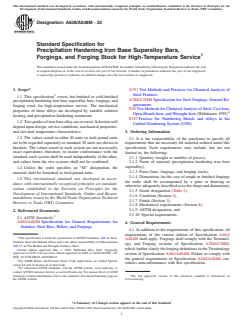
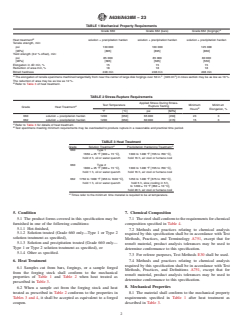


ASTM A638/A638M-23 - Standard Specification for Precipitation Hardening Iron Base Superalloy Bars, Forgings, and Forging Stock for High-Temperature Service
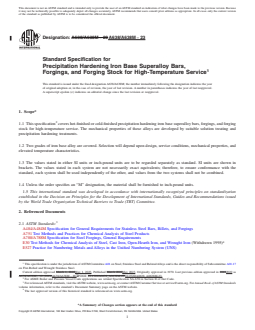
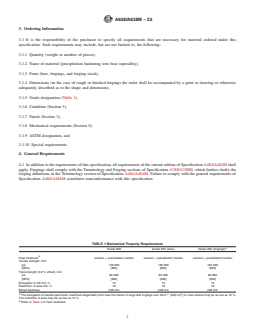
REDLINE ASTM A638/A638M-23 - Standard Specification for Precipitation Hardening Iron Base Superalloy Bars, Forgings, and Forging Stock for High-Temperature Service
Overview
ASTM A638/A638M-23: Standard Specification for Precipitation Hardening Iron Base Superalloy Bars, Forgings, and Forging Stock for High-Temperature Service provides requirements for hot-finished or cold-finished precipitation hardening, iron base superalloys specifically designed for high-temperature environments. Developed by ASTM Committee A01, this international standard is crucial for specifying bars, forgings, and forging stock with enhanced mechanical and metallurgical properties achieved through solution treating and precipitation hardening.
The specification covers two distinctive grades - Grade 660 and Grade 662 - offering material selection flexibility based on design, service conditions, and elevated temperature requirements. It ensures products meet stringent requirements for stress rupture, tensile properties, and chemical composition, making them suitable for critical high-temperature applications in various industries.
Key Topics
- Product Forms Covered: Includes hot-finished or cold-finished bars, forgings, and forging stock.
- Alloy Grades: Addresses both Grade 660 and Grade 662; appropriate grade selection depends on the application needs.
- Mechanical Properties: Specifies minimum values for tensile strength, yield strength, elongation, reduction of area, and Brinell hardness.
- Heat Treatment: Describes solution and precipitation treatments crucial to achieving desired properties.
- Chemical Composition: Sets specific chemical requirements to guarantee consistency and performance.
- Dual Units: Provides values in both Inch-Pound and SI units, ensuring international applicability.
- Product Marking and Traceability: Dictates marking requirements for product identification and traceability, including stamping and tagging for bars and forgings.
- Ordering Information: Outlines essential order details such as quantity, form, dimensions, grade, condition, and finish.
Applications
ASTM A638/A638M-23 is vital for high-temperature service applications where superior mechanical strength and resistance to stress-rupture and oxidation are critical. Key practical applications include:
- Aerospace Components: Used for turbine engine parts, exhaust system elements, and structural aircraft parts exposed to elevated temperatures.
- Power Generation: Specified for superalloy parts in gas turbines, steam turbines, and high-temperature bolting.
- Chemical Processing: Applied in furnace components, reactors, and fixtures where both high temperature and corrosive environments are encountered.
- Oil & Gas Industry: Essential for equipment components such as valves, shafts, and fasteners in refineries and petrochemical plants.
- Industrial Furnaces: Utilized for bars and forgings in heat-treating equipment requiring reliable long-term performance at high heat.
The standard ensures materials are engineered for integrity, longevity, and safety in the most demanding service conditions. Its clear mechanical, chemical, and heat treatment requirements help suppliers, fabricators, and purchasers ensure compliance and quality.
Related Standards
ASTM A638/A638M-23 cites and is closely related to several other key international and ASTM standards, including:
- ASTM A484/A484M: General requirements for stainless steel bars, billets, and forgings.
- ASTM A751: Procedures for chemical analysis of steel products.
- ASTM A788/A788M: General requirements for steel forgings.
- ASTM E527: Practice for numbering metals and alloys in the Unified Numbering System (UNS).
- ASME SA-638: For boiler and pressure vessel code applications.
Keywords: precipitation hardening superalloy, high temperature service, iron base superalloy bars, superalloy forgings, mechanical properties, ASTM A638, heat treatment, stress-rupture properties, material specification, industrial standards.
Relations
- Effective Date
- 01-Jan-2024
- Effective Date
- 01-Sep-2023
- Effective Date
- 01-Mar-2023
- Effective Date
- 05-May-2020
- Effective Date
- 01-Sep-2019
- Effective Date
- 01-May-2019
- Effective Date
- 01-Nov-2018
- Effective Date
- 01-Nov-2018
- Effective Date
- 01-Sep-2018
- Effective Date
- 01-Mar-2018
- Effective Date
- 01-Jan-2018
- Effective Date
- 01-Nov-2017
- Effective Date
- 01-May-2017
- Effective Date
- 01-Dec-2016
- Effective Date
- 01-Jan-2016
Buy Documents
ASTM A638/A638M-23 - Standard Specification for Precipitation Hardening Iron Base Superalloy Bars, Forgings, and Forging Stock for High-Temperature Service
REDLINE ASTM A638/A638M-23 - Standard Specification for Precipitation Hardening Iron Base Superalloy Bars, Forgings, and Forging Stock for High-Temperature Service
Get Certified
Connect with accredited certification bodies for this standard

Element Materials Technology
Materials testing and product certification.

Inštitut za kovinske materiale in tehnologije
Institute of Metals and Technology. Materials testing, metallurgical analysis, NDT.
Sponsored listings
Frequently Asked Questions
ASTM A638/A638M-23 is a technical specification published by ASTM International. Its full title is "Standard Specification for Precipitation Hardening Iron Base Superalloy Bars, Forgings, and Forging Stock for High-Temperature Service". This standard covers: ABSTRACT This specification covers hot-finished or cold-finished precipitation hardening iron base superalloy bars, forgings, and forging stock for high-temperature service. The mechanical properties of these alloys are developed by suitable solution treating and precipitation hardening treatments. Two grades of iron base alloy are covered; Grade 660 and Grade 662 (bars and forgings). The material shall meet the requirements as to stress rupture properties specified. The material shall conform to the chemical, mechanical, and metallurgical properties requirements specified. SCOPE 1.1 This specification2 covers hot-finished or cold-finished precipitation hardening iron base superalloy bars, forgings, and forging stock for high-temperature service. The mechanical properties of these alloys are developed by suitable solution treating and precipitation hardening treatments. 1.2 Two grades of iron base alloy are covered. Selection will depend upon design, service conditions, mechanical properties, and elevated temperature characteristics. 1.3 The values stated in either SI units or inch-pound units are to be regarded separately as standard. SI units are shown in brackets. The values stated in each system are not necessarily exact equivalents; therefore, to ensure conformance with the standard, each system shall be used independently of the other, and values from the two systems shall not be combined. 1.4 Unless the order specifies an “M” designation, the material shall be furnished to inch-pound units. 1.5 This international standard was developed in accordance with internationally recognized principles on standardization established in the Decision on Principles for the Development of International Standards, Guides and Recommendations issued by the World Trade Organization Technical Barriers to Trade (TBT) Committee.
ABSTRACT This specification covers hot-finished or cold-finished precipitation hardening iron base superalloy bars, forgings, and forging stock for high-temperature service. The mechanical properties of these alloys are developed by suitable solution treating and precipitation hardening treatments. Two grades of iron base alloy are covered; Grade 660 and Grade 662 (bars and forgings). The material shall meet the requirements as to stress rupture properties specified. The material shall conform to the chemical, mechanical, and metallurgical properties requirements specified. SCOPE 1.1 This specification2 covers hot-finished or cold-finished precipitation hardening iron base superalloy bars, forgings, and forging stock for high-temperature service. The mechanical properties of these alloys are developed by suitable solution treating and precipitation hardening treatments. 1.2 Two grades of iron base alloy are covered. Selection will depend upon design, service conditions, mechanical properties, and elevated temperature characteristics. 1.3 The values stated in either SI units or inch-pound units are to be regarded separately as standard. SI units are shown in brackets. The values stated in each system are not necessarily exact equivalents; therefore, to ensure conformance with the standard, each system shall be used independently of the other, and values from the two systems shall not be combined. 1.4 Unless the order specifies an “M” designation, the material shall be furnished to inch-pound units. 1.5 This international standard was developed in accordance with internationally recognized principles on standardization established in the Decision on Principles for the Development of International Standards, Guides and Recommendations issued by the World Trade Organization Technical Barriers to Trade (TBT) Committee.
ASTM A638/A638M-23 is classified under the following ICS (International Classification for Standards) categories: 77.140.60 - Steel bars and rods; 77.140.85 - Iron and steel forgings. The ICS classification helps identify the subject area and facilitates finding related standards.
ASTM A638/A638M-23 has the following relationships with other standards: It is inter standard links to ASTM A484/A484M-24, ASTM A484/A484M-23a, ASTM A484/A484M-23, ASTM A484/A484M-20a, ASTM A484/A484M-19, ASTM A788/A788M-19, ASTM A788/A788M-18b, ASTM A484/A484M-18a, ASTM A788/A788M-18a, ASTM A788/A788M-18, ASTM A484/A484M-18, ASTM A788/A788M-17a, ASTM A788/A788M-17, ASTM A788/A788M-16a, ASTM A484/A484M-16. Understanding these relationships helps ensure you are using the most current and applicable version of the standard.
ASTM A638/A638M-23 is available in PDF format for immediate download after purchase. The document can be added to your cart and obtained through the secure checkout process. Digital delivery ensures instant access to the complete standard document.
Standards Content (Sample)
This international standard was developed in accordance with internationally recognized principles on standardization established in the Decision on Principles for the
Development of International Standards, Guides and Recommendations issued by the World Trade Organization Technical Barriers to Trade (TBT) Committee.
Designation: A638/A638M − 23
Standard Specification for
Precipitation Hardening Iron Base Superalloy Bars,
Forgings, and Forging Stock for High-Temperature Service
This standard is issued under the fixed designation A638/A638M; the number immediately following the designation indicates the year
of original adoption or, in the case of revision, the year of last revision. A number in parentheses indicates the year of last reapproval.
A superscript epsilon (´) indicates an editorial change since the last revision or reapproval.
1. Scope* A751 Test Methods and Practices for Chemical Analysis of
2 Steel Products
1.1 This specification covers hot-finished or cold-finished
A788/A788M Specification for Steel Forgings, General Re-
precipitation hardening iron base superalloy bars, forgings, and
quirements
forging stock for high-temperature service. The mechanical
E30 Test Methods for Chemical Analysis of Steel, Cast Iron,
properties of these alloys are developed by suitable solution
Open-Hearth Iron, and Wrought Iron (Withdrawn 1995)
treating and precipitation hardening treatments.
E527 Practice for Numbering Metals and Alloys in the
1.2 Two grades of iron base alloy are covered. Selection will
Unified Numbering System (UNS)
depend upon design, service conditions, mechanical properties,
and elevated temperature characteristics.
3. Ordering Information
1.3 The values stated in either SI units or inch-pound units
3.1 It is the responsibility of the purchaser to specify all
are to be regarded separately as standard. SI units are shown in
requirements that are necessary for material ordered under this
brackets. The values stated in each system are not necessarily
specification. Such requirements may include, but are not
exact equivalents; therefore, to ensure conformance with the
limited to, the following:
standard, each system shall be used independently of the other,
3.1.1 Quantity (weight or number of pieces),
and values from the two systems shall not be combined.
3.1.2 Name of material (precipitation hardening iron base
superalloy),
1.4 Unless the order specifies an “M” designation, the
3.1.3 Form (bars, forgings, and forging stock),
material shall be furnished to inch-pound units.
3.1.4 Dimensions (in the case of rough or finished forgings
1.5 This international standard was developed in accor-
the order shall be accompanied by a print or drawing or
dance with internationally recognized principles on standard-
otherwise adequately described as to the shape and dimension),
ization established in the Decision on Principles for the
3.1.5 Grade designation (Table 1),
Development of International Standards, Guides and Recom-
3.1.6 Condition (Section 5),
mendations issued by the World Trade Organization Technical
3.1.7 Finish (Section 3),
Barriers to Trade (TBT) Committee.
3.1.8 Mechanical requirements (Section 8),
3.1.9 ASTM designation, and
2. Referenced Documents
3.1.10 Special requirements.
2.1 ASTM Standards:
A484/A484M Specification for General Requirements for
4. General Requirements
Stainless Steel Bars, Billets, and Forgings
4.1 In addition to the requirements of this specification, all
requirements of the current edition of Specification A484/
This specification is under the jurisdiction of ASTM Committee A01 on Steel,
A484M shall apply. Forgings shall comply with the Terminol-
Stainless Steel and Related Alloys and is the direct responsibility of Subcommittee
ogy and Forging sections of Specification A788/A788M,
A01.17 on Flat-Rolled and Wrought Stainless Steel.
which further clarify the forging definitions in the Terminology
Current edition approved May 1, 2023. Published May 2023. Originally
approved in 1970. Last previous edition approved in 2020 as A638/A638M – 20.
section of Specification A484/A484M. Failure to comply with
DOI: 10.1520/A0638_A0638M-23.
the general requirements of Specification A484/A484M con-
For ASME Boiler and Pressure Vessel Code applications see related Specifi-
stitutes nonconformance with this specification.
cation SA-638 in Section II of that Code.
For referenced ASTM standards, visit the ASTM website, www.astm.org, or
contact ASTM Customer Service at service@astm.org. For Annual Book of ASTM
Standards volume information, refer to the standard’s Document Summary page on The last approved version of this historical standard is referenced on
the ASTM website. www.astm.org.
*A Summary of Changes section appears at the end of this standard
Copyright © ASTM International, 100 Barr Harbor Drive, PO Box C700, West Conshohocken, PA 19428-2959. United States
A638/A638M − 23
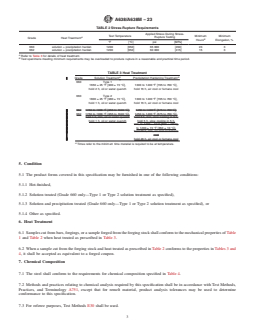
TABLE 1 Mechanical Property Requirements
A
Grade 660 Grade 662 (bars) Grade 662 (forgings)
B
Heat treatment solution + precipitation harden solution + precipitation harden solution + precipitation harden
Tensile strength, min:
psi 130 000 130 000 125 000
[MPa] [895] [895] [860]
Yield strength (0.2 % offset), min:
psi 85 000 85 000 80 000
[MPa] [585] [585] [550]
Elongation in 4D min, % 15 15 15
Reduction of area min, % 18 18 18
Brinell hardness 248 min 248 min 248 min
A 2 2
The elongation of tensile specimens machined tangentially from near the center of large disk forgings over 50 in. [320 cm ] in cross section may be as low as 10 %.
The reduction of area may be as low as 12 %.
B
Refer to Table 3 of heat treatment.
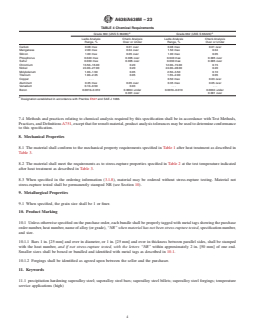
TABLE 2 Stress-Rupture Requirements
Applied Stress During Stress-
Test Temperature
Minimum Minimum
A
Rupture Testing
Grade Heat Treatment
B
Hours Elongation, %
°F [°C] psi [MPa]
660 solution + precipitation harden 1200 [650] 65 000 [450] 23 3
662 solution + precipitation harden 1200 [650] 60 000 [415] 15 3
A
Refer to Table 3 for details of heat treatment.
B
Test specimens meeting minimum requirements may be overloaded to produce rupture in a reasonable and practical time period.
TABLE 3 Heat Treatment
A A
Grade Solution Treatment Precipitation Hardening Treatment
660 Type 1
1650 ± 25 °F [900 ± 15 °C], 1300 to 1400
...
This document is not an ASTM standard and is intended only to provide the user of an ASTM standard an indication of what changes have been made to the previous version. Because
it may not be technically possible to adequately depict all changes accurately, ASTM recommends that users consult prior editions as appropriate. In all cases only the current version
of the standard as published by ASTM is to be considered the official document.
Designation: A638/A638M − 20 A638/A638M − 23
Standard Specification for
Precipitation Hardening Iron Base Superalloy Bars,
Forgings, and Forging Stock for High-Temperature Service
This standard is issued under the fixed designation A638/A638M; the number immediately following the designation indicates the year
of original adoption or, in the case of revision, the year of last revision. A number in parentheses indicates the year of last reapproval.
A superscript epsilon (´) indicates an editorial change since the last revision or reapproval.
1. Scope*
1.1 This specification covers hot-finished or cold-finished precipitation hardening iron base superalloy bars, forgings, and forging
stock for high-temperature service. The mechanical properties of these alloys are developed by suitable solution treating and
precipitation hardening treatments.
1.2 Two grades of iron base alloy are covered. Selection will depend upon design, service conditions, mechanical properties, and
elevated temperature characteristics.
1.3 The values stated in either SI units or inch-pound units are to be regarded separately as standard. SI units are shown in
brackets. The values stated in each system are not necessarily exact equivalents; therefore, to ensure conformance with the
standard, each system shall be used independently of the other, and values from the two systems shall not be combined.
1.4 Unless the order specifies an “M” designation, the material shall be furnished to inch-pound units.
1.5 This international standard was developed in accordance with internationally recognized principles on standardization
established in the Decision on Principles for the Development of International Standards, Guides and Recommendations issued
by the World Trade Organization Technical Barriers to Trade (TBT) Committee.
2. Referenced Documents
2.1 ASTM Standards:
A484/A484M Specification for General Requirements for Stainless Steel Bars, Billets, and Forgings
A751 Test Methods and Practices for Chemical Analysis of Steel Products
A788/A788M Specification for Steel Forgings, General Requirements
E30 Test Methods for Chemical Analysis of Steel, Cast Iron, Open-Hearth Iron, and Wrought Iron (Withdrawn 1995)
E527 Practice for Numbering Metals and Alloys in the Unified Numbering System (UNS)
This specification is under the jurisdiction of ASTM Committee A01 on Steel, Stainless Steel and Related Alloys and is the direct responsibility of Subcommittee A01.17
on Flat-Rolled and Wrought Stainless Steel.
Current edition approved March 1, 2020May 1, 2023. Published March 2020May 2023. Originally approved in 1970. Last previous edition approved in 20102020 as
ε1
A638/A638M – 10 (2018)A638/A638M – 20. . DOI: 10.1520/A0638_A0638M-20.10.1520/A0638_A0638M-23.
For ASME Boiler and Pressure Vessel Code applications see related Specification SA-638 in Section II of that Code.
For referenced ASTM standards, visit the ASTM website, www.astm.org, or contact ASTM Customer Service at service@astm.org. For Annual Book of ASTM Standards
volume information, refer to the standard’s Document Summary page on the ASTM website.
The last approved version of this historical standard is referenced on www.astm.org.
*A Summary of Changes section appears at the end of this standard
Copyright © ASTM International, 100 Barr Harbor Drive, PO Box C700, West Conshohocken, PA 19428-2959. United States
A638/A638M − 23
3. Ordering Information
3.1 It is the responsibility of the purchaser to specify all requirements that are necessary for material ordered under this
specification. Such requirements may include, but are not limited to, the following:
3.1.1 Quantity (weight or number of pieces),
3.1.2 Name of material (precipitation hardening iron base superalloy),
3.1.3 Form (bars, forgings, and forging stock),
3.1.4 Dimensions (in the case of rough or finished forgings the order shall be accompanied by a print or drawing or otherwise
adequately described as to the shape and dimension),
3.1.5 Grade designation (Table 1),
3.1.6 Condition (Section 5),
3.1.7 Finish (Section 3),
3.1.8 Mechanical requirements (Section 8),
3.1.9 ASTM designation, and
3.1.10 Special requirements.
4. General Requirements
4.1 In addition to the requirements of this specification, all requirements of the current edition of Specification A484/A484M shall
apply. Forgings shall comply with the Terminology and Forging sections of Specification A788/A788M, which further clarify the
forging definitions in the Terminology section of Specification A484/A484M. Failure to comply with the general requirements of
Specification A484/A484M constitutes nonconformance with this specification.
TABLE 1 Mechanical Property Requirements
A
Grade 660 Grade 662 (bars) Grade 662 (forgings)
B
Heat treatment solution + precipitation harden solution + precipitation harden solution + precipitation harden
Tensile strength, min:
psi 130 000 130 000 125 000
[MPa] [895] [895] [860]
Yield strength (0.2 % offset), min:
psi 85 000 85 000 80 000
[MPa] [585] [585] [550]
Elongation in 4D min, % 15 15 15
Reduction of area min, % 18 18 18
Brinell hardness 248 min 248 min 248 min
A 2 2
The elongation of tensile specimens machined tangentially from near the center of large disk forgings over 50 in. [320 cm ] in cross section may be as low as 10 %.
The reduction of area may be as low as 12 %.
B
Refer to Table 3 of heat treatment.
A638/A638M − 23
TABLE 2 Stress-Rupture Requirements
Applied Stress During Stress-
Test Temperature
Minimum Minimum
A
Rupture Testing
Grade Heat Treatment
B
Hours Elongation, %
°F [°C] psi [MPa]
660 solution + precipitation harden 1200 [650] 65 000 [450] 23 3
662 solution + precipitation harden 1200 [650] 60 000 [415] 15 3
A
Refer to Table 3 for details of heat treatment.
B
Test specimens meeting minimum requirements may be overloaded to produce rupture in a reasonable and practical time period.
TABLE 3 Heat Treatment
A A
Grade Solution Treatment Precipitation Hardening Treatment
660 Type 1
1650 ± 25 °F [900 ± 15 °C], 1300 to 1400 °F [705 to 760 °C],
hold 2 h, oil or water quench hold 16 h, air cool or furnace
...