

ASTM F3361-18e1
(Guide)Standard Guide for Classifying Alterations for In-Service Aircraft under FAA Authority Oversight
General Information
- Abstract
SIGNIFICANCE AND USE
5.1 To standardize applications of CFR Title 14, as applicable.
SCOPE
1.1 This guide is intended for Part 23 and predecessor aircraft (see Civil Air Regulations (CAR) 3) and:
1.1.1 Is applicable to aircraft to which Part 43 applies.
1.1.2 Addresses both initial installation and replacement of aircraft articles.
1.1.3 Is a guide for classifying an alteration.
1.1.4 The intended audience of this guide is individuals who have been tasked with evaluating alterations for the purpose of categorizing an alteration for the purpose of satisfying the regulations.
1.1.5 Is an alteration to an article.
1.2 This standard does not purport to address all of the safety concerns, if any, associated with its use. It is the responsibility of the user of this standard to establish appropriate safety, health, and environmental practices and determine the applicability of regulatory limitations prior to use.
1.3 This international standard was developed in accordance with internationally recognized principles on standardization established in the Decision on Principles for the Development of International Standards, Guides and Recommendations issued by the World Trade Organization Technical Barriers to Trade (TBT) Committee.
- Status
- Published
- Publication Date
- 30-Nov-2018
- Technical Committee
- F39 - Aircraft Systems
- Drafting Committee
- F39.02 - Inspection, Alteration, Maintenance, and Repair
Overview
ASTM F3361-18e1 is a standardized guide developed by ASTM International for classifying alterations for in-service aircraft operating under FAA authority. This guide specifically applies to aircraft governed by 14 CFR Part 23 (Normal, Utility, Acrobatic, and Commuter Category Airplanes) and their predecessor standards under Civil Air Regulations (CAR) 3. Its primary audience includes professionals who evaluate and categorize alterations to meet regulatory requirements under FAA oversight.
The purpose of this standard is to bring consistency and clarity to the evaluation and classification of alterations to aircraft, articles, and components, including both initial installations and replacements. It aims to standardize the application of relevant sections of CFR Title 14, ensuring adherence to FAA regulations and recognized industry practices.
Key Topics
- Scope and Applicability: The guide applies to alterations of in-service aircraft, especially those to which Part 43 (Maintenance, Preventive Maintenance, Rebuilding, and Alteration) of 14 CFR applies.
- Alteration Classification: The standard provides procedures to determine whether an alteration is major or minor in accordance with regulatory definitions.
- Evaluation Criteria: It sets out the factors to be considered, such as impact on aircraft weight and balance, structural strength, performance, powerplant operation, flight characteristics, airworthiness, and crashworthiness.
- Procedure: The guide details steps for applicants to define the scope of the alteration, use FAA documentation and job aids, and determine certification or approval requirements.
- Key Definitions: Terms such as alteration, major alteration, minor alteration, article, and acceptable practices are precisely defined for regulatory clarity.
- Documentation: Users are encouraged to maintain proper records, including a worksheet for classifying and documenting alterations in the aircraft’s permanent record.
Applications
ASTM F3361-18e1 is widely applicable within the aviation maintenance, modification, and regulatory compliance sectors. Typical practical uses include:
- Aircraft Maintenance Providers: Ensuring that all structural or component changes to in-service aircraft are properly evaluated, categorized, and recorded.
- Regulatory Compliance: Assisting maintenance organizations and individual technicians to stay compliant with FAA mandates when performing, approving, or overseeing alterations and installations.
- Engineering and Airworthiness Inspection: Allowing designated representatives, aviation safety engineers, and inspectors to apply standardized criteria when reviewing modifications.
- STC and Data Approval Processes: Streamlining the process of determining when a Supplemental Type Certificate (STC) or data reclassification is required for a particular alteration.
- Operational Safety: Supporting safety and reliability through rigorous evaluation of the potential impact of alterations on airworthiness and flight characteristics.
By providing a structured approach to distinguishing between major and minor alterations, the standard aids in minimizing regulatory risk and ensuring aircraft modifications uphold safety, reliability, and compliance.
Related Standards
- 14 CFR Part 23: Airworthiness Standards for Normal, Utility, Acrobatic, and Commuter Category Airplanes
- 14 CFR Part 43: Maintenance, Preventive Maintenance, Rebuilding, and Alteration
- 14 CFR Part 21: Certification Procedures for Products and Articles
- FAA Orders & Advisory Circulars: Including AC 43-210 (Standardized Procedures for Approval of Major Repairs and Major Alterations) and FAA Order 8900.1 (Flight Standards Information Management System)
- AFS-300 Job Aid: Guidance on reclassification and STC determinations
- Civil Air Regulations (CAR) 3
- CAM 18: Maintenance, Repair, and Alteration of Airframes, Powerplants, Propellers, and Appliances
For aviation professionals working with in-service aircraft alterations under FAA authority, ASTM F3361-18e1 delivers essential guidelines for regulatory compliance, safety, and efficient alteration classification.
Relations
- Effective Date
- 01-Dec-2018
Get Certified
Connect with accredited certification bodies for this standard

BUREAU VERITAS Certification Germany
Bureau Veritas certification in Germany.

Element Materials Technology
Materials testing and product certification.

AQMS Ltd.
AQMS provides ISO certification to SMEs across the UK.
Sponsored listings
Frequently Asked Questions
ASTM F3361-18e1 is a guide published by ASTM International. Its full title is "Standard Guide for Classifying Alterations for In-Service Aircraft under FAA Authority Oversight". This standard covers: SIGNIFICANCE AND USE 5.1 To standardize applications of CFR Title 14, as applicable. SCOPE 1.1 This guide is intended for Part 23 and predecessor aircraft (see Civil Air Regulations (CAR) 3) and: 1.1.1 Is applicable to aircraft to which Part 43 applies. 1.1.2 Addresses both initial installation and replacement of aircraft articles. 1.1.3 Is a guide for classifying an alteration. 1.1.4 The intended audience of this guide is individuals who have been tasked with evaluating alterations for the purpose of categorizing an alteration for the purpose of satisfying the regulations. 1.1.5 Is an alteration to an article. 1.2 This standard does not purport to address all of the safety concerns, if any, associated with its use. It is the responsibility of the user of this standard to establish appropriate safety, health, and environmental practices and determine the applicability of regulatory limitations prior to use. 1.3 This international standard was developed in accordance with internationally recognized principles on standardization established in the Decision on Principles for the Development of International Standards, Guides and Recommendations issued by the World Trade Organization Technical Barriers to Trade (TBT) Committee.
SIGNIFICANCE AND USE 5.1 To standardize applications of CFR Title 14, as applicable. SCOPE 1.1 This guide is intended for Part 23 and predecessor aircraft (see Civil Air Regulations (CAR) 3) and: 1.1.1 Is applicable to aircraft to which Part 43 applies. 1.1.2 Addresses both initial installation and replacement of aircraft articles. 1.1.3 Is a guide for classifying an alteration. 1.1.4 The intended audience of this guide is individuals who have been tasked with evaluating alterations for the purpose of categorizing an alteration for the purpose of satisfying the regulations. 1.1.5 Is an alteration to an article. 1.2 This standard does not purport to address all of the safety concerns, if any, associated with its use. It is the responsibility of the user of this standard to establish appropriate safety, health, and environmental practices and determine the applicability of regulatory limitations prior to use. 1.3 This international standard was developed in accordance with internationally recognized principles on standardization established in the Decision on Principles for the Development of International Standards, Guides and Recommendations issued by the World Trade Organization Technical Barriers to Trade (TBT) Committee.
ASTM F3361-18e1 is classified under the following ICS (International Classification for Standards) categories: 49.035 - Components for aerospace construction. The ICS classification helps identify the subject area and facilitates finding related standards.
ASTM F3361-18e1 has the following relationships with other standards: It is inter standard links to ASTM F3361-18. Understanding these relationships helps ensure you are using the most current and applicable version of the standard.
ASTM F3361-18e1 is available in PDF format for immediate download after purchase. The document can be added to your cart and obtained through the secure checkout process. Digital delivery ensures instant access to the complete standard document.
Standards Content (Sample)
This international standard was developed in accordance with internationally recognized principles on standardization established in the Decision on Principles for the
Development of International Standards, Guides and Recommendations issued by the World Trade Organization Technical Barriers to Trade (TBT) Committee.
´1
Designation: F3361 − 18
Standard Guide for
Classifying Alterations for In-Service Aircraft under FAA
Authority Oversight
This standard is issued under the fixed designation F3361; the number immediately following the designation indicates the year of
original adoption or, in the case of revision, the year of last revision. A number in parentheses indicates the year of last reapproval. A
superscript epsilon (´) indicates an editorial change since the last revision or reapproval.
ε NOTE—Section references in Fig. 2 were corrected editorially in August 2019.
1. Scope 14 CFRAeronautics and Space,Vol 1, Chapter I, Subchapter
C, Part 23 Airworthiness Standards: Normal, Utility,
1.1 This guide is intended for Part 23 and predecessor
Acrobatic, and Commuter Category Airplanes
aircraft (see Civil Air Regulations (CAR) 3) and:
14 CFRAeronautics and Space,Vol 1, Chapter I, Subchapter
1.1.1 Is applicable to aircraft to which Part 43 applies.
C, Part 43 Maintenance, Preventive Maintenance,
1.1.2 Addresses both initial installation and replacement of
Rebuilding, and Alteration, including Amendments 43-1
aircraft articles.
through 43-49
1.1.3 Is a guide for classifying an alteration.
14 CFRAeronautics and Space,Vol 2, Chapter I, Subchapter
1.1.4 Theintendedaudienceofthisguideisindividualswho
D, Part 65 Certification:Airmen Other Than Flight Crew-
have been tasked with evaluating alterations for the purpose of
members
categorizing an alteration for the purpose of satisfying the
14 CFRAeronautics and Space,Vol 3, Chapter I, Subchapter
regulations.
H, Part 145 Repair Stations
1.1.5 Is an alteration to an article.
2.2 FAA Standards:
1.2 This standard does not purport to address all of the
Civil Aeronautics Manual (CAM) 18 Maintenance, Repair,
safety concerns, if any, associated with its use. It is the
and Alteration of Airframes, Powerplants, Propellers, and
responsibility of the user of this standard to establish appro-
Appliances, dated 12/15/1959
priate safety, health, and environmental practices and deter-
Civil Air Regulations (CAR) 3 Airplane Airworthiness -
mine the applicability of regulatory limitations prior to use.
Normal, Utility, Acrobatic, and Restricted Purpose
1.3 This international standard was developed in accor-
Categories, dated 5/15/1996, including Amendments 3-1
dance with internationally recognized principles on standard-
to 3-8
ization established in the Decision on Principles for the
AC 25.571-1( ) Damage Tolerance and Fatigue Evaluation
Development of International Standards, Guides and Recom-
of Structure
mendations issued by the World Trade Organization Technical
AC 43-210( ) Standardized Procedures for Obtaining Ap-
Barriers to Trade (TBT) Committee.
proval of Data Used in the Performance of Major Repairs
and Major Alterations
2. Referenced Documents
AFS-300 Major Repair andAlteration DataApproval Online
2 4
2.1 Code of Federal Regulations: Job Aid
14 CFRAeronautics and Space,Vol 1, Chapter I, Subchapter
Order 8110.46 MajorAlterations that Require Supplemental
A, Part 1 Definitions and Abbreviations, including Type Certificates, dated 9/30/2002, Cancelled
Amendments 1-1 through 1-69
Order 8300.16 Major Repair and Alteration Data Approval,
14 CFRAeronautics and Space,Vol 1, Chapter I, Subchapter dated 4/18/2014, including Change 1, dated 12/7/2015
C, Part 21 Certification Procedures for Products and
Order 8900.1 Flight Standards Information Management
Articles, including Amendments 21-1 through 21-100 System (FSIMS)
FAA Special Policy on Addressing New Technology as
Applicable as Valid
This guide is under the jurisdiction of ASTM Committee F39 on Aircraft
Systems and is the direct responsibility of Subcommittee F39.02 on Inspection,
Alteration, Maintenance, and Repair. Available from Federal Aviation Administration (FAA), 800 Independence
Current edition approved Dec. 1, 2018. Published January 2019. DOI: 10.1520/ Ave., SW, Washington, DC 20591, http://rgl.faa.gov.
F3361–18E01. As published by AFS-300, https://www.faa.gov/about/office_org/headquarters
Available from U.S. Government Publishing Office (GPO), 732 N. Capitol St., _offices/avs/offices/afx/afs/afs300/.
NW, Washington, DC 20401, https://www.govinfo.gov/app/collection/cfr. Used as reference for 6.2.2 through 6.2.2.6 inclusive.
Copyright © ASTM International, 100 Barr Harbor Drive, PO Box C700, West Conshohocken, PA 19428-2959. United States
´1
F3361 − 18
3. Terminology 3.2.3 ASI—Aviation Safety Inspector (FAA)
3.2.4 DAR—Designated Airworthiness Representative (an
3.1 Definitions:
FAA designation)
3.1.1 accepted practices, n—practices demonstrated to con-
form to standards developed for or used by, or both, the
3.2.5 DER—Designated Engineering Representative (an
aviation industry.
FAA designation)
3.1.2 alteration, n—any appreciable change in the design of
3.2.6 FSDO—Flight Standards District Office (FAA)
an airframe, powerplant, propeller, or appliance.
3.2.7 ODA—Organization Designation Authorization (an
3.1.3 altered state, n—the documented state of the airframe,
FAA designation)
powerplant, propeller, or appliance prior to applying this
3.2.8 OEM—Original Equipment Manufacturer
standard (for example, performing the alteration).
3.2.9 STC—Supplemental Type Certificate
3.1.3.1 Discussion—This includes all changes that have
3.2.10 TC—Type Certificate
been incorporated since the issuance of its original airworthi-
ness certificate.
4. Summary of Guide
3.1.4 appreciable change, n—a change that is large enough
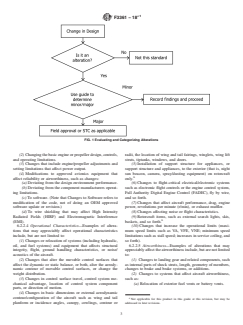
4.1 This guide describes a procedure for evaluating and
to be noticed using an appropriate unit of measure.
categorizingalterationsasminorormajor,thusdeterminingthe
3.1.4.1 Discussion—With modern technology, all changes
appropriate means of approval. (See Fig. 1.)
could be measured, for example, increased weight, thickness,
dimensions, etc., which is not the intent of this definition.
5. Significance and Use
3.1.5 article, n—a material, part, component, process, or
5.1 To standardize applications of CFR Title 14, as appli-
appliance. (14 CFR Part 21)
cable.
3.1.6 complex special process, n—a process that, if not
6. Procedure
properly performed, has a significant adverse effect on the
6.1 Applicant begins process.
integrity of the product.
3.1.7 elementary operations, n—in the context of mainte- 6.2 Applicant defines scope of alteration.
nance or alteration, when:
NOTE 1—Take steps to ensure this change is an alteration, not a repair.
(1) The operation, procedure, or action is clearly defined;
Refer to Section 3, Terminology.
(2) Housing, facilities, equipment, and tooling are suffi-
6.2.1 Is the scope of the alteration sufficient to process as a
cient to perform the operation, procedure, or action;
major change in type design (14 CFR 21.93)?
(3) Proper training and qualifications to perform the
6.2.2 A major change in type design is defined as a change
operation, procedure, or action are established and accom-
that has an appreciable effect on the certificated weight,
plished; and
certificated balance, structural strength, reliability, operational
(4) The operation, procedure, or action is controlled to
characteristics, or other characteristics affecting the airworthi-
consistently yield a measurable standard.
ness of the product.
3.1.8 initial installation, n—the installation of an article that
6.2.2.1 Certified Weight and Balance—Examples of altera-
is new to the aircraft where one was not previously installed.
tions that may appreciably affect the Certified Weight and
Balance include, but are not limited to:
3.1.9 major alteration, n—an alteration not listed in the
(1) Changes that increase the certificated maximum weight
aircraft, aircraft engine, or propeller specifications that (1)
limits (increases in the maximum gross weight, maximum
might appreciably affect weight, balance, structural strength,
take-off, or landing weights).
performance, powerplant operation, flight characteristics, or
(2) Changes in the certificated center of gravity range
other qualities affecting airworthiness; or (2) is not done
limits (for example, decreasing the forward limit or increasing
according to accepted practices or cannot be done by elemen-
the aft limit).
tary operations. (14 CFR Part 1)
6.2.2.2 Structural Strength—Examples of alterations that
3.1.10 minor alteration, n—an alteration other than a major
may appreciably affect structural strength include, but are not
alteration. (14 CFR Part 1)
limited to:
3.1.11 product, n—an aircraft, aircraft engine, or propeller.
(1) Changes to primary structures (structure that carries
(14 CFR Part 21)
flight, ground, or pressure loads as defined in AC 25.571-1.
3.1.12 repair, n—restoration of airframe, powerplant, (2) Substituting an engine, propeller, rotor, or airframe
propeller, or appliance to a condition for safe operation after primary structural materials (such as replacing a reciprocating
damage or deterioration. (CAM 18.1, Definitions) engine with a turbine engine or increasing horsepower output
by 10 % or more).
3.1.13 replacement, n—removal of one previously installed
6.2.2.3 Reliability—Examples of alterations that may appre-
make and/or model with a different make and/or model article.
ciably affect reliability include, but are not limited to:
3.2 Abbreviations:
(1) Changes to manifolding, air induction systems or air
3.2.1 ACO—Aircraft Certification Office (FAA)
intake doors, engine cowling or baffle that affect the flow of
3.2.2 ASE—Aviation Safety Engineer (FAA) engine cooling air and carburetor/fire ignition heat rises.
´1
F3361 − 18
FIG. 1 Evaluating and Categorizing Alterations
(2) Changingthebasicengineorpropellerdesign,controls, radii, the location of wing and tail fairings, winglets, wing lift
and operating limitations. struts, tiptanks, windows, and doors.
(3) Changes that include engine/propeller adjustments and (5) Installation of support structure for appliances, or
setting limitations that affect power output. support structure and appliances, to the exterior (that is, night
(4) Modifications to approved avionics equipment that sun beacon, camera, spray/dusting equipment) on rotorcraft
affect reliability or airworthiness, such as changes: only.
(a) Deviating from the design environment performance. (6) Changes to flight-critical electrical/electronic systems
(b) Deviating from the component manufacturers operat- such as electronic flight controls or the engine control system,
ing limitations. Full Authority Digital Engine Control (FADEC), fly by wire,
(c) To software. (Note that Changes to Software refers to and so forth.
modification of the code, not of doing an OEM approved (7) Changes that affect aircraft performance, drag, engine
software update or revision.) power, revolutions per minute (r/min), or exhaust muffler.
(d) To wire shielding that may affect High Intensity (8) Changes affecting noise or flight characteristics.
Radiated Fields (HIRF) and Electromagnetic Interference (9) Rotorcraft items, such as external search lights, skis,
(EMI). baskets, and so forth.
6.2.2.4 Operational Characteristics—Examples of altera- (10) Changes that increase the operational limits (maxi-
tions that may appreciably affect operational characteristics mum speed limits such as VA, VFE, VNE; minimum speed
include, but are not limited to: limitations such as stall speed; increases in service ceiling, and
(1) Changes or relocation of systems (including hydraulic, so forth).
oil, and fuel systems) and equipment that affects structural 6.2.2.5 Airworthiness—Examples of alterations that may
integrity, flight, ground handling characteristics, or noise/ appreciably affect the airworthiness include, but are not limited
acoustics of the aircraft. to:
(2) Changes that alter the movable control surfaces that (1) Changes to landing gear and related components, such
affect the dynamic or static balance, or both, alter the aerody- as internal parts of shock struts, length, geometry of members,
namic contour of movable control surfaces, or change the changes to brake and brake systems, or additions.
weight distribution. (2) Changes to systems that affect aircraft airworthiness,
(3) Changes in control surface travel, control system me- such as:
chanical advantage, location of control system component (a) Relocation of exterior fuel vents or battery vents.
parts, or direction of motion.
(4) Changes in basic dimensions or external aerodynamic
contour/configuration of the aircraft such as wing and tail
Not applicable for this product in this guide at this revision, but may be
planform or incidence angles, canopy, cowlings, contour or addressed in later revisions.
´1
F3361 − 18
(b) Crew or passenger liquid oxygen (LOX) or on-board 6.2.4.2 14 CFR 43AppendixAto Part 43 MajorAlterations,
generating systems. Major Repairs, and Preventive Maintenance Major Altera-
(c) External critical access doors, Auxiliary Power Unit tions:
(APU) ram air, nacelle blowout doors, fuel drain. (1) Airframe Major AlterationsAlterations of the following
(3) Major deviations to STCs. parts and alterations of the following types, when not listed in
(4) Ch
...