

ASTM D6251/D6251M-23
(Specification)Standard Specification for Wood-Cleated Panelboard Shipping Boxes
General Information
- Abstract
ABSTRACT
This specification covers the fabrication and closure of empty and full wood-cleated, hereafter referred to as wood-cleated, panelboard boxes. These boxes are intended for use as containers for domestic and overseas shipment of general materials and supplies. The box shall be classified according to box type: Type I; Type II; Type II; and Type IV. According to class: Class 1 and Class 2. According to style: Style A; Style A1; Style B; Style C through K. According to preservative treatment; Treatment A and Treatment B. And according to load type: Type 1; Type 2; and Type 3. Panels shall be fabricated by nailing, stapling, or gluing panelboard to cleats placed. Fastener component test, fastener test for securing cleats to panelboard panels; lateral resistance test; direct withdrawal resistance test; oxine copper preservative test; zinc napthenate preservative test; and preservative dryness test shall be performed to conform to the specified requirements.
SCOPE
1.1 This specification covers the fabrication and closure of empty and full wood-cleated, hereafter referred to as wood-cleated, panelboard boxes. These boxes are intended for use as containers for domestic and overseas shipment of general materials and supplies, not exceeding 1000 lb [454 kg] depending on box type (see 10.1).
1.2 Wood-cleated panelboard shipping box performance is dependent on its fabricated components and subsequent assembly; therefore, a variety of types, classes, styles, and treatments reflecting varied performance are specified. This specification, however, does not cover wood-cleated panelboard box performance under all atmospheric, handling, shipping, and storage conditions.
1.3 If the use of other construction methods or techniques is acceptable and permitted (see 5.1.17), the resulting packaging systems shall be of equal or better performance than would result from the use of these specified materials and procedures. The appropriate distribution cycle, specified in Practice D4169, can be used to develop comparative procedures and criteria.
1.4 The values stated in either inch-pound units or SI units are to be regarded separately as standard. Within the text, the SI units are shown in brackets. The values stated in each system are not exact equivalents; therefore, each system must be used independently of the other. Combining values from the two systems may result in nonconformance with the standard. See IEEE/ASTM SI 10 for conversion of units.
1.5 This standard does not purport to address all of the safety concerns, if any, associated with its use. It is the responsibility of the user of this standard to establish appropriate safety, health, and environmental practices and determine the applicability of regulatory limitations prior to use.
1.6 This international standard was developed in accordance with internationally recognized principles on standardization established in the Decision on Principles for the Development of International Standards, Guides and Recommendations issued by the World Trade Organization Technical Barriers to Trade (TBT) Committee.
- Status
- Published
- Publication Date
- 30-Sep-2023
- Technical Committee
- D10 - Packaging
Buy Documents
ASTM D6251/D6251M-23 - Standard Specification for Wood-Cleated Panelboard Shipping Boxes
REDLINE ASTM D6251/D6251M-23 - Standard Specification for Wood-Cleated Panelboard Shipping Boxes
Overview
ASTM D6251/D6251M-23: Standard Specification for Wood-Cleated Panelboard Shipping Boxes provides comprehensive requirements for the design, fabrication, and performance of wood-cleated panelboard boxes. These shipping containers are used globally for the safe, efficient transport of general materials and supplies, supporting both domestic and international logistics chains. The specification includes detailed classifications based on box type, class, style, preservative treatment, and load type, providing clarity for manufacturers, distributors, and end-users who require reliable packaging solutions for shipments up to 1000 lb (454 kg).
Key Topics
- Box Classifications: The standard specifies multiple box types (Types I-IV), classes (1 for domestic, 2 for overseas), styles (A, A1, B, C through K), and preservative treatments (A and B) to suit different requirements and environmental conditions.
- Material and Construction Requirements: Guidance is given on panelboard materials (such as plastic, fiberboard, plywood, or oriented strand board), cleat lumber quality, fastener specifications (nails, staples, screws), and preservatives to ensure box durability and compliance.
- Fabrication and Closure: The standard outlines assembly methods, including nailing, stapling, or gluing the panelboard to wood cleats, and provides options for specialized closures such as unnailed top panel closed with steel strapping for added security.
- Load Capacities and Application Suitability: Boxes are classified by load types (easy, average, difficult), allowing the tailoring of packaging to the nature and fragility of shipped goods.
- Performance Testing: Critical quality assurance tests are required, such as fastener component tests, withdrawal and lateral resistance, and preservative effectiveness, ensuring boxes meet integrity and safety criteria.
Applications
Wood-cleated panelboard shipping boxes are widely used in:
- International and Domestic Shipping: Providing robust packaging for a variety of products, from industrial equipment to consumer goods, across all logistics sectors.
- Military and Government Procurement: Meeting strict requirements for the shipment of supplies and equipment, including adherence to phytosanitary standards for international trade.
- Manufacturing and Warehousing: Offering reliable, standardized packaging that supports efficient handling, stacking, and storage.
- Hazardous Materials Transport: When properly specified and in compliance with relevant regulations, these boxes can be used for the shipment of certain hazardous goods.
Related Standards
To ensure full compliance and adoption of best practices, ASTM D6251/D6251M-23 references and aligns with several related standards, including:
- ASTM D4169 - Practice for Performance Testing of Shipping Containers and Systems
- ASTM D3951 - Practice for Commercial Packaging
- ASTM D4727/D4727M - Specification for Corrugated and Solid Fiberboard
- ASTM D6199 - Practice for Quality of Wood Members of Containers and Pallets
- ASTM D6253 - Practice for Treatment and/or Marking of Wood Packaging Materials
- F1667 - Driven Fasteners Specification
- ISPM 15 - International guidelines for regulating wood packaging material to prevent the spread of pests
Practical Value
Adhering to ASTM D6251/D6251M-23 ensures:
- Standardized Packaging: Consistency in fabrication and performance, supporting quality assurance across supply chains.
- Regulatory Compliance: Meets international shipping regulations, including phytosanitary and hazardous material standards.
- Versatility and Customization: Allows procurement of boxes tailored to specific shipment and environmental needs.
- Enhanced Protection: Provides tested, reliable packaging, minimizing product damage during transport and storage.
By implementing this standard, businesses can improve shipping efficiency, meet customer expectations, and support seamless global trade operations.
Relations
- Effective Date
- 01-Oct-2023
- Effective Date
- 01-Mar-2024
- Effective Date
- 01-Dec-2023
- Refers
ASTM D4169-23e1 - Standard Practice for Performance Testing of Shipping Containers and Systems - Effective Date
- 01-Dec-2023
- Effective Date
- 01-Jan-2022
- Referred By
ASTM D6253-16 - Standard Practice for Treatment and/or Marking of Wood Packaging Materials - Effective Date
- 01-Oct-2023
- Effective Date
- 01-Oct-2023
- Referred By
ASTM F2511-05(2022) - Standard Specification for Rollers, Bearing, Needle, Ferrous, Solid - Effective Date
- 01-Oct-2023
- Effective Date
- 01-Oct-2023
- Effective Date
- 01-Oct-2023
- Referred By
ASTM F1312-19(2023) - Standard Specification for Brick, Insulating, High Temperature, Fire Clay - Effective Date
- 01-Oct-2023
- Effective Date
- 01-Oct-2023
- Effective Date
- 01-Oct-2023
Buy Documents
ASTM D6251/D6251M-23 - Standard Specification for Wood-Cleated Panelboard Shipping Boxes
REDLINE ASTM D6251/D6251M-23 - Standard Specification for Wood-Cleated Panelboard Shipping Boxes
Get Certified
Connect with accredited certification bodies for this standard

BRCGS (Brand Reputation Compliance Global Standards)
Global food safety and quality standards owner.
Sponsored listings
Frequently Asked Questions
ASTM D6251/D6251M-23 is a technical specification published by ASTM International. Its full title is "Standard Specification for Wood-Cleated Panelboard Shipping Boxes". This standard covers: ABSTRACT This specification covers the fabrication and closure of empty and full wood-cleated, hereafter referred to as wood-cleated, panelboard boxes. These boxes are intended for use as containers for domestic and overseas shipment of general materials and supplies. The box shall be classified according to box type: Type I; Type II; Type II; and Type IV. According to class: Class 1 and Class 2. According to style: Style A; Style A1; Style B; Style C through K. According to preservative treatment; Treatment A and Treatment B. And according to load type: Type 1; Type 2; and Type 3. Panels shall be fabricated by nailing, stapling, or gluing panelboard to cleats placed. Fastener component test, fastener test for securing cleats to panelboard panels; lateral resistance test; direct withdrawal resistance test; oxine copper preservative test; zinc napthenate preservative test; and preservative dryness test shall be performed to conform to the specified requirements. SCOPE 1.1 This specification covers the fabrication and closure of empty and full wood-cleated, hereafter referred to as wood-cleated, panelboard boxes. These boxes are intended for use as containers for domestic and overseas shipment of general materials and supplies, not exceeding 1000 lb [454 kg] depending on box type (see 10.1). 1.2 Wood-cleated panelboard shipping box performance is dependent on its fabricated components and subsequent assembly; therefore, a variety of types, classes, styles, and treatments reflecting varied performance are specified. This specification, however, does not cover wood-cleated panelboard box performance under all atmospheric, handling, shipping, and storage conditions. 1.3 If the use of other construction methods or techniques is acceptable and permitted (see 5.1.17), the resulting packaging systems shall be of equal or better performance than would result from the use of these specified materials and procedures. The appropriate distribution cycle, specified in Practice D4169, can be used to develop comparative procedures and criteria. 1.4 The values stated in either inch-pound units or SI units are to be regarded separately as standard. Within the text, the SI units are shown in brackets. The values stated in each system are not exact equivalents; therefore, each system must be used independently of the other. Combining values from the two systems may result in nonconformance with the standard. See IEEE/ASTM SI 10 for conversion of units. 1.5 This standard does not purport to address all of the safety concerns, if any, associated with its use. It is the responsibility of the user of this standard to establish appropriate safety, health, and environmental practices and determine the applicability of regulatory limitations prior to use. 1.6 This international standard was developed in accordance with internationally recognized principles on standardization established in the Decision on Principles for the Development of International Standards, Guides and Recommendations issued by the World Trade Organization Technical Barriers to Trade (TBT) Committee.
ABSTRACT This specification covers the fabrication and closure of empty and full wood-cleated, hereafter referred to as wood-cleated, panelboard boxes. These boxes are intended for use as containers for domestic and overseas shipment of general materials and supplies. The box shall be classified according to box type: Type I; Type II; Type II; and Type IV. According to class: Class 1 and Class 2. According to style: Style A; Style A1; Style B; Style C through K. According to preservative treatment; Treatment A and Treatment B. And according to load type: Type 1; Type 2; and Type 3. Panels shall be fabricated by nailing, stapling, or gluing panelboard to cleats placed. Fastener component test, fastener test for securing cleats to panelboard panels; lateral resistance test; direct withdrawal resistance test; oxine copper preservative test; zinc napthenate preservative test; and preservative dryness test shall be performed to conform to the specified requirements. SCOPE 1.1 This specification covers the fabrication and closure of empty and full wood-cleated, hereafter referred to as wood-cleated, panelboard boxes. These boxes are intended for use as containers for domestic and overseas shipment of general materials and supplies, not exceeding 1000 lb [454 kg] depending on box type (see 10.1). 1.2 Wood-cleated panelboard shipping box performance is dependent on its fabricated components and subsequent assembly; therefore, a variety of types, classes, styles, and treatments reflecting varied performance are specified. This specification, however, does not cover wood-cleated panelboard box performance under all atmospheric, handling, shipping, and storage conditions. 1.3 If the use of other construction methods or techniques is acceptable and permitted (see 5.1.17), the resulting packaging systems shall be of equal or better performance than would result from the use of these specified materials and procedures. The appropriate distribution cycle, specified in Practice D4169, can be used to develop comparative procedures and criteria. 1.4 The values stated in either inch-pound units or SI units are to be regarded separately as standard. Within the text, the SI units are shown in brackets. The values stated in each system are not exact equivalents; therefore, each system must be used independently of the other. Combining values from the two systems may result in nonconformance with the standard. See IEEE/ASTM SI 10 for conversion of units. 1.5 This standard does not purport to address all of the safety concerns, if any, associated with its use. It is the responsibility of the user of this standard to establish appropriate safety, health, and environmental practices and determine the applicability of regulatory limitations prior to use. 1.6 This international standard was developed in accordance with internationally recognized principles on standardization established in the Decision on Principles for the Development of International Standards, Guides and Recommendations issued by the World Trade Organization Technical Barriers to Trade (TBT) Committee.
ASTM D6251/D6251M-23 is classified under the following ICS (International Classification for Standards) categories: 55.160 - Cases. Boxes. Crates. The ICS classification helps identify the subject area and facilitates finding related standards.
ASTM D6251/D6251M-23 has the following relationships with other standards: It is inter standard links to ASTM D6251/D6251M-19, ASTM D6253-24, ASTM D4169-23, ASTM D4169-23e1, ASTM D4169-22, ASTM D6253-16, ASTM D3951-18(2023), ASTM F2511-05(2022), ASTM F1245-19, ASTM B900-16(2022), ASTM F1312-19(2023), ASTM F1142-19, ASTM D6256/D6256M-16. Understanding these relationships helps ensure you are using the most current and applicable version of the standard.
ASTM D6251/D6251M-23 is available in PDF format for immediate download after purchase. The document can be added to your cart and obtained through the secure checkout process. Digital delivery ensures instant access to the complete standard document.
Standards Content (Sample)
This international standard was developed in accordance with internationally recognized principles on standardization established in the Decision on Principles for the
Development of International Standards, Guides and Recommendations issued by the World Trade Organization Technical Barriers to Trade (TBT) Committee.
Designation: D6251/D6251M − 23
Standard Specification for
Wood-Cleated Panelboard Shipping Boxes
This standard is issued under the fixed designation D6251/D6251M; the number immediately following the designation indicates the
year of original adoption or, in the case of revision, the year of last revision. A number in parentheses indicates the year of last
reapproval. A superscript epsilon (´) indicates an editorial change since the last revision or reapproval.
1. Scope mendations issued by the World Trade Organization Technical
Barriers to Trade (TBT) Committee.
1.1 This specification covers the fabrication and closure of
empty and full wood-cleated, hereafter referred to as wood-
2. Referenced Documents
cleated, panelboard boxes. These boxes are intended for use as
2.1 ASTM Standards:
containers for domestic and overseas shipment of general
D996 Terminology of Packaging and Distribution Environ-
materials and supplies, not exceeding 1000 lb [454 kg]
ments
depending on box type (see 10.1).
D1990 Practice for Establishing Allowable Properties for
1.2 Wood-cleated panelboard shipping box performance is
Visually-Graded Dimension Lumber from In-Grade Tests
dependent on its fabricated components and subsequent assem-
of Full-Size Specimens
bly; therefore, a variety of types, classes, styles, and treatments
D3951 Practice for Commercial Packaging
reflecting varied performance are specified. This specification,
D3953 Specification for Strapping, Flat Steel and Seals
however, does not cover wood-cleated panelboard box perfor-
D4169 Practice for Performance Testing of Shipping Con-
mance under all atmospheric, handling, shipping, and storage
tainers and Systems
conditions.
D4727/D4727M Specification for Corrugated and Solid Fi-
1.3 If the use of other construction methods or techniques is berboard Sheet Stock (Container Grade) and Cut Shapes
acceptable and permitted (see 5.1.17), the resulting packaging D6199 Practice for Quality of Wood Members of Containers
systems shall be of equal or better performance than would and Pallets
result from the use of these specified materials and procedures. D6253 Practice for Treatment and/or Marking of Wood
The appropriate distribution cycle, specified in Practice D4169, Packaging Materials
can be used to develop comparative procedures and criteria. F1667 Specification for Driven Fasteners: Nails, Spikes, and
Staples
1.4 The values stated in either inch-pound units or SI units
IEEE/ASTM SI 10 Standard for Use of the International
are to be regarded separately as standard. Within the text, the
System of Units (SI): The Modern Metric System
SI units are shown in brackets. The values stated in each
2.2 Federal Specifications:
system are not exact equivalents; therefore, each system must
A-A-58078 Plastic Board (For Packaging Applications)
be used independently of the other. Combining values from the
FF-F-133 Fasteners, Wood Joint, Corrugated – (Saw Edge)
two systems may result in nonconformance with the standard.
2.3 Code of Federal Regulations:
See IEEE/ASTM SI 10 for conversion of units.
CFR Parts 107-180 Title 49, Hazardous Materials Regula-
1.5 This standard does not purport to address all of the
tions
safety concerns, if any, associated with its use. It is the
2.4 APA—The Engineered Wood Association:
responsibility of the user of this standard to establish appro-
PRP-108 Performance Standards and Policies for Structural-
priate safety, health, and environmental practices and deter-
Use Panels
mine the applicability of regulatory limitations prior to use.
PS 1-19 Structural Plywood
1.6 This international standard was developed in accor-
dance with internationally recognized principles on standard-
For referenced ASTM standards, visit the ASTM website, www.astm.org, or
ization established in the Decision on Principles for the
contact ASTM Customer Service at service@astm.org. For Annual Book of ASTM
Development of International Standards, Guides and Recom-
Standards volume information, refer to the standard’s Document Summary page on
the ASTM website.
Available from ASSIST Quicksearch, https://quicksearch.dla.mil/
This specification is under the jurisdiction of ASTM Committee D10 on qsSearch.aspx.
Packaging and is the direct responsibility of Subcommittee D10.12 on Shipping Available from U.S. Government Printing Office Superintendent of Documents,
Containers, Crates, Pallets, Skids and Related Structures. 732 N. Capitol St., NW, Mail Stop: SDE, Washington, DC 20401, https://
Current edition approved Oct. 1, 2023. Published December 2023. Originally www.ecfr.gov/cgi-bin/ECFR?page=browse.
approved in 1998. Last previous edition approved in 2019 as D6251/D6251M – 19. Available from APA—The Engineered Wood Association, 7011 South 19th
DOI: 10.1520/D6251_D6251M-23. Street, Tacoma, WA 98466, http://www.apawood.org.
Copyright © ASTM International, 100 Barr Harbor Drive, PO Box C700, West Conshohocken, PA 19428-2959. United States
D6251/D6251M − 23
2.5 American Wood Protection Association (AWPA):
P36 Standard for Copper Naphthenate (CuN)
P37 Standard for Oxine Copper (Copper-8-Quinolinolate)
(Cu8)
2.6 Military Standard:
MIL-DTL-2427 Detail Specification Box, Ammunition
Packing: Wood, Nailed
2.7 Hardwood Plywood and Veneer Association:
ANSI/HPVA HP-1-2020 American National Standard for
Hardwood and Decorative Plywood
2.8 National Institute of Standards and Technology (NIST):
PS 2-18 Performance Standard for Wood-Based Structural-
Use Panels
2.9 American Lumber Standards Committee (ALSC):
PS 20-20 American Softwood Lumber Standard
2.10 National Hardwood Lumber Association (NHLA):
Rules for the Measurement and Inspection of Hardwood and
Cypress
2.11 National Motor Freight Traffıc Association:
National Motor Freight Classification
2.12 International Standards for Phytosanitary Measures
(IPPC):
ISPM No. 15 Guidelines for Regulating Wood Packaging
Material in International Trade
2.13 American Society for Mechanical Engineers
(ASME):
ASME B18.6.1 Wood Screws (Inch Series)
FIG. 1 Styles of Cleated Panel Boxes
3. Terminology
3.1 General definitions for packaging and distribution envi-
ronments are found in Terminology D996.
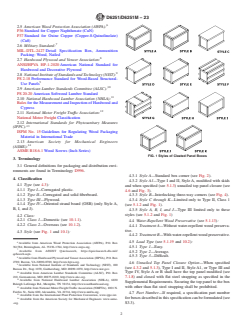
4.3.1 Style A—Standard box corner (see Fig. 2).
4. Classification
4.3.2 Style A1—Type I and II, Style A, modified with skids
4.1 Type (see 4.3):
and when specified (see 5.1.3) unnailed top panel closure (see
4.1.1 Type I—Corrugated plastic.
4.6 and Fig. 3).
4.1.2 Type II—Corrugated and solid fiberboard.
4.3.3 Style B—Interlocking three-way corners (see Fig. 4).
4.1.3 Type III—Plywood.
4.3.4 Style C through K—Limited only to Type II, Class 1
4.1.4 Type IV—Oriented strand board (OSB) (only Style A,
(see 5.1.2 and Fig. 1).
B, I, and J).
4.3.5 Style A, B, I, and J—Type III limited only to these
styles (see 5.1.2 and Fig. 1)
4.2 Class:
4.2.1 Class 1—Domestic (see 10.1.1).
4.4 Water-Repellent Wood Preservative (see 5.1.13):
4.2.2 Class 2—Overseas (see 10.1.2).
4.4.1 Treatment A—Without water-repellent wood preserva-
tive.
4.3 Style (see Fig. 1 and 10.1):
4.4.2 Treatment B—With water-repellent wood preservative.
6 4.5 Load Type (see 5.1.19 and 10.2):
Available from American Wood Protection Association (AWPA), P.O. Box
361784, Birmingham, AL 35236-1784, http://www.awpa.org. 4.5.1 Type 1—Easy.
Available from ASSIST Quicksearch, https://quicksearch.dla.mil/
4.5.2 Type 2—Average.
qsSearch.aspx.
4.5.3 Type 3—Difficult.
Available from Hardwood Plywood and Veneer Association (HPVA), P.O. Box
2789, Reston, VA 22090-0789, http://www.hpva.org.
4.6 Unnailed Top Panel Closure Option—When specified
Available from National Institute of Standards and Technology (NIST), 100
(see 4.3.2 and 5.1.3), Type I and II, Style A1, or Type III and
Bureau Dr., Stop 1070, Gaithersburg, MD 20899-1070, http://www.nist.gov.
Type IV, Style A or B shall have the top panel modified (see
Available from American Lumber Standards Committee (ALSC), P.O. Box
210, Germantown, MD 20875-0210, http://www.alsc.org.
7.1.8) and closed with flat steel strapping as specified in the
Available from National Hardwood Lumber Association (NHLA), 6830
Supplemental Requirements. Securing the top panel to the box
Raleigh LaGrange Rd., Memphis, TN 38134, http://www.natlhardwood.org.
12 with other than flat steel strapping shall be prohibited.
Available from National Motor Freight Traffic Association (NMFTA), 1001 N.
Fairfax St., Suite 600, Alexandria, VA 22314, http://www.nmfta.org.
4.7 Part Number—If required, a specification part number
Available from the International Plant Protection Convention, www.ippc.int.
for boxes described in this specification can be formulated (see
Available from the American Society for Mechanical Engineers www.asme-
.org. S3.3).
D6251/D6251M − 23
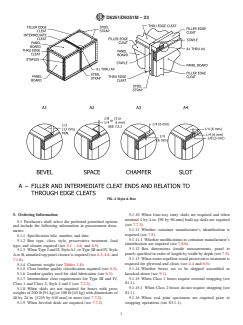
FIG. 2 Style A Box
5. Ordering Information 5.1.10 When four-way entry skids are required and when
nominal 4 by 4-in. [90 by 90-mm] built-up skids are required
5.1 Purchasers shall select the preferred permitted options
(see 7.7.3).
and include the following information in procurement docu-
5.1.11 Whether container manufacturer’s identification is
ments:
required (see 7.8).
5.1.1 Specification title, number, and date.
5.1.11.1 Whether modifications to container manufacturer’s
5.1.2 Box type, class, style, preservative treatment, load
identification are required (see 7.8.6).
type, and closure required (see 4.1 – 4.6, and 6.5).
5.1.12 Box dimensions (inside measurements, panel to
5.1.3 When Type I and II, Style A1; or Type III and IV, Style
panel) specified in order of length by width by depth (see 7.5).
A or B, unnailed top panel closure is required (see 4.3, 4.6, and
5.1.13 When water-repellent wood preservative treatment is
7.1.8).
required for plywood and cleats (see 4.4 and 6.5).
5.1.4 Contents weight (see Tables 1-8).
5.1.14 Whether boxes are to be shipped assembled or
5.1.5 Cleat lumber quality classification required (see 6.3).
knocked-down (see 9.1).
5.1.6 Lumber quality used for skid fabrication (see 6.3).
5.1.15 When Class 1 boxes require external strapping (see
5.1.7 Intermediate cleat requirements for Type III and IV,
S1.1).
Class 1 and Class 2, Style I and J (see 7.2.2).
5.1.15.1 When Class 2 boxes do not require strapping (see
5.1.8 When skids are not required for boxes with gross
weights of 200 lb [91 kg] or 100 lb [45 kg] with dimensions of S1.1).
48 by 24 in. [1219 by 610 mm] or more (see 7.7.2). 5.1.16 When seal joint specimens are required prior to
5.1.9 When beveled skids are required (see 7.7.2). strapping operations (see S3.1.1).
D6251/D6251M − 23
FIG. 4 Style B Box
TABLE 1 Type II Corrugated and Solid Fiberboard Requirements
Contents Weight
Lb [kg] Class 1 Class 2
Not CF D SW SF D SF
A A A,B
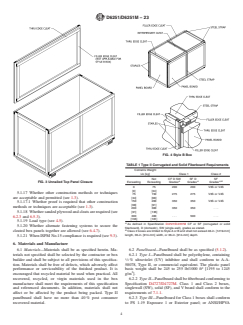
FIG. 3 Unnailed Top Panel Closure
Exceeding Exceeding Grades Grades Grades
0 75 200 200 V3S or V4S
[0] [34]
5.1.17 Whether other construction methods or techniques
75 150 275 275 V3S or V4S
are acceptable and permitted (see 1.3). [34] [68]
150 200 350 350 V3S or V4S
5.1.17.1 Whether proof is required that other construction
[68] [91]
methods or techniques are acceptable (see 1.3).
200 300 350 350 . . .
5.1.18 Whether sanded plywood and cleats are required (see
[91] [136]
300 400 . . . 500 . . .
6.2.3 and 6.5.3).
[136] [181]
5.1.19 Load type (see 4.5).
A
As defined in Specification D4727/D4727M CF or SF (corrugated or solid
5.1.20 Whether alternate fastening systems to secure the
fiberboard), D (domestic), SW (single-wall), grades as stated.
B
cleated box panels together are allowed (see 6.4.7).
Class 2 boxes are limited to Style A or B and shall not exceed 48-in. [1219-mm]
length, 36-in. [914-mm] width, or 36-in. [914-mm] depth.
5.1.21 When ISPM No.15 compliance is required (see 9.3).
6. Materials and Manufacture
6.1 Materials—Materials shall be as specified herein. Ma- 6.2 Panelboard—Panelboard shall be as specified (5.1.2).
terials not specified shall be selected by the contractor or box 6.2.1 Type I—Panelboard shall be polyethylene, containing
builder and shall be subject to all provisions of this specifica- ⁄2 % ultraviolet (UV) inhibitor and shall conform to A-A-
tion. Materials shall be free of defects, which adversely affect 58078, Type II, or commercial equivalent. The plastic panel
performance or serviceability of the finished product. It is basis weight shall be 245 to 255 lb/1000 ft [1195 to 1245
encouraged that recycled material be used when practical. All g/m ].
recovered, recycled, or virgin materials used in the box 6.2.2 Type II—Panelboard shall be fiberboard conforming to
manufacture shall meet the requirements of this specification Specification D4727/D4727M. Class 1 and Class 2 boxes,
and referenced documents. In addition, materials shall not singlewall (SW), solid (SF), and V board shall conform to the
affect or be affected by the product being packed. Type II requirements of 7.1.1.
panelboard shall have no more than 40 % post consumer 6.2.3 Type III—Panelboard for Class 1 boxes shall conform
recovered material. to PS 1-19 Exposure 1 or Exterior panel; or ANSI/HPVA
D6251/D6251M − 23
TABLE 2 Types III and IV, Class 1 Panel Requirements
6.4.3 Single-Leg Fasteners—Single-leg fasteners shall be
Contents Weight formed automatically into a nail from sheared off bright,
A
Min Panel Thickness
lb [kg]
smooth, knurled, or helically fluted low-carbon steel. Medium
PS 1-19, PS 2–18,
B ,E carbon steel (stiff-stock) minimum 0.072-in. (15-gauge) [1.83-
Not and HPVA HP-1-2020
Exceeding
B,C,D
in. [mm]
Exceeding
PRP-108 mm] diameter) wire may also be used. Fasteners are driven
in. [mm]
subsequently by a special machine at a rapid rate, with
F,G
5 1
0 75 ⁄16 ⁄8
sheared-bevel or sheared-square point. For Type I and II boxes,
[0] [34] [8] [3.2]
F,G
5 1
75 150 ⁄16 ⁄8 1
the nail length, before driving, shall be a minimum of ⁄8 in. [3
[34] [68] [8] [3.2]
mm] longer than the thickness of the material being joined. For
F,G F
5 3
150 300 ⁄16 ⁄16
[68] [136] [8] [4.8] Type III and IV boxes, the nail length, before driving, shall be
F
5 3
300 500 ⁄16 ⁄16
a minimum of ⁄2 in. [13 mm] longer than the thickness of the
[136] [227] [8] [4.8]
material being joined. The automatic machine for driving shall
5 1
500 800 ⁄16 ⁄4
[227] [363] [8] [6.4] be provided with needle-point knives, a J-clinch plate, and a
3 5
800 1000 ⁄8 ⁄16 1
⁄32-in. [1-mm] countersink. Single-leg fasteners shall not be
[363] [454] [9.5] [8]
used in joining panelboard to cleats.
A
Commercial tolerances shall apply.
6.4.4 Other Fastenings—Other single-leg fasteners, pre-
B
See 6.2.3.
C
Alternatively low-density plywood conforming to HPVA HP-1-2020 (see 6.2.3) formed or formed from wire, fastenings may be used to the
may be used.
extent specified in 7.1 but must be tested in accordance with
D
OSB panelboard conforming to APA PRP-108 or PS 2-18 and shall be limited to
8.1. Steel wire used to form these fasteners shall have a
Style A, B, I, and J boxes.
E
Low density plywood conforming to HPVA HP-1-2020 (see 6.2.3) shall not be diameter of not less than 0.0625 in. (16 gauge) [1.59 mm]. If
used.
wire other than round wire is used, the cross section area shall
F
⁄20 in. [3.8 mm] min. thick plywood conforming to HPVA HP-1-2020, Type III,
be equal to that of 0.0625 in. round wire. Fastener points and
5 3
Grade 4, may be used in place of the ⁄16 in. [8 mm]. ( ⁄20-in. [3.8-mm] thick plywood
is not a standard thickness in PS 1-19).
shanks shall be determined by the test specified in 8.1 for the
G
At the option of the supplier, ⁄4-in. [6.4-mm] sanded plywood may be furnished.
applicable application and when driven, shall not split the
wood members. The fastener withdrawal resistance shall be
equal to nails specified in 6.4.1. These fasteners, when used,
shall be driven so as to provide a minimum clinch of ⁄8 in. [3
HP-1-2020. Panelboard for Class 2 boxes shall conform to
mm] and shall not be used with plywood and OSB less than ⁄4
PS 1-19 Exposure 1 or Exterior panel; or ANSI/HPVA HP-1-
in. [6.4 mm] thick.
2020. Unless otherwise specified, plywood shall be unsanded.
If smooth finish or sanded panels are required, appropriate 6.4.5 Corrugated Fasteners—Corrugated fasteners shall
sanded grades should be specified in the contract (see 5.1.18). only be used on Type I and II boxes and shall conform to
The plywood thickness shall be specified in Tables 2 and 3. FF-F-133, or commercial equivalent, and as specified in 7.1.
Plywood shall have no defects (knot holes, worm holes, and so
6.4.6 Wood Screws—Wood screws shall be in accordance
forth) extending through the panel. When the plywood is with ASME B18.6.1 and other industry standards. Wood
specified to be surface treated with water-repellant wood
screws are classified as Flat Countersunk Head, Oval Counter-
preservative, the treatment shall be as specified in 6.5. sunk Head, Pan Head, and Round Head. Wood screws shall not
6.2.4 Type IV—Panelboard for Class 1 boxes shall conform
be used in joining panelboard o cleats.
to PS 2-18 Exposure 1 or Exterior panels. Panelboard for Class
6.4.7 Alternate Fastening Systems—If the use of alternate
2 boxes shall conform to PS 2-18 Exposure 1 or Exterior
fastening systems is acceptable or permitted (see 5.1.20), these
panels; or ANSI/HPVA HP-1-2020.
systems can be used to secure the box cleated panels together
(see 7.6).
6.3 Lumber—As specified in 5.1.5, lumber cleats shall
conform to Practice D6199, Class 2, PS 20-20 or the NHLA
6.5 Water-Repellent Wood Preservative—Water-repellent
Rules. As specified in 5.1.6, skids shall conform to Practice
wood preservative shall be a solution containing either copper
D6199 class 3, PS 20-20 or the NHLA Rules.
naphthenate conforming with Practice D6253, MIL-DTL-
2427H and AWPA Standards P36 with a minimum concentra-
6.4 Fasteners—Fasteners are classified as driven nails,
tion of 2.0 % copper metal, oxine copper (formerly referred to
staples, wire stitches, single-leg fasteners, wood screws, other
as copper-8-quinolinolate) conforming with Practice D6253,
fastenings, corrugated fasteners, and alternate fastening sys-
MIL-DTL-2427H and AWPA Standards P37 with a minimum
tems.
concentration of 1.8 % copper metal, or 3 % zinc naphthenate
6.4.1 Nails—Nails shall be in accordance with Specification
conforming with Practice D6253 and MIL-DTL-2427H.
F1667 and other industry standards. Nails are classified as
6.5.1 Type I and II—When specified (see 4.4 and 5.1.13)
plain-shank, helically threaded, annularly threaded, fluted or
Type I and II boxes shall have the wood cleats treated with a
twisted square wire.
water-repellent wood preservative specified in 6.5 applied by
6.4.2 Staples or Wire Stitches—Staples or wire stitches shall
immersion.
be made of steel wire not less than 0.0625 in. diameter (16
gauge), [1.59 mm]. The crown bearing surface (the underside) 6.5.2 Type III and IV—Under some conditions of exposure,
shall be not less than ⁄16 in. [8 mm] long except that for Type Type III and IV boxes may become stained and discolored by
II boxes the bearing surface shall be not less than ⁄2 in. [13 molds and mildew. Such staining is undesirable when the
mm] long. identification markings may become obscured. Water-repellent
D6251/D6251M − 23
TABLE 3 Type III and IV Class 2 Panel Requirements
A
Min Panel Thickness
Contents Weight lb [kg]
Type 1 and 2 Loads Type 3 Load
PS 1-19, PS 2-18, and P S1-19, PS 2–18, and
B,D B,D
Not
HPVA HP-1-2020 HPVA HP-1-2020
B,C B,C
Exceeding PRP-108 PRP-108
in. [mm] in. [mm]
Exceeding
in. [mm] in. [mm]
Style Style Style Style
E E E,F E,F
A and B I and J A and B I and J A and B I and J A and B I and J
G H G F
5 3 3 5 5 3 3 5
0 100 ⁄16 ⁄8 ⁄16 ⁄16 ⁄16 ⁄8 ⁄16 ⁄16
[0] [45] [8] [9.5] [4.8] [8] [8] [9.5] [4.8] [8]
G H G
5 3 3 5 5 3 3 5
100 200 ⁄16 ⁄8 ⁄16 ⁄16 ⁄16 ⁄8 ⁄16 ⁄16
[45] [91] [8] [9.5] [4.8] [8] [8] [9.5] [4.8] [8]
5 G 1 3 3 5 15 1 3
200 300 ⁄16 ⁄2 ⁄16 ⁄8 ⁄16 ⁄32 ⁄4 ⁄8
[91] [136] [8] [12.7] [4.8] [9.5] [8] [11.9] [6.4] [9.5]
G
5 1 3 3 5 15 1 3
300 400 ⁄16 ⁄2 ⁄16 ⁄8 ⁄16 ⁄32 ⁄4 ⁄8
[136] [181] [8] [12.7] [4.8] [9.5] [8] [11.9] [6.4] [9.5]
G
5 1 3 3 5 19 1 1
400 500 ⁄16 ⁄2 ⁄16 ⁄8 ⁄16 ⁄32 ⁄4 ⁄2
[181] [227] [8] [12.7] [4.8] [9.5] [8] [15.1] [6.4] [12.7]
5 1 1 3 5 19 1 1
500 600 ⁄16 ⁄2 ⁄4 ⁄8 ⁄16 ⁄32 ⁄4 ⁄2
[227] [272] [8] [12.7] [6.4] [9.5] [8] [15.1] [6.4] [12.7]
3 5 5 1 3 19 5 5
600 800 ⁄8 ⁄8 ⁄16 ⁄2 ⁄8 ⁄32 ⁄16 ⁄8
[272] [363] [9.5] [15.9] [8] [12.7] [9.5] [15.1] [8] [15.9]
3 5 5 1 1 19 3 5
800 1000 ⁄8 ⁄8 ⁄16 ⁄2 ⁄2 ⁄32 ⁄8 ⁄8
[363] [454] [9.5] [15.9] [8] [12.7] [12.7] [15.1] [9.5] [15.9]
A
Commercial tolerances shall apply.
B
See 6.2.3.
C
Alternatively low density plywood conforming to HPVA HP-1-2020 (see 6.2.3) may be used.
D
Low density plywood conforming to HPVA HP-1-2020 (see 6.2.3) shall not be used.
E
Only Style I and J, top and bottom panels, all other panels as specified for Style A and B.
F
For Air Force shipments, Style I and J contents maximum weight shall be 150 lb [65 kg].
G
At the option of the supplier, ⁄4-in. [6.3-mm] sanded plywood may be furnished.
H
3 3 3
⁄20 in. [3.8 mm] min. thick plywood conforming to HPVA HP-1-2020, Type I, Grade 4, may be used in place of the ⁄16-in. [4.8-mm] thick plywood. ( ⁄20-in. [3.8-mm] thick
plywood is not a standard thickness in PS 1-19 or PS 2-18).
TABLE 4 Cleat Sizes for Type I Panels TABLE 5 Cleat Sizes for Type II Panels
Class 1 Class 2 Class 1
Contents Weight
A
Cleat Size Cleat Size Contents Weight Cleat Size
lb [kg]
A A
in. [mm] in. [mm] lb [kg]
Thickness Width
Not Min Min Min Min
Exceeding
Group III
Exceeding Width Thickness Width Thickness
Group I All Groups
Box Not and IV
3 3 3 3
Exceeding and II Woods of Woods
0 100 1 ⁄4 ⁄4 1 ⁄4 ⁄4
Style Exceeding Woods
in. [mm) in. [mm]
[0] [45] [35] [16] [35] [16]
in. [mm]
3 3 1 3
100 150 1 ⁄4 ⁄4 2 ⁄4 ⁄4
11 5 1
C thru K 0 75 ⁄16 ⁄8 1 ⁄2
[45] [68] [35] [16] [45] [16]
[0] [34] [16] [14] [32]
5 3 5 3
150 225 2 ⁄8 ⁄4 2 ⁄8 ⁄4 3 11 11
C thru K 74 150 ⁄4 ⁄16 1 ⁄16
[68] [102] [54] [16] [54] [16]
[35] [68] [16] [16] [37]
3 3
225 250 3 ⁄4 3 ⁄4 5 9 1
A and B 0 75 ⁄8 ⁄16 1 ⁄2
[102] [113] [64] [16] [64] [16]
[0] [34] [14] [13] (32)
3 3
250 300 3 ⁄4 3 ⁄4 11 5 11
A and B 75 150 ⁄16 ⁄8 1 ⁄16
[113] [136] [64] [16] [64] [16]
[34] [68] [16] [14] [37]
3 3
300 350 3 ⁄4 3 ⁄4
3 11 3
A and B 150 300 ⁄4 ⁄16 1 ⁄4
[136] [159] [64] [16] [64] [16]
[68] [136] [16] [16] [35]
3 3
350 400 3 ⁄4 3 ⁄4
13 3
A and B 300 400 1 ⁄16 1 ⁄4
[159] [181] [64] [16] [64] [16]
[136] [181] [19] [16] [35]
400 500 3 ⁄4 . . . . . .
Class 2
[181] [227] [64] [16]
Contents Weight Min Cleat Size for all Wood
A
A
lb [kg] Groups in. [mm]
Practice D6199 dimension requirements apply.
Box Not
Exceeding Thickness, min Width, min
Style Exceeding
3 3
A or B 0 200 ⁄4 1 ⁄4
Only [0] [91] [16] [35]
preservatives are effective in retarding mildew and similar
A
Practice D6199 dimension requirements apply.
stains. Type III and IV boxes shall be treated such that the
plywood and OSB absorb not less than 2.2-lb/100 ft [10.74
kg/100 m ] water-repellent wood preservative.
6.5.3 When sanded plywood and cleats are specified (see cleats to the panelboard or painting the cleats (see 6.5.5). When
5.1.18, and 6.2.3), the plywood shall be sanded prior to surface boxes are painted, wood preservation shall be accomplished
treatment. Wood shall be preserved by immersing in wood prior to paint application.
preservative for a minimum of three minutes prior to use in 6.5.4 In general, the copper naphthenate solution is the
panel fabrication. There shall be evidence of discoloration of preferred wood preservative unless end items to be packaged in
the plywood and wood cleats when tested in 8.4 for presence of these boxes are food items not packaged in sealed metal cans
preservative. The preservative shall be dry prior to assembling or materials which might be adversely effected by residual
D6251/D6251M − 23
TABLE 6 Cleat Sizes for Type III and IV, Class 1 Panels
6.6 Adhesives—Water-resistant glue that adheres or bonds
A,B
Contents Weight the Type I (polyethylene) and Type II (fiberboard) panels to the
Min Cleat Size
lb [kg] in. [mm]
cleats.
Not
Exceeding Thickness Width
Exceeding
7. Construction
3 3
0 75 ⁄4 1 ⁄8
[0] [34] [16] [29]
7.1 Panel Fabrication—Panels shall be fabricated by
3 3
75 150 ⁄4 1 ⁄4
nailing, stapling, or gluing panelboard to cleats placed as
[34] [68] [16] [35]
3 3
150 300 ⁄4 1 ⁄4
shown in Figs. 1-7 and as specified in 7.2.
[68] [136] [16] [35]
7.1.1 Type I and II Panelboard—Panelboard material as
3 3
300 500 ⁄4 1 ⁄4
specified in 6.2.1 and 6.2.2 shall be joined to cleats by fasteners
[136] [227] [16] [35]
3 1
500 800 ⁄4 2 ⁄4
or adhesives to make a panel for a box to carry contents weight
[227] [363] [16] [45]
as specified in Table 1. Panelboard for one and two piece
3 5
800 1000 ⁄4 2 ⁄8
panels shall be as specified in 7.1.4 – 7.1.6. The contents
[363] [454] [16] [54]
A weight for Type I panel boxes shall not exceed 500 lb [227 kg]
Practice D6199 dimension requirements apply.
B
All wood groups.
for Class 1 nor more than 400 lb [181 kg] for Class 2. The
contents weight for Type II boxes shall not exceed 400 lb [181
kg] for Class 1 nor more than 200 lb [91 kg] for Class 2.
TABLE 7 Cleat Sizes for Type III and IV, Class 2 Panels
Adhesives shall not be used to secure plastic panelboard to
A,B
Contents Weight
Min Edge Cleat Size
cleats. Tables 4 and 5 specify the cleat sizes for Type I and II
lb [kg] in. [mm]
panels.
Not
Exceeding Thickness Width
Exceeding 7.1.2 Type III and IV Panelboard —Panelboard material as
3 3
0 100 ⁄4 1 ⁄4
specified in 6.2.3 and 6.2.4 shall be joined to cleats by use of
[0] [45] [16] [35]
either nails, staples, wire stitches, or other fasteners as speci-
3 3
100 200 ⁄4 1 ⁄4
fied in 6.4 and Table 8, at the option of the supplier (see Fig.
[45] [91] [16] [35]
3 3
200 300 ⁄4 1 ⁄4
5, Insert, All Styles Panel Assembly) for a box to carry content
[91] [136] [16] [35]
weights as specified in Tables 2 and 3. The contents weight for
3 3
300 400 ⁄4 1 ⁄4
Type III and IV boxes shall not exceed 1000 lb [454 kg] for
[136] [181] [16] [35]
3 1
400 500 ⁄4 2 ⁄4
[181] [227] [16] [45]
3 5
500 600 ⁄4 2 ⁄8
[227] [272] [16] [54]
3 1
600 800 ⁄4 3 ⁄4
[272] [363] [16] [70]
3 1
800 1000 ⁄4 3 ⁄4
[363] [454] [16] [70]
A
Practice D6199 dimension requirements apply.
B
All wood groups.
TABLE 8 Nails and Staples Sizes for Joining Panelboard and
Cleats
Staples and
Nails Diameter
Wire Other All Fasteners
Not Less Than
lb [kg] Gauge Diameter Length as
A
Head
[mm] Not Less Specified
in. [mm]
in. [mm]
Than
B B
0 to 150 15 0.072 ⁄64 as specified see 6.4
[0 to 68] [1.83] [1.83] [5.16] in 6.4.2, through
13 B B
150 to 1000 14 0.080 ⁄64 6.4.3, and 6.4.4
C
[68 to 454] [2.03] [2.03] [5.16] 6.4.4
A
Fastening plywood to cleats, not less than the plywood and cleat thickness, plus
⁄8-in. [3.2 mm].
B
Nail dimensions for Type II, Style C through K shall be not less than 1 in. [25 mm]
in length and have not less than ⁄4-in. [6.35-mm] head diameter.
C
NOTE 1—Symbol Identification:
Staple crown for Type II boxes shall be not less than ⁄2 in. [13 mm] long.
A = Two fasteners required if cleats are 2 ⁄4 in. [45 mm] or more in
width (see 7.4.1).
solvents from the wood preservative. The purchaser should be B = ⁄8 in. [10 mm] = min.
C = 6 in. [152 mm] = max.
consulted if there is a question concerning the appropriate
D = Minimum distance between fastener and end of cleat to be not less
wood preservative (see 5.1.2).
3 1
than ⁄4 in. [19 mm] nor more than 1 ⁄2 [38 mm].
6.5.5 Preservative Dryness—Boxes, or box parts, shall be
S = Box assembly fastener spacing (see Table 9 and Table 10).
dried prior to assembling or painting after water-repellent
W = Cleat width (see Tables 4-7).
wood preservative is applied. There shall be an absence of
discoloration when tested as specified in 8.4.3. FIG. 5 Style A Box Fastening and Assembly
D6251/D6251M − 23
NOTE 1—Panel assembly - nails, staples, wood screws or other types of fasteners may be employed at the option of the supplier (see 7.1). Fasteners
shall be staggered in two parallel rows as shown.
Box assembly—Dimensions S and D may be varied enough to prevent nails from striking panel assembly nails or to prevent nails from being driven
into cracks.
NOTE 1—Symbol Identification:
A = Two nails required if cleats are 2 ⁄4 in. [45 mm] or more in width (see 7.4.1).
3 1
D = Minimum distance between fastener and end of cleat to be not less than ⁄4 in. [19 mm] nor more than 1 ⁄2 [38 mm].
S = Box assembly fastener spacing (see Table 9, Table 10, Table 11 or Table 12).
W = Cleat width (see Tables 4-7).
FIG. 6 Style B Box Fastening and Assembly
NOTE 1—Use support cleats to prevent fork-lift tine damage to floor panel when container width is over 40 in. [1014 mm] O.D. and rubbing strips/skids
are required.
Locate the support cleats equal distance between filler edge cleats.
1 × 4-in. [19 × 89-mm] (nom) lumber.
FIG. 7 Support Cleats
D6251/D6251M − 23
Class 1 or Class 2. Tables 2 and 3 specify the panel minimum 7.1.7.2 Class 2 joint cleat thickness shall be as specified for
thickness based on the class, content weight, load type and/or edge cleats and the width shall be not less than 1 ⁄3 times the
required edge cleat width, but under no circumstances shall the
box style. Tables 6 and 7 specify the cleat size for Type III and
IV panels. Fasteners are specified in 6.4 and Table 8. cleat width be less than 2 ⁄4 in. [57 mm].
7.1.8 Top Panel Modification for Unnailed Top Panel
7.1.3 Solid Wood Panels—Solid wood panels may be used
Closure—Type I and II, Style A1, or Type III or IV, Style A or
when the box panel length or width dimension is equal to less
B box top panels shall be modified by providing through and
than the sum of three cleat widths. The wood member thickness
filler edge cleats on the panel underside (see Fig. 3). The Type
shall be ⁄16 in. [2 mm] greater than that specified for the cleat
III or IV, Style B top panel shall be modified by providing
thickness for the loads specified in Tables 6 and 7. When solid
through edge cleats only on the panel underside. The underside
wood panels are used, plywood inner facings may be omitted.
cleats shall be the same width and thickness as required for the
7.1.4 One and Two Piece Panels—Box bottom panels not
outer cleats. Inside through cleats shall be used to reinforce the
exceeding 72 in. [1829 mm] in length or 48 in. [1219 mm] in
box ends’ inside top edge (see Fig. 3). The underside cleats
width, shall consist of a single panelboard piece. Type III and
shall be positioned on the panel so the cleat edges fit snugly
IV, Style I, top and bottom panels, regardless of size, shall
within the applicable box side and end panels. Intermediate or
consist of a single piece of plywood or OSB. All other panels
reinforcing cleats required for the Style A and B box top panels
of Type III and IV, all style boxes, and all Type I and II, Style
are not applicable for cleating the underside of the top panel.
A, A1, and B, box panels shall consist of one or two panelboard
7.2 Cleats—Cleats shall be made from wood specified in
pieces joined by either a lap (see 7.1.5) or butt joint (see 7.1.6
6.3. The cleat size shall be as specified in Tables 4-7 as
and 7.1.7) as specified. In two piece panels, each panelboard
applicable. Cleat arrangement on panels shall be as shown in
piece shall be not less than 24 in. [610 mm] in length or width.
Figs. 1-7. When assembling cleats to panelboard, the clearance
Panelboard joints in adjacent panels shall be not closer than 12
between each filler or intermediate cleat end and the through
in. [305 mm] of being in line with adjacent parallel joints.
cleat shall be approximately equal or approximately ⁄8 in. [3
Adjacent panels may be designed for assembly with joints
mm] shorter on each end (See Fig. 2, Inserts A1 through A4).
running perpendicular to each other.
7.2.1 Top and Bottom Panel Cleats—Filler cleats on top and
7.1.5 Lap Joint—Adjacent panelboard edges shall be lapped
bottom panels, except on top only when the box is provided
not less than 3 in. [76 mm] and fastened by metal stitches, as
with skids, shall be either the same length, or up to ⁄4 in. [6
specified in 6.4.2, which shall pass through both pieces and are
mm] shorter on each end, as the distance between the through
clinched. There shall be not less than two parallel rows of
edge cleats. If filler cleats are the same length as the distance
stitches spaced not less than 2 in. [51 mm] apart, and the
between through edge cleats, each end shall be cut or notched
spacing of stitches in each row shall not exceed 4 in. [102 mm].
as shown (Fig. 2, Inserts A1 through A4) for water drainage.
Type II, Class 1, fiberboard panelboard lap joints may be firmly
The cut or notch clear area shall be adjacent to the panelboard
joined together with water-resistant adhesive. The fiberboard
and the filler cleat end shall abut the through cleat edge when
panel lap joints shall be firmly joined to each other over the
the panel is assembled. Provisions for drainage are not appli-
entire contact surface area. When tested in accordance with
cable for cleats placed on the underside of the unnailed closure
8.2.3, the fiberboard, or a layer of fiberboard, shall remain in
Style A box top panels. Intermediate cleats and additional
contact with not less than 75 % of the other fiberboard piece
cleats shall be as specified in 7.2.2 and 7.2.3.
contact area. Type III maximum plywood thickness for this
7.2.2 Intermediate Cleat Requirements for Box Panels,
type of joint shall be ⁄16 in. [5 mm].
Class 1 and Class 2, with Type 1 or 2 Loads, (see 4.5)—When
7.1.6 Type I and II Butt Joint—Adjacent panelboard edges
one or both panel dimensions measured between the edge
shall be butted at the mid-width of a joint cleat and each pie
cleats inside edge, (unframed area) exceeds 24 in. [610 mm]
fastened to the cleat. Fastening panelboard to cleats using
for Class 1 and Class 2, Style A and B, one or more
metal stitches shall be in accordance with 7.1.5 passing through
intermediate cleats of the same width and thickness as the edge
the fiberboard and into the cleat. When the panelboard joint
cleats shall be applied. These cleats shall be applied perpen-
glued to the cleat, the fiberboard butt joint area shall be glued
dicular to the greater of the two dimensions between the edge
over the entire surface contact area. When tested in accordance
cleats. The distance between edge cleats, which are parallel
with 8.2.3, the fiberboard, or a layer of fiberboard, shall remain
with the intermediate cleats, or between intermediate cleats,
in contact with not less than 75 % of the cleat contact area.
shall not exceed 24 in. [610 mm]. When both panel dimensions
7.1.7 Type III and IV Butt Joint—Adjacent panelboard edges
(unframed area) exceed 24 in. and are approximately the same
shall be butted at the mid-width of a joint cleat specified in
dimensions, the intermediate cleat(s) shall be perpendicular to
7.1.7.1 or 7.1.7.2 and each piece fastened to the cleat. Fasten-
the filler edge cleats on the ends, top, and bottom, and
ing shall conform to the panel fabrication requirements of
perpendicular to the through edge cleats on the sides.
7.1.2. The joint cleat length shall be not less than the distance
7.2.2.1 Regardless of panel size, intermediate cleats are not
between edge cleats – ⁄8 in. [–3 mm].
required perpendicular to the required intermediate cleats
7.1.7.1 Class 1 joint cleat thickness shall be the same as the
unless their purpose is for splicing two pieces of plywood
edge cleats. The joint cleat width shall be not less than 2 ⁄4 in. panels larger than 72 by 48 in. [1829 by 1219 mm]. Interme-
[57 mm], except if the edge cleat width is greater than 2 ⁄4 in.,
diate cleats for Type III and IV, Class 1 and 2, Style I and J
the joint cleat shall be the same width as the edge cleat. shall be as specified (see 5.1.7). The intermediate cleats
D6251/D6251M − 23
drainage requirements on top and bottom panels shall be as positioned lengthwise of a cleat shall be staggered, where
specified in 7.2.1 for filler edge cleats. Cleat spacing for Type possible, to form two parallel rows approximately ⁄8 in. [10
II, Class 2 boxes, shall be as for all other boxes except that the mm] from the cleat edges (see Figs. 5 and 6).
spacing shall be not more than 20 in. [508 mm]. 7.3.4 Corrugated Fasteners—Corrugated fasteners only
shall be used for fastening butt joints for Type II, Class 1
7.2.3 Additional Cleats—Any box panel having the load
boxes. The fastener depth shall be not less than ⁄8 in. [16 mm].
concentrated near the center of an unframed area shall be
Alternatively, staples may be used at the butt joints of all Type
reinforced with an additional cleat of the same width and
thickness as the edge cleat. II box cleats.
7.2.4 Type I and II, Class 1 Joint Cleat—Each joint cleat
7.4 Box Assembly—Each box shall be in agreement with
thickness for Class 1 boxes shall be the same as the edge cleats.
Figs. 1-7 for the box style specified. Styles A, C, F, H, I, J and
Each joint cleat width shall be not less than 2 ⁄4 in. [45 mm],
K panels shall be joined with standard box corners in accor-
except if the edge cleat width is greater than 2 ⁄4 in., the joint
dance with Fig. 5, Style A. Style B, D, E, and G panels shall be
cleat shall be the same width as the edge cleat. The joint cleat
joined with interlocking three-way corners in accordance with
length shall not be less than the distance between edge cleats.
Fig. 6, Style B.
The maximum deviation shall be minus ⁄8 in. [3 mm].
7.4.1 Nailing—Each nail fastening the panelboard and panel
7.2.5 Type I and II, Class 2 Joint Cleat—Each joint cleat
edge cleat to an adjacent panel edge cleat shall be spaced as
thickness shall be as specified for edge cleats and the width
specified in Table 9 or Table 10, as applicable, for the cleat
shall be not less than 1 ⁄3 times the required edge cleat width.
thickness used (see Dimension S, Figs. 5 and 6). Boxes
Under no circumstances shall the cleat width be less than 2 ⁄4
assembled with the box nails specified in 6.4.1 shall have
in. [45 mm].
approximately 10 % more nails than boxes assembled with
cooler or sinker nails. When cleats used are 2 ⁄4 in. [45 mm] or
7.3 Fastening Panelboard to Cleats—Testing is not required
more in width, two nails shall be driven through the cleat near
for fasteners specified in 6.4.1 – 6.4.3 when used to join
the end into the side of the appropriate cleat on the abutting
panelboard to wood for panel fabrication. Other fasteners (see
panel (see Figs. 5 and 6). Nails used in box assembly shall be
6.4.4) shall be tested as specified in 8.1. Fasteners for joining
cement-coated, chemical-etched, or mechanically deformed
panelboard to cleats shall conform to 6.4.1 for nails and 6.4.2
(screw-type or annular-ring type). Adjacent cleated panels shall
for staples and the sizes specified in Table 8. Nails and staples
be fastened together with coolers, sinkers, corkers, or box nails
shall be driven through the panelboard and into the cleats.
using the nail size and spacing specified in Tables 9 and 10, as
Fastener length shall be long enough to be clinched not less
1 applicable.
than ⁄8 in. [3 mm]. Fasteners specified in 6.4.3 and 6.4.4 shall
7.4.2 Wood Screws—Each wood screw fastening the panel-
be driven through the cleat into the panelboard. Except as
board and panel edge cleat to an adjacent panel edge cleat(s)
specified in 6.4.3, fasteners shall be of such length that a clinch
shall be spaced as specified in Table 11 or Table 12, as
of not less than ⁄8 in. [3 mm] is produced. Shiners (fastener
applicable, for the cleat thickness used (see Dimension S, Fig.
point protrusions) shall not be permitted.
5 and Fig. 6). When cleats used are 2 ⁄4 in. [45 mm] or more in
7.3.1 Convergent or divergent staples that are of the speci-
width, two wood screws shall be driven through the cleat near
fied length, not less than the sum of the panelboard and cleat
the end into the side of the appropriate cleat on the abutting
thickness, plus ⁄8 in. [3 mm], normally will not protrude
panel (see Fig. 5 and Fig. 6). Adjacent cleated panels shall be
through the cleats and do not have to be clinched. The fastener
fastened together with wood screws using the wood screw size
bearing surface when driven from panelboard into the cleat
and spacing specified in Table 11 and Table 12, as applicable.
shall not be over driven more than ⁄32 in. [1 mm] or 10 % of
It is recommended to pre-drill pilot holes for wood screws to
the panelboard thickness whichever is greater, or ⁄16 in. [2 mm]
avoid splitting. The pilot hole should be at least the total depth
or 10 % of the cleat thickness whichever is greater, when
driven from cleat into panelboard. The average fastener spac-
ing lengthwise of the cleat shall not exceed 3 in. [76 mm]
TABLE 9 Class 1 Nail Size and Spacing for Fastening Together
between centers (see Figs. 5 and 6).
Adjacent Cleated Panels
7.3.2 Crown type fastener (staples, wire stitches, and so
Max Nail Spacing
Min Nail Size (Penny)
forth) average spacing lengthwise of the cleat, shall not exceed
for all Wood Groups
A
for Wood Groups
Cleats
1 in. [mm]
3 ⁄2 in. [89 mm] measured between crown centers. The fastener
Thickness
Type 1 Type Group Group Group Group
spacing specified in 6.4.3 shall not exceed 2 in. [51 mm], or
in. [mm]
and 2 3 I II III IV
shall be in the ration of not less than 3 to 2 for equivalent nail
Loads Load Woods Woods Woods Woods
diameter, or not less than an average of 1.3 times as many
9 5
⁄16 to ⁄8 6 5 6 6 6 5
automatically driven wire nails as comparable nails specified in [13 to 14] [152] [127]
11 3
⁄32 to ⁄4 5 4 7 7 7 6
6.4.1. The requirements that provide the least spacing between
[7 to 16] [127] [102]
nails shall prevail.
⁄4 5 4 7 7 7 6
[16] [127] [102]
7.3.3 The distance between the nearest fastener edge and the
⁄16 to 1 3 3 8 7 7 7
cleat edge shall be not less than ⁄8 in. [10 mm] (see Fig. 5).
[14 to 19] [76] [76]
Also, the distance between the nearest fastener edge and the
A
If the nail protrudes through the last edge cleat or splits cleat; then the next
cleat end shall be not less than ⁄4 in. [19 mm] nor more than
smaller size penny nail shall be used.
1 ⁄2 in. [38 mm] (see Dimension D, Figs. 5 and 6). Fasteners
D6251/D6251M − 23
TABLE 10 Class 2 Nail Size and Spacing for Fastening Together
cleats are Group I or II Woods; when cleats are Group III or IV
Adjacent Cleated Panels
Woods, only one nail shall be used.
Max Nail Spacing
7.4.5 Type II, Fastening Uncleated Panel Edges—For Style
Min Nail Size (Penny)
for all Wood Groups
A
Cleats for Wood Groups
C to K, inclusive, the fiberboard along each uncleated edge
in. [mm]
Thickness
Type Type Group Group Group Group
shall be fastened to the cleat on the adjacent panel by nails
in. [mm]
1 & 2 3 I II III IV
passing through the fiberboard and into the cleat. Nails shall be
B B
Loads Load Wood Wood Wood Wood
3 not less than 1 in. [25 mm] long. The nail spacing shall not
⁄4 5 4 9 8 7 6
[16] [127] [102]
exceed 3 in. [76 mm]. The nail head diameter shall be not less
A 1
than ⁄4 in. [6.35 mm].
If the nail protrudes through the last edge cleat or splits cleat, then the next
smaller size penny nail shall be used.
7.4.6 Type III Nailing Uncleated Plywood—For Box Style I
B
For load type (see 4.5).
and J, the plywood panel uncleated edges shall be fastened to
the cleat on the adjacent panel by nails passing through the
plywood and into the cleat. Nails shall be spaced not more than
TABLE 11 Class 1 Wood Screw Size and Spacing for Fastening
Together Adjacent Cleated Panels 3 in. [76 mm] apart. Nails shall be not less than 1 in. [25 mm]
longer than the plywood thickness through which the nail
Max Wood Screw
Spacing Min Wood Screw Size (Length, in inches)
passes for Class 1 and not less than 1 ⁄8 in. [35 mm] longer for
A,B
for all Wood Groups for Wood Groups
Cleats
Class 2.
in. [mm]
Thickness
in. [mm]
Type 1 Type Group Group Group Group
7.5 Dimensions—Boxes shall be furnished having the di-
and 2 3 I II III IV
mensions specified (see 5.1.12). In this specification, box
Loads Load Woods Woods Woods Woods
dimensions shall be given in the sequence of length, width, and
9 5
⁄16 to ⁄8 6 5 #8 (2) #8 (
...
This document is not an ASTM standard and is intended only to provide the user of an ASTM standard an indication of what changes have been made to the previous version. Because
it may not be technically possible to adequately depict all changes accurately, ASTM recommends that users consult prior editions as appropriate. In all cases only the current version
of the standard as published by ASTM is to be considered the official document.
Designation: D6251/D6251M − 19 D6251/D6251M − 23
Standard Specification for
Wood-Cleated Panelboard Shipping Boxes
This standard is issued under the fixed designation D6251/D6251M; the number immediately following the designation indicates the
year of original adoption or, in the case of revision, the year of last revision. A number in parentheses indicates the year of last
reapproval. A superscript epsilon (´) indicates an editorial change since the last revision or reapproval.
1. Scope*Scope
1.1 This specification covers the fabrication and closure of empty and full wood-cleated, hereafter referred to as wood-cleated,
panelboard boxes. These boxes are intended for use as containers for domestic and overseas shipment of general materials and
supplies, not exceeding 1000 lb [454 kg] depending on box type (see 10.1).
1.2 Wood-cleated panelboard shipping box performance is dependent on its fabricated components and subsequent assembly;
therefore, a variety of types, classes, styles, and treatments reflecting varied performance are specified. This specification, however,
does not cover wood-cleated panelboard box performance under all atmospheric, handling, shipping, and storage conditions.
1.3 If the use of other construction methods or techniques is acceptable and permitted (see 5.1.17), the resulting packaging systems
shall be of equal or better performance than would result from the use of these specified materials and procedures. The appropriate
distribution cycle, specified in Practice D4169, can be used to develop comparative procedures and criteria.
1.4 The values stated in either inch-pound units or SI units are to be regarded separately as standard. Within the text, the SI units
are shown in brackets. The values stated in each system are not exact equivalents; therefore, each system must be used
independently of the other. Combining values from the two systems may result in nonconformance with the standard. See
IEEE/ASTM SI 10 for conversion of units.
1.5 This standard does not purport to address all of the safety concerns, if any, associated with its use. It is the responsibility
of the user of this standard to establish appropriate safety, health, and environmental practices and determine the applicability of
regulatory limitations prior to use.
1.6 This international standard was developed in accordance with internationally recognized principles on standardization
established in the Decision on Principles for the Development of International Standards, Guides and Recommendations issued
by the World Trade Organization Technical Barriers to Trade (TBT) Committee.
2. Referenced Documents
2.1 ASTM Standards:
D996 Terminology of Packaging and Distribution Environments
D1990 Practice for Establishing Allowable Properties for Visually-Graded Dimension Lumber from In-Grade Tests of Full-Size
Specimens
D3951 Practice for Commercial Packaging
This specification is under the jurisdiction of ASTM Committee D10 on Packaging and is the direct responsibility of Subcommittee D10.12 on Shipping Containers,
Crates, Pallets, Skids and Related Structures.
Current edition approved Aug. 1, 2019Oct. 1, 2023. Published November 2019December 2023. Originally approved in 1998. Last previous edition approved in 20112019
as D6251/D6251M – 11.D6251/D6251M – 19. DOI: 10.1520/D6251_D6251M-19.10.1520/D6251_D6251M-23.
For referenced ASTM standards, visit the ASTM website, www.astm.org, or contact ASTM Customer Service at service@astm.org. For Annual Book of ASTM Standards
volume information, refer to the standard’s Document Summary page on the ASTM website.
*A Summary of Changes section appears at the end of this standard
Copyright © ASTM International, 100 Barr Harbor Drive, PO Box C700, West Conshohocken, PA 19428-2959. United States
D6251/D6251M − 23
D3953 Specification for Strapping, Flat Steel and Seals
D4169 Practice for Performance Testing of Shipping Containers and Systems
D4727/D4727M Specification for Corrugated and Solid Fiberboard Sheet Stock (Container Grade) and Cut Shapes
D6199 Practice for Quality of Wood Members of Containers and Pallets
D6253 Practice for Treatment and/or Marking of Wood Packaging Materials
F1667 Specification for Driven Fasteners: Nails, Spikes, and Staples
IEEE/ASTM SI 10 Standard for Use of the International System of Units (SI): The Modern Metric System
2.2 Federal Specifications:
A-A-58078 Plastic Board (For Packaging Applications)
FF-F-133 Fasteners, Wood Joint, Corrugated – (Saw Edge)
2.3 Code of Federal Regulations:
CFR Parts 107-180 Title 49, Hazardous Materials Regulations
2.4 APA—The Engineered Wood Association:
PRP-108 Performance Standards and Policies for Structural-Use Panels
PS 1-071-19 Structural Plywood
2.5 American Wood Protection Association (AWPA):
P36 Standard for Copper Naphthenate (CuN)
P37 Standard for Oxine Copper (Copper-8-Quinolinolate) (Cu8)
2.6 Military Standard:
MIL-DTL-2427 Detail Specification Box, Ammunition Packing: Wood, Nailed
2.7 Hardwood Plywood and Veneer Association:
ANSI/HPVA HP-1-2004HP-1-2020 American National Standard for Hardwood and Decorative Plywood
2.8 National Institute of Standards and Technology (NIST):
PS 2-04PS 2-18 Performance Standard for Wood-Based Structural-Use Panels
2.9 American Lumber Standards Committee (ALSC):
PS 20-05PS 20-20 American Softwood Lumber Standard
2.10 National Hardwood Lumber Association (NHLA):
Rules for the Measurement and Inspection of Hardwood and Cypress
2.11 National Motor Freight Traffıc Association:
National Motor Freight Classification
2.12 International Standards for Phytosanitary Measures (IPPC):
ISPM No. 15 Guidelines for Regulating Wood Packaging Material in International Trade
2.13 American Society for Mechanical Engineers (ASME):
ASME B18.6.1 Wood Screws (Inch Series)
3. Terminology
3.1 General definitions for packaging and distribution environments are found in Terminology D996.
4. Classification
4.1 Type (see 4.3):
4.1.1 Type I—Corrugated plastic.
4.1.2 Type II—Corrugated and solid fiberboard.
Available from ASSIST Quicksearch, https://quicksearch.dla.mil/qsSearch.aspx.
Available from U.S. Government Printing Office Superintendent of Documents, 732 N. Capitol St., NW, Mail Stop: SDE, Washington, DC 20401, https://www.ecfr.gov/
cgi-bin/ECFR?page=browse.
Available from APA—The Engineered Wood Association, 7011 South 19th Street, Tacoma, WA 98466, http://www.apawood.org.
Available from American Wood Protection Association (AWPA), P.O. Box 361784, Birmingham, AL 35236-1784, http://www.awpa.org.
Available from ASSIST Quicksearch, https://quicksearch.dla.mil/qsSearch.aspx.
Available from Hardwood Plywood and Veneer Association (HPVA), P.O. Box 2789, Reston, VA 22090-0789, http://www.hpva.org.
Available from National Institute of Standards and Technology (NIST), 100 Bureau Dr., Stop 1070, Gaithersburg, MD 20899-1070, http://www.nist.gov.
Available from American Lumber Standards Committee (ALSC), P.O. Box 210, Germantown, MD 20875-0210, http://www.alsc.org.
Available from National Hardwood Lumber Association (NHLA), 6830 Raleigh LaGrange Rd., Memphis, TN 38134, http://www.natlhardwood.org.
Available from National Motor Freight Traffic Association (NMFTA), 1001 N. Fairfax St., Suite 600, Alexandria, VA 22314, http://www.nmfta.org.
Available from the International Plant Protection Convention, www.ippc.int.
Available from the American Society for Mechanical Engineers www.asme.org.
D6251/D6251M − 23
4.1.3 Type III—Plywood.
4.1.4 Type IV—Oriented strand board (OSB) (only Style A, B, I, and J).
4.2 Class:
4.2.1 Class 1—Domestic (see 10.1.1).
4.2.2 Class 2—Overseas (see 10.1.2).
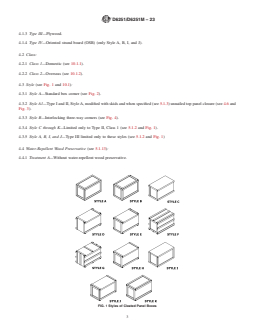
4.3 Style (see Fig. 1 and 10.1):
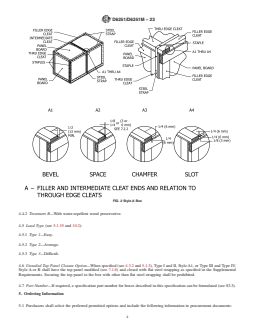
4.3.1 Style A—Standard box corner (see Fig. 2).
4.3.2 Style A1—Type I and II, Style A, modified with skids and when specified (see 5.1.3) unnailed top panel closure (see 4.6 and
Fig. 3).
4.3.3 Style B—Interlocking three-way corners (see Fig. 4).
4.3.4 Style C through K—Limited only to Type II, Class 1 (see 5.1.2 and Fig. 1).
4.3.5 Style A, B, I, and J—Type III limited only to these styles (see 5.1.2 and Fig. 1)
4.4 Water-Repellent Wood Preservative (see 5.1.13):
4.4.1 Treatment A—Without water-repellent wood preservative.
FIG. 1 Styles of Cleated Panel Boxes
D6251/D6251M − 23
FIG. 2 Style A Box
4.4.2 Treatment B—With water-repellent wood preservative.
4.5 Load Type (see 5.1.19 and 10.2):
4.5.1 Type 1—Easy.
4.5.2 Type 2—Average.
4.5.3 Type 3—Difficult.
4.6 Unnailed Top Panel Closure Option—When specified (see 4.3.2 and 5.1.3), Type I and II, Style A1, or Type III and Type IV,
Style A or B shall have the top panel modified (see 7.1.8) and closed with flat steel strapping as specified in the Supplemental
Requirements. Securing the top panel to the box with other than flat steel strapping shall be prohibited.
4.7 Part Number—If required, a specification part number for boxes described in this specification can be formulated (see S3.3).
5. Ordering Information
5.1 Purchasers shall select the preferred permitted options and include the following information in procurement documents:
D6251/D6251M − 23
FIG. 3 Unnailed Top Panel Closure
5.1.1 Specification title, number, and date.
5.1.2 Box type, class, style, preservative treatment, load type, and closure required (see 4.1 – 4.6, and 6.5).
5.1.3 When Type I and II, Style A1; or Type III and IV, Style A or B, unnailed top panel closure is required (see 4.3, 4.6, and 7.1.8).
5.1.4 Contents weight (see Tables 1-8).
5.1.5 Cleat lumber quality classification required (see 6.3).
5.1.6 Lumber quality used for skid fabrication (see 6.3).
5.1.7 Intermediate cleat requirements for Type III and IV, Class 1 and Class 2, Style I and J (see 7.2.2).
5.1.8 When skids are not required for boxes with gross weights of 200 lb [91 kg] or 100 lb [45 kg] with dimensions of 48 by 24
in. [1219 by 610 mm] or more (see 7.7.2).
5.1.9 When beveled skids are required (see 7.7.2).
5.1.10 When four-way entry skids are required and when nominal 4 by 4-in. [90 by 90-mm] built-up skids are required (see 7.7.3).
5.1.11 Whether container manufacturer’s identification is required (see 7.8).
D6251/D6251M − 23
FIG. 4 Style B Box
TABLE 1 Type II Corrugated and Solid Fiberboard Requirements
Contents Weight
Lb [kg] Class 1 Class 2
Not CF D SW SF D SF
A A A,B
Exceeding Exceeding Grades Grades Grades
0 75 200 200 V3S or V4S
[0] [34]
75 150 275 275 V3S or V4S
[34] [68]
150 200 350 350 V3S or V4S
[68] [91]
200 300 350 350 . . .
[91] [136]
300 400 . . . 500 . . .
[136] [181]
A
As defined in Specification D4727/D4727M CF or SF (corrugated or solid
fiberboard), D (domestic), SW (single-wall), grades as stated.
B
Class 2 boxes are limited to Style A or B and shall not exceed 48-in. [1219-mm]
length, 36-in. [914-mm] width, or 36-in. [914-mm] depth.
5.1.11.1 Whether modifications to container manufacturer’s identification are required (see 7.8.6).
5.1.12 Box dimensions (inside measurements, panel to panel) specified in order of length by width by depth (see 7.5).
5.1.13 When water-repellent wood preservative treatment is required for plywood and cleats (see 4.4 and 6.5).
5.1.14 Whether boxes are to be shipped assembled or knocked-down (see 9.1).
5.1.15 When Class 1 boxes require external strapping (see S1.1).
5.1.15.1 When Class 2 boxes do not require strapping (see S1.1).
D6251/D6251M − 23
TABLE 2 Types III and IV, Class 1 Panel Requirements
Contents Weight
A
Panel Min Thickness
lb [kg]
Contents Weight
A
Min Panel Thickness
lb [kg]
PS1-95, PS 2–04,
B ,E
Not
and HPVA HP-1-04
Exceeding
B,C,D
in. [mm]
Exceeding
PRP-108
in. [mm]
PS 1-19, PS 2–18,
B ,E
Not
and HPVA HP-1-2020
Exceeding
B,C,D
in. [mm]
Exceeding PRP-108
in. [mm]
F,G
5 1
0 75 ⁄16 ⁄8
[0] [34] [8] [3.2]
F,G
5 1
75 150 ⁄16 ⁄8
[34] [68] [8] [3.2]
5 F,G 3 F
150 300 ⁄16 ⁄16
[68] [136] [8] [4.8]
F
5 3
300 500 ⁄16 ⁄16
[136] [227] [8] [4.8]
5 1
500 800 ⁄16 ⁄4
[227] [363] [8] [6.4]
3 5
800 1000 ⁄8 ⁄16
[363] [454] [9.5] [8]
A
Commercial tolerances shall apply.
B
See 6.2.3.
C
Alternatively low-density plywood conforming to HPVA HP-1-2004HP-1-2020
(see 6.2.3) may be used.
D
OSB panelboard conforming to APA PRP-108 or PS 2-042-18 and shall be
limited to Style A, B, I, and J boxes.
E
Low density plywood conforming to HPVA HP-1-04HP-1-2020 (see 6.2.3) shall
not be used.
F
⁄20 in. [3.8 mm] min. thick plywood conforming to HPVA HP-1-2004,HP-1-2020,
5 3
Type III, Grade 4, may be used in place of the ⁄16 in. [8 mm]. ( ⁄20-in. [3.8-mm] thick
plywood is not a standard thickness in PS1-95).PS 1-19).
G
At the option of the supplier, ⁄4-in. [6.4-mm] sanded plywood may be furnished.
5.1.16 When seal joint specimens are required prior to strapping operations (see S3.1.1).
5.1.17 Whether other construction methods or techniques are acceptable and permitted (see 1.3).
5.1.17.1 Whether proof is required that other construction methods or techniques are acceptable (see 1.3).
5.1.18 Whether sanded plywood and cleats are required (see 6.2.3 and 6.5.3).
5.1.19 Load type (see 4.5).
5.1.20 Whether alternate fastening systems to secure the cleated box panels together are allowed (see 6.4.66.4.7).
5.1.21 When ISPM No.15 compliance is required (see 9.3).
6. Materials and Manufacture
6.1 Materials—Materials shall be as specified herein. Materials not specified shall be selected by the contractor or box builder and
shall be subject to all provisions of this specification. Materials shall be free of defects, which adversely affect performance or
serviceability of the finished product. It is encouraged that recycled material be used when practical. All recovered, recycled, or
virgin materials used in the box manufacture shall meet the requirements of this specification and referenced documents. In
addition, materials shall not affect or be affected by the product being packed. Type II panelboard shall have no more than 40 %
post consumer recovered material.
6.2 Panelboard—Panelboard shall be as specified (5.1.2).
6.2.1 Type I—Panelboard shall be polyethylene, containing ⁄2 % ultraviolet (UV) inhibitor and shall conform to A-A-58078, Type
2 2
II, or commercial equivalent. The plastic panel basis weight shall be 245 to 255 lb/1000 ft [1195 to 1245 g/m ].
D6251/D6251M − 23
TABLE 3 Type III and IV Class 2 Panel Requirements
A
Panel Min Thickness
Contents Weight lb [kg]
A
Min Panel Thickness
Contents Weight lb [kg]
Type 1 and 2 Loads Type 3 Load
PS1-95, PS 2–04, and PS1-95, PS 2–04, and
B,D B,D
Not
HPVA HP-1-04 HPVA HP-1-04
B,C B,C
Exceeding
PRP-108 PRP-108
in. [mm] in. [mm]
Exceeding
in. [mm] in. [mm]
PS 1-19, PS 2-18, and P S1-19, PS 2–18, and
B,D B,D
Not
HPVA HP-1-2020 HPVA HP-1-2020
B,C B,C
Exceeding
PRP-108 PRP-108
in. [mm] in. [mm]
Exceeding
in. [mm] in. [mm]
Style Style Style Style
E E E,F E,F
A and B I and J A and B I and J A and B I and J A and B I and J
G H G F
5 3 3 5 5 3 3 5
0 100 ⁄16 ⁄8 ⁄16 ⁄16 ⁄16 ⁄8 ⁄16 ⁄16
[0] [45] [8] [9.5] [4.8] [8] [8] [9.5] [4.8] [8]
G H G
5 3 3 5 5 3 3 5
100 200 ⁄16 ⁄8 ⁄16 ⁄16 ⁄16 ⁄8 ⁄16 ⁄16
[45] [91] [8] [9.5] [4.8] [8] [8] [9.5] [4.8] [8]
G
5 1 3 3 5 15 1 3
200 300 ⁄16 ⁄2 ⁄16 ⁄8 ⁄16 ⁄32 ⁄4 ⁄8
[91] [136] [8] [12.7] [4.8] [9.5] [8] [11.9] [6.4] [9.5]
G
5 1 3 3 5 15 1 3
300 400 ⁄16 ⁄2 ⁄16 ⁄8 ⁄16 ⁄32 ⁄4 ⁄8
[136] [181] [8] [12.7] [4.8] [9.5] [8] [11.9] [6.4] [9.5]
5 G 1 3 3 5 19 1 1
400 500 ⁄16 ⁄2 ⁄16 ⁄8 ⁄16 ⁄32 ⁄4 ⁄2
[181] [227] [8] [12.7] [4.8] [9.5] [8] [15.1] [6.4] [12.7]
5 1 1 3 5 19 1 1
500 600 ⁄16 ⁄2 ⁄4 ⁄8 ⁄16 ⁄32 ⁄4 ⁄2
[227] [272] [8] [12.7] [6.4] [9.5] [8] [15.1] [6.4] [12.7]
3 5 5 1 3 19 5 5
600 800 ⁄8 ⁄8 ⁄16 ⁄2 ⁄8 ⁄32 ⁄16 ⁄8
[272] [363] [9.5] [15.9] [8] [12.7] [9.5] [15.1] [8] [15.9]
3 5 5 1 1 19 3 5
800 1000 ⁄8 ⁄8 ⁄16 ⁄2 ⁄2 ⁄32 ⁄8 ⁄8
[363] [454] [9.5] [15.9] [8] [12.7] [12.7] [15.1] [9.5] [15.9]
A
Commercial tolerances shall apply.
B
See 6.2.3.
C
Alternatively low density plywood conforming to HPVA HP-1-2004HP-1-2020 (see 6.2.3) may be used.
D
Low density plywood conforming to HPVA HP-1-04HP-1-2020 (see 6.2.3) shall not be used.
E
Only Style I and J, top and bottom panels, all other panels as specified for Style A and B.
F
For Air Force shipments, Style I and J contents maximum weight shall be 150 lb [65 kg].
G
At the option of the supplier, ⁄4-in. [6.3-mm] sanded plywood may be furnished.
H 3 3 3
⁄20 in. [3.8 mm] min. thick plywood conforming to HPVA HP-1-2004,HP-1-2020, Type I, Grade 4, may be used in place of the ⁄16-in. [4.8-mm] thick plywood. ( ⁄20-in.
[3.8-mm] thick plywood is not a standard thickness in PS1-95 PS 1-19 or PS 2–04).2-18).
TABLE 4 Cleat Sizes for Type I Panels
Class 1 Class 2
Contents Weight
Cleat Size Cleat Size
lb [kg]
A A
in. [mm] in. [mm]
Not Min Min Min Min
Exceeding
Exceeding Width Thickness Width Thickness
3 3 3 3
0 100 1 ⁄4 ⁄4 1 ⁄4 ⁄4
[0] [45] [35] [16] [35] [16]
3 3 1 3
100 150 1 ⁄4 ⁄4 2 ⁄4 ⁄4
[45] [68] [35] [16] [45] [16]
5 3 5 3
150 225 2 ⁄8 ⁄4 2 ⁄8 ⁄4
[68] [102] [54] [16] [54] [16]
3 3
225 250 3 ⁄4 3 ⁄4
[102] [113] [64] [16] [64] [16]
3 3
250 300 3 ⁄4 3 ⁄4
[113] [136] [64] [16] [64] [16]
3 3
300 350 3 ⁄4 3 ⁄4
[136] [159] [64] [16] [64] [16]
3 3
350 400 3 ⁄4 3 ⁄4
[159] [181] [64] [16] [64] [16]
400 500 3 ⁄4 . . . . . .
[181] [227] [64] [16]
A
Practice D6199 dimension requirements apply.
6.2.2 Type II—Panelboard shall be fiberboard conforming to Specification D4727/D4727M. Class 1 and Class 2 boxes, singlewall
(SW), solid (SF), and V board shall conform to the requirements of 7.1.1.
6.2.3 Type III—Panelboard for Class 1 boxes shall conform to PS 1-951-19 Exposure 1 or Exterior panel; or ANSI/HPVA
HP-1-2004.HP-1-2020. Panelboard for Class 2 boxes shall conform to PS 1-95PS 1-19 Exposure 1 or Exterior panel; or
ANSI/HPVA HP-1-2004.HP-1-2020. Unless otherwise specified, plywood shall be unsanded. If smooth finish or sanded panels are
required, appropriate sanded grades should be specified in the contract (see 5.1.18). The plywood thickness shall be specified in
D6251/D6251M − 23
TABLE 5 Cleat Sizes for Type II Panels
Class 1
A
Contents Weight Min Cleat Size, min
lb [kg]
A
Contents Weight Cleat Size
lb [kg]
Thickness Width
Group III
Group I All Groups
Box Not and IV
Exceeding and II Woods of Woods
Style Exceeding Woods
in. [mm) in. [mm]
in. [mm]
11 5 1
C thru K 0 75 ⁄16 ⁄8 1 ⁄2
[0] [34] [16] [14] [32]
3 11 11
C thru K 74 150 ⁄4 ⁄16 1 ⁄16
[35] [68] [16] [16] [37]
5 9 1
A and B 0 75 ⁄8 ⁄16 1 ⁄2
[0] [34] [14] [13] (32)
11 5 11
A and B 75 150 ⁄16 ⁄8 1 ⁄16
[34] [68] [16] [14] [37]
3 11 3
A and B 150 300 ⁄4 ⁄16 1 ⁄4
[68] [136] [16] [16] [35]
13 3
A and B 300 400 1 ⁄16 1 ⁄4
[136] [181] [19] [16] [35]
Class 2
Contents Weight Cleat Min Size for all Wood
A
lb [kg] Groups in. [mm]
Contents Weight Min Cleat Size for all Wood
A
lb [kg] Groups in. [mm]
Box Not
Exceeding Thickness, min Width, min
Style Exceeding
3 3
A or B 0 200 ⁄4 1 ⁄4
Only [0] [91] [16] [35]
A
Practice D6199 dimension requirements apply.
TABLE 6 Cleat Sizes for Type III and IV, Class 1 Panels
A,B
Contents Weight
Min Cleat Size
in. [mm]
lb [kg]
Not
Exceeding Thickness Width
Exceeding
3 3
0 75 ⁄4 1 ⁄8
[0] [34] [16] [29]
3 3
75 150 ⁄4 1 ⁄4
[34] [68] [16] [35]
3 3
150 300 ⁄4 1 ⁄4
[68] [136] [16] [35]
3 3
300 500 ⁄4 1 ⁄4
[136] [227] [16] [35]
3 1
500 800 ⁄4 2 ⁄4
[227] [363] [16] [45]
3 5
800 1000 ⁄4 2 ⁄8
[363] [454] [16] [54]
A
Practice D6199 dimension requirements apply.
B
All wood groups.
Tables 2 and 3. Plywood shall have no defects (knot holes, worm holes, and so forth) extending through the panel. When the
plywood is specified to be surface treated with water-repellant wood preservative, the treatment shall be as specified in 6.5.
6.2.4 Type IV—Panelboard for Class 1 boxes shall conform to PS 2-04PS 2-18 Exposure 1 or Exterior panels. Panelboard for Class
2 boxes shall conform to PS 2-042-18 Exposure 1 or Exterior panels; or ANSI/HPVA HP-1-2004.HP-1-2020.
6.3 Lumber—As specified in 5.1.5, lumber cleats shall conform to Practice D6199, Class 2, PS 20-0520-20 or the NHLA
RulesRules. As specified in 5.1.6, skids shall conform to Practice D6199 class 3, PS 20-0520-20 or the NHLA Rules.
6.4 Fasteners—Fasteners are classified as driven nails, staples, wire stitches, single-leg fasteners, wood screws, other fastenings,
corrugated fasteners, and alternate fastening systems.
6.4.1 Nails—Nails shall be in accordance with Specification F1667 and other industry standards. Nails are classified as
plain-shank, helically threaded, annularly threaded, fluted or twisted square wire.
D6251/D6251M − 23
TABLE 7 Cleat Sizes for Type III and IV, Class 2 Panels
A,B
Contents Weight
Min Edge Cleat Size
lb [kg] in. [mm]
Not
Exceeding Thickness Width
Exceeding
3 3
0 100 ⁄4 1 ⁄4
[0] [45] [16] [35]
3 3
100 200 ⁄4 1 ⁄4
[45] [91] [16] [35]
3 3
200 300 ⁄4 1 ⁄4
[91] [136] [16] [35]
3 3
300 400 ⁄4 1 ⁄4
[136] [181] [16] [35]
3 1
400 500 ⁄4 2 ⁄4
[181] [227] [16] [45]
3 5
500 600 ⁄4 2 ⁄8
[227] [272] [16] [54]
3 1
600 800 ⁄4 3 ⁄4
[272] [363] [16] [70]
3 1
800 1000 ⁄4 3 ⁄4
[363] [454] [16] [70]
A
Practice D6199 dimension requirements apply.
B
All wood groups.
TABLE 8 Nails and Staples Sizes for Joining Panelboard and
Cleats
Staples and
Nails Diameter
Wire Other All Fasteners
Not Less Than
lb [kg] Gauge Diameter Length as
A
Head
[mm] Not Less Specified
in. [mm]
in. [mm]
Than
13 B B
0 to 150 15 0.072 ⁄64 as specified see 6.4
[0 to 68] [1.83] [1.83] [5.16] in 6.4.2, through
B B
150 to 1000 14 0.080 ⁄64 6.4.3, and 6.4.4
C
[68 to 454] [2.03] [2.03] [5.16] 6.4.4
A
Fastening plywood to cleats, not less than the plywood and cleat thickness, plus
⁄8-in. [3.2 mm].
B
Nail dimensions for Type II, Style C through K shall be not less than 1 in. [25 mm]
in length and have not less than ⁄4-in. [6.35-mm] head diameter.
C
Staple crown for Type II boxes shall be not less than ⁄2 in. [13 mm] long.
6.4.2 Staples or Wire Stitches—Staples or wire stitches shall be made of steel wire not less than 0.0625 in. diameter (16 gauge),
[1.59 mm]. The crown bearing surface (the underside) shall be not less than ⁄16 in. [8 mm] long except that for Type II boxes the
bearing surface shall be not less than ⁄2 in. [13 mm] long.
6.4.3 Single-Leg Fasteners—Single-leg fasteners shall be formed automatically into a nail from sheared off bright, smooth,
knurled, or helically fluted low-carbon steel. Medium carbon steel (stiff-stock) minimum 0.072-in. (15-gauge) [1.83-mm] diameter)
wire may also be used. Fasteners are driven subsequently by a special machine at a rapid rate, with sheared-bevel or sheared-square
point. For Type I and II boxes, the nail length, before driving, shall be a minimum of ⁄8 in. [3 mm] longer than the thickness of
the material being joined. For Type III and IV boxes, the nail length, before driving, shall be a minimum of ⁄2 in. [13 mm] longer
than the thickness of the material being joined. The automatic machine for driving shall be provided with needle-point knives, a
J-clinch plate, and a ⁄32-in. [1-mm] countersink. Single-leg fasteners shall not be used in joining panelboard to cleats.
6.4.4 Other Fastenings—Other single-leg fasteners, preformed or formed from wire, fastenings may be used to the extent specified
in 7.1 but must be tested in accordance with 8.1. Steel wire used to form these fasteners shall have a diameter of not less than
0.0625 in. (16 gauge) [1.59 mm]. If wire other than round wire is used, the cross section area shall be equal to that of 0.0625 in.
round wire. Fastener points and shanks shall be determined by the test specified in 8.1 for the applicable application and when
driven, shall not split the wood members. The fastener withdrawal resistance shall be equal to nails specified in 6.4.1. These
fasteners, when used, shall be driven so as to provide a minimum clinch of ⁄8 in. [3 mm] and shall not be used with plywood and
OSB less than ⁄4 in. [6.4 mm] thick.
6.4.5 Corrugated Fasteners—Corrugated fasteners shall only be used on Type I and II boxes and shall conform to FF-F-133, or
commercial equivalent, and as specified in 7.1.
D6251/D6251M − 23
6.4.6 Wood Screws—Wood screws shall be in accordance with ASME B18.6.1 and other industry standards. Wood screws are
classified as Flat Countersunk Head, Oval Countersunk Head, Pan Head, and Round Head. Wood screws shall not be used in
joining panelboard o cleats.
6.4.7 Alternate Fastening Systems—If the use of alternate fastening systems is acceptable or permitted (see 5.1.20), these systems
can be used to secure the box cleated panels together (see 7.6).
6.5 Water-Repellent Wood Preservative—Water-repellent wood preservative shall be a solution containing either copper
naphthenate conforming with Practice D6253, MIL-DTL-2427H and AWPA Standards P36 with a minimum concentration of
2.0 % copper metal, oxine copper (formerly referred to as copper-8-quinolinolate) conforming with Practice D6253, MIL-DTL-
2427H and AWPA Standards P37 with a minimum concentration of 1.8 % copper metal, or 3 % zinc naphthenate conforming with
Practice D6253 and MIL-DTL-2427HMIL-DTL-2427H.
6.5.1 Type I and II—When specified (see 4.4 and 5.1.13) Type I and II boxes shall have the wood cleats treated with a
water-repellent wood preservative specified in 6.5 applied by immersion.
6.5.2 Type III and IV—Under some conditions of exposure, Type III and IV boxes may become stained and discolored by molds
and mildew. Such staining is undesirable when the identification markings may become obscured. Water-repellent preservatives
are effective in retarding mildew and similar stains. Type III and IV boxes shall be treated such that the plywood and OSB absorb
2 2
not less than 2.2-lb/100 ft [10.74 kg/100 m ] water-repellent wood preservative.
6.5.3 When sanded plywood and cleats are specified (see 5.1.18, and 6.2.3), the plywood shall be sanded prior to surface treatment.
Wood shall be preserved by immersing in wood preservative for a minimum of three minutes prior to use in panel fabrication.
There shall be evidence of discoloration of the plywood and wood cleats when tested in 8.4 for presence of preservative. The
preservative shall be dry prior to assembling cleats to the panelboard or painting the cleats (see 6.5.5). When boxes are painted,
wood preservation shall be accomplished prior to paint application.
6.5.4 In general, the copper naphthenate solution is the preferred wood preservative unless end items to be packaged in these boxes
are food items not packaged in sealed metal cans or materials which might be adversely effected by residual solvents from the wood
preservative. The purchaser should be consulted if there is a question concerning the appropriate wood preservative (see 5.1.2).
6.5.5 Preservative Dryness—Boxes, or box parts, shall be dried prior to assembling or painting after water-repellent wood
preservative is applied. There shall be an absence of discoloration when tested as specified in 8.4.3.
6.6 Adhesives—Water-resistant glue that adheres or bonds the Type I (polyethylene) and Type II (fiberboard) panels to the cleats.
7. Construction
7.1 Panel Fabrication—Panels shall be fabricated by nailing, stapling, or gluing panelboard to cleats placed as shown in Figs. 1-7
and as specified in 7.2.
7.1.1 Type I and II Panelboard—Panelboard material as specified in 6.2.1 and 6.2.2 shall be joined to cleats by fasteners or
adhesives to make a panel for a box to carry contents weight as specified in Table 1. Panelboard for one and two piece panels shall
be as specified in 7.1.4 – 7.1.6. The contents weight for Type I panel boxes shall not exceed 500 lb [227 kg] for Class 1 nor more
than 400 lb [181 kg] for Class 2. The contents weight for Type II boxes shall not exceed 400 lb [181 kg] for Class 1 nor more
than 200 lb [91 kg] for Class 2. Adhesives shall not be used to secure plastic panelboard to cleats. Tables 4 and 5 specify the cleat
sizes for Type I and II panels.
7.1.2 Type III and IV Panelboard —Panelboard material as specified in 6.2.3 and 6.2.4 shall be joined to cleats by use of either
nails, staples, wire stitches, or other fasteners as specified in 6.4 and Table 8, at the option of the supplier (see Fig. 5, Insert, All
Styles Panel Assembly) for a box to carry content weights as specified in Tables 2 and 3. The contents weight for Type III and
IV boxes shall not exceed 1000 lb [454 kg] for Class 1 or Class 2. Tables 2 and 3 specify the panel minimum thickness based on
the class, content weight, load type and/or box style. Tables 6 and 7 specify the cleat size for Type III and IV panels. Fasteners
are specified in 6.4 and Table 8.
7.1.3 Solid Wood Panels—Solid wood panels may be used when the box panel length or width dimension is equal to less than the
D6251/D6251M − 23
NOTE 1—Symbol Identification:
A = Two nails required if cleats are 2 ⁄4 in. [45 mm] or more in width (see 7.4.1).
A = Two fasteners required if cleats are 2 ⁄4 in. [45 mm] or more in width (see 7.4.1).
B = ⁄8 in. [10 mm] = min.
C = 6 in. [152 mm] = max.
3 1
D = Minimum distance between fastener and end of cleat to be not less than ⁄4 in. [19 mm] nor more than 1 ⁄2 [38 mm].
S = Box assembly nail spacing (see Table 9 and Table 10).
S = Box assembly fastener spacing (see Table 9 and Table 10).
W = Cleat width (see Tables 4-7).
FIG. 5 Style A Box NailingFastening and Assembly
sum of three cleat widths. The wood member thickness shall be ⁄16 in. [2 mm] greater than that specified for the cleat thickness
for the loads specified in Tables 6 and 7. When solid wood panels are used, plywood inner facings may be omitted.
7.1.4 One and Two Piece Panels—Box bottom panels not exceeding 72 in. [1829 mm] in length or 48 in. [1219 mm] in width,
shall consist of a single panelboard piece. Type III and IV, Style I, top and bottom panels, regardless of size, shall consist of a single
piece of plywood or OSB. All other panels of Type III and IV, all style boxes, and all Type I and II, Style A, A1, and B, box panels
shall consist of one or two panelboard pieces joined by either a lap (see 7.1.5) or butt joint (see 7.1.6 and 7.1.7) as specified. In
two piece panels, each panelboard piece shall be not less than 24 in. [610 mm] in length or width. Panelboard joints in adjacent
panels shall be not closer than 12 in. [305 mm] of being in line with adjacent parallel joints. Adjacent panels may be designed for
assembly with joints running perpendicular to each other.
7.1.5 Lap Joint—Adjacent panelboard edges shall be lapped not less than 3 in. [76 mm] and fastened by metal stitches, as specified
in 6.4.2, which shall pass through both pieces and are clinched. There shall be not less than two parallel rows of stitches spaced
not less than 2 in. [51 mm] apart, and the spacing of stitches in each row shall not exceed 4 in. [102 mm]. Type II, Class 1,
fiberboard panelboard lap joints may be firmly joined together with water-resistant adhesive. The fiberboard panel lap joints shall
be firmly joined to each other over the entire contact surface area. When tested in accordance with 8.2.3, the fiberboard, or a layer
of fiberboard, shall remain in contact with not less than 75 % of the other fiberboard piece contact area. Type III maximum plywood
thickness for this type of joint shall be ⁄16 in. [5 mm].
7.1.6 Type I and II Butt Joint—Adjacent panelboard edges shall be butted at the mid-width of a joint cleat and each pie fastened
to the cleat. Fastening panelboard to cleats using metal stitches shall be in accordance with 7.1.5 passing through the fiberboard
and into the cleat. When the panelboard joint glued to the cleat, the fiberboard butt joint area shall be glued over the entire surface
contact area. When tested in accordance with 8.2.3, the fiberboard, or a layer of fiberboard, shall remain in contact with not less
than 75 % of the cleat contact area.
D6251/D6251M − 23
NOTE 1—Panel assembly - nails, staples, wood screws or other types of fasteners may be employed at the option of the supplier (see 7.1). Fasteners
shall be staggered in two parallel rows as shown.
Box assembly—Dimensions S and D may be varied enough to prevent nails from striking panel assembly nails or to prevent nails from being driven
into cracks.
Symbol Identification
A = Two nails required if cleats are 2 ⁄4 in. [45 mm] or more in width (see 7.4.1).
3 1
D = Minimum distance between fastener and end of cleat to be not less than ⁄4 in. [19 mm] nor more than 1 ⁄2 [38 mm].
S = Box assembly nail spacing (see Table 9 and Table 10).
W = Cleat width (see Tables 4-7).
NOTE 1—Symbol Identification:
A = Two nails required if cleats are 2 ⁄4 in. [45 mm] or more in width (see 7.4.1).
3 1
D = Minimum distance between fastener and end of cleat to be not less than ⁄4 in. [19 mm] nor more than 1 ⁄2 [38 mm].
S = Box assembly fastener spacing (see Table 9, Table 10, Table 11 or Table 12).
W = Cleat width (see Tables 4-7).
FIG. 6 Style B Box NailingFastening and Assembly
7.1.7 Type III and IV Butt Joint—Adjacent panelboard edges shall be butted at the mid-width of a joint cleat specified in 7.1.7.1
or 7.1.7.2 and each piece fastened to the cleat. Fastening shall conform to the panel fabrication requirements of 7.1.2. The joint
cleat length shall be not less than the distance between edge cleats – ⁄8 in. [–3 mm].
7.1.7.1 Class 1 joint cleat thickness shall be the same as the edge cleats. The joint cleat width shall be not less than 2 ⁄4 in. [57
mm], except if the edge cleat width is greater than 2 ⁄4 in., the joint cleat shall be the same width as the edge cleat.
7.1.7.2 Class 2 joint cleat thickness shall be as specified for edge cleats and the width shall be not less than 1 ⁄3 times the required
edge cleat width, but under no circumstances shall the cleat width be less than 2 ⁄4 in. [57 mm].
7.1.8 Top Panel Modification for Unnailed Top Panel Closure—Type I and II, Style A1, or Type III or IV, Style A or B box top
panels shall be modified by providing through and filler edge cleats on the panel underside (see Fig. 3). The Type III or IV, Style
B top panel shall be modified by providing through edge cleats only on the panel underside. The underside cleats shall be the same
width and thickness as required for the outer cleats. Inside through cleats shall be used to reinforce the box ends’ inside top edge
D6251/D6251M − 23
NOTE 1—Use support cleats to prevent fork-lift tine damage to floor panel when container width is over 40 in. [1014 mm] O.D. and rubbing strips/skids
are required.
Locate the support cleats equal distance between filler edge cleats.
1 × 4-in. [19 × 89-mm] (nom) lumber.
FIG. 7 Support Cleats
(see Fig. 3). The underside cleats shall be positioned on the panel so the cleat edges fit snugly within the applicable box side and
end panels. Intermediate or reinforcing cleats required for the Style A and B box top panels are not applicable for cleating the
underside of the top panel.
7.2 Cleats—Cleats shall be made from wood specified in 6.3. The cleat size shall be as specified in Tables 4-7 as applicable. Cleat
arrangement on panels shall be as shown in Figs. 1-7. When assembling cleats to panelboard, the clearance between each filler or
intermediate cleat end and the through cleat shall be approximately equal or approximately ⁄8 in. [3 mm] shorter on each end (See
Fig. 2, Inserts A1 through A4).
7.2.1 Top and Bottom Panel Cleats—Filler cleats on top and bottom panels, except on top only when the box is provided with
skids, shall be either the same length, or up to ⁄4 in. [6 mm] shorter on each end, as the distance between the through edge cleats.
If filler cleats are the same length as the distance between through edge cleats, each end shall be cut or notched as shown (Fig.
2, Inserts A1 through A4) for water drainage. The cut or notch clear area shall be adjacent to the panelboard and the filler cleat
end shall abut the through cleat edge when the panel is assembled. Provisions for drainage are not applicable for cleats placed on
the underside of the unnailed closure Style A box top panels. Intermediate cleats and additional cleats shall be as specified in 7.2.2
and 7.2.3.
7.2.2 Intermediate Cleat Requirements for Box Panels, Class 1 and Class 2, with Type 1 or 2 Loads, (see 4.5)—When one or both
panel dimensions measured between the edge cleats inside edge, (unframed area) exceeds 24 in. [610 mm] for Class 1 and Class
2, Style A and B, one or more intermediate cleats of the same width and thickness as the edge cleats shall be applied. These cleats
shall be applied perpendicular to the greater of the two dimensions between the edge cleats. The distance between edge cleats,
which are parallel with the intermediate cleats, or between intermediate cleats, shall not exceed 24 in. [610 mm]. When both panel
dimensions (unframed area) exceed 24 in. and are approximately the same dimensions, the intermediate cleat(s) shall be
perpendicular to the filler edge cleats on the ends, top, and bottom, and perpendicular to the through edge cleats on the sides.
7.2.2.1 Regardless of panel size, intermediate cleats are not required perpendicular to the required intermediate cleats unless their
purpose is for splicing two pieces of plywood panels larger than 72 by 48 in. [1829 by 1219 mm]. Intermediate cleats for Type
III and IV, Class 1 and 2, Style I and J shall be as specified (see 5.1.7). The intermediate cleats drainage requirements on top and
bottom panels shall be as specified in 7.2.1 for filler edge cleats. Cleat spacing for Type II, Class 2 boxes, shall be as for all other
boxes except that the spacing shall be not more than 20 in. [508 mm].
D6251/D6251M − 23
7.2.3 Additional Cleats—Any box panel having the load concentrated near the center of an unframed area shall be reinforced with
an additional cleat of the same width and thickness as the edge cleat.
7.2.4 Type I and II, Class 1 Joint Cleat—Each joint cleat thickness for Class 1 boxes shall be the same as the edge cleats. Each
1 1
joint cleat width shall be not less than 2 ⁄4 in. [45 mm], except if the edge cleat width is greater than 2 ⁄4 in., the joint cleat shall
be the same width as the edge cleat. The joint cleat length shall not be less than the distance between edge cleats. The maximum
deviation shall be minus ⁄8 in. [3 mm].
7.2.5 Type I and II, Class 2 Joint Cleat—Each joint cleat thickness shall be as specified for edge cleats and the width shall be not
1 1
less than 1 ⁄3 times the required edge cleat width. Under no circumstances shall the cleat width be less than 2 ⁄4 in. [45 mm].
7.3 Fastening Panelboard to Cleats—Testing is not required for fasteners specified in 6.4.1 – 6.4.3 when used to join panelboard
to wood for panel fabrication. Other fasteners (see 6.4.4) shall be tested as specified in 8.1. Fasteners for joining panelboard to
cleats shall conform to 6.4.1 for nails and 6.4.2 for staples and the sizes specified in Table 8. Nails and staples shall be driven
through the panelboard and into the cleats. Fastener length shall be long enough to be clinched not less than ⁄8 in. [3 mm].
Fasteners specified in 6.4.3 and 6.4.4 shall be driven through the cleat into the panelboard. Except as specified in 6.4.3, fasteners
shall be of such length that a clinch of not less than ⁄8 in. [3 mm] is produced. Shiners (fastener point protrusions) shall not be
permitted.
7.3.1 Convergent or divergent staples that are of the specified length, not less than the sum of the panelboard and cleat thickness,
plus ⁄8 in. [3 mm], normally will not protrude through the cleats and do not have to be clinched. The fastener bearing surface when
driven from panelboard into the cleat shall not be over driven more than ⁄32 in. [1 mm] or 10 % of the panelboard thickness
whichever is greater, or ⁄16 in. [2 mm] or 10 % of the cleat thickness whichever is greater, when driven from cleat into panelboard.
The average fastener spacing lengthwise of the cleat shall not exceed 3 in. [76 mm] between centers (see Figs. 5 and 6).
7.3.2 Crown type fastener (staples, wire stitches, and so forth) average spacing lengthwise of the cleat, shall not exceed 3 ⁄2 in.
[89 mm] measured between crown centers. The fastener spacing specified in 6.4.3 shall not exceed 2 in. [51 mm], or shall be in
the ration of not less than 3 to 2 for equivalent nail diameter, or not less than an average of 1.3 times as many automatically driven
wire nails as comparable nails specified in 6.4.1. The requirements that provide the least spacing between nails shall prevail.
7.3.3 The distance between the nearest fastener edge and the cleat edge shall be not less than ⁄8 in. [10 mm] (see Fig. 5). Also,
3 1
the distance between the nearest fastener edge and the cleat end shall be not less than ⁄4 in. [19 mm] nor more than 1 ⁄2 in. [38
mm] (see Dimension D, Figs. 5 and 6). Fasteners positioned lengthwise of a cleat shall be staggered, where possible, to form two
parallel rows approximately ⁄8 in. [10 mm] from the cleat edges (see Figs. 5 and 6).
7.3.4 Corrugated Fasteners—Corrugated fasteners only shall be used for fastening butt joints for Type II, Class 1 boxes. The
fastener depth shall be not less than ⁄8 in. [16 mm]. Alternatively, staples may be used at the butt joints of all Type II box cleats.
7.4 Box Assembly—Each box shall be in agreement with Figs. 1-7 for the box style specified. Styles A, C, F, H, I, J and K panels
shall be joined with standard box corners in accordance with Fig. 5, Style A. Style B, D, E, and G panels shall be joined with
interlocking three-way corners in accordance with Fig. 6, Style B.
7.4.1 Nailing—Each nail fastening the panelboard and panel edge cleat to an adjacent panel edge cleat shall be spaced as specified
in Table 9 or Table 10, as applicable, for the cleat thickness used (see Dimension S, Figs. 5 and 6). Boxes assembled with the box
nails specified in 6.4.1 shall have approximately 10 % more nails than boxes assembled with cooler or sinker nails. When cleats
used are 2 ⁄4 in. [45 mm] or more in width, two nails shall be driven through the cleat near the end into the side of the appropriate
cleat on the abutting panel (see Figs. 5 and 6). Nails used in box assembly shall be cement-coated, chemical-etched, or
mechanically deformed (screw-type or annular-ring type). Adjacent cleated panels shall be fastened together with coolers, sinkers,
corkers, or box nails using the nail size and spacing specified in Tables 9 and 10, as applicable.
7.4.2 Wood Screws—Each wood screw fastening the panelboard and panel edge cleat to an adjacent panel edge cleat(s) shall be
spaced as specified in Table 11 or Table 12, as applicable, for the cleat thickness used (see Dimension S, Fig. 5 and Fig. 6). When
cleats used are 2 ⁄4 in. [45 mm] or more in width, two wood screws shall be driven through the cleat near the end into the side of
the appropriate cleat on the abutting panel (see Fig. 5 and Fig. 6). Adjacent cleated panels shall be fastened together with wood
screws using the wood screw size and spacing specified in Table 11 and Table 12, as applicable. It is recommended to pre-drill
pilot holes for wood screws to avoid splitting. The pilot hole should be at least the total depth of the screw shank and threaded
D6251/D6251M − 23
TABLE 9 Class 1 Nail Size and Spacing for Fastening Together
Adjacent Cleated Panels
Max Nail Spacing
Min Nail Size (Penny)
for all Wood Groups
A
for Wood Groups
Cleats
in. [mm]
Thickness
Type 1 Type Group Group Group Group
in. [mm]
and 2 3 I II III IV
Loads Load Woods Woods Woods Woods
9 5
⁄16 to ⁄8 6 5 6 6 6 5
[13 to 14] [152] [127]
11 3
⁄32 to ⁄4 5 4 7 7 7 6
[7 to 16] [127] [102]
⁄4 5 4 7 7 7 6
[16] [127] [102]
⁄16 to 1 3 3 8 7 7 7
[14 to 19] [76] [76]
A
If the nail protrudes through the last edge cleat or splits cleat; then the next
smaller size penny nail shall be used.
TABLE 10 Class 2 Nail Size and Spacing for Fastening Together
Adjacent Cleated Panels
Max Nail Spacing
Min Nail Size (Penny)
for all Wood Groups
A
Clea
...