

ASTM D3261-24
(Specification)Standard Specification for Butt Heat Fusion Polyethylene (PE) Plastic Fittings for Polyethylene (PE) Plastic Pipe and Tubing
General Information
- Abstract
ABSTRACT
This specification covers polyethylene (PE) butt fusion fittings for use with polyethylene pipe (IPS and ISO) and tubing (CTS). Included are requirements for materials, workmanship, dimensions, marking, sustained pressure, and burst pressure. Pressure strength test shall be performed to meet the requirements prescribed.
SCOPE
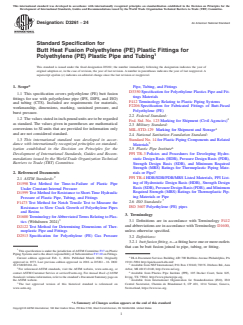
1.1 This specification covers polyethylene (PE) butt fusion fittings for use with polyethylene pipe (IPS, DIPS, and ISO) and tubing (CTS). Included are requirements for materials, workmanship, dimensions, marking, sustained pressure, and burst pressure.
1.2 The values stated in inch-pound units are to be regarded as standard. The values given in parentheses are mathematical conversions to SI units that are provided for information only and are not considered standard.
1.3 This international standard was developed in accordance with internationally recognized principles on standardization established in the Decision on Principles for the Development of International Standards, Guides and Recommendations issued by the World Trade Organization Technical Barriers to Trade (TBT) Committee.
- Status
- Published
- Publication Date
- 31-Jan-2024
- Technical Committee
- F17 - Plastic Piping Systems
- Drafting Committee
- F17.10 - Fittings
Buy Documents
ASTM D3261-24 - Standard Specification for Butt Heat Fusion Polyethylene (PE) Plastic Fittings for Polyethylene (PE) Plastic Pipe and Tubing
REDLINE ASTM D3261-24 - Standard Specification for Butt Heat Fusion Polyethylene (PE) Plastic Fittings for Polyethylene (PE) Plastic Pipe and Tubing
Overview
ASTM D3261-24 is the standard specification developed by ASTM International for butt heat fusion polyethylene (PE) plastic fittings designed for use with polyethylene (PE) plastic pipe and tubing. The standard establishes the essential requirements for materials, construction, dimensions, marking, and performance characteristics, specifically covering fittings intended to be joined by butt fusion with polyethylene pipes and tubing conforming to IPS, DIPS, ISO, and CTS sizing systems.
These fittings are widely used in piping systems for the distribution of water, gas, and other fluids, where strength, reliability, and long service life are critical. Compliance with ASTM D3261 ensures that fittings meet quality and safety expectations, supporting both regulatory requirements and industry best practices across a variety of sectors.
Key Topics
Material Requirements: Specifies the use of polyethylene compounds that comply with ASTM D3350, ensuring suitable density, melt index, flexural modulus, tensile strength, and resistance to slow crack growth. Materials must be properly stabilized against UV exposure and may include acceptable rework material from in-house production.
Workmanship and Dimensions: Fittings must be homogeneous, free of defects, and meet precise dimensional tolerances in accordance with applicable tables and test methods, such as ASTM D2122.
Pressure Performance: Fittings are required to pass stringent sustained pressure and burst pressure tests, confirming that they perform at or above the pressure requirements for the specific pipes or tubing systems with which they are used.
Marking and Identification: Each fitting must be marked with the designation "ASTM D3261", manufacturer’s identification, material designation, date of manufacture or code, and size. Marking methods must not compromise the required wall thickness.
Sampling and Quality Assurance: Manufacturers must perform regular sampling and testing to demonstrate compliance with the standard, and provisions are included for third-party verification, particularly where regulatory or military purchasing is involved.
Potable Water Compliance: For products used in potable water systems, additional certifications, such as ANSI/NSF 61 or the health effects requirements of NSF Standard 14, may be required when specified by regulatory authorities.
Applications
ASTM D3261 butt heat fusion PE fittings are essential components in:
- Municipal Water Distribution: Used for connecting, branching, or changing direction in potable water supply pipelines.
- Natural Gas and Petroleum Gas Systems: When combined with compliance to ASTM D2513, suitable for gas distribution networks.
- Irrigation Systems: Ideal for agricultural and landscape irrigation due to resistance to corrosion and chemicals.
- Industrial Piping: Used in various industrial fluids and chemical transfer applications due to the durability of PE.
- Construction and Plumbing: For both residential and commercial installations requiring reliable plastic piping systems.
The butt fusion joining method provides a homogenous, leak-resistant joint, making ASTM D3261 fittings a preferred choice for long-term performance in demanding environments.
Related Standards
ASTM D3261-24 references and complements several other important standards, including:
- ASTM D3350: Specification for Polyethylene Plastics Pipe and Fittings Materials
- ASTM D2513: Specification for Polyethylene (PE) Gas Pressure Pipe, Tubing, and Fittings
- ASTM F2206: Specification for Fabricated Fittings of Butt-Fused Polyethylene (PE)
- ASTM D1598 & D1599: Test Methods for Time-to-Failure and Short-Term Hydraulic Pressure Resistance
- ASTM F412: Terminology Relating to Plastic Piping Systems
- NSF/ANSI Standard 14 & 61: Requirements for plastic piping components and potable water safety
- ISO 3607: International standards for polyethylene pipes
Following these standards ensures compatibility, performance, and regulatory acceptance for plastic piping systems using butt heat fusion PE fittings.
Keywords: ASTM D3261-24, polyethylene fittings, butt fusion, PE fittings, PE pipe, plastic pipe standards, piping system specification, pressure testing, potable water fittings, ASTM plastic fittings, IPS, DIPS, CTS, ISO pipe sizes, plastic pipe jointing, PE material standards.
Relations
- Effective Date
- 01-Feb-2024
- Effective Date
- 01-Apr-2024
- Effective Date
- 01-Jul-2023
- Effective Date
- 01-Feb-2024
- Referred By
ASTM F905-04(2022) - Standard Practice for Qualification of Polyethylene Saddle-Fused Joints - Effective Date
- 01-Feb-2024
- Effective Date
- 01-Feb-2024
- Effective Date
- 01-Feb-2024
- Referred By
ASTM F2206-19 - Standard Specification for Fabricated Fittings of Butt-Fused Polyethylene (PE) - Effective Date
- 01-Feb-2024
- Effective Date
- 01-Feb-2024
- Effective Date
- 01-Feb-2024
- Referred By
ASTM F2619/F2619M-20 - Standard Specification for High-Density Polyethylene (PE) Line Pipe - Effective Date
- 01-Feb-2024
- Referred By
ASTM D2513-20 - Standard Specification for Polyethylene (PE) Gas Pressure Pipe, Tubing, and Fittings - Effective Date
- 01-Feb-2024
Buy Documents
ASTM D3261-24 - Standard Specification for Butt Heat Fusion Polyethylene (PE) Plastic Fittings for Polyethylene (PE) Plastic Pipe and Tubing
REDLINE ASTM D3261-24 - Standard Specification for Butt Heat Fusion Polyethylene (PE) Plastic Fittings for Polyethylene (PE) Plastic Pipe and Tubing
Get Certified
Connect with accredited certification bodies for this standard

Institut za varilstvo d.o.o. (Welding Institute)
Slovenia's leading welding institute since 1952. ISO 3834, EN 1090, pressure equipment certification, NDT personnel, welder qualification. Only IIW Au
Sponsored listings
Frequently Asked Questions
ASTM D3261-24 is a technical specification published by ASTM International. Its full title is "Standard Specification for Butt Heat Fusion Polyethylene (PE) Plastic Fittings for Polyethylene (PE) Plastic Pipe and Tubing". This standard covers: ABSTRACT This specification covers polyethylene (PE) butt fusion fittings for use with polyethylene pipe (IPS and ISO) and tubing (CTS). Included are requirements for materials, workmanship, dimensions, marking, sustained pressure, and burst pressure. Pressure strength test shall be performed to meet the requirements prescribed. SCOPE 1.1 This specification covers polyethylene (PE) butt fusion fittings for use with polyethylene pipe (IPS, DIPS, and ISO) and tubing (CTS). Included are requirements for materials, workmanship, dimensions, marking, sustained pressure, and burst pressure. 1.2 The values stated in inch-pound units are to be regarded as standard. The values given in parentheses are mathematical conversions to SI units that are provided for information only and are not considered standard. 1.3 This international standard was developed in accordance with internationally recognized principles on standardization established in the Decision on Principles for the Development of International Standards, Guides and Recommendations issued by the World Trade Organization Technical Barriers to Trade (TBT) Committee.
ABSTRACT This specification covers polyethylene (PE) butt fusion fittings for use with polyethylene pipe (IPS and ISO) and tubing (CTS). Included are requirements for materials, workmanship, dimensions, marking, sustained pressure, and burst pressure. Pressure strength test shall be performed to meet the requirements prescribed. SCOPE 1.1 This specification covers polyethylene (PE) butt fusion fittings for use with polyethylene pipe (IPS, DIPS, and ISO) and tubing (CTS). Included are requirements for materials, workmanship, dimensions, marking, sustained pressure, and burst pressure. 1.2 The values stated in inch-pound units are to be regarded as standard. The values given in parentheses are mathematical conversions to SI units that are provided for information only and are not considered standard. 1.3 This international standard was developed in accordance with internationally recognized principles on standardization established in the Decision on Principles for the Development of International Standards, Guides and Recommendations issued by the World Trade Organization Technical Barriers to Trade (TBT) Committee.
ASTM D3261-24 is classified under the following ICS (International Classification for Standards) categories: 23.040.20 - Plastics pipes; 23.040.45 - Plastics fittings. The ICS classification helps identify the subject area and facilitates finding related standards.
ASTM D3261-24 has the following relationships with other standards: It is inter standard links to ASTM D3261-16, ASTM F1473-24, ASTM F1473-23, ASTM F645-18b, ASTM F905-04(2022), ASTM F2769-24, ASTM F2880-21, ASTM F2206-19, ASTM F2623-24e1, ASTM F412-23, ASTM F2619/F2619M-20, ASTM D2513-20. Understanding these relationships helps ensure you are using the most current and applicable version of the standard.
ASTM D3261-24 is available in PDF format for immediate download after purchase. The document can be added to your cart and obtained through the secure checkout process. Digital delivery ensures instant access to the complete standard document.
Standards Content (Sample)
This international standard was developed in accordance with internationally recognized principles on standardization established in the Decision on Principles for the
Development of International Standards, Guides and Recommendations issued by the World Trade Organization Technical Barriers to Trade (TBT) Committee.
Designation: D3261 − 24 An American National Standard
Standard Specification for
Butt Heat Fusion Polyethylene (PE) Plastic Fittings for
Polyethylene (PE) Plastic Pipe and Tubing
This standard is issued under the fixed designation D3261; the number immediately following the designation indicates the year of
original adoption or, in the case of revision, the year of last revision. A number in parentheses indicates the year of last reapproval. A
superscript epsilon (´) indicates an editorial change since the last revision or reapproval.
1. Scope* Pipe, Tubing, and Fittings
D3350 Specification for Polyethylene Plastics Pipe and Fit-
1.1 This specification covers polyethylene (PE) butt fusion
tings Materials
fittings for use with polyethylene pipe (IPS, DIPS, and ISO)
F412 Terminology Relating to Plastic Piping Systems
and tubing (CTS). Included are requirements for materials,
F2206 Specification for Fabricated Fittings of Butt-Fused
workmanship, dimensions, marking, sustained pressure, and
Polyethylene (PE)
burst pressure.
2.2 Federal Standard:
1.2 The values stated in inch-pound units are to be regarded
Fed. Std. No. 123 Marking for Shipment (Civil Agencies)
as standard. The values given in parentheses are mathematical
2.3 Military Standard:
conversions to SI units that are provided for information only
MIL-STD-129 Marking for Shipment and Storage
and are not considered standard.
2.4 National Sanitation Foundation Standard:
1.3 This international standard was developed in accor- Standard No. 14 for Plastic Piping Components and Related
dance with internationally recognized principles on standard-
Materials
ization established in the Decision on Principles for the 2.5 Plastic Pipe Institute
Development of International Standards, Guides and Recom-
PPI TR-3 Policies and Procedures for Developing Hydro-
mendations issued by the World Trade Organization Technical static Design Basis (HDB), Pressure Design Basis (PDB),
Barriers to Trade (TBT) Committee.
Strength Design Basis (SDB), and Minimum Required
Strength (MRS) Ratings for Thermoplastic Piping Mate-
2. Referenced Documents
rials or Pipe7
PPI TR-4 HDB/SDB/PDB/MRS Listed Materials, PPI List-
2.1 ASTM Standards:
ing of Hydrostatic Design Basis (HDB), Strength Design
D1598 Test Method for Time-to-Failure of Plastic Pipe
Basis (SDB), Pressure Design Basis (PDB), and Minimum
Under Constant Internal Pressure
Required Strength (MRS) Ratings for Thermoplastic Pip-
D1599 Test Method for Resistance to Short-Time Hydraulic
ing Materials or Pipe
Pressure of Plastic Pipe, Tubing, and Fittings
2.6 ISO Standards:
F1473 Test Method for Notch Tensile Test to Measure the
ISO 3607 Polyethylene (PE) pipes
Resistance to Slow Crack Growth of Polyethylene Pipes
and Resins
3. Terminology
D1600 Terminology for Abbreviated Terms Relating to Plas-
3.1 Definitions are in accordance with Terminology F412
tics (Withdrawn 2024)
and abbreviations are in accordance with Terminology D1600,
D2122 Test Method for Determining Dimensions of Ther-
unless otherwise specified.
moplastic Pipe and Fittings
D2513 Specification for Polyethylene (PE) Gas Pressure
3.2 Definitions:
3.2.1 butt fusion fitting, n—a fitting have one or more outlets
that can be butt fusion joined to pipe, tubing, or fitting.
This specification is under the jurisdiction of ASTM Committee F17 on Plastic
Piping Systems and is the direct responsibility of Subcommittee F17.10 on Fittings.
Current edition approved Feb. 1, 2024. Published March 2024. Originally DLA Document Services Building 4/D 700 Robbins Avenue Philadelphia, PA
approved in 1973. Last previous edition approved in 2016 as D3261 – 16. DOI: 19111-5094 http://quicksearch.dla.mil/
10.1520/D3261-24. Available from NSF International, P.O. Box 130140, 789 N. Dixboro Rd., Ann
For referenced ASTM standards, visit the ASTM website, www.astm.org, or Arbor, MI 48113-0140, http://www.nsf.org.
contact ASTM Customer Service at service@astm.org. For Annual Book of ASTM Available from Plastics Pipe Institute (PPI), 105 Decker Court, Suite 825,
Standards volume information, refer to the standard’s Document Summary page on Irving, TX 75062, http://www.plasticpipe.org.
the ASTM website. Available from International Organization for Standardization (ISO), ISO
The last approved version of this historical standard is referenced on Central Secretariat, Chemin de Blandonnet 8, CP 401, 1214 Vernier, Geneva,
www.astm.org. Switzerland, https://www.iso.org.
*A Summary of Changes section appears at the end of this standard
Copyright © ASTM International, 100 Barr Harbor Drive, PO Box C700, West Conshohocken, PA 19428-2959. United States
D3261 − 24
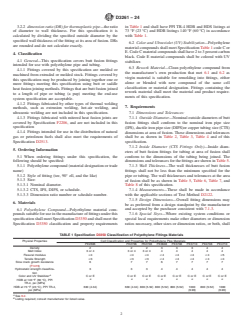
3.2.2 dimension ratio (DR) for thermoplastic pipe—the ratio in Table 1 and shall have PPI TR-4 HDB and HDS listings at
of diameter to wall thickness. For this specification it is 73 °F (23 °C) and HDB listings 140 °F (60 °C) in accordance
calculated by dividing the specified outside diameter by the with Table 1.
specified wall thickness of the fitting at its area of fusion. DRs
6.2 Color and Ultraviolet (UV) Stabilization—Polyethylene
are rounded and do not calculate exactly.
material compounds shall meet Specification Table 1 code C or
E. Code C material compounds shall have 2 to 3 percent carbon
4. Classification
black. Code E material compounds shall be colored with UV
4.1 General—This specification covers butt fusion fittings
stabilizer.
intended for use with polyethylene pipe and tubing.
6.3 Rework Material—Clean polyethylene compound from
4.1.1 Fittings covered by this specification are molded or
the manufacturer’s own production that met 6.1 and 6.2 as
machined from extruded or molded stock. Fittings covered by
virgin material is suitable for remolding into fittings, either
this specification may be produced by joining together one or
alone or blended with new compound of the same cell
more fittings meeting this specification using butt or saddle
classification or material designation. Fittings containing the
heat fusion joining methods. Fittings that are butt fusion joined
rework material shall meet the material and product require-
to a length of pipe or tubing (a pup) meeting the end-use
ments of this specification.
system specification are acceptable.
4.1.2 Fittings fabricated by other types of thermal welding
7. Requirements
methods, such as extrusion welding, hot-air welding, and
ultrasonic welding are not included in this specification.
7.1 Dimensions and Tolerances:
4.1.3 Fittings fabricated with mitered heat fusion joints are
7.1.1 Outside Diameter—Nominal outside diameters of butt
covered by Specification F2206, and are not included in this
fusion fittings shall conform to the nominal iron pipe size
specification
(IPS), ductile iron pipe size (DIPS)or copper tubing size (CTS)
4.1.4 Fittings intended for use in the distribution of natural
dimensions at area of fusion. These dimensions and tolerances
gas or petroleum fuels shall also meet the requirements of
shall be as shown in Table 2, Table 3, Table 4 and of this
Specification D2513.
specification.
7.1.2 Inside Diameter (CTS Fittings Only)—Inside diam-
5. Ordering Information
eters of butt fusion fittings for tubing at area of fusion shall
5.1 When ordering fittings under this specification, the conform to the dimensions of the tubing being joined. The
following should be specified: dimensions and tolerances for the fittings are shown in Table 5.
5.1.1 Polyethylene compound (material designation or trade
7.1.3 Wall Thickness—The wall thicknesses of butt fusion
name) fittings shall not be less than the minimum specified for the
5.1.2 Style of fitting (tee, 90° ell, and the like)
pipe or tubing. The wall thicknesses and tolerances at the area
5.1.3 Size: of fusion shall be as shown in Table 5, Table 6, Table 7, and
5.1.3.1 Nominal diameter.
Table 8 of this specification.
5.1.3.2 CTS, IPS, DIPS, or schedule.
7.1.4 Measurements—These shall be made in accordance
5.1.3.3 Dimension ratio number or schedule number.
with the applicable sections of Test Method D2122.
7.1.5 Design Dimensions—Overall fitting dimensions may
6. Materials
be as preferred from a design standpoint by the manufacturer
6.1 Polyethylene Compound—Polyethylene material com- and accepted by the purchaser consistent with 7.1.3.
pounds suitable for use in the manufacture of fittings under this
7.1.6 Special Sizes—Where existing system conditions or
specification shall meet Specification D3350 and shall meet the special local requirements make other diameters or dimension
Specification D3350 classification and property requirements ratios necessary, other sizes or dimension ratios, or both, shall
TABLE 1 Specification D3350 Classification of Polyethylene Fittings Materials
Physical Properties Cell Classification and Properties for Polyethylene Pipe Materials
PE2606 PE2706 PE2708 PE3608 PE3708 PE3710 PE4708 PE4710
Density 2 2 2 3 3 3 4 4
Melt Index 3 or 4 3 or 4 3 or 4 4 4 4 4 4
Flexural modulus $4 $4 $4 $4 $4 $4 $4 $5
Tensile Strength $3 $3 $3 $4 $4 $4 $4 $4
Slow crack growth resistance 6 7 7 6 7 7 7 7
(F1473)
Hydrostatic strength classifica- 3 3 3 4 4 4 4 4
tion
A
Color and UV Stabilizer C or E C or E C or E C or E C or E C or E C or E C or E
B B B B B B B B
HDB at 140 °F (60 °C), PPI
TR-4, psi (MPa)
HDB at 73 °F (23 °C), PPI TR-4, 630 (4.34) 630 (4.34) 800 (5.52) 800 (5.52) 800 (5.52) 1000 800 (5.52) 1000
psi (MPa) (6.90) (6.90)
A
See 6.2.
B
Listing required; consult manufacturer for listed value.
D3261 − 24
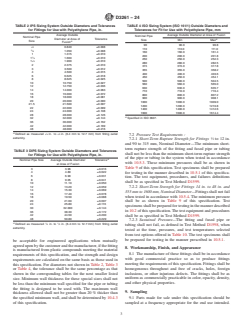
TABLE 2 IPS Sizing System Outside Diameters and Tolerances TABLE 4 ISO Sizing System (ISO 161/1) Outside Diameters and
for Fittings for Use with Polyethylene Pipe, in. Tolerances for Fit for Use with Polyethylene Pipe, mm
Average Outside Average Outside Diameter at Area of Fusion
Nominal Pipe
Nominal Pipe
Diameter at Area of Tolerance A
Size
Min Max
Size
A
Fusion
90 90.0 90.8
⁄2 0.840 ±0.008
110 110.0 111.0
⁄4 1.050 ±0.008
160 160.0 161.4
1 1.315 ±0.010
200 200.0 201.8
1 ⁄4 1.660 ±0.010
250 250.0 252.3
1 ⁄2 1.900 ±0.010
280 280.0 282.5
2 2.375 ±0.010
315 315.0 317.8
3 3.500 ±0.012
355 355.0 358.2
4 4.500 ±0.015
400 400.0 403.6
6 6.625 ±0.018
450 450.0 454.1
8 8.625 ±0.025
500 500.0 504.5
10 10.750 ±0.027
560 560.0 565.0
12 12.750 ±0.036
630 630.0 635.7
14 14.000 ±0.063
710 710.0 716.4
16 16.000 ±0.072
800 800.0 807.2
18 18.000 ±0.081
900 900.0 908.1
20 20.000 ±0.090
1000 1000.0 1009.0
21.5 21.500 ±0.097
1200 1200.0 1210.8
22 22.000 ±0.099
1400 1400.0 1412.6
24 24.000 ±0.108
1600 1600.0 1614.4
28 28.000 ±0.126
A
Specified in ISO 3607.
32 32.000 ±0.144
36 36.000 ±0.162
42 42.000 ±0.189
48 48.000 ±0.216
A 1 1
Defined as measured ⁄4 in. to ⁄2 in. (6.4 mm to 12.7 mm) from fitting outlet 7.2 Pressure Test Requirements :
extremity. 1
7.2.1 Short-Term Rupture Strength for Fittings ⁄2 to 12 in.
and 90 to 315 mm, Nominal Diameter—The minimum short-
term rupture strength of the fitting and fused pipe or tubing
TABLE 3 DIPS Sizing System Outside Diameters and Tolerances
shall not be less than the minimum short-term rupture strength
for Fittings for Use with Polyethylene Pipe, in.
of the pipe or tubing in the system when tested in accordance
A
Nominal Pipe Size Average Outside Diameter Tolerance
with 10.5.3. These minimum pressures shall be as shown in
at Area of Fusion
Table 9 of this specification. Test specimens shall be prepared
3 3.96 ±0.016
4 4.80 ±0.022 for testing in the manner described in 10.5.1 of this specifica-
6 6.90 ±0.031
tion. The test equipment, procedures, and failures definitions
8 9.05 ±0.041
shall be as specified in Test Method D1599.
10 11.10 ±0.050
12 13.20 ±0.059
7.2.2 Short-Term Strength for Fittings 14 in. to 48 in. and
14 15.30 ±0.069
355 mm to 1600 mm, Nominal Diameter—Fittings shall not fail
16 17.40 ±0.078
when tested in accordance with 10.5.4. The minimum pressure
18 19.50 ±0.088
20 21.60 ±0.097
shall be as shown in Table 9 of this specification. Test
24 25.80 ±0.116
specimens shall be prepared for testing in the manner described
30 32.000 ±0.144
in 10.2 of this specification. The test equipment and procedures
36 38.30 ±0.172
42 44.50 ±0.200
shall be as specified in Test Method D1599.
48 50.80 ±0.229
7.2.3 Sustained Pressure—The fitting and fused pipe or
A
1 1
Defined as measured ⁄4 in. to ⁄2 in. (6.4 mm to 12.7 mm) from fitting outlet
tubing shall not fail, as defined in Test Method D1598, when
extremity.
tested at the time, pressures, and test temperatures selected
from test options offered in Table 10. The test specimens shall
be prepared for testing in the manner prescribed in 10.5.1.
be acceptable for engineered applications when mutually
agreed upon by the customer and the manufacturer, if the fitting
8. Workmanship, Finish, and Appearance
is manufactured from plastic compounds meeting the material
8.1 The manufacture of these fittings shall be in accordance
requirements of this specification, and the strength and design
with good commercial practice so as to produce fittings
requirements are calculated on the same basis as those used in
meeting the requirements of this specification. Fittings shall be
this specification. For diameters not shown in Table 2, Table 3
homogeneous throughout and free of cracks, holes, foreign
or Table 4, the tolerance shall be the same percentage as that
inclusions, or other injurious defects. The fittings shall be as
shown in the corresponding tables for the next smaller listed
uniform as commercially practicable in color, opacity, density,
size. Minimum wall thickness for these special sizes shall not
and other physical properties.
be less than the minimum wall specified for the pipe or tubing
the fitting is designed to be used with. The maximum wall
9. Sampling
thickness allowed shall not be greater than 20 % thicker than
the specified minimum wall, and shall be determined by 10.4.3 9.1 Parts made for sale under this specification should be
of this specification. sampled at a frequency appropriate for the end use intended.
D3261 − 24
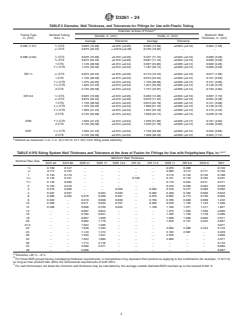
TABLE 5 Diameter, Wall Thickness, and Tolerances for Fittings for Use with Plastic Tubing
A
Diameter at Area of Fusion
Tubing Type Nominal Tubing Minimum Wall
Outside, in. (mm) Inside, in. (mm)
in. (mm) Size, in. Thickness, in. (mm)
Average Tolerance Average Tolerance
0.062 (1.57) ⁄2 CTS 0.625 (15.88) ±0.010 (±0.26) 0.495 (12.58) ±0.004 (±0.10) 0.062 (1.58)
⁄4 CTS 0.875 (22.22) ± 0.010 (±0.26) 0.745 (18.92) . .
0.090 (2.29) ⁄2 CTS 0.625 (15.88) ±0.010 (±0.26) 0.437 (11.10) ±0.004 (±0.10) 0.090 (2.28)
⁄4 CTS 0.875 (22.22) ±0.010 (±0.26) 0.687 (17.44) ±0.004 (±0.10) 0.090 (2.28)
1 CTS 1.125 (28.58) ±0.013 (±0.34) 0.937 (23.80) ±0.005 (±0.12) 0.090 (2.28)
1 ⁄4 CTS 1.375 (34.92) ±0.013 (±0.34) 1.187 (30.14) ±0.005 (±0.12) 0.090 (2.28)
DR 11 ⁄4 CTS 0.875 (22.22) ±0.010 (±0.26) 0.715 (18.16) ±0.004 (±0.10) 0.077 (1.96)
1 CTS 1.125 (28.58) ±0.013 (±0.34) 0.915 (23.24) ±0.005 (±0.12) 0.101 (2.56)
1 ⁄4 CTS 1.375 (34.92) ±0.013 (±0.34) 1.125 (28.58) ±0.005 (±0.12) 0.121 (3.08)
1 ⁄2 CTS 1.625 (41.23) ±0.013 (±0.34) 1.321 (33.55) ±0.005 (±0.12) 0.148 (3.76)
2 CTS 2.125 (53.98) ±0.013 (±0.34) 1.731 (43.97) ±0.005 (±0.12) 0.193 (4.90)
DR 9.3 ⁄2 CTS 0.625 (15.88) ±0.010 (±0.26) 0.483 (12.26) ±0.004 (±0.10) 0.067 (1.70)
⁄4 CTS 0.875 (22.22) ±0.010 (±0.26) 0.679 (17.24) ±0.004 (±0.10) 0.094 (2.38)
1 CTS 1.125 (28.58) ±0.013 (±0.34) 0.873 (22.18) ±0.005 (±0.12) 0.121 (3.08)
1 ⁄4 CTS 1.375 (34.92) ±0.013 (±0.34) 1.069 (27.16) ±0.005 (±0.12) 0.148 (3.76)
1 ⁄2 CTS 1.625 (41.23) ±0.013 (±0.34) 1.267 (32.18) ±0.005 (±0.12) 0.175 (4.45)
2 CTS 2.125 (53.98) ±0.013 (±0.34) 1.659 (42.14) ±0.005 (±0.12) 0.228 (5.79)
DR9 1 ⁄2 CTS 1.625 (41.23) ±0.013 (±0.34) 1.255 (31.85) ±0.005 (±0.12) 0.181 (4.60)
2 CTS 2.125 (53.98) ±0.013 (±0.34) 1.645 (41.78) ±0.005 (±0.12) 0.236 (5.99)
DR7 1 ⁄2 CTS 1.625 (41.23) ±0.013 (±0.34) 1.153 (29.29) ±0.005 (±0.12) 0.232 (5.89)
2 CTS 2.125 (53.98) ±0.013 (±0.34) 1.509 (38.33) ±0.005 (±0.12) 0.304 (7.72)
A
1 1
Defined as measured ⁄4 to ⁄2 in. (6.4 mm to 12.7 mm) from fitting outlet extremity.
A,B,C
TABLE 6 IPS Sizing System Wall Thickness and Tolerance at the Area of Fusion for Fittings for Use with Polyethylene Pipe, in.
Minimum Wall Thickness
Nominal Pipe Size
SCH 40 SCH 80 SDR 21 SDR 17 SDR 13.5 DR 10 DR 11.5 SDR 11 DR 9.3 SDR 9 DR7
⁄2 0.109 0.147 . . . . . 0.076 0.090 . 0.120
⁄4 0.113 0.154 . . . . . 0.095 0.113 0.117 0.150
1 0.133 0.179 . . . . . 0.119 0.142 0.146 0.188
1 ⁄4 0.140 0.191 . . . 0.166 . 0.151 0.179 0.184 0.237
1 ⁄2 0.145 0.200 . . . . . 0.173 0.204 0.211 0.271
2 0.154 0.218 . . . . . 0.216 0.256 0.264 0.339
3 0.216 0.300 . . 0.259 . 0.305 0.318 0.377 0.389 0.500
4 0.237 0.337 . 0.264 0.333 . 0.392 0.409 0.484 0.500 0.643
6 0.280 0.432 0.316 0.390 0.491 . 0.576 0.603 0.713 0.736 0.946
8 0.322 . 0.410 0.508 0.639 . 0.750 0.785 0.928 0.958 1.232
10 0.365 . 0.511 0.633 0.797 . 0.935 0.978 1.156 1.194 1.536
12 0.406 . 0.608 0.750 0.945 . 1.109 1.160 1.371 1.417 1.821
14 . . 0.667 0.824 . . . 1.273 1.505 1.556 2.000
16 . . 0.762 0.941 . . . 1.455 1.720 1.778 2.286
18 . . 0.857 1.059 . . . 1.636 1.935 2.000 2.571
20 . . 0.952 1.176 . . . 1.818 2.151 2.222 2.857
21.5 . . 1.024 1.265 . . . . . . 3.071
22 . . 1.048 1.294 . . . 2.000 2.366 2.444 3.143
24 . . 1.143 1.412 . . . 2.182 2.581 . 3.429
28 . . 1.333 1.647 . . . 2.545 . . 4.000
32 . . 1.524
...
This document is not an ASTM standard and is intended only to provide the user of an ASTM standard an indication of what changes have been made to the previous version. Because
it may not be technically possible to adequately depict all changes accurately, ASTM recommends that users consult prior editions as appropriate. In all cases only the current version
of the standard as published by ASTM is to be considered the official document.
Designation: D3261 − 16 D3261 − 24 An American National Standard
Standard Specification for
Butt Heat Fusion Polyethylene (PE) Plastic Fittings for
Polyethylene (PE) Plastic Pipe and Tubing
This standard is issued under the fixed designation D3261; the number immediately following the designation indicates the year of
original adoption or, in the case of revision, the year of last revision. A number in parentheses indicates the year of last reapproval. A
superscript epsilon (´) indicates an editorial change since the last revision or reapproval.
1. Scope*
1.1 This specification covers polyethylene (PE) butt fusion fittings for use with polyethylene pipe (IPS, DIPS, and ISO) and tubing
(CTS). Included are requirements for materials, workmanship, dimensions, marking, sustained pressure, and burst pressure.
1.2 The values stated in inch-pound units are to be regarded as standard. The values given in parentheses are mathematical
conversions to SI units that are provided for information only and are not considered standard.
1.3 This international standard was developed in accordance with internationally recognized principles on standardization
established in the Decision on Principles for the Development of International Standards, Guides and Recommendations issued
by the World Trade Organization Technical Barriers to Trade (TBT) Committee.
2. Referenced Documents
2.1 ASTM Standards:
D1598 Test Method for Time-to-Failure of Plastic Pipe Under Constant Internal Pressure
D1599 Test Method for Resistance to Short-Time Hydraulic Pressure of Plastic Pipe, Tubing, and Fittings
F1473 Test Method for Notch Tensile Test to Measure the Resistance to Slow Crack Growth of Polyethylene Pipes and Resins
D1600 Terminology for Abbreviated Terms Relating to Plastics (Withdrawn 2024)
D2122 Test Method for Determining Dimensions of Thermoplastic Pipe and Fittings
D2513 Specification for Polyethylene (PE) Gas Pressure Pipe, Tubing, and Fittings
D3350 Specification for Polyethylene Plastics Pipe and Fittings Materials
F412 Terminology Relating to Plastic Piping Systems
F2206 Specification for Fabricated Fittings of Butt-Fused Polyethylene (PE)
2.2 Federal Standard:
Fed. Std. No. 123 Marking for Shipment (Civil Agencies)
2.3 Military Standard:
MIL-STD-129 Marking for Shipment and Storage
2.4 National Sanitation Foundation Standard:
Standard No. 14 for Plastic Piping Components and Related Materials
This specification is under the jurisdiction of ASTM Committee F17 on Plastic Piping Systems and is the direct responsibility of Subcommittee F17.10 on Fittings.
Current edition approved Nov. 1, 2016Feb. 1, 2024. Published November 2016March 2024. Originally approved in 1973. Last previous edition approved in 20152016 as
D3261 – 15.D3261 – 16. DOI: 10.1520/D3261-16.10.1520/D3261-24.
For referenced ASTM standards, visit the ASTM website, www.astm.org, or contact ASTM Customer Service at service@astm.org. For Annual Book of ASTM Standards
volume information, refer to the standard’s Document Summary page on the ASTM website.
The last approved version of this historical standard is referenced on www.astm.org.
DLA Document Services Building 4/D 700 Robbins Avenue Philadelphia, PA 19111-5094 http://quicksearch.dla.mil/
Available from NSF International, P.O. Box 130140, 789 N. Dixboro Rd., Ann Arbor, MI 48113-0140, http://www.nsf.org.
*A Summary of Changes section appears at the end of this standard
Copyright © ASTM International, 100 Barr Harbor Drive, PO Box C700, West Conshohocken, PA 19428-2959. United States
D3261 − 24
2.5 Plastic Pipe Institute
PPI TR-3 Policies and Procedures for Developing Hydrostatic Design Basis (HDB), Pressure Design Basis (PDB), Strength
Design Basis (SDB), and Minimum Required Strength (MRS) Ratings for Thermoplastic Piping Materials or Pipe7
PPI TR-4 HDB/SDB/PDB/MRS Listed Materials, PPI Listing of Hydrostatic Design Basis (HDB), Strength Design Basis
(SDB), Pressure Design Basis (PDB), and Minimum Required Strength (MRS) Ratings for Thermoplastic Piping Materials
or Pipe
2.6 ISO Standards:
ISO 3607 Polyethylene (PE) pipes
3. Terminology
3.1 Definitions are in accordance with Terminology F412 and abbreviations are in accordance with Terminology D1600, unless
otherwise specified.
3.2 Definitions:
3.2.1 butt fusion fitting, n—a fitting have one or more outlets that can be butt fusion joined to pipe, tubing, or fitting.
3.2.2 dimension ratio (DR) for thermoplastic pipe—the ratio of diameter to wall thickness. For this specification it is calculated
by dividing the specified outside diameter by the specified wall thickness of the fitting at its area of fusion. DRs are rounded and
do not calculate exactly.
4. Classification
4.1 General—This specification covers butt fusion fittings intended for use with polyethylene pipe and tubing.
4.1.1 Fittings covered by this specification are molded or machined from extruded or molded stock. Fittings covered by this
specification may be produced by joining together one or more fittings meeting this specification using butt or saddle heat fusion
joining methods. Fittings that are butt fusion joined to a length of pipe or tubing (a pup) meeting the end-use system specification
are acceptable.
4.1.2 Fittings fabricated by other types of thermal welding methods, such as extrusion welding, hot-air welding, and ultrasonic
welding are not included in this specification.
4.1.3 Fittings fabricated with mitered heat fusion joints are covered by Specification F2206, and are not included in this
specification
4.1.4 Fittings intended for use in the distribution of natural gas or petroleum fuels shall also meet the requirements of Specification
D2513.
5. Ordering Information
5.1 When ordering fittings under this specification, the following should be specified:
5.1.1 Polyethylene compound (material designation or trade name)
5.1.2 Style of fitting (tee, 90° ell, and the like)
5.1.3 Size:
5.1.3.1 Nominal diameter.
5.1.3.2 CTS, IPS, DIPS, or schedule.
5.1.3.3 Dimension ratio number or schedule number.
Available from Plastics Pipe Institute (PPI), 105 Decker Court, Suite 825, Irving, TX 75062, http://www.plasticpipe.org.
Available from International Organization for Standardization (ISO), ISO Central Secretariat, Chemin de Blandonnet 8, CP 401, 1214 Vernier, Geneva, Switzerland,
https://www.iso.org.
D3261 − 24
TABLE 1 Specification D3350 Classification of Polyethylene Fittings Materials
Physical Properties Cell Classification and Properties for Polyethylene Pipe Materials
PE2606 PE2706 PE2708 PE3608 PE3708 PE3710 PE4708 PE4710
Density 2 2 2 3 3 3 4 4
Melt Index 3 or 4 3 or 4 3 or 4 4 4 4 4 4
Flexural modulus $4 $4 $4 $4 $4 $4 $4 $5
Tensile Strength $3 $3 $3 $4 $4 $4 $4 $4
Slow crack growth resistance 6 7 7 6 7 7 7 7
(F1473)
Slow crack growth resistance 6 7 7 6 7 7 7 7
(F1473)
Hydrostatic strength classifica- 3 3 3 4 4 4 4 4
tion
A
Color and UV Stabilizer C or E C or E C or E C or E C or E C or E C or E C or E
B B B B B B B B
HDB at 140°F (60°C), PPI TR-4,
psi (MPa)
B B B B B B B B
HDB at 140 °F (60 °C), PPI
TR-4, psi (MPa)
HDB at 73°F (23°C), PPI TR-4, 630 (4.34) 630 (4.34) 800 (5.52) 800 (5.52) 800 (5.52) 1000 800 (5.52) 1000
psi (MPa) (6.90) (6.90)
HDB at 73 °F (23 °C), PPI TR-4, 630 (4.34) 630 (4.34) 800 (5.52) 800 (5.52) 800 (5.52) 1000 800 (5.52) 1000
psi (MPa) (6.90) (6.90)
A
See 6.2.
B
Listing required; consult manufacturer for listed value.
6. Materials
6.1 Polyethylene Compound—Polyethylene material compounds suitable for use in the manufacture of fittings under this
specification shall meet Specification D3350 and shall meet the Specification D3350 classification and property requirements in
Table 1 and shall have PPI TR-4 HDB and HDS listings at 73°F (23°C)73 °F (23 °C) and HDB listings 140°F (60°C)140 °F
(60 °C) in accordance with Table 1.
6.2 Color and Ultraviolet (UV) Stabilization—Polyethylene material compounds shall meet Specification Table 1 code C or E.
Code C material compounds shall have 2 to 3 percent carbon black. Code E material compounds shall be colored with UV
stabilizer.
6.3 Rework Material—Clean polyethylene compound from the manufacturer’s own production that met 6.1 and 6.2 as virgin
material is suitable for remolding into fittings, either alone or blended with new compound of the same cell classification or
material designation. Fittings containing the rework material shall meet the material and product requirements of this specification.
7. Requirements
7.1 Dimensions and Tolerances:
7.1.1 Outside Diameter—Nominal outside diameters of butt fusion fittings shall conform to the nominal iron pipe size (IPS),
ductile iron pipe size (DIPS)or copper tubing size (CTS) dimensions at area of fusion. These dimensions and tolerances shall be
as shown in Table 2, Table 3, Table 4 and of this specification.
7.1.2 Inside Diameter (CTS Fittings Only)—Inside diameters of butt fusion fittings for tubing at area of fusion shall conform to
the dimensions of the tubing being joined. The dimensions and tolerances for the fittings are shown in Table 5.
7.1.3 Wall Thickness—The wall thicknesses of butt fusion fittings shall not be less than the minimum specified for the pipe or
tubing. The wall thicknesses and tolerances at the area of fusion shall be as shown in Table 5, Table 6, Table 7, and Table 8 of
this specification.
7.1.4 Measurements—These shall be made in accordance with the applicable sections of Test Method D2122 for roundable pipe.
7.1.5 Design Dimensions—Overall fitting dimensions may be as preferred from a design standpoint by the manufacturer and
accepted by the purchaser consistent with 7.1.3.
7.1.6 Special Sizes—Where existing system conditions or special local requirements make other diameters or dimension ratios
necessary, other sizes or dimension ratios, or both, shall be acceptable for engineered applications when mutually agreed upon by
D3261 − 24
TABLE 2 IPS Sizing System Outside Diameters and Tolerances
for Fittings for Use with Polyethylene Pipe, in.
Average Outside
Nominal Pipe
Diameter at Area of Tolerance
Size
A
Fusion
⁄2 0.840 ±0.008
⁄4 1.050 ±0.008
1 1.315 ±0.010
1 ⁄4 1.660 ±0.010
1 ⁄2 1.900 ±0.010
2 2.375 ±0.010
3 3.500 ±0.012
4 4.500 ±0.015
6 6.625 ±0.018
8 8.625 ±0.025
10 10.750 ±0.027
12 12.750 ±0.036
14 14.000 ±0.063
16 16.000 ±0.072
18 18.000 ±0.081
20 20.000 ±0.090
21.5 21.500 ±0.097
22 22.000 ±0.099
24 24.000 ±0.108
28 28.000 ±0.126
32 32.000 ±0.144
36 36.000 ±0.162
42 42.000 ±0.189
48 48.000 ±0.216
A
1 1
Defined as measured ⁄4 in. to ⁄2 in. (6.4 mm to 12.7 mm) from fitting outlet
extremity.
TABLE 3 DIPS Sizing System Outside Diameters and Tolerances
for Fittings for Use with Polyethylene Pipe, in.
A
Nominal Pipe Size Average Outside Diameter Tolerance
at Area of Fusion
3 3.96 ±0.016
4 4.80 ±0.022
6 6.90 ±0.031
8 9.05 ±0.041
10 11.10 ±0.050
12 13.20 ±0.059
14 15.30 ±0.069
16 17.40 ±0.078
18 19.50 ±0.088
20 21.60 ±0.097
24 25.80 ±0.116
30 32.000 ±0.144
36 38.30 ±0.172
42 44.50 ±0.200
48 50.80 ±0.229
A 1 1
Defined as measured ⁄4 in. to ⁄2 in. (6.4 to 12.7)(6.4 mm to 12.7 mm) from fitting
outlet extremity.
the customer and the manufacturer, if the fitting is manufactured from plastic compounds meeting the material requirements of this
specification, and the strength and design requirements are calculated on the same basis as those used in this specification. For
diameters not shown in Table 2, Table 3 or Table 4, the tolerance shall be the same percentage as that shown in the corresponding
tables for the next smaller listed size. Minimum wall thickness for these special sizes shall not be less than the minimum wall
specified for the pipe or tubing the fitting is designed to be used with. The maximum wall thickness allowed shall not be greater
than 20 % thicker than the specified minimum wall, and shall be determined by 10.4.3 of this specification.
7.2 Pressure Test Requirements :
7.2.1 Short-Term Rupture Strength for Fittings ⁄2 to 12 in. and 90 to 315 mm, Nominal Diameter—The minimum short-term
rupture strength of the fitting and fused pipe or tubing shall not be less than the minimum short-term rupture strength of the pipe
or tubing in the system when tested in accordance with 10.5.3. These minimum pressures shall be as shown in Table 9 of this
D3261 − 24
TABLE 4 ISO Sizing System (ISO 161/1) Outside Diameters and
Tolerances for Fit for Use with Polyethylene Pipe, mm
Average Outside Diameter at Area of Fusion
Nominal Pipe
A
Size
Min Max
90 90.0 90.8
110 110.0 111.0
160 160.0 161.4
200 200.0 201.8
250 250.0 252.3
280 280.0 282.5
315 315.0 317.8
355 355.0 358.2
400 400.0 403.6
450 450.0 454.1
500 500.0 504.5
560 560.0 565.0
630 630.0 635.7
710 710.0 716.4
800 800.0 807.2
900 900.0 908.1
1000 1000.0 1009.0
1200 1200.0 1210.8
1400 1400.0 1412.6
1600 1600.0 1614.4
A
Specified in ISO 3607.
specification. Test specimens shall be prepared for testing in the manner described in 10.5.1 of this specification. The test
equipment, procedures, and failures definitions shall be as specified in Test Method D1599.
7.2.2 Short-Term Strength for Fittings 14 in. to 48 in. and 355355 mm to 1600 mm, Nominal Diameter—Fittings shall not fail when
tested in accordance with 10.5.4. The minimum pressure shall be as shown in Table 9 of this specification. Test specimens shall
be prepared for testing in the manner described in 10.2 of this specification. The test equipment and procedures shall be as specified
in Test Method D1599.
7.2.3 Sustained Pressure—The fitting and fused pipe or tubing shall not fail, as defined in Test Method D1598, when tested at the
time, pressures, and test temperatures selected from test options offered in Table 10. The test specimens shall be prepared for testing
in the manner prescribed in 10.5.1.
8. Workmanship, Finish, and Appearance
8.1 The manufacture of these fittings shall be in accordance with good commercial practice so as to produce fittings meeting the
requirements of this specification. Fittings shall be homogeneous throughout and free of cracks, holes, foreign inclusions, or other
injurious defects. The fittings shall be as uniform as commercially practicable in color, opacity, density, and other physical
properties.
9. Sampling
9.1 Parts made for sale under this specification should be sampled at a frequency appropriate for the end use intended. When the
fittings are to be installed under a system specification (such as Specification D2513 for gas), the minimum requirements of that
specification must be satisfied.
10. Test Methods
10.1 General—The test methods in this specification cover fittings to be used with pipe and tubing for gas, water, and other
engineered piping systems. Test methods that are applicable from other specifications will be referenced in the paragraph pertaining
to the particular test. Certain special test methods applicable to this specification only are explained in the appropriate paragraph.
10.2 Conditioning—Unless otherwise specified, condition the specimens prior to test at 73.4 6 3.6°F (23 6 2°C)73.4 °F 6 3.6 °F
(23 °C 6 2 °C) for not less than 6 h in air, or 1 h in water, for those tests where conditioning is required and in all cases of
disagreement. Newly molded fittings shall be conditioned 40 h prior to test.
D3261 − 24
TABLE 5 Diameter, Wall Thickness, and Tolerances for Fittings for Use with Plastic Tubing
A
Diameter at Area of Fusion
Tubing Type Nominal Tubing Minimum Wall
Outside, in. (mm) Inside, in. (mm)
in. (mm) Size, in. Thickness, in. (mm)
Average Tolerance Average Tolerance
0.062 (1.57) ⁄2 CTS 0.625 (15.88) ±0.010 (±0.26) 0.495 (12.58) ±0.004 (±0.10) 0.062 (1.58)
⁄4 CTS 0.875 (22.22) ± 0.010 (±0.26) 0.745 (18.92) . .
0.090 (2.29) ⁄2 CTS 0.625 (15.88) ±0.010 (±0.26) 0.437 (11.10) ±0.004 (±0.10) 0.090 (2.28)
⁄4 CTS 0.875 (22.22) ±0.010 (±0.26) 0.687 (17.44) ±0.004 (±0.10) 0.090 (2.28)
1 CTS 1.125 (28.58) ±0.013 (±0.34) 0.937 (23.80) ±0.005 (±0.12) 0.090 (2.28)
1 ⁄4 CTS 1.375 (34.92) ±0.013 (±0.34) 1.187 (30.14) ±0.005 (±0.12) 0.090 (2.28)
DR 11 ⁄4 CTS 0.875 (22.22) ±0.010 (±0.26) 0.715 (18.16) ±0.004 (±0.10) 0.077 (1.96)
1 CTS 1.125 (28.58) ±0.013 (±0.34) 0.915 (23.24) ±0.005 (±0.12) 0.101 (2.56)
1 ⁄4 CTS 1.375 (34.92) ±0.013 (±0.34) 1.125 (28.58) ±0.005 (±0.12) 0.121 (3.08)
1 ⁄2 CTS 1.625 (41.23) ±0.013 (±0.34) 1.321 (33.55) ±0.005 (±0.12) 0.148 (3.76)
2 CTS 2.125 (53.98) ±0.013 (±0.34) 1.731 (43.97) ±0.005 (±0.12) 0.193 (4.90)
DR 9.3 ⁄2 CTS 0.625 (15.88) ±0.010 (±0.26) 0.483 (12.26) ±0.004 (±0.10) 0.067 (1.70)
⁄4 CTS 0.875 (22.22) ±0.010 (±0.26) 0.679 (17.24) ±0.004 (±0.10) 0.094 (2.38)
1 CTS 1.125 (28.58) ±0.013 (±0.34) 0.873 (22.18) ±0.005 (±0.12) 0.121 (3.08)
1 ⁄4 CTS 1.375 (34.92) ±0.013 (±0.34) 1.069 (27.16) ±0.005 (±0.12) 0.148 (3.76)
1 ⁄2 CTS 1.625 (41.23) ±0.013 (±0.34) 1.267 (32.18) ±0.005 (±0.12) 0.175 (4.45)
2 CTS 2.125 (53.98) ±0.013 (±0.34) 1.659 (42.14) ±0.005 (±0.12) 0.228 (5.79)
DR9 1 ⁄2 CTS 1.625 (41.23) ±0.013 (±0.34) 1.255 (31.85) ±0.005 (±0.12) 0.181 (4.60)
2 CTS 2.125 (53.98) ±0.013 (±0.34) 1.645 (41.78) ±0.005 (±0.12) 0.236 (5.99)
DR7 1 ⁄2 CTS 1.625 (41.23) ±0.013 (±0.34) 1.153 (29.29) ±0.005 (±0.12) 0.232 (5.89)
2 CTS 2.125 (53.98) ±0.013 (±0.34) 1.509 (38.33) ±0.005 (±0.12) 0.304 (7.72)
A 1 1
Defined as measured ⁄4 to ⁄2 in. (6.4(6.4 mm to 12.7 mm) from fitting outlet extremity.
A,B,C
TABLE 6 IPS Sizing System Wall Thickness and Tolerance at the Area of Fusion for Fittings for Use with Polyethylene Pipe, in.
Minimum Wall Thickness
Nominal Pipe Size
SCH 40 SCH 80 SDR 21 SDR 17 SDR 13.5 DR 10 DR 11.5 SDR 11 DR 9.3 SDR 9 DR7
⁄2 0.109 0.147 . . . . . 0.076 0.090 . 0.120
⁄4 0.113 0.154 . . . . . 0.095 0.113 0.117 0.150
1 0.133 0.179 . . . . . 0.119 0.142 0.146 0.188
1 ⁄4 0.140 0.191 . . . 0.166 . 0.151 0.179 0.184 0.237
1 ⁄2 0.145 0.200 . . . . . 0.173 0.204 0.211 0.271
2 0.154 0.218 . . . . . 0.216 0.256 0.264 0.339
3 0.216 0.300 . . 0.259 . 0.305 0.318 0.377 0.389 0.500
4 0.237 0.337 . 0.264 0.333 .
...