

ASTM F645-18b
(Guide)Standard Guide for Selection, Design, and Installation of Thermoplastic Water- Pressure Piping Systems
General Information
- Abstract
SIGNIFICANCE AND USE
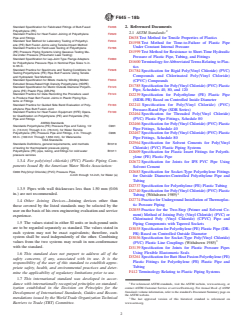
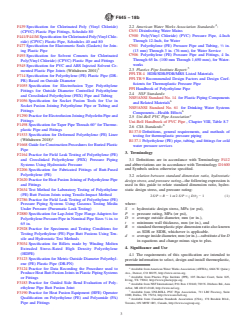
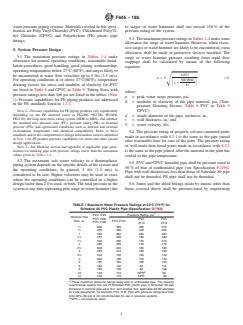
4.1 The requirements of this specification are intended to provide information to select, design and install thermoplastic, water-pressure piping systems. Materials covered in this specification are Poly(Vinyl Chloride) (PVC), Chlorinated Poly(Vinyl Chloride) (CPVC) and Polyethylene (PE) plastic pipe fittings.
SCOPE
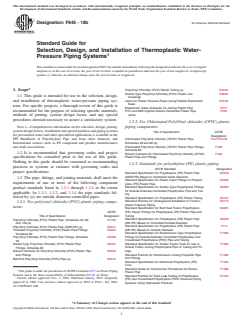
1.1 This guide is intended for use in the selection, design, and installation of thermoplastic water-pressure piping systems. For specific projects, a thorough review of this guide is recommended for the purpose of selecting specific materials, methods of joining, system design factor, and any special procedures deemed necessary to assure a satisfactory system.
Note 1: Comprehensive information on the selection, design, joining, system design factors, installation and special products and piping systems for pressurized water and other specialized applications is available in the PPI Handbook of Polyethylene Pipe and from other domestic and International sources such as PE compound and product manufacturers and trade associations.
1.2 It is recommended that governing codes and project specifications be consulted prior to the use of this guide. Nothing in this guide should be construed as recommending practices or systems at variance with governing codes and project specifications.
1.3 The pipe, fittings, and joining materials shall meet the requirements of one or more of the following component product standards listed in 1.3.1 through 1.3.4 to the extent applicable. In 1.3.1, 1.3.2, and 1.3.4 the pipe standards followed by (a) are outside diameter-controlled pipes.
1.3.1 For poly(vinyl chloride) (PVC) plastic piping components:
Title of Specification
ASTM
Designation
Poly(Vinyl Chloride) (PVC) Plastic Pipe, Schedules 40, 80
and 120 (a)
D1785
Poly(Vinyl Chloride) (PVC) Plastic Pipe (SDR-PR) (a)
D2241
Threaded Poly(Vinyl Chloride) (PVC) Plastic Pipe Fittings,
Schedule 80
D2464
Poly(Vinyl Chloride) (PVC) Plastic Pipe Fittings, Schedule
40
D2466
Socket-Type Poly(Vinyl Chloride) (PVC) Plastic Pipe
Fittings, Schedule 80
D2467
Solvent Cements for Poly(Vinyl Chloride) (PVC) Plastic Pipe
and Fittings
D2564
Bell-End Poly(Vinyl Chloride) (PVC) Pipe (a)
D2672
Poly(Vinyl Chloride) (PVC) Plastic Tubing (a)
D2740
Socket-Type Poly(Vinyl Chloride) (PVC) Plastic Line
Couplings
D3036
Joints for Plastic Pressure Pipes Using Flexible Elastomeric
Seals
D3139
Elastomeric Seals (Gaskets) for Joining Plastic Pipe
F477
PVC and ABS Injected Solvent Cemented Plastic Pipe
Joints
F545
1.3.2 For Chlorinated Poly(Vinyl chloride) (CPVC) plastic piping components:
Title of Specification
ASTM
Designation
Chlorinated Poly(Vinyl chloride) (CPVC) Plastic Pipe, Schedules 40 and 80 (a)
F441/F441M
Chlorinated Poly(Vinyl chloride) (CPVC) Plastic Pipe Fittings, Schedule 80
F439
Solvent Cements for Chlorinated Poly(Vinyl chloride) (CPVC) Plastic Pipe and Fittings
F493
1.3.3 Standards for polyethylene (PE) plastic piping:
ASTM Standard
Designation
Standard Specification for Polyethylene (PE) Plastic Pipe (SIDR-PR) Based on Controlled Inside Diameter
D2239
Standard Specification for Plastic Insert Fittings for Polyethylene (PE) Plastic Pipe
D2609
Standard Specification for Socket-Type Polyethylene Fittings for Outside Diameter-Controlled Polyethylene Pipe and Tubing
D2683
Standard Specification for Polyethylene (PE) Plastic Tubing
D2737
Standard Practice for Underground Installation of Thermoplastic Pressure Piping
D2774
Standard Specification for Butt Heat Fusion Polyethylene (PE) Plastic Fittings for Polyethylene (PE) Plastic Pipe and Tubing
D3261
Standard Specification for Polyethylene (PE) Plastic Pipe (DR-PR) Based on Controlled Outside Diameter
D3035
...
- Status
- Published
- Publication Date
- 31-Oct-2018
- Technical Committee
- F17 - Plastic Piping Systems
- Drafting Committee
- F17.61 - Water
Buy Documents
ASTM F645-18b - Standard Guide for Selection, Design, and Installation of Thermoplastic Water- Pressure Piping Systems
REDLINE ASTM F645-18b - Standard Guide for Selection, Design, and Installation of Thermoplastic Water- Pressure Piping Systems
Overview
ASTM F645-18b - Standard Guide for Selection, Design, and Installation of Thermoplastic Water-Pressure Piping Systems is an internationally recognized guiding document developed by ASTM International. This standard provides comprehensive recommendations for selecting, designing, and installing thermoplastic piping systems used for water under pressure. It addresses materials such as Poly(Vinyl Chloride) (PVC), Chlorinated Poly(Vinyl Chloride) (CPVC), and Polyethylene (PE), covering essential topics to ensure reliable and code-compliant plastic pipe systems for water distribution.
Key Topics
- Material Selection: Guidance on choosing suitable thermoplastic materials-PVC, CPVC, or PE-for specific applications based on performance, durability, and compliance with relevant product standards.
- System Design: Considerations regarding pressure ratings, pipe dimension ratios (SDR), temperature corrections, and surge/water hammer management. Emphasis is placed on ensuring maximum allowable pressure and safe operational velocities.
- Installation Practices: Recommendations for joining methods (solvent cementing, heat fusion, threading, elastomeric seals) and above-ground/underground installation procedures.
- Thermal Expansion and Support: Instructions for managing thermal expansion/contraction, including the use of expansion loops, offsets, and support spacing based on system temperature and pipe properties.
- Compatibility with Codes: Advises users to review governing codes and project specifications in conjunction with the standard to ensure full regulatory compliance.
Applications
The ASTM F645-18b standard is widely used in:
- Municipal Water Supply Systems: Selection and installation of plastic pressure pipe in potable water networks.
- Commercial and Institutional Buildings: Designing interior or exterior thermoplastic water pressure piping for efficient plumbing systems.
- Irrigation and Agricultural Water Distribution: Guidance on specifying PVC, CPVC, or PE pipes for high-reliability irrigation lines.
- Industrial Water Transport: Support for special design factors, elevated temperature requirements, and safe chemical compatibility in industrial water applications.
- Utilities and Infrastructure Upgrades: Standardized approach for upgrading or extending existing water supply infrastructure using plastic piping.
Practical Value: By following ASTM F645-18b, designers and installers can ensure:
- Reliable water pressure performance
- Appropriate material and product selection
- Proper joint integrity through approved joining techniques
- Long-term durability, even under elevated temperatures or surge conditions
- Compliance with both ASTM component standards and local codes
Related Standards
ASTM F645-18b references and aligns with a broad range of component product standards for pipes and fittings, including but not limited to:
- PVC Pipe and Fittings:
- ASTM D1785, D2241, D2464, D2466, D2564, D2672, D3139, F477
- CPVC Pipe and Fittings:
- ASTM F439, F441, F493
- Polyethylene (PE) Pipe and Fittings:
- ASTM D2239, D2609, D2683, D2737, D2774, D3035, F714, F1055, F2620
- Referenced Organization Standards:
- AWWA C900, C901, C906 (American Water Works Association)
- CSA B137.0, B137.1 (Canadian Standards Association)
- NSF/ANSI 14, 61 (NSF International)
Additional Resources: For advanced design, joining, and installation methods, consult the Plastics Pipe Institute (PPI) Handbook of Polyethylene Pipe and manufacturer/trade association guidance.
Conclusion
ASTM F645-18b serves as a critical resource for professionals specifying and installing thermoplastic water-pressure piping systems. Its guidelines help maximize system performance, safety, and regulatory compliance, contributing to robust and long-lasting water infrastructure using PVC, CPVC, and PE pipes and fittings.
Relations
- Effective Date
- 01-Nov-2018
- Effective Date
- 01-Apr-2024
- Effective Date
- 01-Apr-2024
- Effective Date
- 01-Apr-2024
- Effective Date
- 01-Feb-2024
- Effective Date
- 01-Feb-2024
- Effective Date
- 01-Nov-2023
- Effective Date
- 01-Sep-2023
- Effective Date
- 01-Aug-2020
- Effective Date
- 01-Aug-2020
- Effective Date
- 01-Aug-2020
- Effective Date
- 01-Aug-2020
- Effective Date
- 01-Jun-2020
- Effective Date
- 01-Apr-2020
- Effective Date
- 15-Jan-2020
Buy Documents
ASTM F645-18b - Standard Guide for Selection, Design, and Installation of Thermoplastic Water- Pressure Piping Systems
REDLINE ASTM F645-18b - Standard Guide for Selection, Design, and Installation of Thermoplastic Water- Pressure Piping Systems
Get Certified
Connect with accredited certification bodies for this standard

Institut za varilstvo d.o.o. (Welding Institute)
Slovenia's leading welding institute since 1952. ISO 3834, EN 1090, pressure equipment certification, NDT personnel, welder qualification. Only IIW Au
Sponsored listings
Frequently Asked Questions
ASTM F645-18b is a guide published by ASTM International. Its full title is "Standard Guide for Selection, Design, and Installation of Thermoplastic Water- Pressure Piping Systems". This standard covers: SIGNIFICANCE AND USE 4.1 The requirements of this specification are intended to provide information to select, design and install thermoplastic, water-pressure piping systems. Materials covered in this specification are Poly(Vinyl Chloride) (PVC), Chlorinated Poly(Vinyl Chloride) (CPVC) and Polyethylene (PE) plastic pipe fittings. SCOPE 1.1 This guide is intended for use in the selection, design, and installation of thermoplastic water-pressure piping systems. For specific projects, a thorough review of this guide is recommended for the purpose of selecting specific materials, methods of joining, system design factor, and any special procedures deemed necessary to assure a satisfactory system. Note 1: Comprehensive information on the selection, design, joining, system design factors, installation and special products and piping systems for pressurized water and other specialized applications is available in the PPI Handbook of Polyethylene Pipe and from other domestic and International sources such as PE compound and product manufacturers and trade associations. 1.2 It is recommended that governing codes and project specifications be consulted prior to the use of this guide. Nothing in this guide should be construed as recommending practices or systems at variance with governing codes and project specifications. 1.3 The pipe, fittings, and joining materials shall meet the requirements of one or more of the following component product standards listed in 1.3.1 through 1.3.4 to the extent applicable. In 1.3.1, 1.3.2, and 1.3.4 the pipe standards followed by (a) are outside diameter-controlled pipes. 1.3.1 For poly(vinyl chloride) (PVC) plastic piping components: Title of Specification ASTM Designation Poly(Vinyl Chloride) (PVC) Plastic Pipe, Schedules 40, 80 and 120 (a) D1785 Poly(Vinyl Chloride) (PVC) Plastic Pipe (SDR-PR) (a) D2241 Threaded Poly(Vinyl Chloride) (PVC) Plastic Pipe Fittings, Schedule 80 D2464 Poly(Vinyl Chloride) (PVC) Plastic Pipe Fittings, Schedule 40 D2466 Socket-Type Poly(Vinyl Chloride) (PVC) Plastic Pipe Fittings, Schedule 80 D2467 Solvent Cements for Poly(Vinyl Chloride) (PVC) Plastic Pipe and Fittings D2564 Bell-End Poly(Vinyl Chloride) (PVC) Pipe (a) D2672 Poly(Vinyl Chloride) (PVC) Plastic Tubing (a) D2740 Socket-Type Poly(Vinyl Chloride) (PVC) Plastic Line Couplings D3036 Joints for Plastic Pressure Pipes Using Flexible Elastomeric Seals D3139 Elastomeric Seals (Gaskets) for Joining Plastic Pipe F477 PVC and ABS Injected Solvent Cemented Plastic Pipe Joints F545 1.3.2 For Chlorinated Poly(Vinyl chloride) (CPVC) plastic piping components: Title of Specification ASTM Designation Chlorinated Poly(Vinyl chloride) (CPVC) Plastic Pipe, Schedules 40 and 80 (a) F441/F441M Chlorinated Poly(Vinyl chloride) (CPVC) Plastic Pipe Fittings, Schedule 80 F439 Solvent Cements for Chlorinated Poly(Vinyl chloride) (CPVC) Plastic Pipe and Fittings F493 1.3.3 Standards for polyethylene (PE) plastic piping: ASTM Standard Designation Standard Specification for Polyethylene (PE) Plastic Pipe (SIDR-PR) Based on Controlled Inside Diameter D2239 Standard Specification for Plastic Insert Fittings for Polyethylene (PE) Plastic Pipe D2609 Standard Specification for Socket-Type Polyethylene Fittings for Outside Diameter-Controlled Polyethylene Pipe and Tubing D2683 Standard Specification for Polyethylene (PE) Plastic Tubing D2737 Standard Practice for Underground Installation of Thermoplastic Pressure Piping D2774 Standard Specification for Butt Heat Fusion Polyethylene (PE) Plastic Fittings for Polyethylene (PE) Plastic Pipe and Tubing D3261 Standard Specification for Polyethylene (PE) Plastic Pipe (DR-PR) Based on Controlled Outside Diameter D3035 ...
SIGNIFICANCE AND USE 4.1 The requirements of this specification are intended to provide information to select, design and install thermoplastic, water-pressure piping systems. Materials covered in this specification are Poly(Vinyl Chloride) (PVC), Chlorinated Poly(Vinyl Chloride) (CPVC) and Polyethylene (PE) plastic pipe fittings. SCOPE 1.1 This guide is intended for use in the selection, design, and installation of thermoplastic water-pressure piping systems. For specific projects, a thorough review of this guide is recommended for the purpose of selecting specific materials, methods of joining, system design factor, and any special procedures deemed necessary to assure a satisfactory system. Note 1: Comprehensive information on the selection, design, joining, system design factors, installation and special products and piping systems for pressurized water and other specialized applications is available in the PPI Handbook of Polyethylene Pipe and from other domestic and International sources such as PE compound and product manufacturers and trade associations. 1.2 It is recommended that governing codes and project specifications be consulted prior to the use of this guide. Nothing in this guide should be construed as recommending practices or systems at variance with governing codes and project specifications. 1.3 The pipe, fittings, and joining materials shall meet the requirements of one or more of the following component product standards listed in 1.3.1 through 1.3.4 to the extent applicable. In 1.3.1, 1.3.2, and 1.3.4 the pipe standards followed by (a) are outside diameter-controlled pipes. 1.3.1 For poly(vinyl chloride) (PVC) plastic piping components: Title of Specification ASTM Designation Poly(Vinyl Chloride) (PVC) Plastic Pipe, Schedules 40, 80 and 120 (a) D1785 Poly(Vinyl Chloride) (PVC) Plastic Pipe (SDR-PR) (a) D2241 Threaded Poly(Vinyl Chloride) (PVC) Plastic Pipe Fittings, Schedule 80 D2464 Poly(Vinyl Chloride) (PVC) Plastic Pipe Fittings, Schedule 40 D2466 Socket-Type Poly(Vinyl Chloride) (PVC) Plastic Pipe Fittings, Schedule 80 D2467 Solvent Cements for Poly(Vinyl Chloride) (PVC) Plastic Pipe and Fittings D2564 Bell-End Poly(Vinyl Chloride) (PVC) Pipe (a) D2672 Poly(Vinyl Chloride) (PVC) Plastic Tubing (a) D2740 Socket-Type Poly(Vinyl Chloride) (PVC) Plastic Line Couplings D3036 Joints for Plastic Pressure Pipes Using Flexible Elastomeric Seals D3139 Elastomeric Seals (Gaskets) for Joining Plastic Pipe F477 PVC and ABS Injected Solvent Cemented Plastic Pipe Joints F545 1.3.2 For Chlorinated Poly(Vinyl chloride) (CPVC) plastic piping components: Title of Specification ASTM Designation Chlorinated Poly(Vinyl chloride) (CPVC) Plastic Pipe, Schedules 40 and 80 (a) F441/F441M Chlorinated Poly(Vinyl chloride) (CPVC) Plastic Pipe Fittings, Schedule 80 F439 Solvent Cements for Chlorinated Poly(Vinyl chloride) (CPVC) Plastic Pipe and Fittings F493 1.3.3 Standards for polyethylene (PE) plastic piping: ASTM Standard Designation Standard Specification for Polyethylene (PE) Plastic Pipe (SIDR-PR) Based on Controlled Inside Diameter D2239 Standard Specification for Plastic Insert Fittings for Polyethylene (PE) Plastic Pipe D2609 Standard Specification for Socket-Type Polyethylene Fittings for Outside Diameter-Controlled Polyethylene Pipe and Tubing D2683 Standard Specification for Polyethylene (PE) Plastic Tubing D2737 Standard Practice for Underground Installation of Thermoplastic Pressure Piping D2774 Standard Specification for Butt Heat Fusion Polyethylene (PE) Plastic Fittings for Polyethylene (PE) Plastic Pipe and Tubing D3261 Standard Specification for Polyethylene (PE) Plastic Pipe (DR-PR) Based on Controlled Outside Diameter D3035 ...
ASTM F645-18b is classified under the following ICS (International Classification for Standards) categories: 23.040.20 - Plastics pipes. The ICS classification helps identify the subject area and facilitates finding related standards.
ASTM F645-18b has the following relationships with other standards: It is inter standard links to ASTM F645-18a, ASTM D2241-24, ASTM F439-24, ASTM D2609-24, ASTM F714-24, ASTM D3261-24, ASTM F3124-23a, ASTM D2464-23, ASTM D2241-20, ASTM D2467-20, ASTM D2855-20, ASTM D2564-20, ASTM F1533-20, ASTM F412-20, ASTM D1784-20. Understanding these relationships helps ensure you are using the most current and applicable version of the standard.
ASTM F645-18b is available in PDF format for immediate download after purchase. The document can be added to your cart and obtained through the secure checkout process. Digital delivery ensures instant access to the complete standard document.
Standards Content (Sample)
This international standard was developed in accordance with internationally recognized principles on standardization established in the Decision on Principles for the
Development of International Standards, Guides and Recommendations issued by the World Trade Organization Technical Barriers to Trade (TBT) Committee.
Designation: F645 − 18b An American National Standard
Standard Guide for
Selection, Design, and Installation of Thermoplastic Water-
Pressure Piping Systems
ThisstandardisissuedunderthefixeddesignationF645;thenumberimmediatelyfollowingthedesignationindicatestheyearoforiginal
adoptionor,inthecaseofrevision,theyearoflastrevision.Anumberinparenthesesindicatestheyearoflastreapproval.Asuperscript
epsilon (´) indicates an editorial change since the last revision or reapproval.
1. Scope*
Poly(Vinyl Chloride) (PVC) Plastic Tubing (a) D2740
Socket-Type Poly(Vinyl Chloride) (PVC) Plastic Line D3036
1.1 This guide is intended for use in the selection, design,
Couplings
and installation of thermoplastic water-pressure piping sys- Joints for Plastic Pressure Pipes Using Flexible Elastomeric D3139
Seals
tems. For specific projects, a thorough review of this guide is
Elastomeric Seals (Gaskets) for Joining Plastic Pipe F477
recommended for the purpose of selecting specific materials,
PVC and ABS Injected Solvent Cemented Plastic Pipe F545
methods of joining, system design factor, and any special Joints
procedures deemed necessary to assure a satisfactory system.
1.3.2 For Chlorinated Poly(Vinyl chloride) (CPVC) plastic
NOTE 1—Comprehensive information on the selection, design, joining, piping components:
systemdesignfactors,installationandspecialproductsandpipingsystems
Title of Specification ASTM
for pressurized water and other specialized applications is available in the
Designation
PPI Handbook of Polyethylene Pipe and from other domestic and
Chlorinated Poly(Vinyl chloride) (CPVC) Plastic Pipe, F441/F441M
International sources such as PE compound and product manufacturers
Schedules 40 and 80 (a)
Chlorinated Poly(Vinyl chloride) (CPVC) Plastic Pipe Fittings, F439
and trade associations.
Schedule 80
1.2 It is recommended that governing codes and project
Solvent Cements for Chlorinated Poly(Vinyl chloride) (CPVC) F493
Plastic Pipe and Fittings
specifications be consulted prior to the use of this guide.
Nothing in this guide should be construed as recommending
1.3.3 Standards for polyethylene (PE) plastic piping:
practices or systems at variance with governing codes and
ASTM Standard Designation
project specifications.
Standard Specification for Polyethylene (PE) Plastic Pipe D2239
(SIDR-PR) Based on Controlled Inside Diameter
1.3 The pipe, fittings, and joining materials shall meet the
Standard Specification for Plastic Insert Fittings for Polyeth- D2609
requirements of one or more of the following component
ylene (PE) Plastic Pipe
Standard Specification for Socket-Type Polyethylene Fittings D2683
product standards listed in 1.3.1 through 1.3.4 to the extent
for Outside Diameter-Controlled Polyethylene Pipe and Tub-
applicable. In 1.3.1, 1.3.2, and 1.3.4 the pipe standards fol-
ing
lowed by (a) are outside diameter-controlled pipes.
Standard Specification for Polyethylene (PE) Plastic Tubing D2737
Standard Practice for Underground Installation of Thermo- D2774
1.3.1 For poly(vinyl chloride) (PVC) plastic piping compo-
plastic Pressure Piping
nents:
Standard Specification for Butt Heat Fusion Polyethylene D3261
(PE) Plastic Fittings for Polyethylene (PE) Plastic Pipe and
ASTM
Tubing
Title of Specification Designation
Standard Specification for Polyethylene (PE) Plastic Pipe D3035
Poly(Vinyl Chloride) (PVC) Plastic Pipe, Schedules 40, 80 D1785
(DR-PR) Based on Controlled Outside Diameter
and 120 (a)
Standard Specification for Polyethylene (PE) Plastic Pipe F714
Poly(Vinyl Chloride) (PVC) Plastic Pipe (SDR-PR) (a) D2241
(DR-PR) Based on Outside Diameter
Threaded Poly(Vinyl Chloride) (PVC) Plastic Pipe Fittings, D2464
Standard Specification for Electrofusion Type Polyethylene F1055
Schedule 80
Fittings for Outside Diameter Controlled Polyethylene and
Poly(Vinyl Chloride) (PVC) Plastic Pipe Fittings, Schedule D2466
Crosslinked Polyethylene (PEX) Pipe and Tubing
Standard Specification for Socket Fusion Tools for Use in F1056
Socket-Type Poly(Vinyl Chloride) (PVC) Plastic Pipe D2467
Socket Fusion Joining Polyethylene Pipe or Tubing and Fit-
Fittings, Schedule 80
tings
Solvent Cements for Poly(Vinyl Chloride) (PVC) Plastic Pipe D2564
Standard Practice for Electrofusion Joining Polyolefin Pipe F1290
and Fittings
and Fittings
Bell-End Poly(Vinyl Chloride) (PVC) Pipe (a) D2672
Standard Specification for Deformed Polyethylene (PE) F1533
Liner
Standard Guide for Construction Procedures for Buried F1668
This guide is under the jurisdiction ofASTM Committee F17 on Plastic Piping
Plastic Pipe
Systems and is the direct responsibility of Subcommittee F17.61 on Water.
Standard Practice for Field Leak Testing of Polyethylene F2164
Current edition approved Nov. 1, 2018. Published January 2019. Originally
(PE) and Crosslinked Polyethylene (PEX) Pressure Piping
approved in 1980. Last previous edition approved in 2018 as F645–18a. DOI:
Systems Using Hydrostatic Pressure
10.1520/F0645-18B.
*A Summary of Changes section appears at the end of this standard
Copyright © ASTM International, 100 Barr Harbor Drive, PO Box C700, West Conshohocken, PA 19428-2959. United States
F645 − 18b
2. Referenced Documents
Standard Specification for Fabricated Fittings of Butt-Fused F2206
Polyethylene (PE)
2.1 ASTM Standards:
Standard Practice for Heat Fusion Joining of Polyethylene F2620
Pipe and Fittings D638Test Method for Tensile Properties of Plastics
Standard Test Method for Laboratory Testing of Polyethyl- F2634
D1598Test Method for Time-to-Failure of Plastic Pipe
ene (PE) Butt Fusion Joints using Tensile-Impact Method
Under Constant Internal Pressure
Standard Practice for Field Leak Testing of Polyethylene F2786
(PE) Pressure Piping Systems Using Gaseous Testing Me-
D1599Test Method for Resistance to Short-Time Hydraulic
dia Under Pressure (Pneumatic Leak Testing)
Pressure of Plastic Pipe, Tubing, and Fittings
Standard Specification for Lap-Joint Type Flange Adapters F2880
D1600TerminologyforAbbreviatedTermsRelatingtoPlas-
for Polyethylene Pressure Pipe in Nominal Pipe Sizes ¾ in.
to 65 in.
tics
Standard Practice for Specimens and Testing Conditions for F2928
D1784Specification for Rigid Poly(Vinyl Chloride) (PVC)
Testing Polyethylene (PE) Pipe Butt Fusions Using Tensile
Compounds and Chlorinated Poly(Vinyl Chloride)
and Hydrostatic Test Methods
Standard Specification for Billets made by Winding Molten F3034
(CPVC) Compounds
Extruded Stress-Rated High Density Polyethylene (HDPE)
D1785Specification for Poly(Vinyl Chloride) (PVC) Plastic
Standard Specification for Metric Outside Diameter Polyeth- F3123
Pipe, Schedules 40, 80, and 120
ylene (PE) Plastic Pipe (DR-PN)
Standard Practice for Data Recording the Procedure used F3124
D2239Specification for Polyethylene (PE) Plastic Pipe
to Produce Heat Butt Fusion Joints in Plastic Piping Sys-
(SIDR-PR) Based on Controlled Inside Diameter
tems or Fittings
D2241 Specification for Poly(Vinyl Chloride) (PVC)
Standard Practice for Guided Side Bend Evaluation of Poly- F3183
ethylene Pipe Butt Fusion Joint
Pressure-Rated Pipe (SDR Series)
Standard Practice for Heat Fusion Equipment (HFE) Opera- F3190
D2464Specification for Threaded Poly(Vinyl Chloride)
tor Qualification on Polyethylene (PE) and Polyamide (PA)
(PVC) Plastic Pipe Fittings, Schedule 80
Pipe and Fittings
AWWA Standards
D2466Specification for Poly(Vinyl Chloride) (PVC) Plastic
Standards Polyethylene (PE) Pressure Pipe and Tubing, 1/2 C901
Pipe Fittings, Schedule 40
in. (13 mm) Through 3 in. (76 mm), for Water Service
Polyethylene (PE) Pressure Pipe and Fittings, 4 In. Through C906 D2467Specification for Poly(Vinyl Chloride) (PVC) Plastic
65 In. (100 mm Through 1,650 mm), for Waterworks
Pipe Fittings, Schedule 80
CSA Standards
D2564Specification for Solvent Cements for Poly(Vinyl
Standards Definitions, general requirements, and methods B137.0
of testing for thermoplastic pressure piping Chloride) (PVC) Plastic Piping Systems
Polyethylene (PE) pipe, tubing, and fittings for cold water B137.1
D2609Specification for Plastic Insert Fittings for Polyeth-
pressure services
ylene (PE) Plastic Pipe
1.3.4 For poly(vinyl chloride) (PVC) Plastic Piping Com-
D2672Specification for Joints for IPS PVC Pipe Using
ponents Issued By the American Water Works Association:
Solvent Cement
C900 Poly(Vinyl Chloride) (PVC) Pressure Pipe, D2683Specification for Socket-Type Polyethylene Fittings
4-inch through 12-inch, for Water (a)
for Outside Diameter-Controlled Polyethylene Pipe and
Tubing
D2737Specification for Polyethylene (PE) Plastic Tubing
1.3.5 Pipes with wall thicknesses less than 1.50 mm (0.06
D2740Specification for Poly(Vinyl Chloride) (PVC) Plastic
in.) are not recommended. 3
Tubing (Withdrawn 1989)
D2774PracticeforUndergroundInstallationofThermoplas-
1.4 Other Joining Devices—Joining devices other than
tic Pressure Piping
those covered by the listed standards may be selected by the
D2855Practice for the Two-Step (Primer and Solvent Ce-
useronthebasisofhisownengineeringevaluationandservice
ment) Method of Joining Poly (Vinyl Chloride) (PVC) or
experience.
Chlorinated Poly (Vinyl Chloride) (CPVC) Pipe and
1.5 The values stated in either SI units or inch-pound units
Piping Components with Tapered Sockets
are to be regarded separately as standard. The values stated in
D3035SpecificationforPolyethylene(PE)PlasticPipe(DR-
each system may not be exact equivalents; therefore, each
PR) Based on Controlled Outside Diameter
system shall be used independently of the other. Combining
D3036Specification for Socket-Type Poly(Vinyl Chloride)
values from the two systems may result in non-conformance
(PVC) Plastic Line Couplings (Withdrawn 1985)
with the standard.
D3139Specification for Joints for Plastic Pressure Pipes
Using Flexible Elastomeric Seals
1.6 This standard does not purport to address all of the
D3261SpecificationforButtHeatFusionPolyethylene(PE)
safety concerns, if any, associated with its use. It is the
Plastic Fittings for Polyethylene (PE) Plastic Pipe and
responsibility of the user of this standard to establish appro-
Tubing
priate safety, health, and environmental practices and deter-
F412Terminology Relating to Plastic Piping Systems
mine the applicability of regulatory limitations prior to use.
1.7 This international standard was developed in accor-
dance with internationally recognized principles on standard-
For referenced ASTM standards, visit the ASTM website, www.astm.org, or
contact ASTM Customer Service at service@astm.org. For Annual Book of ASTM
ization established in the Decision on Principles for the
Standards volume information, refer to the standard’s Document Summary page on
Development of International Standards, Guides and Recom-
the ASTM website.
mendations issued by the World Trade Organization Technical
The last approved version of this historical standard is referenced on
Barriers to Trade (TBT) Committee. www.astm.org.
F645 − 18b
F439Specification for Chlorinated Poly (Vinyl Chloride) 2.2 American Water Works Association Standards: :
(CPVC) Plastic Pipe Fittings, Schedule 80 C651Disinfecting Water Mains
C900 Poly(Vinyl Chloride) (PVC) Pressure Pipe, 4-Inch
F441/F441MSpecificationforChlorinatedPoly(VinylChlo-
Through 12-Inch, for Water
ride) (CPVC) Plastic Pipe, Schedules 40 and 80
C901 Polyethylene (PE) Pressure Pipe and Tubing, ⁄2 in.
F477Specification for Elastomeric Seals (Gaskets) for Join-
(13 mm) Through 3 in. (76 mm), for Water Service
ing Plastic Pipe
C906 Polyethylene (PE) Pressure Pipe and Fittings, 4 In.
F493Specification for Solvent Cements for Chlorinated
Through 65 In. (100 mm Through 1,650 mm), for Water-
Poly(Vinyl Chloride) (CPVC) Plastic Pipe and Fittings
works
F545Specification for PVC and ABS Injected Solvent Ce-
2.3 Plastics Pipe Institute Report:
mented Plastic Pipe Joints (Withdrawn 2001)
PPI-TR4 HDB/SDB/PDB/MRS Listed Materials
F714Specification for Polyethylene (PE) Plastic Pipe (DR-
PPI-TR9Recommended Design Factors and Design Coef-
PR) Based on Outside Diameter
ficients for Thermoplastic Pressure Pipe
F1055Specification for Electrofusion Type Polyethylene
PPIHandbook of Polyethylene Pipe
Fittings for Outside Diameter Controlled Polyethylene
2.4 NSF Standards:
and Crosslinked Polyethylene (PEX) Pipe and Tubing
NSF/ANSI Standard No. 14 for Plastic Piping Components
F1056Specification for Socket Fusion Tools for Use in
and Related Materials
Socket Fusion Joining Polyethylene Pipe or Tubing and
NSF/ANSI Standard No. 61 for Drinking Water Systems
Fittings
Components—Health Effects
F1290PracticeforElectrofusionJoiningPolyolefinPipeand 7
2.5 Uni-Bell PVC Pipe Association
Fittings
Uni-Bell Handbook of PVC Pipe, Chapter VIII, Table 8.7
F1498SpecificationforTaperPipeThreads60°forThermo-
2.6 CSA Standards:
plastic Pipe and Fittings
B137.0Definitions, general requirements, and methods of
F1533Specification for Deformed Polyethylene (PE) Liner
testing for thermoplastic pressure piping
(Withdrawn 2018)
B137.1Polyethylene (PE) pipe, tubing, and fittings for cold
F1668Guide for Construction Procedures for Buried Plastic
water pressure services
Pipe
3. Terminology
F2164Practice for Field Leak Testing of Polyethylene (PE)
3.1 Definitions are in accordance with Terminology F412
and Crosslinked Polyethylene (PEX) Pressure Piping
and abbreviations are in accordance with Terminology D1600
Systems Using Hydrostatic Pressure
and Symbols unless otherwise specified.
F2206Specification for Fabricated Fittings of Butt-Fused
Polyethylene (PE)
3.2 relation between standard dimension ratio, hydrostatic
F2620PracticeforHeatFusionJoiningofPolyethylenePipe
design stress, and pressure rating—the following expression is
and Fittings
used in this guide to relate standard dimension ratio, hydro-
F2634Test Method for Laboratory Testing of Polyethylene
static design stress, and pressure rating:
(PE) Butt Fusion Joints using Tensile-Impact Method
2S/P 5 R 21or2 S/P 5 D/t 21 (1)
~ !
F2786Practice for Field Leak Testing of Polyethylene (PE)
where:
Pressure Piping Systems Using Gaseous Testing Media
S = hydrostatic design stress, MPa (or psi),
Under Pressure (Pneumatic Leak Testing)
P = pressure rating, MPa (or psi),
F2880Specification for Lap-Joint Type FlangeAdapters for
D = average outside diameter, mm (or in.),
PolyethylenePressurePipeinNominalPipeSizes ⁄4in.to
t = minimum wall thickness, mm (or in.), and
65 in.
R = standardthermoplasticpipedimensionratioalsoknown
F2928Practice for Specimens and Testing Conditions for
as SDR or SIDR, whichever is applicable.
Testing Polyethylene (PE) Pipe Butt Fusions Using Ten-
d = averageinsidediameter,mm(orin.)—substitutedforD
sile and Hydrostatic Test Methods
in equations and change minus sign to plus.
F3034Specification for Billets made by Winding Molten
4. Significance and Use
Extruded Stress-Rated High Density Polyethylene
(HDPE)
4.1 The requirements of this specification are intended to
F3123Specification for Metric Outside Diameter Polyethyl-
provide information to select, design and install thermoplastic,
ene (PE) Plastic Pipe (DR-PN)
F3124Practice for Data Recording the Procedure used to
Available fromAmericanWaterWorksAssociation (AWWA), 6666W. Quincy
Ave., Denver, CO 80235, http://www.awwa.org.
ProduceHeatButtFusionJointsinPlasticPipingSystems
Available from Plastics Pipe Institute (PPI), 105 Decker Court, Suite 825,
or Fittings
Irving, TX 75062, http://www.plasticpipe.org.
F3183Practice for Guided Side Bend Evaluation of Poly- 6
Available from NSF International, P.O. Box 130140, 789 N. Dixboro Rd.,Ann
Arbor, MI 48113-0140, http://www.nsf.org.
ethylene Pipe Butt Fusion Joint
Available from UNI-BELL PVC Pipe Association, 711 LBJ Freeway, Suite
F3190Practice for Heat Fusion Equipment (HFE) Operator
1000, Dallas, TX 75234, http://www.uni-bell.org
Qualification on Polyethylene (PE) and Polyamide (PA) 8
Available from Canadian Standards Association (CSA), 178 Rexdale Blvd.,
Pipe and Fittings Toronto, ON M9W 1R3, Canada, http://www.csagroup.org.
F645 − 18b
water-pressurepipingsystems.Materialscoveredinthisspeci- to surges or water hammers shall not exceed 150% of the
fication are Poly(Vinyl Chloride) (PVC), Chlorinated Poly(Vi- pressure rating of the system.
nyl Chloride) (CPVC) and Polyethylene (PE) plastic pipe
5.3 ThemaximumpressureratingsinTables1-4makesome
fittings.
allowance for surge or water hammer. However, when exces-
sivesurgesorwaterhammerarelikelytobeencountered,extra
5. System Pressure Design
allowance shall be made or protective devices installed. The
5.1 The maximum pressure ratings in Tables 1-4 make
surge or water hammer pressure resulting from rapid flow
allowance for normal operating conditions, reasonable instal-
stoppage shall be calculated by means of the following
lation procedures, good handling, good joining workmanship,
equation:
operatingtemperaturesbelow27°C(80°F),andsurgeslikelyto
4,033
be encountered at water flow velocities up to 5 ft/s (1.5 m/s).
p 5 V (2)
300000d
For operating conditions at or above 27°C(80°F), temperature
!S D
Et
derating factors for stress and modulus of elasticity for PVC
are listed in Table 6 and CPVC in Table 9. Tubing Sizes with
where:
pressure ratings less than 160 psi are listed in the tables. (Note
p = peak water surge pressure, psi,
1). Pressure capabilities for PE piping products are addressed
E = modulus of elasticity of the pipe material, psi, (Tem-
in the PE standards listed in 1.3.3.
perature Derating Factors, Table 6 PVC or Table 9
NOTE2—PressurecapabilitiesforPEpipingproductsvarysignificantly
CPVC)
depending on the PE material (such as PE2406, PE2708, PE3408,
d = inside diameter of the pipe, inclusive, in.,
PE4710), the long-term stress rating system (HDB or MRS), and whether
t = wall thickness, in., and
the standard uses pressure class (PC), pressure rating (PR), or nominal
V = water velocity, ft/s.
pressure (PN), and operational conditions such as internal and external
environment, temperature, and chemical compatibility. Refer to these
5.4 The pressure rating of properly solvent-cemented joints
standards and to the comprehensive design information sources identified
made in accordance with 8.2.1 is the same as the pipe joined
in Note 1 for PE product pressure capabilities for water and other special
after reasonable time for cure of the joint. The pressure rating
design applications.
of well-made heat-fused joints made in accordance with 8.2.1
NOTE 3—See Marking section and appendix of applicable pipe speci-
fication for marking pipe with pressure ratings lower than the maximum
isthesameasthepipejoined,afterthematerialinthejointhas
values given in Tables 1-4.
cooled to the pipe temperature.
5.2 The maximum safe water velocity in a thermoplastic
5.5 PVC and CPVC threaded pipe shall be pressure rated at
pipingsystemdependsonthespecificdetailsofthesystemand
50% of that of nonthreaded pipe (see Specification F1498).
the operating conditions. In general, 5 ft/s (1.5 m/s) is
Pipe with wall thicknesses less than those of Schedule 80 pipe
considered to be safe. Higher velocities may be used in cases
shall not be threaded. PE pipe shall not be threaded.
where the operating conditions can be controlled or a higher
designfactorthan2.0isused,orboth.Thetotalpressureinthe
5.6 Joints and the allied fittings made by means other than
systematanytime(operatingplussurgeorwaterhammer)due those covered above shall be pressure-rated by engineering
TABLE 1 Maximum Water Pressure Ratings at 23°C (73°F) for
Schedule 40 PVC Plastic Pipe (Specification D1785)
A
Pressure Rating, psi
PVC 1120
Nominal Pipe
PVC 1220
PVC PVC
Size, in.
PVC 2116
PVC 2120
2110 2112
⁄2 600 480 300 370
⁄4 480 390 240 300
1 450 360 220 280
1 ⁄4 370 290 180 230
1 ⁄2 330 260 170 210
2 280 220 140 170
2 ⁄2 300 240 150 190
3 260 210 130 160
3 ⁄2 240 190 120 150
4 220 180 110 140
5 190 160 100 120
6 180 140 90 110
8 160 120 80 100
B
10 140 110 NPR 90
12 130 110 NPR 80
A
These maximum pressure ratings apply only to unthreaded pipe. The industry
recommends against the use of threaded PVC plastic pipe in Schedule 40 wall
thickness in nominal pipe sizes 6 in. and smaller. See applicableASTM standard
forcodedesignation,forexample,PVC1120.Pipewithpressureratingslessthan
0.34 MPa (50 psi) is not recommended for use in pressure systems.
B
NPR = not pressure rated.
F645 − 18b
TABLE 2 Maximum Water Pressure Ratings at 23°C (73°F) for Schedule 80 PVC Plastic Pipe (Specification D1785)
A
Pressure Rating, psi
PVC 1120, PVC 1220, and PVC 2116 PVC 2110 PVC 2112
Nominal Pipe Size in.
PVC 2120
Unthreaded Threaded Unthreaded Threaded Unthreaded Threaded Unthreaded Threaded
⁄4 850 420 680 340 420 210 530 260
⁄4 690 340 550 280 340 170 430 210
1 630 320 500 250 320 160 390 200
1 ⁄4 520 260 420 210 260 130 320 160
1 ⁄2 470 240 380 190 240 120 290 150
2 400 200 320 160 200 100 250 130
2 ⁄2 420 210 340 170 210 110 260 130
3 370 190 300 150 190 90 230 120
3 ⁄2 350 170 280 140 170 90 220 110
4 320 160 260 130 160 80 200 100
B
5 290 140 230 120 140 NPR 180 90
6 280 140 220 110 140 NPR 170 90
8 250 120 200 100 120 NPR 150 80
10 230 120 190 90 120 NPR 150 NPR
12 230 110 180 90 110 NPR 140 NPR
A
See applicableASTM standard for code designation, for example, PVC 1120. Pressure ratings are lower at elevated temperatures. Pipe with pressure ratings less than
0.34 MPa (50 psi) is not recommended for use in pressure systems.
B
NPR, not pressure rated.
TABLE 3 Maximum Water Pressure Ratings at 23°C (73°F) for Schedule 120 PVC Plastic Pipe (Specification D1785)
A
Pressure Rating, psi
PVC 1120, PVC 2116 PVC 2110 PVC 2112
Nominal Pipe Size, PVC 1220,
PVC 2120
Unthreaded Threaded Unthreaded Threaded Unthreaded Threaded Unthreaded Threaded
⁄2 1010 510 810 410 510 250 630 320
⁄4 770 390 620 310 390 190 480 240
1 720 360 570 290 360 180 450 220
1 ⁄4 600 300 480 240 300 150 370 190
1 ⁄2 540 270 430 210 270 130 340 170
2 470 240 380 190 240 120 290 150
2 ⁄2 470 230 370 190 230 120 290 150
3 440 220 360 180 220 110 280 140
3 ⁄2 380 190 310 150 190 100 240 120
4 430 220 340 170 220 110 270 130
5 400 200 320 160 200 100 250 120
6 370 190 300 150 190 90 230 120
8 380 180 290 140 180 90 230 110
10 370 180 290 140 180 90 230 110
12 340 170 270 140 170 80 210 110
A
See applicable ASTM standard for code designation, for example, PVC 1120. Pressure ratings are lower at elevated temperatures.
evaluations and service experience by either the design engi- following are likely to be encountered: (1) surges or water
neer or user, or both. The recommendations of the manufac-
hammer, (2) cyclic pressure oscillations, (3) air pockets, (4)
turers shall also be considered (see Specification D3139).
quick-closing valves, (5) pumps with more capacity than the
lines can deliver, (6) flow velocities more than 5 ft/s (7)
5.7 Allowance shall be made for operating conditions in
operating conditions at or above 27 °C(80 °F), and (8) similar
which the water temperature will be above 27°C (80°F) under
factors or combinations of (1) through (7). This will result in
normal service conditions. Elevated temperature derating
using pipe and fittings with heavier walls. Consult manufac-
factors, design stresses and modulus of elasticity for PVC are
listed in Table 6 and CPVC in Table 9. Hydrostatic design turers for specific recommendations. Elevated operating tem-
stressesforthermoplasticpipematerialsaregiveninPPI-TR4, peraturesabove23°C(73°F)willmakethepipemoreflexible
Recommended Hydrostatic Strengths and Design Stresses for
and will lower both the short-term and long-term hydrostatic
ThermoplasticPipeandFittingsCompounds,areportissuedat
strengths. The designer of the piping system shall use any
intervals by the Plastics Pipe Institute.
additional design (safety) factors that are deemed necessary to
cover any unusual or special conditions that may be encoun-
5.8 In piping system design the selection of a design or
tered on a specific job. For PVC pipe temperature derating
safety factor depends on the operating conditions that will be
factors (stress and modulus of elasticity) see Table 6. For
encountered. It may be necessary to use pressure ratings lower
than the pressure ratings listed in Tables 1-4 when the CPVCpipetemperaturederatingfactors(stressandmodulusof
F645 − 18b
TABLE 4 Standard Thermoplastic Pipe Dimension Ratios (SDR)
and Maximum Water Pressure Ratings (PR) at 23°C (73°F) for
Nonthreaded PVC Plastic Pipe (Specification D2241)
A
PVC Pipe Materials
Standard Dimension PVC 1120,
Ratio PVC 1220, PVC 2116 PVC 2112 PVC 2110
(SDR) PVC 2120
B
Pressure Rating, psi
13.5 315 250 200 160
17 250 200 160 125
21 200 160 25 100
C
26 160 125 100 NPR
D
32.5 125 100 NPR NPR
Pressure Rating, psi Standard Dimension Ratio (SDR)
315 13.5 . . .
250 17 13.5 . .
200 21 17 13.5 .
160 26 21 17 13.5
125 32.5 26 21 17
100 NPR 32.5 26 21
A
See applicable ASTM standard for code designation, for example, PVC 1120.
B
Thesemaximumpressureratingsdonotapplytothreadedpipe.pressureratings
areloweratelevatedtemperatures.Pipewithpressureratingslessthan0.34MPa
(50 psi) is not recommended for use in pressure systems.
C
NPR = not pressure rated.
D
Available only in nominal pipe size diameters from 3 to 4 in.
TABLE 5 Thermal Expansion ∆L (in), PVC Pipe (12454)
Length of Pipe Run, L (ft)
Temp/ Change ∆T°F
10 20 30 40 50 60 70 80 90 100
30 0.11 0.22 0.32 0.43 0.54 0.65 0.76 0.86 0.97 1.08
40 0.14 0.29 0.43 0.58 0.72 0.86 1.01 1.15 1.30 1.44
50 0.18 0.36 0.54 0.72 0.90 1.08 1.26 1.40 1.62 1.80
60 0.22 0.43 0.65 0.86 1.08 1.30 1.51 1.73 1.94 2.16
70 0.25 0.50 0.76 1.01 1.26 1.51 1.76 2.02 2.27 2.52
80 0.29 0.58 0.86 1.15 1.44 1.73 2.02 2.30 2.59 2.88
90 0.32 0.65 0.97 1.30 1.62 1.94 2.27 2.59 2.92 3.24
100 0.36 0.72 1.03 1.44 1.80 2.16 2.52 2.88 3.24 3.60
TABLE 6 Temperature Derating for PVC (12454) Allowable Stress and Modulus of Elasticity
Derating Allowable Derating Modulus
Temperature
A B
Factor Stress Factor of
°F °C
Elasticity (psi)
73 (23) 1.00 2,000 1.00 400,000
80 (27) 0.88 1,760 0.97 388,000
90 (32) 0.75 1,500 0.93 372,000
100 (38) 0.62 1,240 0.88 352,000
110 (43) 0.50 1,000 0.84 336,000
120 (49) 0.40 800 0.79 316,000
130 (54) 0.30 600 0.75 300,000
140 (60) 0.22 440 0.70 280,000
A
Stress derating factors are also applied to pipe pressure ratings for elevated temperature compensation (PPI-TR 9/2002).
B
Modulus of Elasticity derating factors (Uni-Bell Handbook of PVC Pipe, 2001, Chapter VIII, table 8.7)
elasticity) see Table 9. The stress derating factor multiplied by 6. PVC System Design for Above Ground Installation
the maximum water pressure rating at 73°F will yield a new with Solvent Cemented Joints
maximum water pressure rating for a given temperature.
6.1 PVC Thermal Expansion:
5.9 Pressure surges may adversely affect the long-term 6.1.1 When designing above ground solvent cemented PVC
performance of system components and shall be kept to the piping systems, thermal expansion/contraction shall be consid-
absolute practical minimum. Where surges are anticipated due ered. Expansion/contraction along the longitudinal axis can be
to the action of pressure regulating valves, pumps, and other significant and is dependent on the coefficient of thermal
operating equipment, the manufacturer shall be consulted for expansion and the change in temperature. If the piping system
recommendations. is restrained, the thrust load generated by large diameter pipe
F645 − 18b
A,B
TABLE 7 Water-Filled PVC (12454) Pipe Support Spacing l (ft)
Schedule 40 Schedule 80
Pipe Size
73°F 100°F 140°F 73°F 100°F 140°F
1 3 1 3
⁄2 43- ⁄4 3- ⁄2 44 3- ⁄4
3 1 1 1 1
⁄4 4- ⁄4 4- ⁄4 44- ⁄4 4- ⁄4 4
3 1 1 1 1
14- ⁄4 4- ⁄2 4- ⁄4 5- ⁄2 5- ⁄4 5
1 1 3 1 3
1 ⁄4 5- ⁄4 54- ⁄4 5- ⁄2 5- ⁄4 5
1 1 1 3 1 1
1 ⁄2 5- ⁄2 5- ⁄4 55- ⁄4 5- ⁄2 5- ⁄4
1 1 1 3
26 5- ⁄4 5- ⁄2 6- ⁄4 65- ⁄4
1 1 1 1
37- ⁄4 76- ⁄2 7- ⁄2 7- ⁄4 7
3 1 1 1 3
48 7- ⁄4 7- ⁄4 8- ⁄2 8- ⁄4 7- ⁄4
1 1 3 1
69- ⁄4 98- ⁄2 10 9- ⁄4 9- ⁄4
1 1 1 3 1
810 ⁄4 10 9- ⁄2 11- ⁄4 10- ⁄4 10- ⁄4
1 3 1 1 1
10 11- ⁄4 10- ⁄4 10- ⁄4 12- ⁄2 12 11- ⁄4
3 1 1
12 12 11- ⁄4 11 13- ⁄2 13 12- ⁄4
A
TheindustryhasnotyetagreedtoaspecificnumericalvaluetouseforlongtermorcreepmodulusforPVCinbending.Theequationpresentedisthisstandardforpipe
support spacing is based on more than 35 years of historical design experience. Regardless of modulus used to calculate support spacing, some additional deflection will
occur over time
B
Support spaces (l) are rounded off.
A
TABLE 8 Thermal Expansion ∆L (in.), CPVC 4120–05 Pipe
Temp. Length of Pipe Run in Feet (L)
Change 10 20 30 40 50 60 70 80 90 100
∆T°F
30 0.12 0.24 0.37 0.49 0.61 0.73 0.86 0.98 1.10 1.22
40 0.16 0.33 0.49 0.65 0.82 0.98 1.14 1.31 1.47 1.63
50 0.20 0.41 0.61 0.82 1.02 1.22 1.43 1.63 1.84 2.04
60 0.24 0.49 0.73 0.98 1.22 1.47 1.71 1.96 2.20 2.45
70 0.29 0.57 0.86 1.14 1.43 1.71 2.00 2.28 2.57 2.86
80 0.33 0.65 0.98 1.31 1.63 1.96 2.28 2.61 2.94 3.26
90 0.37 0.73 1.10 1.47 1.84 2.20 2.57 2.94 3.30 3.67
100 0.41 0.82 1.22 1.63 2.04 2.45 2.86 3.26 3.67 4.08
A -5
Calculated using Eq 3 with the coefficient of thermal expansion for CPVC 4120-05 of 3.4 x 10 , in./in.°F
-5
TABLE 9 Temperature Derating Factors for CPVC 4120-05 (23447)
= 3.0×10 , in./in. °F
Allowable stress and Modulus of Elasticity
L = length of pipe run, ft
Temperature Derating Allowable Derating Modulus of
∆T = change in temperature, °F
A
°F (°C) Factor Stress (S) Factor Elasticity (psi)
(psi)
6.2 PVC Expansion Loops and Offset Lengths:
73 (23) 1.00 2000 1.00 423,000
6.2.1 When designing PVC piping systems with solvent
80 (27) 0.96 1920 0.98 415,000
cementedjointsinlongstraightrunsexposedtolargete
...
This document is not an ASTM standard and is intended only to provide the user of an ASTM standard an indication of what changes have been made to the previous version. Because
it may not be technically possible to adequately depict all changes accurately, ASTM recommends that users consult prior editions as appropriate. In all cases only the current version
of the standard as published by ASTM is to be considered the official document.
Designation: F645 − 18a F645 − 18b An American National Standard
Standard Guide for
Selection, Design, and Installation of Thermoplastic Water-
Pressure Piping Systems
This standard is issued under the fixed designation F645; the number immediately following the designation indicates the year of original
adoption or, in the case of revision, the year of last revision. A number in parentheses indicates the year of last reapproval. A superscript
epsilon (´) indicates an editorial change since the last revision or reapproval.
1. Scope*
1.1 This guide is intended for use in the selection, design, and installation of thermoplastic water-pressure piping systems. For
specific projects, a thorough review of this guide is recommended for the purpose of selecting specific materials, methods of
joining, system design factor, and any special procedures deemed necessary to assure a satisfactory system.
NOTE 1—Comprehensive information on the selection, design, joining, system design factors, installation and special products and piping systems for
pressurized water and other specialized applications is available in the PPI Handbook of Polyethylene Pipe and from other domestic and International
sources such as PE compound and product manufacturers and trade associations.
1.2 It is recommended that governing codes and project specifications be consulted prior to the use of this guide. Nothing in
this guide should be construed as recommending practices or systems at variance with governing codes and project specifications.
1.3 The pipe, fittings, and joining materials shall meet the requirements of one or more of the following component product
standards listed in 1.3.1 through 1.3.4 to the extent applicable. In 1.3.1, 1.3.2, and 1.3.4 the pipe standards followed by (a) are
outside diameter-controlled pipes.
1.3.1 For poly(vinyl chloride) (PVC) plastic piping components:
ASTM
Title of Specification Designation
Poly(Vinyl Chloride) (PVC) Plastic Pipe, Schedules 40, 80 D1785
and 120 (a)
Poly(Vinyl Chloride) (PVC) Plastic Pipe (SDR-PR) (a) D2241
Threaded Poly(Vinyl Chloride) (PVC) Plastic Pipe Fittings, D2464
Schedule 80
Poly(Vinyl Chloride) (PVC) Plastic Pipe Fittings, Schedule D2466
Socket-Type Poly(Vinyl Chloride) (PVC) Plastic Pipe D2467
Fittings, Schedule 80
Solvent Cements for Poly(Vinyl Chloride) (PVC) Plastic Pipe D2564
and Fittings
Bell-End Poly(Vinyl Chloride) (PVC) Pipe (a) D2672
Poly(Vinyl Chloride) (PVC) Plastic Tubing (a) D2740
Socket-Type Poly(Vinyl Chloride) (PVC) Plastic Line D3036
Couplings
Joints for Plastic Pressure Pipes Using Flexible Elastomeric D3139
Seals
Elastomeric Seals (Gaskets) for Joining Plastic Pipe F477
PVC and ABS Injected Solvent Cemented Plastic Pipe F545
Joints
1.3.2 For Chlorinated Poly(Vinyl chloride) (CPVC) plastic piping components:
Title of Specification ASTM
Designation
Chlorinated Poly(Vinyl chloride) (CPVC) Plastic Pipe, Schedules 40 and 80 (a) F441/F441M
Chlorinated Poly(Vinyl chloride) (CPVC) Plastic Pipe Fittings, Schedule 80 F439
Solvent Cements for Chlorinated Poly(Vinyl chloride) (CPVC) Plastic Pipe and Fittings F493
1.3.3 Standards for polyethylene (PE) plastic piping:
ASTM Standard Designation
This guide is under the jurisdiction of ASTM Committee F17 on Plastic Piping Systems and is the direct responsibility of Subcommittee F17.61 on Water.
Current edition approved March 1, 2018Nov. 1, 2018. Published April 2018January 2019. Originally approved in 1980. Last previous edition approved in 2018 as
F645 – 18.F645 – 18a. DOI: 10.1520/F0645-18A.10.1520/F0645-18B.
*A Summary of Changes section appears at the end of this standard
Copyright © ASTM International, 100 Barr Harbor Drive, PO Box C700, West Conshohocken, PA 19428-2959. United States
F645 − 18b
Standard Specification for Polyethylene (PE) Plastic Pipe D2239
(SIDR-PR) Based on Controlled Inside Diameter
Standard Specification for Plastic Insert Fittings for Polyeth- D2609
ylene (PE) Plastic Pipe
Standard Specification for Socket-Type Polyethylene Fittings D2683
for Outside Diameter-Controlled Polyethylene Pipe and Tub-
ing
Standard Specification for Polyethylene (PE) Plastic Tubing D2737
Standard Practice for Underground Installation of Thermo- D2774
plastic Pressure Piping
Standard Specification for Butt Heat Fusion Polyethylene D3261
(PE) Plastic Fittings for Polyethylene (PE) Plastic Pipe and
Tubing
Standard Specification for Polyethylene (PE) Plastic Pipe D3035
(DR-PR) Based on Controlled Outside Diameter
Standard Specification for Polyethylene (PE) Plastic Pipe F714
(DR-PR) Based on Outside Diameter
Standard Specification for Electrofusion Type Polyethylene F1055
Fittings for Outside Diameter Controlled Polyethylene and
Crosslinked Polyethylene (PEX) Pipe and Tubing
Standard Specification for Socket Fusion Tools for Use in F1056
Socket Fusion Joining Polyethylene Pipe or Tubing and Fit-
tings
Standard Practice for Electrofusion Joining Polyolefin Pipe F1290
and Fittings
Standard Specification for Deformed Polyethylene (PE) F1533
Liner
Standard Guide for Construction Procedures for Buried F1668
Plastic Pipe
Standard Practice for Field Leak Testing of Polyethylene F2164
(PE) and Crosslinked Polyethylene (PEX) Pressure Piping
Systems Using Hydrostatic Pressure
Standard Specification for Fabricated Fittings of Butt-Fused F2206
Polyethylene (PE)
Standard Practice for Heat Fusion Joining of Polyethylene F2620
Pipe and Fittings
Standard Test Method for Laboratory Testing of Polyethyl- F2634
ene (PE) Butt Fusion Joints using Tensile-Impact Method
Standard Practice for Field Leak Testing of Polyethylene F2786
(PE) Pressure Piping Systems Using Gaseous Testing Me-
dia Under Pressure (Pneumatic Leak Testing)
Standard Specification for Lap-Joint Type Flange Adapters F2880
for Polyethylene Pressure Pipe in Nominal Pipe Sizes ¾ in.
to 65 in.
Standard Practice for Specimens and Testing Conditions for F2928
Testing Polyethylene (PE) Pipe Butt Fusions Using Tensile
and Hydrostatic Test Methods
Standard Specification for Billets made by Winding Molten F3034
Extruded Stress-Rated High Density Polyethylene (HDPE)
Standard Specification for Metric Outside Diameter Polyeth- F3123
ylene (PE) Plastic Pipe (DR-PN)
Standard Practice for Data Recording the Procedure used F3124
to Produce Heat Butt Fusion Joints in Plastic Piping Sys-
tems or Fittings
Standard Practice for Guided Side Bend Evaluation of Poly- F3183
ethylene Pipe Butt Fusion Joint
Standard Practice for Heat Fusion Equipment (HFE) Opera- F3190
tor Qualification on Polyethylene (PE) and Polyamide (PA)
Pipe and Fittings
AWWA Standards
Standards Polyethylene (PE) Pressure Pipe and Tubing, 1/2 C901
in. (13 mm) Through 3 in. (76 mm), for Water Service
Polyethylene (PE) Pressure Pipe and Fittings, 4 In. Through C906
65 In. (100 mm Through 1,650 mm), for Waterworks
CSA Standards
Standards Definitions, general requirements, and methods B137.0
of testing for thermoplastic pressure piping
Polyethylene (PE) pipe, tubing, and fittings for cold water B137.1
pressure services
1.3.4 For poly(vinyl chloride) (PVC) Plastic Piping Components Issued By the American Water Works Association:
C900 Poly(Vinyl Chloride) (PVC) Pressure Pipe,
4-inch through 12-inch, for Water (a)
1.3.5 Pipes with wall thicknesses less than 1.50 mm (0.06 in.) are not recommended.
F645 − 18b
1.4 Other Joining Devices—Joining devices other than those covered by the listed standards may be selected by the user on the
basis of his own engineering evaluation and service experience.
1.5 The values stated in either SI units or inch-pound units are to be regarded separately as standard. The values stated in each
system may not be exact equivalents; therefore, each system shall be used independently of the other. Combining values from the
two systems may result in non-conformance with the standard.
1.6 This standard does not purport to address all of the safety concerns, if any, associated with its use. It is the responsibility
of the user of this standard to establish appropriate safety, health, and environmental practices and determine the applicability of
regulatory limitations prior to use.
1.7 This international standard was developed in accordance with internationally recognized principles on standardization
established in the Decision on Principles for the Development of International Standards, Guides and Recommendations issued
by the World Trade Organization Technical Barriers to Trade (TBT) Committee.
2. Referenced Documents
2.1 ASTM Standards:
D638 Test Method for Tensile Properties of Plastics
D1598 Test Method for Time-to-Failure of Plastic Pipe Under Constant Internal Pressure
D1599 Test Method for Resistance to Short-Time Hydraulic Pressure of Plastic Pipe, Tubing, and Fittings
D1600 Terminology for Abbreviated Terms Relating to Plastics
D1784 Specification for Rigid Poly(Vinyl Chloride) (PVC) Compounds and Chlorinated Poly(Vinyl Chloride) (CPVC)
Compounds
D1785 Specification for Poly(Vinyl Chloride) (PVC) Plastic Pipe, Schedules 40, 80, and 120
D2239 Specification for Polyethylene (PE) Plastic Pipe (SIDR-PR) Based on Controlled Inside Diameter
D2241 Specification for Poly(Vinyl Chloride) (PVC) Pressure-Rated Pipe (SDR Series)
D2464 Specification for Threaded Poly(Vinyl Chloride) (PVC) Plastic Pipe Fittings, Schedule 80
D2466 Specification for Poly(Vinyl Chloride) (PVC) Plastic Pipe Fittings, Schedule 40
D2467 Specification for Poly(Vinyl Chloride) (PVC) Plastic Pipe Fittings, Schedule 80
D2564 Specification for Solvent Cements for Poly(Vinyl Chloride) (PVC) Plastic Piping Systems
D2609 Specification for Plastic Insert Fittings for Polyethylene (PE) Plastic Pipe
D2672 Specification for Joints for IPS PVC Pipe Using Solvent Cement
D2683 Specification for Socket-Type Polyethylene Fittings for Outside Diameter-Controlled Polyethylene Pipe and Tubing
D2737 Specification for Polyethylene (PE) Plastic Tubing
D2740 Specification for Poly(Vinyl Chloride) (PVC) Plastic Tubing (Withdrawn 1989)
D2774 Practice for Underground Installation of Thermoplastic Pressure Piping
D2855 Practice for the Two-Step (Primer and Solvent Cement) Method of Joining Poly (Vinyl Chloride) (PVC) or Chlorinated
Poly (Vinyl Chloride) (CPVC) Pipe and Piping Components with Tapered Sockets
D3035 Specification for Polyethylene (PE) Plastic Pipe (DR-PR) Based on Controlled Outside Diameter
D3036 Specification for Socket-Type Poly(Vinyl Chloride) (PVC) Plastic Line Couplings (Withdrawn 1985)
D3139 Specification for Joints for Plastic Pressure Pipes Using Flexible Elastomeric Seals
D3261 Specification for Butt Heat Fusion Polyethylene (PE) Plastic Fittings for Polyethylene (PE) Plastic Pipe and Tubing
F412 Terminology Relating to Plastic Piping Systems
F439 Specification for Chlorinated Poly (Vinyl Chloride) (CPVC) Plastic Pipe Fittings, Schedule 80
F441/F441M Specification for Chlorinated Poly(Vinyl Chloride) (CPVC) Plastic Pipe, Schedules 40 and 80
F477 Specification for Elastomeric Seals (Gaskets) for Joining Plastic Pipe
F493 Specification for Solvent Cements for Chlorinated Poly(Vinyl Chloride) (CPVC) Plastic Pipe and Fittings
F545 Specification for PVC and ABS Injected Solvent Cemented Plastic Pipe Joints (Withdrawn 2001)
F714 Specification for Polyethylene (PE) Plastic Pipe (DR-PR) Based on Outside Diameter
F1055 Specification for Electrofusion Type Polyethylene Fittings for Outside Diameter Controlled Polyethylene and Crosslinked
Polyethylene (PEX) Pipe and Tubing
F1056 Specification for Socket Fusion Tools for Use in Socket Fusion Joining Polyethylene Pipe or Tubing and Fittings
F1290 Practice for Electrofusion Joining Polyolefin Pipe and Fittings
F1498 Specification for Taper Pipe Threads 60° for Thermoplastic Pipe and Fittings
F1533 Specification for Deformed Polyethylene (PE) Liner (Withdrawn 2018)
F1668 Guide for Construction Procedures for Buried Plastic Pipe
For referenced ASTM standards, visit the ASTM website, www.astm.org, or contact ASTM Customer Service at service@astm.org. For Annual Book of ASTM Standards
volume information, refer to the standard’s Document Summary page on the ASTM website.
The last approved version of this historical standard is referenced on www.astm.org.
F645 − 18b
F2164 Practice for Field Leak Testing of Polyethylene (PE) and Crosslinked Polyethylene (PEX) Pressure Piping Systems Using
Hydrostatic Pressure
F2206 Specification for Fabricated Fittings of Butt-Fused Polyethylene (PE)
F2620 Practice for Heat Fusion Joining of Polyethylene Pipe and Fittings
F2634 Test Method for Laboratory Testing of Polyethylene (PE) Butt Fusion Joints using Tensile-Impact Method
F2786 Practice for Field Leak Testing of Polyethylene (PE) Pressure Piping Systems Using Gaseous Testing Media Under
Pressure (Pneumatic Leak Testing)
F2880 Specification for Lap-Joint Type Flange Adapters for Polyethylene Pressure Pipe in Nominal Pipe Sizes ⁄4 in. to 65 in.
F2928 Practice for Specimens and Testing Conditions for Testing Polyethylene (PE) Pipe Butt Fusions Using Tensile and
Hydrostatic Test Methods
F3034 Specification for Billets made by Winding Molten Extruded Stress-Rated High Density Polyethylene (HDPE)
F3123 Specification for Metric Outside Diameter Polyethylene (PE) Plastic Pipe (DR-PN)
F3124 Practice for Data Recording the Procedure used to Produce Heat Butt Fusion Joints in Plastic Piping Systems or Fittings
F3183 Practice for Guided Side Bend Evaluation of Polyethylene Pipe Butt Fusion Joint
F3190 Practice for Heat Fusion Equipment (HFE) Operator Qualification on Polyethylene (PE) and Polyamide (PA) Pipe and
Fittings
2.2 American Water Works Association Standards: :
C651 Disinfecting Water Mains
C900 Poly(Vinyl Chloride) (PVC) Pressure Pipe, 4-Inch Through 12-Inch, for Water
C901 Polyethylene (PE) Pressure Pipe and Tubing, ⁄2 in. (13 mm) Through 3 in. (76 mm), for Water Service
C906 Polyethylene (PE) Pressure Pipe and Fittings, 4 In. Through 65 In. (100 mm Through 1,650 mm), for Waterworks
2.3 Plastics Pipe Institute Report:
PPI-TR 4 HDB/SDB/PDB/MRS Listed Materials
PPI-TR 9 Recommended Design Factors and Design Coefficients for Thermoplastic Pressure Pipe
PPI Handbook of Polyethylene Pipe
2.4 NSF Standards:
NSF/ANSI Standard No. 14 for Plastic Piping Components and Related Materials
NSF/ANSI Standard No. 61 for Drinking Water Systems Components—Health Effects
2.5 Uni-Bell PVC Pipe Association
Uni-Bell Handbook of PVC Pipe , Chapter VIII, Table 8.7
2.6 CSA Standards:
B137.0 Definitions, general requirements, and methods of testing for thermoplastic pressure piping
B137.1 Polyethylene (PE) pipe, tubing, and fittings for cold water pressure services
3. Terminology
3.1 Definitions are in accordance with Terminology F412 and abbreviations are in accordance with Terminology D1600 and
Symbols unless otherwise specified.
3.2 relation between standard dimension ratio, hydrostatic design stress, and pressure rating—the following expression is used
in this guide to relate standard dimension ratio, hydrostatic design stress, and pressure rating:
2S/P 5 R 2 1or 2 S/P 5 ~ D/t! 2 1 (1)
where:
S = hydrostatic design stress, MPa (or psi),
P = pressure rating, MPa (or psi),
D = average outside diameter, mm (or in.),
t = minimum wall thickness, mm (or in.), and
R = standard thermoplastic pipe dimension ratio also known as SDR or SIDR, whichever is applicable.
d = average inside diameter, mm (or in.)—substitute d for D in equations and change minus sign to plus.
4. Significance and Use
4.1 The requirements of this specification are intended to provide information to select, design and install thermoplastic,
water-pressure piping systems. Materials covered in this specification are Poly(Vinyl Chloride) (PVC), Chlorinated Poly(Vinyl
Chloride) (CPVC) and Polyethylene (PE) plastic pipe fittings.
Available from American Water Works Association (AWWA), 6666 W. Quincy Ave., Denver, CO 80235, http://www.awwa.org.
Available from Plastics Pipe Institute (PPI), 105 Decker Court, Suite 825, Irving, TX 75062, http://www.plasticpipe.org.
Available from NSF International, P.O. Box 130140, 789 N. Dixboro Rd., Ann Arbor, MI 48113-0140, http://www.nsf.org.
Available from UNI-BELL PVC Pipe Association, 711 LBJ Freeway, Suite 1000, Dallas, TX 75234, http://www.uni-bell.org
Available from Canadian Standards Association (CSA), 178 Rexdale Blvd., Toronto, ON M9W 1R3, Canada, http://www.csagroup.org.
F645 − 18b
5. System Pressure Design
5.1 The maximum pressure ratings in Tables 1-4 make allowance for normal operating conditions, reasonable installation
procedures, good handling, good joining workmanship, operating temperatures below 27°C (80°F), and surges likely to be
encountered at water flow velocities up to 5 ft/s (1.5 m/s). For operating conditions at or above 27°C(80°F), temperature
correctionderating factors for stress and modulus of elasticity for PVC are listed in Table 6 and CPVC in Table 9. Tubing Sizes
with pressure ratings less than 160 psi are listed in the tables. (Note 1). Pressure capabilities for PE piping products are addressed
in the PE standards listed in 1.3.3.
NOTE 2—Pressure capabilities for PE piping products vary significantly depending on the PE material (such as PE2406, PE2708, PE3408, PE4710),
the long-term stress rating system (HDB or MRS), and whether the standard uses pressure class (PC), pressure rating (PR), or nominal pressure (PN),
and operational conditions such as internal and external environment, temperature, and chemical compatibility. Refer to these standards and to the
comprehensive design information sources identified in Note 1 for PE product pressure capabilities for water and other special design applications.
NOTE 3—See Marking section and appendix of applicable pipe specification for marking pipe with pressure ratings lower than the maximum values
given in Tables 1-4.
5.2 The maximum safe water velocity in a thermoplastic piping system depends on the specific details of the system and the
operating conditions. In general, 5 ft/s (1.5 m/s) is considered to be safe. Higher velocities may be used in cases where the
operating conditions can be controlled or a higher design factor than 2.0 is used, or both. The total pressure in the system at any
time (operating plus surge or water hammer) due to surges or water hammers shall not exceed 150 % of the pressure rating of the
system.
5.3 The maximum pressure ratings in Tables 1-4 make some allowance for surge or water hammer. However, when excessive
surges or water hammer are likely to be encountered, extra allowance shall be made or protective devices installed. The surge or
water hammer pressure resulting from rapid flow stoppage shall be calculated by means of the following equation:
4,033
p 5 V (2)
300 000d
!S D
Et
where:
p = peak water surge pressure, psi,
E = modulus of elasticity of the pipe material, psi, (Temperature Correction Factors, Table 6 PVC or Table 9 CPVC)
E = modulus of elasticity of the pipe material, psi, (Temperature Derating Factors, Table 6 PVC or Table 9 CPVC)
d = inside diameter of the pipe, inclusive, in.,
t = wall thickness, in., and
V = water velocity, ft/s.
5.4 The pressure rating of properly solvent-cemented joints made in accordance with 8.2.1 is the same as the pipe joined after
reasonable time for cure of the joint. The pressure rating of well-made heat-fused joints made in accordance with 8.2.1 is the same
as the pipe joined, after the material in the joint has cooled to the pipe temperature.
TABLE 1 Maximum Water Pressure Ratings at 23°C (73°F) for
Schedule 40 PVC Plastic Pipe (Specification D1785)
A
Pressure Rating, psi
PVC 1120
Nominal Pipe
PVC 1220
PVC PVC
Size, in.
PVC 2116
PVC 2120
2110 2112
⁄2 600 480 300 370
⁄4 480 390 240 300
1 450 360 220 280
1 ⁄4 370 290 180 230
1 ⁄2 330 260 170 210
2 280 220 140 170
2 ⁄2 300 240 150 190
3 260 210 130 160
3 ⁄2 240 190 120 150
4 220 180 110 140
5 190 160 100 120
6 180 140 90 110
8 160 120 80 100
B
10 140 110 NPR 90
12 130 110 NPR 80
A
These maximum pressure ratings apply only to unthreaded pipe. The industry
recommends against the use of threaded PVC plastic pipe in Schedule 40 wall
thickness in nominal pipe sizes 6 in. and smaller. See applicable ASTM standard
for code designation, for example, PVC 1120. Pipe with pressure ratings less than
0.34 MPa (50 psi) is not recommended for use in pressure systems.
B
NPR = not pressure rated.
F645 − 18b
TABLE 2 Maximum Water Pressure Ratings at 23°C (73°F) for Schedule 80 PVC Plastic Pipe (Specification D1785)
A
Pressure Rating, psi
PVC 1120, PVC 1220, and PVC 2116 PVC 2110 PVC 2112
Nominal Pipe Size in.
PVC 2120
Unthreaded Threaded Unthreaded Threaded Unthreaded Threaded Unthreaded Threaded
⁄4 850 420 680 340 420 210 530 260
⁄4 690 340 550 280 340 170 430 210
1 630 320 500 250 320 160 390 200
1 ⁄4 520 260 420 210 260 130 320 160
1 ⁄2 470 240 380 190 240 120 290 150
2 400 200 320 160 200 100 250 130
2 ⁄2 420 210 340 170 210 110 260 130
3 370 190 300 150 190 90 230 120
3 ⁄2 350 170 280 140 170 90 220 110
4 320 160 260 130 160 80 200 100
B
5 290 140 230 120 140 NPR 180 90
6 280 140 220 110 140 NPR 170 90
8 250 120 200 100 120 NPR 150 80
10 230 120 190 90 120 NPR 150 NPR
12 230 110 180 90 110 NPR 140 NPR
A
See applicable ASTM standard for code designation, for example, PVC 1120. Pressure ratings are lower at elevated temperatures. Pipe with pressure ratings less than
0.34 MPa (50 psi) is not recommended for use in pressure systems.
B
NPR, not pressure rated.
TABLE 3 Maximum Water Pressure Ratings at 23°C (73°F) for Schedule 120 PVC Plastic Pipe (Specification D1785)
A
Pressure Rating, psi
PVC 1120, PVC 2116 PVC 2110 PVC 2112
Nominal Pipe Size, PVC 1220,
PVC 2120
Unthreaded Threaded Unthreaded Threaded Unthreaded Threaded Unthreaded Threaded
⁄2 1010 510 810 410 510 250 630 320
⁄4 770 390 620 310 390 190 480 240
1 720 360 570 290 360 180 450 220
1 ⁄4 600 300 480 240 300 150 370 190
1 ⁄2 540 270 430 210 270 130 340 170
2 470 240 380 190 240 120 290 150
2 ⁄2 470 230 370 190 230 120 290 150
3 440 220 360 180 220 110 280 140
3 ⁄2 380 190 310 150 190 100 240 120
4 430 220 340 170 220 110 270 130
5 400 200 320 160 200 100 250 120
6 370 190 300 150 190 90 230 120
8 380 180 290 140 180 90 230 110
10 370 180 290 140 180 90 230 110
12 340 170 270 140 170 80 210 110
A
See applicable ASTM standard for code designation, for example, PVC 1120. Pressure ratings are lower at elevated temperatures.
5.5 PVC and CPVC threaded pipe shall be pressure rated at 50 % of that of nonthreaded pipe (see Specification F1498). Pipe
with wall thicknesses less than those of Schedule 80 pipe shall not be threaded. PE pipe shall not be threaded.
5.6 Joints and the allied fittings made by means other than those covered above shall be pressure-rated by engineering
evaluations and service experience by either the design engineer or user, or both. The recommendations of the manufacturers shall
also be considered (see Specification D3139).
5.7 Allowance shall be made for operating conditions in which the water temperature will be above 27°C (80°F) under normal
service conditions. Elevated temperature correctionderating factors, design stresses and modulus of elasticity for PVC are listed
in Table 6 and CPVC in Table 9. Hydrostatic design stresses for thermoplastic pipe materials are given in PPI-TR 4, Recommended
Hydrostatic Strengths and Design Stresses for Thermoplastic Pipe and Fittings Compounds, a report issued at intervals by the
Plastics Pipe Institute.
5.8 In piping system design the selection of a design or safety factor depends on the operating conditions that will be
encountered. It may be necessary to use pressure ratings lower than the pressure ratings listed in Tables 1-4 when the following
are likely to be encountered: (1) surges or water hammer, (2) cyclic pressure oscillations, (3) air pockets, (4) quick-closing valves,
(5) pumps with more capacity than the lines can deliver, (6) flow velocities more than 5 ft/s (7) operating conditions at or above
27 °C(80 °F), and (8) similar factors or combinations of (1) through (7). This will result in using pipe and fittings with heavier
F645 − 18b
TABLE 4 Standard Thermoplastic Pipe Dimension Ratios (SDR)
and Maximum Water Pressure Ratings (PR) at 23°C (73°F) for
Nonthreaded PVC Plastic Pipe (Specification D2241)
A
PVC Pipe Materials
Standard Dimension PVC 1120,
Ratio PVC 1220, PVC 2116 PVC 2112 PVC 2110
(SDR) PVC 2120
B
Pressure Rating, psi
13.5 315 250 200 160
17 250 200 160 125
21 200 160 25 100
C
26 160 125 100 NPR
D
32.5 125 100 NPR NPR
Pressure Rating, psi Standard Dimension Ratio (SDR)
315 13.5 . . .
250 17 13.5 . .
200 21 17 13.5 .
160 26 21 17 13.5
125 32.5 26 21 17
100 NPR 32.5 26 21
A
See applicable ASTM standard for code designation, for example, PVC 1120.
B
These maximum pressure ratings do not apply to threaded pipe. pressure ratings
are lower at elevated temperatures. Pipe with pressure ratings less than 0.34 MPa
(50 psi) is not recommended for use in pressure systems.
C
NPR = not pressure rated.
D
Available only in nominal pipe size diameters from 3 to 4 in.
TABLE 5 Thermal Expansion ΔL (in), PVC Pipe (12454)
Length of Pipe Run, L (ft)
Temp/ Change ΔT °F
10 20 30 40 50 60 70 80 90 100
30 0.11 0.22 0.32 0.43 0.54 0.65 0.76 0.86 0.97 1.08
40 0.14 0.29 0.43 0.58 0.72 0.86 1.01 1.15 1.30 1.44
50 0.18 0.36 0.54 0.72 0.90 1.08 1.26 1.40 1.62 1.80
60 0.22 0.43 0.65 0.86 1.08 1.30 1.51 1.73 1.94 2.16
70 0.25 0.50 0.76 1.01 1.26 1.51 1.76 2.02 2.27 2.52
80 0.29 0.58 0.86 1.15 1.44 1.73 2.02 2.30 2.59 2.88
90 0.32 0.65 0.97 1.30 1.62 1.94 2.27 2.59 2.92 3.24
100 0.36 0.72 1.03 1.44 1.80 2.16 2.52 2.88 3.24 3.60
TABLE 6 Temperature CorrectionsDerating for PVC (12454) Allowable Stress and Modulus of Elasticity
CorrectionDerating Allowable CorrectionDerating Modulus
Temperature
A B
Factor Stress Factor of
°F °C
Elasticity (psi)
73 (23) 1.00 2,000 1.00 400,000
80 (27) 0.88 1,760 0.97 388,000
90 (32) 0.75 1,500 0.93 372,000
100 (38) 0.62 1,240 0.88 352,000
110 (43) 0.50 1,000 0.84 336,000
120 (49) 0.40 800 0.79 316,000
130 (54) 0.30 600 0.75 300,000
140 (60) 0.22 440 0.70 280,000
A
Stress correctionderating factors are also applied to pipe pressure ratings for elevated temperature compensation (PPI-TR 9/2002).
B
Modulus of Elasticity correctionderating factors (Uni-Bell Handbook of PVC Pipe, 2001, Chapter VIII, table 8.7)
walls. Consult manufacturers for specific recommendations. Elevated operating temperatures above 23 °C (73 °F) will make the
pipe more flexible and will lower both the short-term and long-term hydrostatic strengths. The designer of the piping system shall
use any additional design (safety) factors that are deemed necessary to cover any unusual or special conditions that may be
encountered on a specific job. For PVC pipe temperature correctionderating factors (stress and modulus of elasticity) see Table 6.
For CPVC pipe temperature correctionderating factors (stress and modulus of elasticity) see Table 9. The stress correctionderating
factor multiplied by the maximum water pressure rating at 73°F will yield a new maximum water pressure rating for a given
temperature.
5.9 Pressure surges may adversely affect the long-term performance of system components and shall be kept to the absolute
minimum practical.practical minimum. Where surges are anticipated due to the action of pressure regulating valves, pumps, and
other operating equipment, the manufacturer shall be consulted for recommendations.
F645 − 18b
A,B
TABLE 7 Water-Filled PVC (12454) Pipe Support Spacing l (ft)
Schedule 40 Schedule 80
Pipe Size
73°F 100°F 140°F 73°F 100°F 140°F
1 3 1 3
⁄2 4 3- ⁄4 3- ⁄2 4 4 3- ⁄4
3 1 1 1 1
⁄4 4- ⁄4 4- ⁄4 4 4- ⁄4 4- ⁄4 4
3 1 1 1 1
1 4- ⁄4 4- ⁄2 4- ⁄4 5- ⁄2 5- ⁄4 5
1 1 3 1 3
1 ⁄4 5- ⁄4 5 4- ⁄4 5- ⁄2 5- ⁄4 5
1 1 1 3 1 1
1 ⁄2 5- ⁄2 5- ⁄4 5 5- ⁄4 5- ⁄2 5- ⁄4
1 1 1 3
2 6 5- ⁄4 5- ⁄2 6- ⁄4 6 5- ⁄4
1 1 1 1
3 7- ⁄4 7 6- ⁄2 7- ⁄2 7- ⁄4 7
3 1 1 1 3
4 8 7- ⁄4 7- ⁄4 8- ⁄2 8- ⁄4 7- ⁄4
1 1 3 1
6 9- ⁄4 9 8- ⁄2 10 9- ⁄4 9- ⁄4
1 1 1 3 1
8 10 ⁄4 10 9- ⁄2 11- ⁄4 10- ⁄4 10- ⁄4
1 3 1 1 1
10 11- ⁄4 10- ⁄4 10- ⁄4 12- ⁄2 12 11- ⁄4
3 1 1
12 12 11- ⁄4 11 13- ⁄2 13 12- ⁄4
A
The industry has not yet agreed to a specific numerical value to use for long term or creep modulus for PVC in bending. The equation presented is this standard for pipe
support spacing is based on more than 35 years of historical design experience. Regardless of modulus used to calculate support spacing, some additional deflection will
occur over time
B
Support spaces (l) are rounded off.
A
TABLE 8 Thermal Expansion ΔL (in.), CPVC 4120–05 Pipe
Temp. Length of Pipe Run in Feet (L)
Change 10 20 30 40 50 60 70 80 90 100
ΔT °F
30 0.12 0.24 0.37 0.49 0.61 0.73 0.86 0.98 1.10 1.22
40 0.16 0.33 0.49 0.65 0.82 0.98 1.14 1.31 1.47 1.63
50 0.20 0.41 0.61 0.82 1.02 1.22 1.43 1.63 1.84 2.04
60 0.24 0.49 0.73 0.98 1.22 1.47 1.71 1.96 2.20 2.45
70 0.29 0.57 0.86 1.14 1.43 1.71 2.00 2.28 2.57 2.86
80 0.33 0.65 0.98 1.31 1.63 1.96 2.28 2.61 2.94 3.26
90 0.37 0.73 1.10 1.47 1.84 2.20 2.57 2.94 3.30 3.67
100 0.41 0.82 1.22 1.63 2.04 2.45 2.86 3.26 3.67 4.08
A -5
Calculated using Eq 3 with the coefficient of thermal expansion for CPVC 4120-05 of 3.4 x 10 , in./in.°F
TABLE 9 Temperature CorrectionsDerating Factors for CPVC
4120-05 (23447) Allowable stress and Modulus of Elasticity
Temperature Correction Allowable Correction Modulus of
A
°F (°C) Factor Stress (S) Factor Elasticity (psi)
(psi)
Temperature Derating Allowable Derating Modulus of
A
°F (°C) Factor Stress (S) Factor Elasticity (psi)
(psi)
73 (23) 1.00 2000 1.00 423,000
80 (27) 0.96 1920 0.98 415,000
90 (32) 0.91 1820 0.94 398,000
100 (38) 0.82 1640 0.91 385,000
110 (43) 0.74 1480 0.87 368,000
120 (49) 0.65 1300 0.84 355,000
130 (54) 0.57 1140 0.81 343,000
140 (60) 0.50 1000 0.78 330,000
150 (67) 0.45 900 0.74 313,000
160 (71) 0.40 800 0.71 300,000
170 (77) 0.32 640 0.67 283,000
180 (82) 0.25 500 0.64 271,000
190 (88) 0.22 440 0.61 258,000
200 (94) 0.20 400 0.57 241,000
A
Stress correctionderating factors are also applied to CPVC 4120-05 pipe
pressure ratings for elevated temperature compensation.
6. PVC System
...