

ASTM D8104-17(2023)
(Guide)Standard Guide for Determining Coating Qualification Test Data Applicability
General Information
- Abstract
SIGNIFICANCE AND USE
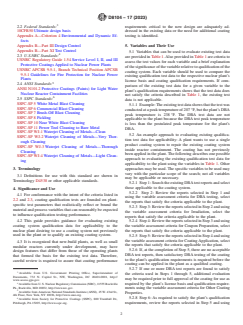
4.1 For conformance with the intent of the criteria listed in 2.2 and 2.3, coating qualification tests are founded on plant-specific test parameters that realistically reflect or bound the material and process variables that can reasonably be expected to influence qualification testing performance.
4.2 This guide provides guidance for evaluating existing coating system qualification data for applicability to the nuclear plant desiring to use a coating system not previously used in the plant or to qualify an existing coating system.
4.3 It is recognized that new-build plants, as well as small modular reactors currently under development, may have design features that differ from those of the operating plants that formed the basis for the existing test data. Therefore, careful review is required to assure that coating performance requirements critical to the new design are adequately addressed in the existing data or the need for additional coating testing is identified.
SCOPE
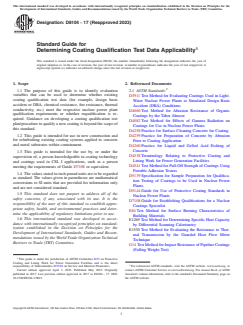
1.1 The purpose of this guide is to identify evaluation variables that can be used to determine whether existing coating qualification test data (for example, design basis accident or DBA, chemical resistance, fire resistance, thermal conductivity, etc.) meet the respective nuclear power plant qualification requirements or whether requalification is required. Guidance on developing a coating qualification test plan/procedure to qualify a new coating is beyond the scope of this standard.
1.2 This guide is intended for use in new construction and for refurbishing existing coating systems applied to concrete and metal substrates within containment.
1.3 This guide is intended for the use by, or under the supervision of, a person knowledgeable in coating technology and coatings used in CSL I applications, such as a person meeting the requirements of Guide D7108 or equivalent.
1.4 The values stated in inch-pound units are to be regarded as standard. The values given in parentheses are mathematical conversions to SI units that are provided for information only and are not considered standard.
1.5 This standard does not purport to address all of the safety concerns, if any, associated with its use. It is the responsibility of the user of this standard to establish appropriate safety, health, and environmental practices and determine the applicability of regulatory limitations prior to use.
1.6 This international standard was developed in accordance with internationally recognized principles on standardization established in the Decision on Principles for the Development of International Standards, Guides and Recommendations issued by the World Trade Organization Technical Barriers to Trade (TBT) Committee.
- Status
- Published
- Publication Date
- 31-Mar-2023
- Technical Committee
- D33 - Protective Coating and Lining Work for Power Generation Facilities
- Drafting Committee
- D33.02 - Service and Material Parameters
Overview
ASTM D8104-17(2023), titled Standard Guide for Determining Coating Qualification Test Data Applicability, provides essential guidance for evaluating the applicability of existing coating qualification test data in nuclear power plant environments. Developed by ASTM International, this standard is crucial for professionals responsible for coatings in both new nuclear construction and refurbishment of existing facilities. It ensures that plant-specific material and process variables are appropriately considered, supporting the effective selection and qualification of protective coating systems for service inside containment structures.
This guide is particularly relevant for evaluating whether existing qualification data-such as those addressing design basis accident (DBA) conditions, chemical and fire resistance, thermal properties, and adhesion-meet the plant’s licensing and performance requirements, or if new or additional qualification testing is necessary.
Key Topics
Applicability of Existing Test Data
The standard outlines variables and criteria to determine if existing qualification test data are relevant to a specific plant’s requirements.- Material compatibility, surface preparation, application parameters, and test performance criteria are evaluated.
- Special considerations are required for new-build plants, small modular reactors, or refurbished systems with different design or operational features.
Evaluation Variables
Key variables include:- Substrate type and cleanliness: Only data from appropriately prepared and similar substrates (e.g., carbon steel, stainless steel, concrete) are considered valid.
- Coating system configuration: Number of coats, material types, thinning agents, colors, accelerators, and application methods must match qualified configurations.
- Test Parameters: Simulation of DBA temperature and pressure profiles, spray chemistry, irradiation, and other specific exposures should represent or exceed the plant’s requirements.
- Coating Properties: Attributes like fire resistance, chemical resistance, adhesion, thermal conductivity, specific heat, emissivity, abrasion resistance, and overall performance under stress are all assessed.
Assessment Process
- Systematic steps are defined for reviewing and filtering existing test reports:
- Identify relevant qualification tests.
- Compare evaluation variables and performance criteria to plant-specific standards.
- Document any differences, determine their significance, and identify any need for further testing or restrictions.
- Systematic steps are defined for reviewing and filtering existing test reports:
Reporting Requirements
- Comprehensive documentation is required, listing all considered variables, describing differences, and evaluating their impact.
- The final report should meet the plant’s Quality control and licensing requirements.
Applications
ASTM D8104-17(2023) is used in the following contexts:
- Nuclear Plant Construction:
Ensures protective coatings specified and installed in newly-built facilities meet all conformance requirements for safety and reliability. - Refurbishment and Repairs:
Used during renovation or repair projects to qualify new coatings or validate existing coating systems when changing products or suppliers. - Containment Area Integrity:
Applies to both concrete and metal substrates within critical containment areas, directly contributing to plant safety and regulatory compliance. - Specialized Expertise:
Guidance is intended for use by, or under supervision of, knowledgeable coating technology professionals (such as those qualified under ASTM D7108).
Related Standards
Several other standards complement ASTM D8104-17(2023), providing detailed methods and definitions relevant to coating qualification:
- ASTM D3911: Test Method for Evaluating Coatings under Simulated DBA Conditions
- ASTM D4082: Test Method for Effects of Gamma Radiation on Coatings
- ASTM D4060: Test Method for Abrasion Resistance of Organic Coatings
- ASTM D4258, D4259, D4260: Surface preparation and cleaning practices for coatings
- ASTM D4541: Test Method for Pull-Off Strength of Coatings
- ASTM E84: Test Method for Surface Burning Characteristics (Fire Resistance)
- ASTM D5144: Guide for Protective Coating Standards in Nuclear Power Plants
- ASTM D7108: Guide for Qualifications of Nuclear Coatings Specialists
- ANSI N101.2, US NRC Regulatory Guide 1.54: Additional regulatory references for nuclear coatings
By following ASTM D8104-17(2023), nuclear plant operators can ensure that coating qualification is based on robust, applicable test data, improving containment safety, regulatory adherence, and operational performance.
Relations
- Effective Date
- 01-Dec-2023
- Effective Date
- 01-Sep-2023
- Effective Date
- 01-Jul-2019
- Effective Date
- 01-Jun-2019
- Effective Date
- 15-Apr-2019
- Effective Date
- 01-Mar-2019
- Effective Date
- 01-Feb-2019
- Effective Date
- 15-Dec-2018
- Effective Date
- 01-Oct-2018
- Effective Date
- 15-Aug-2018
- Effective Date
- 01-Jul-2018
- Effective Date
- 01-Apr-2018
- Effective Date
- 01-Mar-2018
- Effective Date
- 01-Nov-2017
- Effective Date
- 01-Aug-2017
Get Certified
Connect with accredited certification bodies for this standard

DNV
DNV is an independent assurance and risk management provider.

Lloyd's Register
Lloyd's Register is a global professional services organisation specialising in engineering and technology.
DNV Energy Systems
Energy and renewable energy certification.
Sponsored listings
Frequently Asked Questions
ASTM D8104-17(2023) is a guide published by ASTM International. Its full title is "Standard Guide for Determining Coating Qualification Test Data Applicability". This standard covers: SIGNIFICANCE AND USE 4.1 For conformance with the intent of the criteria listed in 2.2 and 2.3, coating qualification tests are founded on plant-specific test parameters that realistically reflect or bound the material and process variables that can reasonably be expected to influence qualification testing performance. 4.2 This guide provides guidance for evaluating existing coating system qualification data for applicability to the nuclear plant desiring to use a coating system not previously used in the plant or to qualify an existing coating system. 4.3 It is recognized that new-build plants, as well as small modular reactors currently under development, may have design features that differ from those of the operating plants that formed the basis for the existing test data. Therefore, careful review is required to assure that coating performance requirements critical to the new design are adequately addressed in the existing data or the need for additional coating testing is identified. SCOPE 1.1 The purpose of this guide is to identify evaluation variables that can be used to determine whether existing coating qualification test data (for example, design basis accident or DBA, chemical resistance, fire resistance, thermal conductivity, etc.) meet the respective nuclear power plant qualification requirements or whether requalification is required. Guidance on developing a coating qualification test plan/procedure to qualify a new coating is beyond the scope of this standard. 1.2 This guide is intended for use in new construction and for refurbishing existing coating systems applied to concrete and metal substrates within containment. 1.3 This guide is intended for the use by, or under the supervision of, a person knowledgeable in coating technology and coatings used in CSL I applications, such as a person meeting the requirements of Guide D7108 or equivalent. 1.4 The values stated in inch-pound units are to be regarded as standard. The values given in parentheses are mathematical conversions to SI units that are provided for information only and are not considered standard. 1.5 This standard does not purport to address all of the safety concerns, if any, associated with its use. It is the responsibility of the user of this standard to establish appropriate safety, health, and environmental practices and determine the applicability of regulatory limitations prior to use. 1.6 This international standard was developed in accordance with internationally recognized principles on standardization established in the Decision on Principles for the Development of International Standards, Guides and Recommendations issued by the World Trade Organization Technical Barriers to Trade (TBT) Committee.
SIGNIFICANCE AND USE 4.1 For conformance with the intent of the criteria listed in 2.2 and 2.3, coating qualification tests are founded on plant-specific test parameters that realistically reflect or bound the material and process variables that can reasonably be expected to influence qualification testing performance. 4.2 This guide provides guidance for evaluating existing coating system qualification data for applicability to the nuclear plant desiring to use a coating system not previously used in the plant or to qualify an existing coating system. 4.3 It is recognized that new-build plants, as well as small modular reactors currently under development, may have design features that differ from those of the operating plants that formed the basis for the existing test data. Therefore, careful review is required to assure that coating performance requirements critical to the new design are adequately addressed in the existing data or the need for additional coating testing is identified. SCOPE 1.1 The purpose of this guide is to identify evaluation variables that can be used to determine whether existing coating qualification test data (for example, design basis accident or DBA, chemical resistance, fire resistance, thermal conductivity, etc.) meet the respective nuclear power plant qualification requirements or whether requalification is required. Guidance on developing a coating qualification test plan/procedure to qualify a new coating is beyond the scope of this standard. 1.2 This guide is intended for use in new construction and for refurbishing existing coating systems applied to concrete and metal substrates within containment. 1.3 This guide is intended for the use by, or under the supervision of, a person knowledgeable in coating technology and coatings used in CSL I applications, such as a person meeting the requirements of Guide D7108 or equivalent. 1.4 The values stated in inch-pound units are to be regarded as standard. The values given in parentheses are mathematical conversions to SI units that are provided for information only and are not considered standard. 1.5 This standard does not purport to address all of the safety concerns, if any, associated with its use. It is the responsibility of the user of this standard to establish appropriate safety, health, and environmental practices and determine the applicability of regulatory limitations prior to use. 1.6 This international standard was developed in accordance with internationally recognized principles on standardization established in the Decision on Principles for the Development of International Standards, Guides and Recommendations issued by the World Trade Organization Technical Barriers to Trade (TBT) Committee.
ASTM D8104-17(2023) is classified under the following ICS (International Classification for Standards) categories: 27.120.20 - Nuclear power plants. Safety. The ICS classification helps identify the subject area and facilitates finding related standards.
ASTM D8104-17(2023) has the following relationships with other standards: It is inter standard links to ASTM E84-23d, ASTM E84-23c, ASTM E84-19b, ASTM D5139-19, ASTM E84-19a, ASTM E84-19, ASTM E1530-19, ASTM D4259-18, ASTM E84-18b, ASTM D7108-12(2018), ASTM E84-18a, ASTM E1269-11(2018), ASTM E84-18, ASTM E84-17a, ASTM E84-17. Understanding these relationships helps ensure you are using the most current and applicable version of the standard.
ASTM D8104-17(2023) is available in PDF format for immediate download after purchase. The document can be added to your cart and obtained through the secure checkout process. Digital delivery ensures instant access to the complete standard document.
Standards Content (Sample)
This international standard was developed in accordance with internationally recognized principles on standardization established in the Decision on Principles for the
Development of International Standards, Guides and Recommendations issued by the World Trade Organization Technical Barriers to Trade (TBT) Committee.
Designation: D8104 − 17 (Reapproved 2023)
Standard Guide for
Determining Coating Qualification Test Data Applicability
This standard is issued under the fixed designation D8104; the number immediately following the designation indicates the year of
original adoption or, in the case of revision, the year of last revision. A number in parentheses indicates the year of last reapproval. A
superscript epsilon (´) indicates an editorial change since the last revision or reapproval.
1. Scope 2. Referenced Documents
1.1 The purpose of this guide is to identify evaluation
2.1 ASTM Standards:
variables that can be used to determine whether existing
D3911 Test Method for Evaluating Coatings Used in Light-
coating qualification test data (for example, design basis
Water Nuclear Power Plants at Simulated Design Basis
accident or DBA, chemical resistance, fire resistance, thermal
Accident (DBA) Conditions
conductivity, etc.) meet the respective nuclear power plant
D4060 Test Method for Abrasion Resistance of Organic
qualification requirements or whether requalification is re-
Coatings by the Taber Abraser
quired. Guidance on developing a coating qualification test
D4082 Test Method for Effects of Gamma Radiation on
plan/procedure to qualify a new coating is beyond the scope of
Coatings for Use in Nuclear Power Plants
this standard.
D4258 Practice for Surface Cleaning Concrete for Coating
1.2 This guide is intended for use in new construction and
D4259 Practice for Preparation of Concrete by Abrasion
for refurbishing existing coating systems applied to concrete
Prior to Coating Application
and metal substrates within containment.
D4260 Practice for Liquid and Gelled Acid Etching of
Concrete
1.3 This guide is intended for the use by, or under the
D4538 Terminology Relating to Protective Coating and
supervision of, a person knowledgeable in coating technology
Lining Work for Power Generation Facilities
and coatings used in CSL I applications, such as a person
D4541 Test Method for Pull-Off Strength of Coatings Using
meeting the requirements of Guide D7108 or equivalent.
Portable Adhesion Testers
1.4 The values stated in inch-pound units are to be regarded
D5139 Specification for Sample Preparation for Qualifica-
as standard. The values given in parentheses are mathematical
tion Testing of Coatings to be Used in Nuclear Power
conversions to SI units that are provided for information only
Plants
and are not considered standard.
D5144 Guide for Use of Protective Coating Standards in
1.5 This standard does not purport to address all of the
Nuclear Power Plants
safety concerns, if any, associated with its use. It is the
D7108 Guide for Establishing Qualifications for a Nuclear
responsibility of the user of this standard to establish appro-
Coatings Specialist
priate safety, health, and environmental practices and deter-
E84 Test Method for Surface Burning Characteristics of
mine the applicability of regulatory limitations prior to use.
Building Materials
1.6 This international standard was developed in accor-
E1269 Test Method for Determining Specific Heat Capacity
dance with internationally recognized principles on standard-
by Differential Scanning Calorimetry
ization established in the Decision on Principles for the
E1530 Test Method for Evaluating the Resistance to Ther-
Development of International Standards, Guides and Recom-
mal Transmission by the Guarded Heat Flow Meter
mendations issued by the World Trade Organization Technical
Technique
Barriers to Trade (TBT) Committee.
G14 Test Method for Impact Resistance of Pipeline Coatings
(Falling Weight Test)
This guide is under the jurisdiction of ASTM Committee D33 on Protective
Coating and Lining Work for Power Generation Facilities and is the direct
responsibility of Subcommittee D33.02 on Service and Material Parameters. For referenced ASTM standards, visit the ASTM website, www.astm.org, or
Current edition approved April 1, 2023. Published May 2023. Originally contact ASTM Customer Service at service@astm.org. For Annual Book of ASTM
published in 2017. Last previous edition approved in 2017 as D8104 – 17. DOI: Standards volume information, refer to the standard’s Document Summary page on
10.1520/D8104-17R23. the ASTM website.
Copyright © ASTM International, 100 Barr Harbor Drive, PO Box C700, West Conshohocken, PA 19428-2959. United States
D8104 − 17 (2023)
2.2 Federal Standards: requirements critical to the new design are adequately ad-
10CFR50 Ultimate design basis dressed in the existing data or the need for additional coating
Appendix A—Criterion 4 Environmental and Dynamic Ef- testing is identified.
fects
Appendix B—Part III Design Control
5. Variables and Their Use
Appendix B—Part XI Test Control
5.1 Variables that can be used to evaluate existing test data
2.3 U.S.NRC Standards:
are provided in Table 1. Also provided in Table 1 are criteria to
USNRC Regulatory Guide 1.54 Service Level I, II, and III
assess the test values for each variable and a brief explanation
Protective Coatings Applied to Nuclear Power Plants
of the significance of the variable relative to qualification of the
USNRC APCSB 9.5-1, Branch Technical Position APCSB
coating system. Each variable should be used to compare the
9.5-1 Guidelines for Fire Protection for Nuclear Power
existing qualification test data to the respective nuclear plant’s
Plants
license basis and coating qualification requirements. If com-
2.4 ANSI Standards:
parison of the existing test data for a given variable to the
ANSI N101.2 Protective Coatings (Paints) for Light Water
plant’s qualification requirements shows that the test data does
Nuclear Reactor Containment Facilities
not satisfy the criteria described in Table 1, the existing test
2.5 SSPC Standards:
data is not applicable.
SSPC-SP 5 White Metal Blast Cleaning
5.1.1 Example: The existing test data shows that the test was
SSPC-SP 6 Commercial Blast Cleaning
conducted at a peak temperature of 207 °F, but the plant’s DBA
SSPC-SP 7 Brush-Off Blast Cleaning
peak temperature is 238 °F. The DBA test data are not
SSPC-SP 8 Pickling
applicable to the plant because the DBA test peak temperature
SSPC-SP 10 Near White Blast Cleaning
is less than the postulated peak temperature for the plant’s
SSPC-SP 11 Power Tool Cleaning to Bare Metal
DBA.
SSPC-SP WJ-1 Waterjet Cleaning of Metals—Clean
5.2 An example approach to evaluating existing qualifica-
SSPC-SP WJ-2 Waterjet Cleaning of Metals—Very Thor-
tion test data for applicability: A plant wants to use a single
ough Cleaning
product coating system to repair the existing coating system
SSPC-SP WJ-3 Waterjet Cleaning of Metals—Thorough
inside reactor containment. The coating has not previously
Cleaning
been applied in the plant. The following describes one possible
SSPC-SP WJ-4 Waterjet Cleaning of Metals—Light Clean-
approach to evaluating the existing qualification test data for
ing
applicability to the plant using the variables in Table 1. Other
approaches may be used. The specific variables to be used may
3. Terminology
vary with the particular scope of the search; not all variables
3.1 Definitions for use with this standard are shown in
may be applicable or necessary.
Terminology D4538 or other applicable standards.
5.2.1 Step 1: Search the existing DBA test reports and select
those applicable to the coating system.
4. Significance and Use
5.2.2 Step 2: Review the reports selected in Step 1 and
4.1 For conformance with the intent of the criteria listed in
using the variable assessment criteria for DBA testing, select
2.2 and 2.3, coating qualification tests are founded on plant-
the reports that satisfy the criteria applicable to the plant.
specific test parameters that realistically reflect or bound the
5.2.3 Step 3: Review the reports selected in Step 2 and using
material and process variables that can reasonably be expected
the variable assessment criteria for Irradiation, select the
to influence qualification testing performance.
reports that satisfy the criteria applicable to the plant.
4.2 This guide provides guidance for evaluating existing
5.2.4 Step 4: Review the reports selected in Step 3 and using
coating system qualification data for applicability to the
the variable assessment criteria for Coupon Preparation, select
nuclear plant desiring to use a coating system not previously
the reports that satisfy the criteria applicable to the plant.
used in the plant or to qualify an existing coating system.
5.2.5 Step 5: Review the reports selected in Step 4 and using
the variable assessment criteria for Coating Application, select
4.3 It is recognized that new-build plants, as well as small
the reports that satisfy the criteria applicable to the plant.
modular reactors currently under development, may have
5.2.6 If, at the completion of Step 5, there are no acceptable
design features that differ from those of the operating plants
DBA test reports, then satisfactory DBA testing of the coating
that formed the basis for the existing test data. Therefore,
to the plant’s qualification requirements is required before the
careful review is required to assure that coating performance
coating can be applied in the plant as a qualified coating.
5.2.7 If one or more DBA test reports are found to satisfy
Available from U.S. Government Printing Office, Superintendent of
the criteria used in Steps 1 through 5, additional evaluation
Documents, 732 N. Capitol St., NW, Washington, DC 20401-0001, http://
may be required prior to full approval of the coating for use as
www.access.gpo.gov.
required by the plant’s license basis and qualification require-
Available from U. S. Nuclear Regulatory Commission (NRC), 11555 Rockville
Pk., Rockville, MD 20852, http://www.nrc.gov.
ments using the variable assessment criteria for Other Coating
Available from American National Standards Institute (ANSI), 25 W. 43rd St.,
Properties.
4th Floor, New York, NY 10036, http://www.ansi.org.
5.2.8 Step 6: As required to satisfy the plant’s qualification
Available from Society for Protective Coatings (SSPC), 800 Trumbull Dr.,
Pittsburgh, PA 15205, http://www.sspc.org. requirements, review the reports selected in Step 5 and using
D8104 − 17 (2023)
TABLE 1 Coating Qualification Test Report Assessment Variables
Variable Assessment Criteria Significance of Variable/Basis of Assessment Criteria
Coupon Preparation
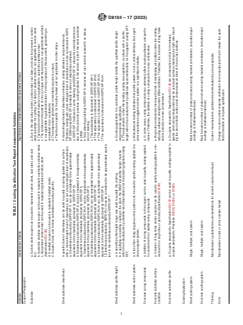
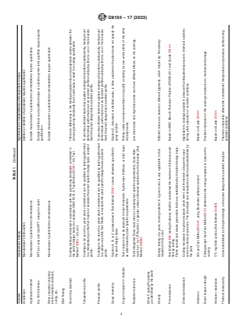
Substrate a. Carbon steel coupon can be used to represent carbon steel, cast steel, and cast a. Due to the low alloy content, carbon steel, cast steel, and cast iron present a carbon
iron. steel substrate for coating. Test data for another metal is not applicable to carbon steel.
b. Austenitic stainless steel coupon can be used to represent austenitic stainless steel. b. Test data for another metal is not applicable to austenitic stainless steel.
c. Galvanized carbon steel can be used to represent galvanized carbon steel c. The surface and reactivity of zinc is unique and test data for a non-galvanized surface
(Specification D5139). is not applicable to galvanized steel. For the purposes of this document, galvanizing is
d. A welded coupon can be used to represent installed welds. considered to be a substrate.
e. Copper, brass, and bronze substrates are alloy-specific. d. The preparation performed on welded coupons is unique.
e. Test data is specific for the alloy tested and not applicable to other alloys.
Steel substrate cleanliness A specific level of cleanliness can be used to qualify a coating applied to a surface A more stringent level of cleanliness enhances coating adhesion and performance.
with a more stringent level of cleanliness, but not a less stringent level of cleanliness. Therefore, testing with a less stringent level of cleanliness is more conservative. SSPC
a. Cleanliness produced by SSPC-SP 11 can be considered to be approximately SP COM ranks SSPC SP standards in terms of cleanliness achieved.
equivalent to the cleanliness produced by SSPC-SP 10. a. SSPC-SP 10 allows for some staining and SSPC-SP 11 allows for small discrete resi-
b. Cleanliness produced by SSPC-SP 8 can be considered to be approximately due of mil
...