

ASTM D2594/D2594M-21
(Test Method)Standard Test Method for Stretch Properties of Knitted Fabrics Having Low Power
General Information
- Abstract
SIGNIFICANCE AND USE
5.1 Fabric stretch and fabric growth are useful in selection of fabrics that are required to stretch, but also recover to their original shape.
5.1.1 In apparel, fabric stretch can be caused by a variety of factors. A momentary stress occurs when a fabric is required to accommodate movement, such as sportswear and other loose-fitting apparel (also known as comfort stretch apparel) or external stress such as grabbing and pulling. Additionally, comfort apparel can be subjected to prolonged stress, such as stretching to accommodate positions such as sitting. Another example of prolonged stress occurs when a fabric is required to stretch to accommodate fitting the form of the body, such as swimwear, anchored slacks, and other form-fitting apparel (also known as semi-support apparel).
5.1.2 Fabric growth can also be in response to a variety of stresses. This method evaluates fabric growth due to exposure to prolonged stresses. In form-fitting apparel, fabric growth can apply as garments are worn for a prolonged period of time or under long periods of stress such as sitting. Upon removal of garments or stress, its growth can be seen and evaluated.
5.2 This test method is not recommended for acceptance testing of commercial shipment because the between-laboratory precision is known to be poor.
5.2.1 If there are differences of practical significance between reported test results for two laboratories (or more), comparative tests should be performed to determine if there is a statistical bias between them, using competent statistical assistance. As a minimum, ensure the test samples to be used are as homogeneous as possible, are drawn from the material from which the disparate test results are obtained, and are assigned randomly in equal numbers to each laboratory for testing. The test results from the two laboratories should be compared using a statistical test for unpaired data, at a probability level chosen prior to the testing series. If a bias is found, eith...
SCOPE
1.1 This test method covers the measurement of fabrics that exhibit high stretch and good recovery from low tension. Fabric stretch is measured when a known load is applied. Fabric growth is evaluated after a known extension is applied and subsequently removed.
1.2 The procedures for fabric stretch and fabric growth can be used together, or individually.
1.3 While this test method can be used for a knit fabric, fabrics intended for support or other applications are better evaluated using other test methods: D3107, D4964, D6614.
1.4 The values stated in either SI units or inch-pound units are to be regarded separately as standard. The values stated in each system are not necessarily exact equivalents; therefore, to ensure conformance with the standard, each system shall be used independently of the other, and values from the two systems shall not be combined.
1.5 This standard does not purport to address all of the safety concerns, if any, associated with its use. It is the responsibility of the user of this standard to establish appropriate safety, health, and environmental practices and determine the applicability of regulatory limitations prior to use.
1.6 This international standard was developed in accordance with internationally recognized principles on standardization established in the Decision on Principles for the Development of International Standards, Guides and Recommendations issued by the World Trade Organization Technical Barriers to Trade (TBT) Committee.
- Status
- Published
- Publication Date
- 30-Jun-2021
- Technical Committee
- D13 - Textiles
- Drafting Committee
- D13.59 - Fabric Physical Test Methods A
Buy Documents
ASTM D2594/D2594M-21 - Standard Test Method for Stretch Properties of Knitted Fabrics Having Low Power
REDLINE ASTM D2594/D2594M-21 - Standard Test Method for Stretch Properties of Knitted Fabrics Having Low Power
Overview
ASTM D2594/D2594M-21 is the Standard Test Method for Stretch Properties of Knitted Fabrics Having Low Power, published by ASTM International. This acclaimed textile standard specifies procedures to measure the stretch and growth properties of knitted fabrics that exhibit high stretch and good recovery under low tension. The method is particularly valuable for evaluating material performance in comfort stretch and semi-support apparel, ensuring fabrics maintain their shape and fit during both active use and prolonged stress.
Key Topics
- Fabric Stretch and Growth: Assesses how much a fabric stretches under an applied force and its ability to recover, as well as how much it grows or permanently extends after prolonged tension.
- Testing Procedures: Details test specimen preparation, conditioning, and the apparatus required to generate consistent, reliable results.
- Directionality: Evaluates both wale-wise (lengthwise) and course-wise (widthwise) stretch for comprehensive fabric characterization.
- Stress Types: Considers momentary stress (e.g., movement such as bending or pulling) and prolonged stress (e.g., fabrics stretched due to sitting or body form fitting).
- Practical Interpretation: Offers guidance for comparing results across laboratories, noting that between-lab precision may vary and should be evaluated statistically.
- Units of Measurement: Supports both SI and inch-pound units, emphasizing that results from different measurement systems should not be combined for conformity.
Applications
ASTM D2594/D2594M-21 is essential for:
- Apparel Designers and Manufacturers: Used to select, develop, and quality control fabrics for comfort stretch (loose-fitting sportswear, activewear) and semi-support apparel (swimwear, fitted slacks).
- Textile Laboratories: Employed for characterizing stretch and recovery properties during product development or for verifying supplier specifications.
- Quality Assurance: Ensures knitted fabrics have consistent stretch and recovery capabilities, minimizing fit issues and enhancing wearer comfort over the garment’s lifecycle.
- Consumer Products: Relevant for a broad range of knitted products where fabric stretch and recovery affect performance, appearance, and durability.
Notably, while the test method is robust for laboratory evaluation, it is not recommended as a basis for acceptance testing in commercial shipments due to known variability in results between laboratories.
Related Standards
For fabrics requiring higher support or other specific stretch characteristics, consider the following related ASTM standards:
- ASTM D3107: Test Methods for Stretch Properties of Fabrics Woven from Stretch Yarns
- ASTM D4964: Test Method for Tension and Elongation of Elastic Fabrics (CRE Type)
- ASTM D6614: Test Method for Stretch Properties of Textile Fabrics – CRE Method
- ASTM D1776: Practice for Conditioning and Testing Textiles
Practical Value
Implementing ASTM D2594/D2594M-21 provides fabric producers and users with:
- Consistent, measurable criteria for fabric performance, vital for product specification and consumer satisfaction
- Improved fabric selection based on objective data, particularly for performance- and fit-critical garments
- Enhanced durability of knitted textile products, ensuring garments maintain their intended appearance and function even after frequent use or prolonged tension
Adoption of this standard supports textile quality management and product innovation, positioning organizations to meet demanding consumer and industry expectations for stretchable knitted fabrics.
Keywords: ASTM D2594, stretch properties, knitted fabric, fabric growth, low-power stretch, textile testing, recovery, comfort stretch apparel, semi-support apparel, textile standards
Relations
- Effective Date
- 01-Jul-2020
- Effective Date
- 01-Jul-2019
- Effective Date
- 01-Jul-2018
- Effective Date
- 15-Jul-2017
- Effective Date
- 01-Mar-2017
- Effective Date
- 01-Jul-2016
- Effective Date
- 15-Sep-2015
- Effective Date
- 01-Sep-2015
- Effective Date
- 01-Jul-2015
- Effective Date
- 01-Jul-2015
- Effective Date
- 01-Apr-2015
- Effective Date
- 01-Oct-2013
- Effective Date
- 01-Oct-2013
- Effective Date
- 01-Oct-2013
- Effective Date
- 01-Oct-2013
Buy Documents
ASTM D2594/D2594M-21 - Standard Test Method for Stretch Properties of Knitted Fabrics Having Low Power
REDLINE ASTM D2594/D2594M-21 - Standard Test Method for Stretch Properties of Knitted Fabrics Having Low Power
Get Certified
Connect with accredited certification bodies for this standard

Control Union Certifications
Global certification for agriculture and sustainability.

Hohenstein Institut
Textile testing and certification.

Bureau Veritas Bangladesh
Bureau Veritas certification services in Bangladesh.
Sponsored listings
Frequently Asked Questions
ASTM D2594/D2594M-21 is a standard published by ASTM International. Its full title is "Standard Test Method for Stretch Properties of Knitted Fabrics Having Low Power". This standard covers: SIGNIFICANCE AND USE 5.1 Fabric stretch and fabric growth are useful in selection of fabrics that are required to stretch, but also recover to their original shape. 5.1.1 In apparel, fabric stretch can be caused by a variety of factors. A momentary stress occurs when a fabric is required to accommodate movement, such as sportswear and other loose-fitting apparel (also known as comfort stretch apparel) or external stress such as grabbing and pulling. Additionally, comfort apparel can be subjected to prolonged stress, such as stretching to accommodate positions such as sitting. Another example of prolonged stress occurs when a fabric is required to stretch to accommodate fitting the form of the body, such as swimwear, anchored slacks, and other form-fitting apparel (also known as semi-support apparel). 5.1.2 Fabric growth can also be in response to a variety of stresses. This method evaluates fabric growth due to exposure to prolonged stresses. In form-fitting apparel, fabric growth can apply as garments are worn for a prolonged period of time or under long periods of stress such as sitting. Upon removal of garments or stress, its growth can be seen and evaluated. 5.2 This test method is not recommended for acceptance testing of commercial shipment because the between-laboratory precision is known to be poor. 5.2.1 If there are differences of practical significance between reported test results for two laboratories (or more), comparative tests should be performed to determine if there is a statistical bias between them, using competent statistical assistance. As a minimum, ensure the test samples to be used are as homogeneous as possible, are drawn from the material from which the disparate test results are obtained, and are assigned randomly in equal numbers to each laboratory for testing. The test results from the two laboratories should be compared using a statistical test for unpaired data, at a probability level chosen prior to the testing series. If a bias is found, eith... SCOPE 1.1 This test method covers the measurement of fabrics that exhibit high stretch and good recovery from low tension. Fabric stretch is measured when a known load is applied. Fabric growth is evaluated after a known extension is applied and subsequently removed. 1.2 The procedures for fabric stretch and fabric growth can be used together, or individually. 1.3 While this test method can be used for a knit fabric, fabrics intended for support or other applications are better evaluated using other test methods: D3107, D4964, D6614. 1.4 The values stated in either SI units or inch-pound units are to be regarded separately as standard. The values stated in each system are not necessarily exact equivalents; therefore, to ensure conformance with the standard, each system shall be used independently of the other, and values from the two systems shall not be combined. 1.5 This standard does not purport to address all of the safety concerns, if any, associated with its use. It is the responsibility of the user of this standard to establish appropriate safety, health, and environmental practices and determine the applicability of regulatory limitations prior to use. 1.6 This international standard was developed in accordance with internationally recognized principles on standardization established in the Decision on Principles for the Development of International Standards, Guides and Recommendations issued by the World Trade Organization Technical Barriers to Trade (TBT) Committee.
SIGNIFICANCE AND USE 5.1 Fabric stretch and fabric growth are useful in selection of fabrics that are required to stretch, but also recover to their original shape. 5.1.1 In apparel, fabric stretch can be caused by a variety of factors. A momentary stress occurs when a fabric is required to accommodate movement, such as sportswear and other loose-fitting apparel (also known as comfort stretch apparel) or external stress such as grabbing and pulling. Additionally, comfort apparel can be subjected to prolonged stress, such as stretching to accommodate positions such as sitting. Another example of prolonged stress occurs when a fabric is required to stretch to accommodate fitting the form of the body, such as swimwear, anchored slacks, and other form-fitting apparel (also known as semi-support apparel). 5.1.2 Fabric growth can also be in response to a variety of stresses. This method evaluates fabric growth due to exposure to prolonged stresses. In form-fitting apparel, fabric growth can apply as garments are worn for a prolonged period of time or under long periods of stress such as sitting. Upon removal of garments or stress, its growth can be seen and evaluated. 5.2 This test method is not recommended for acceptance testing of commercial shipment because the between-laboratory precision is known to be poor. 5.2.1 If there are differences of practical significance between reported test results for two laboratories (or more), comparative tests should be performed to determine if there is a statistical bias between them, using competent statistical assistance. As a minimum, ensure the test samples to be used are as homogeneous as possible, are drawn from the material from which the disparate test results are obtained, and are assigned randomly in equal numbers to each laboratory for testing. The test results from the two laboratories should be compared using a statistical test for unpaired data, at a probability level chosen prior to the testing series. If a bias is found, eith... SCOPE 1.1 This test method covers the measurement of fabrics that exhibit high stretch and good recovery from low tension. Fabric stretch is measured when a known load is applied. Fabric growth is evaluated after a known extension is applied and subsequently removed. 1.2 The procedures for fabric stretch and fabric growth can be used together, or individually. 1.3 While this test method can be used for a knit fabric, fabrics intended for support or other applications are better evaluated using other test methods: D3107, D4964, D6614. 1.4 The values stated in either SI units or inch-pound units are to be regarded separately as standard. The values stated in each system are not necessarily exact equivalents; therefore, to ensure conformance with the standard, each system shall be used independently of the other, and values from the two systems shall not be combined. 1.5 This standard does not purport to address all of the safety concerns, if any, associated with its use. It is the responsibility of the user of this standard to establish appropriate safety, health, and environmental practices and determine the applicability of regulatory limitations prior to use. 1.6 This international standard was developed in accordance with internationally recognized principles on standardization established in the Decision on Principles for the Development of International Standards, Guides and Recommendations issued by the World Trade Organization Technical Barriers to Trade (TBT) Committee.
ASTM D2594/D2594M-21 is classified under the following ICS (International Classification for Standards) categories: 59.080.30 - Textile fabrics. The ICS classification helps identify the subject area and facilitates finding related standards.
ASTM D2594/D2594M-21 has the following relationships with other standards: It is inter standard links to ASTM D4964-96(2020), ASTM D3107-07(2019), ASTM D4849-13(2018), ASTM D4850-13(2017), ASTM D123-17, ASTM D4964-96(2016), ASTM D123-15b, ASTM D123-15a, ASTM D3107-07(2015), ASTM D6614-07(2015), ASTM D123-15, ASTM D4849-13, ASTM D4849-13e1, ASTM D4849-13e3, ASTM D4849-13e2. Understanding these relationships helps ensure you are using the most current and applicable version of the standard.
ASTM D2594/D2594M-21 is available in PDF format for immediate download after purchase. The document can be added to your cart and obtained through the secure checkout process. Digital delivery ensures instant access to the complete standard document.
Standards Content (Sample)
This international standard was developed in accordance with internationally recognized principles on standardization established in the Decision on Principles for the
Development of International Standards, Guides and Recommendations issued by the World Trade Organization Technical Barriers to Trade (TBT) Committee.
Designation: D2594/D2594M − 21
Standard Test Method for
Stretch Properties of Knitted Fabrics Having Low Power
This standard is issued under the fixed designation D2594/D2594M; the number immediately following the designation indicates the
year of original adoption or, in the case of revision, the year of last revision. A number in parentheses indicates the year of last
reapproval. A superscript epsilon (´) indicates an editorial change since the last revision or reapproval.
1. Scope D2904 Practice for Interlaboratory Testing of a Textile Test
Method that Produces Normally Distributed Data (With-
1.1 This test method covers the measurement of fabrics that
drawn 2008)
exhibit high stretch and good recovery from low tension.
D2906 Practice for Statements on Precision and Bias for
Fabric stretch is measured when a known load is applied.
Textiles (Withdrawn 2008)
Fabric growth is evaluated after a known extension is applied
D3107 Test Methods for Stretch Properties of Fabrics Wo-
and subsequently removed.
ven from Stretch Yarns
1.2 The procedures for fabric stretch and fabric growth can
D4849 Terminology Related to Yarns and Fibers
be used together, or individually.
D4850 Terminology Relating to Fabrics and Fabric Test
1.3 While this test method can be used for a knit fabric, Methods
fabrics intended for support or other applications are better
D4964 Test Method for Tension and Elongation of Elastic
evaluated using other test methods: D3107, D4964, D6614. Fabrics (Constant-Rate-of-Extension Type Tensile Testing
Machine)
1.4 The values stated in either SI units or inch-pound units
D6614 Test Method for Stretch Properties of Textile Fabrics
are to be regarded separately as standard. The values stated in
– CRE Method
each system are not necessarily exact equivalents; therefore, to
ensure conformance with the standard, each system shall be
3. Terminology
used independently of the other, and values from the two
systems shall not be combined.
3.1 Definitions:
1.5 This standard does not purport to address all of the
3.1.1 For definition of textile terms used in this test method:
safety concerns, if any, associated with its use. It is the bench marks, refer to Terminology D4849.
responsibility of the user of this standard to establish appro-
3.1.2 For definitions of textile terms used in this test
priate safety, health, and environmental practices and deter-
method: fabric growth; fabric stretch; low-power stretch and
mine the applicability of regulatory limitations prior to use.
tension, refer to Terminology D4850.
1.6 This international standard was developed in accor-
3.1.3 For definitions of other textile terms used in this test
dance with internationally recognized principles on standard-
method, refer to Terminology D123.
ization established in the Decision on Principles for the
Development of International Standards, Guides and Recom-
4. Summary of Test Method
mendations issued by the World Trade Organization Technical
Barriers to Trade (TBT) Committee. 4.1 Fabric Growth—Tension is applied to a looped fabric
specimen until it is extended to a specified elongation. The test
2. Referenced Documents
specimenisheldinplacefor2h.Thepercentchangeinthetest
specimen length is measured immediately after removal of the
2.1 ASTM Standards:
tension. The test specimen is then allowed one hour to recover
D123 Terminology Relating to Textiles
without tension. The percent change in test specimen length is
D1776 Practice for Conditioning and Testing Textiles
measured again after this recovery period.
4.2 Fabric Stretch—A specified tension is applied to and
This test method is under the jurisdiction ofASTM Committee D13 on Textiles
and is the direct responsibility of Subcommittee D13.59 on Fabric Test Methods,
removed from a looped fabric specimen for five cycles. On the
General.
fifth time tension is applied, the tension is held and the percent
Current edition approved July 1, 2021. Published August 2021. Originally
change in the test specimen length is measured.
approved in 1969. Last previous edition approved in 2020 as D2594 – 20. DOI:
10.1520/D2594_D2594M-21.
For referenced ASTM standards, visit the ASTM website, www.astm.org, or
contact ASTM Customer Service at service@astm.org. For Annual Book of ASTM
Standards volume information, refer to the standard’s Document Summary page on The last approved version of this historical standard is referenced on
the ASTM website. www.astm.org.
Copyright © ASTM International, 100 Barr Harbor Drive, PO Box C700, West Conshohocken, PA 19428-2959. United States
D2594/D2594M − 21
5. Significance and Use 6. Apparatus
6.1 Frame, suitable for supporting the hanger assembly and
5.1 Fabric stretch and fabric growth are useful in selection
tension forces applied during testing.
of fabrics that are required to stretch, but also recover to their
original shape.
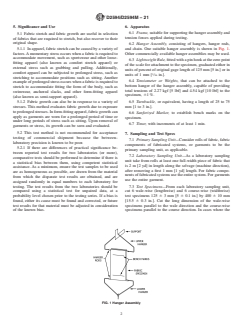
6.2 Hanger Assembly, consisting of hangers, hanger rods,
5.1.1 In apparel, fabric stretch can be caused by a variety of and chain. One suitable hanger assembly is shown in Fig. 1.
factors.Amomentary stress occurs when a fabric is required to
Other commercially available hanger assemblies may be used.
accommodate movement, such as sportswear and other loose-
6.3 Lightweight Rule, fitted with a pin hook at the zero point
fitting apparel (also known as comfort stretch apparel) or
of the scale for attachment to the specimen, graduated either in
external stress such as grabbing and pulling. Additionally,
units of percent of original gage length of 125 mm [5 in.] or in
comfort apparel can be subjected to prolonged stress, such as
units of 1 mm [ ⁄16 in.].
stretching to accommodate positions such as sitting. Another
6.4 Tensiometer or Weights, that can be attached to the
example of prolonged stress occurs when a fabric is required to
bottom hanger of the hanger assembly, capable of providing
stretch to accommodate fitting the form of the body, such as
total tensions of 2.27 kgf [5 lbf] and 4.54 kgf [10 lbf] to the
swimwear, anchored slacks, and other form-fitting apparel
specimen, 61%.
(also known as semi-support apparel).
6.5 Turnbuckle, or equivalent, having a length of 25 to 75
5.1.2 Fabric growth can also be in response to a variety of
mm [1 to 3 in.].
stresses. This method evaluates fabric growth due to exposure
toprolongedstresses.Inform-fittingapparel,fabricgrowthcan
6.6 Sanforized Marker, to establish bench marks on the
apply as garments are worn for a prolonged period of time or
specimen.
under long periods of stress such as sitting. Upon removal of
6.7 Timer, with increments of at least 1 min.
garments or stress, its growth can be seen and evaluated.
5.2 This test method is not recommended for acceptance
7. Sampling and Test Specs
testing of commercial shipment because the between-
7.1 Primary Sampling Unit—Consider rolls of fabric, fabric
laboratory precision is known to be poor.
components of fabricated systems, or garments to be the
5.2.1 If there are differences of practical significance be-
primary sampling unit, as applicable.
tween reported test results for two laboratories (or more),
7.2 Laboratory Sampling Unit—As a laboratory sampling
comparative tests should be performed to determine if there is
unit take from rolls at least one full-width piece of fabric that
a statistical bias between them, using competent statistical
is2m[2yd]in length along the selvage (machine direction),
assistance. As a minimum, ensure the test samples to be used
after removing a first 1 mm [1 yd] length. For fabric compo-
are as homogeneous as possible, are drawn from the material
nents of fabricated systems use the entire system. For garments
from which the disparate test results are obtained, and are
use the entire garment.
assigned randomly in equal numbers to each laboratory for
testing. The test results from the two laboratories should be 7.3 Test Specimens—From each laboratory sampling unit,
compared using a statistical test for unpaired data, at a cut 6 wale-wise (lengthwise) and 6 course-wise (widthwise)
probability level chosen prior to the testing series. If a bias is test specimens 125 63mm[5 6 0.1 in.] by 400 6 10 mm
found, either its cause must be found and corrected, or future [15.5 6 0.3 in.]. Cut the long dimension of the wale-wise
test results for that material must be adjusted in consideration specimens parallel to the wale direction and the course-wise
of the known bias. specimens parallel to the course direction. In cases where the
FIG. 1 Hanger Assembly
D2594/D2594M − 21
fabric is designed to primarily stretch in one direction, testing 10.3.4 Attach the rule to the specimen loop by inserting the
is only required in the intended stretch direction. Take speci- rule pin hook through the face of the fabric in the center of the
mens representing a broad distribution from different positions upper bench mark.
diagonally across the width of the laboratory sampling unit. 10.3.5 Attach the chain by means of the turnbuckle to the
Consider the long direction as the direction of test. Label to lower hanger and extend the specimen loop to the amount
maintain specimen identity. specified in Table 1, that is, such that the lower bench marks
7.3.1 For fabric widths 125 mm [5 in.] or more, take no linesupwiththespecifiedpercentagestretchpointonthescale.
specimen closer than 25 mm [1 in.] from the edges of the
NOTE1—Ifthescaleisinunitsofmeasurement,itishelpfultocalculate
laboratory sampling unit.
the corresponding percentage.
7.3.2 For fabric widths less than 125 mm [5 in.], use the
10.3.6 Lock the chain in the corresponding notch in the
entire width of the laboratory sampling unit for specimens.
lower crossmember of the frame. Adjust the turnbuckle to
7.3.3 Garmentsamplesmaynotallowfor125mmspecimen
make minor adjustments of the position of the lower bench
widths; use available width.
mark.
7.3.4 For fabric and lengths less than 400 6 10 mm [15.5 6
10.3.7 Allow the loop to remain in the extended position for
0.3 in.], use the longest available length from the sampling
2h 6 5 min.
unit. In this case, distances between benchmarks may be
10.3.8 After 2 h 6 5 min, unlock and release the chain and
measured with a metric rule.
remove the lower hanger from the specimen loop.
7.3.5 Garmentsamplesmaynotallowfor400mmspecimen
10.3.9 Measure the position of the lower bench mark
lengths. Use available length. Ensure specimens are free of
relative to the scale on the rule to the nearest 1 % of original
folds, creases, or wrinkles. Avoid gettin
...
This document is not an ASTM standard and is intended only to provide the user of an ASTM standard an indication of what changes have been made to the previous version. Because
it may not be technically possible to adequately depict all changes accurately, ASTM recommends that users consult prior editions as appropriate. In all cases only the current version
of the standard as published by ASTM is to be considered the official document.
Designation: D2594 − 20 D2594/D2594M − 21
Standard Test Method for
Stretch Properties of Knitted Fabrics Having Low Power
This standard is issued under the fixed designation D2594;D2594/D2594M; the number immediately following the designation indicates
the year of original adoption or, in the case of revision, the year of last revision. A number in parentheses indicates the year of last
reapproval. A superscript epsilon (´) indicates an editorial change since the last revision or reapproval.
1. Scope
1.1 This test method covers the measurement of fabrics that exhibit high stretch and good recovery from low tension. Fabric
stretch is measured when a known load is applied. Fabric growth is evaluated after a known extension is applied and subsequently
removed.
1.2 The procedures for fabric stretch and fabric growth can be used together, or individually.
1.3 While this test method can be used for a knit fabric, fabrics intended for support or other applications are better evaluated using
other test methods: D3107, D4964, D6614.
1.4 The values stated in either SI units or inch-pound units are to be regarded separately as the standard. Within the text, the
inch-pound units are shown in parentheses. standard. The values stated in each system are not necessarily exact equivalents;
therefore, to ensure conformance with the standard, each system shall be used independently of the other. Combiningother, and
values from the two systems may result in nonconformance with the specification.shall not be combined.
1.5 This standard does not purport to address all of the safety concerns, if any, associated with its use. It is the responsibility
of the user of this standard to establish appropriate safety, health, and environmental practices and determine the applicability of
regulatory limitations prior to use.
1.6 This international standard was developed in accordance with internationally recognized principles on standardization
established in the Decision on Principles for the Development of International Standards, Guides and Recommendations issued
by the World Trade Organization Technical Barriers to Trade (TBT) Committee.
2. Referenced Documents
2.1 ASTM Standards:
D123 Terminology Relating to Textiles
D1776 Practice for Conditioning and Testing Textiles
D2904 Practice for Interlaboratory Testing of a Textile Test Method that Produces Normally Distributed Data (Withdrawn 2008)
D2906 Practice for Statements on Precision and Bias for Textiles (Withdrawn 2008)
D3107 Test Methods for Stretch Properties of Fabrics Woven from Stretch Yarns
D4849 Terminology Related to Yarns and Fibers
D4850 Terminology Relating to Fabrics and Fabric Test Methods
This test method is under the jurisdiction of ASTM Committee D13 on Textiles and is the direct responsibility of Subcommittee D13.59 on Fabric Test Methods, General.
Current edition approved July 1, 2020July 1, 2021. Published August 2020August 2021. Originally approved in 1969. Last previous edition approved in 20162020 as
D2594 – 04D2594 – 20.(2016). DOI: 10.1520/D2594-20.10.1520/D2594_D2594M-21.
For referenced ASTM standards, visit the ASTM website, www.astm.org, or contact ASTM Customer Service at service@astm.org. For Annual Book of ASTM Standards
volume information, refer to the standard’s Document Summary page on the ASTM website.
The last approved version of this historical standard is referenced on www.astm.org.
Copyright © ASTM International, 100 Barr Harbor Drive, PO Box C700, West Conshohocken, PA 19428-2959. United States
D2594/D2594M − 21
D4964 Test Method for Tension and Elongation of Elastic Fabrics (Constant-Rate-of-Extension Type Tensile Testing Machine)
D6614 Test Method for Stretch Properties of Textile Fabrics – CRE Method
3. Terminology
3.1 Definitions:
3.1.1 For definition of textile terms used in this test method: bench marks, refer to Terminology D4849.
3.1.2 For definitions of textile terms used in this test method: fabric growth; fabric stretch; low-power stretch and tension, refer
to Terminology D4850.
3.1.3 For definitions of other textile terms used in this test method, refer to Terminology D123.
4. Summary of Test Method
4.1 Fabric Growth—Tension is applied to a looped fabric specimen until it is extended to a specified elongation. The test specimen
is held in place for 2 h. The percent change in the test specimen length is measured immediately after removal of the tension. The
test specimen is then allowed one hour to recover without tension. The percent change in test specimen length is measured again
after this recovery period.
4.2 Fabric Stretch—A specified tension is applied to and removed from a looped fabric specimen for five cycles. On the fifth time
tension is applied, the tension is held and the percent change in the test specimen length is measured.
5. Significance and Use
5.1 Fabric stretch and fabric growth are useful in selection of fabrics that are required to stretch, but also recover to their original
shape.
5.1.1 In apparel, fabric stretch can be caused by a variety of factors. A momentary stress occurs when a fabric is required to
accommodate movement, such as sportswear and other loose-fitting apparel (also known as comfort stretch apparel) or external
stress such as grabbing and pulling. Additionally, comfort apparel can be subjected to prolonged stress, such as stretching to
accommodate positions such as sitting. Another example of prolonged stress occurs when a fabric is required to stretch to
accommodate fitting the form of the body, such as swimwear, anchored slacks, and other form-fitting apparel (also known as
semi-support apparel).
5.1.2 Fabric growth can also be in response to a variety of stresses. This method evaluates fabric growth due to exposure to
prolonged stresses. In form-fitting apparel, fabric growth can apply as garments are worn for a prolonged period of time or under
long periods of stress such as sitting. Upon removal of garments or stress, its growth can be seen and evaluated.
5.2 This test method is not recommended for acceptance testing of commercial shipment because the between-laboratory precision
is known to be poor.
5.2.1 If there are differences of practical significance between reported test results for two laboratories (or more), comparative tests
should be performed to determine if there is a statistical bias between them, using competent statistical assistance. As a minimum,
ensure the test samples to be used are as homogeneous as possible, are drawn from the material from which the disparate test results
are obtained, and are assigned randomly in equal numbers to each laboratory for testing. The test results from the two laboratories
should be compared using a statistical test for unpaired data, at a probability level chosen prior to the testing series. If a bias is
found, either its cause must be found and corrected, or future test results for that material must be adjusted in consideration of the
known bias.
6. Apparatus
6.1 Frame, suitable for supporting the hanger assembly illustrated in Fig. 1and tension forces applied during testing.
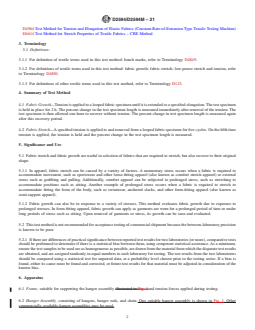
6.2 Hanger Assembly, consisting of hangers, hanger rods, and chain. One suitable hanger assembly is shown in Fig. 1. Other
commercially available hanger assemblies may be used.
D2594/D2594M − 21
FIG. 1 Hanger Assembly
6.3 Lightweight Rule, fitted with a pin hook at the zero point of the scale for attachment to the specimen, graduated either in units
of percent of original gage length of 125 mm (5 in.)[5 in.] or in units of 1 mm ([ ⁄16 in.).in.].
6.4 Tensiometer or Weights, that can be attached to the bottom hanger of the hanger assembly, capable of providing total tensions
of 2.27 kgf (5 lbf)[5 lbf] and 4.54 kgf (10 lbf)[10 lbf] to the specimen, 6 1 %.61 %.
6.5 Turnbuckle, or equivalent, having a length of 25 to 75 mm (1[1 to 3 in.).in.].
6.6 Sanforized Marker, to establish bench marks on the specimen.
6.7 Timer, with increments of at least 1 min.
7. Sampling and Test Specs
7.1 Primary Sampling Unit—Consider rolls of fabric, fabric components of fabricated systems, or garments to be the primary
sampling unit, as applicable.
7.2 Laboratory Sampling Unit—As a laboratory sampling unit take from rolls at least one full-width piece of fabric that is 2 m
(2 yd)[2 yd] in length along the selvage (machine direction), after removing a first 1 mm (1 yd)[1 yd] length. For fabric components
of fabricated systems use the entire system. For garments use the entire garment.
7.3 Test Specimens—From each laboratory sampling unit, cut 6 wale-wise (lengthwise) and 6 course-wise (widthwise) test
specimens 125 6 3 mm (5[5 6 0.1 in.)in.] by 400 6 10 mm (15.5[15.5 6 0.3 in.).in.]. Cut the long dimension of the wale-wise
specimens parallel to the wale direction and the course-wise specimens parallel to the course direction. In cases where the fabric
is designed to primarlyprimarily stretch in one direction, testing is only required in the intended stretch direction. Take specimens
representing a broad distribution from different positions diagonally across the width of the laboratory sampling unit. Consider the
long direction as the direction of test. Label to maintain specimen identity.
7.3.1 For fabric widths 125 mm (5 in.)[5 in.] or more, take no specimen closer than 25 mm (1 in.)[1 in.] from the edges of the
laboratory sampling unit.
7.3.2 For fabric widths less than 125 mm (5 in.),[5 in.], use the entire width of the laboratory sampling unit for specimens.
7.3.3 Garment samples may not allow for 125 mm specimen widths; use available width.
7.3.4 For fabric and lengths less than 400 6 10 mm (15.5[15.5 6 0.3 in),in.], use the longest available length from the sampling
unit. In this case, distances between benchmarks may be measured with a metric rule.
D2594/D2594M − 21
7.3.5 Garment samples may not allow for 400 mm specimen lengths. Use available length. Ensure specimens are free of folds,
creases, or wrinkles. Avoid getting oil, water, grease, etc., on the specimens when handling.
7.3.6 If the fabric has a pattern, ensure that the specimens are a representative sampling of the pattern.
7.3.7 After cutting, fold each specimen in half lengthwise forming a loop and sew the edges opposite the fold together 6 to 13
mm (0.25[0.25 to 0.50 in.)in.] from the cut edges and parallel to the short direction of the specimen. Use sewing thread and stitch
type as agreed upon. Different threads and stitch types may give different results.
7.3.8 Lay the specimen on a flat surface and place bench marks 125 6 3 mm (5[5 6 0.01 in.)in.] apart on the central section of
one face of the looped specimen establishing a gage length along the length of the specimen. Record as measurement (A).(A).
8. Conditioning
8.1 Bring the test specimens to moisture equilibrium for testing in the standard atmosphere for testing textiles as directed in
Practice D1776, or if applicable, in the specified atmosphere in which the testing is to be performed.
9. Preparation of Test Apparatus and Calibration
9.1 Verify measuring scales and tension weights are withi
...