

ASTM D7447-08(2023)
(Practice)Standard Practice for Symbolizing Adhesive Applications
General Information
- Abstract
SIGNIFICANCE AND USE
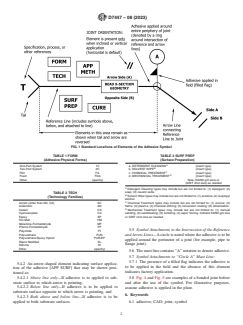
3.1 An adhesive symbol provides an efficient means of placing complete information about adhesives on engineering drawings. The joint is the basis of reference for the symbol to which the arrow line is pointed. The reference line of the symbol is used to designate the type of adhesive to be used, including information about its physical form, chemical technology family, requirements for surface preparation, application method (bead versus roll coat), and cure method. The optional tail (shown at left in Fig. 1) provides a place to include additional information about the adhesive that is not referenced in other notations.
FIG. 1 Standard Locations of Elements of the Adhesive Symbol
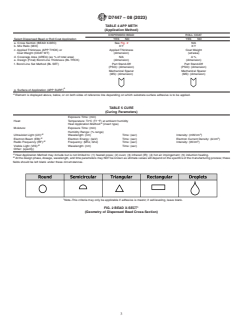
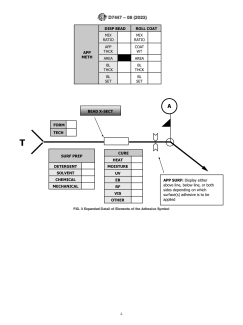
3.2 Refer to Fig. 1 for an overview schematic of the adhesive symbol denoted by a mast supporting a circle with the letter “A” inside for adhesive. Detail behind each of the elements noted (for example, FORM, CHEM, APPL METH) can be found in corresponding tables in Section 5.
SCOPE
1.1 This practice covers a standard symbol that may be used by the design-engineering community on engineering drawings to indicate a bonded assembly for any type of adhesive.
1.2 This design is based on criteria contained in ANSI/AWS A2.4 as well as ISO 15785.
1.3 The values given in SI units are to be regarded as the standard. The values in parentheses are for information only.
1.4 This standard does not purport to address all of the safety concerns, if any, associated with its use. It is the responsibility of the user of this standard to establish appropriate safety, health, and environmental practices and determine the applicability of regulatory limitations prior to use.
1.5 This international standard was developed in accordance with internationally recognized principles on standardization established in the Decision on Principles for the Development of International Standards, Guides and Recommendations issued by the World Trade Organization Technical Barriers to Trade (TBT) Committee.
- Status
- Published
- Publication Date
- 31-Dec-2022
- Technical Committee
- D14 - Adhesives
- Drafting Committee
- D14.60 - Adhesive Material Classification System
Overview
ASTM D7447-08(2023): Standard Practice for Symbolizing Adhesive Applications establishes a unified method for representing adhesive usage on engineering drawings. Developed by ASTM International, this standard helps the design and engineering community efficiently convey comprehensive information about adhesives used in bonded assemblies. By adopting standardized adhesive symbols, stakeholders can ensure clear, consistent communication across design, manufacturing, and quality assurance functions.
This standard is aligned with internationally recognized principles and references both ANSI/AWS A2.4 (Symbols for Welding and Nondestructive Testing) and ISO 15785 (Technical Drawings-Symbolic Presentation and Indication of Adhesive, Fold, and Pressed Joints).
Key Topics
ASTM D7447-08(2023) covers the following key areas:
- Standard Adhesive Symbol: A graphical symbol based on a circle with an ‘A’ (for adhesive), supported by a mast, connected to an arrow and reference line, which directs attention to the joint on the drawing.
- Information Conveyed: The reference line accommodates detailed information such as:
- Physical form (for example, one- or two-part systems, film, foam)
- Chemical technology family (e.g., epoxy, polyurethane)
- Surface preparation requirements (detergent cleaning, solvent wipe, chemical or mechanical treatment)
- Application method (dispensed bead, roll coat)
- Cure method (heat, moisture, UV, electron beam, RF, visible light)
- Optional Tail Element: Additional information not included in the main symbol can be placed in the tail, such as manufacturer specifications or special process notes.
- Bond Joint Orientation: Indicates joint orientation (horizontal, vertical, or inclined) for proper adhesive application.
- Attachment Points: Shows precisely where the adhesive is to be applied, including perimeter or substrate surfaces.
- Field versus Factory Application: A filled flag denotes field application; absence indicates factory or plant application.
Applications
Implementing ASTM D7447-08(2023) delivers practical benefits across various industries and project stages, including:
- Design and Engineering: Streamlines the specification of adhesive requirements directly on CAD drawings, enhancing clarity for downstream processes.
- Manufacturing and Assembly: Supports operators and technicians by precisely indicating where and how to apply adhesives, including details on preparation, application, and curing.
- Quality Assurance: Enables robust inspection and verification processes by providing unambiguous, standardized references for adhesive joints.
- Procurement and Specification: Facilitates accurate communication with suppliers and subcontractors through consistent, internationally recognized notations.
This standard is applicable in automotive, aerospace, electronics, construction, and general manufacturing where adhesive bonding is a key assembly method.
Related Standards
For a comprehensive approach to adhesive symbolization and documentation, consider the following related standards:
- ANSI/AWS A2.4: Symbols for Welding and Nondestructive Testing-basis for the symbolic design approach in ASTM D7447.
- ISO 15785: Technical Drawings-Symbolic Presentation and Indication of Adhesive, Fold, and Pressed Joints-international reference standard for adhesive symbols.
- Additional ASTM adhesive standards, such as those covering adhesive classification, testing, and performance evaluation.
By using ASTM D7447-08(2023) in tandem with these standards, organizations can achieve thorough, effective communication and documentation of adhesive applications in engineering and manufacturing workflows.
Get Certified
Connect with accredited certification bodies for this standard

DIN CERTCO
DIN Group product certification.

Smithers Quality Assessments
US management systems and product certification.
Sponsored listings
Frequently Asked Questions
ASTM D7447-08(2023) is a standard published by ASTM International. Its full title is "Standard Practice for Symbolizing Adhesive Applications". This standard covers: SIGNIFICANCE AND USE 3.1 An adhesive symbol provides an efficient means of placing complete information about adhesives on engineering drawings. The joint is the basis of reference for the symbol to which the arrow line is pointed. The reference line of the symbol is used to designate the type of adhesive to be used, including information about its physical form, chemical technology family, requirements for surface preparation, application method (bead versus roll coat), and cure method. The optional tail (shown at left in Fig. 1) provides a place to include additional information about the adhesive that is not referenced in other notations. FIG. 1 Standard Locations of Elements of the Adhesive Symbol 3.2 Refer to Fig. 1 for an overview schematic of the adhesive symbol denoted by a mast supporting a circle with the letter “A” inside for adhesive. Detail behind each of the elements noted (for example, FORM, CHEM, APPL METH) can be found in corresponding tables in Section 5. SCOPE 1.1 This practice covers a standard symbol that may be used by the design-engineering community on engineering drawings to indicate a bonded assembly for any type of adhesive. 1.2 This design is based on criteria contained in ANSI/AWS A2.4 as well as ISO 15785. 1.3 The values given in SI units are to be regarded as the standard. The values in parentheses are for information only. 1.4 This standard does not purport to address all of the safety concerns, if any, associated with its use. It is the responsibility of the user of this standard to establish appropriate safety, health, and environmental practices and determine the applicability of regulatory limitations prior to use. 1.5 This international standard was developed in accordance with internationally recognized principles on standardization established in the Decision on Principles for the Development of International Standards, Guides and Recommendations issued by the World Trade Organization Technical Barriers to Trade (TBT) Committee.
SIGNIFICANCE AND USE 3.1 An adhesive symbol provides an efficient means of placing complete information about adhesives on engineering drawings. The joint is the basis of reference for the symbol to which the arrow line is pointed. The reference line of the symbol is used to designate the type of adhesive to be used, including information about its physical form, chemical technology family, requirements for surface preparation, application method (bead versus roll coat), and cure method. The optional tail (shown at left in Fig. 1) provides a place to include additional information about the adhesive that is not referenced in other notations. FIG. 1 Standard Locations of Elements of the Adhesive Symbol 3.2 Refer to Fig. 1 for an overview schematic of the adhesive symbol denoted by a mast supporting a circle with the letter “A” inside for adhesive. Detail behind each of the elements noted (for example, FORM, CHEM, APPL METH) can be found in corresponding tables in Section 5. SCOPE 1.1 This practice covers a standard symbol that may be used by the design-engineering community on engineering drawings to indicate a bonded assembly for any type of adhesive. 1.2 This design is based on criteria contained in ANSI/AWS A2.4 as well as ISO 15785. 1.3 The values given in SI units are to be regarded as the standard. The values in parentheses are for information only. 1.4 This standard does not purport to address all of the safety concerns, if any, associated with its use. It is the responsibility of the user of this standard to establish appropriate safety, health, and environmental practices and determine the applicability of regulatory limitations prior to use. 1.5 This international standard was developed in accordance with internationally recognized principles on standardization established in the Decision on Principles for the Development of International Standards, Guides and Recommendations issued by the World Trade Organization Technical Barriers to Trade (TBT) Committee.
ASTM D7447-08(2023) is classified under the following ICS (International Classification for Standards) categories: 83.180 - Adhesives. The ICS classification helps identify the subject area and facilitates finding related standards.
ASTM D7447-08(2023) is available in PDF format for immediate download after purchase. The document can be added to your cart and obtained through the secure checkout process. Digital delivery ensures instant access to the complete standard document.
Standards Content (Sample)
This international standard was developed in accordance with internationally recognized principles on standardization established in the Decision on Principles for the
Development of International Standards, Guides and Recommendations issued by the World Trade Organization Technical Barriers to Trade (TBT) Committee.
Designation: D7447 − 08 (Reapproved 2023)
Standard Practice for
Symbolizing Adhesive Applications
This standard is issued under the fixed designation D7447; the number immediately following the designation indicates the year of
original adoption or, in the case of revision, the year of last revision. A number in parentheses indicates the year of last reapproval. A
superscript epsilon (´) indicates an editorial change since the last revision or reapproval.
1. Scope nology family, requirements for surface preparation, applica-
tion method (bead versus roll coat), and cure method. The
1.1 This practice covers a standard symbol that may be used
optionaltail(shownatleftinFig.1)providesaplacetoinclude
bythedesign-engineeringcommunityonengineeringdrawings
additional information about the adhesive that is not referenced
to indicate a bonded assembly for any type of adhesive.
in other notations.
1.2 This design is based on criteria contained inANSI/AWS
3.2 Refer to Fig. 1 for an overview schematic of the
A2.4 as well as ISO 15785.
adhesivesymboldenotedbyamastsupportingacirclewiththe
1.3 The values given in SI units are to be regarded as the
letter “A” inside for adhesive. Detail behind each of the
standard. The values in parentheses are for information only.
elements noted (for example, FORM, CHEM, APPL METH)
1.4 This standard does not purport to address all of the
can be found in corresponding tables in Section 5.
safety concerns, if any, associated with its use. It is the
responsibility of the user of this standard to establish appro-
4. Elements of the Adhesive Symbol
priate safety, health, and environmental practices and deter-
4.1 The elements represented in Fig. 1 are explained in
mine the applicability of regulatory limitations prior to use.
greater detail in Tables 1-5 and Fig. 2.
1.5 This international standard was developed in accor-
dance with internationally recognized principles on standard-
4.2 Fig. 3 illustrates an expanded view of the parameters
ization established in the Decision on Principles for the
detailed in the tables described in Tables 1-5 and Fig. 2.
Development of International Standards, Guides and Recom-
mendations issued by the World Trade Organization Technical
5. References and Other Notations
Barriers to Trade (TBT) Committee.
5.1 Symbols With References—When specifications,
2. Referenced Documents
processes, or other references are used with the adhesive
symbol, the notation is placed in the tail (see “T” symbol in
2.1 ANSI/AWS Standard:
Fig. 1 or Fig. 3). This notation may reflect information about a
ANSI/AWS A2.4 Symbols for Welding and Nondestructive
particular manufacturer’s product or other pertinent data not
Testing
contained in the symbol elements.
2.2 ISO Standard:
ISO15785 TechnicalDrawings—SymbolicPresentationand
5.2 Symbols Without References—Symbols may be used
Indication of Adhesive, Fold and Pressed Joints
without specifications, processes, or other references when:
5.2.1 A note appears on the drawing: “Unless otherwise
3. Significance and Use
designated, all adhesive bonds are to be made in accordance
3.1 An adhesive symbol provides an efficient means of
with Specification No .”
placing complete information about adhesives on engineering
5.2.2 The bonding procedure to be used is described else-
drawings. The joint is the basis of reference for the symbol to
where such as in shop instructions and process sheets: “Refer
which the arrow line is pointed. The reference line of the
to Instruction for bonding procedure.”
symbol is used to designate the type of adhesive to be used,
5.3 OrientationofBondJoint—The horizontal orientation is
including information about its physical form, chemical tech-
default (“parallel line” element should be omitted) or the
element is present only when either inclined or vertical:
This practice is under the jurisdiction of ASTM Committee D14 on Adhesives
5.3.1 If vertical orientation, display lines as “| |” or
and is the direct responsibility of Subcommittee D14.60 on Adhesive Material
Classification System.
5.3.2 If inclined orientation, display lines as “//.”
Current edition approved Jan. 1, 2023. Published January 2023. Originally
approved in 2008. Last previous edition approved in 2014 as D7447 – 08 (2014).
5.4 Symbol Attachments to the Reference Line:
DOI: 10.1520/D7447-08R23.
5.4.1 Geometry of cross section of the dispensed bead style
Available from American National Standards Institute (ANSI), 25 W. 43rd St.,
4th Floor, New York, NY 10036, http://www.ansi.org. [BEAD X-SECT] and
Copyright © ASTM International, 100 Barr Harbor Drive, PO Box C700, West Conshohocken, PA 19428-2959. United States
D7447 − 08 (2023)
FIG. 1 Standard Locations of Elements of the Adhesive Symbol
TABLE 1 FORM TABLE 3 SURF PREP
(Adhesive Physical Forms) (Surface Preparation)
A
One-Part System 1C a. DETERGENT CLEANING (insert type)
B
Two-Part System 2C b. SOLVENT WIPE (insert type)
C
Film FIL c. CHEMICAL TREATMENT (insert type)
D
Foam FOA d. MECHANICAL TREATMENT (insert type)
Other (specify) Note (SAND grit size) or
(GRIT shot size) as needed
A
Detergent Cleaning types may include but are not limited to: (1) detergent; (2)
soap; (3) caustic soda.
TABLE 2 TECH
B
Solvent Wipe types may incl
...