

ASTM D1876-08(2023)
(Test Method)Standard Test Method for Peel Resistance of Adhesives (T-Peel Test)
General Information
- Abstract
ABSTRACT
This test method is primarily intended for determining the relative peel resistance of adhesive bonds between flexible adherends by means of a T-type specimen using a tension testing machine. The bent, unbonded ends of the test specimen shall be clamped in the test grips of the tension testing machine and a load of a constant head speed shall be applied. An autographic recording of the load versus the head movement or load versus distance peeled shall be made. The peel resistance over a specified length of the bond line after the initial peak shall be determined.
SCOPE
1.1 This test method is primarily intended for determining the relative peel resistance of adhesive bonds between flexible adherends by means of a T-type specimen.
1.2 The values stated in SI units are to be regarded as the standard. The values given in parentheses are provided for information purposes only.
1.3 This standard does not purport to address all of the safety concerns, if any, associated with its use. It is the responsibility of the user of this standard to establish appropriate safety, health, and environmental practices and determine the applicability of regulatory limitations prior to use.
1.4 This international standard was developed in accordance with internationally recognized principles on standardization established in the Decision on Principles for the Development of International Standards, Guides and Recommendations issued by the World Trade Organization Technical Barriers to Trade (TBT) Committee.
- Status
- Published
- Publication Date
- 30-Apr-2023
- Technical Committee
- D14 - Adhesives
- Drafting Committee
- D14.80 - Metal Bonding Adhesives


Overview
ASTM D1876-08(2023), Standard Test Method for Peel Resistance of Adhesives (T-Peel Test), is a widely recognized international standard developed by ASTM International. This test method is designed to determine the relative peel resistance of adhesive bonds formed between flexible adherends using a T-type specimen in a tension testing machine. By providing defined procedures and conditions, this standard ensures objective and reproducible measurements for the peel strength of adhesives, supporting quality assurance, product development, and specification compliance in adhesive bonding technologies.
Key Topics
- Peel Resistance Measurement: Focuses on testing the relative strength required to separate two flexible adherends bonded by an adhesive, using a T-peel configuration under controlled conditions.
- T-Peel Test Procedure: Involves clamping the bent, unbonded ends of a specimen in a tension testing machine and applying a constant speed load. An autographic recording of load versus displacement provides a precise measure of peel resistance.
- Specimen Preparation and Conditioning: Emphasizes the importance of detailed information regarding surface preparation, adhesive mixing, bonding, curing, and specimen conditioning conditions, as specified by the adhesive manufacturer.
- Result Reporting: Standardizes the reporting format, including adhesive identification, adherend details, bonding process, test results, and failure types, thus supporting traceability and data comparability.
Applications
ASTM D1876-08(2023) is critical in a range of industrial and research environments where flexible materials are bonded with adhesives. Key applications include:
- Quality Control: Used by manufacturers to ensure adhesive bonds meet required peel strength specifications for product reliability and safety.
- Research & Development: Assists in comparing the performance of different adhesives and bonding processes by providing a consistent testing framework.
- Product Certification and Compliance: Supports the verification of adhesive products in compliance with contractual or regulatory requirements.
- Material Comparison: Facilitates direct comparison between various adhesives and substrates, such as metals, plastics, coated fabrics, and films, when tested under identical conditions.
- Failure Analysis: Helps in evaluating the type and location of bond failure, offering insights into adhesive and substrate performance attributes.
Related Standards
- ASTM D907 - Terminology of Adhesives: Provides definitions of terms commonly used in adhesive testing and applications.
- ASTM B209/B209M - Specification for Aluminum and Aluminum-Alloy Sheet and Plate (Metric): Frequently referenced for testing with aluminum adherends.
- ISO and Industry Standards - Many international adhesive test methods and standards (such as ISO 8510-2) align conceptually with ASTM D1876.
ASTM D1876-08(2023) is maintained and regularly reviewed by ASTM Committee D14 on Adhesives and meets internationally recognized requirements for standardization, including principles set by the World Trade Organization Technical Barriers to Trade (TBT) Committee. Its widespread use promotes consistency, safety, and innovation in adhesive applications worldwide.
Keywords: T-Peel Test, peel resistance, adhesive bonding, flexible adherends, ASTM D1876, tension testing machine, adhesive strength testing, quality control, bond failure analysis, international standards for adhesives.
Relations
- Effective Date
- 01-Jul-2012
- Effective Date
- 01-May-2012
- Effective Date
- 01-Dec-2011
- Effective Date
- 01-Jan-2011
- Effective Date
- 01-Nov-2010
- Effective Date
- 01-Oct-2008
- Effective Date
- 15-Aug-2008
- Effective Date
- 01-Mar-2008
- Effective Date
- 01-Aug-2007
- Effective Date
- 01-Dec-2006
- Effective Date
- 01-Jul-2006
- Effective Date
- 01-Apr-2005
- Effective Date
- 01-Apr-2005
- Effective Date
- 01-Dec-2004
- Effective Date
- 01-Apr-2004
Get Certified
Connect with accredited certification bodies for this standard

DIN CERTCO
DIN Group product certification.

Smithers Quality Assessments
US management systems and product certification.
Sponsored listings
Frequently Asked Questions
ASTM D1876-08(2023) is a standard published by ASTM International. Its full title is "Standard Test Method for Peel Resistance of Adhesives (T-Peel Test)". This standard covers: ABSTRACT This test method is primarily intended for determining the relative peel resistance of adhesive bonds between flexible adherends by means of a T-type specimen using a tension testing machine. The bent, unbonded ends of the test specimen shall be clamped in the test grips of the tension testing machine and a load of a constant head speed shall be applied. An autographic recording of the load versus the head movement or load versus distance peeled shall be made. The peel resistance over a specified length of the bond line after the initial peak shall be determined. SCOPE 1.1 This test method is primarily intended for determining the relative peel resistance of adhesive bonds between flexible adherends by means of a T-type specimen. 1.2 The values stated in SI units are to be regarded as the standard. The values given in parentheses are provided for information purposes only. 1.3 This standard does not purport to address all of the safety concerns, if any, associated with its use. It is the responsibility of the user of this standard to establish appropriate safety, health, and environmental practices and determine the applicability of regulatory limitations prior to use. 1.4 This international standard was developed in accordance with internationally recognized principles on standardization established in the Decision on Principles for the Development of International Standards, Guides and Recommendations issued by the World Trade Organization Technical Barriers to Trade (TBT) Committee.
ABSTRACT This test method is primarily intended for determining the relative peel resistance of adhesive bonds between flexible adherends by means of a T-type specimen using a tension testing machine. The bent, unbonded ends of the test specimen shall be clamped in the test grips of the tension testing machine and a load of a constant head speed shall be applied. An autographic recording of the load versus the head movement or load versus distance peeled shall be made. The peel resistance over a specified length of the bond line after the initial peak shall be determined. SCOPE 1.1 This test method is primarily intended for determining the relative peel resistance of adhesive bonds between flexible adherends by means of a T-type specimen. 1.2 The values stated in SI units are to be regarded as the standard. The values given in parentheses are provided for information purposes only. 1.3 This standard does not purport to address all of the safety concerns, if any, associated with its use. It is the responsibility of the user of this standard to establish appropriate safety, health, and environmental practices and determine the applicability of regulatory limitations prior to use. 1.4 This international standard was developed in accordance with internationally recognized principles on standardization established in the Decision on Principles for the Development of International Standards, Guides and Recommendations issued by the World Trade Organization Technical Barriers to Trade (TBT) Committee.
ASTM D1876-08(2023) is classified under the following ICS (International Classification for Standards) categories: 83.180 - Adhesives. The ICS classification helps identify the subject area and facilitates finding related standards.
ASTM D1876-08(2023) has the following relationships with other standards: It is inter standard links to ASTM D907-12a, ASTM D907-12, ASTM D907-11a, ASTM D907-11, ASTM B209-10, ASTM D907-08b, ASTM D907-08a, ASTM D907-08, ASTM B209-07, ASTM D907-06, ASTM B209-06, ASTM D907-05e1, ASTM D907-05, ASTM D907-04a, ASTM D907-04. Understanding these relationships helps ensure you are using the most current and applicable version of the standard.
ASTM D1876-08(2023) is available in PDF format for immediate download after purchase. The document can be added to your cart and obtained through the secure checkout process. Digital delivery ensures instant access to the complete standard document.
Standards Content (Sample)
This international standard was developed in accordance with internationally recognized principles on standardization established in the Decision on Principles for the
Development of International Standards, Guides and Recommendations issued by the World Trade Organization Technical Barriers to Trade (TBT) Committee.
Designation: D1876 − 08 (Reapproved 2023)
Standard Test Method for
Peel Resistance of Adhesives (T-Peel Test)
This standard is issued under the fixed designation D1876; the number immediately following the designation indicates the year of
original adoption or, in the case of revision, the year of last revision. A number in parentheses indicates the year of last reapproval. A
superscript epsilon (´) indicates an editorial change since the last revision or reapproval.
This standard has been approved for use by agencies of the U.S. Department of Defense.
INTRODUCTION
The accuracy of the results of strength tests of adhesive bonds will depend on the conditions under
which the bonding process is carried out. Unless otherwise agreed upon by the manufacturer and the
purchaser, the bonding conditions shall be prescribed by the manufacturer of the adhesive. In order to
ensure that complete information is available to the individual conducting the tests, the manufacturer
of the adhesive shall furnish numerical values and other specific information for each of the following
variables:
(1) Procedure for preparation of the surfaces prior to application of the adhesive, the cleaning and
drying of metal surfaces, and special surface treatments such as sanding, which are not specifically
limited by the pertinent test method.
(2) Complete mixing directions for the adhesive.
(3) Conditions for application of the adhesive, including the rate of spread or thickness of film,
number of coats to be applied, whether to be applied to one or both surfaces, and the conditions of
drying where more than one coat is required.
(4) Assembly conditions before application of pressure, including the room temperature, length of
time, and whether open or closed assembly is to be used.
(5) Curing conditions, including the amount of pressure to be applied, the length of time under
pressure, and the temperature of the assembly when under pressure. It should be stated whether this
temperature is that of the glue line, or of the atmosphere at which the assembly is to be maintained.
(6) Conditioning procedure before testing, unless a standard procedure is specified, including the
length of time, temperature, and relative humidity.
A range may be prescribed for any variable by the manufacturer of the adhesive, if it can be assumed
by the test operator that any arbitrarily chosen value within such a range or any combination of such
values for several variables will be acceptable to both the manufacturer and the purchaser of the
adhesive.
1. Scope 1.3 This standard does not purport to address all of the
safety concerns, if any, associated with its use. It is the
1.1 This test method is primarily intended for determining
responsibility of the user of this standard to establish appro-
the relative peel resistance of adhesive bonds between flexible
priate safety, health, and environmental practices and deter-
adherends by means of a T-type specimen.
mine the applicability of regulatory limitations prior to use.
1.2 The values stated in SI units are to be regarded as the
1.4 This international standard was developed in accor-
standard. The values given in parentheses are provided for
dance with internationally recognized principles on standard-
information purposes only.
ization established in the Decision on Principles for the
Development of International Standards, Guides and Recom-
This test method is under the jurisdiction of ASTM Committee D14 on
mendations issued by the World Trade Organization Technical
Adhesives and is the direct responsibility of D14.80 on Metal Bonding Adhesives.
Current edition approved May 1, 2023. Published May 2023. Originally Barriers to Trade (TBT) Committee.
ɛ1
approved in 1961. Last previous edition approved in 2015 as D1876 – 08 (2015) .
DOI: 10.1520/D1876-08R23.
Copyright © ASTM International, 100 Barr Harbor Drive, PO Box C700, West Conshohocken, PA 19428-2959. United States
D1876 − 08 (2023)
2. Referenced Documents 4.1.2 The rate of movement between heads essentially
2 constant under fluctuating loads.
2.1 ASTM Standards:
B209 Specification for Aluminum and Aluminum-Alloy
NOTE 1—It is difficult to meet this requirement when loads are
measured with a spring-type or pendulum-type weighing device.
Sheet and Plate (Metric) B0209_B0209M
D907 Terminology of Adhesives
4.1.3 The machine equipped with suitable grips capable of
clamping the specimens firmly and without slippage through-
3. Terminology
out the tests.
3.1 Definitions:
4.1.4 The machine shall be autographic, giving a chart that
3.1.1 Many terms in this test method are defined in Termi-
can be read in terms of inches of separation as one coordinate
nology D907.
and applied load as the other coordinate.
3.1.2 peel strength, n—the average load per unit width of
4.1.5 The applied tension as measured and recorded accu-
bondline required to separate progressively a flexible member
rate to 61 % of any reading when calibrated in compliance
from a rigid member or another flexible member.
with Practices requirements.
3.1.2.1 Discussion—Flexible has different meanings in dif-
4.2 Conditioning Room or Desiccators—The conditioning
ferent peel tests, such as “T,” 180-degree, floating-roller, or
room or desiccators (Note 2) shall be capable of maintaining a
climbing-drum. The angle between the members varies with
relative humidity of 50 % 6 2 % at 23 °C 6 1 °C (73.4 °F 6
the type of peel test.
1.8 °F).
3.2 Definitions of Terms Specific to This Standard:
NOTE 2—A saturated solution of calcium nitrate will give approxi-
3.2.1 flexible, adj—indicates that the adherends shall have
mately 51 % relative humidity at the testing temperature.
such dimensions and physical properties as to permit bending
5. Test Specimen
them through any angle up to 90° without breaking or cracking.
3.2.2 T-peel strength, n—the average load per unit width of
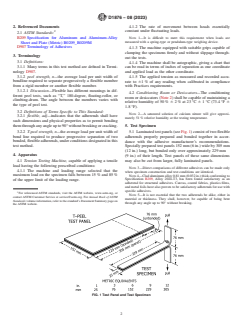
5.1 Laminated test panels (see Fig. 1) consist of two flexible
bond line required to produce progressive separation of two adherends properly prepared and bonded together in accor-
bonded, flexible adherends, under conditions designated in this
dance with the adhesive manufacturer’s recommendations.
test method. Specially prepared test panels 152 mm (6 in.) wide by 305 mm
(12 in.) long, but bonded only over approximately 229 mm
4. Apparatus
(9 in.) of their length. Test panels of these same dimensions
4.1 Tension Testing Machine, capable of applying a tensile may also be cut from larger, fully laminated panels.
load having the following prescribed
...