


ASTM D2789-95(2011)
(Test Method)Standard Test Method for Hydrocarbon Types in Low Olefinic Gasoline by Mass Spectrometry
Standard Test Method for Hydrocarbon Types in Low Olefinic Gasoline by Mass Spectrometry
SIGNIFICANCE AND USE
A knowledge of the hydrocarbon composition of gasoline process streams, blending stocks and finished motor fuels is useful in following the effect of changes in plant operating conditions, diagnosing process upsets, blending finished products and in evaluating the relationship between composition and performance properties.
SCOPE
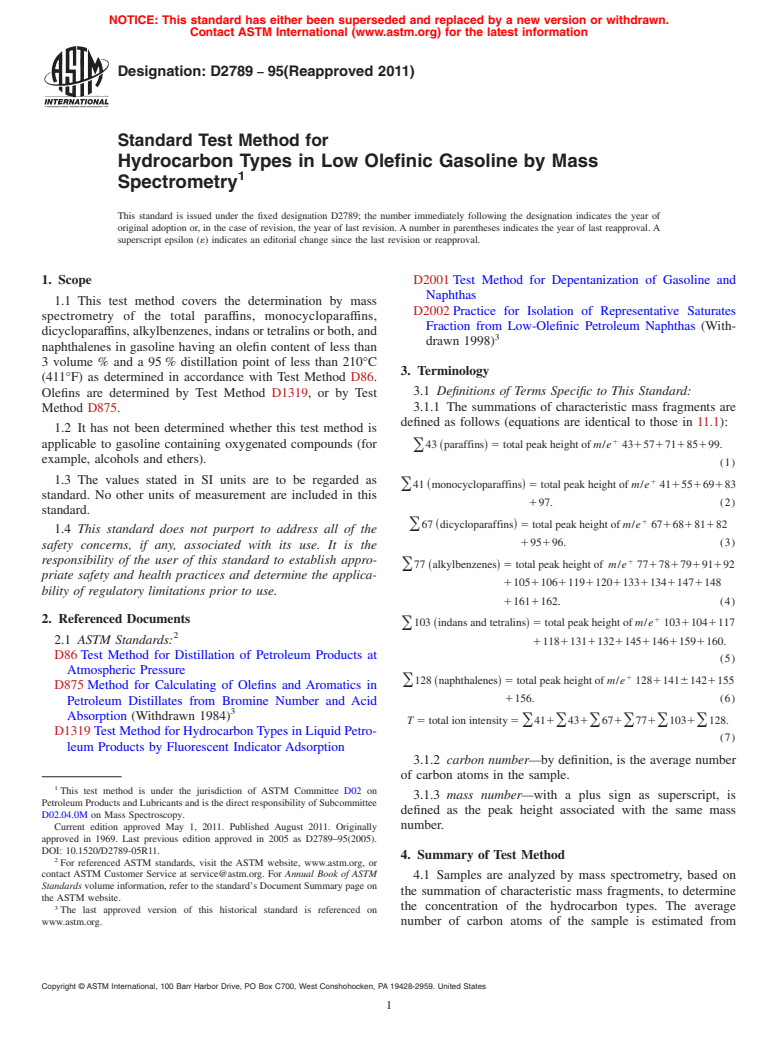
1.1 This test method covers the determination by mass spectrometry of the total paraffins, monocycloparaffins, dicycloparaffins, alkylbenzenes, indans or tetralins or both, and naphthalenes in gasoline having an olefin content of less than 3 volume % and a 95 % distillation point of less than 210°C (411°F) as determined in accordance with Test Method D86. Olefins are determined by Test Method D1319, or by Test Method D875.
1.2 It has not been determined whether this test method is applicable to gasoline containing oxygenated compounds (for example, alcohols and ethers).
1.3 The values stated in SI units are to be regarded as standard. No other units of measurement are included in this standard.
1.4 This standard does not purport to address all of the safety concerns, if any, associated with its use. It is the responsibility of the user of this standard to establish appropriate safety and health practices and determine the applicability of regulatory limitations prior to use.
General Information
Relations
Standards Content (Sample)
NOTICE: This standard has either been superseded and replaced by a new version or withdrawn.
Contact ASTM International (www.astm.org) for the latest information
Designation:D2789 −95(Reapproved 2011)
Standard Test Method for
Hydrocarbon Types in Low Olefinic Gasoline by Mass
1
Spectrometry
This standard is issued under the fixed designation D2789; the number immediately following the designation indicates the year of
original adoption or, in the case of revision, the year of last revision. A number in parentheses indicates the year of last reapproval. A
superscript epsilon (´) indicates an editorial change since the last revision or reapproval.
1. Scope D2001 Test Method for Depentanization of Gasoline and
Naphthas
1.1 This test method covers the determination by mass
D2002 Practice for Isolation of Representative Saturates
spectrometry of the total paraffins, monocycloparaffins,
Fraction from Low-Olefinic Petroleum Naphthas (With-
dicycloparaffins, alkylbenzenes, indans or tetralins or both, and
3
drawn 1998)
naphthalenes in gasoline having an olefin content of less than
3 volume % and a 95 % distillation point of less than 210°C
3. Terminology
(411°F) as determined in accordance with Test Method D86.
Olefins are determined by Test Method D1319,orbyTest 3.1 Definitions of Terms Specific to This Standard:
3.1.1 The summations of characteristic mass fragments are
Method D875.
defined as follows (equations are identical to those in 11.1):
1.2 It has not been determined whether this test method is
1
applicable to gasoline containing oxygenated compounds (for 43 paraffins 5 total peak height of m/e 43157171185199.
~ !
(
example, alcohols and ethers).
(1)
1.3 The values stated in SI units are to be regarded as 1
41 ~monocycloparaffins! 5 total peak height of m/e 41155169183
(
standard. No other units of measurement are included in this
197. (2)
standard.
1
67 ~dicycloparaffins! 5 total peak height of m/e 67168181182
(
1.4 This standard does not purport to address all of the
195196. (3)
safety concerns, if any, associated with its use. It is the
responsibility of the user of this standard to establish appro- 1
77 alkylbenzenes 5 total peak height of m/e 77178179191192
~ !
(
priate safety and health practices and determine the applica-
11051106111911201133113411471148
bility of regulatory limitations prior to use.
11611162. (4)
2. Referenced Documents 1
103 ~indans and tetralins! 5 total peak height of m/e 10311041117
(
2
2.1 ASTM Standards:
1118113111321145114611591160.
D86 Test Method for Distillation of Petroleum Products at
(5)
Atmospheric Pressure
1
128 naphthalenes 5 total peak height of m/e 128114161421155
~ !
(
D875 Method for Calculating of Olefins and Aromatics in
1156. (6)
Petroleum Distillates from Bromine Number and Acid
3
Absorption (Withdrawn 1984)
T 5 total ion intensity 5 411 431 671 771 1031 128.
( ( ( ( ( (
D1319 Test Method for Hydrocarbon Types in Liquid Petro-
(7)
leum Products by Fluorescent Indicator Adsorption
3.1.2 carbon number—by definition, is the average number
of carbon atoms in the sample.
1
This test method is under the jurisdiction of ASTM Committee D02 on
3.1.3 mass number—with a plus sign as superscript, is
Petroleum Products and Lubricants and is the direct responsibility of Subcommittee
defined as the peak height associated with the same mass
D02.04.0M on Mass Spectroscopy.
Current edition approved May 1, 2011. Published August 2011. Originally number.
approved in 1969. Last previous edition approved in 2005 as D2789–95(2005).
DOI: 10.1520/D2789-05R11.
4. Summary of Test Method
2
For referenced ASTM standards, visit the ASTM website, www.astm.org, or
contact ASTM Customer Service at service@astm.org. For Annual Book of ASTM
4.1 Samples are analyzed by mass spectrometry, based on
Standards volume information, refer to the standard’s Document Summary page on
the summation of characteristic mass fragments, to determine
the ASTM website.
3
the concentration of the hydrocarbon types. The average
The last approved version of this historical standard is referenced on
www.astm.org. number of carbon atoms of the sample is estimated from
Copyright © ASTM International, 100 Barr Harbor Drive, PO Box C700, West Conshohocken, PA 19428-2959. United States
1
---------------------- Page: 1 ----------------------
D2789−95 (2011)
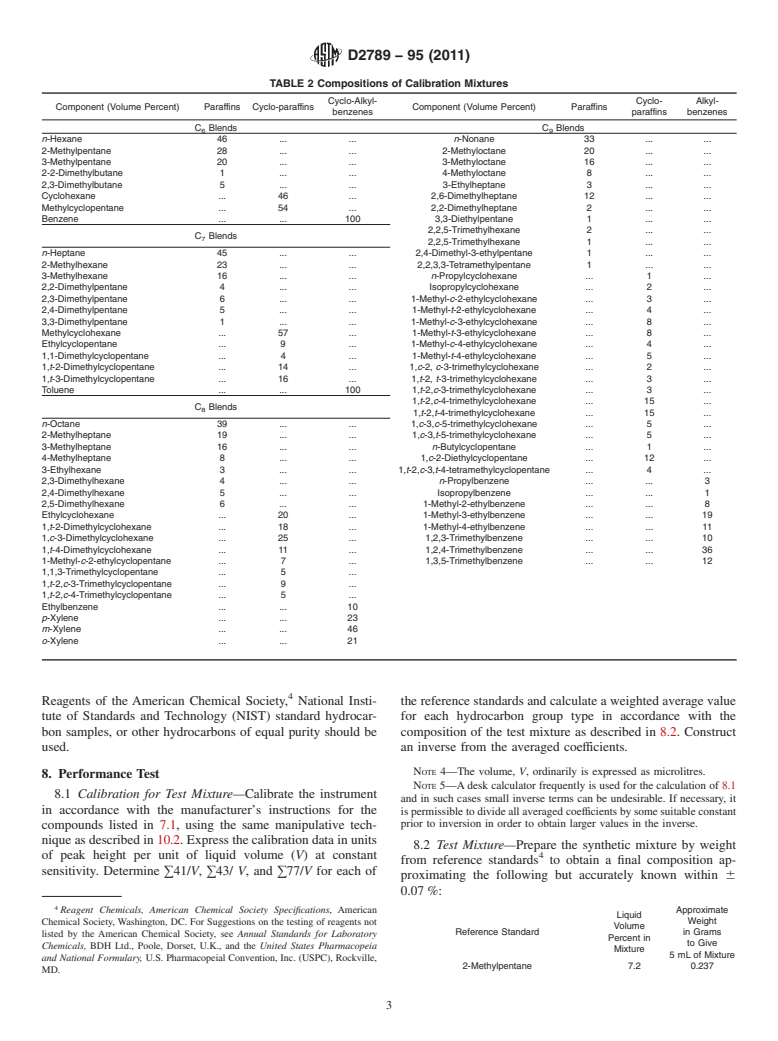
develop their own calibration data using the blends described in Table 2.
spectral data. Calculations are made from calibration data
whicharedependentupontheaveragenumberofcarbonatoms
6.2 Sample Inlet System—Any sample inlet system that
of the sample. Results are expressed in liquid volume percent.
allows the introduction of the text mixture (8.2) without loss,
contamination, or change of composition.
5. Significance and Use
NOTE 2—Laboratory testing has shown that, unless a special sampling
5.1 A knowledge of the hydrocarbon composition of gaso-
techniqueoraheatedinletsystemisused,relativelylargeerrorswilloccur
line process streams, blending stocks and finished motor fuels
i
...
Questions, Comments and Discussion
Ask us and Technical Secretary will try to provide an answer. You can facilitate discussion about the standard in here.