

ASTM B363-23
(Specification)Standard Specification for Seamless and Welded Unalloyed Titanium and Titanium Alloy Welding Fittings
General Information
- Abstract
ABSTRACT
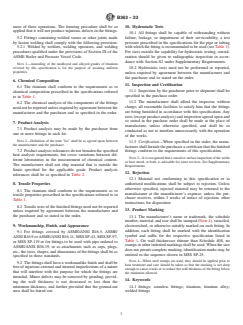
This specification covers fittings intended for general corrosion-resisting and elevated-temperature services, factory made from unalloyed titanium and titanium alloys. The titanium for welding fittings may consist of billets, bars, plates, seamless or welded pipe or tube that conforms to all the requirements for manufacturing process, testing, chemical composition, and mechanical properties. Forging, forming, or shaping operations may be performed by hammering, pressing, piercing, extruding, upsetting, rolling, bending, fusion welding, or by a combination of two or more of these operations. The titanium shall conform to the requirements as to prescribed chemical composition. Product analysis tolerances of aluminum, carbon, chromium, hydrogen, iron, molybdenum, nickel, niobium, nitrogen, oxygen, palladium, ruthenium, silicon, vanadium, zirconium, and some residuals shall be specified. The titanium shall conform to the requirements as to tensile properties prescribed in the specifications.
SCOPE
1.1 This specification2 covers fittings intended for general corrosion-resisting and elevated-temperature services, factory made from unalloyed titanium and titanium alloys. The term welding fittings applies to parts such as 45° and 90° elbows, 180° returns, caps, tees, reducers, lap-joint stub ends, and other types.
1.2 This standard does not purport to address all of the safety concerns, if any, associated with its use. It is the responsibility of the user of this standard to establish appropriate safety, health, and environmental practices and determine the applicability of regulatory limitations prior to use.
1.3 This international standard was developed in accordance with internationally recognized principles on standardization established in the Decision on Principles for the Development of International Standards, Guides and Recommendations issued by the World Trade Organization Technical Barriers to Trade (TBT) Committee.
- Status
- Published
- Publication Date
- 31-Oct-2023
- Technical Committee
- B10 - Reactive and Refractory Metals and Alloys
- Drafting Committee
- B10.01 - Titanium
Buy Documents

ASTM B363-23 - Standard Specification for Seamless and Welded Unalloyed Titanium and Titanium Alloy Welding Fittings
REDLINE ASTM B363-23 - Standard Specification for Seamless and Welded Unalloyed Titanium and Titanium Alloy Welding Fittings
Overview
ASTM B363-23: Standard Specification for Seamless and Welded Unalloyed Titanium and Titanium Alloy Welding Fittings is a comprehensive industry standard developed by ASTM International. This specification covers the requirements for unalloyed titanium and titanium alloy welding fittings, both seamless and welded, designed for use in general corrosion-resisting and elevated-temperature services. The standard applies to factory-made fittings such as elbows, returns, caps, tees, reducers, and lap-joint stub ends, which are manufactured from titanium billets, bars, plates, seamless or welded pipe, or tube. ASTM B363-23 provides critical guidance on the manufacturing processes, chemical composition, mechanical properties, testing, marking, and certification of titanium welding fittings.
Key Topics
- Scope of Use: ASTM B363-23 fittings are intended for environments requiring high corrosion resistance and stability at elevated temperatures. Typical fittings include 45° and 90° elbows, 180° returns, tees, reducers, caps, and stub ends.
- Material Requirements: The standard mandates use of titanium and titanium alloys conforming to specified chemical compositions and mechanical properties. Acceptable starting materials include billets, bars, plates, castings, seamless or welded pipes, and tubes.
- Manufacturing Methods: Permissible processes include hammering, pressing, piercing, extruding, upsetting, rolling, bending, fusion welding, or combinations thereof. Welding must meet specific requirements for operator qualification and procedure as outlined in the ASME Boiler and Pressure Vessel Code.
- Testing and Inspection: Products must undergo tests for compliance with chemical composition and tensile properties. Purchasers may request product analyses and hydrostatic or radiographic testing as supplementary requirements.
- Dimensions and Tolerances: Fittings must adhere to dimensional specifications set forth in referenced industry standards, ensuring compatibility and safe assembly.
- Product Marking and Certification: Each fitting must be durably marked with the manufacturer’s information, material grade, size, and applicable specification symbols. Certification is available upon request.
Applications
ASTM B363-23 is widely used in industries that demand high-performance fittings with exceptional resistance to corrosion and high temperatures. Key application areas include:
- Chemical Processing Plants: Where titanium's resistance to strong acids and oxidizers is essential.
- Power Generation: Used for high-temperature piping systems in power plants, including nuclear facilities.
- Petrochemical and Oil & Gas: Applied in systems exposed to aggressive media and elevated temperatures.
- Aerospace and Defense: Utilized in hydraulic, fuel, and exhaust systems due to their lightweight strength and durability.
- Marine and Desalination: Ideal for seawater handling systems because of titanium’s corrosion resistance in chloride-rich environments.
- Pharmaceutical and Food Equipment: Provides non-contaminating, easily cleaned fittings for sterile, corrosion-sensitive applications.
Related Standards
ASTM B363-23 references and aligns with several important standards to ensure wide acceptance and compatibility:
- ASTM B265: Titanium and Titanium Alloy Strip, Sheet, and Plate
- ASTM B338: Seamless and Welded Titanium Tubes for Condensers and Heat Exchangers
- ASTM B348: Titanium and Titanium Alloy Bars and Billets
- ASTM B367: Titanium and Titanium Alloy Castings
- ASTM B381: Titanium and Titanium Alloy Forgings
- ASTM B861/B862: Titanium Seamless and Welded Pipe
- ASME/ANSI B16.5, B16.9, B16.11: Dimensions for pipe flanges and fittings
- MSS SP-25, SP-43, SP-97, SP-119: Standard practices for marking, lightweight fittings, and reinforced outlets
Keywords: ASTM B363-23, titanium fittings, welded titanium, seamless titanium, titanium alloy welding fittings, corrosion-resistant, high-temperature applications.
By following ASTM B363-23, industries ensure reliable, safe, and standardized use of titanium welding fittings, leading to improved operational safety and longevity in demanding environments.
Relations
- Effective Date
- 01-Nov-2023
- Effective Date
- 01-Apr-2024
- Effective Date
- 15-Nov-2023
- Effective Date
- 01-Nov-2019
- Effective Date
- 01-Nov-2019
- Referred By
ASTM F1155-10(2019) - Standard Practice for Selection and Application of Piping System Materials - Effective Date
- 01-Nov-2023
Buy Documents
ASTM B363-23 - Standard Specification for Seamless and Welded Unalloyed Titanium and Titanium Alloy Welding Fittings
REDLINE ASTM B363-23 - Standard Specification for Seamless and Welded Unalloyed Titanium and Titanium Alloy Welding Fittings
Get Certified
Connect with accredited certification bodies for this standard

Element Materials Technology
Materials testing and product certification.

Inštitut za kovinske materiale in tehnologije
Institute of Metals and Technology. Materials testing, metallurgical analysis, NDT.
Sponsored listings
Frequently Asked Questions
ASTM B363-23 is a technical specification published by ASTM International. Its full title is "Standard Specification for Seamless and Welded Unalloyed Titanium and Titanium Alloy Welding Fittings". This standard covers: ABSTRACT This specification covers fittings intended for general corrosion-resisting and elevated-temperature services, factory made from unalloyed titanium and titanium alloys. The titanium for welding fittings may consist of billets, bars, plates, seamless or welded pipe or tube that conforms to all the requirements for manufacturing process, testing, chemical composition, and mechanical properties. Forging, forming, or shaping operations may be performed by hammering, pressing, piercing, extruding, upsetting, rolling, bending, fusion welding, or by a combination of two or more of these operations. The titanium shall conform to the requirements as to prescribed chemical composition. Product analysis tolerances of aluminum, carbon, chromium, hydrogen, iron, molybdenum, nickel, niobium, nitrogen, oxygen, palladium, ruthenium, silicon, vanadium, zirconium, and some residuals shall be specified. The titanium shall conform to the requirements as to tensile properties prescribed in the specifications. SCOPE 1.1 This specification2 covers fittings intended for general corrosion-resisting and elevated-temperature services, factory made from unalloyed titanium and titanium alloys. The term welding fittings applies to parts such as 45° and 90° elbows, 180° returns, caps, tees, reducers, lap-joint stub ends, and other types. 1.2 This standard does not purport to address all of the safety concerns, if any, associated with its use. It is the responsibility of the user of this standard to establish appropriate safety, health, and environmental practices and determine the applicability of regulatory limitations prior to use. 1.3 This international standard was developed in accordance with internationally recognized principles on standardization established in the Decision on Principles for the Development of International Standards, Guides and Recommendations issued by the World Trade Organization Technical Barriers to Trade (TBT) Committee.
ABSTRACT This specification covers fittings intended for general corrosion-resisting and elevated-temperature services, factory made from unalloyed titanium and titanium alloys. The titanium for welding fittings may consist of billets, bars, plates, seamless or welded pipe or tube that conforms to all the requirements for manufacturing process, testing, chemical composition, and mechanical properties. Forging, forming, or shaping operations may be performed by hammering, pressing, piercing, extruding, upsetting, rolling, bending, fusion welding, or by a combination of two or more of these operations. The titanium shall conform to the requirements as to prescribed chemical composition. Product analysis tolerances of aluminum, carbon, chromium, hydrogen, iron, molybdenum, nickel, niobium, nitrogen, oxygen, palladium, ruthenium, silicon, vanadium, zirconium, and some residuals shall be specified. The titanium shall conform to the requirements as to tensile properties prescribed in the specifications. SCOPE 1.1 This specification2 covers fittings intended for general corrosion-resisting and elevated-temperature services, factory made from unalloyed titanium and titanium alloys. The term welding fittings applies to parts such as 45° and 90° elbows, 180° returns, caps, tees, reducers, lap-joint stub ends, and other types. 1.2 This standard does not purport to address all of the safety concerns, if any, associated with its use. It is the responsibility of the user of this standard to establish appropriate safety, health, and environmental practices and determine the applicability of regulatory limitations prior to use. 1.3 This international standard was developed in accordance with internationally recognized principles on standardization established in the Decision on Principles for the Development of International Standards, Guides and Recommendations issued by the World Trade Organization Technical Barriers to Trade (TBT) Committee.
ASTM B363-23 is classified under the following ICS (International Classification for Standards) categories: 77.150.50 - Titanium products. The ICS classification helps identify the subject area and facilitates finding related standards.
ASTM B363-23 has the following relationships with other standards: It is inter standard links to ASTM B363-19, ASTM B861-24, ASTM B862-23, ASTM B862-19, ASTM B861-19, ASTM F1155-10(2019). Understanding these relationships helps ensure you are using the most current and applicable version of the standard.
ASTM B363-23 is available in PDF format for immediate download after purchase. The document can be added to your cart and obtained through the secure checkout process. Digital delivery ensures instant access to the complete standard document.
Standards Content (Sample)
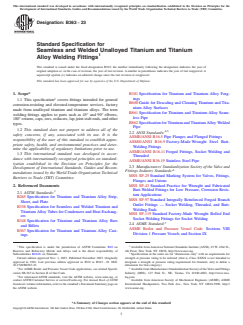
This international standard was developed in accordance with internationally recognized principles on standardization established in the Decision on Principles for the
Development of International Standards, Guides and Recommendations issued by the World Trade Organization Technical Barriers to Trade (TBT) Committee.
Designation: B363 − 23
Standard Specification for
Seamless and Welded Unalloyed Titanium and Titanium
Alloy Welding Fittings
This standard is issued under the fixed designation B363; the number immediately following the designation indicates the year of
original adoption or, in the case of revision, the year of last revision. A number in parentheses indicates the year of last reapproval. A
superscript epsilon (´) indicates an editorial change since the last revision or reapproval.
This standard has been approved for use by agencies of the U.S. Department of Defense.
1. Scope* B381 Specification for Titanium and Titanium Alloy Forg-
2 ings
1.1 This specification covers fittings intended for general
B600 Guide for Descaling and Cleaning Titanium and Tita-
corrosion-resisting and elevated-temperature services, factory
nium Alloy Surfaces
made from unalloyed titanium and titanium alloys. The term
B861 Specification for Titanium and Titanium Alloy Seam-
welding fittings applies to parts such as 45° and 90° elbows,
less Pipe
180° returns, caps, tees, reducers, lap-joint stub ends, and other
B862 Specification for Titanium and Titanium Alloy Welded
types.
Pipe
1.2 This standard does not purport to address all of the
4,5
2.2 ANSI Standards:
safety concerns, if any, associated with its use. It is the
ASME/ANSI B16.5 Pipe Flanges and Flanged Fittings
responsibility of the user of this standard to establish appro-
ASME/ANSI B16.9 Factory-Made Wrought Steel Butt-
priate safety, health, and environmental practices and deter-
Welding Fittings
mine the applicability of regulatory limitations prior to use.
ASME/ANSI B16.11 Forged Fittings, Socket Welding and
1.3 This international standard was developed in accor-
Threaded
dance with internationally recognized principles on standard-
ASME/ANSI B36.19 Stainless Steel Pipe
ization established in the Decision on Principles for the
2.3 Manufacturers’ Standardization Society of the Valve and
Development of International Standards, Guides and Recom-
Fittings Industry Standards:
mendations issued by the World Trade Organization Technical
MSS SP-25 Standard Marking System for Valves, Fittings,
Barriers to Trade (TBT) Committee.
Flanges and Unions
MSS SP-43 Standard Practice for Wrought and Fabricated
2. Referenced Documents
Butt-Welded Fittings for Low Pressure, Corrosion Resis-
2.1 ASTM Standards:
tant Applications
B265 Specification for Titanium and Titanium Alloy Strip,
MSS SP-97 Standard Integrally Reinforced Forged Branch
Sheet, and Plate
Outlet Fittings — Socket Welding, Threaded, and Butt-
B338 Specification for Seamless and Welded Titanium and
Welding Ends
Titanium Alloy Tubes for Condensers and Heat Exchang-
MSS SP-119 Standard Factory-Made Wrought Belled End
ers
Socket-Welding Fittings for Socket Welding
B348 Specification for Titanium and Titanium Alloy Bars
2.4 ASME Standard:
and Billets
ASME Boiler and Pressure Vessel Code Sections VIII
B367 Specification for Titanium and Titanium Alloy Cast-
Division 1 Pressure Vessels and Section IX
ings
1 4
This specification is under the jurisdiction of ASTM Committee B10 on Available from American National Standards Institute (ANSI), 25 W. 43rd St.,
Reactive and Refractory Metals and Alloys and is the direct responsibility of 4th Floor, New York, NY 10036, http://www.ansi.org.
Subcommittee B10.01 on Titanium. Specifications in the order are for “dimensions only” with no requirements for
Current edition approved Nov. 1, 2023. Published November 2023. Originally strength or pressure rating to be inferred. (that is, Class XXXX is not intended to
approved in 1961. Last previous edition approved in 2019 as B363 – 19. DOI: designate a strength or pressure rating requirement for titanium; only to define a
10.1520/B0363-23. dimension for that category.)
2 6
For ASME Boiler and Pressure Vessel Code applications, see related Specifi- Available from Manufacturers Standardization Society of the Valve and Fittings
cation SB-363 in Section II of that Code. Industry (MSS), 127 Park St., NE, Vienna, VA 22180-4602, http://www.mss-
For referenced ASTM standards, visit the ASTM website, www.astm.org, or hq.com.
contact ASTM Customer Service at service@astm.org. For Annual Book of ASTM Available from American Society of Mechanical Engineers (ASME), ASME
Standards volume information, refer to the standard’s Document Summary page on International Headquarters, Two Park Ave., New York, NY 10016-5990, http://
the ASTM website. www.asme.org.
*A Summary of Changes section appears at the end of this standard
Copyright © ASTM International, 100 Barr Harbor Drive, PO Box C700, West Conshohocken, PA 19428-2959. United States
B363 − 23
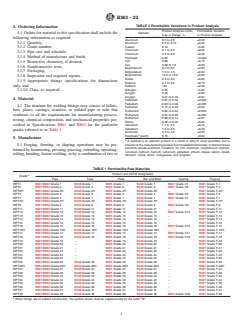
TABLE 2 Permissible Variations in Product Analysis
3. Ordering Information
Product Analysis Limits, Permissible Variation
3.1 Orders for material to this specification shall include the Element
max or Range, % in Product Analysis
following information as required:
Aluminum 0.5 to 2.5 ±0.20
3.1.1 Quantity,
Aluminum 2.5 to 6.75 ±0.40
Carbon 0.10 +0.02
3.1.2 Grade number,
Chromium 0.1 to 0.2 ±0.02
3.1.3 Pipe size and schedule,
Chromium 5.5 to 6.5 ±0.30
3.1.4 Method of manufacture and finish,
Hydrogen 0.02 +0.002
Iron 0.80 +0.15
3.1.5 Restrictive chemistry, if desired,
Iron 0.80 to 1.8 ±0.20
3.1.6 Nondestructive tests,
Molybdenum 0.2 to 0.4 ±0.03
3.1.7 Packaging,
Molybdenum 1.5 to 4.5 ±0.20
Molybdenum 14.0 to 16.0 ±0.50
3.1.8 Inspection and required reports,
Nickel 0.3 to 0.9 ±0.05
3.1.9 Appropriate fittings specifications for dimensions
Niobium 2.2 to 3.2 ±0.15
only, and
Niobium >30 ±0.50
Nitrogen 0.05 +0.02
3.1.10 Class, as required.
Oxygen 0.30 +0.03
Oxygen 0.31 to 0.40 ±0.04
4. Material
Palladium 0.01 to 0.02 ±0.002
Palladium 0.04 to 0.08 ±0.005
4.1 The titanium for welding fittings may consist of billets,
Palladium 0.12 to 0.25 ±0.02
bars, plates, castings, seamless or welded pipe or tube that
Ruthenium 0.02 to 0.04 ±0.005
Ruthenium 0.04 to 0.06 ±0.005
conforms to all the requirements for manufacturing process,
Ruthenium 0.08 to 0.14 ±0.01
testing, chemical composition, and mechanical properties pre-
Silicon 0.06 to 0.40 ±0.02
scribed in Specifications B861 and B862 for the particular
Vanadium 1.1 to 4.5 ±0.15
Vanadium 7.5 to 8.5 ±0.40
grades referred to in Table 1.
Zirconium 3.5 to 4.5 ±0.20
A
Residuals (each) 0.15 +0.02
5. Manufacture
A
A residual is an element present in a metal or alloy in small quantities and is
5.1 Forging, forming, or shaping operations may be per- inherent to the manufacturing process but not added intentionally. In titanium these
elements include aluminum, vanadium, tin, iron, chromium, molybdenum, niobium,
formed by hammering, pressing, piercing, extruding, upsetting,
zirconium, hafnium, bismuth, ruthenium, palladium, yttrium, copper, silicon, cobalt,
rolling, bending, fusion welding, or by a combination of two or
tantalum, nickel, boron, manganese, and tungsten.
TABLE 1 Permissible Raw Materials
Product and ASTM Designation
A
Grade
Pipe Tube Plate Bar and Billet Casting Forging
WPT1 B861/B862 Grade 1 B338 Grade 1 B265 Grade 1 B348 Grade 1 B367 Grade C1 B381 Grade F-1
WPT2 B861/B862 Grade 2 B338 Grade 2 B265 Grade 2 B348 Grade 2 B367 Grade C2 B381 Grade F-2
WPT2H B861/B862 Grade 2H B338 Grade 2H B265 Grade 2H B348 Grade 2H . B381 Grade F-2H
WPT3 B861/B862 Grade 3 B338 Grade 3 B265 Grade 3 B348 Grade 3 B367 Grade C3 B381 Grade F-3
WPT7 B861/B862 Grade 7 B338 Grade 7 B265 Grade 7 B348 Grade 7 B367 Grade C7 B381 Grade F-7
WPT7H B861/B862 Grade 7H B338 Grade 7H B265 Grade 7H B348 Grade 7H . B381 Grade F-7H
WPT9 B861/B862 Grade 9 B338 Grade 9 B265 Grade 9 B348 Grade 9 B367 Grade C9 B381 Grade F-9
WPT11 B861/B862 Grade 11 B338 Grade 11 B265 Grade 11 B348 Grade 11 . B381 Grade F-11
WPT12 B861/B862 Grade 12 B338 Grade 12 B265 Grade 12 B348 Grade 12 B367 Grade C12 B381 Grade F-12
WPT13 B861/B862 Grade 13 B338 Grade 13 B265 Grade 13 B348 Grade 13 . B381 Grade F-13
WPT14 B861/B862 Grade 14 B338 Grade 14 B265 Grade 14 B348 Grade 14 . B381 Grade F-14
WPT15 B861/B862 Grade 15 B338 Grade 15 B265 Grade 15 B348 Grade 15 . B381 Grade F-15
WPT16 B861/B862 Grade 16 B338 Grade 16 B265 Grade 16 B348 Grade 16 B367 Grade C16 B381 Grade F-16
WPT16H B861/B862 Grade 16H B338 Grade 16H B265 Grade 16H B348 Grade 16H . B381 Grade F-16H
WPT17 B861/B862 Grade 17 B338 Grade 17 B265 Grade 17 B348 Grade 17 B367 Grade C17 B381 Grade F-17
WPT18 B861/B862 Grade 18 B338 Grade 18 B265 Grade 18 B348 Grade 18 B367 Grade C18 B381 Grade F-18
WPT19 B861/B862 Grade 19 . B265 Grade 19 B348 Grade 19 . B381 Grade F-19
WPT20 B861/B862 Grade 20 . B265 Grade 20 B348 Grade 20 . B381 Grade F-20
WPT21 B861/B862 Grade 21 . B265 Grade 21 B348 Grade 21 . B381 Grade F-21
WPT23 B861/B862 Grade 23 . B265 Grade 23 B348 Grade 23 . B381 Grade F-23
WPT24 B861/B862 Grade 24 . B265 Grade 24 B348 Grade 24 . B381 Grade F-24
WPT25 B861/B862 Grade 25 . B265 Grade 25 B348 Grade 25 . B381 Grade F-25
WPT26 B861/B862 Grade 26 B338 Grade 26 B265 Grade 26 B348 Grade 26 . B381 Grade F-26
WPT26H B861/B862 Grade 26H B338 Grade 26H B265 Grade 26H B348 Grade 26H . B381 Grade F-26H
WPT27 B861/B862 Grade
...
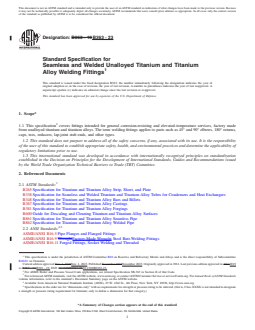
This document is not an ASTM standard and is intended only to provide the user of an ASTM standard an indication of what changes have been made to the previous version. Because
it may not be technically possible to adequately depict all changes accurately, ASTM recommends that users consult prior editions as appropriate. In all cases only the current version
of the standard as published by ASTM is to be considered the official document.
Designation: B363 − 19 B363 − 23
Standard Specification for
Seamless and Welded Unalloyed Titanium and Titanium
Alloy Welding Fittings
This standard is issued under the fixed designation B363; the number immediately following the designation indicates the year of
original adoption or, in the case of revision, the year of last revision. A number in parentheses indicates the year of last reapproval. A
superscript epsilon (´) indicates an editorial change since the last revision or reapproval.
This standard has been approved for use by agencies of the U.S. Department of Defense.
1. Scope*
1.1 This specification covers fittings intended for general corrosion-resisting and elevated-temperature services, factory made
from unalloyed titanium and titanium alloys. The term welding fittings applies to parts such as 45° and 90° elbows, 180° returns,
caps, tees, reducers, lap-joint stub ends, and other types.
1.2 This standard does not purport to address all of the safety concerns, if any, associated with its use. It is the responsibility
of the user of this standard to establish appropriate safety, health, and environmental practices and determine the applicability of
regulatory limitations prior to use.
1.3 This international standard was developed in accordance with internationally recognized principles on standardization
established in the Decision on Principles for the Development of International Standards, Guides and Recommendations issued
by the World Trade Organization Technical Barriers to Trade (TBT) Committee.
2. Referenced Documents
2.1 ASTM Standards:
B265 Specification for Titanium and Titanium Alloy Strip, Sheet, and Plate
B338 Specification for Seamless and Welded Titanium and Titanium Alloy Tubes for Condensers and Heat Exchangers
B348 Specification for Titanium and Titanium Alloy Bars and Billets
B367 Specification for Titanium and Titanium Alloy Castings
B381 Specification for Titanium and Titanium Alloy Forgings
B600 Guide for Descaling and Cleaning Titanium and Titanium Alloy Surfaces
B861 Specification for Titanium and Titanium Alloy Seamless Pipe
B862 Specification for Titanium and Titanium Alloy Welded Pipe
4,5
2.2 ANSI Standards:
ASME/ANSI B16.5 Pipe Flanges and Flanged Fittings
ASME/ANSI B16.9 WroughtFactory-Made Wrought Steel Butt-Welding Fittings
ASME/ANSI B16.11 Forged Fittings, Socket Welding and Threaded
This specification is under the jurisdiction of ASTM Committee B10 on Reactive and Refractory Metals and Alloys and is the direct responsibility of Subcommittee
B10.01 on Titanium.
Current edition approved Nov. 1, 2019Nov. 1, 2023. Published November 2019November 2023. Originally approved in 1961. Last previous edition approved in 20142019
as B363 – 14.B363 – 19. DOI: 10.1520/B0363-19.10.1520/B0363-23.
For ASME Boiler and Pressure Vessel Code applications, see related Specification SB-363 in Section II of that Code.
For referenced ASTM standards, visit the ASTM website, www.astm.org, or contact ASTM Customer Service at service@astm.org. For Annual Book of ASTM Standards
volume information, refer to the standard’s Document Summary page on the ASTM website.
Available from American National Standards Institute (ANSI), 25 W. 43rd St., 4th Floor, New York, NY 10036, http://www.ansi.org.
Specifications in the order are for “dimensions only” with no requirements for strength or pressure rating to be inferred. (that is, Class XXXX is not intended to designate
a strength or pressure rating requirement for titanium; only to define a dimension for that category.)
*A Summary of Changes section appears at the end of this standard
Copyright © ASTM International, 100 Barr Harbor Drive, PO Box C700, West Conshohocken, PA 19428-2959. United States
B363 − 23
ASME/ANSI B36.19 Stainless Steel Pipe
2.3 Manufacturers’ Standardization Society of the Valve and Fittings Industry Standards:
MSS SP-25 Standard Marking System for Valves, Fittings, Flanges and Unions
MSS SP-43 Standard Practice for Light Weight Stainless Steel Butt-Welding FittingsWrought and Fabricated Butt-Welded
Fittings for Low Pressure, Corrosion Resistant Applications
MSS SP-97 Standard Integrally Reinforced Forged Branch Outlet Fittings — Socket Welding, Threaded, and Butt-Welding Ends
MSS SP-119 Standard Factory-Made Wrought Belled End Socket-Welding Fittings for Socket Welding
2.4 ASME Standard:
ASME Boiler and Pressure Vessel Code Sections VIII Division 1 Pressure Vessels and Section IX
3. Ordering Information
3.1 Orders for material to this specification shall include the following information as required:
3.1.1 Quantity,
3.1.2 Grade number,
3.1.3 Pipe size and schedule,
3.1.4 Method of manufacture and finish,
3.1.5 Restrictive chemistry, if desired,
3.1.6 Nondestructive tests,
3.1.7 Packaging,
3.1.8 Inspection and required reports,
3.1.9 Appropriate fittings specifications for dimensions only, and
3.1.10 Class, as required.
4. Material
4.1 The titanium for welding fittings may consist of billets, bars, plates, castings, seamless or welded pipe or tube that conforms
to all the requirements for manufacturing process, testing, chemical composition, and mechanical properties prescribed in
Specifications B861 and B862 for the particular grades referred to in Table 1.
5. Manufacture
5.1 Forging, forming, or shaping operations may be performed by hammering, pressing, piercing, extruding, upsetting, rolling,
bending, fusion welding, or by a combination of two or more of these operations. The forming procedure shall be so applied that
it will not produce injurious defects in the fittings.
5.2 Fittings containing welded seams or other joints made by fusion welding shall comply with the following provision:
5.2.1 Welded by welders, welding operators, and welding procedures qualified under the provisions of Section IX of the ASME
Boiler and Pressure Vessel Code.
NOTE 1—Annealing of the unalloyed and alloyed grades of titanium covered by this specification is for the purpose of assuring uniform properties.
Available from Manufacturers Standardization Society of the Valve and Fittings Industry (MSS), 127 Park St., NE, Vienna, VA 22180-4602, http://www.mss-hq.com.
Available from American Society of Mechanical Engineers (ASME), ASME International Headquarters, ThreeTwo Park Ave., New York, NY 10016-5990,
http://www.asme.org.
B363 − 23
TABLE 1 Permissible Raw Materials
Product and ASTM Designation
A
Grade
Pipe Tube Plate Bar and Billet Casting Forging
WPT1 B861/B862 Grade 1 B338 Grade 1 B265 Grade 1 B348 Grade 1 B367 Grade C1 B381 Grade F-1
WPT2 B861/B862 Grade 2 B338 Grade 2 B265 Grade 2 B348 Grade 2 B367 Grade C2 B381 Grade F-2
WPT2H B861/B862 Grade 2H B338 Grade 2H B265 Grade 2H B348 Grade 2H . B381 Grade F-2H
WPT3 B861/B862 Grade 3 B338 Grade 3 B265 Grade 3 B348 Grade 3 B367 Grade C3 B381 Grade F-3
WPT7 B861/B862 Grade 7 B338 Grade 7 B265 Grade 7 B348 Grade 7 B367 Grade C7 B381 Grade F-7
WPT7H B861/B862 Grade 7H B338 Grade 7H B265 Grade 7H B348 Grade 7H . B381 Grade F-7H
WPT9 B861/B862 Grade 9 B338 Grade 9 B265 Grade 9 B348 Grade 9 . B381 Grade F-9
WPT9 B861/B862 Grade 9 B338 Grade 9 B265 Grade 9 B348 Grade 9 B367 Grade C9 B381 Grade F-9
WPT11 B861/B862 Grade 11 B338 Grade 11 B265 Grade 11 B348 Grade 11 B367 Grade C11 B381 Grade F-11
WPT11 B861/B862 Grade 11 B338 Grade 11 B265 Grade 11 B348 Grade 11 . B381 Grade F-11
WPT12 B861/B862 Grade 12 B338 Grade 12 B265 Grade 12 B348 Grade 12 . B381 Grade F-12
WPT12 B861/B862 Grade 12 B338 Grade 12 B265 Grade 12 B348 Grade 12 B367 Grade C12 B381 Grade F-12
WPT13 B861/B862 Grade 13 B338 Grade 13 B265 Grade 13 B348 Grade 13 . B381 Grade F-13
WPT14 B861/B862 Grade 14 B338 Grade 14 B265 Grade 14 B348 Grade 14 . B381 Grade F-14
WPT15 B861/B862 Grade 15 B338 Grade 15 B265 Grade 15 B348 Grade 15 . B381 Grade F-15
WPT16 B861/B862 Grade 16 B338 Grade 16 B265 Grade 16 B348 Grade 16 . B381 Grade F-16
WPT16 B861/B862 Grade 16 B338 Grade 16 B265 Grade 16 B348 Grade 16 B367 Grade C16 B381 Grade F-16
WPT16H B861/B862 Grade 16H B338 Grade 16H B265 Grade 16H B348 Grade 16H . B381 Grade F-16H
WPT17 B861/B862 Grade 17 B338 Grade 17 B265 Grade 17 B348 Grade 17 . B381 Grade F-17
WPT17 B861/B862 Grade 17 B338 Grade 17 B265 Grade 17 B348 Grade 17 B367 Grade C17 B381 Grade F-17
WPT18 B861/B862 Grade 18 B338 Grade 18 B265 Grade 18 B348 Grade 18 . B381 Grade F-18
WPT18 B861/B862 Grade 18 B338 Grade 18 B265 Grade 18 B348 Grade 18 B367 Grade C18 B381 Grade F-18
WPT19 B861/B862 Grade 19 . B265 Grade 19 B348 Grade 19 . B381 Grade F-19
WPT20 B861/B862 Grade 20 . B265 Grade 20 B348 Grade 20 . B381 Grade F-20
WPT21 B861/B862 Grade 21 . B265 Grade 21 B348 Grade 21 . B381 Grade F-21
WPT23 B861/B862 Grade 23 . B265 Grade 23 B348 Grade 23 . B381 Grade F-23
WPT24 B861/B862 Grade 24 . B265 Grade 24 B348 Grade 24 . B381 Grade F-24
WPT25 B861/B862 Grade 25 . B265 Grade 25 B348 Grade 25 . B381 Grade F-25
WPT26 B861/B862 Grade 26 B338 Grade 26 B265 Grade 26 B348 Grade 26 . B381 Grade F-26
WPT26H B861/B862 Grade 26H B338 Grade 26H B265 Grade 26H B348 Grade 26H . B381 Grade F-26H
WPT27 B861/B862 Grade 27 B338 Grade 27 B265 Grade 27 B348 Grade 27 . B381 Grade F-27
WPT28 B861/B862 Grade 28 B338 Grade 28 B265 Grade 28 B348 Grade 28 . B381 Grade F-28
WPT33 B861/B862 Grade 33 B338 Grade 33 B265 Grade 33 B348 Grade 33 . B381 Grade F-33
WPT34 B861/B862 Grade 34 B338 Grade 34 B265 Grade 34 B348 Grade 34 . B381 Grade F-34
WPT35 B861/B862 Grade 35 B338 Grade 35 B265 Grade 35 B348 Grade 35 . B381 Grade F-35
WPT36 B861/B862 Grade 36 B338 Grade 36 B26
...