

ASTM B862-23
(Specification)Standard Specification for Titanium and Titanium Alloy Welded Pipe
General Information
- Abstract
ABSTRACT
This specification covers the requirements for 33 grades of titanium and titanium alloy welded pipe intended for general corrosion resisting and elevated temperature service. Welded pipe shall be made from annealed flat-rolled products by a welding process. Welded pipe may be further reduced by cold working or hot working. Grades 1, 2, 2 H, 7, 7H, 11,13, 14, 16, 16H, 17, 26H, 33, and 37 shall be furnished as welded or annealed. Grades 3, 12, 15, and 34 shall be furnished as annealed. Grade 5, 23, 24, 25, 35 shall be furnished as annealed, or aged. Grade 9, 18, 38 shall be furnished as annealed. Grade 19, 20, 21 shall be furnished as solution treated, or solution treated and aged. The materials shall conform to the required chemical composition for nitrogen, carbon, hydrogen, iron, oxygen, aluminum, vanadium, tin, ruthenium, palladium, cobalt, molybdenum, chromium, nickel, niobium, zirconium, silicon, and titanium. They shall also conform to the required mechanical propetries such as tensile strength, yield strength, and elongation.
SCOPE
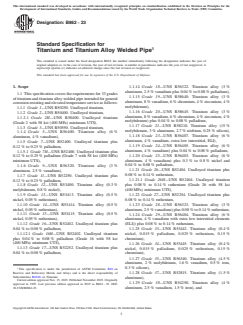
1.1 This specification covers the requirements for 33 grades of titanium and titanium alloy welded pipe intended for general corrosion resisting and elevated temperature service as follows:
1.1.1 Grade 1—UNS R50250. Unalloyed titanium,
1.1.2 Grade 2—UNS R50400. Unalloyed titanium,
1.1.2.1 Grade 2H—UNS R50400. Unalloyed titanium (Grade 2 with 58 ksi (400 MPa) minimum UTS),
1.1.3 Grade 3—UNS R50550. Unalloyed titanium,
1.1.4 Grade 5—UNS R56400. Titanium alloy (6 % aluminum, 4 % vanadium),
1.1.5 Grade 7—UNS R52400. Unalloyed titanium plus 0.12 % to 0.25 % palladium,
1.1.5.1 Grade 7H—UNS R52400. Unalloyed titanium plus 0.12 % to 0.25 % palladium (Grade 7 with 58 ksi (400 MPa) minimum UTS),
1.1.6 Grade 9—UNS R56320. Titanium alloy (3 % aluminum, 2.5 % vanadium),
1.1.7 Grade 11—UNS R52250. Unalloyed titanium plus 0.12 % to 0.25 % palladium,
1.1.8 Grade 12—UNS R53400. Titanium alloy (0.3 % molybdenum, 0.8 % nickel),
1.1.9 Grade 13—UNS R53413. Titanium alloy (0.5 % nickel, 0.05 % ruthenium),
1.1.10 Grade 14—UNS R53414. Titanium alloy (0.5 % nickel, 0.05 % ruthenium),
1.1.11 Grade 15—UNS R53415. Titanium alloy (0.5 % nickel, 0.05 % ruthenium),
1.1.12 Grade 16—UNS R52402. Unalloyed titanium plus 0.04 % to 0.08 % palladium,
1.1.12.1 Grade 16H—UNS R52402. Unalloyed titanium plus 0.04 % to 0.08 % palladium (Grade 16 with 58 ksi (400 MPa) minimum UTS),
1.1.13 Grade 17—UNS R52252. Unalloyed titanium plus 0.04 % to 0.08 % palladium,
1.1.14 Grade 18—UNS R56322. Titanium alloy (3 % aluminum, 2.5 % vanadium plus 0.04 % to 0.08 % palladium),
1.1.15 Grade 19—UNS R58640. Titanium alloy (3 % aluminum, 8 % vanadium, 6 % chromium, 4 % zirconium, 4 % molybdenum),
1.1.16 Grade 20—UNS R58645. Titanium alloy (3 % aluminum, 8 % vanadium, 6 % chromium, 4 % zirconium, 4 % molybdenum) plus 0.04 % to 0.08 % palladium,
1.1.17 Grade 21—UNS R58210. Titanium alloy (15 % molybdenum, 3 % aluminum, 2.7 % niobium, 0.25 % silicon),
1.1.18 Grade 23—UNS R56407. Titanium alloy (6 % aluminum, 4 % vanadium, extra low interstitial, ELI),
1.1.19 Grade 24—UNS R56405. Titanium alloy (6 % aluminum, 4 % vanadium) plus 0.04 % to 0.08 % palladium,
1.1.20 Grade 25—UNS R56403. Titanium alloy (6 % aluminum, 4 % vanadium) plus 0.3 % to 0.8 % nickel and 0.04 % to 0.08 % palladium,
1.1.21 Grade 26—UNS R52404. Unalloyed titanium plus 0.08 % to 0.14 % ruthenium,
1.1.21.1 Grade 26H—UNS R52404. Unalloyed titanium plus 0.08 % to 0.14 % ruthenium (Grade 26 with 58 ksi (400 MPa) minimum UTS),
1.1.22 Grade 27—UNS R52254. Unalloyed titanium plus 0.08 % to 0.14 % ruthenium,
1.1.23 Grade 28—UNS R56323. Titanium alloy (3 % aluminum, 2.5 % vanadium) plus 0.08 % to 0.14 % ruthenium,
1.1.24 Grade 29—UNS R56404. Titanium alloy (6 % aluminum, 4 % vanadium with extra low interstitial elements (ELI)) plus 0.08 % to 0.14 % ruthenium,
1.1.25 Grade 33—UNS R53442. Titaniu...
- Status
- Published
- Publication Date
- 14-Nov-2023
- Technical Committee
- B10 - Reactive and Refractory Metals and Alloys
- Drafting Committee
- B10.01 - Titanium
Buy Documents
ASTM B862-23 - Standard Specification for Titanium and Titanium Alloy Welded Pipe
REDLINE ASTM B862-23 - Standard Specification for Titanium and Titanium Alloy Welded Pipe
Overview
ASTM B862-23: Standard Specification for Titanium and Titanium Alloy Welded Pipe provides comprehensive requirements for the manufacture, chemical composition, mechanical properties, and testing of welded pipes made from 33 grades of titanium and titanium alloys. Developed by ASTM International, this standard is designed for pipes intended for general corrosion resistance and elevated temperature service applications. ASTM B862-23 ensures that titanium welded pipes meet stringent quality and performance criteria for use in a variety of demanding environments.
Key Topics
Key aspects of ASTM B862-23 include:
- Product Scope: Covers 33 grades of titanium and titanium alloy welded pipe, including unalloyed grades and those with specific alloying elements such as aluminum, vanadium, palladium, ruthenium, nickel, chromium, and others.
- Manufacturing Methods: Specifies welded pipe production from annealed flat-rolled products, which may be further processed by hot or cold working. Requirements for welding, annealing, and aging are detailed based on the grade.
- Chemical Composition: Defines strict limits for elements including nitrogen, carbon, hydrogen, iron, oxygen, aluminum, vanadium, and others to ensure material purity and suitability.
- Mechanical Properties: Sets minimum requirements for tensile strength, yield strength, and elongation for each pipe grade.
- Testing and Inspection: Mandates mechanical testing, chemical analyses, hydrostatic testing, dimensional checks, and optional supplementary requirements such as liquid penetrant testing.
- Dimensions and Tolerances: Provides nominal pipe sizes, schedules, wall thicknesses, and allowable dimensional tolerances aligned with ANSI/ASME standards.
- Certification and Marking: Specifies the need for traceable marking and comprehensive certification for each pipe segment.
Applications
Titanium and titanium alloy welded pipes manufactured to ASTM B862-23 are widely used in industries that demand high corrosion resistance and performance under elevated temperatures, including:
- Chemical Processing: Piping systems handling corrosive chemicals, acids, and chlorides, where titanium’s inertness extends service life.
- Oil & Gas: Offshore and subsea piping, heat exchangers, and flowlines where resistance to seawater corrosion is crucial.
- Power Generation: Condenser and heat recovery piping in thermal and nuclear power plants.
- Aerospace and Defense: Lightweight, high-strength piping in fuel and hydraulic systems.
- Pharmaceutical and Medical: Process lines where purity and biocompatibility of titanium alloys support stringent regulatory requirements.
- Desalination & Marine: Piping exposed to saltwater and corrosive marine environments.
ASTM B862-23 welded titanium pipes are selected where reliability, longevity, and minimal maintenance are critical, especially in aggressive media or high-stress applications.
Related Standards
For comprehensive quality assurance and compatibility, the following standards are often referenced alongside ASTM B862-23:
- ASTM B338: Standard Specification for Seamless and Welded Titanium and Titanium Alloy Tubes for Condensers and Heat Exchangers
- ASTM B265: Specification for Titanium and Titanium Alloy Strip, Sheet, and Plate
- AWS A5.16/A5.16M: Specification for Titanium and Titanium Alloy Welding Electrodes and Rods
- ASME B36.19M / B36.10: Pipe dimension standards for stainless steel and carbon steel piping
- ASTM A370, E8/E8M, E1409, E1447: Various test methods for mechanical and chemical properties
Practical Value
By adhering to ASTM B862-23, manufacturers, engineers, and end users can ensure that titanium and titanium alloy welded pipes are suitably engineered for demanding service conditions. The standard enables selection of the correct grade and condition for specific processes, ensures material traceability, and provides confidence in meeting international compliance requirements for safety and performance.
Keywords: ASTM B862, titanium pipe, welded pipe, titanium alloy, corrosion resistance, piping standards, titanium welded pipe, ASTM standards
Relations
- Effective Date
- 15-Nov-2023
- Effective Date
- 01-Mar-2024
- Effective Date
- 01-Jan-2024
- Effective Date
- 15-Sep-2023
- Effective Date
- 01-May-2022
- Effective Date
- 15-Nov-2023
- Referred By
ASTM F1155-10(2019) - Standard Practice for Selection and Application of Piping System Materials - Effective Date
- 15-Nov-2023
Buy Documents
ASTM B862-23 - Standard Specification for Titanium and Titanium Alloy Welded Pipe
REDLINE ASTM B862-23 - Standard Specification for Titanium and Titanium Alloy Welded Pipe
Get Certified
Connect with accredited certification bodies for this standard

Element Materials Technology
Materials testing and product certification.

Inštitut za kovinske materiale in tehnologije
Institute of Metals and Technology. Materials testing, metallurgical analysis, NDT.
Sponsored listings
Frequently Asked Questions
ASTM B862-23 is a technical specification published by ASTM International. Its full title is "Standard Specification for Titanium and Titanium Alloy Welded Pipe". This standard covers: ABSTRACT This specification covers the requirements for 33 grades of titanium and titanium alloy welded pipe intended for general corrosion resisting and elevated temperature service. Welded pipe shall be made from annealed flat-rolled products by a welding process. Welded pipe may be further reduced by cold working or hot working. Grades 1, 2, 2 H, 7, 7H, 11,13, 14, 16, 16H, 17, 26H, 33, and 37 shall be furnished as welded or annealed. Grades 3, 12, 15, and 34 shall be furnished as annealed. Grade 5, 23, 24, 25, 35 shall be furnished as annealed, or aged. Grade 9, 18, 38 shall be furnished as annealed. Grade 19, 20, 21 shall be furnished as solution treated, or solution treated and aged. The materials shall conform to the required chemical composition for nitrogen, carbon, hydrogen, iron, oxygen, aluminum, vanadium, tin, ruthenium, palladium, cobalt, molybdenum, chromium, nickel, niobium, zirconium, silicon, and titanium. They shall also conform to the required mechanical propetries such as tensile strength, yield strength, and elongation. SCOPE 1.1 This specification covers the requirements for 33 grades of titanium and titanium alloy welded pipe intended for general corrosion resisting and elevated temperature service as follows: 1.1.1 Grade 1—UNS R50250. Unalloyed titanium, 1.1.2 Grade 2—UNS R50400. Unalloyed titanium, 1.1.2.1 Grade 2H—UNS R50400. Unalloyed titanium (Grade 2 with 58 ksi (400 MPa) minimum UTS), 1.1.3 Grade 3—UNS R50550. Unalloyed titanium, 1.1.4 Grade 5—UNS R56400. Titanium alloy (6 % aluminum, 4 % vanadium), 1.1.5 Grade 7—UNS R52400. Unalloyed titanium plus 0.12 % to 0.25 % palladium, 1.1.5.1 Grade 7H—UNS R52400. Unalloyed titanium plus 0.12 % to 0.25 % palladium (Grade 7 with 58 ksi (400 MPa) minimum UTS), 1.1.6 Grade 9—UNS R56320. Titanium alloy (3 % aluminum, 2.5 % vanadium), 1.1.7 Grade 11—UNS R52250. Unalloyed titanium plus 0.12 % to 0.25 % palladium, 1.1.8 Grade 12—UNS R53400. Titanium alloy (0.3 % molybdenum, 0.8 % nickel), 1.1.9 Grade 13—UNS R53413. Titanium alloy (0.5 % nickel, 0.05 % ruthenium), 1.1.10 Grade 14—UNS R53414. Titanium alloy (0.5 % nickel, 0.05 % ruthenium), 1.1.11 Grade 15—UNS R53415. Titanium alloy (0.5 % nickel, 0.05 % ruthenium), 1.1.12 Grade 16—UNS R52402. Unalloyed titanium plus 0.04 % to 0.08 % palladium, 1.1.12.1 Grade 16H—UNS R52402. Unalloyed titanium plus 0.04 % to 0.08 % palladium (Grade 16 with 58 ksi (400 MPa) minimum UTS), 1.1.13 Grade 17—UNS R52252. Unalloyed titanium plus 0.04 % to 0.08 % palladium, 1.1.14 Grade 18—UNS R56322. Titanium alloy (3 % aluminum, 2.5 % vanadium plus 0.04 % to 0.08 % palladium), 1.1.15 Grade 19—UNS R58640. Titanium alloy (3 % aluminum, 8 % vanadium, 6 % chromium, 4 % zirconium, 4 % molybdenum), 1.1.16 Grade 20—UNS R58645. Titanium alloy (3 % aluminum, 8 % vanadium, 6 % chromium, 4 % zirconium, 4 % molybdenum) plus 0.04 % to 0.08 % palladium, 1.1.17 Grade 21—UNS R58210. Titanium alloy (15 % molybdenum, 3 % aluminum, 2.7 % niobium, 0.25 % silicon), 1.1.18 Grade 23—UNS R56407. Titanium alloy (6 % aluminum, 4 % vanadium, extra low interstitial, ELI), 1.1.19 Grade 24—UNS R56405. Titanium alloy (6 % aluminum, 4 % vanadium) plus 0.04 % to 0.08 % palladium, 1.1.20 Grade 25—UNS R56403. Titanium alloy (6 % aluminum, 4 % vanadium) plus 0.3 % to 0.8 % nickel and 0.04 % to 0.08 % palladium, 1.1.21 Grade 26—UNS R52404. Unalloyed titanium plus 0.08 % to 0.14 % ruthenium, 1.1.21.1 Grade 26H—UNS R52404. Unalloyed titanium plus 0.08 % to 0.14 % ruthenium (Grade 26 with 58 ksi (400 MPa) minimum UTS), 1.1.22 Grade 27—UNS R52254. Unalloyed titanium plus 0.08 % to 0.14 % ruthenium, 1.1.23 Grade 28—UNS R56323. Titanium alloy (3 % aluminum, 2.5 % vanadium) plus 0.08 % to 0.14 % ruthenium, 1.1.24 Grade 29—UNS R56404. Titanium alloy (6 % aluminum, 4 % vanadium with extra low interstitial elements (ELI)) plus 0.08 % to 0.14 % ruthenium, 1.1.25 Grade 33—UNS R53442. Titaniu...
ABSTRACT This specification covers the requirements for 33 grades of titanium and titanium alloy welded pipe intended for general corrosion resisting and elevated temperature service. Welded pipe shall be made from annealed flat-rolled products by a welding process. Welded pipe may be further reduced by cold working or hot working. Grades 1, 2, 2 H, 7, 7H, 11,13, 14, 16, 16H, 17, 26H, 33, and 37 shall be furnished as welded or annealed. Grades 3, 12, 15, and 34 shall be furnished as annealed. Grade 5, 23, 24, 25, 35 shall be furnished as annealed, or aged. Grade 9, 18, 38 shall be furnished as annealed. Grade 19, 20, 21 shall be furnished as solution treated, or solution treated and aged. The materials shall conform to the required chemical composition for nitrogen, carbon, hydrogen, iron, oxygen, aluminum, vanadium, tin, ruthenium, palladium, cobalt, molybdenum, chromium, nickel, niobium, zirconium, silicon, and titanium. They shall also conform to the required mechanical propetries such as tensile strength, yield strength, and elongation. SCOPE 1.1 This specification covers the requirements for 33 grades of titanium and titanium alloy welded pipe intended for general corrosion resisting and elevated temperature service as follows: 1.1.1 Grade 1—UNS R50250. Unalloyed titanium, 1.1.2 Grade 2—UNS R50400. Unalloyed titanium, 1.1.2.1 Grade 2H—UNS R50400. Unalloyed titanium (Grade 2 with 58 ksi (400 MPa) minimum UTS), 1.1.3 Grade 3—UNS R50550. Unalloyed titanium, 1.1.4 Grade 5—UNS R56400. Titanium alloy (6 % aluminum, 4 % vanadium), 1.1.5 Grade 7—UNS R52400. Unalloyed titanium plus 0.12 % to 0.25 % palladium, 1.1.5.1 Grade 7H—UNS R52400. Unalloyed titanium plus 0.12 % to 0.25 % palladium (Grade 7 with 58 ksi (400 MPa) minimum UTS), 1.1.6 Grade 9—UNS R56320. Titanium alloy (3 % aluminum, 2.5 % vanadium), 1.1.7 Grade 11—UNS R52250. Unalloyed titanium plus 0.12 % to 0.25 % palladium, 1.1.8 Grade 12—UNS R53400. Titanium alloy (0.3 % molybdenum, 0.8 % nickel), 1.1.9 Grade 13—UNS R53413. Titanium alloy (0.5 % nickel, 0.05 % ruthenium), 1.1.10 Grade 14—UNS R53414. Titanium alloy (0.5 % nickel, 0.05 % ruthenium), 1.1.11 Grade 15—UNS R53415. Titanium alloy (0.5 % nickel, 0.05 % ruthenium), 1.1.12 Grade 16—UNS R52402. Unalloyed titanium plus 0.04 % to 0.08 % palladium, 1.1.12.1 Grade 16H—UNS R52402. Unalloyed titanium plus 0.04 % to 0.08 % palladium (Grade 16 with 58 ksi (400 MPa) minimum UTS), 1.1.13 Grade 17—UNS R52252. Unalloyed titanium plus 0.04 % to 0.08 % palladium, 1.1.14 Grade 18—UNS R56322. Titanium alloy (3 % aluminum, 2.5 % vanadium plus 0.04 % to 0.08 % palladium), 1.1.15 Grade 19—UNS R58640. Titanium alloy (3 % aluminum, 8 % vanadium, 6 % chromium, 4 % zirconium, 4 % molybdenum), 1.1.16 Grade 20—UNS R58645. Titanium alloy (3 % aluminum, 8 % vanadium, 6 % chromium, 4 % zirconium, 4 % molybdenum) plus 0.04 % to 0.08 % palladium, 1.1.17 Grade 21—UNS R58210. Titanium alloy (15 % molybdenum, 3 % aluminum, 2.7 % niobium, 0.25 % silicon), 1.1.18 Grade 23—UNS R56407. Titanium alloy (6 % aluminum, 4 % vanadium, extra low interstitial, ELI), 1.1.19 Grade 24—UNS R56405. Titanium alloy (6 % aluminum, 4 % vanadium) plus 0.04 % to 0.08 % palladium, 1.1.20 Grade 25—UNS R56403. Titanium alloy (6 % aluminum, 4 % vanadium) plus 0.3 % to 0.8 % nickel and 0.04 % to 0.08 % palladium, 1.1.21 Grade 26—UNS R52404. Unalloyed titanium plus 0.08 % to 0.14 % ruthenium, 1.1.21.1 Grade 26H—UNS R52404. Unalloyed titanium plus 0.08 % to 0.14 % ruthenium (Grade 26 with 58 ksi (400 MPa) minimum UTS), 1.1.22 Grade 27—UNS R52254. Unalloyed titanium plus 0.08 % to 0.14 % ruthenium, 1.1.23 Grade 28—UNS R56323. Titanium alloy (3 % aluminum, 2.5 % vanadium) plus 0.08 % to 0.14 % ruthenium, 1.1.24 Grade 29—UNS R56404. Titanium alloy (6 % aluminum, 4 % vanadium with extra low interstitial elements (ELI)) plus 0.08 % to 0.14 % ruthenium, 1.1.25 Grade 33—UNS R53442. Titaniu...
ASTM B862-23 is classified under the following ICS (International Classification for Standards) categories: 77.150.50 - Titanium products. The ICS classification helps identify the subject area and facilitates finding related standards.
ASTM B862-23 has the following relationships with other standards: It is inter standard links to ASTM B862-19, ASTM A370-24, ASTM E8/E8M-24, ASTM A370-23, ASTM E8/E8M-22, ASTM B363-23, ASTM F1155-10(2019). Understanding these relationships helps ensure you are using the most current and applicable version of the standard.
ASTM B862-23 is available in PDF format for immediate download after purchase. The document can be added to your cart and obtained through the secure checkout process. Digital delivery ensures instant access to the complete standard document.
Standards Content (Sample)
This international standard was developed in accordance with internationally recognized principles on standardization established in the Decision on Principles for the
Development of International Standards, Guides and Recommendations issued by the World Trade Organization Technical Barriers to Trade (TBT) Committee.
Designation: B862 − 23
Standard Specification for
Titanium and Titanium Alloy Welded Pipe
This standard is issued under the fixed designation B862; the number immediately following the designation indicates the year of
original adoption or, in the case of revision, the year of last revision. A number in parentheses indicates the year of last reapproval. A
superscript epsilon (´) indicates an editorial change since the last revision or reapproval.
This standard has been approved for use by agencies of the U.S. Department of Defense.
1. Scope 1.1.14 Grade 18—UNS R56322. Titanium alloy (3 %
aluminum, 2.5 % vanadium plus 0.04 % to 0.08 % palladium),
1.1 This specification covers the requirements for 33 grades
1.1.15 Grade 19—UNS R58640. Titanium alloy (3 %
of titanium and titanium alloy welded pipe intended for general
aluminum, 8 % vanadium, 6 % chromium, 4 % zirconium, 4 %
corrosion resisting and elevated temperature service as follows:
molybdenum),
1.1.1 Grade 1—UNS R50250. Unalloyed titanium,
1.1.16 Grade 20—UNS R58645. Titanium alloy (3 %
1.1.2 Grade 2—UNS R50400. Unalloyed titanium,
aluminum, 8 % vanadium, 6 % chromium, 4 % zirconium, 4 %
1.1.2.1 Grade 2H—UNS R50400. Unalloyed titanium
molybdenum) plus 0.04 % to 0.08 % palladium,
(Grade 2 with 58 ksi (400 MPa) minimum UTS),
1.1.17 Grade 21—UNS R58210. Titanium alloy (15 %
1.1.3 Grade 3—UNS R50550. Unalloyed titanium,
molybdenum, 3 % aluminum, 2.7 % niobium, 0.25 % silicon),
1.1.4 Grade 5—UNS R56400. Titanium alloy (6 %
1.1.18 Grade 23—UNS R56407. Titanium alloy (6 %
aluminum, 4 % vanadium),
aluminum, 4 % vanadium, extra low interstitial, ELI),
1.1.5 Grade 7—UNS R52400. Unalloyed titanium plus
1.1.19 Grade 24—UNS R56405. Titanium alloy (6 %
0.12 % to 0.25 % palladium,
aluminum, 4 % vanadium) plus 0.04 % to 0.08 % palladium,
1.1.5.1 Grade 7H—UNS R52400. Unalloyed titanium plus
1.1.20 Grade 25—UNS R56403. Titanium alloy (6 %
0.12 % to 0.25 % palladium (Grade 7 with 58 ksi (400 MPa)
aluminum, 4 % vanadium) plus 0.3 % to 0.8 % nickel and
minimum UTS),
0.04 % to 0.08 % palladium,
1.1.6 Grade 9—UNS R56320. Titanium alloy (3 %
1.1.21 Grade 26—UNS R52404. Unalloyed titanium plus
aluminum, 2.5 % vanadium),
0.08 % to 0.14 % ruthenium,
1.1.7 Grade 11—UNS R52250. Unalloyed titanium plus
0.12 % to 0.25 % palladium, 1.1.21.1 Grade 26H—UNS R52404. Unalloyed titanium
plus 0.08 % to 0.14 % ruthenium (Grade 26 with 58 ksi
1.1.8 Grade 12—UNS R53400. Titanium alloy (0.3 %
molybdenum, 0.8 % nickel), (400 MPa) minimum UTS),
1.1.9 Grade 13—UNS R53413. Titanium alloy (0.5 % 1.1.22 Grade 27—UNS R52254. Unalloyed titanium plus
0.08 % to 0.14 % ruthenium,
nickel, 0.05 % ruthenium),
1.1.10 Grade 14—UNS R53414. Titanium alloy (0.5 % 1.1.23 Grade 28—UNS R56323. Titanium alloy (3 %
nickel, 0.05 % ruthenium), aluminum, 2.5 % vanadium) plus 0.08 % to 0.14 % ruthenium,
1.1.11 Grade 15—UNS R53415. Titanium alloy (0.5 % 1.1.24 Grade 29—UNS R56404. Titanium alloy (6 %
nickel, 0.05 % ruthenium),
aluminum, 4 % vanadium with extra low interstitial elements
1.1.12 Grade 16—UNS R52402. Unalloyed titanium plus (ELI)) plus 0.08 % to 0.14 % ruthenium,
0.04 % to 0.08 % palladium,
1.1.25 Grade 33—UNS R53442. Titanium alloy (0.4 %
1.1.12.1 Grade 16H—UNS R52402. Unalloyed titanium
nickel, 0.015 % palladium, 0.025 % ruthenium, 0.15 %
plus 0.04 % to 0.08 % palladium (Grade 16 with 58 ksi chromium),
(400 MPa) minimum UTS),
1.1.26 Grade 34—UNS R53445. Titanium alloy (0.4 %
1.1.13 Grade 17—UNS R52252. Unalloyed titanium plus
nickel, 0.015 % palladium, 0.025 % ruthenium, 0.15 %
0.04 % to 0.08 % palladium,
chromium),
1.1.27 Grade 35—UNS R56340. Titanium alloy (4.5 %
aluminum, 2 % molybdenum, 1.6 % vanadium, 0.5 % iron,
1 0.3 % silicon),
This specification is under the jurisdiction of ASTM Committee B10 on
Reactive and Refractory Metals and Alloys and is the direct responsibility of
1.1.28 Grade 37—UNS R52815. Titanium alloy (1.5 %
Subcommittee B10.01 on Titanium.
aluminum),
Current edition approved Nov. 15, 2023. Published November 2023. Originally
1.1.29 Grade 38—UNS R54250. Titanium alloy (4 %
approved in 1995. Last previous edition approved in 2019 as B862 – 19. DOI:
10.1520/B0862-23. aluminum, 2.5 % vanadium, 1.5 % iron), and
Copyright © ASTM International, 100 Barr Harbor Drive, PO Box C700, West Conshohocken, PA 19428-2959. United States
B862 − 23
1.1.30 Grade 39—UNS R53390. Titanium alloy (0.25 % E2371 Test Method for Analysis of Titanium and Titanium
iron, 0.4 % silicon). Alloys by Direct Current Plasma and Inductively Coupled
NOTE 1—H grade material is identical to the corresponding numeric
Plasma Atomic Emission Spectrometry (Performance-
grade (that is, Grade 2H = Grade 2) except for the higher guaranteed
Based Test Methodology)
minimum UTS, and may always be certified as meeting the requirements
E2994 Test Method for Analysis of Titanium and Titanium
of its corresponding numeric grade. Grades 2H, 7H, 16H, and 26H are
Alloys by Spark Atomic Emission Spectrometry and Glow
intended primarily for pressure vessel use.
Discharge Atomic Emission Spectrometry (Performance-
1.2 Pipe 8 in. NPS (nominal pipe size) and larger is most
Based Method)
frequently custom made for an order. In such cases, the
2.2 ANSI/ASME Standards:
purchaser carefully should consider the applicability of this
B.1.20.1 Pipe Threads, General Purpose (Inch)
specification. Since the pipe is custom made, the purchaser
B 36.10 Carbon, Alloy and Stainless Steel Pipes
may choose a wall thickness other than those in Table 1 to meet
B 36.19M-1985 Stainless Steel Pipe
specific operating conditions. The purchaser may also be better
ASME Boiler and Pressure Vessel Code Section VIII
served to specify only the portions of this specification that are
2.3 AWS Standard:
required to meet the operating conditions (for example,
annealing, flattening test, chemistry, properties, etc.). AWS A5.16 ⁄A5.16M-2013 Specification for Titanium and
Titanium Alloy Welding Electrodes and Rods
1.3 Optional supplementary requirements are provided for
pipe where a greater degree of testing is desired. These
3. Terminology
supplementary requirements may be invoked by the purchaser,
3.1 Definitions:
when desired, by specifying in the order.
3.1.1 lot, n—a number of pieces of pipe of the same nominal
1.4 The values stated in inch-pound units are to be regarded
size and wall thickness manufactured by the same process from
as standard. The values given in parentheses are mathematical
a single heat of titanium or titanium alloy and heat treated by
conversions to SI units that are provided for information only
the same furnace parameters in the same furnace.
and are not considered standard.
3.1.2 welded pipe, n—a hollow tubular product produced by
1.5 This international standard was developed in accor-
forming flat-rolled product and seam welding to make a right
dance with internationally recognized principles on standard-
circular cylinder.
ization established in the Decision on Principles for the
Development of International Standards, Guides and Recom-
4. Ordering Information
mendations issued by the World Trade Organization Technical
4.1 Orders for materials under this specification shall in-
Barriers to Trade (TBT) Committee.
clude the following information as required:
4.1.1 Quantity,
2. Referenced Documents
4.1.2 Grade number (Section 1 and Table 2),
2.1 ASTM Standards:
4.1.3 Nominal pipe size and schedule (Table 1),
A370 Test Methods and Definitions for Mechanical Testing
4.1.4 Diameter tolerance (see 9.2),
of Steel Products
4.1.5 Method of manufacture and finish (Sections 5 and 10),
B600 Guide for Descaling and Cleaning Titanium and Tita-
4.1.6 Product analysis, if required (Sections 6 and 7; Table
nium Alloy Surfaces
1 and Table 3),
E8/E8M Test Methods for Tension Testing of Metallic Ma-
4.1.7 Mechanical properties, (Sections 8, 11, 13, 14, and 15,
terials
and Table 4),
E29 Practice for Using Significant Digits in Test Data to
4.1.8 Packaging (Section 22),
Determine Conformance with Specifications
4.1.9 Inspection and test reports (Sections 18, 19 and 20),
E539 Test Method for Analysis of Titanium Alloys by
and
Wavelength Dispersive X-Ray Fluorescence Spectrometry
4.1.10 Supplementary requirements.
E1409 Test Method for Determination of Oxygen and Nitro-
gen in Titanium and Titanium Alloys by Inert Gas Fusion
5. Manufacture
E1417 Practice for Liquid Penetrant Testing
5.1 Welded pipe shall be made from annealed flat-rolled
E1447 Test Method for Determination of Hydrogen in Re-
products by a welding process that will yield a product meeting
active Metals and Reactive Metal Alloys by Inert Gas
the requirements of this specification. Filler metal, if used,
Fusion with Detection by Thermal Conductivity or Infra-
shall be produced to the latest revision of Specification
red Spectrometry
AWS A5.16 ⁄A5.16M-2013 employing the ER Ti-X grade
E1941 Test Method for Determination of Carbon in Refrac-
listed in Table 5, unless specified otherwise on the purchase
tory and Reactive Metals and Their Alloys by Combustion
order.
Analysis
2 3
For referenced ASTM standards, visit the ASTM website, www.astm.org, or Available from American National Standards Institute (ANSI), 25 W. 43rd St.,
contact ASTM Customer Service at service@astm.org. For Annual Book of ASTM 4th Floor, New York, NY 10036, http://www.ansi.org.
Standards volume information, refer to the standard’s Document Summary page on Available from American Welding Society (AWS), 550 NW LeJeune Rd.,
the ASTM website. Miami, FL 33126, http://www.aws.org.
B862 − 23
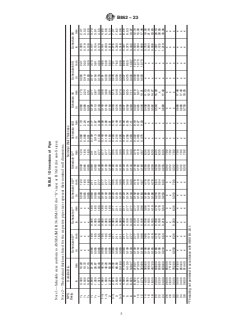
TABLE 1 Dimensions of Pipe
NOTE 1—Schedule sizes conform to ANSI/ASME B 36.19M-1985 (for “S” sizes) or B 36.10 (for non-S sizes).
NOTE 2—The decimal thickness listed for the respective pipe sizes represent their nominal wall dimensions.
NPS Outside Dia. Nominal Wall Thickness
Desig.
A A A A
Schedule 5S Schedule 5 Schedule 10S Schedule 10 Schedule 40S Schedule 40 Schedule 80S Schedule 80
in mm in mm in mm in mm in mm in mm in mm in mm in mm
⁄8 0.405 10.29 x x x x 0.049 1.24 0.049 1.24 0.068 1.73 0.068 1.73 0.095 2.41 0.095 2.41
⁄4 0.540 13.72 x x x x 0.065 1.65 0.065 1.65 0.088 2.24 0.088 2.24 0.119 3.02 0.119 3.02
⁄8 0.675 17.15 x x x x 0.065 1.65 0.065 1.65 0.091 2.31 0.091 2.31 0.126 3.20 0.126 3.20
⁄2 0.840 21.34 0.065 1.65 0.065 1.65 0.083 2.11 0.083 2.11 0.109 2.77 0.109 2.77 0.147 3.73 0.147 3.73
⁄4 1.050 26.67 0.065 1.65 0.065 1.65 0.083 2.11 0.083 2.11 0.113 2.87 0.113 2.87 0.154 3.91 0.154 3.91
1 1.315 33.40 0.065 1.65 0.065 1.65 0.109 2.77 0.109 2.77 0.133 3.38 0.133 3.38 0.179 4.55 0.179 4.55
1- ⁄4 1.660 42.16 0.065 1.65 0.065 1.65 0.109 2.77 0.109 2.77 0.140 3.56 0.140 3.56 0.191 4.85 0.191 4.85
1- ⁄2 1.900 48.26 0.065 1.65 0.065 1.65 0.109 2.77 0.109 2.77 0.145 3.68 0.145 3.68 0.200 5.08 0.200 5.08
2 2.375 60.32 0.065 1.65 0.065 1.65 0.109 2.77 0.109 2.77 0.154 3.91 0.154 3.91 0.218 5.54 0.218 5.54
2- ⁄2 2.875 73.02 0.083 2.11 0.083 2.11 0.120 3.05 0.120 3.05 0.203 5.16 0.203 5.16 0.276 7.01 0.276 7.01
3 3.500 88.90 0.083 2.11 0.083 2.11 0.120 3.05 0.120 3.05 0.216 5.49 0.216 5.49 0.300 7.62 0.300 7.62
3- ⁄2 4.000 101.60 0.083 2.11 0.083 2.11 0.120 3.05 0.120 3.05 0.226 5.74 0.226 5.74 0.318 8.08 0.318 8.08
4 4.500 114.30 0.083 2.11 0.083 2.11 0.120 3.05 0.120 3.05 0.237 6.02 0.237 6.02 0.337 8.56 0.337 8.56
5 5.563 141.30 0.109 2.77 0.109 2.77 0.134 3.40 0.134 3.40 0.258 6.55 0.258 6.55 0.375 9.53 0.375 9.53
6 6.625 168.27 0.109 2.77 0.109 2.77 0.134 3.40 0.134 3.40 0.280 7.11 0.280 7.11 0.432 10.97 0.432 10.97
8 8.625 219.07 0.109 2.77 0.109 2.77 0.148 3.76 0.148 3.76 0.322 8.18 0.322 8.18 0.500 12.70 0.500 12.70
10 10.75 273.05 0.134 3.40 0.134 3.40 0.165 4.19 0.165 4.19 0.365 9.27 0.365 9.27 0.500 12.70 0.594 15.09
12 12.75 323.85 0.156 3.96 0.156 3.96 0.180 4.57 0.180 4.57 0.375 9.53 0.406 10.31 0.500 12.70 0.688 17.48
14 14.00 355.60 0.156 3.96 0.156 3.96 0.188 4.78 0.250 6.35 x x 0.438 11.13 x x 0.750 19.05
16 16.00 406.40 0.165 4.19 0.165 4.19 0.188 4.78 0.250 6.35 x x 0.500 12.70 x x 0.844 21.44
18 18.00 457.20 0.165 4.19 0.165 4.19 0.188 4.78 0.250 6.35 x x 0.562 14.27 x x 0.938 23.83
20 20.00 508.00 0.188 4.78 0.188 4.78 0.218 5.54 0.250 6.35 x x 0.594 15.09 x x 1.031 26.19
22 22.00 558.80 0.188 4.78 0.188 4.78 0.218 5.54 0.250 6.35 x x x x x x 1.125 28.58
24 24.00 609.60 0.218 5.54 0.218 5.54 0.250 6.35 0.250 6.35 x x 0.688 17.48 x x 1.219 30.96
26 26.00 660.40 x x x x x x 0.312 7.92 x x x x x x x x
28 28.00 711.20 x x x x x x 0.312 7.92 x x x x x x x x
30 30.00 762.00 0.250 6.35 0.250 6.35 0.312 7.92 0.312 7.92 x x x x x x x x
32 32.00 812.80 x x x x x x 0.312 7.92 x x 0.688 17.48 x x x x
34 34.00 863.60 x x x x x x 0.312 7.92 x x 0.688 17.48 x x x x
36 36.00 914.40 x x x x x x 0.312 7.92 x x 0.750 19.05 x x x x
A
Threading not permitted in accordance with ANSI B.1.20.1.
B862 − 23
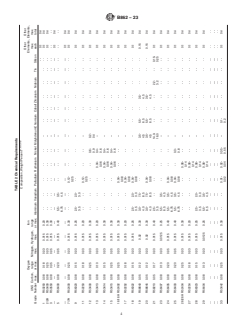
TABLE 2 Chemical Requirements
A,B,C,D,E
Composition, Weight Percent
Other Other
Oxygen Iron Elements, Elements,
UNS Carbon, range Nitrogen, Hydrogen, range max. max.
Grade Number max. or max. max. max. or max. Aluminum Vanadium Palladium Ruthenium Nickel Molybdenum Chromium Cobalt Zirconium Niobium Tin Silicon each total
- - 0.1 0.4
1 R50250 0.08 0.18 0.03 0.015 0.20 - - - - - - - - - - - - - - - - - - - - - - - - 0.1 0.4
2/2H R50400 0.08 0.25 0.03 0.015 0.30 - - - - - - - - - - - - - - - - - - - - - - - - 0.1 0.4
3 R50550 0.08 0.35 0.05 0.015 0.30 - - - - - - - - - - - - - - - - - - - - - - - - - - - -
— — — — — — — — — — — — — — — — — — 0.1 0.4
5 R56400 0.08 0.20 0.05 0.015 0.40 5.5- 3.5- - - - - - - - - - - - - - - - - - - - - - - - -
6.75 4.5
— — — — — — — — — — — — — — — — — — 0.1 0.4
7/7H R52400 0.08 0.25 0.03 0.015 0.30 - - - - 0.12- - - - - - - - - - - - - - - - - - - 0.1 0.4
0.25
9 R56320 0.08 0.15 0.03 0.015 0.25 2.5- 2.0- - - - - - - - - - - - - - - - - - - - - 0.1 0.4
3.5 3.0
11 R52250 0.08 0.18 0.03 0.015 0.20 - - - - 0.12- - - - - - - - - - - - - - - - - - - 0.1 0.4
0.25
12 R53400 0.08 0.25 0.03 0.015 0.30 - - - - - - - - 0.6- 0.2- - - - - - - - - - - - - 0.1 0.4
0.9 0.4
13 R53413 0.08 0.10 0.03 0.015 0.20 - - - - - - 0.04- 0.4- - - - - - - - - - - - - - - 0.1 0.4
0.06 0.6
14 R53414 0.08 0.15 0.03 0.015 0.30 - - - - - - 0.04- 0.4- - - - - - - - - - - - - - - 0.1 0.4
0.06 0.6
15 R53415 0.08 0.25 0.05 0.015 0.30 - - - - - - 0.04- 0.4- - - - - - - - - - - - - - - 0.1 0.4
0.06 0.6
16/16H R52402 0.08 0.25 0.03 0.015 0.30 - - - - 0.04- - - - - - - - - - - - - - - - - - - 0.1 0.4
0.08
17 R52252 0.08 0.18 0.03 0.015 0.20 - - - - 0.04- - - - - - - - - - - - - - - - - - - 0.1 0.4
0.08
18 R56322 0.08 0.15 0.03 0.015 0.25 2.5- 2.0- 0.04- - - - - - - - - - - - - - - - - - - 0.1 0.4
3.5 3.0 0.08
19 R58640 0.05 0.12 0.03 0.02 0.30 3.0- 7.5- - - - - - - 3.5- 5.5- - - 3.5- - - - - - - 0.15 0.4
4.0 8.5 4.5 6.5 4.5
20 R58645 0.05 0.12 0.03 0.02 0.30 3.0- 7.5- 0.04- - - - - 3.5- 5.5- - - 3.5- - - - - - - 0.15 0.4
4.0 8.5 0.08 4.5 6.5 4.5
21 R58210 0.05 0.17 0.03 0.015 0.40 2.5- - - - - - - - - 14.0- - - - - - - 2.2- - - 0.15- 0.1 0.4
3.5 16.0 3.2 0.25
23 R56407 0.08 0.13 0.03 0.0125 0.25 5.5- 3.5- - - - - - - - - - - - - - - - - - - - - 0.1 0.4
6.5 4.5
24 R56405 0.08 0.20 0.05 0.015 0.40 5.5- 3.5- 0.04- - - - - - - - - - - - - - - - - - - 0.1 0.4
6.75 4.5 0.08
25 R56403 0.08 0.20 0.05 0.015 0.40 5.5- 3.5- 0.04- - - 0.3- - - - - - - - - - - - - - - 0.1 0.4
6.75 4.5 0.08 0.8
26/26H R52404 0.08 0.25 0.03 0.015 0.30 - - - - - - 0.08- - - - - - - - - - - - - - - - - 0.1 0.4
0.14
27 R52254 0.08 0.18 0.03 0.015 0.20 - - - - - - 0.08- - - - - - - - - - - - - - - - - 0.1 0.4
0.14
28 R56323 0.08 0.15 0.03 0.015 0.25 2.5- 2.0- - - 0.08- - - - - - - - - - - - - - - - - 0.1 0.4
3.5 3.0 0.14
29 R56404 0.08 0.13 0.03 0.0125 0.25 5.5- 3.5- - - 0.08- - - - - - - - - - - - - - - - - 0.1 0.4
6.5 4.5 0.14
— — — — — — — — — — — — — — — — — — - - - -
— — — — — — — — — — — — — — — — — — - - - -
— — — — — — — — — — — — — — — — — — - - - -
33 R53442 0.08 0.25 0.03 0.015 0.30 - - - - 0.01- 0.02- 0.35- - - 0.1- - - - - - - - - - - 0.1 0.4
0.02 0.04 0.55 0.2
B862 − 23
TABLE 2 Continued
A,B,C,D,E
Composition, Weight Percent
Other Other
Oxygen Iron Elements, Elements,
UNS Carbon, range Nitrogen, Hydrogen, range max. max.
Grade Number max. or max. max. max. or max. Aluminum Vanadium Palladium Ruthenium Nickel Molybdenum Chromium Cobalt Zirconium Niobium Tin Silicon each total
34 R53445 0.08 0.35 0.05 0.015 0.30 - - - - 0.01- 0.02- 0.35- - - 0.1- - - - - - - - - - - 0.1 0.4
0.02 0.04 0.55 0.2
35 R56340 0.08 0.25 0.05 0.015 0.20- 4.0- 1.1- - - - - - - 1.5- - - - - - - - - - - 0.20- 0.1 0.4
0.80 5.0 2.1 2.5 0.40
— — — — — — — — — — — — — — — — — — - - - -
37 R52815 0.08 0.25 0.03 0.015 0.30 1.0- - - - - - - - - - - - - - - - - - - - - - - 0.1 0.4
2.0
38 R54250 0.08 0.20- 0.03 0.015 1.2- 3.5- 2.0- - - - - - - - - - - - - - - - - - - - - 0.1 0.4
0.30 1.8 4.5 3.0
39 R53390 0.08 0.15 0.03 0.015 0.15- — — — — — — — — — — — 0.30- 0.1 0.4
0.40 0.50
A
At minimum, the analysis of samples from the top and bottom of the ingot shall be completed and reported for all elements listed for the respective grade in this table.
B
Final product hydrogen shall be reported. Ingot hydrogen need not be reported. Lower hydrogen may be obtained by negotiation with the manufacturer.
C
Single values are maximum. The percentage of titanium is determined by difference.
D
Other elements need not be reported unless the concentration level is greater than 0.1 % each, or 0.4 % total. Other elements may not be added intentionally. Other elements may be present in titanium or titanium
alloys in small quantities and are inherent to the manufacturing process. In titanium these elements typically include aluminum, vanadium, tin, chromium, molybdenum, niobium, zirconium, hafnium, bismuth, ruthenium,
palladium, yttrium, copper, silicon, cobalt, tantalum, nickel, boron, manganese, and tungsten.
E
The purchaser may, in the written purchase order, request analysis for specific elements not listed in this specification.
B862 − 23
TABLE 3 Permissible Variations in Product Analysis
6.1.2 Elements intentionally added to the melt must be
Product Analysis Limits, Permissible Variation identified, analyzed, and reported in the chemical analysis.
Element
Max or Range, % in Product Analysis
6.2 When agreed upon by the producer and purchaser and
Aluminum 0.5 to 2.5 ±0.20
requested by the purchaser in a written purchase order, chemi-
Aluminum 2.5 to 6.75 ±0.40
Carbon 0.10 +0.02
cal analysis shall be completed for specific residual elements
Chromium 0.1 to 0.2 ±0.02
not listed in this specification.
Chromium 5.5 to 6.5 ±0.30
Hydrogen 0.02 +0.002
6.3 At least two samples for chemical analysis shall be
Iron 0.80 +0.15
tested to determine chemical composition. Samples shall be
Iron 1.2 to 1.8 ±0.20
Molybdenum 0.2 to 0.4 ±0.03
taken from the ingot or the opposite extremes of the product to
Molybdenum 1.5 to 4.5 ±0.20
be analyzed.
Molybdenum 14.0 to 16.0 ±0.50
Nickel 0.3 to 0.9 ±0.05
Niobium 2.2 to 3.2 ±0.15
7. Product Analysis
Nitrogen 0.05 +0.02
7.1 When requested by the purchaser and stated in the
Oxygen 0.30 +0.03
Oxygen 0.31 to 0.40 ±0.04
purchase order, an analysis of chemical composition shall be
Palladium 0.01 to 0.02 ±0.002
made on the finished product.
Palladium 0.04 to 0.08 ±0.005
Palladium 0.12 to 0.25 ±0.02
7.2 The product analysis tolerances listed in Table 3 do not
Ruthenium 0.02 to 0.06 ±0.005
broaden the specified analysis requirements but cover varia-
Ruthenium 0.08 to 0.14 ±0.01
Silicon 0.06 to 0.50 ±0.02
tions between different laboratories in the measurement of
Vanadium 2.0 to 4.5 ±0.15
chemical content. The manufacturer shall not ship finished
Vanadium 7.5 to 8.5 ±0.40
product outside of the limits specified in Table 2 for the
Zirconium 3.5 to 4.5 ±0.20
A
Residuals (each) 0.15 +0.02
applicable grade.
A
A residual is an element in a metal or alloy in small quantities inherent to the
manufacturing process but not added intentionally.
8. Tensile Requirements
8.1 The tensile properties of the pipe, in the condition
specified, shall conform to the room temperature requirements
5.1.1 Welded pipe may be further reduced by cold working
of Table 4. Mechanical properties for other conditions may be
or hot working. Cold reduced pipe shall be annealed after cold
established by written agreement between the manufacturer
working at a temperature of not less than 1000 °F. Hot worked
and the purchaser.
pipe finished above 1400 °F (760 °C) need not be further heat
treated.
9. Permissible Variations in Dimensions
5.2 Pipe shall be furnished as follows unless otherwise
9.1 A system of standard pip
...
This document is not an ASTM standard and is intended only to provide the user of an ASTM standard an indication of what changes have been made to the previous version. Because
it may not be technically possible to adequately depict all changes accurately, ASTM recommends that users consult prior editions as appropriate. In all cases only the current version
of the standard as published by ASTM is to be considered the official document.
Designation: B862 − 19 B862 − 23
Standard Specification for
Titanium and Titanium Alloy Welded Pipe
This standard is issued under the fixed designation B862; the number immediately following the designation indicates the year of
original adoption or, in the case of revision, the year of last revision. A number in parentheses indicates the year of last reapproval. A
superscript epsilon (´) indicates an editorial change since the last revision or reapproval.
This standard has been approved for use by agencies of the U.S. Department of Defense.
1. Scope
1.1 This specification covers the requirements for 33 grades of titanium and titanium alloy welded pipe intended for general
corrosion resisting and elevated temperature service as follows:
1.1.1 Grade 1—UNS R50250. Unalloyed titanium,
1.1.2 Grade 2—UNS R50400. Unalloyed titanium,
1.1.2.1 Grade 2H—UNS R50400. Unalloyed titanium (Grade 2 with 58 ksi (400 MPa) minimum UTS),
1.1.3 Grade 3—UNS R50550. Unalloyed titanium,
1.1.4 Grade 5—UNS R56400. Titanium alloy (6 % aluminum, 4 % vanadium),
1.1.5 Grade 7—UNS R52400. Unalloyed titanium plus 0.120.12 % to 0.25 % palladium,
1.1.5.1 Grade 7H—UNS R52400. Unalloyed titanium plus 0.120.12 % to 0.25 % palladium (Grade 7 with 58 ksi (400 MPa)
minimum UTS),
1.1.6 Grade 9—UNS R56320. Titanium alloy (3 % aluminum, 2.5 % vanadium),
1.1.7 Grade 11—UNS R52250. Unalloyed titanium plus 0.120.12 % to 0.25 % palladium,
1.1.8 Grade 12—UNS R53400. Titanium alloy (0.3 % molybdenum, 0.8 % nickel),
1.1.9 Grade 13—UNS R53413. Titanium alloy (0.5 % nickel, 0.05 % ruthenium),
1.1.10 Grade 14—UNS R53414. Titanium alloy (0.5 % nickel, 0.05 % ruthenium),
1.1.11 Grade 15—UNS R53415. Titanium alloy (0.5 % nickel, 0.05 % ruthenium),
1.1.12 Grade 16—UNS R52402. Unalloyed titanium plus 0.040.04 % to 0.08 % palladium,
This specification is under the jurisdiction of ASTM Committee B10 on Reactive and Refractory Metals and Alloys and is the direct responsibility of Subcommittee
B10.01 on Titanium.
Current edition approved Nov. 1, 2019Nov. 15, 2023. Published November 2019November 2023. Originally approved in 1995. Last previous edition approved in 20142019
as B862 – 14.B862 – 19. DOI: 10.1520/B0862-19.10.1520/B0862-23.
Copyright © ASTM International, 100 Barr Harbor Drive, PO Box C700, West Conshohocken, PA 19428-2959. United States
B862 − 23
1.1.12.1 Grade 16H—UNS R52402. Unalloyed titanium plus 0.040.04 % to 0.08 % palladium (Grade 16 with 58 ksi (400 MPa)
(400 MPa) minimum UTS),
1.1.13 Grade 17—UNS R52252. Unalloyed titanium plus 0.040.04 % to 0.08 % palladium,
1.1.14 Grade 18—UNS R56322. Titanium alloy (3 % aluminum, 2.5 % vanadium plus 0.040.04 % to 0.08 % palladium),
1.1.15 Grade 19—UNS R58640. Titanium alloy (3 % aluminum, 8 % vanadium, 6 % chromium, 4 % zirconium, 4 %
molybdenum),
1.1.16 Grade 20—UNS R58645. Titanium alloy (3 % aluminum, 8 % vanadium, 6 % chromium, 4 % zirconium, 4 %
molybdenum) plus 0.040.04 % to 0.08 % palladium,
1.1.17 Grade 21—UNS R58210. Titanium alloy (15 % molybdenum, 3 % aluminum, 2.7 % niobium, 0.25 % silicon),
1.1.18 Grade 23—UNS R56407. Titanium alloy (6 % aluminum, 4 % vanadium, extra low interstitial, ELI),
1.1.19 Grade 24—UNS R56405. Titanium alloy (6 % aluminum, 4 % vanadium) plus 0.040.04 % to 0.08 % palladium,
1.1.20 Grade 25—UNS R56403. Titanium alloy (6 % aluminum, 4 % vanadium) plus 0.30.3 % to 0.8 % nickel and 0.040.04 %
to 0.08 % palladium,
1.1.21 Grade 26—UNS R52404. Unalloyed titanium plus 0.080.08 % to 0.14 % ruthenium,
1.1.21.1 Grade 26H—UNS R52404. Unalloyed titanium plus 0.080.08 % to 0.14 % ruthenium (Grade 26 with 58 ksi (400 MPa)
(400 MPa) minimum UTS),
1.1.22 Grade 27—UNS R52254. Unalloyed titanium plus 0.080.08 % to 0.14 % ruthenium,
1.1.23 Grade 28—UNS R56323. Titanium alloy (3 % aluminum, 2.5 % vanadium) plus 0.080.08 % to 0.14 % ruthenium,
1.1.24 Grade 29—UNS R56404. Titanium alloy (6 % aluminum, 4 % vanadium with extra low interstitial elements (ELI)) plus
0.080.08 % to 0.14 % ruthenium,
1.1.25 Grade 33—UNS R53442. Titanium alloy (0.4 % nickel, 0.015 % palladium, 0.025 % ruthenium, 0.15 % chromium),
1.1.26 Grade 34—UNS R53445. Titanium alloy (0.4 % nickel, 0.015 % palladium, 0.025 % ruthenium, 0.15 % chromium),
1.1.27 Grade 35—UNS R56340. Titanium alloy (4.5 % aluminum, 2 % molybdenum, 1.6 % vanadium, 0.5 % iron, 0.3 % silicon),
1.1.28 Grade 37—UNS R52815. Titanium alloy (1.5 % aluminum),
1.1.29 Grade 38—UNS R54250. Titanium alloy (4 % aluminum, 2.5 % vanadium, 1.5 % iron), and
1.1.30 Grade 39—UNS R53390. Titanium alloy (0.25 % iron, 0.4 % silicon).
NOTE 1—H grade material is identical to the corresponding numeric grade (that is, Grade 2H = Grade 2) except for the higher guaranteed minimum UTS,
and may always be certified as meeting the requirements of its corresponding numeric grade. Grades 2H, 7H, 16H, and 26H are intended primarily for
pressure vessel use.
1.2 Pipe 8 in. NPS (nominal pipe size) and larger is most frequently custom made for an order. In such cases, the purchaser
carefully should consider the applicability of this specification. Since the pipe is custom made, the purchaser may choose a wall
thickness other than those in Table 1 to meet specific operating conditions. The purchaser may also be better served to specify only
the portions of this specification that are required to meet the operating conditions (for example, annealing, flattening test,
chemistry, properties, etc.).
B862 − 23
TABLE 1 Dimensions of Pipe
NOTE 1—Schedule sizes conform to ANSI/ASME B 36.19M-1985 (for “S” sizes) or B 36.10 (for non-S sizes).
NOTE 2—The decimal thickness listed for the respective pipe sizes represent their nominal wall dimensions.
NPS Outside Dia. Nominal Wall Thickness
Desig. A A A A
Schedule 5S Schedule 5 Schedule 10S Schedule 10 Schedule 40S Schedule 40 Schedule 80S Schedule 80
in mm in mm in mm in mm in mm in mm in mm in mm in mm
⁄8 0.405 10.29 x x x x 0.049 1.24 0.049 1.24 0.068 1.73 0.068 1.73 0.095 2.41 0.095 2.41
⁄4 0.540 13.72 x x x x 0.065 1.65 0.065 1.65 0.088 2.24 0.088 2.24 0.119 3.02 0.119 3.02
⁄8 0.675 17.15 x x x x 0.065 1.65 0.065 1.65 0.091 2.31 0.091 2.31 0.126 3.20 0.126 3.20
⁄2 0.840 21.34 0.065 1.65 0.065 1.65 0.083 2.11 0.083 2.11 0.109 2.77 0.109 2.77 0.147 3.73 0.147 3.73
⁄4 1.050 26.67 0.065 1.65 0.065 1.65 0.083 2.11 0.083 2.11 0.113 2.87 0.113 2.87 0.154 3.91 0.154 3.91
1 1.315 33.40 0.065 1.65 0.065 1.65 0.109 2.77 0.109 2.77 0.133 3.38 0.133 3.38 0.179 4.55 0.179 4.55
1- ⁄4 1.660 42.16 0.065 1.65 0.065 1.65 0.109 2.77 0.109 2.77 0.140 3.56 0.140 3.56 0.191 4.85 0.191 4.85
1- ⁄2 1.900 48.26 0.065 1.65 0.065 1.65 0.109 2.77 0.109 2.77 0.145 3.68 0.145 3.68 0.200 5.08 0.200 5.08
2 2.375 60.32 0.065 1.65 0.065 1.65 0.109 2.77 0.109 2.77 0.154 3.91 0.154 3.91 0.218 5.54 0.218 5.54
2- ⁄2 2.875 73.02 0.083 2.11 0.083 2.11 0.120 3.05 0.120 3.05 0.203 5.16 0.203 5.16 0.276 7.01 0.276 7.01
3 3.500 88.90 0.083 2.11 0.083 2.11 0.120 3.05 0.120 3.05 0.216 5.49 0.216 5.49 0.300 7.62 0.300 7.62
3- ⁄2 4.000 101.60 0.083 2.11 0.083 2.11 0.120 3.05 0.120 3.05 0.226 5.74 0.226 5.74 0.318 8.08 0.318 8.08
4 4.500 114.30 0.083 2.11 0.083 2.11 0.120 3.05 0.120 3.05 0.237 6.02 0.237 6.02 0.337 8.56 0.337 8.56
5 5.563 141.30 0.109 2.77 0.109 2.77 0.134 3.40 0.134 3.40 0.258 6.55 0.258 6.55 0.375 9.53 0.375 9.53
6 6.625 168.27 0.109 2.77 0.109 2.77 0.134 3.40 0.134 3.40 0.280 7.11 0.280 7.11 0.432 10.97 0.432 10.97
8 8.625 219.07 0.109 2.77 0.109 2.77 0.148 3.76 0.148 3.76 0.322 8.18 0.322 8.18 0.500 12.70 0.500 12.70
10 10.75 273.05 0.134 3.40 0.134 3.40 0.165 4.19 0.165 4.19 0.365 9.27 0.365 9.27 0.500 12.70 0.594 15.09
12 12.75 323.85 0.156 3.96 0.156 3.96 0.180 4.57 0.180 4.57 0.375 9.53 0.406 10.31 0.500 12.70 0.688 17.48
14 14.00 355.60 0.156 3.96 0.156 3.96 0.188 4.78 0.250 6.35 x x 0.438 11.13 x x 0.750 19.05
16 16.00 406.40 0.165 4.19 0.165 4.19 0.188 4.78 0.250 6.35 x x 0.500 12.70 x x 0.844 21.44
18 18.00 457.20 0.165 4.19 0.165 4.19 0.188 4.78 0.250 6.35 x x 0.562 14.27 x x 0.938 23.83
20 20.00 508.00 0.188 4.78 0.188 4.78 0.218 5.54 0.250 6.35 x x 0.594 15.09 x x 1.031 26.19
22 22.00 558.80 0.188 4.78 0.188 4.78 0.218 5.54 0.250 6.35 x x x x x x 1.125 28.58
24 24.00 609.60 0.218 5.54 0.218 5.54 0.250 6.35 0.250 6.35 x x 0.688 17.48 x x 1.219 30.96
26 26.00 660.40 x x x x x x 0.312 7.92 x x x x x x x x
28 28.00 711.20 x x x x x x 0.312 7.92 x x x x x x x x
30 30.00 762.00 0.250 6.35 0.250 6.35 0.312 7.92 0.312 7.92 x x x x x x x x
32 32.00 812.80 x x x x x x 0.312 7.92 x x 0.688 17.48 x x x x
34 34.00 863.60 x x x x x x 0.312 7.92 x x 0.688 17.48 x x x x
36 36.00 914.40 x x x x x x 0.312 7.92 x x 0.750 19.05 x x x x
A
Threading not permitted in accordance with ANSI B.1.20.1.
B862 − 23
1.3 Optional supplementary requirements are provided for pipe where a greater degree of testing is desired. These supplementary
requirements may be invoked by the purchaser, when desired, by specifying in the order.
1.4 The values stated in inch-pound units are to be regarded as standard. The values given in parentheses are mathematical
conversions to SI units that are provided for information only and are not considered standard.
1.5 This international standard was developed in accordance with internationally recognized principles on standardization
established in the Decision on Principles for the Development of International Standards, Guides and Recommendations issued
by the World Trade Organization Technical Barriers to Trade (TBT) Committee.
2. Referenced Documents
2.1 ASTM Standards:
A370 Test Methods and Definitions for Mechanical Testing of Steel Products
B600 Guide for Descaling and Cleaning Titanium and Titanium Alloy Surfaces
E8E8/E8M Test Methods for Tension Testing of Metallic Materials [Metric] E0008_E0008M
E29 Practice for Using Significant Digits in Test Data to Determine Conformance with Specifications
E539 Test Method for Analysis of Titanium Alloys by Wavelength Dispersive X-Ray Fluorescence Spectrometry
E1409 Test Method for Determination of Oxygen and Nitrogen in Titanium and Titanium Alloys by Inert Gas Fusion
E1417 Practice for Liquid Penetrant Testing
E1447 Test Method for Determination of Hydrogen in Reactive Metals and Reactive Metal Alloys by Inert Gas Fusion with
Detection by Thermal Conductivity or Infrared Spectrometry
E1941 Test Method for Determination of Carbon in Refractory and Reactive Metals and Their Alloys by Combustion Analysis
E2371 Test Method for Analysis of Titanium and Titanium Alloys by Direct Current Plasma and Inductively Coupled Plasma
Atomic Emission Spectrometry (Performance-Based Test Methodology)
E2994 Test Method for Analysis of Titanium and Titanium Alloys by Spark Atomic Emission Spectrometry and Glow Discharge
Atomic Emission Spectrometry (Performance-Based Method)
2.2 ANSI/ASME Standards:
B.1.20.1 Pipe Threads, General Purpose (Inch)
B 36.10 Carbon, Alloy and Stainless Steel Pipes
B 36.19M-1985 Stainless Steel Pipe
ASME Boiler and Pressure Vessel Code Section VIII
2.3 AWS Standard:
AWS A5.16 ⁄A5.16M-2013 Specification for Titanium and Titanium Alloy Welding Electrodes and Rods
3. Terminology
3.1 Definitions:
3.1.1 lot, n—a number of pieces of pipe of the same nominal size and wall thickness manufactured by the same process from a
single heat of titanium or titanium alloy and heat treated by the same furnace parameters in the same furnace.
3.1.2 welded pipe, n—a hollow tubular product produced by forming flat-rolled product and seam welding to make a right circular
cylinder.
4. Ordering Information
4.1 Orders for materials under this specification shall include the following information as required:
4.1.1 Quantity,
4.1.2 Grade number (Section 1 and Table 2),
For referenced ASTM standards, visit the ASTM website, www.astm.org, or contact ASTM Customer Service at service@astm.org. For Annual Book of ASTM Standards
volume information, refer to the standard’s Document Summary page on the ASTM website.
Available from American National Standards Institute (ANSI), 25 W. 43rd St., 4th Floor, New York, NY 10036, http://www.ansi.org.
Available from American Welding Society (AWS), 550 NW LeJeune Rd., Miami, FL 33126, http://www.aws.org.
B862 − 23
TABLE 2 Chemical Requirements
A,B,C,D,E
Composition, Weight Percent
Other Other
Oxygen Iron Elements, Elements,
UNS Carbon, range Nitrogen, Hydrogen, range max. max.
Grade Number max. or max. max. max. or max. Aluminum Vanadium Palladium Ruthenium Nickel Molybdenum Chromium Cobalt Zirconium Niobium Tin Silicon each total
- - 0.1 0.4
1 R50250 0.08 0.18 0.03 0.015 0.20 - - - - - - - - - - - - - - - - - - - - - - - - 0.1 0.4
2/2H R50400 0.08 0.25 0.03 0.015 0.30 - - - - - - - - - - - - - - - - - - - - - - - - 0.1 0.4
3 R50550 0.08 0.35 0.05 0.015 0.30 - - - - - - - - - - - - - - - - - - - - - - - - - - - -
— — — — — — — — — — — — — — — — — — 0.1 0.4
5 R56400 0.08 0.20 0.05 0.015 0.40 5.5- 3.5- - - - - - - - - - - - - - - - - - - - - - - - -
6.75 4.5
— — — — — — — — — — — — — — — — — — 0.1 0.4
7/7H R52400 0.08 0.25 0.03 0.015 0.30 - - - - 0.12- - - - - - - - - - - - - - - - - - - 0.1 0.4
0.25
9 R56320 0.08 0.15 0.03 0.015 0.25 2.5- 2.0- - - - - - - - - - - - - - - - - - - - - 0.1 0.4
3.5 3.0
11 R52250 0.08 0.18 0.03 0.015 0.20 - - - - 0.12- - - - - - - - - - - - - - - - - - - 0.1 0.4
0.25
12 R53400 0.08 0.25 0.03 0.015 0.30 - - - - - - - - 0.6- 0.2- - - - - - - - - - - - - 0.1 0.4
0.9 0.4
13 R53413 0.08 0.10 0.03 0.015 0.20 - - - - - - 0.04- 0.4- - - - - - - - - - - - - - - 0.1 0.4
0.06 0.6
14 R53414 0.08 0.15 0.03 0.015 0.30 - - - - - - 0.04- 0.4- - - - - - - - - - - - - - - 0.1 0.4
0.06 0.6
15 R53415 0.08 0.25 0.05 0.015 0.30 - - - - - - 0.04- 0.4- - - - - - - - - - - - - - - 0.1 0.4
0.06 0.6
16/16H R52402 0.08 0.25 0.03 0.015 0.30 - - - - 0.04- - - - - - - - - - - - - - - - - - - 0.1 0.4
0.08
17 R52252 0.08 0.18 0.03 0.015 0.20 - - - - 0.04- - - - - - - - - - - - - - - - - - - 0.1 0.4
0.08
18 R56322 0.08 0.15 0.03 0.015 0.25 2.5- 2.0- 0.04- - - - - - - - - - - - - - - - - - - 0.1 0.4
3.5 3.0 0.08
19 R58640 0.05 0.12 0.03 0.02 0.30 3.0- 7.5- - - - - - - 3.5- 5.5- - - 3.5- - - - - - - 0.15 0.4
4.0 8.5 4.5 6.5 4.5
20 R58645 0.05 0.12 0.03 0.02 0.30 3.0- 7.5- 0.04- - - - - 3.5- 5.5- - - 3.5- - - - - - - 0.15 0.4
4.0 8.5 0.08 4.5 6.5 4.5
21 R58210 0.05 0.17 0.03 0.015 0.40 2.5- - - - - - - - - 14.0- - - - - - - 2.2- - - 0.15- 0.1 0.4
3.5 16.0 3.2 0.25
23 R56407 0.08 0.13 0.03 0.0125 0.25 5.5- 3.5- - - - - - - - - - - - - - - - - - - - - 0.1 0.4
6.5 4.5
24 R56405 0.08 0.20 0.05 0.015 0.40 5.5- 3.5- 0.04- - - - - - - - - - - - - - - - - - - 0.1 0.4
6.75 4.5 0.08
25 R56403 0.08 0.20 0.05 0.015 0.40 5.5- 3.5- 0.04- - - 0.3- - - - - - - - - - - - - - - 0.1 0.4
6.75 4.5 0.08 0.8
26/26H R52404 0.08 0.25 0.03 0.015 0.30 - - - - - - 0.08- - - - - - - - - - - - - - - - - 0.1 0.4
0.14
27 R52254 0.08 0.18 0.03 0.015 0.20 - - - - - - 0.08- - - - - - - - - - - - - - - - - 0.1 0.4
0.14
28 R56323 0.08 0.15 0.03 0.015 0.25 2.5- 2.0- - - 0.08- - - - - - - - - - - - - - - - - 0.1 0.4
3.5 3.0 0.14
29 R56404 0.08 0.13 0.03 0.0125 0.25 5.5- 3.5- - - 0.08- - - - - - - - - - - - - - - - - 0.1 0.4
6.5 4.5 0.14
— — — — — — — — — — — — — — — — — — - - - -
— — — — — — — — — — — — — — — — — — - - - -
— — — — — — — — — — — — — — — — — — - - - -
33 R53442 0.08 0.25 0.03 0.015 0.30 - - - - 0.01- 0.02- 0.35- - - 0.1- - - - - - - - - - - 0.1 0.4
0.02 0.04 0.55 0.2
B862 − 23
TABLE 2 Continued
A,B,C,D,E
Composition, Weight Percent
Other Other
Oxygen Iron Elements, Elements,
UNS Carbon, range Nitrogen, Hydrogen, range max. max.
Grade Number max. or max. max. max. or max. Aluminum Vanadium Palladium Ruthenium Nickel Molybdenum Chromium Cobalt Zirconium Niobium Tin Silicon each total
34 R53445 0.08 0.35 0.05 0.015 0.30 - - - - 0.01- 0.02- 0.35- - - 0.1- - - - - - - - - - - 0.1 0.4
0.02 0.04 0.55 0.2
35 R56340 0.08 0.25 0.05 0.015 0.20- 4.0- 1.1- - - - - - - 1.5- - - - - - - - - - - 0.20- 0.1 0.4
0.80 5.0 2.1 2.5 0.40
— — — — — — — — — — — — — — — — — — - - - -
37 R52815 0.08 0.25 0.03 0.015 0.30 1.0- - - - - - - - - - - - - - - - - - - - - - - 0.1 0.4
2.0
38 R54250 0.08 0.20- 0.03 0.015 1.2- 3.5- 2.0- - - - - - - - - - - - - - - - - - - - - 0.1 0.4
0.30 1.8 4.5 3.0
39 R53390 0.08 0.15 0.03 0.015 0.15- — — — — — — — — — — — 0.30- 0.1 0.4
0.40 0.50
A
At minimum, the analysis of samples from the top and bottom of the ingot shall be completed and reported for all elements listed for the respective grade in this table.
B
Final product hydrogen shall be reported. Ingot hydrogen need not be reported. Lower hydrogen may be obtained by negotiation with the manufacturer.
C
Single values are maximum. The percentage of titanium is determined by difference.
D
Other elements need not be reported unless the concentration level is greater than 0.1 % each, or 0.4 % total. Other elements may not be added intentionally. Other elements may be present in titanium or titanium
alloys in small quantities and are inherent to the manufacturing process. In titanium these elements typically include aluminum, vanadium, tin, chromium, molybdenum, niobium, zirconium, hafnium, bismuth, ruthenium,
palladium, yttrium, copper, silicon, cobalt, tantalum, nickel, boron, manganese, and tungsten.
E
The purchaser may, in the written purchase order, request analysis for specific elements not listed in this specification.
B862 − 23
4.1.3 Nominal pipe size and schedule (Table 1),
4.1.4 Diameter tolerance (see 9.2),
4.1.5 Method of manufacture and finish (Sections 5 and 10),
4.1.6 Product analysis, if required (Sections 6 and 7; Table 1 and Table 3),
4.1.7 Mechanical properties, (Sections 8, 11, 13, 14, and 15, and Table 4),
4.1.8 Packaging (Section 22),
4.1.9 Inspection and test reports (Sections 18, 19 and 20), and
4.1.10 Supplementary requirements.
5. Manufacture
5.1 Welded pipe shall be made from annealed flat-rolled products by a welding process that will yield a product meeting the
requirements of this specification. Filler metal, if used, shall be produced to the latest revision of Specification
AWS A5.16 ⁄A5.16M-2013 employing the ER Ti-X grade listed in Table 5, unless specified otherwise on the purchase order.
5.1.1 Welded pipe may be further reduced by cold working or hot working. Cold reduced pipe shall be annealed after cold working
at a temperature of not less than 1000°F.1000 °F. Hot worked pipe finished above 1400°F (760°C)1400 °F (760 °C) need not be
further heat treated.
5.2 Pipe shall be furnished as follows unless otherwise specified:
5.2.1 Grades 1, 2, 2H, 7, 7H, 11, 13, 14, 16, 16H, 17, 26H, 33, 37, and 39 shall be furnished as welded or annealed.
TABLE 3 Permissible Variations in Product Analysis
Product Analysis Limits, Permissible Variation
Element
Max or Range, % in Product Analysis
Aluminum 0.5 to 2.5 ±0.20
Aluminum 2.5 to 6.75 ±0.40
Carbon 0.10 +0.02
Chromium 0.1 to 0.2 ±0.02
Chromium 5.5 to 6.5 ±0.30
Hydrogen 0.02 +0.002
Iron 0.80 +0.15
Iron 1.2 to 1.8 ±0.20
Molybdenum 0.2 to 0.4 ±0.03
Molybdenum 1.5 to 4.5 ±0.20
Molybdenum 14.0 to 16.0 ±0.50
Nickel 0.3 to 0.9 ±0.05
Niobium 2.2 to 3.2 ±0.15
Nitrogen 0.05 +0.02
Oxygen 0.30 +0.03
Oxygen 0.31 to 0.40 ±0.04
Palladium 0.01 to 0.02 ±0.002
Palladium 0.04 to 0.08 ±0.005
Palladium 0.12 to 0.25 ±0.02
Ruthenium 0.02 to 0.04 ±0.005
Ruthenium 0.02 to 0.06 ±0.005
Ruthenium 0.04 to 0.06 ±0.005
Ruthenium 0.08 to 0.14 ±0.01
Silicon 0.06 to 0.50 ±0.02
Vanadium 2.0 to 4.5 ±0.15
Vanadium 7.5 to 8.5 ±0.40
Zirconium 3.5 to 4.5 ±0.20
A
Residuals (each) 0.15 +0.02
A
A residual is an element in a metal or alloy in small quantities inherent to the
manufacturing process but not added intentionally.
B862 − 23
A
TABLE 4 Tensile Requirements
Tensile Strength, min Yield Strength (0.2 % Offset) Elongation 2 in. or
50 mm, gauge
min max
length, min %
Grade
ksi (MPa) ksi (MPa) ksi (MPa)
1 35 (240) 20 (138) 45 (310) 24
2 50 (345) 40 (275) 65 (450) 20
B,C
2H 58 (400) 40 (275) 65 (450) 20
3 65 (450) 55 (380) 80 (550) 18
5 130 (895) 120 (828) . . 10
D
5 160 (1103) 150 (1034) . . 6
7 50 (345) 40 (275) 65 (450) 20
B,C
7H 58 (400) 40 (275) 65 (450) 20
9 90 (620) 70 (483) . . 15
11 35 (240) 20 (138) 45 (310) 24
12 70 (483) 50 (345) . . 18
13 40 (275) 25 (170) . . 24
14 60 (410) 40 (275) . . 20
15 70 (483) 55 (380) . . 18
16 50 (345) 40 (275) 65 (450) 20
B,C
16H 58 (400) 40 (275) 65 (450) 20
17 35 (240) 20 (138) 45 (310) 24
18 90 (620) 70 (483) . . 15
E
19 115 (793) 110 (759) . . 15
D
19 135 (930) 130 (897) 159 (1096) 10
D
19 165 (1138) 160 (1103) 185 (1276) 5
E
20 115 (793) 110 (759) . . 15
D
20 135 (930) 130 (897) 159 (1096) 10
D
20 165 (1138) 160 (1103) 185 (1276) 5
E
21 115 (793) 110 (759) . . 15
D
...