

ASTM B898-20
(Specification)Standard Specification for Reactive and Refractory Metal Clad Plate
General Information
- Abstract
ABSTRACT
This specification covers plate consisting of a base metal to which is bonded, integrally and continuously, on one or both sides a layer of one of the following: titanium, zirconium, tantalum, niobium, and their alloys. The material generally is intended for pressure vessel use. The cladding metal shall be bonded to the base metal by any cladding operation that will produce a clad product which will conform to the requirements of this specification. When the cladding operation does not affect the chemical composition of the cladding or base metal, or both, the chemical analysis, in accordance with cladding, or base metal specifications or both, may be performed prior to the cladding operation. All heat treatments shall be performed as needed in the cladding operation unless otherwise specified or agreed between the purchaser and the manufacturer. Mechanical testing of the base metal, in accordance with the base metal specification, may be performed prior to the cladding operation. The tensile properties shall be determined by a tension test on the base metal only in accordance with the testing requirements of the base metal specification. The specimen orientation, location with respect to thickness, and number of tests and retests shall be in accordance with the requirements of the base metal specification when tension, bend, and impact tests shall be performed. The product surfaces shall be free of excess imperfections and extraneous materials as determined by visual examination.
SCOPE
1.1 This specification covers plate consisting of a base metal to which is bonded, integrally and continuously, on one or both sides a layer of one of the following: titanium, zirconium, tantalum, niobium, and their alloys. The material generally is intended for pressure vessel use.
1.2 The values stated in inch-pound units are to be regarded as standard. The values given in parentheses are mathematical conversions to SI units that are provided for information only and are not considered standard. The values in parentheses and in metric tables are provided for information only.
1.3 This international standard was developed in accordance with internationally recognized principles on standardization established in the Decision on Principles for the Development of International Standards, Guides and Recommendations issued by the World Trade Organization Technical Barriers to Trade (TBT) Committee.
- Status
- Published
- Publication Date
- 31-Mar-2020
- Technical Committee
- B10 - Reactive and Refractory Metals and Alloys
- Drafting Committee
- B10.01 - Titanium
Buy Documents
ASTM B898-20 - Standard Specification for Reactive and Refractory Metal Clad Plate
REDLINE ASTM B898-20 - Standard Specification for Reactive and Refractory Metal Clad Plate
Overview
ASTM B898-20 – Standard Specification for Reactive and Refractory Metal Clad Plate establishes the requirements for plate products consisting of a base metal that is integrally and continuously bonded, on one or both sides, with a layer of titanium, zirconium, tantalum, niobium, or their respective alloys. These clad plates offer superior corrosion resistance and mechanical performance, making them especially suitable for pressure vessel applications and other highly demanding environments.
The specification outlines the acceptable materials, manufacturing processes, mechanical and chemical requirements, testing methods, inspection procedures, and product marking information. ASTM B898-20’s focus on quality and uniformity supports safe, reliable use of clad metals in industrial sectors requiring enhanced performance.
Key Topics
- Clad Plate Composition: Plates consist of a primary base metal (commonly steel) and a cladding layer of reactive or refractory metals (such as titanium, zirconium, tantalum, niobium) or their alloys.
- Bonding Methods: The cladding metal must be integrally and continuously bonded to the base metal through methods such as explosion bonding, roll bonding, or weld overlay.
- Mechanical and Chemical Requirements:
- Chemical composition must comply with relevant specifications for both base and cladding metals.
- Mechanical properties are typically verified for the base metal only, unless otherwise agreed.
- Bond shear strength testing is required, with a minimum specification for clad bond performance.
- Testing and Inspection:
- Ultrasonic nondestructive testing is mandatory to ensure bond integrity, utilizing recognized standardized methods.
- Quality levels for ultrasonic inspection are specified (Class A, B, or C), defining maximum allowable defects and minimum bond areas.
- Supplementary tests (bend, impact, tensile) may be required per customer agreement.
- Workmanship and Appearance: The product must be free of excessive imperfections and extraneous materials. Surface finish and flatness tolerances are clearly specified to meet application needs.
- Documentation and Marking: Each plate is required to be clearly marked with the manufacturer’s information, relevant specification numbers, and traceability data.
Applications
ASTM B898-20 clad plates are primarily utilized in industries where the combination of the base metal’s mechanical strength and the cladding metal’s resistance to corrosion and high temperatures are critical. Major applications include:
- Pressure Vessels: For chemical, petrochemical, oil and gas processing, where resistance to aggressive chemicals is essential.
- Heat Exchangers: In environments demanding resistance to corrosive media.
- Desalination Plants and Power Generation: Where durability and longevity against saline or harsh operational conditions are required.
- Equipment Fabrication: Components in pharmaceutical, food, and nuclear sectors needing both hygiene and strength.
- Marine and Offshore Structures: Offering extended service life by protecting against corrosion.
Related Standards
ASTM B898-20 references or aligns with several important standards and codes to ensure consistency and compliance in fabrication and inspection, including:
- ASTM B265: Titanium and Titanium Alloy Strip, Sheet, and Plate
- ASTM B393: Niobium and Niobium Alloy Strip, Sheet, and Plate
- ASTM B551/B551M: Zirconium and Zirconium Alloy Strip, Sheet, and Plate
- ASTM B708: Tantalum and Tantalum Alloy Plate, Sheet, and Strip
- ASTM E114: Ultrasonic Pulse-Echo Straight-Beam Contact Testing
- ASME Boiler and Pressure Vessel Code, Section VIII & IX: For welding qualifications and fabrication procedures
- ASNT SNT-TC-1A: Recommended Practice for Personnel Qualification in Nondestructive Testing
By following ASTM B898-20, manufacturers and users ensure high quality and reliability of reactive and refractory metal clad plates in critical applications, contributing to operational safety, structural integrity, and long service life.
Relations
- Refers
ASTM B265-20a - Standard Specification for Titanium and Titanium Alloy Strip, Sheet, and Plate - Effective Date
- 01-Apr-2020
- Effective Date
- 01-Jan-2020
- Refers
ASTM B708-12(2019) - Standard Specification for Tantalum and Tantalum Alloy Plate, Sheet, and Strip - Effective Date
- 01-Nov-2019
- Effective Date
- 01-Apr-2018
- Effective Date
- 01-Nov-2015
- Refers
ASTM B265-13ae1 - Standard Specification for Titanium and Titanium Alloy Strip, Sheet, and Plate - Effective Date
- 01-Jul-2013
- Refers
ASTM B265-13a - Standard Specification for Titanium and Titanium Alloy Strip, Sheet, and Plate - Effective Date
- 01-Jul-2013
- Effective Date
- 01-Jun-2013
- Effective Date
- 01-Dec-2012
- Effective Date
- 15-May-2012
- Refers
ASTM B265-11e1 - Standard Specification for Titanium and Titanium Alloy Strip, Sheet, and Plate - Effective Date
- 01-Sep-2011
- Effective Date
- 01-Sep-2011
- Effective Date
- 15-Jun-2010
- Effective Date
- 01-May-2010
- Effective Date
- 01-Oct-2009
Buy Documents
ASTM B898-20 - Standard Specification for Reactive and Refractory Metal Clad Plate
REDLINE ASTM B898-20 - Standard Specification for Reactive and Refractory Metal Clad Plate
Get Certified
Connect with accredited certification bodies for this standard

Element Materials Technology
Materials testing and product certification.

Inštitut za kovinske materiale in tehnologije
Institute of Metals and Technology. Materials testing, metallurgical analysis, NDT.
Sponsored listings
Frequently Asked Questions
ASTM B898-20 is a technical specification published by ASTM International. Its full title is "Standard Specification for Reactive and Refractory Metal Clad Plate". This standard covers: ABSTRACT This specification covers plate consisting of a base metal to which is bonded, integrally and continuously, on one or both sides a layer of one of the following: titanium, zirconium, tantalum, niobium, and their alloys. The material generally is intended for pressure vessel use. The cladding metal shall be bonded to the base metal by any cladding operation that will produce a clad product which will conform to the requirements of this specification. When the cladding operation does not affect the chemical composition of the cladding or base metal, or both, the chemical analysis, in accordance with cladding, or base metal specifications or both, may be performed prior to the cladding operation. All heat treatments shall be performed as needed in the cladding operation unless otherwise specified or agreed between the purchaser and the manufacturer. Mechanical testing of the base metal, in accordance with the base metal specification, may be performed prior to the cladding operation. The tensile properties shall be determined by a tension test on the base metal only in accordance with the testing requirements of the base metal specification. The specimen orientation, location with respect to thickness, and number of tests and retests shall be in accordance with the requirements of the base metal specification when tension, bend, and impact tests shall be performed. The product surfaces shall be free of excess imperfections and extraneous materials as determined by visual examination. SCOPE 1.1 This specification covers plate consisting of a base metal to which is bonded, integrally and continuously, on one or both sides a layer of one of the following: titanium, zirconium, tantalum, niobium, and their alloys. The material generally is intended for pressure vessel use. 1.2 The values stated in inch-pound units are to be regarded as standard. The values given in parentheses are mathematical conversions to SI units that are provided for information only and are not considered standard. The values in parentheses and in metric tables are provided for information only. 1.3 This international standard was developed in accordance with internationally recognized principles on standardization established in the Decision on Principles for the Development of International Standards, Guides and Recommendations issued by the World Trade Organization Technical Barriers to Trade (TBT) Committee.
ABSTRACT This specification covers plate consisting of a base metal to which is bonded, integrally and continuously, on one or both sides a layer of one of the following: titanium, zirconium, tantalum, niobium, and their alloys. The material generally is intended for pressure vessel use. The cladding metal shall be bonded to the base metal by any cladding operation that will produce a clad product which will conform to the requirements of this specification. When the cladding operation does not affect the chemical composition of the cladding or base metal, or both, the chemical analysis, in accordance with cladding, or base metal specifications or both, may be performed prior to the cladding operation. All heat treatments shall be performed as needed in the cladding operation unless otherwise specified or agreed between the purchaser and the manufacturer. Mechanical testing of the base metal, in accordance with the base metal specification, may be performed prior to the cladding operation. The tensile properties shall be determined by a tension test on the base metal only in accordance with the testing requirements of the base metal specification. The specimen orientation, location with respect to thickness, and number of tests and retests shall be in accordance with the requirements of the base metal specification when tension, bend, and impact tests shall be performed. The product surfaces shall be free of excess imperfections and extraneous materials as determined by visual examination. SCOPE 1.1 This specification covers plate consisting of a base metal to which is bonded, integrally and continuously, on one or both sides a layer of one of the following: titanium, zirconium, tantalum, niobium, and their alloys. The material generally is intended for pressure vessel use. 1.2 The values stated in inch-pound units are to be regarded as standard. The values given in parentheses are mathematical conversions to SI units that are provided for information only and are not considered standard. The values in parentheses and in metric tables are provided for information only. 1.3 This international standard was developed in accordance with internationally recognized principles on standardization established in the Decision on Principles for the Development of International Standards, Guides and Recommendations issued by the World Trade Organization Technical Barriers to Trade (TBT) Committee.
ASTM B898-20 is classified under the following ICS (International Classification for Standards) categories: 77.150.50 - Titanium products. The ICS classification helps identify the subject area and facilitates finding related standards.
ASTM B898-20 has the following relationships with other standards: It is inter standard links to ASTM B265-20a, ASTM B265-20, ASTM B708-12(2019), ASTM B393-18, ASTM B265-15, ASTM B265-13ae1, ASTM B265-13a, ASTM B265-13, ASTM B708-12, ASTM B551/B551M-12, ASTM B265-11e1, ASTM B265-11, ASTM E114-10, ASTM B265-10, ASTM B393-09. Understanding these relationships helps ensure you are using the most current and applicable version of the standard.
ASTM B898-20 is available in PDF format for immediate download after purchase. The document can be added to your cart and obtained through the secure checkout process. Digital delivery ensures instant access to the complete standard document.
Standards Content (Sample)
This international standard was developed in accordance with internationally recognized principles on standardization established in the Decision on Principles for the
Development of International Standards, Guides and Recommendations issued by the World Trade Organization Technical Barriers to Trade (TBT) Committee.
Designation:B898 −20
Standard Specification for
Reactive and Refractory Metal Clad Plate
This standard is issued under the fixed designation B898; the number immediately following the designation indicates the year of
original adoption or, in the case of revision, the year of last revision.Anumber in parentheses indicates the year of last reapproval.A
superscript epsilon (´) indicates an editorial change since the last revision or reapproval.
1. Scope 2.2 ASME Code:
BoilerandPressureVesselCode,SectionIXWeldingQuali-
1.1 Thisspecificationcoversplateconsistingofabasemetal
fications
towhichisbonded,integrallyandcontinuously,ononeorboth
Boiler and Pressure Vessel Code, Section VIIIDivisions 1,
sides a layer of one of the following: titanium, zirconium,
2, 3
tantalum, niobium, and their alloys. The material generally is
2.3 Military Standard:
intended for pressure vessel use.
MIL-J-24445A Joint, Bimetallic Bonded, Aluminum to
1.2 Thevaluesstatedininch-poundunitsaretoberegarded
Steel
as standard. The values given in parentheses are mathematical
2.4 ASNT Standards:
conversions to SI units that are provided for information only
SNT-TC-1A Recommended Practice No. SNT-TC-1A Per-
andarenotconsideredstandard.Thevaluesinparenthesesand
sonnel Qualification and Certification in Nondestructive
in metric tables are provided for information only.
Testing
1.3 This international standard was developed in accor-
3. Terminology
dance with internationally recognized principles on standard-
3.1 Definitions of Terms Specific to This Standard:
ization established in the Decision on Principles for the
3.1.1 This material is considered as single-clad or double-
Development of International Standards, Guides and Recom-
clad dependent upon whether one or both sides of the base
mendations issued by the World Trade Organization Technical
metal are covered by a cladding metal.
Barriers to Trade (TBT) Committee.
3.1.2 base metal, n—the component that comprises the
greatest percentage of total thickness.
2. Referenced Documents
2 3.1.3 cladding metal, or cladding metals, n—the
2.1 ASTM Standards:
component, or components, which individually comprise less
B265Specification for Titanium and Titanium Alloy Strip,
than the greatest percentage of total thickness.
Sheet, and Plate
3.1.4 cladding operation, n—the production event, which
B393Specification for Niobium and Niobium Alloy Strip,
results in the formation of the bond between the cladding and
Sheet, and Plate
base metal components, plus all related prebonding and post
B551/B551MSpecification for Zirconium and Zirconium
bonding operations, prior to supply to the purchaser.
Alloy Strip, Sheet, and Plate
B708Specification for Tantalum and Tantalum Alloy Plate,
3.1.5 interface, n—of the clad product, is that region of
Sheet, and Strip
thickness in which the product transitions from essentially
E114Practice for Ultrasonic Pulse-Echo Straight-Beam
100% base metal to 100% cladding metal. Also known as
Contact Testing
bond or bond zone.
3.1.6 interlayer, n—ametallayerofatypeorgradedifferent
from the cladding metal and base metal, which is applied
This specification is under the jurisdiction of ASTM Committee B10 on between the cladding and base metal.
Reactive and Refractory Metals and Alloys and is the direct responsibility of
Subcommittee B10.01 on Titanium.
Current edition approved April 1, 2020. Published April 2020. Originally Available from American Society of Mechanical Engineers (ASME), ASME
approved in 1999. Last previous edition approved in 2019 as B898–19. DOI: International Headquarters, Three Park Ave., New York, NY 10016-5990, http://
10.1520/B0898-20. www.asme.org.
2 4
For referenced ASTM standards, visit the ASTM website, www.astm.org, or Available from DLA Document Services, Building 4/D, 700 Robbins Ave.,
contact ASTM Customer Service at service@astm.org. For Annual Book of ASTM Philadelphia, PA 19111-5094, http://quicksearch.dla.mil.
Standards volume information, refer to the standard’s Document Summary page on AvailablefromAmericanSocietyforNondestructiveTesting(ASNT),P.O.Box
the ASTM website. 28518, 1711 Arlingate Ln., Columbus, OH 43228-0518, http://www.asnt.org.
Copyright © ASTM International, 100 Barr Harbor Drive, PO Box C700, West Conshohocken, PA 19428-2959. United States
B898−20
3.1.7 integrally and continuously bonded, adv—a condition 6. Chemical Composition
in which the cladding metal and base metal are brought
6.1 The composite plate may conform to any desired com-
together to form a metallurgical bond at essentially the entire
bination of cladding metal and base metal as described in 6.2
interfaceofthetwometalsbymeansotherthanthoseprocesses
and 6.3 and as agreed upon between the purchaser and the
that do not produce a homogeneous composite plate.
manufacturer.
6.2 Cladding Metal—The cladding metal shall conform to
4. Ordering Information
the requirements as to chemical composition prescribed in the
4.1 Ordersformaterialunderthisspecificationshallinclude
applicable cladding metal specification: B265, B393, B551/
the following information:
B551M,or B708.
4.1.1 Quantity.
6.3 Base Metal—The base metal shall be steel or any other
4.1.2 Product dimensions, including thickness of both clad-
product conforming to specifications for metal plate. The base
ding metal and base metal. It should state whether each
metal shall conform to the requirements as to chemical
thicknessvalueisminimumornominal.Ifnotstated,thickness
composition prescribed in the base metal specification.
values shall be nominal.
7. Mechanical Properties
4.1.3 Cladding metal type and specification (the cladding
metal specification) (see Section 6). 7.1 The base metal shall conform to the mechanical prop-
erty requirements prescribed in the base metal specification.
4.1.4 Base metal type and specification (the base metal
specification) (see Section 6).
7.2 The mechanical properties of the cladding metal may
4.1.5 Flatness requirements (see 10.3).
not conform necessarily to the mechanical property require-
4.1.6 Ultrasonic inspection level (see Section 11). ments prescribed in the cladding metal specification unless
4.1.7 Heat treatment requirements, if any. otherwise agreed upon between manufacturer and purchaser.
4.1.8 Restrictions limiting or disallowing welding, or weld
7.3 Mechanicaltestingofthebasemetal,inaccordancewith
repair, or both, if any (see Section 12).
the base metal specification, may be performed prior to the
4.1.9 Any additional codes and standards specified by the cladding operation if the cladding operation does not affect the
purchaser or manufacturer.
applicable mechanical properties of the base metal.
4.1.10 Supplementary Requirements, if any.
7.4 Unless simulated post cladding heat treatments are
4.1.11 Additional requirements, if any.
specifiedbythepurchaser,SupplementaryRequirementS5,the
mechanical test specimens shall be representative of the
5. Materials and Manufacture
material in the heat treatment condition of product being
shipped from the clad manufacturer.
5.1 Process:
7.5 Tensile Strength Requirements—The tensile properties
5.1.1 The base metal shall be manufactured in accordance
shall be determined by a tension test on the base metal only in
withallapplicablerequirementsofthebasemetalspecification
accordance with the testing requirements of the base metal
(see 4.1.4).
specification. When tension test specimen are taken from the
5.1.2 The cladding metal shall be manufactured in accor-
clad plate, the cladding shall be removed before tension tests
dance with all applicable requirements of the cladding metal
are made.
specification (see 4.1.3).
5.1.3 The cladding metal shall be bonded to the base metal 7.6 Bond Shear Strength Testing:
by any cladding operation that will produce a clad product 7.6.1 Abond shear strength test shall be performed on each
which will conform to the requirements of this specification. clad plate. The minimum permissible shear strength shall be
Cladding methods may be, but are not limited to, explosion 20000 psi (137.9 MPa).
bonding, roll bonding, and weld overlay. 7.6.2 The specimen shall be taken from an end of the plate.
When the clad plate is produced by explosion cladding, the
5.1.4 The cladding metal may be fabricated from multiple
sheets or plates by edge butt welding prior to the cladding specimen shall be from a location which is typical of the
maximum distance from the initiation point. The specimen
operation.
shall be prepared and tested in the manner of Fig. 1.
5.1.5 The cladding thickness may consist of multiple layers
7.6.3 Retesting shall be permitted only when the test speci-
of the cladding metal.
men or test method is defective. When retesting is performed,
5.2 Heat Treatment—Unless otherwise specified or agreed
two test specimens shall be obtained from a location adjacent
between the purchaser and the manufacturer, all heat treat-
to the original specimen. The shear strength values of both
ments shall be performed as needed in the cladding operation
must exceed the minimum specified value. Only one set of
to assure the following:
retests is allowed.
5.2.1 The cladding metal conforms to the applicable re-
7.6.4 The results of all tests and all retests shall be included
quirements of the cladding metal specification,
in the Material Test Report, paragraph 16.1.2.
5.2.2 The base metal conforms to the applicable require-
8. Chemical Analysis
ments of the base metal specification, and
5.2.3 The clad bond exhibits optimum resistance to dis- 8.1 When the cladding operation does not affect the chemi-
bonding during common fabrication processes. cal composition of the cladding or base metal, or both, the
B898−20
in. mm Other Comment
W _ _ 1.5t# W# 3t _
t #0.125 #3.2 _ Note 3
T #1.00 #25.4 _ Note 4
Angle “a” _ _ 90° (±0.1°) _
NOTE 1—The cladding metal shall be removed (machined) from the base metal over the full interface surface except for the area of the clad metal test
lug. The machined surface shall lie within 60.001 in. (0.05 mm) of the interface (bondzone). If the bond has a wave morphology, the interface shall be
defined as the centerline of the wave height.
NOTE 2—Shear blocks shall be bolted (or otherwise fixtured) rigidly together with a spacing sufficient to allow the specimen to slide freely but not
to exceed the specimen thickness by >0.005 in. (0.12 mm).
NOTE 3—When cladding metal thickness is >0.125 in. (3.2 mm), the thickness of the cladding metal test lug (t) shall be machined to 0.125 in. When
cladding metal thickness is <0.125 in., the lug thickness is to be as-clad.
NOTE 4—When base metal is >1.0 in. (25.4 mm), the specimen thickness is to be machined to 1.0 in. When base metal thickness is ≤1.0 in., the back
side face is to be machined as needed to produce parallel front and back faces.
NOTE 5—Test loading rate not to exceed 0.4 in./min (10 mm).
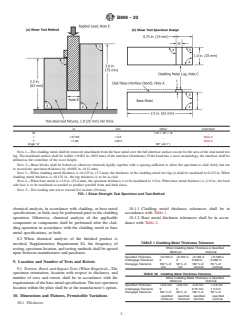
FIG. 1Shear Strength Test Specimen and Test Method
chemical analysis, in accordance with cladding, or base metal 10.1.1 Cladding metal thickness tolerances shall be in
specifications, or both, may be performed prior to the cladding accordance with Table 1.
operation. Otherwise, chemical analysis of the applicable 10.1.2 Base metal thickness tolerances shall be in accor-
component or components shall be performed after the clad-
dance with Table 2.
ding operation in accordance with the cladding metal or base
metal specifications, or both.
8.2 When chemical analysis of the finished product is
TABLE 1 Cladding Metal Thickness Tolerance
invoked, Supplementary Requirement S4, the frequency of
When Cladding Metal Thickness is Specified
testing,specimenlocation,andtestingmethodsshallbeagreed
Minimum Nominal
upon between manufacturer and purchaser.
Specified Thickness #0.150 in. >0.150 in. <0.188 in. $0.188 in.
Undergage Tolerance 0 0 0.030 in. 0.060 in.
9. Location and Number of Tests and Retests
Overgage Tolerance 100 % of 50 % of 100 % of 50 % of
min min nominal nominal
9.1 Tension, Bend, and Impact Tests (When Required)—The
specimen orientation, location with respect to thickness, and
TABLE1M Cladding Metal Thickness Tolerance
When Cladding Metal Thickness is Specified
number of tests and retests shall be in accordance with the
Minimum Nominal
requirementsofthebasemetalspecification.Thetestspecimen
Specified Thickness #3.8 mm >3.8 mm <4.8 mm $4.8 mm
location within the plate shall be at the manufacturer’s option.
Undergage Tolerance 0 0 0.75 mm 1.5 mm
Overgage Tolerance 100 % of 50 % of 100 % of 50 % of
specified specified specified specified
10. Dimensions and Flatness, Permissible Variations
minimum minimum nominal nominal
10.1 Thickness:
B898−20
TABLE 2 Base Metal Thickness Tolerance
10.3.1 Flatness of the clad plate shall be in accordance with
When Base Metal Thickness is Specified one of the following flatness tolerance requirements. When
Minimum Nominal
flatness requirements are not specified by the purchaser,
Specified Thickness <1.0 in. $1.0 in. <1.0 in. $1.0 in.
flatness tolerances of 10.3.1.1 shall apply.
Undergage Tolerance 0 0 0.01 in. 0.01 in.
10.3.1.1 Standard Plate Flatness—Out-of-flatness of the
Overgage Tolerance 0.21 in. 0.26 in. 0.20 in. over 0.25 in. over
over min over min nominal nominal cladding face shall not exceed the requirements of Table 4.
This flatness criteria typically is applicable for clad plates
TABLE2M Base Metal Thickness Tolerance
intended for subsequent forming, or fabrication, or both.
When Base Metal Thickness is Specified
Minimum Nominal 10.3.1.2 Special Flatness—Out-of-flatness of the cladding
Specified Thickness <25.4 mm $25.4 mm <25.4 mm $25.4 mm
face shall not exceed 0.100 in. (2.5 mm) over any 36-in.
Undergage Tolerance 0 0 0.25 mm 0.25 mm
(915-mm)span.Thisflatnesscriteriatypicallyisapplicablefor
Overgage Tolerance 5.3 over 6.6 over 5.1 over 6.4 over
specified specified specified specified
plates used in the flat condition.
minimum minimum nominal nominal
10.3.1.3 Machined Flatness—Out-of-flatness of one or both
faces, as specified by the purchaser, shall not exceed 0.010 in.
(0.25 mm) over any 36-in. (915-mm) span.
10.3.1.4 Suitable for Machining Flat—Thematerialshallbe
10.1.3 When the purchaser specifies flatness in accordance
supplied in a condition suitable for subsequent machining of
with 10.3.1.3 or 10.3.1.4, overgage tolerances in excess of specified face or faces while protecting minimum specified
those specified herein may be specified by the manufacturer.
thickness. The combination of the flatness of the product and
10.1.4 When agreed upon by the producer and the thethicknessofthecomponentmetalsshallpermitthecladding
purchaser, overgage tolerances different from those specified
metal,orthebasemetal,orboth,asspecifiedbythepurchaser,
herein shall apply. to be machined to the requirements of 10.3.1.3 without
10.1.5 When an interlayer metal is included in the product
reducing thickness below the minimum specified, upon appli-
and when its thickness exceeds 0.005 in. (0.127 mm) nominal, cation of proper set-up and machining practice.
its composition and nominal thickness shall be reported.
10.3.1.5 Other Flatness—Other flatness requirements may
be agreed upon mutually between the manufacturer and the
10.2 Length and Width or Diameter Tolerances:
purchaser.
10.2.1 Clad plates shall be supplied with edges cut to the
dimensions specified by the purchaser. Cutting may be per-
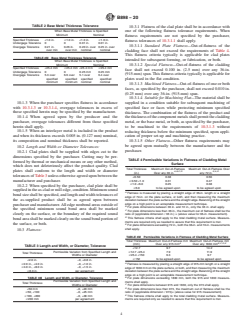
TABLE 4 Permissible Variations in Flatness of Cladding Metal
formed by thermal or mechanical means or any other method,
Surface
which does not deleteriously affect the product quality. Clad
Total Thickness Maximum Out-of-Flatness Maximum Out-of-Flatness Over
plates shall conform to the length and width or diameter A,B,C,D E,A,D
(in.) Over any 36 in. any 72 in.
tolerancesofTable3unlessotherwiseagreeduponbetweenthe
<0.50 0.38 0.56
manufacturer and purchaser. $0.50 <1.0 0.31 0.47
$1.0 <6.0 0.25 0.38
10.2.2 When specified by the purchaser, clad plate shall be
$6.0 to be agreed upon to be agreed upon
suppliedintheas-cladormilledge,condition.Minimumsound
A
Flatness is measured by placing a straight edge of 36-in. length or a straight
bondsizeshallbespecified,andlengthandwidthtolerancesof
edge of 72-in. on the plate surface, or both, and then measuring the maximum
the as-supplied product shall be as agreed upon between
deviation between the plate surface and the straight edge. Balancing of the straight
edge on a high point is an acceptable measurement technique.
purchaserandmanufacturer.Alledgenonbondareasoutsideof
B
For plate dimensions between 36 in. and 72 in., only the 36 in. shall apply.
the specified minimum sound bond area shall be marked C
For plate dimensions less than 36 in., the maximum out of flatness shall be the
clearly on the surface, or the boundary of the required sound
ratio of (applicable dimension / 36 in.) × (above value for 36-in. measurement).
D
This flatness criteria shall apply to the total cladding metal surface. Measure-
bondareashallbemarkedclearlyonthesoundbondportionof
ments are required only as needed to assure that this requirement is met.
the surface, or both. E
For plate dimensions exceeding 72 in., both the 36-in. and 72-in. measurements
shall apply.
10.3 Flatness:
TABLE4M Permissible Variations in Flatness of Cladding Metal Surface
Total Thickness Maximum Out-of-Flatness mm Maximum Out-of-Flatness mm
A B,C,D,E
(mm) Over any 915 mm Over any 1830 mm
TABLE 3 Length and Width, or Diameter, Tolerance
<12.7 9.7 14.2
Permissible Variation f
...
This document is not an ASTM standard and is intended only to provide the user of an ASTM standard an indication of what changes have been made to the previous version. Because
it may not be technically possible to adequately depict all changes accurately, ASTM recommends that users consult prior editions as appropriate. In all cases only the current version
of the standard as published by ASTM is to be considered the official document.
Designation: B898 − 19 B898 − 20
Standard Specification for
Reactive and Refractory Metal Clad Plate
This standard is issued under the fixed designation B898; the number immediately following the designation indicates the year of
original adoption or, in the case of revision, the year of last revision. A number in parentheses indicates the year of last reapproval. A
superscript epsilon (´) indicates an editorial change since the last revision or reapproval.
1. Scope
1.1 This specification covers plate consisting of a base metal to which is bonded, integrally and continuously, on one or both
sides a layer of one of the following: titanium, zirconium, tantalum, niobium, and their alloys. The material generally is intended
for pressure vessel use.
1.2 The values stated in inch-pound units are to be regarded as standard. The values given in parentheses are mathematical
conversions to SI units that are provided for information only and are not considered standard. The values in parentheses and in
metric tables are provided for information only.
1.3 This international standard was developed in accordance with internationally recognized principles on standardization
established in the Decision on Principles for the Development of International Standards, Guides and Recommendations issued
by the World Trade Organization Technical Barriers to Trade (TBT) Committee.
2. Referenced Documents
2.1 ASTM Standards:
B265 Specification for Titanium and Titanium Alloy Strip, Sheet, and Plate
B393 Specification for Niobium and Niobium Alloy Strip, Sheet, and Plate
B551/B551M Specification for Zirconium and Zirconium Alloy Strip, Sheet, and Plate
B708 Specification for Tantalum and Tantalum Alloy Plate, Sheet, and Strip
E114 Practice for Ultrasonic Pulse-Echo Straight-Beam Contact Testing
2.2 ASME Code:
Boiler and Pressure Vessel Code, Section IX Welding Qualifications
Boiler and Pressure Vessel Code, Section VIII Divisions 1, 2, 3
2.3 Military Standard:
MIL-J-24445A Joint, Bimetallic Bonded, Aluminum to Steel
2.4 ASNT Standards:
SNT-TC-1A Recommended Practice No. SNT-TC-1A Personnel Qualification and Certification in Nondestructive Testing
3. Terminology
3.1 Definitions of Terms Specific to This Standard:
3.1.1 This material is considered as single-clad or double-clad dependent upon whether one or both sides of the base metal are
covered by a cladding metal.
3.1.2 base metal, n—the component that comprises the greatest percentage of total thickness.
3.1.3 cladding metal, or cladding metals, n—the component, or components, which individually comprise less than the greatest
percentage of total thickness.
This specification is under the jurisdiction of ASTM Committee B10 on Reactive and Refractory Metals and Alloys and is the direct responsibility of Subcommittee
B10.01 on Titanium.
Current edition approved Nov. 1, 2019April 1, 2020. Published December 2019April 2020. Originally approved in 1999. Last previous edition approved in 20162019 as
B898 – 11 (2016).B898 – 19. DOI: 10.1520/B0898-19.10.1520/B0898-20.
For referenced ASTM standards, visit the ASTM website, www.astm.org, or contact ASTM Customer Service at service@astm.org. For Annual Book of ASTM Standards
volume information, refer to the standard’s Document Summary page on the ASTM website.
Available from American Society of Mechanical Engineers (ASME), ASME International Headquarters, Three Park Ave., New York, NY 10016-5990, http://
www.asme.org.
Available from DLA Document Services, Building 4/D, 700 Robbins Ave., Philadelphia, PA 19111-5094, http://quicksearch.dla.mil.
Available from American Society for Nondestructive Testing (ASNT), P.O. Box 28518, 1711 Arlingate Ln., Columbus, OH 43228-0518, http://www.asnt.org.
Copyright © ASTM International, 100 Barr Harbor Drive, PO Box C700, West Conshohocken, PA 19428-2959. United States
B898 − 20
3.1.4 cladding operation, n—the production event, which results in the formation of the bond between the cladding and base
metal components, plus all related prebonding and post bonding operations, prior to supply to the purchaser.
3.1.5 interface, n—of the clad product, is that region of thickness in which the product transitions from essentially 100 % base
metal to 100 % cladding metal. Also known as bond or bond zone.
3.1.6 interlayer, n—a metal layer of a type or grade different from the cladding metal and base metal, which is applied between
the cladding and base metal.
3.1.7 integrally and continuously bonded, adv—a condition in which the cladding metal and base metal are brought together to
form a metallurgical bond at essentially the entire interface of the two metals by means other than those processes that do not
produce a homogeneous composite plate.
4. Ordering Information
4.1 Orders for material under this specification shall include the following information:
4.1.1 Quantity.
4.1.2 Product dimensions, including thickness of both cladding metal and base metal. It should state whether each thickness
value is minimum or nominal. If not stated, thickness values shall be nominal.
4.1.3 Cladding metal type and specification (the cladding metal specification) (see Section 6).
4.1.4 Base metal type and specification (the base metal specification) (see Section 6).
4.1.5 Flatness requirements (see 10.3).
4.1.6 Ultrasonic inspection level (see Section 11).
4.1.7 Heat treatment requirements, if any.
4.1.8 Restrictions limiting or disallowing welding, or weld repair, or both, if any (see Section 12).
4.1.9 Any additional codes and standards specified by the purchaser or manufacturer.
4.1.10 Supplementary Requirements, if any.
4.1.11 Additional requirements, if any.
5. Materials and Manufacture
5.1 Process:
5.1.1 The base metal shall be manufactured in accordance with all applicable requirements of the base metal specification (see
4.1.4).
5.1.2 The cladding metal shall be manufactured in accordance with all applicable requirements of the cladding metal
specification (see 4.1.3).
5.1.3 The cladding metal shall be bonded to the base metal by any cladding operation that will produce a clad product which
will conform to the requirements of this specification. Cladding methods may be, but are not limited to, explosion bonding, roll
bonding, and weld overlay.
5.1.4 The cladding metal may be fabricated from multiple sheets or plates by edge butt welding prior to the cladding operation.
5.1.5 The cladding thickness may consist of multiple layers of the cladding metal.
5.2 Heat Treatment—Unless otherwise specified or agreed between the purchaser and the manufacturer, all heat treatments shall
be performed as needed in the cladding operation to assure the following:
5.2.1 The cladding metal conforms to the applicable requirements of the cladding metal specification,
5.2.2 The base metal conforms to the applicable requirements of the base metal specification, and
5.2.3 The clad bond exhibits optimum resistance to disbonding during common fabrication processes.
6. Chemical Composition
6.1 The composite plate may conform to any desired combination of cladding metal and base metal as described in 6.2 and 6.3
and as agreed upon between the purchaser and the manufacturer.
6.2 Cladding Metal—The cladding metal shall conform to the requirements as to chemical composition prescribed in the
applicable cladding metal specification: B265, B393, B551/B551M, or B708.
6.3 Base Metal—The base metal shall be steel or any other product conforming to specifications for metal plate. The base metal
shall conform to the requirements as to chemical composition prescribed in the base metal specification.
7. Mechanical Properties
7.1 The base metal shall conform to the mechanical property requirements prescribed in the base metal specification.
7.2 The mechanical properties of the cladding metal may not conform necessarily to the mechanical property requirements
prescribed in the cladding metal specification unless otherwise agreed upon between manufacturer and purchaser.
7.3 Mechanical testing of the base metal, in accordance with the base metal specification, may be performed prior to the
cladding operation if the cladding operation does not affect the applicable mechanical properties of the base metal.
B898 − 20
7.4 Unless simulated post cladding heat treatments are specified by the purchaser, Supplementary Requirement S5, the
mechanical test specimens shall be representative of the material in the heat treatment condition of product being shipped from
the clad manufacturer.
7.5 Tensile Strength Requirements—The tensile properties shall be determined by a tension test on the base metal only in
accordance with the testing requirements of the base metal specification. When tension test specimen are taken from the clad plate,
the cladding shall be removed before tension tests are made.
7.6 Bond Shear Strength Testing:
7.6.1 A bond shear strength test shall be performed on each clad plate. The minimum permissible shear strength shall be 20 000
psi (137.9 MPa).
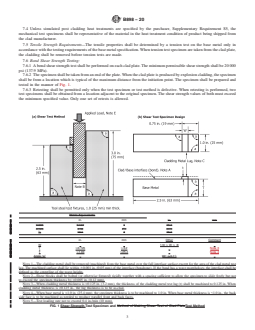
7.6.2 The specimen shall be taken from an end of the plate. When the clad plate is produced by explosion cladding, the specimen
shall be from a location which is typical of the maximum distance from the initiation point. The specimen shall be prepared and
tested in the manner of Fig. 1.
7.6.3 Retesting shall be permitted only when the test specimen or test method is defective. When retesting is performed, two
test specimens shall be obtained from a location adjacent to the original specimen. The shear strength values of both must exceed
the minimum specified value. Only one set of retests is allowed.
Metric Equivalents
in. mm in. mm
0.005 0.127 1 25.4
0.125 3.18 2 ⁄2 64.5
⁄4 19.1 3 76.2
in. mm Other Comment
W _ _ 1.5t # W # 3t _
t #0.125 #3.2 _ Note 3
T #1.00 #25.4 _ Note 4
Angle “a” _ _ 90° (±0.1°) _
NOTE 1—The cladding metal shall be removed (machined) from the base metal over the full interface surface except for the area of the clad metal test
lug. The machined surface shall lie within 60.001 in. (0.05 mm) of the interface (bondzone). If the bond has a wave morphology, the interface shall be
defined as the centerline of the wave height.
NOTE 2—Shear blocks shall be bolted (or otherwise fixtured) rigidly together with a spacing sufficient to allow the specimen to slide freely but not
to exceed the specimen thickness by >0.005 in. (0.12 mm).
NOTE 3—When cladding metal thickness is >0.125 in. (3.2 mm), the thickness of the cladding metal test lug (t) shall be machined to 0.125 in. When
cladding metal thickness is <0.125 in., the lug thickness is to be as-clad.
NOTE 4—When base metal is >1.0 in. (25.4 mm), the specimen thickness is to be machined to 1.0 in. When base metal thickness is ≤1.0 in., the back
side face is to be machined as needed to produce parallel front and back faces.
NOTE 5—Test loading rate not to exceed 0.4 in./min (10 mm).
FIG. 1 Shear Strength Test Specimen and Method of Making Shear Test of Clad PlateTest Method
B898 − 20
7.6.4 The results of all tests and all retests shall be included in the Material Test Report, paragraph 16.1.2.
8. Chemical Analysis
8.1 When the cladding operation does not affect the chemical composition of the cladding or base metal, or both, the chemical
analysis, in accordance with cladding, or base metal specifications, or both, may be performed prior to the cladding operation.
Otherwise, chemical analysis of the applicable component or components shall be performed after the cladding operation in
accordance with the cladding metal or base metal specifications, or both.
8.2 When chemical analysis of the finished product is invoked, Supplementary Requirement S4, the frequency of testing,
specimen location, and testing methods shall be agreed upon between manufacturer and purchaser.
9. Location and Number of Tests and Retests
9.1 Tension, Bend, and Impact Tests (When Required)—The specimen orientation, location with respect to thickness, and
number of tests and retests shall be in accordance with the requirements of the base metal specification. The test specimen location
within the plate shall be at the manufacturer’s option.
10. Dimensions and Flatness, Permissible Variations
10.1 Thickness:
10.1.1 Cladding metal thickness tolerances shall be in accordance with Table 1.
10.1.2 Base metal thickness tolerances shall be in accordance with Table 2.
10.1.3 When the purchaser specifies flatness in accordance with 10.3.1.3 or 10.3.1.4, overgage tolerances in excess of those
specified herein may be specified by the manufacturer.
10.1.4 When agreed upon by the producer and the purchaser, overgage tolerances different from those specified herein shall
apply.
10.1.5 When an interlayer metal is included in the product and when its thickness exceeds 0.005 in. (0.127 mm) nominal, its
composition and nominal thickness shall be reported.
10.2 Length and Width or Diameter Tolerances:
10.2.1 Clad plates shall be supplied with edges cut to the dimensions specified by the purchaser. Cutting may be performed by
thermal or mechanical means or any other method, which does not deleteriously affect the product quality. Clad plates shall
conform to the length and width or diameter tolerances of Table 3 unless otherwise agreed upon between the manufacturer and
purchaser.
10.2.2 When specified by the purchaser, clad plate shall be supplied in the as-clad or mill edge, condition. Minimum sound bond
size shall be specified, and length and width tolerances of the as-supplied product shall be as agreed upon between purchaser and
manufacturer. All edge nonbond areas outside of the specified minimum sound bond area shall be marked clearly on the surface,
or the boundary of the required sound bond area shall be marked clearly on the sound bond portion of the surface, or both.
10.3 Flatness:
10.3.1 Flatness of the clad plate shall be in accordance with one of the following flatness tolerance requirements. When flatness
requirements are not specified by the purchaser, flatness tolerances of 10.3.1.1 shall apply.
10.3.1.1 Standard Plate Flatness—Out-of-flatness of the cladding face shall not exceed the requirements of Table 4. This
flatness criteria typically is applicable for clad plates intended for subsequent forming, or fabrication, or both.
10.3.1.2 Special Flatness—Out-of-flatness of the cladding face shall not exceed 0.100 in. (2.5 mm) over any 36-in. (915-mm)
span. This flatness criteria typically is applicable for plates used in the flat condition.
TABLE 1 Cladding Metal Thickness Tolerance
When Cladding Metal Thickness is Specified
Minimum Nominal
Specified Thickness # 0.150 in. > 0.150 in. < 0.188 in. $ 0.188 in.
Specified Thickness #0.150 in. >0.150 in. <0.188 in. $0.188 in.
Undergage Tolerance 0 0 0.030 in. 0.060 in.
Overgage Tolerance 100 % of 50 % of 100 % of 50 % of
min min nominal nominal
TABLE 1M Cladding Metal Thickness Tolerance
When Cladding Metal Thickness is Specified
Minimum Nominal
Specified Thickness # 3.8 mm > 3.8 mm < 4.8 mm $ 4.8 mm
Specified Thickness #3.8 mm >3.8 mm <4.8 mm $4.8 mm
Undergage Tolerance 0 0 0.75 mm 1.5 mm
Overgage Tolerance 100 % of 50 % of 100 % of 50 % of
specified specified specified specified
minimum minimum nominal nominal
B898 − 20
TABLE 2 Base Metal Thickness Tolerance
When Base Metal Thickness is Specified
Minimum Nominal
Specified Thickness < 1.0 in. $ 1.0 in. < 1.0 in. $ 1.0 in.
Specified Thickness <1.0 in. $1.0 in. <1.0 in. $1.0 in.
Undergage Tolerance 0 0 0.01 in. 0.01 in.
Overgage Tolerance 0.21 in. 0.26 in. 0.20 in. over 0.25 in. over
over min over min nominal nominal
TABLE 2M Base Metal Thickness Tolerance
When Base Metal Thickness is Specified
Minimum Nominal
Specified Thickness < 25.4 mm $ 25.4 mm < 25.4 mm $ 25.4 mm
Specified Thickness <25.4 mm $25.4 mm <25.4 mm $25.4 mm
Undergage Tolerance 0 0 0.25 mm 0.25 mm
Overgage Tolerance 5.3 over 6.6 over 5.1 over 6.4 over
specified specified specified specified
minimum minimum nominal nominal
TABLE 3 Length and Width, or Diameter, Tolerance
Permissible Variation from Specified Length and
Total Thickness
Widths or Diameter
<2.0 in. –0, +0.8 in.
$ 2.0 in., < 4.0 in. –0, +1.0 in.
$2.0 in., <4.0 in. –0, +1.0 in.
$ 4.0 in., <8.0 in. –0, +1.5 in.
$4.0 in., <8.0 in. –0, +1.5 in.
$ 8.0 in. per agreement
$8.0 in. per agreement
TABLE 3M Length and Width, or Diameter, Tolerance
Permissible Variation from Specified Length and
Total Thickness
Widths or Diameter
<50 mm –0, +20 mm
$ 50, <100 –0, +25 mm
$50, <100 –0, +25 mm
$ 100, <200 –0, +38 mm
$100, <200 –0, +38 mm
$ 200 mm per agreement
$200 mm per agreement
10.3.1.3 Machined Flatness—Out-of-flatness of one or both faces, as specified by the purchaser, shall not exceed 0.010 in. (0.25
mm) over any 36-in. (915-mm) span.
10.3.1.4 Suitable for Machining Flat—The material shall be supplied in a condition suitable for subsequent machining of
specified face or faces while protecting minimum specified thickness. The combination of the flatness of the product and the
thickness of the component metals shall permit the cladding metal, or the base metal, or both, as specified by the purchaser, to be
machined to the requirements of 10.3.1.3 without reducing thickness below the minimum specified, upon application of proper
set-up and machining practice.
10.3.1.5 Other Flatness—Other flatness requirements may be agreed upon mutually between the manufacturer and the
purchaser.
11. Nondestructive Testing
11.1 After the completion of all mechanical and thermal processing components of the cladding operation, clad plates shall be
inspected for bond integrity by pulse-echo, straight-beam, ultrasonic inspection.
11.1.1 Operator Qualification—Individuals performing examinations in accordance with this specification shall be qualified and
certified in accordance with the requirement of the latest edition of ASNT SNT-TC-1A or an equivalent accepted standard which
covers the qualification and certification of ultrasonic nondestructive examination candidates and which is acceptable to the
purchaser.
...