

ASTM C1277-20
(Specification)Standard Specification for Shielded Couplings Joining Hubless Cast Iron Soil Pipe and Fittings
General Information
- Abstract
ABSTRACT
This specification covers the materials and testing of shield hubless couplings to join hubless cast iron soil pipe and fittings. Gaskets shall comply with the required physical and chemical properties, dimensions, and material specifications. The rubber gasket shall conform to the required physical requirements such as tensile strength, elongation, durometer, accelerated aging, compression set, oil immersion, ozone cracking, tear resistance, and water absorption. The shield and clamp assembly shall be made of material conforming to the requirements such as tensile strength and hardness. All parts shall be made of 300 series stainless steel, namely: Type 301; Type 304; Type 300; Type 301; and Type 305. The material shall also undergo physical tests like deflection, shear, and unstrained hydrostatic tests.
SCOPE
1.1 This specification covers the materials and testing of shielded hubless couplings to join hubless cast iron soil pipe and fittings.
1.2 Several different types of hubless couplings are available for use in hubless cast iron sanitary and storm drain, waste, and vent piping applications to connect hubless cast iron soil pipe and fittings by using a sleeve-type, or some other type coupling device. It is the purpose of this specification to furnish information as to the characteristics of one such sleeve-type couplings when applied to cast iron soil pipe and fittings manufactured in accordance with Specification A888, latest revision, and CISPI 301, latest revision.
1.3 The values stated in inch-pound units are to be regarded as standard. The values given in parentheses are mathematical conversions to SI units that are provided for information only and are not considered standard.
1.4 The committee with jurisdiction over this standard is aware of other comparable standard published by the Cast Iron Soil Pipe Institute, CISPI 310, FM 1680 published by Factory Mutual, and Specification C1540 published by ASTM.
1.5 The following precautionary caveat pertains only to the test method portion, Section 7, of this specification. This standard does not purport to address all of the safety concerns, if any, associated with its use. It is the responsibility of the user of this standard to establish appropriate safety, health, and environmental practices and determine the applicability of regulatory limitations prior to use.
1.6 This international standard was developed in accordance with internationally recognized principles on standardization established in the Decision on Principles for the Development of International Standards, Guides and Recommendations issued by the World Trade Organization Technical Barriers to Trade (TBT) Committee.
- Status
- Published
- Publication Date
- 30-Apr-2020
- Technical Committee
- A04 - Iron Castings
- Drafting Committee
- A04.75 - Gaskets and Coupling for Plumbing and Sewer Piping
Buy Documents
ASTM C1277-20 - Standard Specification for Shielded Couplings Joining Hubless Cast Iron Soil Pipe and Fittings
REDLINE ASTM C1277-20 - Standard Specification for Shielded Couplings Joining Hubless Cast Iron Soil Pipe and Fittings
Overview
ASTM C1277-20: Standard Specification for Shielded Couplings Joining Hubless Cast Iron Soil Pipe and Fittings is an international standard published by ASTM International. It covers the materials, construction, and testing requirements for shielded, hubless couplings used to join hubless cast iron soil pipe and fittings. These couplings are essential components in sanitary and storm drain, waste, and vent piping systems, providing a reliable and durable connection for no-hub cast iron assemblies.
This standard ensures that shielded couplings meet rigorous criteria for physical and chemical properties, dimensions, and performance. By adhering to ASTM C1277-20, manufacturers, engineers, and plumbing professionals can confirm compatibility with other related standards and achieve safe, leak-resistant assemblies.
Key Topics
Scope of Application
The specification applies to shielded hubless couplings designed for use with hubless cast iron soil pipes and fittings in drainage, waste, and vent (DWV) systems as described in ASTM A888 and CISPI 301.Material Requirements
- Gaskets: Must comply with ASTM C564, possessing required physical traits such as tensile strength, elongation, durometer hardness, aging resistance, compression set, oil and water absorption, ozone cracking, and tear resistance.
- Shield and Clamp Assemblies: All metallic parts must be made from 300 series stainless steel (Types 301, 304, 305). Hardness and tensile strength of the metal components are specified to ensure durability.
Testing and Performance
Couplings must undergo stringent testing to guarantee performance under field conditions:- Deflection and Shear Tests: Verifies the coupling’s ability to maintain integrity under load and pipe movement.
- Unrestrained Hydrostatic Test: Ensures leak resistance under internal pressure.
- Routine Production Testing: Physical testing during manufacturing to ensure consistent quality.
Marking and Certification
Each coupling and gasket must be clearly marked with relevant sizing, origin, specification reference, and manufacturer's information. Certification may be requested by purchasers to confirm compliance with standard requirements.
Applications
ASTM C1277-20 is widely employed in the construction and maintenance of:
- Sanitary drainage systems in commercial, industrial, and residential buildings
- Stormwater and vent piping networks, including above- and below-ground installations
- Retrofit and repair projects where secure, corrosion-resistant joints are necessary
- Prefabricated plumbing modules utilizing hubless cast iron components
- Code-compliant wastewater and drainage infrastructure
Its use ensures compatibility with standard cast iron pipe and fitting dimensions, supports long-term joint performance, reduces leak risks, and helps meet building code and health standards.
Related Standards
Shielded couplings specified under ASTM C1277-20 are intended for use with products made to similar and related standards, including:
- ASTM A888: Hubless Cast Iron Soil Pipe and Fittings for Sanitary and Storm Drain, Waste, and Vent Piping Applications
- ASTM C564: Rubber Gaskets for Cast Iron Soil Pipe and Fittings
- CISPI 301 & CISPI 310: Cast Iron Soil Pipe Institute standards specifying pipe, fittings, and couplings for hubless applications
- FM 1680: Factory Mutual standard for couplings used in hubless cast iron systems
- ASTM C1540: Specification for Heavy-Duty Shielded Couplings for Joining Hubless Cast Iron
Leveraging these standards together ensures a fully compliant, robust, and durable plumbing installation that meets both national and international requirements.
Keywords: ASTM C1277-20, shielded couplings, hubless cast iron pipe, cast iron soil fittings, DWV systems, sanitary plumbing standards, ASTM cast iron specifications, gasket requirements, stainless steel couplings, plumbing code compliance.
Relations
- Effective Date
- 01-May-2020
- Effective Date
- 01-Nov-2023
- Effective Date
- 01-Nov-2023
- Refers
ASTM C564-20a - Standard Specification for Rubber Gaskets for Cast Iron Soil Pipe and Fittings - Effective Date
- 01-May-2020
- Effective Date
- 01-May-2020
- Effective Date
- 15-Mar-2020
- Effective Date
- 15-Nov-2018
- Effective Date
- 01-Mar-2018
- Effective Date
- 01-Feb-2018
- Effective Date
- 01-Nov-2017
- Effective Date
- 01-Nov-2017
- Effective Date
- 01-Oct-2017
- Effective Date
- 01-Jun-2017
- Effective Date
- 01-Dec-2016
- Effective Date
- 01-May-2016
Buy Documents
ASTM C1277-20 - Standard Specification for Shielded Couplings Joining Hubless Cast Iron Soil Pipe and Fittings
REDLINE ASTM C1277-20 - Standard Specification for Shielded Couplings Joining Hubless Cast Iron Soil Pipe and Fittings
Get Certified
Connect with accredited certification bodies for this standard

Institut za varilstvo d.o.o. (Welding Institute)
Slovenia's leading welding institute since 1952. ISO 3834, EN 1090, pressure equipment certification, NDT personnel, welder qualification. Only IIW Au
Sponsored listings
Frequently Asked Questions
ASTM C1277-20 is a technical specification published by ASTM International. Its full title is "Standard Specification for Shielded Couplings Joining Hubless Cast Iron Soil Pipe and Fittings". This standard covers: ABSTRACT This specification covers the materials and testing of shield hubless couplings to join hubless cast iron soil pipe and fittings. Gaskets shall comply with the required physical and chemical properties, dimensions, and material specifications. The rubber gasket shall conform to the required physical requirements such as tensile strength, elongation, durometer, accelerated aging, compression set, oil immersion, ozone cracking, tear resistance, and water absorption. The shield and clamp assembly shall be made of material conforming to the requirements such as tensile strength and hardness. All parts shall be made of 300 series stainless steel, namely: Type 301; Type 304; Type 300; Type 301; and Type 305. The material shall also undergo physical tests like deflection, shear, and unstrained hydrostatic tests. SCOPE 1.1 This specification covers the materials and testing of shielded hubless couplings to join hubless cast iron soil pipe and fittings. 1.2 Several different types of hubless couplings are available for use in hubless cast iron sanitary and storm drain, waste, and vent piping applications to connect hubless cast iron soil pipe and fittings by using a sleeve-type, or some other type coupling device. It is the purpose of this specification to furnish information as to the characteristics of one such sleeve-type couplings when applied to cast iron soil pipe and fittings manufactured in accordance with Specification A888, latest revision, and CISPI 301, latest revision. 1.3 The values stated in inch-pound units are to be regarded as standard. The values given in parentheses are mathematical conversions to SI units that are provided for information only and are not considered standard. 1.4 The committee with jurisdiction over this standard is aware of other comparable standard published by the Cast Iron Soil Pipe Institute, CISPI 310, FM 1680 published by Factory Mutual, and Specification C1540 published by ASTM. 1.5 The following precautionary caveat pertains only to the test method portion, Section 7, of this specification. This standard does not purport to address all of the safety concerns, if any, associated with its use. It is the responsibility of the user of this standard to establish appropriate safety, health, and environmental practices and determine the applicability of regulatory limitations prior to use. 1.6 This international standard was developed in accordance with internationally recognized principles on standardization established in the Decision on Principles for the Development of International Standards, Guides and Recommendations issued by the World Trade Organization Technical Barriers to Trade (TBT) Committee.
ABSTRACT This specification covers the materials and testing of shield hubless couplings to join hubless cast iron soil pipe and fittings. Gaskets shall comply with the required physical and chemical properties, dimensions, and material specifications. The rubber gasket shall conform to the required physical requirements such as tensile strength, elongation, durometer, accelerated aging, compression set, oil immersion, ozone cracking, tear resistance, and water absorption. The shield and clamp assembly shall be made of material conforming to the requirements such as tensile strength and hardness. All parts shall be made of 300 series stainless steel, namely: Type 301; Type 304; Type 300; Type 301; and Type 305. The material shall also undergo physical tests like deflection, shear, and unstrained hydrostatic tests. SCOPE 1.1 This specification covers the materials and testing of shielded hubless couplings to join hubless cast iron soil pipe and fittings. 1.2 Several different types of hubless couplings are available for use in hubless cast iron sanitary and storm drain, waste, and vent piping applications to connect hubless cast iron soil pipe and fittings by using a sleeve-type, or some other type coupling device. It is the purpose of this specification to furnish information as to the characteristics of one such sleeve-type couplings when applied to cast iron soil pipe and fittings manufactured in accordance with Specification A888, latest revision, and CISPI 301, latest revision. 1.3 The values stated in inch-pound units are to be regarded as standard. The values given in parentheses are mathematical conversions to SI units that are provided for information only and are not considered standard. 1.4 The committee with jurisdiction over this standard is aware of other comparable standard published by the Cast Iron Soil Pipe Institute, CISPI 310, FM 1680 published by Factory Mutual, and Specification C1540 published by ASTM. 1.5 The following precautionary caveat pertains only to the test method portion, Section 7, of this specification. This standard does not purport to address all of the safety concerns, if any, associated with its use. It is the responsibility of the user of this standard to establish appropriate safety, health, and environmental practices and determine the applicability of regulatory limitations prior to use. 1.6 This international standard was developed in accordance with internationally recognized principles on standardization established in the Decision on Principles for the Development of International Standards, Guides and Recommendations issued by the World Trade Organization Technical Barriers to Trade (TBT) Committee.
ASTM C1277-20 is classified under the following ICS (International Classification for Standards) categories: 23.040.10 - Iron and steel pipes; 23.040.40 - Metal fittings. The ICS classification helps identify the subject area and facilitates finding related standards.
ASTM C1277-20 has the following relationships with other standards: It is inter standard links to ASTM C1277-18, ASTM A888-23, ASTM A240/A240M-23a, ASTM C564-20a, ASTM C1540-20, ASTM C564-20, ASTM A888-18a, ASTM A888-18, ASTM C1540-18, ASTM A644-17, ASTM A240/A240M-17, ASTM A888-17a, ASTM A888-17, ASTM A240/A240M-16a, ASTM A240/A240M-16. Understanding these relationships helps ensure you are using the most current and applicable version of the standard.
ASTM C1277-20 is available in PDF format for immediate download after purchase. The document can be added to your cart and obtained through the secure checkout process. Digital delivery ensures instant access to the complete standard document.
Standards Content (Sample)
This international standard was developed in accordance with internationally recognized principles on standardization established in the Decision on Principles for the
Development of International Standards, Guides and Recommendations issued by the World Trade Organization Technical Barriers to Trade (TBT) Committee.
Designation:C1277 −20
Standard Specification for
Shielded Couplings Joining Hubless Cast Iron Soil Pipe and
Fittings
This standard is issued under the fixed designation C1277; the number immediately following the designation indicates the year of
original adoption or, in the case of revision, the year of last revision. A number in parentheses indicates the year of last reapproval. A
superscript epsilon (´) indicates an editorial change since the last revision or reapproval.
1. Scope 2. Referenced Documents
1.1 This specification covers the materials and testing of 2.1 ASTM Standards:
shielded hubless couplings to join hubless cast iron soil pipe A240/A240M Specification for Chromium and Chromium-
and fittings. Nickel Stainless Steel Plate, Sheet, and Strip for Pressure
Vessels and for General Applications
1.2 Several different types of hubless couplings are avail-
A644 Terminology Relating to Iron Castings
able for use in hubless cast iron sanitary and storm drain,
A888 Specification for Hubless Cast Iron Soil Pipe and
waste,andventpipingapplicationstoconnecthublesscastiron
Fittings for Sanitary and Storm Drain, Waste, and Vent
soil pipe and fittings by using a sleeve-type, or some other type
Piping Applications
couplingdevice.Itisthepurposeofthisspecificationtofurnish
C564 Specification for Rubber Gaskets for Cast Iron Soil
information as to the characteristics of one such sleeve-type
Pipe and Fittings
couplings when applied to cast iron soil pipe and fittings
C1540 Specification for Heavy-Duty Shielded Couplings
manufactured in accordance with Specification A888, latest
Joining Hubless Cast Iron Soil Pipe and Fittings
revision, and CISPI 301, latest revision.
D395 Test Methods for Rubber Property—Compression Set
1.3 The values stated in inch-pound units are to be regarded
D412 Test Methods forVulcanized Rubber andThermoplas-
as standard. The values given in parentheses are mathematical
tic Elastomers—Tension
conversions to SI units that are provided for information only
D471 Test Method for Rubber Property—Effect of Liquids
and are not considered standard.
D573 Test Method for Rubber—Deterioration in an Air
1.4 The committee with jurisdiction over this standard is Oven
D624 Test Method for Tear Strength of Conventional Vul-
aware of other comparable standard published by the Cast Iron
canized Rubber and Thermoplastic Elastomers
Soil Pipe Institute, CISPI 310, FM 1680 published by Factory
Mutual, and Specification C1540 published by ASTM. D1149 Test Methods for Rubber Deterioration—Cracking in
an Ozone Controlled Environment
1.5 The following precautionary caveat pertains only to the
D2240 Test Method for Rubber Property—Durometer Hard-
test method portion, Section 7, of this specification. This
ness
standard does not purport to address all of the safety concerns,
D3677 Test Methods for Rubber—Identification by Infrared
if any, associated with its use. It is the responsibility of the user
Spectrophotometry
of this standard to establish appropriate safety, health, and
environmental practices and determine the applicability of
2.2 CISPI Standards:
regulatory limitations prior to use. CISPI 301 Specification for Hubless Cast Iron Soil Pipe and
1.6 This international standard was developed in accor-
Fittings for Sanitary and Storm Drain, Waste, and Vent
dance with internationally recognized principles on standard- Piping Applications
ization established in the Decision on Principles for the CISPI 310 Specification for Couplings for Use in Connec-
Development of International Standards, Guides and Recom- tion with Hubless Cast Iron Soil Pipe and Fittings for
mendations issued by the World Trade Organization Technical Sanitary and Storm Drain, Waste, and Vent Piping Appli-
Barriers to Trade (TBT) Committee. cations
1 2
This specification is under the jurisdiction of ASTM Committee A04 on Iron For referenced ASTM standards, visit the ASTM website, www.astm.org, or
Castings and is the direct responsibility of Subcommittee A04.75 on Gaskets and contact ASTM Customer Service at service@astm.org. For Annual Book of ASTM
Coupling for Plumbing and Sewer Piping. Standards volume information, refer to the standard’s Document Summary page on
Current edition approved May 1, 2020. Published May 2020. Originally the ASTM website.
approved in 1994. Last previous edition approved in 2018 as C1277 – 18. DOI: Available from Cast Iron Soil Pipe Institute (CISPI), 2401 Fieldcrest Dr.,
10.1520/C1277-20. Mundelein, IL 60060, http://www.cispi.org.
Copyright © ASTM International, 100 Barr Harbor Drive, PO Box C700, West Conshohocken, PA 19428-2959. United States
C1277−20
2.3 Factory Mutual Standard: 3.2.4 coupling, n—the complete assembly.
FM 1680 Couplings Used in Hubless Cast Iron Systems for
3.2.5 fitting, n—parts of a pipeline other than straight pipes,
Drain, Waste or Vent, Sewer, Rainwater or Storm Water
valves, or couplings.
System,Above or Below Ground, Industrial, Commercial
3.2.6 gasket, n—the elastomeric portion of the coupling.
and Residential
3.2.7 joint, n—the point of assembly consisting of the
3. Terminology coupling and the joined pipes or fittings, or both.
3.2.8 manufacturer clamp assembly and shield, n—the en-
3.1 Definitions of the following terms used in this specifi-
tity that attaches the clamp assembly to the shield for the
cationarefoundinTerminologyA644: elastomericand durom-
couplings covered by this standard specification.
eter.
3.2.9 manufacturer gaskets, n—the entity that molds the
3.2 Definitions of Terms Specific to This Standard:
gaskets covered by this standard specification.
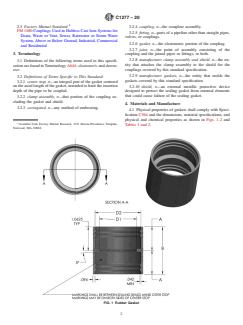
3.2.1 center stop, n—an integral part of the gasket centered
on the axial length of the gasket, intended to limit the insertion
3.2.10 shield, n—an external metallic protective device
depth of the pipe to be coupled.
designed to protect the sealing gasket from external elements
that could cause failure of the sealing gasket.
3.2.2 clamp assembly, n—that portion of the coupling ex-
cluding the gasket and shield.
4. Materials and Manufacture
3.2.3 corrugated, n—any method of embossing.
4.1 Physical properties of gaskets shall comply with Speci-
fication C564 and the dimensions, material specifications, and
physical and chemical properties as shown in Figs. 1-2 and
Available from Factory Mutual Research, 1151 Boston-Providence Turnpike,
Tables 1 and 2.
Norwood, MA, 02062.
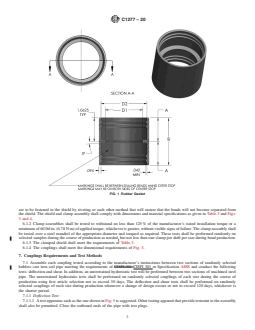
FIG. 1 Rubber Gasket
C1277−20
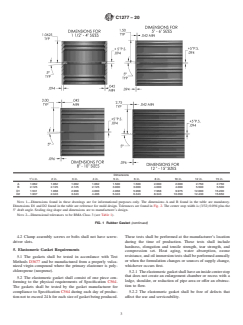
Dimensions
1 ⁄2 in. 2 in. 3 in. 4 in. 5 in. 6 in. 8 in. 10 in. 12 in. 15 in.
A 1.062 1.062 1.062 1.062 1.500 1.500 2.000 2.000 2.750 2.750
B 2.125 2.125 2.125 2.125 3.000 3.000 4.000 4.000 5.500 5.500
D1 1.531 1.968 2.968 4.000 4.968 5.968 7.968 9.975 12.000 15.200
D2 1.937 2.343 3.343 4.406 5.343 6.343 8.343 10.350 12.430 15.650
NOTE 1—Dimensions found in these drawings are for informational purposes only. The dimensions A and B found in the table are mandatory.
Dimensions D1 and D2 found in the table are reference for mold design. Tolerances are found in Fig. 2. The center stop width is (3/32) 0.094 plus the
5° draft angle. Sealing ring shape and dimensions are to manufacturer’s design.
NOTE 2—Dimensional tolerances to be RMA Class 3 (see Table 1).
FIG. 1 Rubber Gasket (continued)
4.2 Clamp assembly screws or bolts shall not have screw- These tests shall be performed at the manufacturer’s location
driver slots. during the time of production. These tests shall include
hardness, elongation and tensile strength, tear strength, and
5. Elastomeric Gasket Requirements
compression set. Heat aging, water absorption, ozone
resistance, and oil immersion tests shall be performed annually
5.1 The gaskets shall be tested in accordance with Test
or when the formulation changes or sources of supply change,
Methods D3677 and be manufactured from a properly vulca-
nized virgin compound where the primary elastomer is poly- whichever occurs first.
chloroprene (neoprene).
5.2.1 Theelastomericgasketshallhaveaninsidecenterstop
that does not create an enlargement chamber or recess with a
5.2 The elastomeric gasket shall consist of one piece con-
ledge, shoulder, or reduction of pipe area or offer an obstruc-
forming to the physical requirements of Specification C564.
tion to flow.
The gaskets shall be tested by the gasket manufacturer for
compliance to Specification C564 during each day of produc- 5.2.2 The elastomeric gasket shall be free of defects that
tion not to exceed 24 h for each size of gasket being produced. affect the use and serviceability.
C1277−20
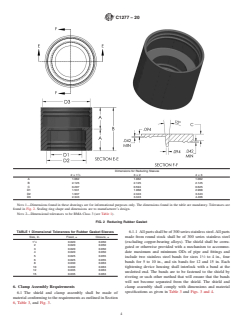
Dimensions for Reducing Sleeves
2×1 ⁄2 3×2 4×3
A 1.062 1.062 1.062
B 2.125 2.125 2.125
C 0.297 0.594 0.625
D1 1.531 1.968 2.968
D2 1.937 2.343 3.343
D3 2.343 3.343 4.406
NOTE 1—Dimensions found in these drawings are for informational purposes only. The dimensions found in the table are mandatory. Tolerances are
found in Fig. 2. Sealing ring shape and dimensions are to manufacturer’s design.
NOTE 2—Dimensional tolerances to be RMA Class 3 (see Table 1).
FIG. 2 Reducing Rubber Gasket
TABLE 1 Dimensional Tolerances for Rubber Gasket Sleeves
6.1.1 All parts shall be of 300 series stainless steel.All parts
Size, in. Fixed, ± Closure, ± made from round stock shall be of 300 series stainless steel
1 ⁄2 0.020 0.050
(excluding copper-bearing alloys). The shield shall be corru-
2 0.020 0.050
gated or otherwise provided with a mechanism to accommo-
3 0.020 0.050
date maximum and minimum ODs of pipe and fittings and
4 0.020 0.050
5 0.025 0.055 1
include two stainless steel bands for sizes 1 ⁄2 to 4 in., four
6 0.025 0.055
bands for 5 to 10 in., and six bands for 12 and 15 in. Each
8 0.030 0.063
10 0.030 0.063
tightening device housing shall interlock with a band at the
12 0.035 0.063
unslotted end. The bands are to be fastened to the shield by
15 0.035 0.063
riveting or such other method that will ensure that the bands
will not become separated from the shield. The shield and
6. Clamp Assembly Requirements clamp assembly shall comply with dimensions and material
specifications as given in Table 3 and Figs. 3 and 4.
6.1 The shield and clamp assembly shall be made of
material conforming to the requirements as outlined in Section
6, Table 3, and Fig. 3.
C1277−20
TABLE 2 Rubber Gasket Physical Requirements
NOTE 1—Material: The sealing sleeve shall be made from an elastomeric compound that meets the requirements of Specification C564.
NOTE 2—Physical tests:The test specimens shall be obtained from finished sleeves and tested pursuant to the methods described in the following table.
Physical Tests, ASTM
Test
Min or Max Requirements Test Method
Tensile Strength 1500 psi min D412
Elongation 250 min D412
Durometer (Shore A) 70±5at76±5°F D2240
Accelerated Aging 15 % max tensile and 20 % max elongation deterioration, 10 points D573
max; increase in hardness, all determinations after oven aging for
96 h at 158 °F
Compression Set 25 % max after 22 h at 158 °F D395 Method B
Oil Immersion 80 % max. volume change after immersion in ASTM oil no. IRM903 D471
for 70 h at 212 °F
Ozone Cracking No visible cracking at 2 times magnification of the gasket after 100 h. D1149
Exposure in 1.0 ppm ozone concentration at 100 °F. Testing and
inspection to be on gasket which is loop mounted to give approxi-
mately 20 % elongation of outer surface
Tear Resistance Die C; 150 lb min per inch of thickness D624
Water Absorption 20 % max by weight after 7 days at 158 °F D471
A,B,C,D,E
TABLE 3 Material Specifications
Band Type 301 AISI stainless steel—minimum tensile 140 000 psi for 1 ⁄2 to 15
in.; Type 304 AISI stainless steel is permitted
Type 304 AISI stainless steel—minimum tensile 140 000 psi
Eyelets/Rivets Type 300 grade AISI stainless steel
Screw Housing Type 301 AISI stainless steel for 1 ⁄2 to 15 in.; Type 304 AISI stainless steel
is permitted
Screw Type 305 AISI and or Type 304L annealed stainless steel— ⁄16 hex head/
1 3
shoulder for 1 ⁄2 to 10 in.; ⁄8 hex head/shoulder for 12 and 15 in. is
required for couplings which require installed torque greater than 60 in.-lbf
When
...
This document is not an ASTM standard and is intended only to provide the user of an ASTM standard an indication of what changes have been made to the previous version. Because
it may not be technically possible to adequately depict all changes accurately, ASTM recommends that users consult prior editions as appropriate. In all cases only the current version
of the standard as published by ASTM is to be considered the official document.
Designation: C1277 − 18 C1277 − 20
Standard Specification for
Shielded Couplings Joining Hubless Cast Iron Soil Pipe and
Fittings
This standard is issued under the fixed designation C1277; the number immediately following the designation indicates the year of
original adoption or, in the case of revision, the year of last revision. A number in parentheses indicates the year of last reapproval. A
superscript epsilon (´) indicates an editorial change since the last revision or reapproval.
1. Scope
1.1 This specification covers the materials and testing of shielded hubless couplings to join hubless cast iron soil pipe and
fittings.
1.2 Several different types of hubless couplings are available for use in hubless cast iron sanitary and storm drain, waste, and
vent piping applications to connect hubless cast iron soil pipe and fittings by using a sleeve-type, or some other type coupling
device. It is the purpose of this specification to furnish information as to the characteristics of one such sleeve-type couplings when
applied to cast iron soil pipe and fittings manufactured in accordance with Specification A888, latest revision, and CISPI-301,
CISPI 301, latest revision.
1.3 The values stated in inch-pound units are to be regarded as standard. The values given in parentheses are mathematical
conversions to SI units that are provided for information only and are not considered standard.
1.4 The committee with jurisdiction over this standard is aware of other comparable standard published by the Cast Iron Soil
Pipe Institute, CISPI-310, CISPI 310, FM 1680 published by Factory Mutual, and Specification C1540 published by ASTM.
1.5 The following precautionary caveat pertains only to the test method portion, Section 7, of this specification. This standard
does not purport to address all of the safety concerns, if any, associated with its use. It is the responsibility of the user of this
standard to establish appropriate safety, health, and environmental practices and determine the applicability of regulatory
limitations prior to use.
1.6 This international standard was developed in accordance with internationally recognized principles on standardization
established in the Decision on Principles for the Development of International Standards, Guides and Recommendations issued
by the World Trade Organization Technical Barriers to Trade (TBT) Committee.
2. Referenced Documents
2.1 ASTM Standards:
A240/A240M Specification for Chromium and Chromium-Nickel Stainless Steel Plate, Sheet, and Strip for Pressure Vessels and
for General Applications
A644 Terminology Relating to Iron Castings
A888 Specification for Hubless Cast Iron Soil Pipe and Fittings for Sanitary and Storm Drain, Waste, and Vent Piping
Applications
C564 Specification for Rubber Gaskets for Cast Iron Soil Pipe and Fittings
C1540 Specification for Heavy-Duty Shielded Couplings Joining Hubless Cast Iron Soil Pipe and Fittings
D395 Test Methods for Rubber Property—Compression Set
D412 Test Methods for Vulcanized Rubber and Thermoplastic Elastomers—Tension
D471 Test Method for Rubber Property—Effect of Liquids
D573 Test Method for Rubber—Deterioration in an Air Oven
D624 Test Method for Tear Strength of Conventional Vulcanized Rubber and Thermoplastic Elastomers
D1149 Test Methods for Rubber Deterioration—Cracking in an Ozone Controlled Environment
D2240 Test Method for Rubber Property—Durometer Hardness
This specification is under the jurisdiction of ASTM Committee A04 on Iron Castings and is the direct responsibility of Subcommittee A04.75 on Gaskets and Coupling
for Plumbing and Sewer Piping.
Current edition approved Feb. 1, 2018May 1, 2020. Published February 2018May 2020. Originally approved in 1994. Last previous edition approved in 20152018 as
C1277 – 15.C1277 – 18. DOI: 10.1520/C1277-18.10.1520/C1277-20.
For referenced ASTM standards, visit the ASTM website, www.astm.org, or contact ASTM Customer Service at service@astm.org. For Annual Book of ASTM Standards
volume information, refer to the standard’s Document Summary page on the ASTM website.
Copyright © ASTM International, 100 Barr Harbor Drive, PO Box C700, West Conshohocken, PA 19428-2959. United States
C1277 − 20
D3677 Test Methods for Rubber—Identification by Infrared Spectrophotometry
2.2 CISPI Standards:
CISPI-301 CISPI 301 Specification for Hubless Cast Iron Soil Pipe and Fittings for Sanitary and Storm Drain, Waste, and Vent
Piping Applications
CISPI-310 CISPI 310 Specification for Couplings for Use in Connection with Hubless Cast Iron Soil Pipe and Fittings for
Sanitary and Storm Drain, Waste, and Vent Piping Applications
2.3 Factory Mutual Standard:
FM 1680 Couplings Used in Hubless Cast Iron Systems for Drain, Waste or Vent, Sewer, Rainwater or Storm Water System,
Above or Below Ground, Industrial, Commercial and Residential
3. Terminology
3.1 Definitions of the following terms used in this specification are found in Terminology A644: elastomeric and durometer.
3.2 Definitions of Terms Specific to This Standard:
3.2.1 center stop, n—an integral part of the gasket centered on the axial length of the gasket, intended to limit the insertion depth
of the pipe to be coupled.
3.2.2 clamp assembly, n—that portion of the coupling excluding the gasket and shield.
3.2.3 corrugated, n—any method of embossing.
3.2.4 coupling, n—the complete assembly.
3.2.5 fitting, n—parts of a pipeline other than straight pipes, valves, or couplings.
3.2.6 gasket, n—the elastomeric portion of the coupling.
3.2.7 joint, n—the point of assembly consisting of the coupling and the joined pipes or fittings, or both.
3.2.8 manufacturer clamp assembly and shield, n—the entity that attaches the clamp assembly to the shield for the couplings
covered by this standard specification.
3.2.9 manufacturer gaskets, n—the entity that molds the gaskets covered by this standard specification.
3.2.10 shield, n—an external metallic protective device designed to protect the sealing gasket from external elements that could
cause failure of the sealing gasket.
4. Materials and Manufacture
4.1 Physical properties of gaskets shall comply with Specification C564 and the dimensions, material specifications, and
physical and chemical properties as shown in Figs. 1-2 and Tables 1 and 2.
4.2 Clamp assembly screws or bolts shall not have screwdriver slots.
5. Elastomeric Gasket Requirements
5.1 The gaskets shall be tested in accordance with Test Methods D3677 and be manufactured from a properly vulcanized virgin
compound where the primary elastomer is polychloroprene (neoprene).
5.2 The elastomeric gasket shall consist of one piece conforming to the physical requirements of Specification C564. The
gaskets shall be tested by the gasket manufacturer for compliance to Specification C564 during each day of production not to
exceed 24 h for each size of gasket being produced. These tests shall be performed at the manufacturer’s location during the time
of production. These tests shall include hardness, elongation and tensile strength, tear strength, and compression set. Heat aging,
water absorption, ozone resistance, and oil immersion tests shall be performed annually or when the formulation changes or
sources of supply change, whichever occurs first.
5.2.1 The elastomeric gasket shall have an inside center stop that does not create an enlargement chamber or recess with a ledge,
shoulder, or reduction of pipe area or offer an obstruction to flow.
5.2.2 The elastomeric gasket shall be free of defects that affect the use and serviceability.
6. Clamp Assembly Requirements
6.1 The shield and clamp assembly shall be made of material conforming to the requirements as outlined in Section 6, Table
3, and Fig. 3.
6.1.1 All parts shall be of 300 series stainless steel. All parts made from round stock shall be of 300 series stainless steel
(excluding copper-bearing alloys). The shield shall be corrugated or otherwise provided with a mechanism to accommodate
maximum and minimum ODs of pipe and fittings and include two stainless steel bands for sizes 1 ⁄2 to 4 in., four bands for 5 to
10 in., and six bands for 12 and 15 in. Each tightening device housing shall interlock with a band at the unslotted end. The bands
Available from Cast Iron Soil Pipe Institute (CISPI), 2401 Fieldcrest Dr., Mundelein, IL 60060, http://www.cispi.org.
Available from Factory Mutual Research, 1151 Boston-Providence Turnpike, Norwood, MA, 02062.
C1277 − 20
FIG. 1 Rubber Gasket
are to be fastened to the shield by riveting or such other method that will ensure that the bands will not become separated from
the shield. The shield and clamp assembly shall comply with dimensions and material specifications as given in Table 3 and Figs.
3 and 4.
6.1.2 Clamp assemblies shall be tested to withstand no less than 125 % of the manufacturer’s stated installation torque or a
minimum of 60 lbf·in. (6.78 N·m) of applied torque, whichever is greater, without visible signs of failure. The clamp assembly shall
be tested over a steel mandrel of the appropriate diameter and torqued as required. These tests shall be performed randomly on
selected samples during the course of production as needed, but not less than one clamp per shift per size during band production.
6.1.3 The clamped shield shall meet the requirements of Table 3.
6.1.4 The couplings shall meet the dimensional requirements of Fig. 3.
7. Couplings Requirements and Test Methods
7.1 Assemble each coupling tested according to the manufacturer’s instructions between two sections of randomly selected
hubless cast iron soil pipe meeting the requirements of CISPI-301 CISPI 301 or Specification A888 and conduct the following
tests: deflection and shear. In addition, an unrestrained hydrostatic test will be performed between two sections of machined steel
pipe. The unrestrained hydrostatic tests shall be performed on randomly selected couplings of each size during the course of
production using first article selection not to exceed 30 days. The deflection and shear tests shall be performed on randomly
selected couplings of each size during production whenever a change of design occurs or not to exceed 120 days, whichever is
the shorter period.
7.1.1 Deflection Test:
7.1.1.1 A test apparatus such as the one shown in Fig. 5 is suggested. Other testing apparati that provide restraint to the assembly
shall also be permitted. Close the outboard ends of the pipe with test plugs.
C1277 − 20
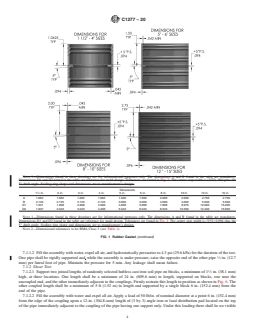
NOTE 1—Dimensions found in these drawings are for informational purposes only. The dimensions A and B found in the table are mandatory.
Dimensions D1 and D2 found in the table are reference for mold design. Tolerances are found in Fig. 2. The center stop width is (3/32) .094 plus the
5° draft angle. Sealing ring shape and dimensions are to manufacturer’s design.
Dimensions
1 ⁄2 in. 2 in. 3 in. 4 in. 5 in. 6 in. 8 in. 10 in. 12 in. 15 in.
A 1.062 1.062 1.062 1.062 1.500 1.500 2.000 2.000 2.750 2.750
B 2.125 2.125 2.125 2.125 3.000 3.000 4.000 4.000 5.500 5.500
D1 1.531 1.968 2.968 4.000 4.968 5.968 7.968 9.975 12.000 15.200
D2 1.937 2.343 3.343 4.406 5.343 6.343 8.343 10.350 12.430 15.650
NOTE 1—Dimensions found in these drawings are for informational purposes only. The dimensions A and B found in the table are mandatory.
Dimensions D1 and D2 found in the table are reference for mold design. Tolerances are found in Fig. 2. The center stop width is (3/32) 0.094 plus the
5° draft angle. Sealing ring shape and dimensions are to manufacturer’s design.
NOTE 2—Dimensional tolerances to be RMA Class 3 (see Table 1).
FIG. 1 Rubber Gasket (continued)
7.1.1.2 Fill the assembly with water, expel all air, and hydrostatically pressurize to 4.3 psi (29.6 kPa) for the duration of the test.
One pipe shall be rigidly supported and, while the assembly is under pressure, raise the opposite end of the other pipe ⁄2 in. (12.7
mm) per lineal foot of pipe. Maintain the pressure for 5 min. Any leakage shall mean failure.
7.1.2 Shear Test:
7.1.2.1 Support two joined lengths of randomly selected hubless cast iron soil pipe on blocks, a minimum of 1 ⁄2 in. (38.1 mm)
high, at three locations. One length shall be a minimum of 24 in. (609.6 mm) in length, supported on blocks, one near the
uncoupled end, and the other immediately adjacent to the couplings. Firmly restrain this length in position as shown in Fig. 6. The
other coupled length shall be a minimum of 5 ft (1.52 m) in length and supported by a single block 6 in. (152.4 mm) from the
end of the pipe.
7.1.2.2 Fill the assembly with water and expel all air. Apply a load of 50 lb/in. of nominal diameter at a point 6 in. (152.4 mm)
from the edge of the coupling upon a 12-in. (304.8-mm) length of (3 by 3) angle iron or load distribution pad located on the top
of the pipe immediately adjacent to the coupling of the pipe having one support only. Under this loading there shall be no visible
C1277 − 20
NOTE 1—Dimensions found in these drawings are for informational purposes only. The dimensions found in the table are mandatory. Tolerances are
found in Fig. 2. Sealing ring shape and dimensions are to manufacturer’s design.
Dimensions for Reducing Sleeves
2 × 1 ⁄2 3 × 2 4 × 3
A 1.062 1.062 1.062
B 2.125 2.125 2.125
C 0.297 0.594 0.625
D1 1.531 1.968 2.968
D2 1.937 2.343 3.343
D3 2.343 3.343 4.406
NOTE 1—Dimensions found in these drawings are for informational purposes only. The dimensions f
...