


ASTM D3420-21
(Test Method)Standard Test Method for Pendulum Impact Resistance of Plastic Film
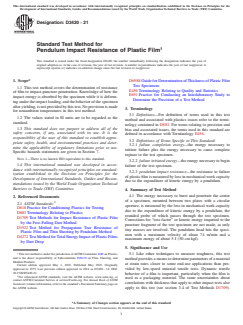
Standard Test Method for Pendulum Impact Resistance of Plastic Film
SIGNIFICANCE AND USE
5.1 Like other techniques to measure toughness, this test method provides a means to determine parameters of a material at strain rates closer to some end-use applications than provided by low-speed uniaxial tensile tests. Dynamic tensile behavior of a film is important, particularly when the film is used as a packaging material. The same uncertainties about correlations with thickness that apply to other impact tests also apply to this test (see section 3.4 of Test Methods D1709). Hence, no provision for rationalizing to unit thickness is provided. Also, no provision is made for testing at non-ambient temperatures.
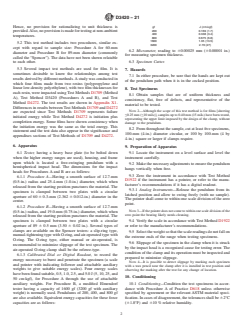
5.2 This test method includes two procedures, similar except with regard to sample size: Procedure A for 60-mm diameter and Procedure B for 89-mm diameter (commonly called the “Spencer”). The data have not been shown relatable to each other.
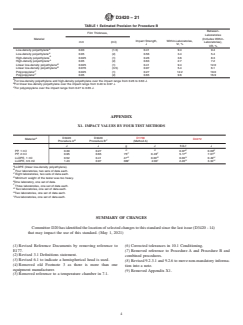
5.3 Several impact test methods are used for film. It is sometimes desirable to know the relationships among test results derived by different methods. A study was conducted in which four films made from two resins (polypropylene and linear low-density polyethylene), with two film thicknesses for each resin, were impacted using Test Methods D1709 (Method A), Test Method D3420 (Procedures A and B), and Test Method D4272. The test results are shown in Appendix X1. Differences in results between Test Methods D1709 and D4272 are expected since Test Methods D1709 represents failure initiated energy while Test Method D4272 is initiation plus completion energy. Some films have shown consistency when the initiation energy was the same as the total energy. This statement and the test data also appear in the significance and appendixes sections of Test Methods of D1709 and D4272.
SCOPE
1.1 This test method covers the determination of resistance of film to impact-puncture penetration. Knowledge of how the impact energy is absorbed by the specimen while it is deforming under the impact loading, and the behavior of the specimen after yielding, is not provided by this test. No provision is made for nonambient temperatures in this test method.
1.2 The values stated in SI units are to be regarded as the standard.
1.3 This standard does not purport to address all of the safety concerns, if any, associated with its use. It is the responsibility of the user of this standard to establish appropriate safety, health, and environmental practices and determine the applicability of regulatory limitations prior to use. Specific hazards statements are given in Section 7.
Note 1: There is no known ISO equivalent to this standard.
1.4 This international standard was developed in accordance with internationally recognized principles on standardization established in the Decision on Principles for the Development of International Standards, Guides and Recommendations issued by the World Trade Organization Technical Barriers to Trade (TBT) Committee.
General Information
- Status
- Published
- Publication Date
- 30-Apr-2021
- Technical Committee
- D20 - Plastics
- Drafting Committee
- D20.19 - Film, Sheeting, and Molded Products
Relations
- Effective Date
- 01-Feb-2024
- Effective Date
- 01-Nov-2023
- Effective Date
- 01-Apr-2022
- Effective Date
- 01-Jan-2020
- Effective Date
- 01-Aug-2019
- Effective Date
- 15-Apr-2019
- Effective Date
- 01-Feb-2019
- Effective Date
- 01-Dec-2018
- Effective Date
- 01-Nov-2018
- Effective Date
- 01-Oct-2017
- Effective Date
- 01-Oct-2017
- Effective Date
- 15-Aug-2017
- Effective Date
- 01-May-2016
- Effective Date
- 15-Apr-2016
- Effective Date
- 15-May-2015
Overview
ASTM D3420-21 - Standard Test Method for Pendulum Impact Resistance of Plastic Film is an internationally recognized testing method developed by ASTM International. It specifies the procedures for determining the resistance of plastic films to impact-puncture penetration using a pendulum apparatus. This standard is especially significant in the packaging and plastic film industries, where understanding a material’s toughness at realistic, dynamic strain rates is vital. Testing according to ASTM D3420-21 helps manufacturers, quality assurance professionals, and researchers assess the suitability of plastic films for various end-use applications.
Key Topics
- Pendulum Impact Testing: Measures the energy required to puncture a plastic film with a swinging pendulum, simulating high-rate impact conditions that more closely resemble real-world use than low-speed tensile tests.
- Two Procedures:
- Procedure A: Uses a 60-mm diameter aperture.
- Procedure B (Spencer Test): Uses an 89-mm diameter aperture. Data from Procedures A and B are not interchangeable.
- Standard Test Conditions: Tests are conducted under ambient conditions. There are no provisions for non-ambient temperature testing within this method.
- Test Results: The method measures mechanical work capacity lost due to the expenditure of kinetic energy in puncturing, but does not provide details of material deformation or post-yield behavior.
- Specimen Preparation: Requires specimens of uniform thickness and consistency, free of defects to ensure valid results.
- Calibration and Maintenance: Guidance on maintaining equipment accuracy is included, supporting repeatable and precise measurements.
Applications
- Quality Control in Manufacturing: Ensures plastic films used in packaging, agriculture, and industrial applications meet required impact resistance benchmarks.
- Material Development and Comparison: Allows researchers and product developers to assess and compare the toughness of films made from different polymers, such as polypropylene or polyethylene, at relevant thicknesses.
- Product Validation and Compliance: Brands and suppliers can document conformity to ASTM D3420-21 to reassure customers and meet procurement or regulatory requirements.
- Performance Benchmarking Across Methods: ASTM D3420 data can complement results from related standards (such as ASTM D1709 and D4272), giving a broader understanding of a film’s behavior under various impact test scenarios.
Related Standards
- ASTM D1709: Test Methods for Impact Resistance of Plastic Film by the Free-Falling Dart Method - evaluates failure-initiated energy.
- ASTM D1922: Test Method for Propagation Tear Resistance of Plastic Film and Thin Sheeting by Pendulum Method.
- ASTM D4272: Test Method for Total Energy Impact of Plastic Films by Dart Drop - assesses both initiation and completion energy.
- ASTM D6988: Guide for Determination of Thickness of Plastic Film Test Specimens.
- ASTM D883, ASTM E691: Provide terminology and precision guidance relevant to testing.
Note: There is currently no ISO equivalent for ASTM D3420-21.
Practical Value
Implementing ASTM D3420-21 provides several benefits:
- Supports consistent, reproducible measurement of plastic film impact resistance.
- Enables benchmarking of film performance for end-use requirements.
- Assists in research, development, and quality assurance workflows.
- Facilitates clear, standardized communication across supply chains and regulatory bodies.
By following ASTM D3420-21, organizations ensure reliable and comparable assessment of plastic film toughness, contributing to safer and more effective product performance in demanding applications.
Keywords: ASTM D3420-21, pendulum impact resistance, plastic film test, packaging material toughness, impact-puncture, plastic film standard, quality control, dynamic tensile behavior, impact testing method.
Buy Documents
ASTM D3420-21 - Standard Test Method for Pendulum Impact Resistance of Plastic Film
REDLINE ASTM D3420-21 - Standard Test Method for Pendulum Impact Resistance of Plastic Film
Get Certified
Connect with accredited certification bodies for this standard

Smithers Quality Assessments
US management systems and product certification.

DIN CERTCO
DIN Group product certification.
Sponsored listings
Frequently Asked Questions
ASTM D3420-21 is a standard published by ASTM International. Its full title is "Standard Test Method for Pendulum Impact Resistance of Plastic Film". This standard covers: SIGNIFICANCE AND USE 5.1 Like other techniques to measure toughness, this test method provides a means to determine parameters of a material at strain rates closer to some end-use applications than provided by low-speed uniaxial tensile tests. Dynamic tensile behavior of a film is important, particularly when the film is used as a packaging material. The same uncertainties about correlations with thickness that apply to other impact tests also apply to this test (see section 3.4 of Test Methods D1709). Hence, no provision for rationalizing to unit thickness is provided. Also, no provision is made for testing at non-ambient temperatures. 5.2 This test method includes two procedures, similar except with regard to sample size: Procedure A for 60-mm diameter and Procedure B for 89-mm diameter (commonly called the “Spencer”). The data have not been shown relatable to each other. 5.3 Several impact test methods are used for film. It is sometimes desirable to know the relationships among test results derived by different methods. A study was conducted in which four films made from two resins (polypropylene and linear low-density polyethylene), with two film thicknesses for each resin, were impacted using Test Methods D1709 (Method A), Test Method D3420 (Procedures A and B), and Test Method D4272. The test results are shown in Appendix X1. Differences in results between Test Methods D1709 and D4272 are expected since Test Methods D1709 represents failure initiated energy while Test Method D4272 is initiation plus completion energy. Some films have shown consistency when the initiation energy was the same as the total energy. This statement and the test data also appear in the significance and appendixes sections of Test Methods of D1709 and D4272. SCOPE 1.1 This test method covers the determination of resistance of film to impact-puncture penetration. Knowledge of how the impact energy is absorbed by the specimen while it is deforming under the impact loading, and the behavior of the specimen after yielding, is not provided by this test. No provision is made for nonambient temperatures in this test method. 1.2 The values stated in SI units are to be regarded as the standard. 1.3 This standard does not purport to address all of the safety concerns, if any, associated with its use. It is the responsibility of the user of this standard to establish appropriate safety, health, and environmental practices and determine the applicability of regulatory limitations prior to use. Specific hazards statements are given in Section 7. Note 1: There is no known ISO equivalent to this standard. 1.4 This international standard was developed in accordance with internationally recognized principles on standardization established in the Decision on Principles for the Development of International Standards, Guides and Recommendations issued by the World Trade Organization Technical Barriers to Trade (TBT) Committee.
SIGNIFICANCE AND USE 5.1 Like other techniques to measure toughness, this test method provides a means to determine parameters of a material at strain rates closer to some end-use applications than provided by low-speed uniaxial tensile tests. Dynamic tensile behavior of a film is important, particularly when the film is used as a packaging material. The same uncertainties about correlations with thickness that apply to other impact tests also apply to this test (see section 3.4 of Test Methods D1709). Hence, no provision for rationalizing to unit thickness is provided. Also, no provision is made for testing at non-ambient temperatures. 5.2 This test method includes two procedures, similar except with regard to sample size: Procedure A for 60-mm diameter and Procedure B for 89-mm diameter (commonly called the “Spencer”). The data have not been shown relatable to each other. 5.3 Several impact test methods are used for film. It is sometimes desirable to know the relationships among test results derived by different methods. A study was conducted in which four films made from two resins (polypropylene and linear low-density polyethylene), with two film thicknesses for each resin, were impacted using Test Methods D1709 (Method A), Test Method D3420 (Procedures A and B), and Test Method D4272. The test results are shown in Appendix X1. Differences in results between Test Methods D1709 and D4272 are expected since Test Methods D1709 represents failure initiated energy while Test Method D4272 is initiation plus completion energy. Some films have shown consistency when the initiation energy was the same as the total energy. This statement and the test data also appear in the significance and appendixes sections of Test Methods of D1709 and D4272. SCOPE 1.1 This test method covers the determination of resistance of film to impact-puncture penetration. Knowledge of how the impact energy is absorbed by the specimen while it is deforming under the impact loading, and the behavior of the specimen after yielding, is not provided by this test. No provision is made for nonambient temperatures in this test method. 1.2 The values stated in SI units are to be regarded as the standard. 1.3 This standard does not purport to address all of the safety concerns, if any, associated with its use. It is the responsibility of the user of this standard to establish appropriate safety, health, and environmental practices and determine the applicability of regulatory limitations prior to use. Specific hazards statements are given in Section 7. Note 1: There is no known ISO equivalent to this standard. 1.4 This international standard was developed in accordance with internationally recognized principles on standardization established in the Decision on Principles for the Development of International Standards, Guides and Recommendations issued by the World Trade Organization Technical Barriers to Trade (TBT) Committee.
ASTM D3420-21 is classified under the following ICS (International Classification for Standards) categories: 83.140.10 - Films and sheets. The ICS classification helps identify the subject area and facilitates finding related standards.
ASTM D3420-21 has the following relationships with other standards: It is inter standard links to ASTM D883-24, ASTM D883-23, ASTM E456-13a(2022)e1, ASTM D883-20, ASTM D883-19c, ASTM D883-19a, ASTM D883-19, ASTM D883-18a, ASTM D883-18, ASTM E456-13A(2017)e3, ASTM E456-13A(2017)e1, ASTM D883-17, ASTM D1709-16a, ASTM D1709-16, ASTM D1709-15a. Understanding these relationships helps ensure you are using the most current and applicable version of the standard.
ASTM D3420-21 is available in PDF format for immediate download after purchase. The document can be added to your cart and obtained through the secure checkout process. Digital delivery ensures instant access to the complete standard document.
Standards Content (Sample)
This international standard was developed in accordance with internationally recognized principles on standardization established in the Decision on Principles for the
Development of International Standards, Guides and Recommendations issued by the World Trade Organization Technical Barriers to Trade (TBT) Committee.
Designation: D3420 − 21
Standard Test Method for
Pendulum Impact Resistance of Plastic Film
This standard is issued under the fixed designation D3420; the number immediately following the designation indicates the year of
original adoption or, in the case of revision, the year of last revision. A number in parentheses indicates the year of last reapproval. A
superscript epsilon (´) indicates an editorial change since the last revision or reapproval.
1. Scope* D6988 GuideforDeterminationofThicknessofPlasticFilm
Test Specimens
1.1 This test method covers the determination of resistance
E456 Terminology Relating to Quality and Statistics
of film to impact-puncture penetration. Knowledge of how the
E691 Practice for Conducting an Interlaboratory Study to
impact energy is absorbed by the specimen while it is deform-
Determine the Precision of a Test Method
ing under the impact loading, and the behavior of the specimen
afteryielding,isnotprovidedbythistest.Noprovisionismade
3. Terminology
for nonambient temperatures in this test method.
3.1 Definitions—For definition of terms used in this test
1.2 The values stated in SI units are to be regarded as the
method and associated with plastics issues refer to the termi-
standard.
nology contained in D883. For terms relating to precision and
1.3 This standard does not purport to address all of the
bias and associated issues, the terms used in this standard are
safety concerns, if any, associated with its use. It is the
defined in accordance with Terminology E456.
responsibility of the user of this standard to establish appro-
3.2 Definitions of Terms Specific to This Standard:
priate safety, health, and environmental practices and deter-
3.2.1 failure completion energy—the energy necessary to
mine the applicability of regulatory limitations prior to use.
initiate failure plus the energy necessary to cause complete
Specific hazards statements are given in Section 7.
rupture to the test specimen.
NOTE 1—There is no known ISO equivalent to this standard.
3.2.2 failure initiated energy—theenergynecessarytobegin
1.4 This international standard was developed in accor-
failure of the test specimen.
dance with internationally recognized principles on standard-
3.2.3 pendulum impact resistance—the resistance to failure
ization established in the Decision on Principles for the
ofplasticfilmismeasuredbylossinmechanicalworkcapacity
Development of International Standards, Guides and Recom-
due to the expenditure of kinetic energy by a pendulum.
mendations issued by the World Trade Organization Technical
Barriers to Trade (TBT) Committee.
4. Summary of Test Method
4.1 The energy necessary to burst and penetrate the center
2. Referenced Documents
of a specimen, mounted between two plates with a circular
2.1 ASTM Standards:
aperture, is measured by the loss in mechanical work-capacity
D618 Practice for Conditioning Plastics for Testing
due to the expenditure of kinetic energy by a pendulum, the
D883 Terminology Relating to Plastics
rounded probe of which passes through the test specimen.
D1709 Test Methods for Impact Resistance of Plastic Film
Corrections for “toss factor” or kinetic energy imparted to the
by the Free-Falling Dart Method
puncture fragment of the test specimen are not made, as only
D1922 Test Method for Propagation Tear Resistance of
tiny masses are involved. The pendulum head hits the speci-
Plastic Film and Thin Sheeting by Pendulum Method
men with a maximum velocity of about 74 m/min and a
D4272 Test Method forTotal Energy Impact of Plastic Films
maximum energy of about 5 J (50 cm·kgf).
by Dart Drop
5. Significance and Use
This test method is under the jurisdiction ofASTM Committee D20 on Plastics
5.1 Like other techniques to measure toughness, this test
and is the direct responsibility of Subcommittee D20.19 on Film, Sheeting, and
methodprovidesameanstodetermineparametersofamaterial
Molded Products.
at strain rates closer to some end-use applications than pro-
Current edition approved May 1, 2021. Published May 2021. Originally
vided by low-speed uniaxial tensile tests. Dynamic tensile
approved in 1975. Last previous edition approved in 2014 as D3420 – 14. DOI:
10.1520/D3420-21.
behavior of a film is important, particularly when the film is
For referenced ASTM standards, visit the ASTM website, www.astm.org, or
used as a packaging material. The same uncertainties about
contact ASTM Customer Service at service@astm.org. For Annual Book of ASTM
correlations with thickness that apply to other impact tests also
Standards volume information, refer to the standard’s Document Summary page on
the ASTM website. apply to this test (see section 3.4 of Test Methods D1709).
*A Summary of Changes section appears at the end of this standard
Copyright © ASTM International, 100 Barr Harbor Drive, PO Box C700, West Conshohocken, PA 19428-2959. United States
D3420 − 21
Hence, no provision for rationalizing to unit thickness is
gf J (cm·kgf)
200 0.169 (1.7)
provided.Also,noprovisionismadefortestingatnon-ambient
400 0.338 (3.4)
temperatures.
800 0.675 (6.8)
1600 1.35 (13.5)
5.2 This test method includes two procedures, similar ex-
3200 2.70 (27)
cept with regard to sample size: Procedure A for 60-mm
6.2 Micrometer, reading to 60.00025 mm (60.00001 in.)
diameter and Procedure B for 89-mm diameter (commonly
for measuring specimen thickness.
called the “Spencer”). The data have not been shown relatable
6.3 Specimen Cutter.
to each other.
5.3 Several impact test methods are used for film. It is
7. Hazards
sometimes desirable to know the relationships among test
7.1 In either procedure, be sure that the hands are kept out
results derived by different methods.Astudy was conducted in
of the pendulum path when it is in the cocked position.
which four films made from two resins (polypropylene and
linear low-density polyethylene), with two film thicknesses for 8. Test Specimens
each resin, were impacted using Test Methods D1709 (Method
8.1 Obtain samples that are of uniform thickness and
A), Test Method D3420 (Procedures A and B), and Test
consistency, flat, free of defects, and representative of the
Method D4272. The test results are shown in Appendix X1.
material to be tested.
DifferencesinresultsbetweenTestMethodsD1709andD4272
NOTE 2—Although the scope of this test method is for films [sheeting
are expected since Test Methods D1709 represents failure
≤0.25 mm (≤10 mils)], samples up to 0.40 mm (15 mils) have been tested,
initiated energy while Test Method D4272 is initiation plus
representing the upper limit imposed by the design of the clamp, without
completion energy. Some films have shown consistency when
damage to the pendulum.
the initiation energy was the same as the total energy. This
8.2 From throughout the sample, cut at least five specimens,
statement and the test data also appear in the significance and
100-mm (4-in.) diameter circular, or 100 by 100-mm (4 by
appendixes sections of Test Methods of D1709 and D4272.
4-in.) square or larger if clamps require.
6. Apparatus
9. Preparation of Apparatus
6.1 Tester, having a heavy base plate (to be bolted down 9.1 Locate the instrument on a level surface and level the
when the higher energy ranges are used), housing, and frame
instrument carefully.
upon which is located a free-swinging pendulum with a
9.2 Make the necessary adjustments to ensure the pendulum
hemispherical impact head. The dimensions for the impact
hangs vertically when free.
heads for Procedures A and B are as follows:
9.3 Zero the instrument in accordance with Test Method
6.1.1 Procedure A—Having a smooth surface of 12.7-mm
D1922 if the instrument has a pointer, or refer to the manu-
(0.5-in.) radius and 25.4-mm (1.0-in.) diameter, which when
facturer’s recommendations if it has a digital readout.
released from the starting position punctures the material. The
9.3.1 Analog Instruments—Release the pendulum from its
specimen is clamped between two plates with a circular
latched position and allow to swing freely (with no sample).
aperture of 60 6 0.3-mm (2.362 6 0.012-in.) diameter in the
The pointer shall come to within one scale division of the zero
center.
point.
6.1.2 Procedure B—Having a smooth surface of 12.7-mm
NOTE3—Ifthepointerdoesnotcometowithinonescaledivisionofthe
(0.5-in.) radius, and 19.0-mm (0.75-in.) diameter, which when
zero point the bearing likely needs cleaning.
released from the starting position punctures the material. The
9.4 Verify the scale in accordance with Test Method D1922
specimen is clamped between two plates with a circular
aperture of 89 6 0.5 mm (3.50 6 0.02 in.). Several types of or refer to the manufacturer’s recommendations.
clamps are available on the Spencer testers: a slip-ring type,
9.5 Selecttheweightsothatthescalereading
...
This document is not an ASTM standard and is intended only to provide the user of an ASTM standard an indication of what changes have been made to the previous version. Because
it may not be technically possible to adequately depict all changes accurately, ASTM recommends that users consult prior editions as appropriate. In all cases only the current version
of the standard as published by ASTM is to be considered the official document.
Designation: D3420 − 14 D3420 − 21
Standard Test Method for
Pendulum Impact Resistance of Plastic Film
This standard is issued under the fixed designation D3420; the number immediately following the designation indicates the year of
original adoption or, in the case of revision, the year of last revision. A number in parentheses indicates the year of last reapproval. A
superscript epsilon (´) indicates an editorial change since the last revision or reapproval.
1. Scope*
1.1 This test method covers the determination of resistance of film to impact-puncture penetration. Knowledge of how the impact
energy is absorbed by the specimen while it is deforming under the impact loading, and the behavior of the specimen after yielding,
is not provided by this test. No provision is made for nonambient temperatures in this test method.
1.2 The values stated in SI units are to be regarded as the standard.
1.3 This standard does not purport to address all of the safety concerns, if any, associated with its use. It is the responsibility
of the user of this standard to establish appropriate safety safety, health, and healthenvironmental practices and determine the
applicability of regulatory limitations prior to use. Specific hazards statements are given in Section 7.
NOTE 1—There is no known ISO equivalent to this standard.
1.4 This international standard was developed in accordance with internationally recognized principles on standardization
established in the Decision on Principles for the Development of International Standards, Guides and Recommendations issued
by the World Trade Organization Technical Barriers to Trade (TBT) Committee.
2. Referenced Documents
2.1 ASTM Standards:
D618 Practice for Conditioning Plastics for Testing
D883 Terminology Relating to Plastics
D1709 Test Methods for Impact Resistance of Plastic Film by the Free-Falling Dart Method
D1922 Test Method for Propagation Tear Resistance of Plastic Film and Thin Sheeting by Pendulum Method
D4272 Test Method for Total Energy Impact of Plastic Films by Dart Drop
D6988 Guide for Determination of Thickness of Plastic Film Test Specimens
E177E456 Practice for Use of the Terms Precision and Bias in ASTM Test MethodsTerminology Relating to Quality and
Statistics
E691 Practice for Conducting an Interlaboratory Study to Determine the Precision of a Test Method
3. Terminology
3.1 Definitions—Definitions of terms relating to plastics not otherwise described For definition of terms used in this test method
This test method is under the jurisdiction of ASTM Committee D20 on Plastics and is the direct responsibility of Subcommittee D20.19 on Film, Sheeting, and Molded
Products.
Current edition approved Dec. 1, 2014May 1, 2021. Published December 2014May 2021. Originally approved in 1975. Last previous edition approved in 20082014 as
D3420 – 08a.D3420 – 14. DOI: 10.1520/D3420-14.10.1520/D3420-21.
For referenced ASTM standards, visit the ASTM website, www.astm.org, or contact ASTM Customer Service at service@astm.org. For Annual Book of ASTM Standards
volume information, refer to the standard’s Document Summary page on the ASTM website.
*A Summary of Changes section appears at the end of this standard
Copyright © ASTM International, 100 Barr Harbor Drive, PO Box C700, West Conshohocken, PA 19428-2959. United States
D3420 − 21
shall be and associated with plastics issues refer to the terminology contained in D883. For terms relating to precision and bias
and associated issues, the terms used in this standard are defined in accordance with Terminology D883E456.
3.2 Definitions of Terms Specific to This Standard:
3.2.1 failure completion energy—the energy necessary to initiate failure plus the energy necessary to cause complete rupture to
the test specimen.
3.2.2 failure initiated energy—the energy necessary to begin failure of the test specimen.
3.2.3 pendulum impact resistance—the resistance to failure of plastic film is measured by loss in mechanical work capacity due
to the expenditure of kinetic energy by a pendulum.
4. Summary of Test Method
4.1 The energy necessary to burst and penetrate the center of a specimen, mounted between two plates with a circular aperture,
is measured by the loss in mechanical work-capacity due to the expenditure of kinetic energy by a pendulum, the rounded probe
of which passes through the test specimen. Corrections for “toss factor” or kinetic energy imparted to the puncture fragment of
the test specimen are not made, as only tiny masses are involved. The pendulum head hits the specimen with a maximum velocity
of about 74 m/min and a maximum energy of about 5 J (50 cm·kgf).
5. Significance and Use
5.1 Like other techniques to measure toughness, this test method provides a means to determine parameters of a material at strain
rates closer to some end-use applications than provided by low-speed uniaxial tensile tests. Dynamic tensile behavior of a film is
important, particularly when the film is used as a packaging material. The same uncertainties about correlations with thickness that
apply to other impact tests also apply to this test (see section 3.4 of Test Methods D1709). Hence, no provision for rationalizing
to unit thickness is provided. Also, no provision is made for testing at non-ambient temperatures.
5.2 This test method includes two procedures, similar except with regard to sample size: Procedure A for 60-mm diameter and
Procedure B for 89-mm diameter (commonly called the “Spencer”). The data have not been shown relatable to each other.
5.3 Several impact test methods are used for film. It is sometimes desirable to know the relationships among test results derived
by different methods. A study was conducted in which four films made from two resins (polypropylene and linear low-density
polyethylene), with two film thicknesses for each resin, were impacted using Test Methods D1709 (Method A), Test Method D3420
(Procedures A and B), and Test Method D4272. The test results are shown in Appendix X2X1. Differences in results between Test
Methods D1709 and D4272 are expected since Test Methods D1709 represents failure initiated energy while Test Method D4272
is initiation plus completion energy. Some films have shown consistency when the initiation energy was the same as the total
energy. This statement and the test data also appear in the significance and appendixes sections of Test Methods of D1709 and
D4272.
6. Apparatus
6.1 Tester, having a heavy base plate (to be bolted down when the higher energy ranges are used), housing, and frame upon which
is located a free-swinging pendulum with an a hemispherical impact head. The dimensions for the impact heads for Procedures
A and B are as follows:
6.1.1 Procedure A—Hemispherical, having Having a smooth surface of 12.7-mm (0.5-in.) radius and 25.4-mm (1.0-in.) diameter,
which when released from the starting position punctures the material. The specimen is clamped between two plates with a circular
aperture of 60 6 0.3-mm (2.362 6 0.012-in.) diameter in the center.
6.1.2 Procedure B—Having a smooth surface of 12.7-mm (0.5-in.) radius, and 19.0-mm (0.75-in.) diameter, which when released
from the starting position punctures the material. The specimen is clamped between two plates with a circular aperture of 89 6
0.5 mm (3.50 6 0.02 in.). Several types of clamps are available on the Spencer testers: a slip-ring type, manual-tightening type
with O-ring, and air-operated type with O-ring. The O-ring type, either manual or air-operated, is recommended to minimize
slippage of the test specimen. The air-operated O-ring clamp shall be the referee-type.
6.1.3 Calibrated Dial or Digital Readout, to record the energy necessary to burst and penetrate the specimen (a scale and pointer
D3420 − 21
with indicating follower and attachable auxiliary weights to give suitable energy scales). Four energy scales have been found
suitable, 0.5, 1.0, 2.5, and 5.0 J (5, 10, 25, and 50 cm·kgf), for Procedure A through the use of attachable auxiliary weights. For
Procedure B, a modified Elmendorf tester having a capacity of 1600 gf (3200 gf with auxiliary weight) is normally used.
Pendulums of 200, 400, and 800 gf are also available. Equivalent energy capacities for these force capacities are as follows:
gf J (cm·kgf)
200 0.169 (1.7)
400 0.338 (3.4)
800 0.675 (6.8)
1600 1.35 (13.5)
3200 2.70 (27)
6.2 Micrometer, reading to 60.00025 mm (60.00001 in.) for measuring specimen thickness.
6.3 Specimen Cutter.
7. Hazards
7.1 In Procedure A do not release the pendulum manually when the temperature chamber is in position unless the unit is plugged
in and energized; otherwise the chamber doors will not open and will be struck by the pendulum ball. In either procedure, be sure
that the hands are kept out of the pendulum path when it is in the cocked position.
8. Test Specimens
8.1 Obtain samples that are of uniform thickness and consistency, flat, free of defects, and representative of the material to be
tested.
NOTE 2—Although the scope of this test method is for films [sheeting ≤0.25 mm (≤10 mils)], samples up to 0.40 mm (15 mils) have been tested,
representing the upper limit imposed by the design of the clamp, without damage to the pendulum.
8.2 From throughout the sample, cut at least five specimens, 100-mm (4-in.) diameter circular, or 100 by 100-mm (4 by 4-in.)
square or larger if clamps require.
9. Preparation of Apparatus
9.1 Locate the instrument on a level surface and level the instrument carefully.
9.2 Make the necessary adjustments to ensure the pendulum hangs vertically when free.
9.3 Procedure A: Zero the instrument in accordance with Test Method D1922 if the instrument has a pointer, or refer to the
manufacturer’s recommendations if it has a digital readout.
9.1.1 Level the instrument carefully, using the level located on the instrument (assuming the level has been properly mounted and
calibrated).
9.1.2 Attach the largest weight (for example, “50 cm·kgf” or “5.0 J”).
9.1.3 Adjust the auxiliary weights on the rear of the pendulum so the pendulum hangs vertically when free.
9.1.4 Set the pointer on Point P of the scale, and adjust the arm that moves the pointer so it just contacts the pointer in this position.
9.3.1 Analog Instruments—Release the pendulum from its latched position and allow to swing freely (with no sample). The pointer
shall come to within one scale division of the zero point. If this is not the case, the bearing likely needs cleaning.
NOTE 3—If the pointer does not come to within one scale division of the zero point the bearing likely needs cleaning.
D3420 − 21
9.1.6 Whenever the range of test is changed, the instrument must be reset so the “pointer pusher” is against the pointer with the
pointer at P and the pendulum hanging freely. This is done by repositioning the auxiliary weights.
9.1.7 Select the energy range and attach the correct weights to the pendulum. Do not use a higher range than is necessary to ensure
rupture of the film under test.
9.4 Verify the scale in accordance with Test Method D1922 or refer to the manufacturer’s recommendations.
9.5 Select the weight so that the scale readings do not fall on the extreme ends of the range when testing specimens.
9.6 Procedure B: Slippage of the specimen in the clamp when it is struck by the impact head is a recognized cause for testing error.
The condition of the clamp and its operation must be inspected and prepared to minimize slippage.
9.2.1 Locate the instrument on a level surface.
9.2.2 Zero the instrument in accordance with Test Method D1922 if the instrument has a pointer, or refer to the manufacturer’s
recommendations if it has a digital readout.
9.2.3 Select the weight so that the scale readings do not fall on the extreme ends of the range when testing specimens.
9.2.4 Slippage of the specimen in the clamp when it is struck by the impact head is a recognized cause for testing error. The
condition of the clamp and its operation must be inspected and prepared to minimize slippage. Any slippage that occurs can be
detected by marking each specimen with a wax pencil near the clamp after it is installed in test position, and by observing the
marking after the test for any change of location.
NOTE 3—A calibration discussion is given in Appendix X1 for the tester in Procedure A.
NOTE 4—It is possible to detect slippage by marking each specimen with a wax pencil near the clamp after it is installed in test position and observing
the marking after the test for any change of location.
10. Conditioning
10.1 Conditioning—Condition the test specimens in accordance with Procedure A of Practice D618 unless otherwise specified by
agreement or the relevant ASTM material specification. In cases of disagreement, the tolerances shall be 61°C62°C (61.8°F) and
65 %610 % relative humidity.
10.2 Test Conditions—Conduct the tests at 23 6 2°C (73.4 6 3.6°F) and 50 6 10 % relative humidity unless otherwise specified
by agreement or the relevant ASTM material specification. In cases of disagreement, the tolerances shall be 61°C (61.8°F) and
65 % relative humidity.
11. Procedure
11.1 Procedure A: Determine the thickness of the specimens to the nearest 0.00025 mm (0.01 mil), in accordance with Test
Methods D6988.
11.1.1 Determine the thickness of the specimens to the nearest 0.00025 mm (0.01 mil), in accordance with Test Methods D6988.
11.1.2 Set the control switches properly.
NOTE 4—In the TMI instrument (Procedure A): power switch, ON; selector switch, MANUAL; temperature control switch (for ambient temperature),
OFF.
11.1.3 Place a specimen in the specimen holder.
11.1.3.1 Turn the knob and pull it outward to remove pressure from the hinged plate of the specimen holder. Open the specimen
holder, push the knob forward, and turn it to exert a gripping pressure on the specimen.
D3420 − 21
11.1.3.2 If the specimen has excessive curl, tape it in position in the specimen holder.
11.1.4 Set the pendulum to its latched position by raising it completely with the hand and then gently releasing it, making certain
it engages the latch. This movement ensures the proper functioning of the relay which will open the temperature chamber doors
at the proper instant during the test.
11.1.5 Place the specimen holder in the instrument and tighten it in place with the tightening knobs.
11.1.6 Set the movable pointer to P on the graduated scale.
11.1.7 For an ambient temperature test, the pendulum will release when the MANUAL button is pushed.
11.1.8 After the swing, determine if the film specimen ruptured. If not, record this fact. If so, read the position of the movable
pointer on the appropriate scale (corresponding to the weights used) and record this value in joules or centimetres-kilograms-force.
NOTE 5—It is wise to make trial tests, especially for thicker specimens, by dropping the pendulum from a partial arc, so as to avoid damage to the
pendulum (bending). If damage is suspected, the impact point shall be checked for proper centering by inserting a clear specimen in the holder and
allowing the impact head to rest against it.
11.1.9 Remove the tested specimen and test the remaining specimens as described above.
11.2 Place a specimen in the specimen holder and secure.
11.2.1 If the specimen has excessive curl, tape it in position in the specimen holder.
11.3 Set the pendulum in its raised latched position.
11.4 If required by the instrument design, place the specimen holder in the instrument and tighten it in place with the tightening
knobs.
11.5 Zero the indicator and mark the specimen as described in 9.6.
11.5.1 Wh
...
Questions, Comments and Discussion
Ask us and Technical Secretary will try to provide an answer. You can facilitate discussion about the standard in here.
Loading comments...