

ASTM E3341-23a
(Guide)Standard Guide for General Principles of Resilience
General Information
- Abstract
SIGNIFICANCE AND USE
4.1 Every system is subject to disruptive events and stressors. Events and stressors can occur at all life-cycle stages and affect systems in multiple ways and on a range of scales. It is imperative to define and understand the nature of the events and stressors that may affect a system in order to address the opportunities and challenges presented.
4.2 A resilient system is better able to withstand an anticipated disruptive event or stressor.
4.3 Knowledge from historic disruptive events can aid in the design of system resilience. However, assumptions based on historical events may not be indicative of future conditions or future system operations, or they may not be consistent with design criteria in codes and standards. Systems can be designed to withstand and limit damage and support health and safety; stressors and recovery of function can often be more robustly addressed in initial system design practice. Advancing resilience requires addressing all principles of resilience for applicable events and stressors during the design process and life of the system.
Note 1: Design practice is influenced by codes, standards, federal regulations, and other applicable industry best practices. Both resilience, particularly recovery of function and services, and stressors, are new concepts for design practice of many systems, and guidance is evolving.
4.4 This guide provides general guidance but does not prescribe a specific course of action.
4.5 This guide is intended to inform those associated with creating or managing a system when considering its resilience. This could be product development teams, designers, or assessment teams.
4.6 The general principles of resilience are interrelated. However, to facilitate clarity, they are discussed individually as much as possible.
4.7 The general principles in this guide are intended to identify the required performance of more resilient systems and to assist users in making decisions that advance resilience....
SCOPE
1.1 This guide covers general principles related to the resilience of systems, including natural and anthropological systems.
1.2 Resilience is defined by four general principles: planning and preparation, adaptation, withstanding and limiting impacts, and recovery of operations and function. This guide covers the fundamentals for each of the general principles.
1.3 This guide recognizes that, in applying principles of resilience, decision makers often balance opportunities and challenges, as well as the safety and risk associated with each of the general principles and their interdependence.
1.4 This guide recognizes that improved resilience may result from a variety of sources and potential solutions. Solutions and their associated impacts can span economic, physical, environmental, health and wellness, ecological, and other human aspects related to individuals, organizations, social systems, physical systems, and natural systems.
1.5 The general principles identified in this guide are applicable to all types of systems, the boundaries of which are defined by the user based upon the system functions, uses, and impacts, as well as other natural, social, economic, or physical constraints for the specific situation.
1.6 Applying the principles in this guide will require informed assessment and practical experience to determine if system resilience goals are advanced or achieved through application of the four principles and meeting project requirements.
1.7 This guide acknowledges that the various contexts in which a system is used or operates directly affects its resilience.
1.8 This guide recognizes that one or more components make up systems, requiring evaluation of each component individually, as well as being part of the relevant system, and in relationship to relevant externalities.
1.9 This guide recommends four general principles to inform planning and design processes; it does not recommen...
- Status
- Published
- Publication Date
- 14-Dec-2023
- Technical Committee
- E60 - Sustainability
- Drafting Committee
- E60.80 - General Sustainability Standards
Overview
ASTM E3341-23a, Standard Guide for General Principles of Resilience, published by ASTM International, establishes foundational guidance for enhancing the resilience of systems-encompassing both natural and anthropological systems. This comprehensive guide identifies and elaborates on the four core principles of resilience: planning and preparation, adaptation, withstanding and limiting impacts, and recovery of operations and function. Applying these principles helps organizations and communities better prepare for, respond to, and recover from disruptive events and stressors across all life-cycle stages.
Resilience, as defined in ASTM E3341-23a, is the ability of systems to anticipate hazards, adapt to evolving conditions, withstand and limit the negative effects of events, and return to intended functions within a specified period. This guide serves stakeholders involved in system creation, management, and assessment-supporting decisions that advance system resilience within various contexts.
Key Topics
Four General Principles of Resilience
- Planning and Preparation
- Identify measurable system performance requirements and goals.
- Recognize relevant hazards, stressors, and system interdependencies.
- Engage stakeholders to define resilience objectives and boundaries.
- Adaptation
- Address the system’s ability to adjust to future disruptive events or evolving stressors.
- Incorporate flexibility in system design to accommodate changes in use or function.
- Withstanding and Limiting Impacts
- Design systems to resist disruptive loads and functions without significant loss of performance.
- Utilize resilience performance criteria in analyses and risk assessments.
- Recovery
- Ensure timely restoration of services and operations post-disruption.
- Integrate recovery planning into initial design to support rapid and efficient recovery phases.
Applying Resilience
- Analyze both components and systems as interconnected entities.
- Consider resilience through routine, design-level, and extreme disruptive events.
- Balance opportunities and challenges, factoring in safety, risk, and trade-offs.
Applications
The principles outlined in ASTM E3341-23a are applicable to an extensive array of systems subject to environmental, physical, social, or economic disturbances. Typical applications include:
Infrastructure Planning and Asset Management
- Enhance resilience in buildings, transportation systems, utility networks, and critical infrastructure.
- Support compliance with evolving codes, standards, and regulations promoting resilient design.
Organizational Management
- Strengthen business continuity and operational resilience by identifying stressors and defining recovery strategies.
- Facilitate informed assessment and decision-making among stakeholders.
Community and Environmental Systems
- Foster resilient social systems, ecological networks, and public services (e.g., healthcare, education).
- Mitigate risks from natural disasters, technological events, or human-caused hazards.
Product and Service Design
- Support the development of products or services with robust resilience to disruptions, ensuring sustained performance throughout their life cycle.
Implementation of ASTM E3341-23a encourages a proactive, integrated approach to resilience, resulting in systems that are better equipped to absorb, adapt, and recover from disturbances.
Related Standards
Several related ASTM and international standards complement the guidance in ASTM E3341-23a, supporting robust resilience practices:
- ASTM E2432 - Guide for Sustainability in the Built Environment
- ASTM E3032 - Guide for Climate Resiliency Planning and Strategy
- ASTM E3136 - Guide for Climate Resiliency in Water Resources
- ASTM E3249 - Guide for Remedial Action Resiliency to Climate Impacts
- ISO/TR 22370:2020 - Security and resilience – Urban resilience framework and principles
- ISO 22392:2020 - Community resilience – Guidelines for peer reviews
- ISO/TS 22393:2021 - Community resilience – Planning recovery and renewal
Consulting these and other referenced standards enables a holistic and consistent approach to resilience, addressing both specific sectors and broader systemic challenges.
Keywords: resilience, resilient systems, adaptation, recovery, stressors, disruptive events, risk assessment, asset management, infrastructure, ASTM E3341-23a, sustainability, planning, preparation, codes and standards.
Relations
- Effective Date
- 15-Dec-2023
Get Certified
Connect with accredited certification bodies for this standard

CIS Institut d.o.o.
Personal Protective Equipment (PPE) certification body. Notified Body NB-2890 for EU Regulation 2016/425 PPE.

Kiwa BDA Testing
Building and construction product certification.
Kmetijski inštitut Slovenije
Agricultural Institute of Slovenia. Soil testing, plant health, agricultural product analysis.
Sponsored listings
Frequently Asked Questions
ASTM E3341-23a is a guide published by ASTM International. Its full title is "Standard Guide for General Principles of Resilience". This standard covers: SIGNIFICANCE AND USE 4.1 Every system is subject to disruptive events and stressors. Events and stressors can occur at all life-cycle stages and affect systems in multiple ways and on a range of scales. It is imperative to define and understand the nature of the events and stressors that may affect a system in order to address the opportunities and challenges presented. 4.2 A resilient system is better able to withstand an anticipated disruptive event or stressor. 4.3 Knowledge from historic disruptive events can aid in the design of system resilience. However, assumptions based on historical events may not be indicative of future conditions or future system operations, or they may not be consistent with design criteria in codes and standards. Systems can be designed to withstand and limit damage and support health and safety; stressors and recovery of function can often be more robustly addressed in initial system design practice. Advancing resilience requires addressing all principles of resilience for applicable events and stressors during the design process and life of the system. Note 1: Design practice is influenced by codes, standards, federal regulations, and other applicable industry best practices. Both resilience, particularly recovery of function and services, and stressors, are new concepts for design practice of many systems, and guidance is evolving. 4.4 This guide provides general guidance but does not prescribe a specific course of action. 4.5 This guide is intended to inform those associated with creating or managing a system when considering its resilience. This could be product development teams, designers, or assessment teams. 4.6 The general principles of resilience are interrelated. However, to facilitate clarity, they are discussed individually as much as possible. 4.7 The general principles in this guide are intended to identify the required performance of more resilient systems and to assist users in making decisions that advance resilience.... SCOPE 1.1 This guide covers general principles related to the resilience of systems, including natural and anthropological systems. 1.2 Resilience is defined by four general principles: planning and preparation, adaptation, withstanding and limiting impacts, and recovery of operations and function. This guide covers the fundamentals for each of the general principles. 1.3 This guide recognizes that, in applying principles of resilience, decision makers often balance opportunities and challenges, as well as the safety and risk associated with each of the general principles and their interdependence. 1.4 This guide recognizes that improved resilience may result from a variety of sources and potential solutions. Solutions and their associated impacts can span economic, physical, environmental, health and wellness, ecological, and other human aspects related to individuals, organizations, social systems, physical systems, and natural systems. 1.5 The general principles identified in this guide are applicable to all types of systems, the boundaries of which are defined by the user based upon the system functions, uses, and impacts, as well as other natural, social, economic, or physical constraints for the specific situation. 1.6 Applying the principles in this guide will require informed assessment and practical experience to determine if system resilience goals are advanced or achieved through application of the four principles and meeting project requirements. 1.7 This guide acknowledges that the various contexts in which a system is used or operates directly affects its resilience. 1.8 This guide recognizes that one or more components make up systems, requiring evaluation of each component individually, as well as being part of the relevant system, and in relationship to relevant externalities. 1.9 This guide recommends four general principles to inform planning and design processes; it does not recommen...
SIGNIFICANCE AND USE 4.1 Every system is subject to disruptive events and stressors. Events and stressors can occur at all life-cycle stages and affect systems in multiple ways and on a range of scales. It is imperative to define and understand the nature of the events and stressors that may affect a system in order to address the opportunities and challenges presented. 4.2 A resilient system is better able to withstand an anticipated disruptive event or stressor. 4.3 Knowledge from historic disruptive events can aid in the design of system resilience. However, assumptions based on historical events may not be indicative of future conditions or future system operations, or they may not be consistent with design criteria in codes and standards. Systems can be designed to withstand and limit damage and support health and safety; stressors and recovery of function can often be more robustly addressed in initial system design practice. Advancing resilience requires addressing all principles of resilience for applicable events and stressors during the design process and life of the system. Note 1: Design practice is influenced by codes, standards, federal regulations, and other applicable industry best practices. Both resilience, particularly recovery of function and services, and stressors, are new concepts for design practice of many systems, and guidance is evolving. 4.4 This guide provides general guidance but does not prescribe a specific course of action. 4.5 This guide is intended to inform those associated with creating or managing a system when considering its resilience. This could be product development teams, designers, or assessment teams. 4.6 The general principles of resilience are interrelated. However, to facilitate clarity, they are discussed individually as much as possible. 4.7 The general principles in this guide are intended to identify the required performance of more resilient systems and to assist users in making decisions that advance resilience.... SCOPE 1.1 This guide covers general principles related to the resilience of systems, including natural and anthropological systems. 1.2 Resilience is defined by four general principles: planning and preparation, adaptation, withstanding and limiting impacts, and recovery of operations and function. This guide covers the fundamentals for each of the general principles. 1.3 This guide recognizes that, in applying principles of resilience, decision makers often balance opportunities and challenges, as well as the safety and risk associated with each of the general principles and their interdependence. 1.4 This guide recognizes that improved resilience may result from a variety of sources and potential solutions. Solutions and their associated impacts can span economic, physical, environmental, health and wellness, ecological, and other human aspects related to individuals, organizations, social systems, physical systems, and natural systems. 1.5 The general principles identified in this guide are applicable to all types of systems, the boundaries of which are defined by the user based upon the system functions, uses, and impacts, as well as other natural, social, economic, or physical constraints for the specific situation. 1.6 Applying the principles in this guide will require informed assessment and practical experience to determine if system resilience goals are advanced or achieved through application of the four principles and meeting project requirements. 1.7 This guide acknowledges that the various contexts in which a system is used or operates directly affects its resilience. 1.8 This guide recognizes that one or more components make up systems, requiring evaluation of each component individually, as well as being part of the relevant system, and in relationship to relevant externalities. 1.9 This guide recommends four general principles to inform planning and design processes; it does not recommen...
ASTM E3341-23a is classified under the following ICS (International Classification for Standards) categories: 13.200 - Accident and disaster control. The ICS classification helps identify the subject area and facilitates finding related standards.
ASTM E3341-23a has the following relationships with other standards: It is inter standard links to ASTM E3341-23. Understanding these relationships helps ensure you are using the most current and applicable version of the standard.
ASTM E3341-23a is available in PDF format for immediate download after purchase. The document can be added to your cart and obtained through the secure checkout process. Digital delivery ensures instant access to the complete standard document.
Standards Content (Sample)
This international standard was developed in accordance with internationally recognized principles on standardization established in the Decision on Principles for the
Development of International Standards, Guides and Recommendations issued by the World Trade Organization Technical Barriers to Trade (TBT) Committee.
Designation: E3341 − 23a
Standard Guide for
General Principles of Resilience
This standard is issued under the fixed designation E3341; the number immediately following the designation indicates the year of
original adoption or, in the case of revision, the year of last revision. A number in parentheses indicates the year of last reapproval. A
superscript epsilon (´) indicates an editorial change since the last revision or reapproval.
1. Scope 1.9 This guide recommends four general principles to in-
form planning and design processes; it does not recommend a
1.1 This guide covers general principles related to the
specific course of action. This guide cannot replace education
resilience of systems, including natural and anthropological
or experience and should be used in conjunction with informed
systems.
judgment.
1.2 Resilience is defined by four general principles: plan-
1.10 This standard does not purport to address all of the
ning and preparation, adaptation, withstanding and limiting
safety concerns, if any, associated with its use. It is the
impacts, and recovery of operations and function. This guide
responsibility of the user of this standard to establish appro-
covers the fundamentals for each of the general principles.
priate safety, health, and environmental practices and deter-
1.3 This guide recognizes that, in applying principles of
mine the applicability of regulatory limitations prior to use.
resilience, decision makers often balance opportunities and
1.11 This international standard was developed in accor-
challenges, as well as the safety and risk associated with each
dance with internationally recognized principles on standard-
of the general principles and their interdependence.
ization established in the Decision on Principles for the
Development of International Standards, Guides and Recom-
1.4 This guide recognizes that improved resilience may
mendations issued by the World Trade Organization Technical
result from a variety of sources and potential solutions.
Barriers to Trade (TBT) Committee.
Solutions and their associated impacts can span economic,
physical, environmental, health and wellness, ecological, and
2. Referenced Documents
other human aspects related to individuals, organizations,
2.1 ASTM Standards:
social systems, physical systems, and natural systems.
C1145 Terminology of Advanced Ceramics
1.5 The general principles identified in this guide are
E2114 Terminology for Sustainability
applicable to all types of systems, the boundaries of which are
E2135 Terminology for Property and Asset Management
defined by the user based upon the system functions, uses, and
E2432 Guide for General Principles of Sustainability Rela-
impacts, as well as other natural, social, economic, or physical
tive to the Built Environment
constraints for the specific situation.
E2921 Practice for Minimum Criteria for Comparing Whole
1.6 Applying the principles in this guide will require in-
Building Life Cycle Assessments for Use with Building
formed assessment and practical experience to determine if
Codes, Standards, and Rating Systems
system resilience goals are advanced or achieved through
E3027 Guide for Making Sustainability-Related Chemical
application of the four principles and meeting project require-
Selection Decisions in the Life-Cycle of Products
ments.
E3032 Guide for Climate Resiliency Planning and Strategy
E3136 Guide for Climate Resiliency in Water Resources
1.7 This guide acknowledges that the various contexts in
E3249 Guide for Remedial Action Resiliency to Climate
which a system is used or operates directly affects its resil-
Impacts
ience.
1.8 This guide recognizes that one or more components
3. Terminology
make up systems, requiring evaluation of each component
3.1 Definitions—For terminology where the definition is
individually, as well as being part of the relevant system, and
defined in another standard:
in relationship to relevant externalities.
3.1.1 built environment, n—refer to Guide E2432.
3.1.2 durability, n—refer to Terminology C1145.
This guide is under the jurisdiction of ASTM Committee E60 on Sustainability
and is the direct responsibility of Subcommittee E60.80 on General Sustainability
Standards. For referenced ASTM standards, visit the ASTM website, www.astm.org, or
Current edition approved Dec. 15, 2023. Published December 2023. Originally contact ASTM Customer Service at service@astm.org. For Annual Book of ASTM
approved in 2010. Last previous edition approved in 2023 as E3341 – 23. DOI: Standards volume information, refer to the standard’s Document Summary page on
10.1520/E3341-23A. the ASTM website.
Copyright © ASTM International, 100 Barr Harbor Drive, PO Box C700, West Conshohocken, PA 19428-2959. United States
E3341 − 23a
3.1.3 repairable, n—refer to Terminology E2135. affect systems in multiple ways and on a range of scales. It is
imperative to define and understand the nature of the events
3.1.4 risk, n—refer to Guide E3027.
and stressors that may affect a system in order to address the
3.1.5 risk assessment, n—refer to Terminology E2135.
opportunities and challenges presented.
3.1.6 service life, n—refer to Practice E2921.
4.2 A resilient system is better able to withstand an antici-
3.1.7 sustainability, n—refer to Terminology E2114.
pated disruptive event or stressor.
3.2 Definitions of Terms Specific to This Standard:
4.3 Knowledge from historic disruptive events can aid in the
3.2.1 disruptive event, n—an event over a short timeframe
design of system resilience. However, assumptions based on
that may impact a system to a degree that the system is unable
historical events may not be indicative of future conditions or
to perform its intended function or service.
future system operations, or they may not be consistent with
design criteria in codes and standards. Systems can be designed
3.2.1.1 Discussion—Disruptive events may be caused by
to withstand and limit damage and support health and safety;
natural hazards (for example, an earthquake, fire, floods, or
stressors and recovery of function can often be more robustly
pandemic), technological hazards (for example, oil spill), or
addressed in initial system design practice. Advancing resil-
human-caused hazards (for example, an attack).
ience requires addressing all principles of resilience for appli-
3.2.2 resilience, n—the ability to prepare for anticipated
cable events and stressors during the design process and life of
hazards, adapt to changing conditions, to withstand and limit
the system.
negative impacts due to events, and to return to intended
functions/services within a specified time after a disruptive
NOTE 1—Design practice is influenced by codes, standards, federal
event.
regulations, and other applicable industry best practices. Both resilience,
particularly recovery of function and services, and stressors, are new
3.2.2.1 Discussion—Resilience is not durability nor sustain-
concepts for design practice of many systems, and guidance is evolving.
ability but may include those concepts.
4.4 This guide provides general guidance but does not
3.2.3 resilient, adj—able to withstand or recover from
prescribe a specific course of action.
disruptive events or stressors.
4.5 This guide is intended to inform those associated with
3.2.4 stressor, n—a changing condition that negatively af-
creating or managing a system when considering its resilience.
fects system performance over time.
This could be product development teams, designers, or
3.2.4.1 Discussion—Slowly changing conditions may be assessment teams.
environmental (for example, the effects of climate), physical
4.6 The general principles of resilience are interrelated.
(for example, degradation of transportation or water systems or
However, to facilitate clarity, they are discussed individually as
increased demands on existing systems), or social (for
much as possible.
example, lack of training or educated workforce or chronic
4.7 The general principles in this guide are intended to
food or water shortages).
identify the required performance of more resilient systems and
3.2.5 system, n—an assembly of interconnected natural and
to assist users in making decisions that advance resilience.
anthropological components that serve a function or provide a
service at or within defined boundaries.
4.8 The general principles identified in this guide are
intended to inform the development and refinement of tools
3.2.5.1 Discussion—An anthropological system can be
and standards that qualify and quantify resilience.
physical (for example, building, utility network) or social (for
4.9 This guide, in covering general principles, is intended to
example, education, financial). Both anthropological and natu-
be a basis for the creation of more specific documents on more
ral (for example, wetland, forest) systems can be composed of
specific topics.
an interdependent set of systems.
4. Significance and Use 5. The General Principles
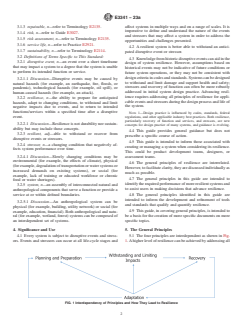
4.1 Every system is subject to disruptive events and stress- 5.1 The four principles are interdependent as shown in Fig.
ors. Events and stressors can occur at all life-cycle stages and 1. A higher level of resilience can be achieved by addressing all
FIG. 1 Interdependency of Principles and How They Lead to Resilience
E3341 − 23a
four resilience principles, from planning through recovery, as normal operations, operations during a disruptive event, and
decisions at each stage or phase of resilience have an influence operations during periods of degraded function or recovery.
or impact on the other stages or phases.
6.5 Once the system’s boundary and resilient goals are
specified, the effects of disruptive events on the system are
5.2 Planning and Preparation—Planning and preparation
evaluated based upon the four principles.
involve identifying measurable system performance
requirements, goals for improved resilience, relevant hazards
6.6 The resilience of a system may depend on the resilience
and stressors for the system(s) under consideration,
of its components, including reliance on or interdependence
interdependencies, and engagement of relevant stakeholders
with other systems.
who have a role or an interest in the operation or function of the
7. The Planning and Preparation Principle
system.
7.1 For resilience, the planning and preparation principle
5.3 Adaptation:
includes establishment of system resilient goals, engagement
5.3.1 Adaptation addresses the performance of the system
of stakeholders, and identification of disruptive events and
for future disruptive events or stressors.
stressors. The following points should be considered:
NOTE 2—Systems may need to continue to perform the same function 7.1.1 Establishment of system resilience goals that are
over a planned period of time during which changes in disruptive events
measurable. A resilience planning process should specify goals
or stressors may occur. For example, a house may need to be elevated to
of the desired system performance for functional and opera-
accommodate rising water levels caused by sea level rise.
tional levels after a disruptive event. These levels of perfor-
NOTE 3—Systems may have new uses following a disruptive event,
mance may be informed by system requirements, as well as
where a system function is altered to meet another purpose. For example,
external interdependencies or code/regulatory requirements.
a public meeting area or school may serve as a shelter during or after
events when needed.
7.1.2 Engagement of stakeholders for expected performance
of the system at hand. In
...
This document is not an ASTM standard and is intended only to provide the user of an ASTM standard an indication of what changes have been made to the previous version. Because
it may not be technically possible to adequately depict all changes accurately, ASTM recommends that users consult prior editions as appropriate. In all cases only the current version
of the standard as published by ASTM is to be considered the official document.
Designation: E3341 − 23 E3341 − 23a
Standard Guide for
General Principles of Resilience
This standard is issued under the fixed designation E3341; the number immediately following the designation indicates the year of
original adoption or, in the case of revision, the year of last revision. A number in parentheses indicates the year of last reapproval. A
superscript epsilon (´) indicates an editorial change since the last revision or reapproval.
1. Scope
1.1 This guide covers general principles related to the resilience of systems, including natural and anthropological systems.
1.2 Resilience is defined by four general principles: planning and preparation, adaptation, withstanding and limiting impacts, and
recovery of operations and function. This guide covers the fundamentals for each of the general principles.
1.3 This guide recognizes that, in applying principles of resilience, decision makers often balance opportunities and challenges,
as well as the safety and risk associated with each of the general principles and their interdependence.
1.4 This guide recognizes that improved resilience may result from a variety of sources and potential solutions. Solutions and their
associated impacts can span economic, physical, environmental, health and wellness, ecological, and other human aspects related
to individuals, organizations, social systems, physical systems, and natural systems.
1.5 The general principles identified in this guide are applicable to all types of systems, the boundaries of which are defined by
the user based upon the system functions, uses, and impacts, as well as other natural, social, economic, or physical constraints for
the specific situation.
1.6 Applying the principles in this guide will require informed assessment and practical experience to determine if system
resilience goals are advanced or achieved through application of the four principles and meeting project requirements.
1.7 This guide acknowledges that the various contexts in which a system is used or operates directly affects its resilience.
1.8 This guide recognizes that one or more components make up systems, requiring evaluation of each component individually,
as well as being part of the relevant system, and in relationship to relevant externalities.
1.9 This guide recommends four general principles to inform planning and design processes; it does not recommend a specific
course of action. This guide cannot replace education or experience and should be used in conjunction with informed judgment.
1.10 This standard does not purport to address all of the safety concerns, if any, associated with its use. It is the responsibility
of the user of this standard to establish appropriate safety, health, and environmental practices and determine the applicability of
regulatory limitations prior to use.
This guide is under the jurisdiction of ASTM Committee E60 on Sustainability and is the direct responsibility of Subcommittee E60.80 on General Sustainability
Standards.
Current edition approved Dec. 1, 2023Dec. 15, 2023. Published December 2023. Originally approved in 2022.2010. Last previous edition approved in 20222023 as
E3341 – 22.E3341 – 23. DOI: 10.1520/E3341-23.10.1520/E3341-23A.
Copyright © ASTM International, 100 Barr Harbor Drive, PO Box C700, West Conshohocken, PA 19428-2959. United States
E3341 − 23a
1.11 This international standard was developed in accordance with internationally recognized principles on standardization
established in the Decision on Principles for the Development of International Standards, Guides and Recommendations issued
by the World Trade Organization Technical Barriers to Trade (TBT) Committee.
2. Referenced Documents
2.1 ASTM Standards:
C1145 Terminology of Advanced Ceramics
E2114 Terminology for Sustainability
E2135 Terminology for Property and Asset Management
E2432 Guide for General Principles of Sustainability Relative to the Built Environment
E2921 Practice for Minimum Criteria for Comparing Whole Building Life Cycle Assessments for Use with Building Codes,
Standards, and Rating Systems
E3027 Guide for Making Sustainability-Related Chemical Selection Decisions in the Life-Cycle of Products
E3032 Guide for Climate Resiliency Planning and Strategy
E3136 Guide for Climate Resiliency in Water Resources
E3249 Guide for Remedial Action Resiliency to Climate Impacts
3. Terminology
3.1 Definitions—For terminology where the definition is defined in another standard:
3.1.1 built environment, n—refer to Guide E2432.
3.1.2 durability, n—refer to Terminology C1145.
3.1.3 repairable, n—refer to Terminology E2135.
3.1.4 risk, n—refer to Guide E3027.
3.1.5 risk assessment, n—refer to Terminology E2135.
3.1.6 service life, n—refer to Practice E2921.
3.1.7 sustainability, n—refer to Terminology E2114.
3.2 Definitions of Terms Specific to This Standard:
3.2.1 disruptive event, n—an event over a short timeframe that may impact a system to a degree that the system is unable to
perform its intended function or service.
3.2.1.1 Discussion—
Disruptive events may be caused by natural hazards (for example, an earthquake, fire, floods, or pandemic), technological hazards
(for example, oil spill), or human-caused hazards (for example, an attack).
3.2.2 resilience, n—the ability to prepare for anticipated hazards, adapt to changing conditions, to withstand and limit negative
impacts due to events, and to return to intended functions/services within a specified time after a disruptive event.
3.2.2.1 Discussion—
Resilience is not durability nor sustainability but may include those concepts.
3.2.3 resilient, adj—able to withstand or recover from disruptive events or stressors.
3.2.4 stressor, n—a changing condition that negatively affects system performance over time.
3.2.4.1 Discussion—
For referenced ASTM standards, visit the ASTM website, www.astm.org, or contact ASTM Customer Service at service@astm.org. For Annual Book of ASTM Standards
volume information, refer to the standard’s Document Summary page on the ASTM website.
E3341 − 23a
Slowly changing conditions may be environmental (for example, the effects of climate), physical (for example, degradation of
transportation or water systems or increased demands on existing systems), or social (for example, lack of training or educated
workforce or chronic food or water shortages).
3.2.5 system, n—an assembly of interconnected natural and anthropological components that serve a function or provide a service
at or within defined boundaries.
3.2.5.1 Discussion—
An anthropological system can be physical (for example, building, utility network) or social (for example, education, financial).
Both anthropological and natural (for example, wetland, forest) systems can be composed of an interdependent set of systems.
4. Significance and Use
4.1 Every system is subject to disruptive events and stressors. Events and stressors can occur at all life-cycle stages and affect
systems in multiple ways and on a range of scales. It is imperative to define and understand the nature of the events and stressors
that may affect a system in order to address the opportunities and challenges presented.
4.2 A resilient system is better able to withstand an anticipated disruptive event or stressor.
4.3 Knowledge from historic disruptive events can aid in the design of system resilience. However, assumptions based on
historical events may not be indicative of future conditions or future system operations, or they may not be consistent with design
criteria in codes and standards. Systems can be designed to withstand and limit damage and support health and safety; stressors
and recovery of function can often be more robustly addressed in initial system design practice. Advancing resilience requires
addressing all principles of resilience for applicable events and stressors during the design process and life of the system.
NOTE 1—Design practice is influenced by codes, standards, federal regulations, and other applicable industry best practices. Both resilience, particularly
recovery of function and services, and stressors, are new concepts for design practice of many systems, and guidance is evolving.
4.4 This guide provides general guidance but does not prescribe a specific course of action.
4.5 This guide is intended to inform those associated with creating or managing a system when considering its resilience. This
could be product development teams, designers, or assessment teams.
4.6 The general principles of resilience are interrelated. However, to facilitate clarity, they are discussed individually as much as
possible.
4.7 The general principles in this guide are intended to identify the required performance of more resilient systems and to assist
users in making decisions that advance resilience.
4.8 The general principles identified in this guide are intended to inform the development and refinement of tools and standards
that qualify and quantify resilience.
4.9 This guide, in covering general principles, is intended to be a basis for the creation of more specific documents on more
specific topics.
5. The General Principles
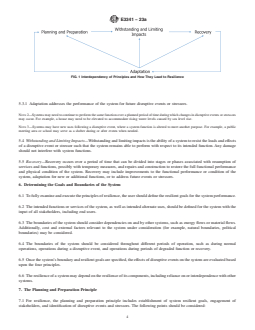
5.1 The four principles are interdependent as shown in Fig. 1. A higher level of resilience can be achieved by addressing all four
resilience principles, from planning through recovery, as decisions at each stage or phase of resilience have an influence or impact
on the other stages or phases.
5.2 Planning and Preparation—Planning and preparation involve identifying measurable system performance requirements, goals
for improved resilience, relevant hazards and stressors for the system(s) under consideration, interdependencies, and engagement
of relevant stakeholders who have a role or an interest in the operation or function of the system.
5.3 Adaptation:
E3341 − 23a
FIG. 1 Interdependency of Principles and How They Lead to Resilience
5.3.1 Adaptation addresses the performance of the system for future disruptive events or stressors.
NOTE 2—Systems may need to continue to perform the same function over a planned period of time during which changes in disruptive events or stressors
may occur. For example, a house may need to be elevated to accommodate rising water levels caused by sea level rise.
NOTE 3—Systems may have new uses following a disruptive event, where a system function is altered to meet another purpose. For example, a public
meeting area or school may serve as a shelter during or after events when needed.
5.4 Withstanding and Limiting Impacts—Withstanding and limiting impacts is the ability of a system to resist the loads and effects
of a disruptive event or stressor such that the system remains able to perform with respect to its intended function. Any damage
should not interfere with system functions.
5.5 Recovery—Recovery occurs over a period of time that can be divided into stages or phases associated with resumption of
services and functions, possibly with temporary measures, and repairs and construction to restore the full functional performance
and physical condition of the system. Recovery may include improvements to the functional performance or condition of the
system, adaptation for new or additional functions, or to address future events or stressors.
6. Determining the Goals and Boundaries of the System
6.1 To fully examine and execute the principles of resilience, the user should define the resilient goals for the system performance.
6.2 The intended functions or services of the system, as well as intended alternate uses, should be defined for the
...