

ASTM D5671-20
(Practice)Standard Practice for Polishing and Etching Coal Samples for Microscopical Analysis by Reflected Light
General Information
- Abstract
SIGNIFICANCE AND USE
5.1 Components observable in surfaces of coal samples prepared in accordance with the laboratory procedures of this practice will have differential relief that will aid in their maceral identification by visual classification and enables identification of plant parts or tissues that formed the coal.
5.2 Samples prepared by this practice can be used for microscopical determination of the volume percent of physical components of coal in accordance with Test Method D2799.
5.3 Samples prepared by this practice can be used for the microscopical identification of botanical components by taphonomic rank. Samples for this purpose should be limited to telovitrinite and semifusinite rich coals of bright lithotype to maximize feedback from etching.
SCOPE
1.1 This practice covers laboratory procedures for preparing an etched, polished surface of granular and block samples of coal for examination with a microscope using reflected light illumination.
1.2 Units—The values stated in SI units are to be regarded as standard. The values given in parentheses after SI units are provided for information only and are not considered standard.
1.3 This standard does not purport to address all of the safety concerns, if any, associated with its use. It is the responsibility of the user of this standard to establish appropriate safety, health, and environmental practices and determine the applicability of regulatory limitations prior to use.
1.4 This international standard was developed in accordance with internationally recognized principles on standardization established in the Decision on Principles for the Development of International Standards, Guides and Recommendations issued by the World Trade Organization Technical Barriers to Trade (TBT) Committee.
- Status
- Published
- Publication Date
- 30-Sep-2020
- Technical Committee
- D05 - Coal and Coke
- Drafting Committee
- D05.28 - Petrographic Analysis of Coal and Coke
Buy Documents
ASTM D5671-20 - Standard Practice for Polishing and Etching Coal Samples for Microscopical Analysis by Reflected Light
REDLINE ASTM D5671-20 - Standard Practice for Polishing and Etching Coal Samples for Microscopical Analysis by Reflected Light
Overview
ASTM D5671-20 is the established international standard practice for polishing and etching coal samples for microscopical analysis by reflected light. Issued by ASTM International, this standard outlines laboratory procedures that prepare both granular and block coal samples to facilitate detailed petrographic examination. Polishing and etching surfaces according to this practice enhances the differential relief of coal components, allowing for accurate identification of macerals and preservation states, as well as enabling further analysis of plant tissue origins within the coal matrix. ASTM D5671-20 supports advanced petrographic investigations, aiding in the morphological study and classification of coal.
Key Topics
- Sample Preparation: Details procedures for preparing coal briquets or blocks to achieve a flat, scratch-free, and polished surface, suitable for microscopical analysis by reflected light.
- Etching Technique: Provides guidelines for using an acidified potassium permanganate solution to chemically etch coal surfaces, which enhances the visual contrast between different components and allows maceral and botanical tissue identification.
- Component Identification: Facilitates the recognition of key botanical features such as bark, cuticle, root, shoot, wood (xylem), fungal tissues, and degraded matrices in etched coal samples.
- Safety and Compliance: Emphasizes adherence to laboratory best practices, safety, and health protocols during the handling of chemicals and preparation of samples.
- Analytical Consistency: Specifies use of SI units and supports standardized measurements, supporting reliable reproducibility and comparison of analytical results across laboratories.
Applications
The procedures described in ASTM D5671-20 offer valuable applications in coal petrography and geology:
- Maceral Identification: Enhanced relief and contrast from etching assists in classifying macerals-key micro-organic constituents of coal-by visual means, which is essential for understanding coal quality and origin.
- Volume Percent Determination: Enables microscopical determination of physical component volume percentages, supporting quantitative coal characterization in accordance with ASTM D2799.
- Botanical Analysis: Supports the identification of preserved plant tissues and assessment of botanical components by taphonomic rank, especially effective in telovitrinite and semifusinite-rich coals.
- Industrial and Research Uses: Widely used in coal mining, geological surveys, academic research, and energy resource assessment, as well as in laboratories concerned with coal composition, fuel behavior, and origin studies.
- Quality Assurance: Assists in routine laboratory quality control and benchmarking, as it ensures coal samples are prepared consistently according to recognized international protocols.
Related Standards
ASTM D5671-20 references and complements several related ASTM standards to ensure comprehensive analysis and reliable results:
- ASTM D121 - Terminology of Coal and Coke
- ASTM D2797 - Practice for Preparing Coal Samples for Microscopical Analysis by Reflected Light
- ASTM D2798 - Test Method for Microscopical Determination of the Vitrinite Reflectance of Coal
- ASTM D2799 - Test Method for Microscopical Determination of the Maceral Composition of Coal
- ASTM D4596 - Practice for Collection of Channel Samples of Coal in a Mine
- ASTM D5192 - Practice for Collection of Coal Samples from Core
These standards collectively foster consistency, accuracy, and safety in coal microscopical analysis globally.
Keywords: coal microscopical analysis, coal sample preparation, etching, polishing, maceral identification, ASTM D5671-20, reflected light microscopy, coal petrography.
Relations
- Effective Date
- 01-Mar-2024
- Effective Date
- 01-Nov-2019
- Effective Date
- 01-Sep-2015
- Effective Date
- 01-Sep-2012
- Effective Date
- 01-Jun-2011
- Effective Date
- 15-Apr-2011
- Effective Date
- 01-Apr-2011
- Effective Date
- 01-Sep-2010
- Effective Date
- 01-Oct-2009
- Effective Date
- 01-Sep-2009
- Effective Date
- 01-Sep-2009
- Effective Date
- 01-Jun-2009
- Effective Date
- 01-Jun-2009
- Effective Date
- 01-Feb-2009
- Effective Date
- 01-May-2008
Buy Documents
ASTM D5671-20 - Standard Practice for Polishing and Etching Coal Samples for Microscopical Analysis by Reflected Light
REDLINE ASTM D5671-20 - Standard Practice for Polishing and Etching Coal Samples for Microscopical Analysis by Reflected Light
Get Certified
Connect with accredited certification bodies for this standard

Bureau Veritas Chile
Bureau Veritas certification services in Chile.
Bureau Veritas Peru
Bureau Veritas certification services in Peru.
BVQI Peru
Bureau Veritas certification in Peru.
Sponsored listings
Frequently Asked Questions
ASTM D5671-20 is a standard published by ASTM International. Its full title is "Standard Practice for Polishing and Etching Coal Samples for Microscopical Analysis by Reflected Light". This standard covers: SIGNIFICANCE AND USE 5.1 Components observable in surfaces of coal samples prepared in accordance with the laboratory procedures of this practice will have differential relief that will aid in their maceral identification by visual classification and enables identification of plant parts or tissues that formed the coal. 5.2 Samples prepared by this practice can be used for microscopical determination of the volume percent of physical components of coal in accordance with Test Method D2799. 5.3 Samples prepared by this practice can be used for the microscopical identification of botanical components by taphonomic rank. Samples for this purpose should be limited to telovitrinite and semifusinite rich coals of bright lithotype to maximize feedback from etching. SCOPE 1.1 This practice covers laboratory procedures for preparing an etched, polished surface of granular and block samples of coal for examination with a microscope using reflected light illumination. 1.2 Units—The values stated in SI units are to be regarded as standard. The values given in parentheses after SI units are provided for information only and are not considered standard. 1.3 This standard does not purport to address all of the safety concerns, if any, associated with its use. It is the responsibility of the user of this standard to establish appropriate safety, health, and environmental practices and determine the applicability of regulatory limitations prior to use. 1.4 This international standard was developed in accordance with internationally recognized principles on standardization established in the Decision on Principles for the Development of International Standards, Guides and Recommendations issued by the World Trade Organization Technical Barriers to Trade (TBT) Committee.
SIGNIFICANCE AND USE 5.1 Components observable in surfaces of coal samples prepared in accordance with the laboratory procedures of this practice will have differential relief that will aid in their maceral identification by visual classification and enables identification of plant parts or tissues that formed the coal. 5.2 Samples prepared by this practice can be used for microscopical determination of the volume percent of physical components of coal in accordance with Test Method D2799. 5.3 Samples prepared by this practice can be used for the microscopical identification of botanical components by taphonomic rank. Samples for this purpose should be limited to telovitrinite and semifusinite rich coals of bright lithotype to maximize feedback from etching. SCOPE 1.1 This practice covers laboratory procedures for preparing an etched, polished surface of granular and block samples of coal for examination with a microscope using reflected light illumination. 1.2 Units—The values stated in SI units are to be regarded as standard. The values given in parentheses after SI units are provided for information only and are not considered standard. 1.3 This standard does not purport to address all of the safety concerns, if any, associated with its use. It is the responsibility of the user of this standard to establish appropriate safety, health, and environmental practices and determine the applicability of regulatory limitations prior to use. 1.4 This international standard was developed in accordance with internationally recognized principles on standardization established in the Decision on Principles for the Development of International Standards, Guides and Recommendations issued by the World Trade Organization Technical Barriers to Trade (TBT) Committee.
ASTM D5671-20 is classified under the following ICS (International Classification for Standards) categories: 73.040 - Coals. The ICS classification helps identify the subject area and facilitates finding related standards.
ASTM D5671-20 has the following relationships with other standards: It is inter standard links to ASTM D121-15(2024), ASTM D2798-11a(2019), ASTM D121-15, ASTM D2799-12, ASTM D2798-11a, ASTM D2798-11, ASTM D2799-11, ASTM D2799-10, ASTM D121-09a, ASTM D2799-09, ASTM D2798-09a, ASTM D4596-09, ASTM D5192-09, ASTM D121-09, ASTM D5192-08. Understanding these relationships helps ensure you are using the most current and applicable version of the standard.
ASTM D5671-20 is available in PDF format for immediate download after purchase. The document can be added to your cart and obtained through the secure checkout process. Digital delivery ensures instant access to the complete standard document.
Standards Content (Sample)
This international standard was developed in accordance with internationally recognized principles on standardization established in the Decision on Principles for the
Development of International Standards, Guides and Recommendations issued by the World Trade Organization Technical Barriers to Trade (TBT) Committee.
Designation:D5671 −20
Standard Practice for
Polishing and Etching Coal Samples for Microscopical
Analysis by Reflected Light
This standard is issued under the fixed designation D5671; the number immediately following the designation indicates the year of
original adoption or, in the case of revision, the year of last revision. A number in parentheses indicates the year of last reapproval. A
superscript epsilon (´) indicates an editorial change since the last revision or reapproval.
1. Scope 3. Terminology
1.1 This practice covers laboratory procedures for preparing 3.1 Terminology used in this standard can be found in
an etched, polished surface of granular and block samples of Terminology D121.
coal for examination with a microscope using reflected light
4. Summary of Practice
illumination.
4.1 Asubsplit of a representative sample obtained in accor-
1.2 Units—The values stated in SI units are to be regarded
dance with Practice D4596 and prepared in accordance with
as standard. The values given in parentheses after SI units are
Practice D2797, or a block of coal obtained in accordance with
provided for information only and are not considered standard.
Practice D5192, is polished to a flat, scratch-free surface; the
1.3 This standard does not purport to address all of the
reflectance of vitrinite is determined on a subsplit in accor-
safety concerns, if any, associated with its use. It is the
dance with Test Method D2798; and then other subsplits are
responsibility of the user of this standard to establish appro-
chemically etched using an acidified potassium permanganate
priate safety, health, and environmental practices and deter-
solution.
mine the applicability of regulatory limitations prior to use.
1.4 This international standard was developed in accor-
5. Significance and Use
dance with internationally recognized principles on standard-
5.1 Components observable in surfaces of coal samples
ization established in the Decision on Principles for the
prepared in accordance with the laboratory procedures of this
Development of International Standards, Guides and Recom-
practice will have differential relief that will aid in their
mendations issued by the World Trade Organization Technical
maceral identification by visual classification and enables
Barriers to Trade (TBT) Committee.
identification of plant parts or tissues that formed the coal.
2. Referenced Documents
5.2 Samples prepared by this practice can be used for
2 microscopical determination of the volume percent of physical
2.1 ASTM Standards:
components of coal in accordance with Test Method D2799.
D121 Terminology of Coal and Coke
D2797 Practice for Preparing Coal Samples for Microscopi- 5.3 Samples prepared by this practice can be used for the
cal Analysis by Reflected Light microscopicalidentificationofbotanicalcomponentsbytapho-
D2798 Test Method for Microscopical Determination of the nomic rank. Samples for this purpose should be limited to
Vitrinite Reflectance of Coal telovitrinite and semifusinite rich coals of bright lithotype to
D2799 Test Method for Microscopical Determination of the maximize feedback from etching.
Maceral Composition of Coal
6. Apparatus
D4596 Practice for Collection of Channel Samples of Coal
in a Mine
6.1 Ultrasonic Cleaner, large enough for sample holder and
D5192 Practice for Collection of Coal Samples from Core sample preparations to be immersed in cleaning solution.
6.2 Beakers—Glass beakers of (50, 100, and 500) ml
capacity, one each for each etching setup.
This practice is under the jurisdiction of ASTM Committee D05 on Coal and
Coke and is the direct responsibility of Subcommittee D05.28 on Petrographic
6.3 Stirring Rods, glass, approximately 20 cm long.
Analysis of Coal and Coke.
Current edition approved Oct. 1, 2020. Published November 2020. Originally 6.4 Hot Plate, electric or gas-heated with capability for
approved in 1995. Last previous edition approved in 2019 as D5671 – 95(2019).
temperature control and rotating stirring magnets.
DOI: 10.1520/D5671-20.
For referenced ASTM standards, visit the ASTM website, www.astm.org, or 6.5 Watch Glasses, glass, 100 mm to 200 mm in diameter,
contact ASTM Customer Service at service@astm.org. For Annual Book of ASTM
depending on size of specimen blocks to be etched.
Standards volume information, refer to the standard’s Document Summary page on
the ASTM website. 6.6 Graduated Cylinders, glass, (25 and 100) ml.
Copyright © ASTM International, 100 Barr Harbor Drive, PO Box C700, West Conshohocken, PA 19428-2959. United States
D5671−20
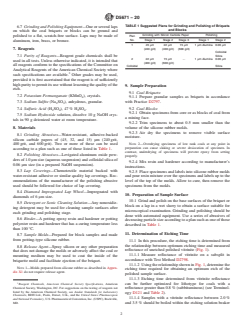
TABLE 1 Suggested Plans for Grinding and Polishing of Briquets
6.7 Grinding and Polishing Equipment—Oneorseverallaps
and Blocks
on which the coal briquets or blocks can be ground and
Grinding with Silicon Carbide Paper Polishing
polished to a flat, scratch-free surface. Laps may be made of Plan
No.
Stage 1 Stage 2 Stage 3 Stage 1 Stage 2
aluminum, iron, brass, or bronze.
145µm 22 µm 15 µm 1 µm Alumina 0.06 µm
(240 grit) (400 grit) (600 grit)
7. Reagents
Colloidal
Silica
7.1 Purity of Reagents—Reagent grade chemicals shall be
222µm 15 µm . 1 µm Alumina 0.06 µm
used in all tests. Unless otherwise indicated, it is intended that
(400 grit) (600 grit)
all reagents conform to the specifications of the Committee on
Colloidal Silica
Analytical Reagents of the American Chemical Society where
such specifications are available. Other grades may be used,
provided it is first ascertained that the reagent is of sufficiently
highpuritytopermititsusewithoutlesseningthequalityofthe
9. Sample Preparation
etch.
9.1 Coal Briquets:
7.2 Potassium Permanganate (KMnO ), crystals.
9.1.1 Prepare granular samples as briquets in accordance
7.3 Sodium Sulfite (Na SO ), anhydrous, granular. with Practice D2797.
2 3
7.4 Sulfuric Acid (H SO ), 47 % H SO . 9.2 Coal Blocks:
2 4 2 4
9.2.1 Obtain specimens from core or as blocks of coal from
7.5 Sodium Hydroxide solution, dissolve 10 g NaOH crys-
a mining face.
tals in 90 g deionized water at room temperature.
9.2.2 Trim specimens to about 0.5 mm smaller than the
volume of the silicone rubber molds.
8. Materials
9.2.3 Air dry the specimens to remove visible surface
8.1 Grinding Abrasives—Water-resistant, adhesive-backed
moisture.
silicon carbide papers of (45, 32, and 15) µm (240 grit,
400 grit, and 600 grit). Two or more of these can be used NOTE 2—Overdrying specimens of low rank coals at any point in
preparation can cause slaking or severe desiccation of specimen. In
according to a plan such as one of those listed in Table 1.
contrast, underdrying of specimens will prevent epoxy from setting
8.2 Polishing Abrasives—Levigated aluminum oxide pow-
properly.
dersof 1.0 µm size (aqueoussuspension)andcolloidalsilicaof
9.2.4 Mix resin and hardener according to manufacturer’s
0.06 µm size (in a prepared NaOH suspension).
instructions.
8.3 Lap Coverings—Chemotextile material backed with 9.2.5 Place specimens and labels into silicone rubber molds
water-resistant adhesive or similar quality lap coverings. Rec- and pour resin mixture over the specimens and labels up to the
ommendations of the manufacturer of the polishing abrasive level of the top of the molds. Allow to cure, then remove the
used should be followed for choice of lap covering. specimens from the molds.
8.4 Diamond Impregnated Lap Wheel—Impregnated with
10. Preparation of Sample Surface
diamonds of 6 µm size.
10.1 Grind and polish on the base surfaces of the briquet or
8.5 Detergent or Sonic Cleaning Solution—Any nonoxidiz-
block on a lap in a wet slurry to obtain a surface suitable for
ing detergent may be used for cleaning sample surfaces after
microscopical examination. Grinding and polishing should be
each grinding and polishing stage.
done with automated equipment. Use a series of abrasives of
8.6 Binder—A potting epoxy resin and hardener or potting
decreasingparticlesizeaccordingtoaplansuchasoneofthose
polyester resin and hardener that has a curing temperature less
described in Table 1.
than 100 °C.
11. Determination of Etching Time
8.7 Sample Molds—Prepared for block samples and made
from potting-type silicone rubber.
11.1 In this procedure, the etching time is determined from
the relationship between optimum etching time and measured
8.8 Release Agent—Spray silicon or any other preparation
reflectance of unetched polished vitrinite (Fig. 1).
that does not damage the molds or adversely affect the coal or
11.1.1 Measure reflectance of vitrinite on a subsplit in
mounting medium may be used to coat the inside of the
accordance with Test Method D2798.
briquette mold and facilitate ejection of the briquet.
11.1.2 Using the relationship shown in Fig. 1, determine the
NOTE 1—Molds prepared from silicone rubber as described in Appen-
etching time required for obtaining an optimum etch of the
dix X1 do not require release agent.
polished sample surface.
11.1.3 Etching time determined from vitrinite reflectance
can be further optimized for lithotype for coals with a
Reagent Chemicals, American Chemical Society Specifications, American
Chemical Society, Washington, DC. For suggestions on the testing of reagents not
reflectance greater than 0.8 % (subbituminous) (see Terminol-
listed by the American Chemical Society, see Analar Standards for Laboratory
ogy D121 and Table 2).
Chemicals, BDH Ltd., Poole, Dorset, U.K., and the United States Pharmacopeia
11.1.4 Samples with a vitrinite reflectance between 2.0 %
and National Formulary, U.S. Pharmaceutical Convention, Inc. (USPC), Rockville,
MD. and 3.5 % should be boiled within the etching solution beaker
D5671−20
12.7 Cleanthecoalsurfaceultrasonicallyindeionizedwater
or rinsing solution, for 3 min.
12.8 Dry the surface with a stream of compressed air
immediately after removing from ultrasonic bath.
NOTE 3—For some samples, a small area of the polished surface can be
masked using drafting tape smoothed so as to prevent any etching effects.
After etching, this tape is removed, which produces a line that demarcates
the etched and unetched areas. Drafting tape is recommended, as this does
not leave adhesive residues on the sample surface.
NOTE 4—For block samples of low rank coal, primarily less than 0.5 %
reflectance, blocks can be stored in a shallow bath of deionized water to
prevent slaking or severe drying. Prior to examination, the sample surface
can be dried with a stream of compressed air. Some low rank coals may
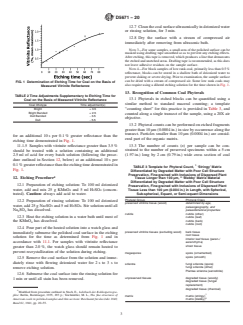
FIG. 1 Determination of Etching Time for Coal on the Basis of
also require using a diluted etching solution for the time shown in Fig. 1.
Measured Vitrinite Reflectance
13. Recognition of Common Coal Phyterals
TABLE 2 Time Adjustments Supplementary to Etching Time for
13.1 Phyterals in etched blocks can be quantified us
...
This document is not an ASTM standard and is intended only to provide the user of an ASTM standard an indication of what changes have been made to the previous version. Because
it may not be technically possible to adequately depict all changes accurately, ASTM recommends that users consult prior editions as appropriate. In all cases only the current version
of the standard as published by ASTM is to be considered the official document.
Designation: D5671 − 95 (Reapproved 2019) D5671 − 20
Standard Practice for
Polishing and Etching Coal Samples for Microscopical
Analysis by Reflected Light
This standard is issued under the fixed designation D5671; the number immediately following the designation indicates the year of
original adoption or, in the case of revision, the year of last revision. A number in parentheses indicates the year of last reapproval. A
superscript epsilon (´) indicates an editorial change since the last revision or reapproval.
1. Scope
1.1 This practice covers laboratory procedures for preparing an etched, polished surface of granular and block samples of coal for
examination with a microscope using reflected light illumination.
1.2 Units—The values stated in SI units are to be regarded as standard. No other units of measurement are included in this The
values given in parentheses after SI units are provided for information only and are not considered standard.
1.3 This standard does not purport to address all of the safety concerns, if any, associated with its use. It is the responsibility
of the user of this standard to establish appropriate safety, health, and environmental practices and determine the applicability of
regulatory limitations prior to use.
1.4 This international standard was developed in accordance with internationally recognized principles on standardization
established in the Decision on Principles for the Development of International Standards, Guides and Recommendations issued
by the World Trade Organization Technical Barriers to Trade (TBT) Committee.
2. Referenced Documents
2.1 ASTM Standards:
D121 Terminology of Coal and Coke
D2797 Practice for Preparing Coal Samples for Microscopical Analysis by Reflected Light
D2798 Test Method for Microscopical Determination of the Vitrinite Reflectance of Coal
D2799 Test Method for Microscopical Determination of the Maceral Composition of Coal
D4596 Practice for Collection of Channel Samples of Coal in a Mine
D5192 Practice for Collection of Coal Samples from Core
3. Terminology
3.1 Terminology used in this standard can be found in Terminology D121.
4. Summary of Practice
4.1 A subsplit of a representative sample obtained in accordance with Practice D4596 and prepared in accordance with Practice
This practice is under the jurisdiction of ASTM Committee D05 on Coal and Coke and is the direct responsibility of Subcommittee D05.28 on Petrographic Analysis
of Coal and Coke.
Current edition approved Nov. 1, 2019Oct. 1, 2020. Published November 2019November 2020. Originally approved in 1995. Last previous edition approved in 20112019
as D5671 – 95(2011). – 95(2019). DOI: 10.1520/D5671-95R19.10.1520/D5671-20.
For referenced ASTM standards, visit the ASTM website, www.astm.org, or contact ASTM Customer Service at service@astm.org. For Annual Book of ASTM Standards
volume information, refer to the standard’s Document Summary page on the ASTM website.
Copyright © ASTM International, 100 Barr Harbor Drive, PO Box C700, West Conshohocken, PA 19428-2959. United States
D5671 − 20
D2797, or a block of coal obtained in accordance with Practice D5192, is polished to a flat, scratch-free surface,surface; the
reflectance of vitrinite is determined on a subsplit in accordance with Test Method D2798,; and then other subsplits are chemically
etched using an acidified potassium permanganate solution.
5. Significance and Use
5.1 Components observable in surfaces of coal samples prepared in accordance with the laboratory procedures of this practice will
have differential relief that will aid in their maceral identification by visual classification and enables identification of plant parts
or tissues that formed the coal.
5.2 Samples prepared by this practice can be used for microscopical determination of the volume percent of physical components
of coal in accordance with Test Method D2799.
5.3 Samples prepared by this practice can be used for the microscopical identification of botanical components by taphonomic
rank. Samples for this purpose should be limited to telovitrinite and semifusinite rich coals of bright lithotype to maximize
feedback from etching.
6. Apparatus
6.1 Ultrasonic Cleaner—Cleaner, large enough for sample holder and sample preparations to be immersed in cleaning solution.
6.2 Beakers—glass beakers, 50, Glass beakers of (50, 100, and 500 ml 500) ml capacity, one each for each etching setup.
6.3 Stirring Rods—Rods, glass, approximately 20 cm long.
6.4 Hot Plate—Plate, electric or gas-heated with capability for temperature control and rotating stirring magnets.
6.5 Watch Glasses—Glasses, glass, 100–200 100 mm to 200 mm in diameter, depending on size of specimen blocks to be etched.
6.6 Graduated Cylinders—Cylinders, glass, 25(25 and 100100) ml.
6.7 Grinding and Polishing Equipment—oneOne or several laps on which the coal briquets or blocks can be ground and polished
to a flat, scratch-free surface. Laps may be made of aluminum, iron, brass, or bronze.
7. Reagents
7.1 Purity of Reagents—Reagent grade chemicals shall be used in all tests. Unless otherwise indicated, it is intended that all
reagents conform to the specifications of the Committee on Analytical Reagents of the American Chemical Society where such
specifications are available. Other grades may be used, provided it is first ascertained that the reagent is of sufficiently high purity
to permit its use without lessening the quality of the etch.
7.2 Potassium Permanganate (KMnO ), crystals.
7.3 Sodium Sulfite (Na SO ), anhydrous, granular.
2 3
7.4 Sulfuric Acid (H SO ), 47 % H SO .
2 4 2 4
7.5 Sodium Hydroxide solution, dissolve 10 g NaOH crystals in 90 g deionized water at room temperature.
Reagent Chemicals, American Chemical Society Specifications, American Chemical Society, Washington, DC. For suggestions on the testing of reagents not listed by
the American Chemical Society, see Analar Standards for Laboratory Chemicals, BDH Ltd., Poole, Dorset, U.K., and the United States Pharmacopeia and National
Formulary, U.S. Pharmaceutical Convention, Inc. (USPC), Rockville, MD.
D5671 − 20
8. Materials
8.1 Grinding Abrasives—Water-resistant, adhesive-backed silicon carbide papers of 45,(45, 32, and 1515) μm (240, 400,(240 grit,
400 grit, and 600 grit). Two or more of these can be used according to a plan such as one of those listed in Table 1.
8.2 Polishing Abrasives—Levigated aluminum oxide powders of 1.0 μm size (aqueous suspension) and colloidal silica of 0.06 μm
size (in a prepared NaOH suspension).
8.3 Lap Coverings—Chemotextile material backed with water-resistant adhesive or similar quality lap coverings. Recommenda-
tions of the manufacturer of the polishing abrasive used should be followed for choice of lap covering.
8.4 Diamond Impregnated Lap Wheel—Impregnated with diamonds of 6 μm size.
8.5 Detergent or Sonic Cleaning Solution—Any nonoxidizing detergent may be used for cleaning sample surfaces after each
grinding and polishing stage.
8.6 Binder—A potting epoxy resin and hardener or potting polyester resin and hardener that has a curing temperature less than
100 °C.
8.7 Sample Molds—Prepared for block samples and is made from potting-type silicone rubber.
8.8 Release Agent—Spray silicon or any other preparation that does not damage the molds or adversely affect the coal or mounting
TABLE 1 Suggested Plans for Grinding and Polishing of Briquets
and Blocks
Grinding with Silicon Carbide Paper Polishing
Plan
No.
Stage 1 Stage 2 Stage 3 Stage 1 Stage 2
1 45μ m 22 μm 15 μm 1 μm Alumina 0.06 μm
(240 grit) (400 grit) (600 grit)
1 45 μm 22 μm 15 μm 1 μm Alumina 0.06 μm
(240 grit) (400 grit) (600 grit)
Colloidal
Silica
2 22 μm 15 μm . 1 μm Alumina 0.06 μm
(400 grit) (600 grit)
Colloidal Silica
medium may be used to coat the inside of the briquette mold and facilitate ejection of the briquet.
NOTE 1—Molds prepared from silicone rubber as described in Appendix X1 do not require release agent.
9. Sample Preparation
9.1 Coal Briquets:
9.1.1 Prepare granular samples as briquets in accordance with Practice D2797.
9.2 Coal Blocks:
9.2.1 Obtain specimens from core or as blocks of coal from a mining face.
9.2.2 Trim specimens to about 0.5 mm smaller than the volume of the silicone rubber molds.
9.2.3 Air dry the specimens to remove visible surface moisture.
NOTE 2—Overdrying specimens of low rank coals at any point in preparation can cause slaking or severe desiccation of specimen. In contrast, underdrying
D5671 − 20
of specimens will prevent epoxy from setting properly.
9.2.4 Mix resin and hardener according to manufacturer’s instructions.
9.2.5 Place specimens and labels into silicone rubber molds and pour resin mixture over the specimens and labels up to the level
of the top of the molds. Allow to cure, then remove the specimens from the molds.
10. Preparation of Sample Surface
10.1 Grind and polish on the base surfaces of the briquet or block on a lap in a wet slurry to obtain a surface suitable for
microscopical examination. Grinding and polishing should be done with automated equipment. Use a series of abrasives of
decreasing particle size according to a plan such as one of those described in Table 1.
11. Determination of Etching Time
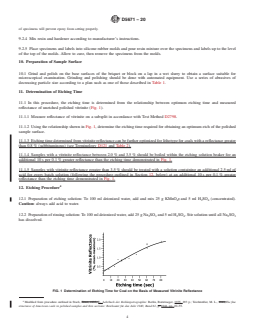
11.1 In this procedure, the etching time is determined from the relationship between optimum etching time and measured
reflectance of unetched polished vitrinite (Fig. 1).
11.1.1 Measure reflectance of vitrinite on a subsplit in accordance with Test Method D2798.
11.1.2 Using the relationship shown in Fig. 1, determine the etching time required for obtaining an optimum etch of the polished
sample surface.
11.1.3 Etching time determined from vitrinite reflectance can be further optimized for lithotype for coals with a reflectance greater
than 0.8 % (subbituminous) (see Terminology D121 and Table 2).
11.1.4 Samples with a vitrinite reflectance between 2.0 % and 3.5 % should be boiled within the etching solution beaker for an
additional 10 s per 0.1 % greater reflectance than the etching time demonstrated in Fig. 1.
11.1.5 Samples with vitrinite reflectance greater than 3.5 % should be treated with a solution containing an additional 2.5 ml of
acid for every batch solution (following the procedure outlined in Section 12, below) at an additional 10 s per 0.1 % greater
reflectance than the etching time demonstrated in Fig. 1.
12. Etching Procedure
12.1 Preparation of etching solution: To 100 ml deionized water, add and mix 25 g KMnO , and 5 ml H SO (concentrated).
4 2 4
Caution: always add acid to water.
12.2 Preparation of rinsing solution: To 100 ml deionized water, add 25 g Na SO and 5 ml H SO . Stir solution until all Na SO
2 3 2 4 2 3
has dissolved.
FIG. 1 Determination of Etching Time for Coal on the Basis of Measured Vitrinite Reflectance
Modified from procedure outlined in Stach, Ernst, 1935, E., Lehrbuch der Kohlenpetrographie: Berlin, Borntraeger, 1935, 293 p.; Teichmüller, M. L., 1941,The fin
...