

ASTM D3827-92(2020)
(Test Method)Standard Test Method for Estimation of Solubility of Gases in Petroleum and Other Organic Liquids
General Information
- Abstract
SIGNIFICANCE AND USE
5.1 Knowledge of gas solubility is of extreme importance in the lubrication of gas compressors. It is believed to be a substantial factor in boundary lubrication, where the sudden release of dissolved gas may cause cavitation erosion, or even collapse of the fluid film. In hydraulic and seal oils, gas dissolved at high pressure can cause excessive foaming on release of the pressure. In aviation oils and fuels, the difference in pressure between take-off and cruise altitude can cause foaming in storage vessels and interrupt flow to pumps.
SCOPE
1.1 This test method covers a procedure for estimating the equilibrium solubility of several common gases in petroleum and synthetic lubricants, fuels, and solvents, at temperatures between 0 and 488 K.
1.2 This test method is limited to systems in which polarity and hydrogen bonding are not strong enough to cause serious deviations from regularity. Specifically excluded are such gases as HCl, NH3, and SO2, and hydroxy liquids such as alcohols, glycols, and water. Estimating the solubility of CO2 in nonhydrocarbons is also specifically excluded.
1.3 Highly aromatic oils such as diphenoxy phenylene ethers violate the stated accuracy above 363 K, at which point the estimate for nitrogen solubility is 43 % higher than the observation.
1.4 Lubricants are given preference in this test method to the extent that certain empirical factors were adjusted to the lubricant data. Estimates for distillate fuels are made from the lubricant estimates by a further set of empirical factors, and are less accurate. Estimates for halogenated solvents are made as if they were hydrocarbons, and are the least accurate of the three.
1.5 The values stated in SI units are to be regarded as the standard. The values in parentheses are for information only.
1.6 This standard does not purport to address all of the safety concerns, if any, associated with its use. It is the responsibility of the user of this standard to establish appropriate safety, health, and environmental practices and determine the applicability of regulatory limitations prior to use.
1.7 This international standard was developed in accordance with internationally recognized principles on standardization established in the Decision on Principles for the Development of International Standards, Guides and Recommendations issued by the World Trade Organization Technical Barriers to Trade (TBT) Committee.
- Status
- Published
- Publication Date
- 31-Oct-2020
- Technical Committee
- D27 - Electrical Insulating Liquids and Gases
- Drafting Committee
- D27.07 - Physical Test

Overview
ASTM D3827-92(2020): Standard Test Method for Estimation of Solubility of Gases in Petroleum and Other Organic Liquids provides a systematic procedure for estimating how much of several common gases will dissolve in petroleum-based and synthetic lubricants, fuels, and solvents. Applicable from 0 to 488 K, this method is crucial across a range of industrial sectors where the physical behavior of dissolved gases can directly affect system performance, safety, and equipment longevity.
Understanding the solubility of gases in organic liquids is essential, particularly in processes like lubrication of gas compressors, hydraulic and seal oil performance, and the stability of aviation fuels. By accurately estimating gas solubility under equilibrium conditions, industry professionals can predict and prevent issues such as cavitation, foaming, and flow interruption.
Key Topics
Scope and Limitations
- Applicable to systems where strong polarity or hydrogen bonding does not create major deviations.
- Not suitable for highly polar systems (e.g., HCl, NH₃, SO₂, alcohols, glycols, water) or estimating CO₂ solubility in nonhydrocarbons.
- Most accurate for lubricants, less so for distillate fuels and halogenated solvents.
Test Method Essentials
- Estimates the equilibrium solubility of gases using solubility parameters for both the gas and the liquid.
- Uses empirical adjustments for lubricants, distillate fuels, and halogenated solvents.
- Measurement units are provided in SI, with additional data in parentheses for reference.
Significance and Use
- Gas Compressor Lubrication: Dissolved gases can lead to cavitation erosion or fluid film collapse.
- Hydraulic and Seal Oils: High-pressure gases can cause foaming on pressure release.
- Aviation Fluids: Pressure differences can induce foaming in storage and disrupt fuel flow.
Precision and Reliability
- Precision varies by material: highest with lubricants, lower with fuels and halogenated solvents.
- Relies on established physical test data and referenced ASTM methods for supporting measurements.
Applications
ASTM D3827-92(2020) is indispensable for quality control and R&D in the following industries:
- Oil & Gas: Ensures selection of compatible lubricants for compressors, preventing equipment damage from gas release.
- Automotive & Aviation: Maintains hydraulic and fuel system reliability by anticipating foaming and related issues.
- Industrial Fluids: Guides the formulation or selection of process fluids needing controlled gas solubility.
- Chemical Manufacturing: Assists in product development and validation for organic liquids used in various process streams.
By estimating gas solubility accurately, engineers can design safer, more reliable systems, mitigate operational risks, and comply with international best practices.
Related Standards
This standard references and interfaces with several other ASTM test methods, including:
- ASTM D1218: Test Method for Refractive Index and Refractive Dispersion of Hydrocarbon Liquids.
- ASTM D1250: Guide for Use of Temperature and Pressure Volume Correction Factors for Generalized Crude Oils, Refined Products, and Lubricating Oils.
- ASTM D1298: Test Method for Density, Relative Density, or API Gravity of Crude Petroleum and Liquid Petroleum Products.
- ASTM D2502: Test Method for Estimation of Mean Relative Molecular Mass of Petroleum Oils from Viscosity Measurements.
- ASTM D2503: Test Method for Relative Molecular Mass (Molecular Weight) of Hydrocarbons by Thermoelectric Measurement of Vapor Pressure.
Together, these standards support a comprehensive approach to evaluating and controlling the physical-chemical properties of petroleum and synthetic liquids in diverse industrial applications.
Keywords: gas solubility, petroleum liquids, organic liquids, lubricants, distillate fuels, ASTM D3827, hydraulic oil, aviation fuel, equilibrium solubility, foaming, cavitation, industrial standards.
Relations
- Effective Date
- 01-May-2019
- Effective Date
- 01-May-2019
- Effective Date
- 01-May-2019
- Effective Date
- 15-May-2012
- Effective Date
- 15-Apr-2012
- Effective Date
- 01-Apr-2012
- Effective Date
- 01-Oct-2009
- Effective Date
- 01-Nov-2007
- Effective Date
- 01-Nov-2007
- Effective Date
- 01-May-2007
- Effective Date
- 01-Nov-2005
- Effective Date
- 01-May-2004
- Effective Date
- 01-Apr-2004
- Effective Date
- 10-Dec-2002
- Effective Date
- 10-Jun-2002
Get Certified
Connect with accredited certification bodies for this standard

Element Materials Technology
Materials testing and product certification.

ABS Group Brazil
ABS Group certification services in Brazil.

ABS Quality Evaluations Inc.
American Bureau of Shipping quality certification.
Sponsored listings
Frequently Asked Questions
ASTM D3827-92(2020) is a standard published by ASTM International. Its full title is "Standard Test Method for Estimation of Solubility of Gases in Petroleum and Other Organic Liquids". This standard covers: SIGNIFICANCE AND USE 5.1 Knowledge of gas solubility is of extreme importance in the lubrication of gas compressors. It is believed to be a substantial factor in boundary lubrication, where the sudden release of dissolved gas may cause cavitation erosion, or even collapse of the fluid film. In hydraulic and seal oils, gas dissolved at high pressure can cause excessive foaming on release of the pressure. In aviation oils and fuels, the difference in pressure between take-off and cruise altitude can cause foaming in storage vessels and interrupt flow to pumps. SCOPE 1.1 This test method covers a procedure for estimating the equilibrium solubility of several common gases in petroleum and synthetic lubricants, fuels, and solvents, at temperatures between 0 and 488 K. 1.2 This test method is limited to systems in which polarity and hydrogen bonding are not strong enough to cause serious deviations from regularity. Specifically excluded are such gases as HCl, NH3, and SO2, and hydroxy liquids such as alcohols, glycols, and water. Estimating the solubility of CO2 in nonhydrocarbons is also specifically excluded. 1.3 Highly aromatic oils such as diphenoxy phenylene ethers violate the stated accuracy above 363 K, at which point the estimate for nitrogen solubility is 43 % higher than the observation. 1.4 Lubricants are given preference in this test method to the extent that certain empirical factors were adjusted to the lubricant data. Estimates for distillate fuels are made from the lubricant estimates by a further set of empirical factors, and are less accurate. Estimates for halogenated solvents are made as if they were hydrocarbons, and are the least accurate of the three. 1.5 The values stated in SI units are to be regarded as the standard. The values in parentheses are for information only. 1.6 This standard does not purport to address all of the safety concerns, if any, associated with its use. It is the responsibility of the user of this standard to establish appropriate safety, health, and environmental practices and determine the applicability of regulatory limitations prior to use. 1.7 This international standard was developed in accordance with internationally recognized principles on standardization established in the Decision on Principles for the Development of International Standards, Guides and Recommendations issued by the World Trade Organization Technical Barriers to Trade (TBT) Committee.
SIGNIFICANCE AND USE 5.1 Knowledge of gas solubility is of extreme importance in the lubrication of gas compressors. It is believed to be a substantial factor in boundary lubrication, where the sudden release of dissolved gas may cause cavitation erosion, or even collapse of the fluid film. In hydraulic and seal oils, gas dissolved at high pressure can cause excessive foaming on release of the pressure. In aviation oils and fuels, the difference in pressure between take-off and cruise altitude can cause foaming in storage vessels and interrupt flow to pumps. SCOPE 1.1 This test method covers a procedure for estimating the equilibrium solubility of several common gases in petroleum and synthetic lubricants, fuels, and solvents, at temperatures between 0 and 488 K. 1.2 This test method is limited to systems in which polarity and hydrogen bonding are not strong enough to cause serious deviations from regularity. Specifically excluded are such gases as HCl, NH3, and SO2, and hydroxy liquids such as alcohols, glycols, and water. Estimating the solubility of CO2 in nonhydrocarbons is also specifically excluded. 1.3 Highly aromatic oils such as diphenoxy phenylene ethers violate the stated accuracy above 363 K, at which point the estimate for nitrogen solubility is 43 % higher than the observation. 1.4 Lubricants are given preference in this test method to the extent that certain empirical factors were adjusted to the lubricant data. Estimates for distillate fuels are made from the lubricant estimates by a further set of empirical factors, and are less accurate. Estimates for halogenated solvents are made as if they were hydrocarbons, and are the least accurate of the three. 1.5 The values stated in SI units are to be regarded as the standard. The values in parentheses are for information only. 1.6 This standard does not purport to address all of the safety concerns, if any, associated with its use. It is the responsibility of the user of this standard to establish appropriate safety, health, and environmental practices and determine the applicability of regulatory limitations prior to use. 1.7 This international standard was developed in accordance with internationally recognized principles on standardization established in the Decision on Principles for the Development of International Standards, Guides and Recommendations issued by the World Trade Organization Technical Barriers to Trade (TBT) Committee.
ASTM D3827-92(2020) is classified under the following ICS (International Classification for Standards) categories: 75.040 - Crude petroleum. The ICS classification helps identify the subject area and facilitates finding related standards.
ASTM D3827-92(2020) has the following relationships with other standards: It is inter standard links to ASTM D2502-14(2019)e1, ASTM D2502-14(2019), ASTM D1250-19e1, ASTM D1298-12a, ASTM D2503-92(2012), ASTM D1298-12, ASTM D2502-04(2009), ASTM D2503-92(2007), ASTM D1218-02(2007), ASTM D1250-07, ASTM D1298-99(2005), ASTM D1250-04, ASTM D2502-04, ASTM D1250-80(2002), ASTM D1218-02. Understanding these relationships helps ensure you are using the most current and applicable version of the standard.
ASTM D3827-92(2020) is available in PDF format for immediate download after purchase. The document can be added to your cart and obtained through the secure checkout process. Digital delivery ensures instant access to the complete standard document.
Standards Content (Sample)
This international standard was developed in accordance with internationally recognized principles on standardization established in the Decision on Principles for the
Development of International Standards, Guides and Recommendations issued by the World Trade Organization Technical Barriers to Trade (TBT) Committee.
Designation: D3827 − 92 (Reapproved 2020)
Standard Test Method for
Estimation of Solubility of Gases in Petroleum and Other
Organic Liquids
This standard is issued under the fixed designation D3827; the number immediately following the designation indicates the year of
original adoption or, in the case of revision, the year of last revision.Anumber in parentheses indicates the year of last reapproval.A
superscript epsilon (´) indicates an editorial change since the last revision or reapproval.
1. Scope 2. Referenced Documents
1.1 This test method covers a procedure for estimating the 2.1 ASTM Standards:
equilibrium solubility of several common gases in petroleum D1218Test Method for Refractive Index and Refractive
and synthetic lubricants, fuels, and solvents, at temperatures Dispersion of Hydrocarbon Liquids
between 0 and 488 K. D1250Guide for the Use of the Joint API and ASTM
Adjunct for Temperature and Pressure Volume Correction
1.2 This test method is limited to systems in which polarity
FactorsforGeneralizedCrudeOils,RefinedProducts,and
and hydrogen bonding are not strong enough to cause serious
Lubricating Oils: API MPMS Chapter 11.1
deviations from regularity. Specifically excluded are such
D1298Test Method for Density, Relative Density, or API
gases as HCl, NH , and SO , and hydroxy liquids such as
3 2
Gravity of Crude Petroleum and Liquid Petroleum Prod-
alcohols, glycols, and water. Estimating the solubility of CO
ucts by Hydrometer Method
in nonhydrocarbons is also specifically excluded.
D2502Test Method for Estimation of Mean Relative Mo-
1.3 Highly aromatic oils such as diphenoxy phenylene
lecular Mass of Petroleum Oils from Viscosity Measure-
ethers violate the stated accuracy above 363 K, at which point
ments
the estimate for nitrogen solubility is 43% higher than the
D2503TestMethodforRelativeMolecularMass(Molecular
observation.
Weight) of Hydrocarbons by Thermoelectric Measure-
1.4 Lubricants are given preference in this test method to ment of Vapor Pressure
the extent that certain empirical factors were adjusted to the
3. Terminology
lubricant data. Estimates for distillate fuels are made from the
lubricantestimatesbyafurthersetofempiricalfactors,andare
3.1 Definitions:
lessaccurate.Estimatesforhalogenatedsolventsaremadeasif
3.1.1 Bunsen coeffıcient, n—the solubility of a gas, ex-
theywerehydrocarbons,andaretheleastaccurateofthethree.
pressed as the gas volume reduced to 273 K (32°F) and 0.10
MPa(1atm),dissolvedbyonevolumeofliquidatthespecified
1.5 The values stated in SI units are to be regarded as the
temperature and 0.10 MPa.
standard. The values in parentheses are for information only.
3.1.2 Ostwald coeffıcient, n—the solubility of a gas, ex-
1.6 This standard does not purport to address all of the
pressed as the volume of gas dissolved per volume of liquid
safety concerns, if any, associated with its use. It is the
whenbothareinequilibriumatthespecifiedpartialpressureof
responsibility of the user of this standard to establish appro-
gas and at the specified temperature.
priate safety, health, and environmental practices and deter-
mine the applicability of regulatory limitations prior to use.
3.2 Definitions of Terms Specific to This Standard:
1.7 This international standard was developed in accor-
3.2.1 distillate fuel, n—a petroleum product having a mo-
dance with internationally recognized principles on standard-
lecular weight below 300 g/mol.
ization established in the Decision on Principles for the
3.2.2 halogenated solvent, n—a partially or fully haloge-
Development of International Standards, Guides and Recom-
natedhydrocarbonhavingamolarvolumebelow300mL/mol.
mendations issued by the World Trade Organization Technical
3.2.3 solubility parameter, n—thesquarerootoftheinternal
Barriers to Trade (TBT) Committee.
energy change (heat absorbed minus work done) of vaporiza-
tion per unit volume of liquid, at 298 K.
This test method is under the jurisdiction of ASTM Committee D27 on
Electrical Insulating Liquids and Gases and is the direct responsibility of Subcom-
mittee D27.07 on Physical Test. For referenced ASTM standards, visit the ASTM website, www.astm.org, or
Current edition approved Nov. 1, 2020. Published November 2020. Originally contact ASTM Customer Service at service@astm.org. For Annual Book of ASTM
approved in 1979. Last previous edition approved in 2012 as D3827– 92(2012). Standards volume information, refer to the standard’s Document Summary page on
DOI: 10.1520/D3827-92R20. the ASTM website.
Copyright © ASTM International, 100 Barr Harbor Drive, PO Box C700, West Conshohocken, PA 19428-2959. United States
D3827 − 92 (2020)
TABLE 1 Solubility Parameters of Gaseous Solutes
6.1.1 Iftheliquidisanonhydrocarbon,obtain δ fromTable
Gas M δ at 298 K Fuel Factor 2. If it is not listed there, and the structure is known, calculate
2 2
He 4 3.35 1.27 δ by the method of Fedors.
Ne 20 3.87 1.37
6.1.2 If the liquid is refined petroleum or a synthetic
H 2 5.52 1.27
hydrocarbon, determine ρ by Test Method D1218 or equiva-
N 28 6.04 1.70
Air 29 6.67 1.44 lent. If ρ is 0.885 g/mL or less, calculate δ as follows:
CO 28 7.47 1.37
δ 5 12.03ρ17.36 (1)
O 32 7.75 1.28 1
Ar 40 7.71 1.37
6.1.3 If the liquid is refined petroleum or a synthetic
CH 16 9.10 1.42
Kr 84 10.34 1.37
hydrocarbon with ρ=0.886 g/mL or more, or a nonhydrocar-
CO 44 14.81 1.14
bon of unknown structure, determine n by Test Method
D
D1218, and calculate as follows:
δ 5 8.63n 10.96 (2)
1 D
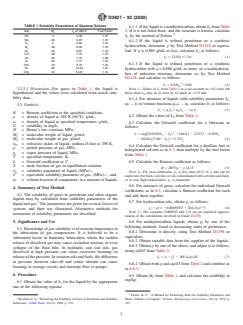
3.2.3.1 Discussion—For gases in Table 1, the liquid is
NOTE 1—Values of δ from Table 2 or ρ are accurate to 60.2 unit, but
those from n may be in error by as much as 61.0 unit.
hypothetical and the values were calculated from actual solu-
D
bility data.
6.1.4 For mixtures of liquids with solubility parameters δ ,
a
φ . δ in volume fractions φ , . φ, calculate δ as follows:
3.3 Symbols: b i a b i 1
δ 5 φ δ 1φ δ …1φ δ (3)
1 a a b b i i
B = Bunsen coefficient at the specified condition,
6.2 Obtain the value of δ from Table 1.
ρ = density of liquid at 288 K (60°F), g/mL,
ρ = density of liquid at specified temperature, g/mL,
t 6.3 Calculate the Ostwald coefficient for a lubricant as
G = solubility in mg/k,
follows:
H = Henry’s law constant, MPa,
L 5 exp 0.0395 δ 2 δ 2 2.66 1 2 273/T 2 0.303δ
@~ ~ ! !~ !
M = molecular weight of liquid, g/mol, 1 2 1
M = molecular weight of gas, g/mol, 2 0.0241 17.60 2 δ 15.731 (4)
~ ! #
2 2
n = refractive index of liquid, sodium D-line at 298 K,
D
6.4 Calculate the Ostwald coefficient for a distillate fuel or
p = partial pressure of gas, MPa,
halogenated solvent as in 6.3, then multiply by the fuel factor
p = vapor pressure of liquid, MPa,
v
from Table 1.
T = specified temperature, K,
L = Ostwald coefficient at T, 6.5 Calculate the Bunsen coefficient as follows:
X = mole fraction of gas in equilibrium solution,
B 5 2697~p 2 p !L/T (5)
v
δ = solubility parameter of liquid, (MPa) ⁄2,
NOTE 2—For most lubricants, p is less than 10% of p and can be
v
δ = equivalent solubility parameter of gas, (MPa) ⁄2 , and
neglected.Forfuels,solventsoroilscontaminatedwithsolventsandfuels,
φ = volumefractionofcomponent iinamixtureofliquids.
or at very high temperatures, p is important.
i
v
6.6 For mixtures of gases, calculate the individual Ostwald
4. Summary of Test Method
coefficients as in 6.3, calculate a Bunsen coefficient for each
4.1 The solubility of gases in petro
...