

ASTM E3082-20
(Test Method)Standard Test Methods for Determining the Effectiveness of Fire Retardant Treatments for Natural Christmas Trees
General Information
- Abstract
SIGNIFICANCE AND USE
4.1 In past research experiments, some surface applied fire retardant chemicals improved the fire performance characteristics of natural Christmas trees, whereas other retardants were not effective, or adversely affected tree quality or burning characteristics. These methods are intended to provide a two-step process to determine the effectiveness of surface applied treatments to natural Christmas trees.
4.2 The fire performance of natural trees is highly variable and varies from species to species. Test results from these methods do not intend to provide data for judgment on the absolute fire performance of any natural or treated natural tree, but rather provide a means for comparing the fire performance of treated versus untreated trees.
4.3 These test methods do not take into account the influence of decorations that are added to the tree.
4.4 For Test Method 1, only Fraser fir [Abies fraseri (Pursh) Poi.] trees are tested. Although this is one of the most commonly used Christmas trees in the United States, it is possible that results for other tree species will differ from the results for this species.
4.5 For Test Method 2, Large Scale Fire Test, it is important that the treated and untreated tree specimens be evaluated consistently and as simultaneously as possible for adequate comparative results.
4.6 The performance of the treatment will vary depending on the uniformity of the application of the treatment. This quality of application is not determined by these test methods.
SCOPE
1.1 This fire-test-response standard provides a two-step testing process for determining the effectiveness of surface applied treatments for natural Christmas trees to improve fire test response. In order for a treatment to be considered compliant with this standard, the Conditions of Acceptance of both Methods 1 and 2 are to be met.
1.2 The purpose of these test methods is to:
1.2.1 Utilize a detached branch test (Method 1) to screen potential surface-applied fire retardant products and to determine their effectiveness in limiting the spread of flame and the continuation of flaming by comparing the burning characteristics of treated and untreated small Christmas tree branches subjected to a small open Bunsen-burner type flame ignition source, and
1.2.2 Use whole natural Christmas trees (Method 2) to determine the effectiveness of surface applied fire retardants found to be effective in the detached branch test (Method 1) through comparison of heat release rate contribution of treated trees as compared to untreated trees when subjected to an open flame ignition source.
1.3 The values stated in inch-pound units are to be regarded as standard. The values given in parentheses are mathematical conversions to SI units that are provided for information only and are not considered standard.
1.4 This standard does not purport to address all of the safety concerns, if any, associated with its use. It is the responsibility of the user of this standard to establish appropriate safety, health, and environmental practices and determine the applicability of regulatory limitations prior to use.
1.5 Fire testing is inherently hazardous. Adequate safeguards for personnel and property shall be employed in conducting these tests.
1.6 The text of this standard references notes and footnotes which provide explanatory material. These notes and footnotes (excluding those in tables and figures) shall not be considered as requirements of the standard.
1.7 This international standard was developed in accordance with internationally recognized principles on standardization established in the Decision on Principles for the Development of International Standards, Guides and Recommendations issued by the World Trade Organization Technical Barriers to Trade (TBT) Committee.
- Status
- Published
- Publication Date
- 14-Mar-2020
- Technical Committee
- E05 - Fire Standards
- Drafting Committee
- E05.15 - Furnishings and Contents
Buy Documents
ASTM E3082-20 - Standard Test Methods for Determining the Effectiveness of Fire Retardant Treatments for Natural Christmas Trees
REDLINE ASTM E3082-20 - Standard Test Methods for Determining the Effectiveness of Fire Retardant Treatments for Natural Christmas Trees
Overview
ASTM E3082-20 specifies standardized test methods for determining the effectiveness of surface-applied fire retardant treatments for natural Christmas trees. Developed by ASTM International, this standard provides a robust, two-step testing process for comparing the fire performance of treated versus untreated trees. These methods are crucial for assessing the efficacy of fire retardants designed to reduce fire hazards associated with natural Christmas trees, primarily in residential and commercial settings during the holiday season.
Key Topics
Test Method 1: Detached Branch Test
- This small-scale test evaluates the ability of fire retardant treatments to limit flame spread and duration on individual Christmas tree branches. It is primarily conducted on Fraser fir branches, a common species in the United States, and provides initial screening data.
Test Method 2: Large Scale Fire Test
- This method examines the fire performance of whole, treated and untreated trees using controlled ignition sources. Key metrics include the peak heat release rate and total heat released, enabling direct comparison of fire retardant effectiveness.
Comparative Assessment
- The methods do not provide absolute fire safety ratings but are designed for comparative evaluation. This allows stakeholders to determine if surface-applied treatments yield significant improvements in fire performance.
Conditions of Acceptance
- Treatments must meet specific criteria, such as reduced after-flaming and limited flame spread, to be deemed effective. In large-scale tests, the peak heat release rate must not exceed 100 kW.
Exclusions
- Results apply only to the species and conditions tested (notably Fraser fir). The influence of decorations or other variables is not considered, and the quality of treatment application is not evaluated by these methods.
Applications
Product Certification
- Manufacturers use ASTM E3082-20 to validate and support claims for fire retardant products applied to natural Christmas trees, facilitating compliance with local fire codes and regulations.
Regulatory Compliance
- Authorities having jurisdiction (AHJ) can utilize these standardized methods to enforce requirements for fire safety in public spaces, such as malls, hotels, and event venues displaying natural Christmas trees.
Risk Assessment
- Building owners, safety professionals, and risk managers apply these test methods to assess the relative performance of treated versus untreated trees, supporting decisions related to building content safety and insurance.
Research and Development
- R&D teams employ these methods when designing or improving fire retardant chemical treatments, ensuring that new products meet established comparative standards for effectiveness.
Related Standards
- ASTM E176: Terminology of Fire Standards – provides definitions applicable throughout fire testing.
- ASTM E2067: Practice for Full-Scale Oxygen Consumption Calorimetry Fire Tests – referenced for large-scale fire testing instrumentation and data acquisition.
- NFPA 1 and NFPA 289: Fire Code and Standard Method of Fire Test for Individual Fuel Packages – referenced for establishing performance benchmarks and test procedures.
- UL 1975: Standard for Fire Tests for Foamed Plastics Used for Decorative Purposes – relevant for testing synthetic ornaments or decorations.
- UL 2358: Outline for Fire Tests of Pre-lit Artificial Seasonal Use Trees.
- GPA 2140: Liquefied Petroleum Gas Specifications and Test Method – relates to test fuels used in fire testing.
- California Code of Regulations, Title 19: Provides regulatory context for chemical registration and labeling relevant to fire retardant treatments.
Practical Value
ASTM E3082-20 delivers practical value to manufacturers, safety engineers, and regulatory bodies seeking to reduce the fire risks of natural Christmas trees. By standardizing fire testing and reporting, it enhances transparency, supports regulatory compliance, and encourages the development of more effective fire retardants. These methods ultimately contribute to improved fire safety for public and private spaces during the high-risk holiday season.
Keywords: ASTM E3082-20, fire retardant, Christmas trees, fire test, peak heat release, fire safety, natural trees, holiday fire risk, fire hazard reduction, product certification, regulatory compliance.
Relations
- Effective Date
- 15-Mar-2020
- Effective Date
- 01-Jan-2024
- Effective Date
- 01-Nov-2023
- Effective Date
- 01-Mar-2020
- Effective Date
- 01-Feb-2020
- Effective Date
- 15-Dec-2018
- Effective Date
- 01-Mar-2018
- Effective Date
- 01-Nov-2015
- Effective Date
- 01-Aug-2015
- Effective Date
- 01-Aug-2015
- Effective Date
- 01-Feb-2015
- Effective Date
- 01-Oct-2014
- Effective Date
- 15-Aug-2014
- Effective Date
- 01-Aug-2014
- Effective Date
- 01-Jul-2014
Buy Documents
ASTM E3082-20 - Standard Test Methods for Determining the Effectiveness of Fire Retardant Treatments for Natural Christmas Trees
REDLINE ASTM E3082-20 - Standard Test Methods for Determining the Effectiveness of Fire Retardant Treatments for Natural Christmas Trees
Get Certified
Connect with accredited certification bodies for this standard

ECOCERT
Organic and sustainability certification.

CIS Institut d.o.o.
Personal Protective Equipment (PPE) certification body. Notified Body NB-2890 for EU Regulation 2016/425 PPE.

Eurofins Food Testing Global
Global leader in food, environment, and pharmaceutical product testing.
Sponsored listings
Frequently Asked Questions
ASTM E3082-20 is a standard published by ASTM International. Its full title is "Standard Test Methods for Determining the Effectiveness of Fire Retardant Treatments for Natural Christmas Trees". This standard covers: SIGNIFICANCE AND USE 4.1 In past research experiments, some surface applied fire retardant chemicals improved the fire performance characteristics of natural Christmas trees, whereas other retardants were not effective, or adversely affected tree quality or burning characteristics. These methods are intended to provide a two-step process to determine the effectiveness of surface applied treatments to natural Christmas trees. 4.2 The fire performance of natural trees is highly variable and varies from species to species. Test results from these methods do not intend to provide data for judgment on the absolute fire performance of any natural or treated natural tree, but rather provide a means for comparing the fire performance of treated versus untreated trees. 4.3 These test methods do not take into account the influence of decorations that are added to the tree. 4.4 For Test Method 1, only Fraser fir [Abies fraseri (Pursh) Poi.] trees are tested. Although this is one of the most commonly used Christmas trees in the United States, it is possible that results for other tree species will differ from the results for this species. 4.5 For Test Method 2, Large Scale Fire Test, it is important that the treated and untreated tree specimens be evaluated consistently and as simultaneously as possible for adequate comparative results. 4.6 The performance of the treatment will vary depending on the uniformity of the application of the treatment. This quality of application is not determined by these test methods. SCOPE 1.1 This fire-test-response standard provides a two-step testing process for determining the effectiveness of surface applied treatments for natural Christmas trees to improve fire test response. In order for a treatment to be considered compliant with this standard, the Conditions of Acceptance of both Methods 1 and 2 are to be met. 1.2 The purpose of these test methods is to: 1.2.1 Utilize a detached branch test (Method 1) to screen potential surface-applied fire retardant products and to determine their effectiveness in limiting the spread of flame and the continuation of flaming by comparing the burning characteristics of treated and untreated small Christmas tree branches subjected to a small open Bunsen-burner type flame ignition source, and 1.2.2 Use whole natural Christmas trees (Method 2) to determine the effectiveness of surface applied fire retardants found to be effective in the detached branch test (Method 1) through comparison of heat release rate contribution of treated trees as compared to untreated trees when subjected to an open flame ignition source. 1.3 The values stated in inch-pound units are to be regarded as standard. The values given in parentheses are mathematical conversions to SI units that are provided for information only and are not considered standard. 1.4 This standard does not purport to address all of the safety concerns, if any, associated with its use. It is the responsibility of the user of this standard to establish appropriate safety, health, and environmental practices and determine the applicability of regulatory limitations prior to use. 1.5 Fire testing is inherently hazardous. Adequate safeguards for personnel and property shall be employed in conducting these tests. 1.6 The text of this standard references notes and footnotes which provide explanatory material. These notes and footnotes (excluding those in tables and figures) shall not be considered as requirements of the standard. 1.7 This international standard was developed in accordance with internationally recognized principles on standardization established in the Decision on Principles for the Development of International Standards, Guides and Recommendations issued by the World Trade Organization Technical Barriers to Trade (TBT) Committee.
SIGNIFICANCE AND USE 4.1 In past research experiments, some surface applied fire retardant chemicals improved the fire performance characteristics of natural Christmas trees, whereas other retardants were not effective, or adversely affected tree quality or burning characteristics. These methods are intended to provide a two-step process to determine the effectiveness of surface applied treatments to natural Christmas trees. 4.2 The fire performance of natural trees is highly variable and varies from species to species. Test results from these methods do not intend to provide data for judgment on the absolute fire performance of any natural or treated natural tree, but rather provide a means for comparing the fire performance of treated versus untreated trees. 4.3 These test methods do not take into account the influence of decorations that are added to the tree. 4.4 For Test Method 1, only Fraser fir [Abies fraseri (Pursh) Poi.] trees are tested. Although this is one of the most commonly used Christmas trees in the United States, it is possible that results for other tree species will differ from the results for this species. 4.5 For Test Method 2, Large Scale Fire Test, it is important that the treated and untreated tree specimens be evaluated consistently and as simultaneously as possible for adequate comparative results. 4.6 The performance of the treatment will vary depending on the uniformity of the application of the treatment. This quality of application is not determined by these test methods. SCOPE 1.1 This fire-test-response standard provides a two-step testing process for determining the effectiveness of surface applied treatments for natural Christmas trees to improve fire test response. In order for a treatment to be considered compliant with this standard, the Conditions of Acceptance of both Methods 1 and 2 are to be met. 1.2 The purpose of these test methods is to: 1.2.1 Utilize a detached branch test (Method 1) to screen potential surface-applied fire retardant products and to determine their effectiveness in limiting the spread of flame and the continuation of flaming by comparing the burning characteristics of treated and untreated small Christmas tree branches subjected to a small open Bunsen-burner type flame ignition source, and 1.2.2 Use whole natural Christmas trees (Method 2) to determine the effectiveness of surface applied fire retardants found to be effective in the detached branch test (Method 1) through comparison of heat release rate contribution of treated trees as compared to untreated trees when subjected to an open flame ignition source. 1.3 The values stated in inch-pound units are to be regarded as standard. The values given in parentheses are mathematical conversions to SI units that are provided for information only and are not considered standard. 1.4 This standard does not purport to address all of the safety concerns, if any, associated with its use. It is the responsibility of the user of this standard to establish appropriate safety, health, and environmental practices and determine the applicability of regulatory limitations prior to use. 1.5 Fire testing is inherently hazardous. Adequate safeguards for personnel and property shall be employed in conducting these tests. 1.6 The text of this standard references notes and footnotes which provide explanatory material. These notes and footnotes (excluding those in tables and figures) shall not be considered as requirements of the standard. 1.7 This international standard was developed in accordance with internationally recognized principles on standardization established in the Decision on Principles for the Development of International Standards, Guides and Recommendations issued by the World Trade Organization Technical Barriers to Trade (TBT) Committee.
ASTM E3082-20 is classified under the following ICS (International Classification for Standards) categories: 13.220.40 - Ignitability and burning behaviour of materials and products; 71.100.50 - Wood-protecting chemicals. The ICS classification helps identify the subject area and facilitates finding related standards.
ASTM E3082-20 has the following relationships with other standards: It is inter standard links to ASTM E3082-17e1, ASTM E176-24, ASTM E2067-23, ASTM D5025-20a, ASTM D5025-20, ASTM E176-18a, ASTM E176-18, ASTM E2067-15, ASTM E176-15a, ASTM E176-15ae1, ASTM E176-15, ASTM E176-14c, ASTM E176-14b, ASTM E176-14a, ASTM E176-14. Understanding these relationships helps ensure you are using the most current and applicable version of the standard.
ASTM E3082-20 is available in PDF format for immediate download after purchase. The document can be added to your cart and obtained through the secure checkout process. Digital delivery ensures instant access to the complete standard document.
Standards Content (Sample)
This international standard was developed in accordance with internationally recognized principles on standardization established in the Decision on Principles for the
Development of International Standards, Guides and Recommendations issued by the World Trade Organization Technical Barriers to Trade (TBT) Committee.
Designation: E3082 − 20 An American National Standard
Standard Test Methods for
Determining the Effectiveness of Fire Retardant Treatments
for Natural Christmas Trees
This standard is issued under the fixed designation E3082; the number immediately following the designation indicates the year of
original adoption or, in the case of revision, the year of last revision. A number in parentheses indicates the year of last reapproval. A
superscript epsilon (´) indicates an editorial change since the last revision or reapproval.
1. Scope* (excluding those in tables and figures) shall not be considered
as requirements of the standard.
1.1 This fire-test-response standard provides a two-step
1.7 This international standard was developed in accor-
testing process for determining the effectiveness of surface
dance with internationally recognized principles on standard-
applied treatments for natural Christmas trees to improve fire
ization established in the Decision on Principles for the
test response. In order for a treatment to be considered
Development of International Standards, Guides and Recom-
compliant with this standard, the Conditions of Acceptance of
mendations issued by the World Trade Organization Technical
both Methods 1 and 2 are to be met.
Barriers to Trade (TBT) Committee.
1.2 The purpose of these test methods is to:
1.2.1 Utilize a detached branch test (Method 1) to screen
2. Referenced Documents
potential surface-applied fire retardant products and to deter-
2.1 ASTM Standards:
mine their effectiveness in limiting the spread of flame and the
E176 Terminology of Fire Standards
continuation of flaming by comparing the burning characteris-
D1835 Specification for Liquefied Petroleum (LP) Gases
tics of treated and untreated small Christmas tree branches
D5025 Specification for Laboratory Burner Used for Small-
subjected to a small open Bunsen-burner type flame ignition
Scale Burning Tests on Plastic Materials
source, and
E2067 Practice for Full-Scale Oxygen Consumption Calo-
1.2.2 Use whole natural Christmas trees (Method 2) to
rimetry Fire Tests
determine the effectiveness of surface applied fire retardants
2.2 California Regulations:
found to be effective in the detached branch test (Method 1)
California Code of Regulations, Title 19, Chapter 8, Article
through comparison of heat release rate contribution of treated
3 Registration and Labeling of Chemicals
trees as compared to untreated trees when subjected to an open
2.3 NFPA Standards:
flame ignition source.
NFPA 1 Fire Code
1.3 The values stated in inch-pound units are to be regarded
NFPA289 Standard Method of Fire Test for Individual Fuel
as standard. The values given in parentheses are mathematical
Packages
conversions to SI units that are provided for information only
2.4 UL Standards:
and are not considered standard.
UL 1975 Standard for Fire Tests for Foamed Plastics Used
1.4 This standard does not purport to address all of the
for Decorative Purposes
safety concerns, if any, associated with its use. It is the
UL 2358 Outline for Fire Tests of Pre-lit Artificial Seasonal
responsibility of the user of this standard to establish appro-
Use Trees and Other Seasonal Decorative Items
priate safety, health, and environmental practices and deter- 6
2.5 Gas Processors Association Standard:
mine the applicability of regulatory limitations prior to use.
GPA 2140 Liquefied Petroleum Gas Specifications and Test
1.5 Fire testing is inherently hazardous. Adequate safe-
Method
guards for personnel and property shall be employed in
conducting these tests.
For referenced ASTM standards, visit the ASTM website, www.astm.org, or
1.6 The text of this standard references notes and footnotes
contact ASTM Customer Service at service@astm.org. For Annual Book of ASTM
which provide explanatory material. These notes and footnotes
Standards volume information, refer to the standard’s Document Summary page on
the ASTM website.
Available from State of California Department of Industrial Relations.
1 4
These test methods are under the jurisdiction ofASTM Committee E05 on Fire Available from National Fire Protection Association (NFPA), 1 Batterymarch
Standards and are the direct responsibility of Subcommittee E05.15 on Furnishings Park, Quincy, MA 02169-7471, http://www.nfpa.org.
and Contents. Available from Underwriters Laboratories (UL), 2600 N.W. Lake Rd., Camas,
Current edition approved March 15, 2020. Published April 2020. Originally WA 98607-8542, http://www.ul.com.
ɛ1 6
approved in 2017. Last previous edition approved in 2017 as E3082–17 . DOI: Available from Gas Processors Association (GPA), 66 American Plaza, Suite
10.1520/E3082-20. 700, Tulsa, OK 74135, http://www.gpaglobal.org.
*A Summary of Changes section appears at the end of this standard
Copyright © ASTM International, 100 Barr Harbor Drive, PO Box C700, West Conshohocken, PA 19428-2959. United States
E3082 − 20
3. Terminology
3.1 Definitions—For definitions of terms used in these test
methods refer to Terminology E176.
3.2 Definitions of Terms Specific to This Standard:
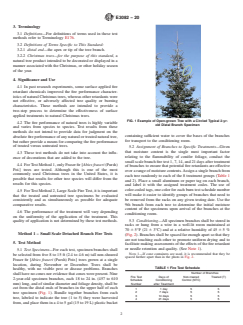
3.2.1 distal end—the apex or tip of the tree branch.
3.2.2 Christmas trees—for the purpose of this standard,a
natural tree product intended to be decorated or displayed in a
manner associated with the Christmas, or other holiday season
of the year.
4. Significance and Use
4.1 In past research experiments, some surface applied fire
retardant chemicals improved the fire performance character-
istics of natural Christmas trees, whereas other retardants were
not effective, or adversely affected tree quality or burning
characteristics. These methods are intended to provide a
two-step process to determine the effectiveness of surface
applied treatments to natural Christmas trees.
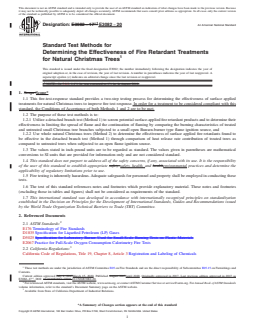
FIG. 1 Example of Open-grown Tree with a Circled Typical 2-yr-
4.2 The fire performance of natural trees is highly variable
old Distal Branch Specimen
and varies from species to species. Test results from these
methods do not intend to provide data for judgment on the
containing sufficient water to cover the bases of the branches
absolute fire performance of any natural or treated natural tree,
for transport to the conditioning room.
but rather provide a means for comparing the fire performance
of treated versus untreated trees.
5.2 Assignment of Branches to Specific Treatments—Given
that moisture content is the single most important factor
4.3 These test methods do not take into account the influ-
relating to the flammability of conifer foliage, conduct the
ence of decorations that are added to the tree.
small scale branch fire test 1, 7, 14, and 21 days after treatment
4.4 ForTest Method 1, only Fraser fir [Abies fraseri (Pursh)
of branches to ensure that potential fire retardants are effective
Poi.] trees are tested. Although this is one of the most
over a range of moisture contents.Assign a single branch from
commonly used Christmas trees in the United States, it is
each tree randomly to each of the 8 treatment groups (Table 1
possible that results for other tree species will differ from the
and 2). Place a small aluminum or paper tag on each branch,
results for this species.
and label it with the assigned treatment codes. The use of
color-coded tags, one color for each burn test schedule number
4.5 ForTest Method 2, Large Scale FireTest, it is important
will make it easier to identify groups of branches that need to
that the treated and untreated tree specimens be evaluated
be removed from the racks on any given testing date. Use the
consistently and as simultaneously as possible for adequate
9th branch from each tree to determine the initial moisture
comparative results.
content of the specimens upon arrival of the branches at the
4.6 The performance of the treatment will vary depending
conditioning room.
on the uniformity of the application of the treatment. This
5.3 Conditioning—All specimen branches shall be stored in
quality of application is not determined by these test methods.
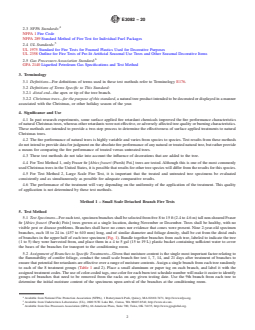
racks or hung from a wire in a well-lit room maintained at
70 6 5°F (21 6 3°C) and at a relative humidity of 45 65%
Method 1 – Small Scale Detached Branch Fire Tests
(Fig. 2). Branches shall be spaced far enough apart so that they
are not touching each other to promote uniform drying and to
5. Test Method
facilitate making assessments of the effects of the fire retardant
or needle retention and quality. (See Note 1).
5.1 Test Specimens—For each test, specimen branches shall
NOTE 1—If cone containers are used, it is recommended that they be
be selected from five 8 to 15 ft (2.4 to 4.6 m) tall non-sheared
spaced further apart than in the photo in Fig. 2.
Fraser fir [Abies fraseri (Pursh) Poir.] trees grown at a single
location, during November or December. Trees shall be
TABLE 1 Fire Test Schedule
healthy, with no visible pest or disease problems. Branches
Number of Branches
shall have no cones nor evidence that cones were present. Nine
Fire Test Days of Non-treated Treated (T)
2-year-old specimen branches, each 18 to 24 in. (457 to 610
Schedule Conditioning Control (NTC)
mm) long, and of similar diameter and foliage density, shall be Number after Treatment
cut from the distal ends of branches in the upper half of each 1 1 day 5 5
2 7 days 5 5
tree specimen (Fig. 1). Bundle together branches from each
3 14 days 5 5
tree, labeled to indicate the tree (1 to 5) they were harvested
4 21 days 5 5
from, and place them ina4to5gal(15to19L) plastic bucket
E3082 − 20
in length by 0.05 in. 6 0.005 in. (1.3 6 0.13 mm) width, for
the burner. The burner shall be in compliance with Specifica-
tion D5025.
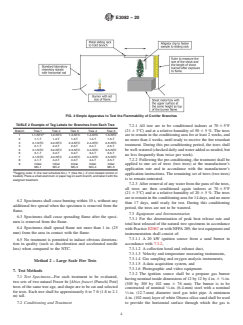
5.7 Test Apparatus—Arrange the gas burner, box, racks,
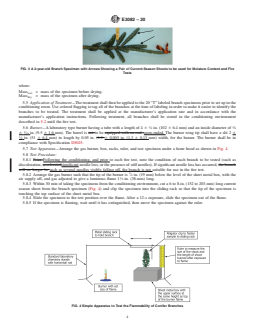
ruler, and test specimen under a fume hood as shown in Fig. 4.
5.8 Test Procedure:
5.8.1 Following the conditioning, and prior to each fire test,
note the condition of each branch to be tested (such as
discoloration, significant needle loss, or the presence of stiff
needles).Ifsignificantneedlelosshasoccurred,suchasseveral
needles visibly falling off, the branch is not suitable for use in
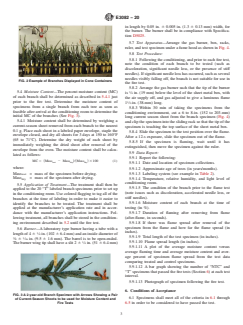
FIG. 2 Example of Branches Displayed in Cone Containers
the fire test.
5.8.2 Arrange the gas burner such that the tip of the burner
5.4 Moisture Content—The percent moisture content (MC) 3
is ⁄4 in. (19 mm) below the level of the sheet metal box, with
of each branch shall be determined as described in 5.4.1 just
the air supply off, and gas adjusted to give a luminous flame
prior to the fire test. Determine the moisture content of 1
1 ⁄2-in. (38-mm) long.
specimens from a single branch from each tree as soon as
5.8.3 Within 30 min of taking the specimens from the
feasible after arrival at the conditioning room to determine the
conditioning environment, cuta6to 8-in. (152 to 203-mm)
initial MC of the branches (See Fig. 3).
long current season shoot from the branch specimen (Fig. 4)
5.4.1 Moisture content shall be determined by weighing a
and clip the specimen into the sliding rack so that the tip of the
current-season shoot removed from each branch to the nearest
specimen is touching the top surface of the sheet metal box.
0.1 g. Place each shoot in a labeled paper envelope, staple the
5.8.4 Slide the specimen to the test position over the flame.
envelope closed, and dry all shoots for 3 days at 150 to 160°F
After a 12-s exposure, slide the specimen out of the flame.
(65 to 71°C). Determine the dry weight of each shoot by
5.8.5 If the specimen is flaming, wait until it has
immediately weighing the dried shoot after removal of the
extinguished, then move the specimen against the ruler.
envelope from the oven. The moisture content shall be calcu-
5.9 Data Report:
lated as follows:
5.9.1 Report the following:
MC 5 ~Mass 2 Mass !⁄~Mass ! 3100 (1)
wet dry dry
5.9.1.1 Date and location of specimen collections.
where:
5.9.1.2 Approximate age of trees (in years/months).
Mass = mass of the specimen before drying. 5.9.1.3 Labeling system (see example in Table 2).
wet
Mass = mass of the specimen after drying.
dry 5.9.1.4 Temperature, relative humidity, and light level of
conditioning room.
5.5 Application of Treatment—The treatment shall then be
5.9.1.5 The condition of the branch prior to the flame test
applied to the 20 “T” labeled branch specimens prior to set up
(note issues such as discoloration, accelerated needle loss, or
in the conditioning room. Use colored flagging to tag all of the
stiff needles).
branches at the time of labeling in order to make it easier to
5.9.1.6 Moisture content of each branch at the time of
identify the branches to be treated. The treatment shall be
testing (in %).
applied at the manufacturer’s application rate and in accor-
5.9.1.7 Duration of flaming after removing from flame
dance with the manufacturer’s application instructions. Fol-
(after-flame, in seconds).
lowing treatment, all branches shall be stored in the condition-
ing environment described in 5.2 until the fire test.
5.9.1.8 If
...
This document is not an ASTM standard and is intended only to provide the user of an ASTM standard an indication of what changes have been made to the previous version. Because
it may not be technically possible to adequately depict all changes accurately, ASTM recommends that users consult prior editions as appropriate. In all cases only the current version
of the standard as published by ASTM is to be considered the official document.
´1
Designation: E3082 − 17 E3082 − 20 An American National Standard
Standard Test Methods for
Determining the Effectiveness of Fire Retardant Treatments
for Natural Christmas Trees
This standard is issued under the fixed designation E3082; the number immediately following the designation indicates the year of
original adoption or, in the case of revision, the year of last revision. A number in parentheses indicates the year of last reapproval. A
superscript epsilon (´) indicates an editorial change since the last revision or reapproval.
1 1
ε NOTE—In 5.8.2, 1-1 ⁄2 in. was corrected to 1 ⁄2 in. in August 2018.
1. Scope Scope*
1.1 This fire-test-response standard provides a two-step testing process for determining the effectiveness of surface applied
treatments for natural Christmas trees to improve fire test response. In order for a treatment to be considered compliant with this
standard, the Conditions of Acceptance of both Methods 1 and 2 are to be met.
1.2 The purpose of these test methods is to:
1.2.1 Utilize a detached branch test (Method 1) to screen potential surface-applied fire retardant products and to determine their
effectiveness in limiting the spread of flame and the continuation of flaming by comparing the burning characteristics of treated
and untreated small Christmas tree branches subjected to a small open Bunsen-burner type flame ignition source, and
1.2.2 Use whole natural Christmas trees (Method 2) to determine the effectiveness of surface applied fire retardants found to
be effective in the detached branch test (Method 1) through comparison of heat release rate contribution of treated trees as
compared to untreated trees when subjected to an open flame ignition source.
1.3 The values stated in inch-pound units are to be regarded as standard. The values given in parentheses are mathematical
conversions to SI units that are provided for information only and are not considered standard.
1.4 This standard does not purport to address all of the safety concerns, if any, associated with its use. It is the responsibility
of the user of this standard to establish appropriate safety safety, health, and healthenvironmental practices and determine the
applicability of regulatory limitations prior to use.
1.5 Fire testing is inherently hazardous. Adequate safeguards for personnel and property shall be employed in conducting these
tests.
1.6 The text of this standard references notes and footnotes which provide explanatory material. These notes and footnotes
(excluding those in tables and figures) shall not be considered as requirements of the standard.
1.7 This international standard was developed in accordance with internationally recognized principles on standardization
established in the Decision on Principles for the Development of International Standards, Guides and Recommendations issued
by the World Trade Organization Technical Barriers to Trade (TBT) Committee.
2. Referenced Documents
2.1 ASTM Standards:
E176 Terminology of Fire Standards
D1835 Specification for Liquefied Petroleum (LP) Gases
D5025 Specification for Laboratory Burner Used for Small-Scale Burning Tests on Plastic Materials
E2067 Practice for Full-Scale Oxygen Consumption Calorimetry Fire Tests
2.2 California Regulations:
California Code of Regulations, Title 19, Chapter 8, Article 3 Registration and Labeling of Chemicals
These test methods are under the jurisdiction of ASTM Committee E05 on Fire Standards and are the direct responsibility of Subcommittee E05.15 on Furnishings and
Contents.
Current edition approved July 1, 2017March 15, 2020. Published August 2017April 2020. Originally approved in 2017. Last previous edition approved in 2017 as
ɛ1
E3082–17 . DOI: 10.1520/E3082-17E01.10.1520/E3082-20.
For referenced ASTM standards, visit the ASTM website, www.astm.org, or contact ASTM Customer Service at service@astm.org. For Annual Book of ASTM Standards
volume information, refer to the standard’s Document Summary page on the ASTM website.
Available from State of California Department of Industrial Relations.
*A Summary of Changes section appears at the end of this standard
Copyright © ASTM International, 100 Barr Harbor Drive, PO Box C700, West Conshohocken, PA 19428-2959. United States
E3082 − 20
2.3 NFPA Standards:
NFPA 1 Fire Code
NFPA 289 Standard Method of Fire Test for Individual Fuel Packages
2.4 UL Standards:
UL 1975 Standard for Fire Tests for Foamed Plastics Used for Decorative Purposes
UL 2358 Outline for Fire Tests of Pre-lit Artificial Seasonal Use Trees and Other Seasonal Decorative Items
2.5 Gas Processors Association Standard:
GPA 2140 Liquefied Petroleum Gas Specifications and Test Method
3. Terminology
3.1 Definitions—For definitions of terms used in these test methods refer to Terminology E176.
3.2 Definitions of Terms Specific to This Standard:
3.2.1 distal end—the apex or tip of the tree branch.
3.2.2 Christmas trees—for the purpose of this standard, a natural tree product intended to be decorated or displayed in a manner
associated with the Christmas, or other holiday season of the year.
4. Significance and Use
4.1 In past research experiments, some surface applied fire retardant chemicals improved the fire performance characteristics
of natural Christmas trees, whereas other retardants were not effective, or adversely affected tree quality or burning characteristics.
These methods are intended to provide a two-step process to determine the effectiveness of surface applied treatments to natural
Christmas trees.
4.2 The fire performance of natural trees is highly variable and varies from species to species. Test results from these methods
do not intend to provide data for judgment on the absolute fire performance of any natural or treated natural tree, but rather provide
a means for comparing the fire performance of treated versus untreated trees.
4.3 These test methods do not take into account the influence of decorations that are added to the tree.
4.4 For Test Method 1, only Fraser fir [Abies fraseri (Pursh) Poi.] trees are tested. Although this is one of the most commonly
used Christmas trees in the United States, it is possible that results for other tree species will differ from the results for this species.
4.5 For Test Method 2, Large Scale Fire Test, it is important that the treated and untreated tree specimens be evaluated
consistently and as simultaneously as possible for adequate comparative results.
4.6 The performance of the treatment will vary depending on the uniformity of the application of the treatment. This quality
of application is not determined by these test methods.
Method 1 – Small Scale Detached Branch Fire Tests
5. Test Method
5.1 Test Specimens—For each test, specimen branches shall be selected from five 8 to 15 ft (2.4 to 4.6 m) tall non-sheared Fraser
fir [Abies fraseri (Pursh) Poir.] trees grown at a single location, during November or December. Trees shall be healthy, with no
visible pest or disease problems. Branches shall have no cones nor evidence that cones were present. Nine 2-year-old specimen
branches, each 18 to 24 in. (457 to 610 mm) long, and of similar diameter and foliage density, shall be cut from the distal ends
of branches in the upper half of each tree specimen (Fig. 1). Bundle together branches from each tree, labeled to indicate the tree
(1 to 5) they were harvested from, and place them in a 4 to 5 gal (15 to 19 L) plastic bucket containing sufficient water to cover
the bases of the branches for transport to the conditioning room.
5.2 Assignment of Branches to Specific Treatments—Given that moisture content is the single most important factor relating to
the flammability of conifer foliage, conduct the small scale branch fire test 1, 7, 14, and 21 days after treatment of branches to
ensure that potential fire retardants are effective over a range of moisture contents. Assign a single branch from each tree randomly
to each of the 8 treatment groups (Table 1 and 2). Place a small aluminum or paper tag on each branch, and label it with the
assigned treatment codes. The use of color-coded tags, one color for each burn test schedule number will make it easier to identify
groups of branches that need to be removed from the racks on any given testing date. Use the 9th branch from each tree to
determine the initial moisture content of the specimens upon arrival of the branches at the conditioning room.
Available from National Fire Protection Association (NFPA), 1 Batterymarch Park, Quincy, MA 02169-7471, http://www.nfpa.org.
Available from Underwriters Laboratories (UL), 2600 N.W. Lake Rd., Camas, WA 98607-8542, http://www.ul.com.
Available from Gas Processors Association (GPA), 66 American Plaza, Suite 700, Tulsa, OK 74135, http://www.gpaglobal.org.
E3082 − 20
FIG. 1 Example of Open-grown Tree with a Circled Typical 2-yr-old Distal Branch Specimen
TABLE 1 Fire Test Schedule
Number of Branches
Fire Test Days of Non-treated Treated (T)
Schedule Conditioning Control (NTC)
Number after Treatment
1 1 day 5 5
2 7 days 5 5
3 14 days 5 5
4 21 days 5 5
5.3 Conditioning—All specimen branches shall be stored in racks or hung from a wire in a lightedwell-lit room maintained at
68 6 5°C (20 6 3°C)70 6 5°F (21 6 3°C) and at a relative humidity of 45 6 5 % (Fig. 2). Branches shall be spaced far enough
apart so that they are not touching each other to promote uniform drying and to facilitate making assessments of the effects of the
fire retardant or needle retention and quality. (See Note 1).
NOTE 1—If cone containers are used, it is recommended that they be spaced further apart than in the photo in Fig. 2.
5.4 Moisture Content—The percent moisture content (MC) of each branch shall be determined as described in 5.4.1 just prior
to the fire test. Determine the moisture content of specimens from a single branch from each tree as soon as feasible after arrival
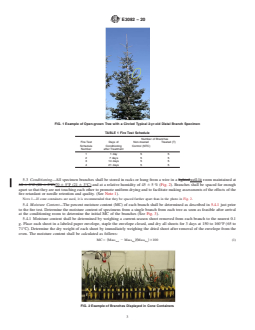
at the conditioning room to determine the initial MC of the branches (See Fig. 3).
5.4.1 Moisture content shall be determined by weighing a current-season shoot removed from each branch to the nearest 0.1
g. Place each shoot in a labeled paper envelope, staple the envelope closed, and dry all shoots for 3 days at 150 to 160°F (65 to
71°C). Determine the dry weight of each shoot by immediately weighing the dried shoot after removal of the envelope from the
oven. The moisture content shall be calculated as follows:
MC 5 ~Mass 2 Mass !⁄~Mass !3100 (1)
wet dry dry
FIG. 2 Example of Branches Displayed in Cone Containers
E3082 − 20
FIG. 3 A 2-year-old Branch Specimen with Arrows Showing a Pair of Current-Season Shoots to be used for Moisture Content and Fire
Tests
where:
Mass = mass of the specimen before drying.
wet
Mass = mass of the specimen after drying.
dry
5.5 Application of Treatment—The treatment shall then be applied to the 20 “T” labeled branch specimens prior to set up in the
conditioning room. Use colored flagging to tag all of the branches at the time of labeling in order to make it easier to identify the
branches to be treated. The treatment shall be applied at the manufacturer’s application rate and in accordance with the
manufacturer’s application instructions. Following treatment, all branches shall be stored in the conditioning environment
described in 5.2 until the fire test.
1 3
5.6 Burner—A laboratory type burner having a tube with a length of 4 6 ⁄4 in. (102 6 6.4 mm) and an inside diameter of ⁄8
6 ⁄16 in. (9.5 6 1.6 mm). The barrel is not to be equipped with an end. open-ended. The burner wing tip shall have a slit 2 6
⁄4 in. (51 6 6.4 mm) in length by 0.05 in. (1.3 6 0.005 in. (1.3 6 0.13 mm) width, for the burner. The burner shall be in
compliance with Specification D5025.
5.7 Test Apparatus—Arrange the gas burner, box, racks, ruler, and test specimen under a fume hood as shown in Fig. 4.
5.8 Test Procedure:
5.8.1 Prior Following the conditioning, and prior to each fire test, note the condition of each branch to be tested (such as
discoloration, acceleratedsignificant needle loss, or the presence of stiff needles). If significant needle loss has occurred, the branch
will no longer be such as several needles visibly falling off, the branch is not suitable for use in the fire test.
5.8.2 Arrange the gas burner such that the tip of the burner is ⁄4 in. (19 mm) below the level of the sheet metal box, with the
air supply off, and gas adjusted to give a luminous flame 1 ⁄2-in. (38-mm) long.
5.8.3 Within 30 min of taking the specimens from the conditioning environment, cut a 6 to 8-in. (152 to 203-mm) long current
season shoot from the branch specimen (Fig. 4) and clip the specimen into the sliding rack so that the tip of the specimen is
touching the top surface of the sheet metal box.
5.8.4 Slide the specimen to the test position over the flame. After a 12-s exposure, slide the specimen out of the flame.
5.8.5 If the specimen is flaming, wait until it has extinguished, then move the specimen against the ruler.
FIG. 4 Simple Apparatus to Test the Flammability of Conifer Branches
...