

ASTM F1700-20
(Specification)Standard Specification for Solid Vinyl Floor Tile
General Information
- Abstract
ABSTRACT
This specification establishes the material and performance characteristics that determine serviceability and recommended applicability of solid vinyl floor tiles intended for use in commercial, light commercial, and residential buildings. Floor tiles shall be classified as Class I for monolithic vinyl tiles, Class II for surface-decorated vinyl tiles, and Class III for printed film vinyl tiles. Furthermore, these classes of tiles shall be subgrouped as Type A for tiles with smooth surfaces, and Type B for those with embossed surfaces. The tiles shall be composed of binder, filler, and pigments compounded with suitable lubricants and processing aids, the composition for all of which shall be dictated by their respective classes. When tested, the tiles shall adhere to the following physical requirements: binder content; dimension including size, thickness, squareness, and dimensional stability; residual indentation; flexibility; resistance to chemicals such as white vinegar, rubbing alcohol, white mineral oil, sodium hydroxide solution, hydrochloric acid solution, sulfuric acid solution, household ammonia solution, household bleach, olive oil, kerozene, unleaded gasoline, and phenol; resistance to heat; and resistance to light.
SCOPE
1.1 This specification covers solid vinyl2 floor tiles that are monolithic, surface decorated or printed, and protected by a clear wear layer.
1.2 This type of floor covering is intended for use in commercial, light commercial, and residential buildings. General information and performance characteristics which determine serviceability and recommended use are included in this specification.
1.3 This standard does not purport to address all of the safety concerns, if any, associated with its use. It is the responsibility of the user of this standard to establish appropriate safety, health, and environmental practices and determine the applicability of regulatory limitations prior to use.
1.4 The values stated in inch-pound units are to be regarded as standard. The values given in parentheses are mathematical conversions to SI units that are provided for information only and are not considered standard.
1.5 This international standard was developed in accordance with internationally recognized principles on standardization established in the Decision on Principles for the Development of International Standards, Guides and Recommendations issued by the World Trade Organization Technical Barriers to Trade (TBT) Committee.
- Status
- Published
- Publication Date
- 31-Dec-2019
- Technical Committee
- F06 - Resilient Floor Coverings
- Drafting Committee
- F06.80 - Specifications

Overview
ASTM F1700-20: Standard Specification for Solid Vinyl Floor Tile establishes comprehensive requirements for the material composition, performance, and classification of solid vinyl floor tiles. This standard is critical for manufacturers, architects, designers, and building owners who seek assurance in the quality and durability of resilient vinyl tile floor coverings used in commercial, light commercial, and residential applications. ASTM F1700-20 sets minimum physical and chemical resistance benchmarks, facilitating consistent product performance and serviceability standards across the vinyl flooring industry.
Key Topics
Classification System:
- Class I: Monolithic vinyl tiles, uniform in composition and color throughout.
- Class II: Surface-decorated vinyl tiles, where decorative layers are applied to the surface.
- Class III: Printed film vinyl tiles, utilizing printed films beneath a clear wear layer.
- Each class is further divided into:
- Type A: Smooth surface tiles
- Type B: Embossed surface tiles
Material Composition:
- Solid vinyl tile construction requires binders (primarily vinyl chloride polymers or copolymers), fillers, pigments, lubricants, and processing aids.
- Specific binder minimum weight percentages and wear layer requirements are defined for durability.
Physical and Performance Requirements:
Vinyl floor tiles are tested and evaluated for:- Binder content
- Dimensional accuracy (size, thickness, squareness, dimensional stability)
- Residual indentation and flexibility
- Resistance to common chemicals and staining agents such as acids, household cleaners, gasoline, and oils
- Resistance to heat and light (color stability over time and exposure)
- Workmanship and appearance quality, ensuring products are free from defects like blemishes, edge breaks, or delamination
Testing and Inspection:
Adherence to standard ASTM and ANSI/ASQC Z1.4–1993 procedures for sampling, physical testing, and inspection ensures consistent quality and performance across all tile shipments.
Applications
Commercial Spaces:
Solid vinyl floor tiles specified under ASTM F1700-20 are ideal for high-traffic areas such as retail stores, healthcare facilities, offices, and educational buildings due to their robust performance under frequent use.Light Commercial and Residential Use:
The standard covers lighter-use applications, including small businesses, multi-unit residential complexes, kitchens, bathrooms, and basements, where ease of maintenance and affordability are priorities.Institutional and Public Areas:
With rigorous requirements for chemical and stain resistance, these vinyl tiles offer reliable flooring solutions for schools, laboratories, and public assembly buildings.Design Flexibility:
A comprehensive classification system and variety of tile types (monolithic, surface-decorated, printed film; smooth and embossed) ensure aesthetic as well as functional versatility for a multitude of interior design concepts.
Related Standards
- ASTM F141: Terminology Relating to Resilient Floor Coverings
- ASTM F386: Test Method for Thickness of Resilient Flooring Materials
- ASTM F410: Test Method for Wear Layer Thickness
- ASTM F925: Test Method for Resistance to Chemicals of Resilient Flooring
- ASTM F137, F1514, F1515, F1914, F2055, F2199: Additional test methods for flexibility, heat and light stability, indentation, size, squareness, and dimensional stability
- ISO 10582: Specification for heterogeneous poly(vinyl chloride) floor coverings
- ANSI/ASQC Z1.4–1993: Sampling procedures for inspection
Practical Value
ASTM F1700-20 is instrumental for suppliers and users seeking robust, consistent, and verified resilient flooring solutions. By adhering to this standard, specifiers and procurement professionals can ensure solid vinyl floor tiles meet essential service, safety, and durability requirements, support regulatory compliance, and deliver long-term value across diverse flooring applications.
Keywords: ASTM F1700, vinyl floor tile, resilient flooring, commercial flooring, chemical resistant flooring, vinyl tile standard, floor tile specification
Relations
- Effective Date
- 01-Jan-2020
- Effective Date
- 01-Dec-2023
- Effective Date
- 01-Aug-2023
- Effective Date
- 01-Jul-2020
- Effective Date
- 01-Jun-2020
- Effective Date
- 15-Jan-2020
- Effective Date
- 01-Nov-2019
- Effective Date
- 01-Oct-2018
- Effective Date
- 15-Jul-2018
- Effective Date
- 01-Jun-2018
- Effective Date
- 01-Dec-2017
- Effective Date
- 01-May-2014
- Effective Date
- 01-Dec-2013
- Effective Date
- 01-Dec-2013
- Effective Date
- 01-May-2013
Get Certified
Connect with accredited certification bodies for this standard

DIN CERTCO
DIN Group product certification.
DIBt (Deutsches Institut für Bautechnik)
German Institute for Building Technology.

Aboma Certification B.V.
Specialized in construction, metal, and transport sectors.
Sponsored listings
Frequently Asked Questions
ASTM F1700-20 is a technical specification published by ASTM International. Its full title is "Standard Specification for Solid Vinyl Floor Tile". This standard covers: ABSTRACT This specification establishes the material and performance characteristics that determine serviceability and recommended applicability of solid vinyl floor tiles intended for use in commercial, light commercial, and residential buildings. Floor tiles shall be classified as Class I for monolithic vinyl tiles, Class II for surface-decorated vinyl tiles, and Class III for printed film vinyl tiles. Furthermore, these classes of tiles shall be subgrouped as Type A for tiles with smooth surfaces, and Type B for those with embossed surfaces. The tiles shall be composed of binder, filler, and pigments compounded with suitable lubricants and processing aids, the composition for all of which shall be dictated by their respective classes. When tested, the tiles shall adhere to the following physical requirements: binder content; dimension including size, thickness, squareness, and dimensional stability; residual indentation; flexibility; resistance to chemicals such as white vinegar, rubbing alcohol, white mineral oil, sodium hydroxide solution, hydrochloric acid solution, sulfuric acid solution, household ammonia solution, household bleach, olive oil, kerozene, unleaded gasoline, and phenol; resistance to heat; and resistance to light. SCOPE 1.1 This specification covers solid vinyl2 floor tiles that are monolithic, surface decorated or printed, and protected by a clear wear layer. 1.2 This type of floor covering is intended for use in commercial, light commercial, and residential buildings. General information and performance characteristics which determine serviceability and recommended use are included in this specification. 1.3 This standard does not purport to address all of the safety concerns, if any, associated with its use. It is the responsibility of the user of this standard to establish appropriate safety, health, and environmental practices and determine the applicability of regulatory limitations prior to use. 1.4 The values stated in inch-pound units are to be regarded as standard. The values given in parentheses are mathematical conversions to SI units that are provided for information only and are not considered standard. 1.5 This international standard was developed in accordance with internationally recognized principles on standardization established in the Decision on Principles for the Development of International Standards, Guides and Recommendations issued by the World Trade Organization Technical Barriers to Trade (TBT) Committee.
ABSTRACT This specification establishes the material and performance characteristics that determine serviceability and recommended applicability of solid vinyl floor tiles intended for use in commercial, light commercial, and residential buildings. Floor tiles shall be classified as Class I for monolithic vinyl tiles, Class II for surface-decorated vinyl tiles, and Class III for printed film vinyl tiles. Furthermore, these classes of tiles shall be subgrouped as Type A for tiles with smooth surfaces, and Type B for those with embossed surfaces. The tiles shall be composed of binder, filler, and pigments compounded with suitable lubricants and processing aids, the composition for all of which shall be dictated by their respective classes. When tested, the tiles shall adhere to the following physical requirements: binder content; dimension including size, thickness, squareness, and dimensional stability; residual indentation; flexibility; resistance to chemicals such as white vinegar, rubbing alcohol, white mineral oil, sodium hydroxide solution, hydrochloric acid solution, sulfuric acid solution, household ammonia solution, household bleach, olive oil, kerozene, unleaded gasoline, and phenol; resistance to heat; and resistance to light. SCOPE 1.1 This specification covers solid vinyl2 floor tiles that are monolithic, surface decorated or printed, and protected by a clear wear layer. 1.2 This type of floor covering is intended for use in commercial, light commercial, and residential buildings. General information and performance characteristics which determine serviceability and recommended use are included in this specification. 1.3 This standard does not purport to address all of the safety concerns, if any, associated with its use. It is the responsibility of the user of this standard to establish appropriate safety, health, and environmental practices and determine the applicability of regulatory limitations prior to use. 1.4 The values stated in inch-pound units are to be regarded as standard. The values given in parentheses are mathematical conversions to SI units that are provided for information only and are not considered standard. 1.5 This international standard was developed in accordance with internationally recognized principles on standardization established in the Decision on Principles for the Development of International Standards, Guides and Recommendations issued by the World Trade Organization Technical Barriers to Trade (TBT) Committee.
ASTM F1700-20 is classified under the following ICS (International Classification for Standards) categories: 83.080.20 - Thermoplastic materials; 91.060.30 - Ceilings. Floors. Stairs. The ICS classification helps identify the subject area and facilitates finding related standards.
ASTM F1700-20 has the following relationships with other standards: It is inter standard links to ASTM F1700-18a, ASTM F1914-18(2023), ASTM F141-23, ASTM F925-13(2020), ASTM F2199-20, ASTM F141-12(2020), ASTM F1514-19, ASTM F137-08(2018), ASTM F2199-18, ASTM F1914-18, ASTM F1914-17, ASTM F2199-09(2014), ASTM F137-08(2013), ASTM F410-08(2013), ASTM F925-13. Understanding these relationships helps ensure you are using the most current and applicable version of the standard.
ASTM F1700-20 is available in PDF format for immediate download after purchase. The document can be added to your cart and obtained through the secure checkout process. Digital delivery ensures instant access to the complete standard document.
Standards Content (Sample)
This international standard was developed in accordance with internationally recognized principles on standardization established in the Decision on Principles for the
Development of International Standards, Guides and Recommendations issued by the World Trade Organization Technical Barriers to Trade (TBT) Committee.
Designation:F1700 −20
Standard Specification for
Solid Vinyl Floor Tile
This standard is issued under the fixed designation F1700; the number immediately following the designation indicates the year of
original adoption or, in the case of revision, the year of last revision. A number in parentheses indicates the year of last reapproval. A
superscript epsilon (´) indicates an editorial change since the last revision or reapproval.
This standard has been approved for use by agencies of the U.S. Department of Defense.
1. Scope F386 Test Method for Thickness of Resilient Flooring Ma-
terials Having Flat Surfaces
1.1 This specification covers solid vinyl floor tiles that are
F410 Test Method for Wear Layer Thickness of Resilient
monolithic, surface decorated or printed, and protected by a
Floor Coverings by Optical Measurement
clear wear layer.
F925 Test Method for Resistance to Chemicals of Resilient
1.2 This type of floor covering is intended for use in
Flooring
commercial, light commercial, and residential buildings. Gen-
F1514 TestMethodforMeasuringHeatStabilityofResilient
eral information and performance characteristics which deter-
Flooring by Color Change
mine serviceability and recommended use are included in this
F1515 Test Method for Measuring Light Stability of Resil-
specification.
ient Flooring by Color Change
1.3 This standard does not purport to address all of the
F1914 Test Methods for Short-Term Indentation and Re-
safety concerns, if any, associated with its use. It is the
sidual Indentation of Resilient Floor Covering
responsibility of the user of this standard to establish appro-
F2055 Test Method for Size and Squareness of Resilient
priate safety, health, and environmental practices and deter-
Floor Tile by Dial Gage Method
mine the applicability of regulatory limitations prior to use.
F2199 Test Method for Determining Dimensional Stability
1.4 The values stated in inch-pound units are to be regarded
and Curling Properties of Resilient Flooring after Expo-
as standard. The values given in parentheses are mathematical
sure to Heat
conversions to SI units that are provided for information only
2.2 Other Standards:
and are not considered standard.
ANSI/ASQC Z1.4–1993 Sampling Procedures and Tables
1.5 This international standard was developed in accor-
for Inspection by Attributes
dance with internationally recognized principles on standard-
ization established in the Decision on Principles for the
3. Classification
Development of International Standards, Guides and Recom-
mendations issued by the World Trade Organization Technical
3.1 The vinyl floor tiles covered by this specification shall
Barriers to Trade (TBT) Committee.
be classified as follows:
3.1.1 Class I—Monolithic Vinyl Tile.
2. Referenced Documents
3.1.1.1 Type A—Smooth Surface.
2.1 ASTM Standards:
3.1.1.2 Type B—Embossed Surface.
F137 Test Method for Flexibility of Resilient Flooring Ma-
terials with Cylindrical Mandrel Apparatus
3.1.2 Class II—Surface-Decorated Vinyl Tile.
F141 Terminology Relating to Resilient Floor Coverings
3.1.2.1 Type A—Smooth Surface.
F373 Test Method for Embossed Depth of Resilient Floor
3.1.2.2 Type B—Embossed Surface.
Coverings
3.1.3 Class III—Printed Film Vinyl Tile.
3.1.3.1 Type A—Smooth Surface.
This specification is under the jurisdiction of ASTM Committee F06 on
Resilient Floor Coverings and is the direct responsibility of Subcommittee F06.80
3.1.3.2 Type B—Embossed Surface.
on Specifications.
Current edition approved Jan. 1, 2020. Published January 2020. Originally
3.2 The embossed surfaces may or may not be grouted with
approved in 1996. Last previous edition approved in 2018 as F1700 – 18a. DOI:
ink.
10.1520/F1700-20.
For solid vinyl definition, refer to Terminology F141.
For referenced ASTM standards, visit the ASTM website, www.astm.org, or
contact ASTM Customer Service at service@astm.org. For Annual Book of ASTM
Standards volume information, refer to the standard’s Document Summary page on Available from American National Standards Institute, 11 West 42nd St., New
the ASTM website. York, NY 10036.
Copyright © ASTM International, 100 Barr Harbor Drive, PO Box C700, West Conshohocken, PA 19428-2959. United States
F1700−20
4. Ordering Information 5.4 Surface Decorated—In surface-decorated tiles, the pat-
tern and color need not extend through the entire thickness of
4.1 The purchaser shall state whether this specification is to
the tile. The composition of each layer shall be according to
be used, select the preferred options permitted herein, and
Table 1.
include the following contract requirements on the purchase
5.4.1 The appearance of the surface decorated tile, when the
order:
wearing layer is removed by any suitable means, to a depth of
4.1.1 Title, number, and date of this specification,
0.010 in. (0.25 mm) shall compare favorably for decoration
4.1.2 Class, type, and pattern number (Section 3),
with the tile’s original appearance.
4.1.3 Quantity in square feet, pieces, or cartons,
4.1.4 Size required (Section 6), 5.5 Printed Film Vinyl Tile—The structure of printed solid
4.1.5 Thickness required (Section 6), vinyl tiles is formed of vinyl wear layer which may be
4.1.6 Lot formation if other than as specified in ANSI/ transparentortranslucent.Thepatternandcolorsarecreatedby
ASQC Z1.4–1993 (see Sections 8 and 10), a print between the wear layer and the intermediate colored
4.1.7 Sampling if other than as specified in ANSI/ASQC layer or base layer. Other base layers may be added. Products
Z1.4–1993 (see Sections 8 and 10), will comply with Table 1 for binder content.
4.1.8 Packingrequirementifotherthanasspecified(Section 5.5.1 For commercial applications, the wear layer shall be a
12), minimum of 0.020 in. (0.50 mm) thick.
4.1.9 Palletization if required (agreement between the 5.5.2 The wear layer may have a clear specialty perfor-
manufacturer and the purchaser), mance top layer(s) with an average minimum total thickness of
4.1.10 Marking required if other than specified (Section 13) 0.0004 in. The specialty performance top layer(s) may consist
(agreement between the manufacturer and the purchaser), of a single or multiple layers, which do not delaminate under
4.1.11 Chemical resistance (see 6.8). The basic chemicals normal use. Top layer thinner than 0.0004 in. may be used but
used in the test are those likely to be found in domestic, cannot be counted as part of the clear specialty performance
commercial and institutional use. Many proprietary com- top layer.
pounds contain one or more of these basic chemicals. Should
6. Physical Requirements
the flooring for unusual application need to be resistant to a
specific chemical, this additional requirement should become
6.1 BinderContent—Thebindercontentshallbedetermined
part of the procurement document.
by statement of formula (Manufacturer Certificate of Compli-
4.1.12 Other requirements (agreement between the manu-
ance).
facturer and the purchaser).
6.2 Size —Unless otherwise specified (see 4.1.4), the tile
shall be 12 by 12 in. (305 by 305 mm).Atolerance of 60.016
5. Material and Manufacture
in. (0.4 mm) per linear ft (305 mm) shall be permitted when
5.1 Material—The tile shall be composed of binder, filler,
measured in accordance with Test Method F2055. Certain
and pigments compounded with suitable lubricants and pro-
specialty items are available in other sizes.
cessing aids. The binder consists of one or more polymers or
6.3 Thickness:
copolymers of vinyl chloride, other modifying resins,
6.3.1 Product—Unless otherwise specified (see 4.1.5), the
plasticizers, and stabilizers which comprise at least the follow-
tile shall be furnished in 0.0625-in. (1.6-mm), 0.080-in. (2-
ing minimum percent weight: see Table 1. The polymers or
mm), 0.100-in. (2.5-mm), and 0.125-in. (3-mm) thicknesses.A
copolymers of vinyl chloride comprise at least 60 % of the
tolerance of 60.005 in. (0.13 mm) shall be permitted when
weight of the binder. Any copolymer of vinyl chloride used
tested in accordance with Test Method F386.
shall contain at least 85 % vinyl chloride.
6.3.2 Wear Layer—For Class III products, the thickness
5.2 Class, Type, and Pattern Number—The class, type, and
shall be measured in five (5) unembossed locations to deter-
pattern number, as applicable shall be as specified in the
mine thickness average. See Test Method F410.
contract or order (see 4.1).
6.4 Squareness —When tested in accordance with Test
NOTE 1—The patterns that are available are indicated in individual
Method F2055, the out-of-squareness of the tile shall not
manufacturer’s current catalogs.
exceed 0.010 in. (0.25 mm).
5.3 Monolithic Vinyl Tile—The tile shall be uniform, with
6.5 Residual Indentation—When tested in accordance with
respecttocolor,patterneffect,andcomposition,throughoutthe
Test Method F1914 the average residual indentation at the end
thickness of the tile.
of 60-min recovery shall not exceed 8 %, and the maximum
residual indentation of any single specimen shall not exceed
10 %. If the residual indentation values at 1 h exceed the listed
TABLE 1 Minimum Binder Content
requirements, the specimens shall be remeasured after an
Class I Class II Class III
additional 23 h of recovery (24 h total) for compliance
Each ply or layer 34 % 34 % . . .
determination.
Clear we
...
This document is not an ASTM standard and is intended only to provide the user of an ASTM standard an indication of what changes have been made to the previous version. Because
it may not be technically possible to adequately depict all changes accurately, ASTM recommends that users consult prior editions as appropriate. In all cases only the current version
of the standard as published by ASTM is to be considered the official document.
Designation: F1700 − 18a F1700 − 20
Standard Specification for
Solid Vinyl Floor Tile
This standard is issued under the fixed designation F1700; the number immediately following the designation indicates the year of
original adoption or, in the case of revision, the year of last revision. A number in parentheses indicates the year of last reapproval. A
superscript epsilon (´) indicates an editorial change since the last revision or reapproval.
This standard has been approved for use by agencies of the U.S. Department of Defense.
1. Scope
1.1 This specification covers solid vinyl floor tiles that are monolithic, surface decorated or printed, and protected by a clear
wear layer.
1.2 This type of floor covering is intended for use in commercial, light commercial, and residential buildings. General
information and performance characteristics which determine serviceability and recommended use are included in this
specification.
1.3 This standard does not purport to address all of the safety concerns, if any, associated with its use. It is the responsibility
of the user of this standard to establish appropriate safety, health, and environmental practices and determine the applicability of
regulatory limitations prior to use.
1.4 The values stated in inch-pound units are to be regarded as standard. The values given in parentheses are mathematical
conversions to SI units that are provided for information only and are not considered standard.
1.5 This international standard was developed in accordance with internationally recognized principles on standardization
established in the Decision on Principles for the Development of International Standards, Guides and Recommendations issued
by the World Trade Organization Technical Barriers to Trade (TBT) Committee.
2. Referenced Documents
2.1 ASTM Standards:
F137 Test Method for Flexibility of Resilient Flooring Materials with Cylindrical Mandrel Apparatus
F141 Terminology Relating to Resilient Floor Coverings
F373 Test Method for Embossed Depth of Resilient Floor Coverings
F386 Test Method for Thickness of Resilient Flooring Materials Having Flat Surfaces
F410 Test Method for Wear Layer Thickness of Resilient Floor Coverings by Optical Measurement
F925 Test Method for Resistance to Chemicals of Resilient Flooring
F1514 Test Method for Measuring Heat Stability of Resilient Flooring by Color Change
F1515 Test Method for Measuring Light Stability of Resilient Flooring by Color Change
F1914 Test Methods for Short-Term Indentation and Residual Indentation of Resilient Floor Covering
F2055 Test Method for Size and Squareness of Resilient Floor Tile by Dial Gage Method
F2199 Test Method for Determining Dimensional Stability and Curling Properties of Resilient Flooring after Exposure to Heat
2.2 Other Standards:
ANSI/ASQC Z1.4–1993 Sampling Procedures and Tables for Inspection by Attributes
3. Classification
3.1 The vinyl floor tiles covered by this specification shall be classified as follows:
3.1.1 Class I—Monolithic Vinyl Tile.
This specification is under the jurisdiction of ASTM Committee F06 on Resilient Floor Coverings and is the direct responsibility of Subcommittee F06.80 on
Specifications.
Current edition approved March 1, 2018Jan. 1, 2020. Published April 2018January 2020. Originally approved in 1996. Last previous edition approved in 2018 as
F1700 – 18.F1700 – 18a. DOI: 10.1520/F1700-18A.10.1520/F1700-20.
For solid vinyl definition, refer to Terminology F141.
For referenced ASTM standards, visit the ASTM website, www.astm.org, or contact ASTM Customer Service at service@astm.org. For Annual Book of ASTM Standards
volume information, refer to the standard’s Document Summary page on the ASTM website.
Available from American National Standards Institute, 11 West 42nd St., New York, NY 10036.
Copyright © ASTM International, 100 Barr Harbor Drive, PO Box C700, West Conshohocken, PA 19428-2959. United States
F1700 − 20
3.1.1.1 Type A—Smooth Surface.
3.1.1.2 Type B—Embossed Surface.
3.1.2 Class II—Surface-Decorated Vinyl Tile.
3.1.2.1 Type A—Smooth Surface.
3.1.2.2 Type B—Embossed Surface.
3.1.3 Class III—Printed Film Vinyl Tile.
3.1.3.1 Type A—Smooth Surface.
3.1.3.2 Type B—Embossed Surface.
3.2 The embossed surfaces may or may not be grouted with ink.
4. Ordering Information
4.1 The purchaser shall state whether this specification is to be used, select the preferred options permitted herein, and include
the following contract requirements on the purchase order:
4.1.1 Title, number, and date of this specification,
4.1.2 Class, type, and pattern number (Section 3),
4.1.3 Quantity in square feet, pieces, or cartons,
4.1.4 Size required (Section 6),
4.1.5 Thickness required (Section 6),
4.1.6 Lot formation if other than as specified in ANSI/ASQC Z1.4–1993 (see Sections 8 and 10),
4.1.7 Sampling if other than as specified in ANSI/ASQC Z1.4–1993 (see Sections 8 and 10),
4.1.8 Packing requirement if other than as specified (Section 12),
4.1.9 Palletization if required (agreement between the manufacturer and the purchaser),
4.1.10 Marking required if other than specified (Section 13) (agreement between the manufacturer and the purchaser),
4.1.11 Chemical resistance (see 6.8). The basic chemicals used in the test are those likely to be found in domestic, commercial
and institutional use. Many proprietary compounds contain one or more of these basic chemicals. Should the flooring for unusual
application need to be resistant to a specific chemical, this additional requirement should become part of the procurement
document.
4.1.12 Other requirements (agreement between the manufacturer and the purchaser).
5. Material and Manufacture
5.1 Material—The tile shall be composed of binder, filler, and pigments compounded with suitable lubricants and processing
aids. The binder consists of one or more polymers or copolymers of vinyl chloride, other modifying resins, plasticizers, and
stabilizers which comprise at least the following minimum percent weight: see Table 1. The polymers or copolymers of vinyl
chloride comprise at least 60 % of the weight of the binder. Any copolymer of vinyl chloride used shall contain at least 85 % vinyl
chloride.
5.2 Class, Type, and Pattern Number—The class, type, and pattern number, as applicable shall be as specified in the contract
or order (see 4.1).
NOTE 1—The patterns that are available are indicated in individual manufacturer’s current catalogs.
5.3 Monolithic Vinyl Tile—The tile shall be uniform, with respect to color, pattern effect, and composition, throughout the
thickness of the tile.
5.4 Surface Decorated—In surface-decorated tiles, the pattern and color need not extend through the entire thickness of the tile.
The composition of each layer shall be according to Table 1.
5.4.1 The appearance of the surface decorated tile, when the wearing layer is removed by any suitable means, to a depth of 0.010
in. (0.25 mm) shall compare favorably for decoration with the tile’s original appearance.
5.5 Printed Film Vinyl Tile—The structure of printed solid vinyl tiles is formed of vinyl wear layer which may be transparent
or translucent. The pattern and colors are created by a print between the wear layer and the intermediate colored layer or base layer.
Other base layers may be added. Products will comply with Table 1 for binder content.
5.5.1 For commercial applications, the wear layer shall be a minimum of 0.020 in. (0.50 mm) thick.
TABLE 1 Minimum Binder Content
Class I Class II Class III
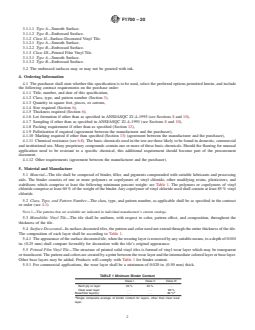
Each ply or layer 34 % 34 % . . .
Clear wear layer . . . . . . 90 %
A
Base/Inter layer(s) . . . . . . 30 %
A
Single composite average of binder content for layers, other than clear wear
layer.
F1700 − 20
5.5.2 The wear layer may have a clear specialty performance top layer(s) with an average minimum total thickness of 0.0004
in. The specialty performance top layer(s) may consist of a single or multiple layers, which do not delaminate under normal use.
Top layer thinner than 0.0004 in. may be used but cannot be counted as part of the clear specialty performance top layer.
6. Physical Requirements
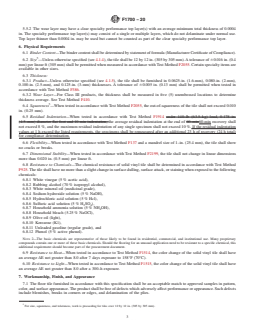
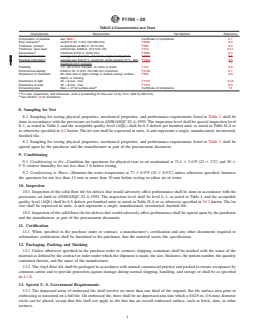
6.1 Binder Content—The binder content shall be determined by statement of formula (Manufacturer Certificate of Compliance).
6.2 Size —Unless otherwise specified (see 4.1.4), the tile shall be 12 by 12 in. (305 by 305 mm). A tolerance of 60.016 in. (0.4
mm) per linear ft (305 mm) shall be permitted when measured in accordance with Test Method F2055. Certain specialty items are
available in other sizes.
6.3 Thickness:
6.3.1 Product—Unless otherwise specified (see 4.1.5), the tile shall be furnished in 0.0625-in. (1.6-mm), 0.080-in. (2-mm),
0.100-in. (2.5-mm), and 0.125-in. (3-mm) thicknesses. A tolerance of 60.005 in. (0.13 mm) shall be permitted when tested in
accordance with Test Method F386.
6.3.2 Wear Layer—For Class III products, the thickness shall be measured in five (5) unembossed locations to determine
thickness average. See Test Method F410.
6.4 Squareness —When tested in accordance with Test Method F2055, the out-of-squareness of the tile shall not exceed 0.010
in. (0.25 mm).
6.5 Residual Indentation—When tested in accordance with Test Method F1914 under 140–lb (63.5–kg) load, 0.178–in.
(4.5–mm) diameter flat foot and 10 min indentation, the average residual indentation at the end of 60–min60-min recovery shall
not exceed 8 %, and the maximum residual inde
...