

ASTM E3299/E3299M-22
(Test Method)Standard Test Methods for Compression Resistance of Helmets
General Information
- Abstract
SIGNIFICANCE AND USE
4.1 The purpose of this standard is to provide reliable and repeatable compression test methods for the evaluation of helmets used in law enforcement, corrections, and military applications.
4.2 It is anticipated that this standard will be referenced by certifiers, purchasers, or other users in order to meet their specific needs. Those users will specify which test methods apply and will specify any performance categories or levels.
SCOPE
1.1 This standard provides test methods for assessing compression resistance of helmets worn by military, law enforcement, and corrections personnel. These test methods are applicable for many styles of helmet (that is, high-cut, mid-cut, full-cut).
1.2 Three compression test methods are included: (1) top-to-bottom, (2) side-to-side, and (3) front-to-back.
1.3 It is anticipated that this standard will be referenced by suppliers, certifiers, purchasers, or other users to meet their specific needs. Those users will specify, in other standards and specifications, which test methods and conditioning procedures are applicable and will specify any performance categories or levels.
1.4 Units—The values stated in either SI units or inch-pound units are to be regarded separately as standard. The values stated in each system are not necessarily exact equivalents; therefore, to ensure conformance with the standard, each system shall be used independently of the other, and values from the two systems shall not be combined.
1.5 This standard does not purport to address all of the safety concerns, if any, associated with its use. It is the responsibility of the user of this standard to establish appropriate safety, health, and environmental practices and determine the applicability of regulatory limitations prior to use.
1.6 This international standard was developed in accordance with internationally recognized principles on standardization established in the Decision on Principles for the Development of International Standards, Guides and Recommendations issued by the World Trade Organization Technical Barriers to Trade (TBT) Committee.
- Status
- Published
- Publication Date
- 28-Feb-2022
- Technical Committee
- E54 - Homeland Security Applications
- Drafting Committee
- E54.04 - Public Safety Equipment
Overview
ASTM E3299/E3299M-22: Standard Test Methods for Compression Resistance of Helmets establishes procedures for reliably evaluating the compression resistance of helmets intended for use by law enforcement, corrections, and military personnel. These test methods are vital for assessing the structural integrity and protective performance of various helmet styles, including high-cut, mid-cut, and full-cut models. The standard is referenced by suppliers, certifiers, purchasers, and users to ensure compliance with safety and performance requirements for head protection equipment.
Key Topics
Compression Resistance: The standard outlines three primary compression test methods to assess helmet durability:
- Top-to-bottom compression
- Side-to-side compression
- Front-to-back compression
Applicable Helmet Styles: The methods are applicable to a wide range of helmet types used in military and law enforcement, supporting various operational needs.
Testing Procedures: The procedures specify marking helmet planes, test item preparation, equipment setup, application of force, and post-test inspection for damage such as delamination, ply separation, or distortion.
Test Conditions: All testing is conducted under controlled ambient conditions to ensure repeatable and reliable results.
Units of Measurement: The standard allows the use of either SI units or inch-pound units, but requires consistency within each test to prevent errors.
Reporting Requirements: Detailed documentation and reporting of test conditions, item description, deflection measurements, and inspection results are mandatory, aligning with recognized laboratory quality standards.
Applications
Helmet Certification: ASTM E3299/E3299M-22 is used by certification bodies to verify helmets meet established performance benchmarks for compression resistance.
Procurement and Specification: Organizations procuring helmets for military, police, or corrections use this standard to define product requirements and evaluate compliance during vendor selection.
Quality Assurance: Manufacturers and testing laboratories employ these test methods as part of ongoing quality control, ensuring that helmets consistently meet safety and durability expectations.
Performance Evaluation: The procedures enable comparative analysis of helmet designs, materials, and assemblies under standardized conditions, supporting product development and innovation in head protection.
Practical Value
Enhanced Safety: By standardizing compression resistance evaluation, ASTME3299/E3299M-22 supports the selection and deployment of helmets that offer reliable head protection in high-risk environments.
Repeatability and Reliability: The methods ensure that testing across different laboratories and helmet models yields consistent and objective results.
Customizable Implementation: Purchasers and certifiers can specify which methods and performance levels are applicable for their particular use case, allowing flexibility within a unified framework.
Related Standards
- ASTM F1446: Test Methods for Equipment and Procedures Used in Evaluating Performance Characteristics of Protective Headgear
- ASTM D2240: Test Method for Rubber Property-Durometer Hardness
- ASTM D3575: Test Methods for Flexible Cellular Materials Made from Olefin Polymers
- ASTM D4819: Specification for Flexible Cellular Materials Made From Polyolefin Plastics
- ISO/IEC 17025: General Requirements for the Competence of Testing and Calibration Laboratories
- FMVSS No. 218: Laboratory Test Procedure for Motorcycle Helmets (U.S. DOT)
Keywords: compression resistance, helmet testing, law enforcement helmet, military helmet, head protection standard, ASTM helmet standard, helmet quality assurance, protective equipment testing
For further details and the most current requirements, always consult the official ASTM E3299/E3299M-22 publication.
Relations
- Effective Date
- 01-Apr-2024
- Effective Date
- 01-Feb-2020
- Refers
ASTM D3575-20 - Standard Test Methods for Flexible Cellular Materials Made from Olefin Polymers - Effective Date
- 01-Feb-2020
- Effective Date
- 01-Oct-2018
- Effective Date
- 01-Nov-2015
- Refers
ASTM D3575-14 - Standard Test Methods for Flexible Cellular Materials Made From Olefin Polymers - Effective Date
- 01-Jan-2014
- Refers
ASTM D3575-08 - Standard Test Methods for Flexible Cellular Materials Made From Olefin Polymers - Effective Date
- 01-Feb-2008
- Effective Date
- 01-Mar-2005
- Refers
ASTM D3575-00 - Standard Test Methods for Flexible Cellular Materials Made From Olefin Polymers - Effective Date
- 10-Aug-2000
- Refers
ASTM D3575-00e1 - Standard Test Methods for Flexible Cellular Materials Made From Olefin Polymers - Effective Date
- 10-Aug-2000
- Refers
ASTM D4819-96 - Standard Specification for Flexible Cellular Materials Made From Polyolefin Plastics - Effective Date
- 10-Mar-1996
Get Certified
Connect with accredited certification bodies for this standard

CIS Institut d.o.o.
Personal Protective Equipment (PPE) certification body. Notified Body NB-2890 for EU Regulation 2016/425 PPE.

Kiwa BDA Testing
Building and construction product certification.
Kmetijski inštitut Slovenije
Agricultural Institute of Slovenia. Soil testing, plant health, agricultural product analysis.
Sponsored listings
Frequently Asked Questions
ASTM E3299/E3299M-22 is a standard published by ASTM International. Its full title is "Standard Test Methods for Compression Resistance of Helmets". This standard covers: SIGNIFICANCE AND USE 4.1 The purpose of this standard is to provide reliable and repeatable compression test methods for the evaluation of helmets used in law enforcement, corrections, and military applications. 4.2 It is anticipated that this standard will be referenced by certifiers, purchasers, or other users in order to meet their specific needs. Those users will specify which test methods apply and will specify any performance categories or levels. SCOPE 1.1 This standard provides test methods for assessing compression resistance of helmets worn by military, law enforcement, and corrections personnel. These test methods are applicable for many styles of helmet (that is, high-cut, mid-cut, full-cut). 1.2 Three compression test methods are included: (1) top-to-bottom, (2) side-to-side, and (3) front-to-back. 1.3 It is anticipated that this standard will be referenced by suppliers, certifiers, purchasers, or other users to meet their specific needs. Those users will specify, in other standards and specifications, which test methods and conditioning procedures are applicable and will specify any performance categories or levels. 1.4 Units—The values stated in either SI units or inch-pound units are to be regarded separately as standard. The values stated in each system are not necessarily exact equivalents; therefore, to ensure conformance with the standard, each system shall be used independently of the other, and values from the two systems shall not be combined. 1.5 This standard does not purport to address all of the safety concerns, if any, associated with its use. It is the responsibility of the user of this standard to establish appropriate safety, health, and environmental practices and determine the applicability of regulatory limitations prior to use. 1.6 This international standard was developed in accordance with internationally recognized principles on standardization established in the Decision on Principles for the Development of International Standards, Guides and Recommendations issued by the World Trade Organization Technical Barriers to Trade (TBT) Committee.
SIGNIFICANCE AND USE 4.1 The purpose of this standard is to provide reliable and repeatable compression test methods for the evaluation of helmets used in law enforcement, corrections, and military applications. 4.2 It is anticipated that this standard will be referenced by certifiers, purchasers, or other users in order to meet their specific needs. Those users will specify which test methods apply and will specify any performance categories or levels. SCOPE 1.1 This standard provides test methods for assessing compression resistance of helmets worn by military, law enforcement, and corrections personnel. These test methods are applicable for many styles of helmet (that is, high-cut, mid-cut, full-cut). 1.2 Three compression test methods are included: (1) top-to-bottom, (2) side-to-side, and (3) front-to-back. 1.3 It is anticipated that this standard will be referenced by suppliers, certifiers, purchasers, or other users to meet their specific needs. Those users will specify, in other standards and specifications, which test methods and conditioning procedures are applicable and will specify any performance categories or levels. 1.4 Units—The values stated in either SI units or inch-pound units are to be regarded separately as standard. The values stated in each system are not necessarily exact equivalents; therefore, to ensure conformance with the standard, each system shall be used independently of the other, and values from the two systems shall not be combined. 1.5 This standard does not purport to address all of the safety concerns, if any, associated with its use. It is the responsibility of the user of this standard to establish appropriate safety, health, and environmental practices and determine the applicability of regulatory limitations prior to use. 1.6 This international standard was developed in accordance with internationally recognized principles on standardization established in the Decision on Principles for the Development of International Standards, Guides and Recommendations issued by the World Trade Organization Technical Barriers to Trade (TBT) Committee.
ASTM E3299/E3299M-22 is classified under the following ICS (International Classification for Standards) categories: 13.340.20 - Head protective equipment. The ICS classification helps identify the subject area and facilitates finding related standards.
ASTM E3299/E3299M-22 has the following relationships with other standards: It is inter standard links to ASTM E3005-24, ASTM E3005-20, ASTM D3575-20, ASTM E3005-18, ASTM E3005-15, ASTM D3575-14, ASTM D3575-08, ASTM D4819-96(2005), ASTM D3575-00, ASTM D3575-00e1, ASTM D4819-96. Understanding these relationships helps ensure you are using the most current and applicable version of the standard.
ASTM E3299/E3299M-22 is available in PDF format for immediate download after purchase. The document can be added to your cart and obtained through the secure checkout process. Digital delivery ensures instant access to the complete standard document.
Standards Content (Sample)
This international standard was developed in accordance with internationally recognized principles on standardization established in the Decision on Principles for the
Development of International Standards, Guides and Recommendations issued by the World Trade Organization Technical Barriers to Trade (TBT) Committee.
Designation: E3299/E3299M − 22
Standard Test Methods for
Compression Resistance of Helmets
ThisstandardisissuedunderthefixeddesignationE3299/E3299M;thenumberimmediatelyfollowingthedesignationindicatestheyear
of original adoption or, in the case of revision, the year of last revision. A number in parentheses indicates the year of last reapproval.
A superscript epsilon (´) indicates an editorial change since the last revision or reapproval.
1. Scope 2. Referenced Documents
2.1 ASTM Standards:
1.1 This standard provides test methods for assessing com-
pression resistance of helmets worn by military, law D2240 Test Method for Rubber Property—Durometer Hard-
ness
enforcement,andcorrectionspersonnel.Thesetestmethodsare
applicable for many styles of helmet (that is, high-cut, mid-cut, D3575 Test Methods for Flexible Cellular Materials Made
from Olefin Polymers
full-cut).
D4819 Specification for Flexible Cellular Materials Made
1.2 Three compression test methods are included: (1) top-
From Polyolefin Plastics
to-bottom, (2) side-to-side, and (3) front-to-back.
E3005 Terminology for Body Armor
1.3 It is anticipated that this standard will be referenced by
F1446 Test Methods for Equipment and Procedures Used in
suppliers, certifiers, purchasers, or other users to meet their
Evaluating the Performance Characteristics of Protective
specific needs. Those users will specify, in other standards and
Headgear
specifications,whichtestmethodsandconditioningprocedures
2.2 U.S. Government Standards:
are applicable and will specify any performance categories or
FMVSS No. 218 Laboratory Test Procedure for Motorcycle
levels.
Helmets, National Highway Traffic Safety Administra-
tion
1.4 Units—The values stated in either SI units or inch-
2.3 ISO/IEC Standards:
pound units are to be regarded separately as standard. The
ISO/IEC 17025 General Requirements for the Competence
values stated in each system are not necessarily exact equiva-
of Testing and Calibration Laboratories
lents; therefore, to ensure conformance with the standard, each
system shall be used independently of the other, and values
3. Terminology
from the two systems shall not be combined.
3.1 Definitions:
1.5 This standard does not purport to address all of the
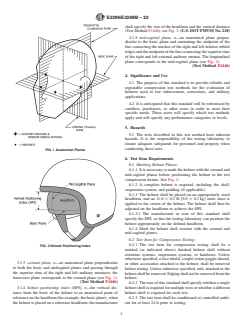
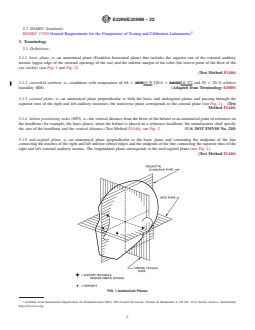
3.1.1 basic plane, n—an anatomical plane (Frankfort hori-
safety concerns, if any, associated with its use. It is the
zontal plane) that includes the superior rim of the external
responsibility of the user of this standard to establish appro-
auditory meatus (upper edge of the external openings of the
priate safety, health, and environmental practices and deter-
ear) and the inferior margin of the orbit (the lowest point of the
mine the applicability of regulatory limitations prior to use.
floor of the eye socket) (see Fig. 1 and Fig. 2).
1.6 This international standard was developed in accor-
(Test Method F1446)
dance with internationally recognized principles on standard-
3.1.2 controlled ambient, n—conditions with temperature of
ization established in the Decision on Principles for the
68 6 10 °F [20.0 6 5.6 °C] and 50 6 20 % relative humidity
Development of International Standards, Guides and Recom-
(RH). (Adapted from Terminology E3005)
mendations issued by the World Trade Organization Technical
Barriers to Trade (TBT) Committee.
For referenced ASTM standards, visit the ASTM website, www.astm.org, or
contact ASTM Customer Service at service@astm.org. For Annual Book of ASTM
Standards volume information, refer to the standard’s Document Summary page on
These test methods are under the jurisdiction of ASTM Committee E54 on the ASTM website.
Homeland Security Applications and are the direct responsibility of Subcommittee Available from National Highway Traffic Safety Administration (NHTSA),
E54.04 on Personal Protective Equipment (PPE). 1200 New Jersey Ave., SE, Washington, DC 20590, http://www.nhtsa.gov.
Current edition approved March 1, 2022. Published March 2022. Originally Available from International Organization for Standardization (ISO), ISO
approved in 2021. Last previous edition approved in 2021 as E3299/E3299M – 21a. Central Secretariat, Chemin de Blandonnet 8, CP 401, 1214 Vernier, Geneva,
DOI: 10.1520/E3299_E3299M-22. Switzerland, https://www.iso.org.
Copyright © ASTM International, 100 Barr Harbor Drive, PO Box C700, West Conshohocken, PA 19428-2959. United States
E3299/E3299M − 22
shall specify the size of the headform and the vertical distance
(Test Method F1446); see Fig. 2. (U.S. DOT FMVSS No. 218)
3.1.5 mid-sagittal plane, n—an anatomical plane perpen-
dicular to the basic plane and containing the midpoint of the
line connecting the notches of the right and left inferior orbital
ridgesandthemidpointofthelineconnectingthesuperiorrims
of the right and left external auditory meatus. The longitudinal
plane corresponds to the mid-sagittal plane (see Fig. 1).
(Test Method F1446)
4. Significance and Use
4.1 The purpose of this standard is to provide reliable and
repeatable compression test methods for the evaluation of
helmets used in law enforcement, corrections, and military
applications.
4.2 It is anticipated that this standard will be referenced by
certifiers, purchasers, or other users in order to meet their
specific needs. Those users will specify which test methods
apply and will specify any performance categories or levels.
5. Hazards
5.1 The tests described in this test method have inherent
hazards. It is the responsibility of the testing laboratory to
ensure adequate safeguards for personnel and property when
conducting these tests.
FIG. 1 Anatomical Planes
6. Test Item Requirements
6.1 Marking Helmet Planes:
6.1.1 It is necessary to mark the helmet with the coronal and
mid-sagittal planes before positioning the helmet in the test
compression fixture. See Fig. 2.
6.1.2 A complete helmet is required, including the shell,
suspension system, and padding (if applicable).
6.1.3 The helmet shall be placed on an appropriately sized
headform, and an 11.0 6 0.2 lb [5.0 6 0.1 kg] static mass is
applied to the crown of the helmet. The helmet shall then be
adjusted on the headform to achieve the HPI.
6.1.3.1 The manufacturer or user of this standard shall
specify the HPI, so that the testing laboratory can position the
helmet appropriately on the defined headform.
6.1.4 Mark the helmet shell exterior with the coronal and
mid-sagittal planes.
6.2 Test Item for Compression Testing:
6.2.1 The test item for compression testing shall be a
FIG. 2 Helmet Positioning Index
marked (as indicated above) finished helmet shell without
retention systems, suspension systems, or hardware. Unless
otherwise specified, a face shield, a night vision goggle shroud,
3.1.3 coronal plane, n—an anatomical plane perpendicular
or other accessories attached to the helmet, shall be removed
to both the basic and midsagittal planes and passing through
before testing. Unless otherwise specified, rails attached to the
the superior rims of the right and left auditory meatuses; the
helmetshallberemoved.Edgingshallnotberemovedfromthe
transverse plane corresponds to the coronal plane (see Fig. 1).
helmet.
(Test Method F1446)
6.2.2 Theuserofthisstandardshallspecifywhetherasingle
helmet shell is required for multiple tests or whether a different
3.1.4 helmet positioning index (HPI), n—the vertical dis-
tance from the brow of the helmet to an anatomical point of helmet shell is required for each test.
referenceontheheadform(forexample,thebasicplane),when 6.2.3 The test item shall be conditioned at controlled ambi-
the helmet is placed on a reference headform; the manufacturer ent for at least 24 h prior to testing.
E3299/E3299M − 22
7. Equipment and Test Setup Requirements 8.1.1 The helmet shall be oriented such that the coronal and
mid-sagittal planes are both approximately 90° to the base
7.1 A universal testing machine, with capacity of at least
plate.
25 % above the maximum force required, and capable of a
8.1.2 In order to maintain the correct orientation, the helmet
compression rate of 6 in.⁄min [152 mm/min], shall be used to
shall be supported in one of the following two ways, unless
apply compressive force to the helmet and to measure deflec-
specified elsewhere:
tion.
8.1.2.1 A fixture or jig shall be placed on the base plate
7.1.1 The testing machine shall have a valid calibration
beneath the helmet and shall be rigid and non-compressive.
certificate for the load cell (force verification) and for the
The fixture or jig shall completely support the helmet around
specified crosshead speed (speed verification) of 6 in.⁄min
its periphery. The fixture or jig shall extend at least 1 in.
[152 mm⁄min] (compression).
[25 mm] beyond the edge of the finished shell on the same
7.1.2 The applied force shall be perpendicular to the base
plane as the edge (not up the sides of the helmet) to ensure that
plateuponwhichthehelmetrests.Thebaseplateshallbeaflat,
it is supported. The helmet shall be positioned and centered on
rigid surface that is larger than the helmet.
the jig on the base plate so that the helmet is in the as-worn
7.2 A flat, steel anvil with a minimum thickness of 1 in.
position. Anti-friction material, such as PTFE, shall be placed
[2.5 cm] and a diameter of 2.5 6 0.1 in. [6.4 6 0.3 cm] shall
between the edge(s) of the helmet and the fixture, where they
be rigidly attached to the universal test machine as the contact
come in contact.
with the helmet.
8.1.2.2 A rigid and non-compressive supporting material
7.3 For side-to-side and front-to-back compression testing,
shall be placed in the gaps between the helmet edge and the
a rigidly supported foam pad, positioned at 90° to the base
base plate when the helmet is positioned in the as-worn
plate and touching the crown of the helmet, shall be used to
position. The base plate and supporting material combined
maintain the correct orientation and position of the helmet.
shall be in contact with at least 75 % of
...
This document is not an ASTM standard and is intended only to provide the user of an ASTM standard an indication of what changes have been made to the previous version. Because
it may not be technically possible to adequately depict all changes accurately, ASTM recommends that users consult prior editions as appropriate. In all cases only the current version
of the standard as published by ASTM is to be considered the official document.
Designation: E3299/E3299M − 21a E3299/E3299M − 22
Standard Test Methods for
Compression Resistance of Helmets
This standard is issued under the fixed designation E3299/E3299M; the number immediately following the designation indicates the year
of original adoption or, in the case of revision, the year of last revision. A number in parentheses indicates the year of last reapproval.
A superscript epsilon (´) indicates an editorial change since the last revision or reapproval.
1. Scope
1.1 This standard provides test methods for assessing compression resistance of helmets worn by military, law enforcement, and
corrections personnel. These test methods are applicable for many styles of helmet (that is, high-cut, mid-cut, full-cut).
1.2 Three compression test methods are included: (1) top-to-bottom, (2) side-to-side, and (3) front-to-back.
1.3 It is anticipated that this standard will be referenced by suppliers, certifiers, purchasers, or other users to meet their specific
needs. Those users will specify, in other standards and specifications, which test methods and conditioning procedures are
applicable and will specify any performance categories or levels.
1.4 Units—The values stated in either SI units or inch-pound units are to be regarded separately as standard. The values stated in
each system are not necessarily exact equivalents; therefore, to ensure conformance with the standard, each system shall be used
independently of the other, and values from the two systems shall not be combined.
1.5 This standard does not purport to address all of the safety concerns, if any, associated with its use. It is the responsibility
of the user of this standard to establish appropriate safety, health, and environmental practices and determine the applicability of
regulatory limitations prior to use.
1.6 This international standard was developed in accordance with internationally recognized principles on standardization
established in the Decision on Principles for the Development of International Standards, Guides and Recommendations issued
by the World Trade Organization Technical Barriers to Trade (TBT) Committee.
2. Referenced Documents
2.1 ASTM Standards:
D2240 Test Method for Rubber Property—Durometer Hardness
D3575 Test Methods for Flexible Cellular Materials Made from Olefin Polymers
D4819 Specification for Flexible Cellular Materials Made From Polyolefin Plastics
E3005 Terminology for Body Armor
F1446 Test Methods for Equipment and Procedures Used in Evaluating the Performance Characteristics of Protective Headgear
2.2 U.S. Government Standards:
FMVSS No. 218 Laboratory Test Procedure for Motorcycle Helmets, National Highway Traffic Safety Administration
These test methods are under the jurisdiction of ASTM Committee E54 on Homeland Security Applications and are the direct responsibility of Subcommittee E54.04
on Personal Protective Equipment (PPE).
Current edition approved Dec. 1, 2021March 1, 2022. Published December 2021March 2022. Originally approved in 2021. Last previous edition approved in 2021 as
E3299/E3299M – 21.E3299/E3299M – 21a. DOI: 10.1520/E3299_E3299M-21A.10.1520/E3299_E3299M-22.
For referenced ASTM standards, visit the ASTM website, www.astm.org, or contact ASTM Customer Service at service@astm.org. For Annual Book of ASTM Standards
volume information, refer to the standard’s Document Summary page on the ASTM website.
Available from National Highway Traffic Safety Administration (NHTSA), 1200 New Jersey Ave., SE, Washington, DC 20590, http://www.nhtsa.gov.
Copyright © ASTM International, 100 Barr Harbor Drive, PO Box C700, West Conshohocken, PA 19428-2959. United States
E3299/E3299M − 22
2.3 ISO/IEC Standards:
ISO/IEC 17025 General Requirements for the Competence of Testing and Calibration Laboratories
3. Terminology
3.1 Definitions:
3.1.1 basic plane, n—an anatomical plane (Frankfort horizontal plane) that includes the superior rim of the external auditory
meatus (upper edge of the external openings of the ear) and the inferior margin of the orbit (the lowest point of the floor of the
eye socket) (see Fig. 1 and Fig. 2).
(Test Method F1446)
3.1.2 controlled ambient, n—conditions with temperature of 68 6 10°F10 °F [20.0 6 5.6°C]5.6 °C] and 50 6 20 % relative
humidity (RH). (Adapted from Terminology E3005)
3.1.3 coronal plane, n—an anatomical plane perpendicular to both the basic and midsagittal planes and passing through the
superior rims of the right and left auditory meatuses; the transverse plane corresponds to the coronal plane (see Fig. 1). (Test
Method F1446)
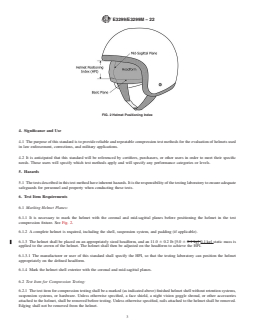
3.1.4 helmet positioning index (HPI), n—the vertical distance from the brow of the helmet to an anatomical point of reference on
the headform (for example, the basic plane), when the helmet is placed on a reference headform; the manufacturer shall specify
the size of the headform and the vertical distance (Test Method F1446); see Fig. 2. (U.S. DOT FMVSS No. 218)
3.1.5 mid-sagittal plane, n—an anatomical plane perpendicular to the basic plane and containing the midpoint of the line
connecting the notches of the right and left inferior orbital ridges and the midpoint of the line connecting the superior rims of the
right and left external auditory meatus. The longitudinal plane corresponds to the mid-sagittal plane (see Fig. 1).
(Test Method F1446)
FIG. 1 Anatomical Planes
Available from International Organization for Standardization (ISO), ISO Central Secretariat, Chemin de Blandonnet 8, CP 401, 1214 Vernier, Geneva, Switzerland,
https://www.iso.org.
E3299/E3299M − 22
FIG. 2 Helmet Positioning Index
4. Significance and Use
4.1 The purpose of this standard is to provide reliable and repeatable compression test methods for the evaluation of helmets used
in law enforcement, corrections, and military applications.
4.2 It is anticipated that this standard will be referenced by certifiers, purchasers, or other users in order to meet their specific
needs. Those users will specify which test methods apply and will specify any performance categories or levels.
5. Hazards
5.1 The tests described in this test method have inherent hazards. It is the responsibility of the testing laboratory to ensure adequate
safeguards for personnel and property when conducting these tests.
6. Test Item Requirements
6.1 Marking Helmet Planes:
6.1.1 It is necessary to mark the helmet with the coronal and mid-sagittal planes before positioning the helmet in the test
compression fixture. See Fig. 2.
6.1.2 A complete helmet is required, including the shell, suspension system, and padding (if applicable).
6.1.3 The helmet shall be placed on an appropriately sized headform, and an 11.0 6 0.2 lb [5.0 6 0.1 kg] 0.1 kg] static mass is
applied to the crown of the helmet. The helmet shall then be adjusted on the headform to achieve the HPI.
6.1.3.1 The manufacturer or user of this standard shall specify the HPI, so that the testing laboratory can position the helmet
appropriately on the defined headform.
6.1.4 Mark the helmet shell exterior with the coronal and mid-sagittal planes.
6.2 Test Item for Compression Testing:
6.2.1 The test item for compression testing shall be a marked (as indicated above) finished helmet shell without retention systems,
suspension systems, or hardware. Unless otherwise specified, a face shield, a night vision goggle shroud, or other accessories
attached to the helmet, shall be removed before testing. Unless otherwise specified, rails attached to the helmet shall be removed.
Edging shall not be removed from the helmet.
E3299/E3299M − 22
6.2.2 The user of this standard shall specify whether a single helmet shell is required for multiple tests or whether a different
helmet shell is required for each test.
6.2.3 The test item shall be conditioned at controlled ambient for at least 24 h prior to testing.
7. Equipment and Test Setup Requirements
7.1 A universal testing machine, with capacity up to of at least 25 % above the maximum force required, and capable of a
compression rate of 6 in. ⁄min [152 mm/min], shall be used to apply compressive force to the helmet and to measure deflection.
7.1.1 The testing machine shall have a valid calibration certificate for the load cell (force verification) and for the specified
crosshead speed (speed verification) of 6 in. ⁄min [152 mm ⁄min] (compression).
7.1.2 The applied force shall be perpendicular to the base plate upon which the helmet rests. The base plate shall be a flat, rigid
surface that is larger than the helmet.
7.2 A flat, steel anvil with a minimum thickness of 1 in. [2.5 cm] and a diameter of 2.5 6 0.1 in. [6.4 6 0.3 cm] shall be rigidly
attached to the universal test machine as the contact with the helmet.
7.3 For side-to-side and front-to-back compression testing, a rigidly supported foam pad, positioned at 90° to the base plate and
touching the crown of the helmet, shall be used to maintain the correct orientation and position of the helmet.
7.3.1 The foam pad shall be approximately 4 in. [10 cm] wide by 4 in. [10 cm] long by 2 in. [5 cm] thick.
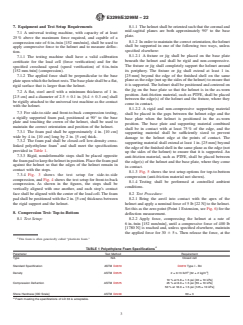
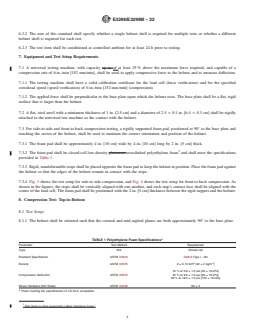
7.3.2 The foam pad shall be closed-cell low-density plastazote crosslinked polyethylene foam and shall meet the specifications
provided in Table 1.
7.3.3 Rigid, nondeformable stops shall be placed opposite the foam pad to keep the helmet in position. Place the foam pad against
the helmet so that the edges of the helmet remain in contact with the stops.
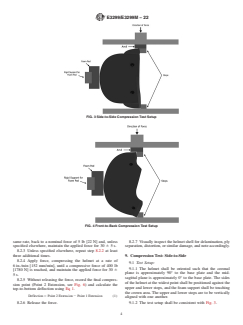
7.3.4 Fig. 3 shows the test setup for side-to-side compression, and Fig. 4 shows the test setup for front-to-back compression. As
shown in the figures, the stops shall be vertically aligned with one another, and each stop’s contact face shall be aligned with the
center of the load cell. The foam pad shall be positioned with the 2 in. [5 cm] thickness between the rigid support and the helmet.
8. Compression Test: Top-to-Bottom
8.1 Test Setup:
8.1.1 The helmet shall be oriented such that the coronal and mid-sagittal planes are both approximately 90° to the base plate.
A
TABLE 1 Polyethylene Foam Specifications
Parameter Test Method Req
...