

ASTM E3005-24
(Terminology)Standard Terminology for Body Armor and Ballistic Protection
General Information
- Abstract
SCOPE
1.1 The scope of this terminology is to provide a standard terminology for body armor providing protection against ballistic threats, stabbing, fragmentation, blunt impact, or a combination of threats.
1.2 The intent of this terminology is to have terms, abbreviations, and formulas that are applicable across federal agencies, law enforcement and corrections agencies, testing and certification bodies, and manufacturers.
1.2.1 The terminology is kept general herein and should be defined more specifically as needed within individual test methods or other standards.
1.3 This terminology is not intended to describe test methods or performance requirements for body armor.
1.4 This international standard was developed in accordance with internationally recognized principles on standardization established in the Decision on Principles for the Development of International Standards, Guides and Recommendations issued by the World Trade Organization Technical Barriers to Trade (TBT) Committee.
- Status
- Published
- Publication Date
- 31-Mar-2024
- Technical Committee
- E54 - Homeland Security Applications
- Drafting Committee
- E54.04 - Public Safety Equipment
Overview
ASTM E3005-24: Standard Terminology for Body Armor and Ballistic Protection provides a unified set of terms, abbreviations, and definitions related to personal protective equipment designed to shield wearers from ballistic threats, stabbing, fragmentation, blunt impact, or combinations thereof. Developed under ASTM Committee E54 on Homeland Security Applications, this terminology standard is intended for use by federal agencies, law enforcement, corrections agencies, testing and certification bodies, and body armor manufacturers worldwide. While the standard is comprehensive in its coverage of terminology, it does not describe specific test methods or set performance requirements for body armor or ballistic protective equipment.
Key Topics
Body Armor Types
- Definitions for various forms of armor, such as soft armor, hard armor, and combination armor, including stand-alone and in-conjunction products.
- Key terms like vest, tactical body armor, and concealable body armor are standardized to reduce ambiguity across applications.
Ballistic and Impact Protection
- Terms relating to protection mechanisms, such as ballistic resistance, stab resistance, blunt impact resistance, and fragmentation protection.
- Includes detailed definitions for ballistic panel, stab panel, trauma pack, and trauma plate.
Testing and Certification Terminology
- Clear definitions for testing apparatus and procedures, such as backing assembly, clay block, impactor, test threat, and fair hit.
- Terminology related to performance measurement, such as backface deformation, complete penetration, perforation, and various V-values (V05, V50, etc.).
Armor Components and Accessories
- Standardized definitions for parts and auxiliary products including carrier, insert, applique, armor coupon, and shoot pack.
- Descriptions for accessories that enhance protection or coverage, such as armor applique, panel cover, and witness panel.
Applications
Federal and Law Enforcement Agencies
- Enhances communication and standardizes terminology for procurement, field operations, and interagency cooperation.
- Helps ensure consistency in protective equipment specifications across multiple jurisdictions.
Manufacturers and Product Developers
- Guides the consistent use of essential terms when designing, producing, and marketing body armor and ballistic protection products.
- Assists with clear labelling, product documentation, and compliance declarations.
Testing and Certification Bodies
- Provides a common vocabulary for preparing, conducting, and reporting on armor testing programs.
- Facilitates uniform assessment, certification, and documentation in conformity with internationally recognized standards.
Standards Developers and Policy Makers
- Serves as a foundational reference for other standards covering test methods, performance requirements, and certification for personal protective equipment.
Related Standards
- ASTM E3111/E3111M: Test Methods for Ballistic Resistant Head Protection
- ASTM E3113: Specification for Ballistic-resistant Vehicle Door Panels Used by Public Safety Agencies
- ASTM E3141: Test Method for Ballistic Resistant Shields for Law Enforcement
- ASTM E3236/E3236M: Specification for Ballistic-resistant Barriers Used in Homeland Security or Public Safety Applications
- ASTM E3347/E3347M: Specification for Ballistic-resistant Shields Used by Law Enforcement Officers
- MIL-STD-3027: DOD Standard for Performance Requirements and Testing of Body Armor
- NIJ Standard-0101.06 / ISO/IEC 17065: Ballistic Resistance of Body Armor and Conformity Assessment
- SAAMI Glossary: Industry glossary for ammunition and small arms terms
Practical Value
By delivering a single, internationally recognized source for key terminology used in the body armor and ballistic protection sector, ASTM E3005-24 helps foster clarity, reduce miscommunication, and support technical precision in every phase of personal protective equipment development, acquisition, testing, and certification. Stakeholders across public safety, military, and commercial markets benefit from consistent language, aiding in product comparison, regulatory compliance, and operational safety.
Keywords: body armor terminology, ballistic protection, ASTM E3005, soft armor, hard armor, stab resistance, blunt impact, ballistic standards, PPE, public safety equipment
Relations
- Effective Date
- 01-Apr-2024
- Effective Date
- 01-Apr-2024
- Effective Date
- 01-Apr-2024
- Effective Date
- 01-Apr-2024
- Effective Date
- 01-Apr-2024
- Effective Date
- 01-Apr-2024
- Effective Date
- 01-Apr-2024
- Effective Date
- 01-Apr-2024
- Effective Date
- 01-Apr-2024
- Effective Date
- 01-Apr-2024
- Referred By
ASTM E3112/E3112M-20 - Standard Test Method for Ballistic-resistant Products and Shoot Packs - Effective Date
- 01-Apr-2024
- Referred By
ASTM E3141/E3141M-23 - Standard Test Method for Ballistic Resistant Shields for Law Enforcement - Effective Date
- 01-Apr-2024
- Effective Date
- 01-Apr-2024
- Effective Date
- 01-Apr-2024
- Effective Date
- 01-Apr-2024
Get Certified
Connect with accredited certification bodies for this standard

CIS Institut d.o.o.
Personal Protective Equipment (PPE) certification body. Notified Body NB-2890 for EU Regulation 2016/425 PPE.

Kiwa BDA Testing
Building and construction product certification.
Kmetijski inštitut Slovenije
Agricultural Institute of Slovenia. Soil testing, plant health, agricultural product analysis.
Sponsored listings
Frequently Asked Questions
ASTM E3005-24 is a standard published by ASTM International. Its full title is "Standard Terminology for Body Armor and Ballistic Protection". This standard covers: SCOPE 1.1 The scope of this terminology is to provide a standard terminology for body armor providing protection against ballistic threats, stabbing, fragmentation, blunt impact, or a combination of threats. 1.2 The intent of this terminology is to have terms, abbreviations, and formulas that are applicable across federal agencies, law enforcement and corrections agencies, testing and certification bodies, and manufacturers. 1.2.1 The terminology is kept general herein and should be defined more specifically as needed within individual test methods or other standards. 1.3 This terminology is not intended to describe test methods or performance requirements for body armor. 1.4 This international standard was developed in accordance with internationally recognized principles on standardization established in the Decision on Principles for the Development of International Standards, Guides and Recommendations issued by the World Trade Organization Technical Barriers to Trade (TBT) Committee.
SCOPE 1.1 The scope of this terminology is to provide a standard terminology for body armor providing protection against ballistic threats, stabbing, fragmentation, blunt impact, or a combination of threats. 1.2 The intent of this terminology is to have terms, abbreviations, and formulas that are applicable across federal agencies, law enforcement and corrections agencies, testing and certification bodies, and manufacturers. 1.2.1 The terminology is kept general herein and should be defined more specifically as needed within individual test methods or other standards. 1.3 This terminology is not intended to describe test methods or performance requirements for body armor. 1.4 This international standard was developed in accordance with internationally recognized principles on standardization established in the Decision on Principles for the Development of International Standards, Guides and Recommendations issued by the World Trade Organization Technical Barriers to Trade (TBT) Committee.
ASTM E3005-24 is classified under the following ICS (International Classification for Standards) categories: 01.040.13 - Environment. Health protection. Safety (Vocabularies); 13.310 - Protection against crime; 13.340.01 - Protective equipment in general. The ICS classification helps identify the subject area and facilitates finding related standards.
ASTM E3005-24 has the following relationships with other standards: It is inter standard links to ASTM E3005-20, ASTM E3195-19, ASTM E3110/E3110M-22, ASTM E3347/E3347M-23, ASTM E2771-11(2019), ASTM E3368/E3368M-23a, ASTM E3003-20, ASTM E3192/E3192M-20, ASTM E3068-20, ASTM E3086-20, ASTM E3112/E3112M-20, ASTM E3141/E3141M-23, ASTM E3236/E3236M-21, ASTM E3078/E3078M-23, ASTM F3279-24. Understanding these relationships helps ensure you are using the most current and applicable version of the standard.
ASTM E3005-24 is available in PDF format for immediate download after purchase. The document can be added to your cart and obtained through the secure checkout process. Digital delivery ensures instant access to the complete standard document.
Standards Content (Sample)
This international standard was developed in accordance with internationally recognized principles on standardization established in the Decision on Principles for the
Development of International Standards, Guides and Recommendations issued by the World Trade Organization Technical Barriers to Trade (TBT) Committee.
Designation: E3005 − 24
Standard Terminology for
Body Armor and Ballistic Protection
This standard is issued under the fixed designation E3005; the number immediately following the designation indicates the year of
original adoption or, in the case of revision, the year of last revision. A number in parentheses indicates the year of last reapproval. A
superscript epsilon (´) indicates an editorial change since the last revision or reapproval.
1. Scope 2.2 DOD Standard:
MIL-STD-3027 Method Standard for Performance Require-
1.1 The scope of this terminology is to provide a standard
ments and Testing of Body Armor
terminology for body armor providing protection against
ballistic threats, stabbing, fragmentation, blunt impact, or a 2.3 ISO Standard:
combination of threats. ISO/IEC 17065 Conformity assessment: Requirements for
bodies certifying products, processes and services
1.2 The intent of this terminology is to have terms,
2.4 SAAMI Standard:
abbreviations, and formulas that are applicable across federal
agencies, law enforcement and corrections agencies, testing SAAMI Glossary of Industry Terms
and certification bodies, and manufacturers.
1.2.1 The terminology is kept general herein and should be 3. Terminology
defined more specifically as needed within individual test
accessory, n—a body armor component that is detachable or
methods or other standards.
removable from the body armor and is intended to provide
1.3 This terminology is not intended to describe test meth-
extended area of coverage protection against threats that may
ods or performance requirements for body armor.
include ballistic threats, stabbing, fragmentation, blunt
impact, or a combination of threats.
1.4 This international standard was developed in accor-
DISCUSSION—Accessories are typically attachments to tactical body
dance with internationally recognized principles on standard-
armor providing protection to areas not covered by the vest, such as the
ization established in the Decision on Principles for the
shoulders, upper arms, neck, sides, pelvis, and groin. See tactical body
Development of International Standards, Guides and Recom-
armor. See vest.
mendations issued by the World Trade Organization Technical
ammunition, n—one or more loaded cartridges consisting of
Barriers to Trade (TBT) Committee.
case, primer, propellant, and one or more projectiles.
2. Referenced Documents
angle of incidence, n—the angle between the test threat line of
2.1 ASTM Standards:
aim and the line normal to a reference plane based on the
E3111/E3111M Test Methods for Ballistic Resistant Head
front surface of the backing assembly or witness panel. See
Protection
also obliquity.
E3113 Specification for Ballistic-resistant Vehicle Door Pan-
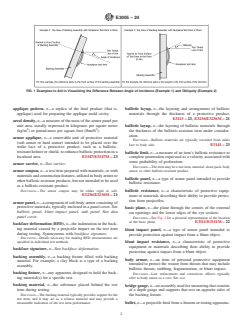
DISCUSSION—Some standards have used the terms angle of incidence
els Used by Public Safety Agencies and obliquity as synonyms, but in this standard, they are defined
differently. Fig. 1 provides examples to aid in visualizing the difference
E3141 Test Method for Ballistic Resistant Shields for Law
between angle of incidence and obliquity.
Enforcement
E3236/E3236M Specification for Ballistic-resistant Barriers
applique, n—a three-dimensional item molded from backing
Used in Homeland Security or Public Safety Applications
material that is shaped and sized for testing or conditioning
E3347/E3347M Specification for Ballistic-Resistant Shields
a nonplanar test item.
Used by Law Enforcement Officers
DISCUSSION—Some appliques are designed for the purpose of filling
the entire space behind a nonplanar test item; other appliques are
designed to assess features of a nonplanar test item.
This terminology is under the jurisdiction of ASTM Committee E54 on
Homeland Security Applications and is the direct responsibility of Subcommittee
E54.04 on Public Safety Equipment.
Current edition approved April 1, 2024. Published April 2024. Originally Available from U.S. Government Printing Office Superintendent of Documents,
approved in 2015. Last previous edition approved in 2020 as E3005 – 20. DOI: 732 N. Capitol St., NW, Mail Stop: SDE, Washington, DC 20401, http://
10.1520/E3005-24. www.access.gpo.gov.
2 4
For referenced ASTM standards, visit the ASTM website, www.astm.org, or Available from American National Standards Institute (ANSI), 25 W. 43rd St.,
contact ASTM Customer Service at service@astm.org. For Annual Book of ASTM 4th Floor, New York, NY 10036, http://www.ansi.org.
Standards volume information, refer to the standard’s Document Summary page on Available from Sporting Arms and Ammunition Manufacturers’ Institute, Inc.,
the ASTM website. 11 Mile Hill Rd, Newtown, Connecticut, 06470–2539, www.saami.org.
Copyright © ASTM International, 100 Barr Harbor Drive, PO Box C700, West Conshohocken, PA 19428-2959. United States
E3005 − 24
FIG. 1 Examples to Aid in Visualizing the Difference Between Angle of Incidence (Example 1) and Obliquity (Example 2)
applique pattern, n—a replica of the final product (that is, ballistic layup, n—the layering and arrangement of ballistic
applique) used for preparing the applique mold cavity. materials through the thickness of a protective product.
E3113 – 23, E3236/E3236M – 21
areal density, n—a measure of the mass of the armor panel per
unit area, usually expressed in kilograms per square meter
ballistic layup, n—the layering of ballistic materials through
2 2
(kg/m ) or pound-mass per square foot (lbm/ft ).
the thickness of the ballistic-resistant item under consider-
ation.
armor applique, n—a removable unit of protective material
DISCUSSION—Ballistic materials are typically recorded from strike
(soft armor or hard armor) intended to be placed over the
face to body side. E3141 – 23
strike face of a protective product, such as a ballistic-
resistant helmet or shield, to enhance ballistic protection in a
ballistic limit, n—a measure of an item’s ballistic resistance to
localized area. E3347/E3347M – 23
complete penetration expressed as a velocity associated with
some probability of perforation.
armor carrier, n—See carrier.
DISCUSSION—The item may be a test item, material, shoot pack, body
armor, or other ballistic-resistant product.
armor coupon, n—a test item prepared with materials, or with
materials and construction features, utilized in body armor or
ballistic panel, n—a type of armor panel intended to provide
other ballistic-resistant products, but not intended to be used
ballistic resistance.
as a ballistic-resistant product.
DISCUSSION—The armor coupon may be either rigid or soft.
ballistic resistance, n—a characteristic of protective equip-
E3236/E3236M – 21
ment or materials describing their ability to provide protec-
tion from projectiles.
armor panel, n—a component of soft body armor consisting of
protective materials, typically enclosed in a panel cover. See
basic plane, n—the plane through the centers of the external
ballistic panel, blunt impact panel, stab panel. See also
ear openings and the lower edges of the eye sockets.
panel cover.
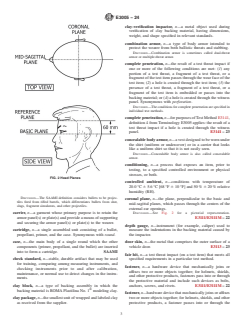
DISCUSSION—See Fig. 2 for a pictorial representation of the location
of the basic plane. E3111/E3111M – 22
backface deformation (BFD), n—the indentation in the back-
ing material caused by a projectile impact on the test item
blunt impact panel, n—a type of armor panel intended to
during testing. Synonymous with backface signature.
provide protection against impact from a blunt object.
DISCUSSION—Details necessary for making BFD measurements are
specified in individual test methods.
blunt impact resistance, n—a characteristic of protective
equipment or materials describing their ability to provide
backface signature, n—See backface deformation.
protection against impact from a blunt object.
backing assembly, n—a backing fixture filled with backing
body armor, n—an item of personal protective equipment
material. For example, a clay block is a type of a backing
intended to protect the wearer from threats that may include
assembly.
ballistic threats, stabbing, fragmentation, or blunt impact.
backing fixture, n—any apparatus designed to hold the back-
DISCUSSION—Law enforcement and corrections officers typically
ing material(s) for a specific test. refer to body armor as a vest. See vest.
backing material, n—the substance placed behind the test
bridge gauge, n—an assembly used for measuring that consists
item during testing. of a depth gauge and supports that rest on opposite sides of
DISCUSSION—The backing material typically provides support for the
the backing fixture.
test item, and it may act as a witness material and may provide a
measurable indication of the test item performance. bullet, n—a projectile fired from a firearm or testing apparatus.
E3005 − 24
clay-verification impactor, n—a metal object used during
verification of clay backing material, having dimensions,
weight, and shape specified in relevant standards.
combination armor, n—a type of body armor intended to
protect the wearer from both ballistic threats and stabbing.
DISCUSSION—Combination armor is sometimes called dual-threat
armor or multiple-threat armor.
complete penetration, n—the result of a test threat impact if
one or more of the following conditions are met: (1) any
portion of a test threat, a fragment of a test threat, or a
fragment of the test item passes through the wear face of the
test item; (2) a hole is created through the test item; (3) the
presence of a test threat, a fragment of a test threat, or a
fragment of the test item is embedded or passes into the
backing material; or (4) a hole is created through the witness
panel. Synonymous with perforation.
DISCUSSION—The conditions for complete penetration are specified in
individual test methods.
complete penetration, n—for purposes of Test Method E3141,
definition 4 from Terminology E3005 applies: the result of a
test threat impact if a hole is created through the witness
panel. E3141 – 23
concealable body armor, n—a vest designed to be worn under
the shirt (uniform or undercover) or in a carrier that looks
like a uniform shirt so that it is not easily seen.
DISCUSSION—Concealable body armor is also called concealable
armor.
conditioning, n—a process that exposes an item, prior to
testing, to a specified controlled environment or physical
stresses, or both.
FIG. 2 Head Planes
controlled ambient, n—conditions with temperature of
20.0 °C 6 5.6 °C [68 °F 6 10 °F] and 50 % 6 20 % relative
humidity (RH).
DISCUSSION—The SAAMI definition considers bullets to be projec-
coronal plane, n—the plane, perpendicular to the basic and
tiles fired from rifled barrels, which differentiates bullets from shot,
mid-sagittal planes, which passes through the centers of the
slugs, fragment simulators, and other projectiles.
external ear openings.
carrier, n—a garment whose primary purpose is to retain the DISCUSSION—See Fig. 2 for a pictorial representation.
armor panel(s) or plate(s) and provide a means of supporting E3111/E3111M – 22
and securing the armor panel(s) or plate(s) to the wearer.
depth gauge, n—instrument (for example, caliper) used to
cartridge, n—a single assembled unit consisting of a bullet, measure the indentations in the backing material caused by
propellant, primer, and the case. Synonymous with round. the impactor.
case, n—the main body of a single round which the other door skin, n—the metal that comprises the outer surface of a
components (primer, propellant, and the bullet) are inserted vehicle door. E3113 – 23
into to form a cartridge. SAAMI
fair hit, n—a test threat impact (on a test item) that meets all
check standard, n—stable, durable artifact that may be used specified requirements in a particular test method.
for training, comparing among measuring instruments, and
fastener, n—a hardware device that mechanically joins or
checking instruments prior to and after calibration,
affixes two or more objects together; for helmets, shields,
maintenance, or normal use to detect changes in the instru-
and other protective products, fasteners pass into or through
ments.
the protective material and include such devices as bolts,
clay block, n—a type of backing assembly in which the a
...
This document is not an ASTM standard and is intended only to provide the user of an ASTM standard an indication of what changes have been made to the previous version. Because
it may not be technically possible to adequately depict all changes accurately, ASTM recommends that users consult prior editions as appropriate. In all cases only the current version
of the standard as published by ASTM is to be considered the official document.
Designation: E3005 − 20 E3005 − 24
Standard Terminology for
Body Armor and Ballistic Protection
This standard is issued under the fixed designation E3005; the number immediately following the designation indicates the year of
original adoption or, in the case of revision, the year of last revision. A number in parentheses indicates the year of last reapproval. A
superscript epsilon (´) indicates an editorial change since the last revision or reapproval.
1. Scope
1.1 The scope of this terminology is to provide a standard terminology for body armor providing protection against ballistic
threats, stabbing, fragmentation, blunt impact, or a combination of threats.
1.2 The intent of this terminology is to have terms, abbreviations, and formulas that are applicable across federal agencies, law
enforcement and corrections agencies, testing and certification bodies, and manufacturers.
1.2.1 The terminology is kept general herein and should be defined more specifically as needed within individual test methods or
other standards.
1.3 This terminology is not intended to describe test methods or performance requirements for body armor.
1.4 This international standard was developed in accordance with internationally recognized principles on standardization
established in the Decision on Principles for the Development of International Standards, Guides and Recommendations issued
by the World Trade Organization Technical Barriers to Trade (TBT) Committee.
2. Referenced Documents
2.1 ASTM Standards:
E3111/E3111M Test Methods for Ballistic Resistant Head Protection
E3113 Specification for Ballistic-resistant Vehicle Door Panels Used by Public Safety Agencies
E3141 Test Method for Ballistic Resistant Shields for Law Enforcement
E3236/E3236M Specification for Ballistic-resistant Barriers Used in Homeland Security or Public Safety Applications
E3347/E3347M Specification for Ballistic-Resistant Shields Used by Law Enforcement Officers
2.2 DOD Standard:
MIL-STD-3027 Method Standard for Performance Requirements and Testing of Body Armor
2.3 NIJISO Standard:
NIJ Standard-0101.06ISO/IEC 17065 Ballistic Resistance of Body ArmorConformity assessment: Requirements for bodies
certifying products, processes and services
This terminology is under the jurisdiction of ASTM Committee E54 on Homeland Security Applications and is the direct responsibility of Subcommittee E54.04 on
Personal Protective Equipment (PPE)Public Safety Equipment.
Current edition approved Feb. 1, 2020April 1, 2024. Published March 2020April 2024. Originally approved in 2015. Last previous edition approved in 20182020 as
E3005 – 18.E3005 – 20. DOI: 10.1520/E3005-20.10.1520/E3005-24.
For referenced ASTM standards, visit the ASTM website, www.astm.org, or contact ASTM Customer Service at service@astm.org. For Annual Book of ASTM Standards
volume information, refer to the standard’s Document Summary page on the ASTM website.
Available from U.S. Government Printing Office Superintendent of Documents, 732 N. Capitol St., NW, Mail Stop: SDE, Washington, DC 20401, http://
www.access.gpo.gov.
Available from American National Institute of Justice (NIJ), 810 7th St., NW, Washington, DC 20531, http://nij.gov.Standards Institute (ANSI), 25 W. 43rd St., 4th Floor,
New York, NY 10036, http://www.ansi.org.
Copyright © ASTM International, 100 Barr Harbor Drive, PO Box C700, West Conshohocken, PA 19428-2959. United States
E3005 − 24
2.4 SAAMI Standard:
SAAMI Glossary of Industry Terms
3. Terminology
accessory, n—a body armor component that is detachable or removable from the body armor and is intended to provide extended
area of coverage protection against threats that may include ballistic threats, stabbing, fragmentation, blunt impact, or a
combination of threats.
DISCUSSION—
Accessories are typically attachments to tactical body armor providing protection to areas not covered by the vest, such as the shoulders, upper arms,
neck, sides, pelvis, and groin. See tactical body armor. See vest.
ammunition, n—one or more loaded cartridges consisting of case, primer, propellant, and one or more projectiles.
angle of incidence, n—the angle between the test threat line of aim and the line normal to a reference plane based on the front
surface of the backing assembly or witness panel. See also obliquity.
DISCUSSION—
Some standards have used the terms angle of incidence and obliquity as synonyms, but in this standard, they are defined differently. Fig. 1 provides
examples to aid in visualizing the difference between angle of incidence and obliquity.
applique, n—a three-dimensional item molded from backing material that is shaped and sized for testing or conditioning a
nonplanar test item.
DISCUSSION—
Some appliques are designed for the purpose of filling the entire space behind a nonplanar test item; other appliques are designed to assess features
of a nonplanar test item.
applique pattern, n—a replica of the final product (that is, applique) used for preparing the applique mold cavity.
areal density, n—a measure of the mass of the armor panel per unit area, usually expressed in kilograms per square meter
2 2
(kg/m ) or pound-mass per square foot (lbm/ft ).
armor applique, n—a removable unit of protective material (soft armor or hard armor) intended to be placed over the strike
face of a protective product, such as a ballistic-resistant helmet or shield, to enhance ballistic protection in a localized area.
E3347/E3347M – 23
armor carrier, n—See carrier.
FIG. 1 Examples to Aid in Visualizing the Difference Between Angle of Incidence (Example 1) and Obliquity (Example 2)
Available from Sporting Arms and Ammunition Manufacturers’ Institute, Inc., 11 Mile Hill Rd, Newtown, Connecticut, 06470–2539, www.saami.org.
E3005 − 24
armor coupon, n—a test item prepared with materials, or with materials and construction features, utilized in body armor or
other ballistic-resistant products, but not intended to be used as a ballistic-resistant product.
DISCUSSION—
The armor coupon may be either rigid or soft. E3236/E3236M – 21
armor panel, n—a component of soft body armor consisting of protective materials, typically enclosed in a panel cover. See
ballistic panel, blunt impact panel, stab panel. See also panel cover.
backface deformation (BFD), n—the indentation in the backing material caused by a projectile impact on the test item during
testing. Synonymous with backface signature.
DISCUSSION—
Details necessary for making BFD measurements are specified in individual test methods.
backface signature, n—See backface deformation.
backing assembly, n—a backing fixture filled with backing material. For example, a clay block is a type of a backing assembly.
backing fixture, n—any apparatus designed to hold the backing material(s) for a specific test.
backing material, n—the substance placed behind the test item during testing.
DISCUSSION—
The backing material typically provides support for the test item, and it may act as a witness material and may provide a measurable indication of the
test item performance.
ballistic panel,layup, n—a type of armor panel intended to provide ballistic resistance.the layering and arrangement of ballistic
materials through the thickness of a protective product. E3113 – 23, E3236/E3236M – 21
ballistic layup, n—the layering of ballistic materials through the thickness of the ballistic-resistant item under consideration.
DISCUSSION—
Ballistic materials are typically recorded from strike face to body side. E3141 – 23
ballistic limit, n—a measure of an item’s ballistic resistance to complete penetration expressed as a velocity associated with
some probability of perforation.
DISCUSSION—
The item may be a test item, material, shoot pack, body armor, or other ballistic-resistant product.
ballistic panel, n—a type of armor panel intended to provide ballistic resistance.
ballistic resistance, n—a characteristic of protective equipment or materials describing their ability to provide protection from
projectiles.
basic plane, n—the plane through the centers of the external ear openings and the lower edges of the eye sockets.
DISCUSSION—
See Fig. 2 for a pictorial representation of the location of the basic plane. E3111/E3111M – 22
blunt impact panel, n—a type of armor panel intended to provide protection against impact from a blunt object.
blunt impact resistance, n—a characteristic of protective equipment or materials describing their ability to provide protection
against impact from a blunt object.
E3005 − 24
FIG. 2 Head Planes
body armor, n—an item of personal protective equipment intended to protect the wearer from threats that may include ballistic
threats, stabbing, fragmentation, or blunt impact.
DISCUSSION—
Law enforcement and corrections officers typically refer to body armor as a vest. See vest.
bridge gauge, n—an assembly used for measuring that consists of a depth gauge and supports that rest on opposite sides of the
backing fixture.
bullet, n—a projectile fired from a firearm or testing apparatus.
DISCUSSION—
The SAAMI definition considers bullets to be projectiles fired from rifled barrels, which differentiates bullets from shot, slugs, fragment simulators,
and other projectiles.
carrier, n—a garment whose primary purpose is to retain the armor panel(s) or plate(s) and provide a means of supporting and
securing the armor panel(s) or plate(s) to the wearer.
cartridge, n—a single assembled unit consisting of a bullet, propellant, primer, and the case. Synonymous with round.
case, n—the main body of a single round which the other components (primer, propellant, and the bullet) are inserted into to
form a cartridge. SAAMI
E3005 − 24
check standard, n—stable, durable artifact that may be used for training, comparing among measuring instruments, and
checking instruments prior to and after calibration, maintenance, or normal use to detect changes in the instruments. ®
clay block, n—a type of backing assembly in which the backing material is ROMA Plastilina No. 1 modeling clay.
clay package, n—the smallest unit of wrapped and labeled clay as received from the supplier.
clay-verification impactor, n—a metal object used during verification of clay backing material, having dimensions, weight, and
shape specified in relevant standards.
combination armor, n—a type of body armor intended to protect the wearer from both ballistic threats and stabbing.
DISCUSSION—
Combination armor is sometimes called dual-threat armor or multiple-threat armor.
complete penetration, n—the result of a test threat impact if one or more of the following conditions are met: (1) any portion
of a test threat, a fragment of a test threat, or a fragment of the test item passes through the wear face of the test item; (2) a hole
is created through the test item; (3) the presence of a test threat, a fragment of a test threat, or a fragment of the test item is
embedded or passes into the backing material; or (4) a hole is created through the witness panel. Synonymous with perforation.
DISCUSSION—
The conditions for complete penetration are specified in individual test methods.
complete penetration, n—for purposes of Test Method E3141, definition 4 from Terminology E3005 applies: the result of a test
threat impact if a hole is created through the witness panel. E3141 – 23
concealable body armor, n—a vest designed to be worn under the shirt (uniform or undercover) or in a carrier that looks like
a uniform shirt so that it is not easily seen.
DISCUSSION—
Concealable body armor is also called concealable armor.
conditioning, n—a process that exposes an item, prior to testing, to a specified controlled environment or physical stresses, or
both.
controlled ambient, n—conditions with temperature of 20.0 6 5.6°C [68 6 10°F] and 5020.0 °C 6 5.6 °C [68 °F 6 10 °F] and
50 % 6 20 % relative humidity (RH).
coronal plane, n—the plane, perpendicular to the basic and mid-sagittal planes, which passes through the centers of the external
ear openings.
DISCUSSION—
See Fig. 2 for a pictorial representation. E3111/E3111M – 22
depth gauge, n—instrument (for example, caliper) used to measure the indentations in the backing material caused by the
impactor.
door skin, n—the metal that comprises the outer surface of a vehicle door. E3113 – 23
fair hit, n—a test threat impact (on a test item) that meets all specified requirements in a particular test method.
fastener, n—a hardware device th
...