

ASTM D3575-20
(Test Method)Standard Test Methods for Flexible Cellular Materials Made from Olefin Polymers
General Information
- Abstract
SIGNIFICANCE AND USE
5.1 The test procedures provide a standard method of obtaining data for research and development, quality control, acceptance and rejection under specifications, and special purposes.
5.2 The data obtained by these test methods are applicable to the material under conditions of the particular test and are not necessarily the same as obtained in other environments or use conditions.
SCOPE
1.1 These test methods apply to flexible closed cell materials made from olefin polymers or blends of olefin polymers with other polymers as defined in Section 3.
1.2 These test methods cover test procedures only. Product requirements are outlined in Specification D4819.
1.3 Unless specifically stated otherwise, by agreement between the purchaser and supplier, all tests shall be performed in accordance with the test methods specified in this standard.
1.4 The values stated in SI units are to be regarded as the standard.
1.5 This standard does not purport to address all of the safety concerns, if any, associated with its use. It is the responsibility of the user of this standard to establish appropriate safety, health, and environmental practices and determine the applicability of regulatory limitations prior to use.
Note 1: This standard and ISO 7214 address the same subject matter, but differ in technical content.
1.6 This international standard was developed in accordance with internationally recognized principles on standardization established in the Decision on Principles for the Development of International Standards, Guides and Recommendations issued by the World Trade Organization Technical Barriers to Trade (TBT) Committee.
- Status
- Published
- Publication Date
- 31-Jan-2020
- Technical Committee
- D20 - Plastics
- Drafting Committee
- D20.22 - Cellular Materials - Plastics and Elastomers
Buy Documents
ASTM D3575-20 - Standard Test Methods for Flexible Cellular Materials Made from Olefin Polymers
REDLINE ASTM D3575-20 - Standard Test Methods for Flexible Cellular Materials Made from Olefin Polymers
Overview
ASTM D3575-20: Standard Test Methods for Flexible Cellular Materials Made from Olefin Polymers provides a comprehensive set of procedures for evaluating the physical properties of flexible closed-cell materials manufactured from olefin polymers or their blends. Developed by ASTM International, this standard ensures consistency and reliability in testing, supporting research and development, quality control, and compliance with specifications for flexible cellular materials commonly used in various industries.
Key Topics
ASTM D3575-20 covers a broad array of test methods designed to characterize important attributes of flexible cellular olefin materials. The key aspects include:
- Scope and Applicability: Applies to flexible closed-cell materials made from olefin polymers and blends, specifying test methods but not product requirements (which are addressed in ASTM D4819).
- Standardized Test Conditions: Recommends testing under controlled temperature and humidity for reliable, repeatable results.
- Properties Evaluated:
- Compression set under constant deflection
- Compression deflection (load required for specified compression)
- Tear resistance (referencing ASTM D624)
- Water absorption
- Flammability (ease of ignition)
- Energy absorption
- Thermal stability
- Tensile strength and elongation (referencing ASTM D412)
- Thermal conductivity (referencing ASTM C177, C518)
- Density (using both mass/volume and displacement methods)
- Buoyancy
- Constant compression creep
- Dynamic cushioning
- Precision and Bias: Includes guidelines for assessing repeatability and reproducibility.
Applications
The test methods described in ASTM D3575-20 are vital for a range of applications involving flexible polyolefin foams, including:
- Research and Development: Establish performance benchmarks and optimize material formulations.
- Quality Control: Guarantee that materials meet stringent industry and end-user requirements.
- Specification Compliance: Support acceptance and rejection criteria in procurement or contractual settings.
- Special Use Conditions: Provide data for customized applications where environmental or mechanical stresses differ.
- Industry Sectors:
- Automotive (gaskets, seals, sound dampening)
- Packaging (protective cushions, inserts)
- Construction (thermal insulation, expansion joint fillers)
- Sporting goods (protective padding, equipment)
- Marine (flotation devices, buoyancy aids)
- Performance Evaluation: Data generated can be used for product comparison, certification, and regulatory reporting.
Related Standards
ASTM D3575-20 references and aligns with several other key ASTM and international standards, including:
- ASTM D4819 - Specification for Flexible Cellular Materials Made From Polyolefin Plastics
- ASTM D412 - Test Methods for Vulcanized Rubber and Thermoplastic Elastomers - Tension
- ASTM D624 - Test Method for Tear Strength of Vulcanized Rubber and Thermoplastic Elastomers
- ASTM D1596 - Test Method for Dynamic Shock Cushioning of Packaging Material
- ASTM C177/C518 - Test Methods for Thermal Transmission Properties
- ASTM D2863 - Oxygen Index for Flammability
- ASTM F355 - Impact Attenuation for Recreation and Sports
- ASTM D883, E177, E456, E691, D1056, D1349, D1667, E2935 – Supporting terminology and practices
- ISO 7214 - International equivalent with differing technical content
Practical Value
By adhering to ASTM D3575-20, manufacturers, suppliers, and end-users ensure that flexible cellular olefin materials are tested in a reliable, repeatable manner across all relevant properties. This facilitates robust product development, procurement assurance, and regulatory compliance, supporting innovation and safety across diverse application sectors.
Keywords: ASTM D3575-20, olefin polymer foam testing, flexible cellular materials, material properties, quality control, research and development, industry standards, closed-cell foam, density testing, compression set, thermal conductivity, tear resistance, water absorption.
Relations
- Replaces
ASTM D3575-14 - Standard Test Methods for Flexible Cellular Materials Made From Olefin Polymers - Effective Date
- 01-Feb-2020
- Effective Date
- 01-Feb-2024
- Effective Date
- 01-Dec-2023
- Effective Date
- 01-Nov-2023
- Effective Date
- 01-Oct-2023
- Effective Date
- 01-Oct-2023
- Effective Date
- 29-Sep-2023
- Effective Date
- 01-Apr-2022
- Effective Date
- 01-Jan-2020
- Effective Date
- 01-Oct-2019
- Effective Date
- 01-Aug-2019
- Effective Date
- 15-Apr-2019
- Effective Date
- 01-Feb-2019
- Effective Date
- 01-Dec-2018
- Effective Date
- 01-Nov-2018
Buy Documents
ASTM D3575-20 - Standard Test Methods for Flexible Cellular Materials Made from Olefin Polymers
REDLINE ASTM D3575-20 - Standard Test Methods for Flexible Cellular Materials Made from Olefin Polymers
Frequently Asked Questions
ASTM D3575-20 is a standard published by ASTM International. Its full title is "Standard Test Methods for Flexible Cellular Materials Made from Olefin Polymers". This standard covers: SIGNIFICANCE AND USE 5.1 The test procedures provide a standard method of obtaining data for research and development, quality control, acceptance and rejection under specifications, and special purposes. 5.2 The data obtained by these test methods are applicable to the material under conditions of the particular test and are not necessarily the same as obtained in other environments or use conditions. SCOPE 1.1 These test methods apply to flexible closed cell materials made from olefin polymers or blends of olefin polymers with other polymers as defined in Section 3. 1.2 These test methods cover test procedures only. Product requirements are outlined in Specification D4819. 1.3 Unless specifically stated otherwise, by agreement between the purchaser and supplier, all tests shall be performed in accordance with the test methods specified in this standard. 1.4 The values stated in SI units are to be regarded as the standard. 1.5 This standard does not purport to address all of the safety concerns, if any, associated with its use. It is the responsibility of the user of this standard to establish appropriate safety, health, and environmental practices and determine the applicability of regulatory limitations prior to use. Note 1: This standard and ISO 7214 address the same subject matter, but differ in technical content. 1.6 This international standard was developed in accordance with internationally recognized principles on standardization established in the Decision on Principles for the Development of International Standards, Guides and Recommendations issued by the World Trade Organization Technical Barriers to Trade (TBT) Committee.
SIGNIFICANCE AND USE 5.1 The test procedures provide a standard method of obtaining data for research and development, quality control, acceptance and rejection under specifications, and special purposes. 5.2 The data obtained by these test methods are applicable to the material under conditions of the particular test and are not necessarily the same as obtained in other environments or use conditions. SCOPE 1.1 These test methods apply to flexible closed cell materials made from olefin polymers or blends of olefin polymers with other polymers as defined in Section 3. 1.2 These test methods cover test procedures only. Product requirements are outlined in Specification D4819. 1.3 Unless specifically stated otherwise, by agreement between the purchaser and supplier, all tests shall be performed in accordance with the test methods specified in this standard. 1.4 The values stated in SI units are to be regarded as the standard. 1.5 This standard does not purport to address all of the safety concerns, if any, associated with its use. It is the responsibility of the user of this standard to establish appropriate safety, health, and environmental practices and determine the applicability of regulatory limitations prior to use. Note 1: This standard and ISO 7214 address the same subject matter, but differ in technical content. 1.6 This international standard was developed in accordance with internationally recognized principles on standardization established in the Decision on Principles for the Development of International Standards, Guides and Recommendations issued by the World Trade Organization Technical Barriers to Trade (TBT) Committee.
ASTM D3575-20 has the following relationships with other standards: It is inter standard links to ASTM D3575-14, ASTM D883-24, ASTM F355-23, ASTM D883-23, ASTM D1596-14(2023), ASTM D2863-23, ASTM D2863-95, ASTM E456-13a(2022)e1, ASTM D883-20, ASTM D2863-19, ASTM D883-19c, ASTM D883-19a, ASTM D883-19, ASTM D883-18a, ASTM D883-18. Understanding these relationships helps ensure you are using the most current and applicable version of the standard.
ASTM D3575-20 is available in PDF format for immediate download after purchase. The document can be added to your cart and obtained through the secure checkout process. Digital delivery ensures instant access to the complete standard document.
Standards Content (Sample)
This international standard was developed in accordance with internationally recognized principles on standardization established in the Decision on Principles for the
Development of International Standards, Guides and Recommendations issued by the World Trade Organization Technical Barriers to Trade (TBT) Committee.
Designation:D3575 −20
Standard Test Methods for
Flexible Cellular Materials Made from Olefin Polymers
This standard is issued under the fixed designation D3575; the number immediately following the designation indicates the year of
original adoption or, in the case of revision, the year of last revision. A number in parentheses indicates the year of last reapproval. A
superscript epsilon (´) indicates an editorial change since the last revision or reapproval.
1. Scope* D412 Test Methods forVulcanized Rubber andThermoplas-
tic Elastomers—Tension
1.1 These test methods apply to flexible closed cell materi-
D624 Test Method for Tear Strength of Conventional Vul-
als made from olefin polymers or blends of olefin polymers
canized Rubber and Thermoplastic Elastomers
with other polymers as defined in Section 3.
D883 Terminology Relating to Plastics
1.2 These test methods cover test procedures only. Product
D1056 Specification for Flexible Cellular Materials—
requirements are outlined in Specification D4819.
Sponge or Expanded Rubber
1.3 Unless specifically stated otherwise, by agreement be-
D1349 Practice for Rubber—Standard Conditions for Test-
tweenthepurchaserandsupplier,alltestsshallbeperformedin
ing
accordance with the test methods specified in this standard.
D1596 Test Method for Dynamic Shock Cushioning Char-
acteristics of Packaging Material
1.4 The values stated in SI units are to be regarded as the
D1667 Specification for Flexible Cellular Materials—Poly
standard.
(Vinyl Chloride) Foam (Closed-Cell)
1.5 This standard does not purport to address all of the
D2863 Test Method for Measuring the Minimum Oxygen
safety concerns, if any, associated with its use. It is the
Concentration to Support Candle-Like Combustion of
responsibility of the user of this standard to establish appro-
Plastics (Oxygen Index)
priate safety, health, and environmental practices and deter-
D4819 Specification for Flexible Cellular Materials Made
mine the applicability of regulatory limitations prior to use.
From Polyolefin Plastics
NOTE 1—This standard and ISO 7214 address the same subject matter,
E177 Practice for Use of the Terms Precision and Bias in
but differ in technical content.
ASTM Test Methods
1.6 This international standard was developed in accor-
E456 Terminology Relating to Quality and Statistics
dance with internationally recognized principles on standard-
E691 Practice for Conducting an Interlaboratory Study to
ization established in the Decision on Principles for the
Determine the Precision of a Test Method
Development of International Standards, Guides and Recom-
E2935 Practice for Conducting Equivalence Testing in
mendations issued by the World Trade Organization Technical
Laboratory Applications
Barriers to Trade (TBT) Committee.
F355 TestMethodforImpactAttenuationofPlayingSurface
Systems, Other Protective Sport Systems, and Materials
2. Referenced Documents
Used for Athletics, Recreation and Play
2.1 ASTM Standards:
C177 Test Method for Steady-State Heat Flux Measure-
3. Terminology
ments and Thermal Transmission Properties by Means of
3.1 Terms used in this standard are defined in accordance
the Guarded-Hot-Plate Apparatus
with Terminology D883, unless otherwise specified. For terms
C518 Test Method for Steady-State Thermal Transmission
relating to precision, bias and associated issues, the terms used
Properties by Means of the Heat Flow Meter Apparatus
in this standard are defined in accordance with Terminology
E456.
These test methods are under the jurisdiction of ASTM Committee D20 on
3.2 Definitions of Terms Specific to This Standard:
Plastics and are the direct responsibility of Subcommittee D20.22 on Cellular
Materials - Plastics and Elastomers. 3.2.1 blend, n—mixture of olefin polymers with other
Current edition approved Feb. 1, 2020. Published March 2020. Originally
monomer(s) or polymer(s) in which at least 51 mass percent is
approved in 1977. Last previous edition approved in 2014 as D3575-14. DOI:
the olefin polymer.
10.1520/D3575-20.
For referenced ASTM standards, visit the ASTM website, www.astm.org, or
3.2.2 flexible cellular material, n—a cellular polymer that
contact ASTM Customer Service at service@astm.org. For Annual Book of ASTM
will not visibly rupture within a specified time when a
Standards volume information, refer to the standard’s Document Summary page on
the ASTM website. specimen is bent around a 25.4 mm (1.0 in.) mandrel 180
*A Summary of Changes section appears at the end of this standard
Copyright © ASTM International, 100 Barr Harbor Drive, PO Box C700, West Conshohocken, PA 19428-2959. United States
D3575−20
degrees within an agreed upon period of time and at a 5. Significance and Use
predetermined temperature.
5.1 The test procedures provide a standard method of
3.2.3 constant compression creep, n—the time-dependent
obtaining data for research and development, quality control,
change in thickness of a material under a constant compressive
acceptance and rejection under specifications, and special
stress or compression force.
purposes.
3.2.4 olefin polymers, n—polymers made by the polymer-
5.2 The data obtained by these test methods are applicable
ization of olefins or copolymerization of olefins with other
to the material under conditions of the particular test and are
monomers, the olefins being at least 51 mass percent.
not necessarily the same as obtained in other environments or
use conditions.
4. Summary of Test Methods
4.1 Table 1 contains a list of all the assigned suffix letters
6. Sampling
that are used in describing the cellular products covered by
these test methods.
6.1 When possible, use the completed manufactured prod-
uct for the tests specified. Randomly select representative
4.2 These test methods do not contain test methods for all
samples of the lot being examined, as required.
the suffix letters listed in Table 1. Where the test method is not
included, it shall be arranged between the purchaser and
6.2 Extruded or molded shapes or sizes too small for cutting
supplier.
standard test specimens are difficult to classify or test by these
4.3 Test methods included in this standard are indicated in
testmethodsandwillusuallyrequirespecialtestingprocedures
Table 1 by showing the applicable section numbers after the
or the use of standard test sheets.
suffix letter.
6.3 When it is necessary or advisable to obtain test speci-
4.4 In cases involving referee decisions, SI units shall be
mensfromthearticle,asinthosecaseswheretheentiresample
used.
is not required or adaptable for testing, specify the method of
cutting and the exact position from which specimens are to be
taken. It is possible that the apparent density and the state of
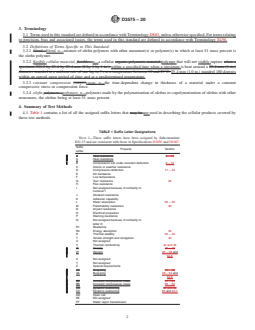
TABLE 1 Suffix Letter Designations
crosslinking will vary in different parts of the finished product,
NOTE 1—These suffix letters have been assigned by Subcommittee
especially if the article is of complicated shape or of varying
D11.33 and are consistent with those in Specifications D1056 and D1667.
thickness, and these factors affect the physical properties of the
Suffix
Property Section
Letter specimens.Also,theapparentdensityisaffectedbythenumber
A Heat resistance of cut surfaces as opposed to the number of skin-covered
B Compression set under constant deflection 9–16
surfaces on the test specimen.
C Ozone or weather resistance
D Compression deflection 17–24
6.4 When the finished product does not lend itself to testing
E Oil resistance
or to the taking of test specimens because of complicated
F Low temperature
G Tear resistance 25
shape,smallsize,metalorfabricinserts,solidcovers,adhesion
H Flex resistance
to metal, or other reasons, prepare standard test sheets. When
I Not assigned because of similarity to
numeral 1 differences due to the difficulty in obtaining suitable test
J Abrasion resistance
specimens from the finished part arise, the manufacturer and
K Adhesion capability
purchaser may agree on acceptable deviations. This can be
L Water absorption 26–32
M Flammability resistance 33 done by comparing the results of standard test specimens and
N Impact resistance
those obtained on actual parts.
O Electrical properties
P Staining resistance
6.5 Ifthematerialtobetestedisanisotropic,preparethetest
Q Not assigned because of similarity to
specimens so as to measure the property in the direction of
letter O
R1 Resilience
interest in the application.
R2 Energy absorption 34
S Thermal stability 35–42
7. Conditioning
T Tensile strength and elongation 43
U Not assigned
V Thermal conductivity 44 and 45 7.1 Conduct tests under known conditions of temperature
W Density 46–48 and
and humidity or as specified in the individual test procedure. In
64.5
case of dispute, conduct the test at a temperature of 23 6 2°C
X Not assigned
Y Not assigned
(73.4 6 3.6°F) and in an atmosphere of 50 6 10 % relative
Z Special requirements
humidity. The product shall be conditioned, undeflected, and
AA Buoyancy 49–54 and
undistorted, at the temperature and humidity of test for at least
64.6
BB Constant compressive creep 55–62
24 h before being tested.
CC Dynamic cushioning 63 and 64.7
DD Open cell
7.2 It is recommended, for referee purposes, that all tests
EE Not assigned
shall be performed 96 h or more after the foam has been
FF Water vapor transmission
manufactured.
D3575−20
8. Measurement of Test Specimens deviates more than 20 % from this mean, test two additional
specimens and report the mean for all five values.
8.1 Measuredimensionsuptoandincluding25.4mm(1in.)
using a dial-type gauge with a minimum foot area of 645.1
13. Procedure
2 2
mm (1 in. ). Hold the pressure on the foot to a maximum of
13.1 Perform the entire test procedure at 23 6 2°C (73.4 6
800 Pa (0.116 psi).
3.6°F).
NOTE 2—Thickness of materials having irregular surface characteristics
NOTE 4—See Practice D1349 if conditions other than these are desired.
shall be measured as agreed upon between the purchaser and the supplier.
13.2 Measure the test specimen original thickness (t)in
o
8.2 Dimensionsover25.4mm(1in.)shallbemeasuredwith
accordance with the procedure in Section 8.
a dial or digital gauge, scale, or tape. Take care not to distort
the test specimen.
13.3 Place the test specimen or specimens in the apparatus
in a manner that will not allow the specimens to come into
8.3 The scale, tape, or gauge shall be graduated to permit
contact with each other upon being compressed and deflect the
measurements within 61 % of the dimension to be measured.
specimens to 50 % 6 1 % of their thickness.
8.4 Results reported shall be the average of a minimum of
13.4 Allow the test specimen to remain deflected in the
three equally spaced measurements of length and width and for
apparatus for 22 h 6 30 minutes.
thickness shall be the average of the center and four equally
spaced measurements around the perimeter of the specimens.
13.5 Remove the specimen from the test apparatus at the
end of the 22-h period. Measure the final thickness ( t) after 24
f
h 6 30 minutes of recovery.
Suffix Tests Suffix B—Compression Set Under Constant
Deflection
14. Calculation
14.1 Calculate the constant deflection compression set,
9. Scope
expressed as a percentage of the original thickness, as follows:
9.1 This test method covers the deflection of the foam
t 2 t
~ !
o f
specimen under a compressive force and under specified
C 5 3100 (1)
d
t
o
conditions of time and temperature, then noting the effect on
the thickness of the specimen after releasing the compressive
where:
force.
C = compression set expressed as a percent of the original
d
9.2 This international standard was developed in accor-
thickness,
t = original thickness, mm (in.), and
dance with internationally recognized principles on standard-
o
t = thickness of the specimen after the specified recovery
ization established in the Decision on Principles for the
f
period, mm. (in.)
Development of International Standards, Guides and Recom-
mendations issued by the World Trade Organization Technical
15. Report
Barriers to Trade (TBT) Committee.
15.1 The original and final thicknesses of the three speci-
mens to the nearest 0.0254 mm (0.001 in.).
10. Apparatus
15.2 The average compression set value, of the three speci-
10.1 Compression Device, consisting of two or more flat
mens tested to the nearest 0.1 % for each sample, except as
steel or aluminum plates that are of sufficient thickness to
noted in 13.1.
prevent deflection of the plates under load. The plates are held
paralleltoeachotherbyboltsorclamps,andthespacebetween
16. Precision and Bias
the plates is adjustable to the required deflection thickness by
16.1 See Section 64 for precision and bias data.
means of spacers.
Suffix D—Compression Deflection (Also called Load
11. Test Specimens
Deflection or Compressive Strength)
11.1 The test specimens shall have parallel top and bottom
17. Scope
surfaces and essentially perpendicular sides.
17.1 This test method covers the measurement of the force
11.2 Specimensshallbe50.8by50.8by25.4mm(2by2by
necessary to produce a 25 % compression over the entire top
1 in.) unless otherwise specified. Specimens less than 25.4 mm
area of the foam specimen.
in thickness shall be plied up, without the use of an adhesive,
to produce a total thickness of 25.4 mm.
NOTE 5—Compression deflection tests other than at 25 % may be
specified as agreed upon between the purchaser and the supplier.
NOTE 3—To obtain accurate data when testing foams with large cells or
irregular surfaces, or both, larger samples approximately 101.6 by 101.6 17.2 This international standard was developed in accor-
by 25.4 mm (4 by 4 by 1 in.) are recommended.
dance with internationally recognized principles on standard-
ization established in the Decision on Principles for the
12. Number of Specimens
Development of International Standards, Guides and Recom-
12.1 Test three specimens for each sample. The values mendations issued by the World Trade Organization Technical
reported shall be the mean of those observed. If any value Barriers to Trade (TBT) Committee.
D3575−20
18. Apparatus 23.3 The average compression deflection of the three speci-
mens in kPa or psi to the nearest 0.1, except as noted in 20.1.
18.1 An apparatus shall be capable of compressing the
specimen between a flat supporting plate and a flat compres-
24. Precision and Bias
sion foot, larger than the specimen to be tested, at a uniform
24.1 See Section 64 for precision and bias data.
speed of 31.75 6 12.7 mm/min (1.25 6 0.5 in⁄min). The
apparatus shall be capable of measuring the force required to
Suffix G—Tear Resistance, Test Method D624
produce the specified compression and the displacement of the
compression foot.
25. Test Method D624
25.1 Die C shall be used.
19. Test Specimens
25.2 Test the material at the thickness to be supplied, unless
19.1 The test specimen shall be 50.8 by 50.8 by 25.4 mm (2
otherwise arranged by agreement between the purchaser and
by 2 by 1 in.), unless otherwise specified, with parallel top and
the supplier.
bottom surfaces. Tolerances for the dimensions shall be 61.27
mm (0.050 in.). Specimens less than 25.4 mm thick shall be
Suffix L—Water Absorption
plied up, without the use of cement, to a minimum of 25.4 mm.
26. Scope
NOTE 6—Specimens less than 25.4 mm (1 in.) thick may be tested
without being plied up, but the thickness must be specified.
26.1 This test method covers the measurement of the water
absorbed by olefin polymer flexible cellular materials during
20. Number of Specimens
submersion under pressure.
20.1 Test three specimens for each sample. The values
26.2 This international standard was developed in accor-
reported shall be the mean of those observed. If any value
dance with internationally recognized principles on standard-
deviates more than 20 % from this mean, test two additional
ization established in the Decision on Principles for the
specimens and report the mean for all five values.
Development of International Standards, Guides and Recom-
mendations issued by the World Trade Organization Technical
21. Procedure
Barriers to Trade (TBT) Committee.
21.1 Placethespecimencenteredinthelineoftheaxialload
on the supporting plate of the apparatus.
27. Test Specimens
21.2 Bring the compression foot into contact with the
27.1 Testspecimensshallbe101.6by101.6mm(4by4in.)
specimen and determine the thickness after applying a total
by the thickness of material being supplied. Unless otherwise
pretest-pressure of 190 6 50 Pa (0.028 6 0.007 psi) to the
specified, the presence of skin on the top or bottom surfaces
specimen area. Compress the specimen 25 6 0.5 % of this
shall be optional.
thickness at 12.7 6 1 mm/min (0.5 6 0.039 in.⁄min) and take
28. Number of Specimens
the reading of the load immediately, unless another speed is
specified.
28.1 Test three specimens for each sample. The values
reported shall be the mean of those observed. If any value
NOTE 7—Where foam is appreciably compressed by this pretest-
pressure, foot area and loading shall be as agreed upon between the deviates more than 20 % from this mean, test two additional
purchaser and the supplier.
specimens and report the mean for all five values.
22. Calculation
29. Procedure
22.1 Calculate the 25 % compression deflection stress, per
29.1 Measuretheareaofthecutsurfacesinaccordancewith
unit area of specimen, expressed as kilopascals or psi, as
Section 8 and calculate the area of the cut surfaces.
follows:
29.2 Weigh the specimens and submerge under a 3 6 0.1-m
F
(10-ft 6 4-in.) head of water (equal to 28.68–31.09 kPa or
CD 5 (2)
A
4.16–4.51 psi) at 23 6 2°C (73.4 6 3.6°F) for 48 h 6 15 min.
Then place the specimens in a stream of air for the minimum
where:
time required to remove visible water from the surfaces and
CD = compression deflection stress per unit of specimen
reweigh.
area, kPa (psi),
F = force required to compress the specimen 25 % of the
NOTE 8—To remove visible and entrapped water from the surface and
thickness as measured in 8.2, kN (lbf), and cut edges, direct a stream of air (using approximately 30 psi air pressure)
2 2
at the surfaces and cut edges at approximately a 45 degree angle and from
A = specimen contact surface area, m (in. ).
the distance of approximately 6.35 mm (0.25 in.) from the surface for
approximately 4 min.
23. Report
23.1 The average thickness of the three specimens to the 30. Calculation
nearest 0.0254 mm (0.001 in). 2
30.1 Calculate the water absorption, expressed in kg/m
23.2 The average area of the three specimens to the nearest (lb/ft ) of cut surfaces (surfaces without skin or rind) as
2 2
0.645 mm (0.001 in. ). follows:
D3575−20
W 2 W 38. Number of Specimens
2 1
Water Absorption 5 (3)
A
38.1 A single specimen shall be tested for each sample.
where:
39. Procedure
W = specimen mass before immersion, kg (lb),
39.1 Determine all three dimensions in accordance with the
W = specimen mass after immersion, kg (lb), and
2 2
A = area of cut surface, m (ft ). procedure in Section 8.
39.2 Adjust the oven temperature to 70 6 2°C (158 6
31. Report
3.6°F).
31.1 The initial and final mass of the three specimens to the
39.3 Expose the test specimen in the oven at the above
nearest 0.001 g.
temperature for 24 h 6 15 minutes.
2 2
31.2 The average water absorption in kg/m (lb/ft)ofthe
39.4 Remove the test specimen and allow to cool at 236
three specimens tested to the nearest 0.1, except as noted in
2°C (73.4 6 3.6°F) for 2 h 6 15 minutes.
28.1.
39.5 Determine all three dimensions at the end of the
cooling period.
32. Precision and Bias
32.1 See Section 64 for precision and bias data.
40. Calculation
40.1 Calculate the dimensional change for each dimension
Suffix M—Flammability Ease of Ignition
as a percent of original as follows:
33. See Test Method D2863
L 2 L
f o
% dimensional change 5 3100 (4)
L
o
Suffix R —Energy Absorption
where:
34. See Test Method F355
L = original dimension, mm (in.), and
o
L = dimension at end of test, mm (in.).
f
34.1 Procedure A of Test Method F355 shall be used.
34.2 The impact velocity shall be 3.45 6 0.17 m/s.
41. Report
NOTE 9—Approximate drop height is 60 cm (24 in.).
41.1 Thedimensionalchangeofeachdirectionofinterestas
a percent of the original dimension to the nearest 0.1 %.
34.3 Conduct the test at 23 6 2°C (73.4 6 3.6°F).
41.2 The shrinkage as negative values and growth as posi-
34.4 The test specimens shall be 25.4 mm (1 in.) thick.
tive values.
Suffix S—Thermal Stability
42. Precision and Bias
35. Scope
42.1 See Section 64 for precision and bi
...
This document is not an ASTM standard and is intended only to provide the user of an ASTM standard an indication of what changes have been made to the previous version. Because
it may not be technically possible to adequately depict all changes accurately, ASTM recommends that users consult prior editions as appropriate. In all cases only the current version
of the standard as published by ASTM is to be considered the official document.
Designation: D3575 − 14 D3575 − 20
Standard Test Methods for
Flexible Cellular Materials Made Fromfrom Olefin Polymers
This standard is issued under the fixed designation D3575; the number immediately following the designation indicates the year of
original adoption or, in the case of revision, the year of last revision. A number in parentheses indicates the year of last reapproval. A
superscript epsilon (´) indicates an editorial change since the last revision or reapproval.
1. Scope Scope*
1.1 These test methods apply to flexible closed cell materials made from olefin polymers or blends of olefin polymers with other
polymers as defined in Section 3.
1.2 These test methods cover test procedures only. Product requirements are outlined in Specification D4819.
1.3 Unless specifically stated otherwise, by agreement between the purchaser and supplier, all tests shall be performed in
accordance with the test methods specified in this standard.
1.4 The values stated in SI units are to be regarded as the standard.
1.5 This standard does not purport to address all of the safety concerns, if any, associated with its use. It is the responsibility
of the user of this standard to establish appropriate safety safety, health, and healthenvironmental practices and determine the
applicability orof regulatory limitations prior to use.
NOTE 1—This standard and ISO 7214 address the same subject matter, but differ in technical content.
1.6 This international standard was developed in accordance with internationally recognized principles on standardization
established in the Decision on Principles for the Development of International Standards, Guides and Recommendations issued
by the World Trade Organization Technical Barriers to Trade (TBT) Committee.
2. Referenced Documents
2.1 ASTM Standards:
C177 Test Method for Steady-State Heat Flux Measurements and Thermal Transmission Properties by Means of the
Guarded-Hot-Plate Apparatus
C518 Test Method for Steady-State Thermal Transmission Properties by Means of the Heat Flow Meter Apparatus
D412 Test Methods for Vulcanized Rubber and Thermoplastic Elastomers—Tension
D624 Test Method for Tear Strength of Conventional Vulcanized Rubber and Thermoplastic Elastomers
D883 Terminology Relating to Plastics
D1056 Specification for Flexible Cellular Materials—Sponge or Expanded Rubber
D1349 Practice for Rubber—Standard Conditions for Testing
D1596 Test Method for Dynamic Shock Cushioning Characteristics of Packaging Material
D1667 Specification for Flexible Cellular Materials—Poly (Vinyl Chloride) Foam (Closed-Cell)
D2863 Test Method for Measuring the Minimum Oxygen Concentration to Support Candle-Like Combustion of Plastics
(Oxygen Index)
D4819 Specification for Flexible Cellular Materials Made From Polyolefin Plastics
E177 Practice for Use of the Terms Precision and Bias in ASTM Test Methods
E456 Terminology Relating to Quality and Statistics
E691 Practice for Conducting an Interlaboratory Study to Determine the Precision of a Test Method
E2935 Practice for Conducting Equivalence Testing in Laboratory Applications
F355 Test Method for Impact Attenuation of Playing Surface Systems, Other Protective Sport Systems, and Materials Used for
Athletics, Recreation and Play
These test methods are under the jurisdiction of ASTM Committee D20 on Plastics and are the direct responsibility of Subcommittee D20.22 on Cellular Materials -
Plastics and Elastomers.
Current edition approved Jan. 1, 2014Feb. 1, 2020. Published January 2014March 2020. Originally approved in 1977. Last previous edition approved in 20082014 as
D3575 - 08.D3575-14. DOI: 10.1520/D3575-14.10.1520/D3575-20.
For referenced ASTM standards, visit the ASTM website, www.astm.org, or contact ASTM Customer Service at service@astm.org. For Annual Book of ASTM Standards
volume information, refer to the standard’s Document Summary page on the ASTM website.
*A Summary of Changes section appears at the end of this standard
Copyright © ASTM International, 100 Barr Harbor Drive, PO Box C700, West Conshohocken, PA 19428-2959. United States
D3575 − 20
3. Terminology
3.1 Terms used in this standard are defined in accordance with Terminology D883, unless otherwise specified. For terms relating
to precision, bias and associated issues, the terms used in this standard are defined in accordance with Terminology E456.
3.2 Definitions of Terms Specific to This Standard:
3.2.1 blend—blend, n—mixture of olefin polymers with other monomer(s) or polymer(s) in which at least 51 mass percent is
the olefin polymer.
3.2.2 flexible cellular material, flexible—n—a cellular organic polymeric material polymer that will not visibly rupture when a
specimen 203.2 by 25.4 by 25.4 mm (8 by 1 by 1 in.) within a specified time when a specimen is bent around a 25.4-mm (1-in.)
diameter mandrel at a uniform rate of one lap in 5 s at a temperature between 18 and 29°C. 25.4 mm (1.0 in.) mandrel 180 degrees
within an agreed upon period of time and at a predetermined temperature.
3.2.3 constant compression creep—creep, n—the time-dependent change in thickness of a material under a constant
compressive stress or compression force.
3.2.4 olefin polymers—polymers, n—polymers made by the polymerization of olefins or copolymerization of olefins with other
monomers, the olefins being at least 51 mass percent.
4. Summary of Test Methods
4.1 Table 1 contains a list of all the assigned suffix letters that may be are used in describing the cellular products covered by
these test methods.
TABLE 1 Suffix Letter Designations
NOTE 1—These suffix letters have been assigned by Subcommittee
D11.33 and are consistent with those in Specifications D1056 and D1667.
Suffix
Property Section
Letter
A Heat resistance 9 – 16
A Heat resistance
B Compression set under constant deflection 9 – 16
C Ozone or weather resistance
D Compression deflection 17 – 24
E Oil resistance
F Low temperature
G Tear resistance 25
H Flex resistance
I Not assigned because of similarity to
numeral 1
J Abrasion resistance
K Adhesion capability
L Water absorption 26 – 32
M Flammability resistance 33
N Impact resistance
O Electrical properties
P Staining resistance
Q Not assigned because of similarity to
letter O
R1 Resilience
R2 Energy absorption 34
S Thermal stability 35 – 42
T Tensile strength and elongation 43
U Not assigned
V Thermal conductivity 44 and 45
W Density 46 – 49
W Density 46 – 48 and
64.5
X Not assigned
Y Not assigned
Z Special requirements
AA Buoyancy 50 – 56
AA Buoyancy 49 – 54 and
64.6
BB Constant compressive creep 57 – 64
BB Constant compressive creep 55 – 62
CC Dynamic cushioning 65 and 66
CC Dynamic cushioning 63 and 64.7
DD Open cell
EE Not assigned
FF Water vapor transmission
D3575 − 20
4.2 These test methods do not contain test methods for all the suffix letters listed in Table 1. Where the test method is not
included, it shall be arranged between the purchaser and supplier.
4.3 Test methods included in this standard are indicated in Table 1 by showing the applicable section numbers after the suffix
letter.
4.4 In cases involving referee decisions, SI units shall be used.
5. Significance and Use
5.1 The test procedures provide a standard method of obtaining data for research and development, quality control, acceptance
and rejection under specifications, and special purposes.
5.2 The data obtained by these test methods are applicable to the material under conditions of the particular test and are not
necessarily the same as obtained in other environments or use conditions.
6. Sampling
6.1 When possible, use the completed manufactured product for the tests specified. Randomly select representative samples of
the lot being examined, as required.
6.2 Extruded or molded shapes or sizes too small for cutting standard test specimens are difficult to classify or test by these test
methods and will usually require special testing procedures or the use of standard test sheets.
6.3 When it is necessary or advisable to obtain test specimens from the article, as in those cases where the entire sample is not
required or adaptable for testing, specify the method of cutting and the exact position from which specimens are to be taken. The
It is possible that the apparent density and the state of crosslinking maywill vary in different parts of the finished product, especially
if the article is of complicated shape or of varying thickness, and these factors affect the physical properties of the specimens. Also,
the apparent density is affected by the number of cut surfaces as opposed to the number of skin-covered surfaces on the test
specimen.
6.4 When the finished product does not lend itself to testing or to the taking of test specimens because of complicated shape,
small size, metal or fabric inserts, solid covers, adhesion to metal, or other reasons, prepare standard test sheets. When differences
due to the difficulty in obtaining suitable test specimens from the finished part arise, the manufacturer and purchaser may agree
on acceptable deviations. This can be done by comparing the results of standard test specimens and those obtained on actual parts.
6.5 If the material to be tested is anisotropic, prepare the test specimens so as to measure the property in the direction of interest
in the application.
7. Conditioning
7.1 Conduct tests under known conditions of temperature and humidity or as specified in the individual test procedure. In case
of dispute, conduct the test at a temperature of 23 6 2°C (73.4 6 3.6°F) and in an atmosphere of 50 6 10 % relative humidity.
The product shall be conditioned, undeflected, and undistorted, at the temperature and humidity of test for at least 24 h before being
tested.
7.2 It is recommended, for referee purposes, that all tests shall be performed 96 h or more after the foam has been manufactured.
8. Measurement of Test Specimens
8.1 Measure dimensions up to and including 25.4 mm (1 in.) using a dial-type gauge with a minimum foot area of 645.1 mm
(1 in. ). Pressure Hold the pressure on the foot shall be held to 190 6 50 Pa (0.028 6 0.007 to a maximum of 800 Pa (0.116 psi).
NOTE 2—Where foam is appreciably compressed by this test method, foot area and loading shall be as agreed upon between the purchaser and the
supplier.
NOTE 2—Thickness of materials having irregular surface characteristics shall be measured as agreed upon between the purchaser and the supplier.
8.2 Dimensions over 25.4 mm (1 in.) mayshall be measured with a dial or digital gauge, scale, or tape. Take care not to distort
the test specimen.
8.3 The scale, tape, or gauge shall be graduated to permit measurements within 61 % of the dimension to be measured.
8.4 Results reported shall be the average of a minimum of three equally spaced measurements of length and width and for
thickness shall be the average of the center and four equally spaced measurements around the perimeter of the specimens.
Suffix Tests Suffix B—Compression Set Under Constant Deflection
9. Scope
9.1 This test method covers the deflection of the foam specimen under a compressive force and under specified conditions of
time and temperature, then noting the effect on the thickness of the specimen after releasing the compressive force.
D3575 − 20
9.2 This international standard was developed in accordance with internationally recognized principles on standardization
established in the Decision on Principles for the Development of International Standards, Guides and Recommendations issued
by the World Trade Organization Technical Barriers to Trade (TBT) Committee.
10. Apparatus
10.1 Compression Device, consisting of two or more flat steel or aluminum plates that are of sufficient thickness to prevent
deflection of the plates under load. The plates are held parallel to each other by bolts or clamps, and the space between the plates
is adjustable to the required deflection thickness by means of spacers.
11. Test Specimens
11.1 The test specimens shall have parallel top and bottom surfaces and essentially perpendicular sides.
11.2 Specimens shall be 50.8 by 50.8 by 25.4 mm (2 by 2 by 1 in.) unless otherwise specified. Specimens less than 25.4 mm
in thickness shall be plied up, without the use of an adhesive, to produce a total thickness of 25.4 mm.
NOTE 3—To obtain accurate data when testing foams with large cells or irregular surfaces, or both, larger samples approximately 101.6 by 101.6 by
25.4 mm (4 by 4 by 1 in.) are recommended.
12. Number of Specimens
12.1 Test three specimens for each sample. The values reported shall be the mean of those observed. If any value deviates more
than 20 % from this mean, test two additional specimens and report the mean for all five values.
13. Procedure
13.1 Perform the entire test procedure at 23 6 2°C (73.4 6 3.6°F).
NOTE 4—See Practice D1349 if conditions other than these are desired.
13.2 Measure the test specimen original thickness (t ) in accordance with the procedure in Section 8.
o
13.3 Place the test specimen or specimens in the apparatus in a manner that will not allow the specimens to come into contact
with each other upon being compressed and deflect the specimens to 50 % 6 1 % of their thickness.
13.4 Allow the test specimen to remain deflected in the apparatus for 22 h 6 30 minutes.
13.5 Remove the specimen from the test apparatus at the end of the 22-h period. Measure the final thickness ( t ) after 24 h 6
f
30 minutes of recovery.
14. Calculation
14.1 Calculate the constant deflection compression set, expressed as a percentage of the original thickness, as follows:
t 2 t
~ !
o f
C 5 3100 (1)
d
t
o
where:
C = compression set expressed as a percent of the original thickness,
d
t = original thickness, mm (in.), and
o
t = thickness of the specimen after the specified recovery period, mm. (in.)
f
15. Report
15.1 The original and final thicknesses of the three specimens to the nearest 0.0254 mm (0.001 in.).
15.2 Report the The average compression set value, of the three specimens tested, tested to the nearest 0.1 % for each sample,
except as noted in 13.1.
16. Precision and Bias
16.1 See Section 6764 for precision and bias data.
Suffix D—Compression Deflection (Also called Load Deflection or Compressive Strength)
17. Scope
17.1 This test method covers the measurement of the force necessary to produce a 25 % compression over the entire top area
of the foam specimen.
NOTE 5—Compression deflection tests other than at 25 % may be specified as agreed upon between the purchaser and the supplier.
D3575 − 20
17.2 This international standard was developed in accordance with internationally recognized principles on standardization
established in the Decision on Principles for the Development of International Standards, Guides and Recommendations issued
by the World Trade Organization Technical Barriers to Trade (TBT) Committee.
18. Apparatus
18.1 An apparatus shall be provided having a flat capable of compressing the specimen between a flat supporting plate and a
flat compression foot, larger than the specimen to be tested, connected to a force-measuring device and mounted in a manner such
that the product or specimen can be deflected (compressed) at a speed of 0.21 to 0.84 mm/sat a uniform speed of 31.75 6 12.7
mm/min (1.25 6 0.5 in (0.5 to 2 in./min). ⁄min). The apparatus shall be arranged to support the specimen on a level horizontal
plate.capable of measuring the force required to produce the specified compression and the displacement of the compression foot.
19. Test Specimens
19.1 The test specimen shall be 50.8 by 50.8 by 25.4 mm (2 by 2 by 1 in.) with parallel top and bottom surfaces. The thickness
shall be no greater than 75 % of the minimum top dimension.
2 2
19.1 Specimens shall be a minimum of 2580.6 mmThe test specimen shall be 50.8 by 50.8 by 25.4 (4 in.mm (2 ) in area and
have a minimum thickness of 25.4 mm (1 by 2 by 1 in.), unless otherwise specified, with parallel top and bottom surfaces.
Tolerances for the dimensions shall be 61.27 mm (0.050 in.). Specimens less than 25.4 mm thick shall be plied up, without the
use of cement, to a minimum of 25.4 mm.
NOTE 6—Specimens less than 25.4 mm (1 in.) thick may be tested without being plied up, but the thickness must be specified.
20. Number of Specimens
20.1 Test three specimens for each sample. The values reported shall be the mean of those observed. If any value deviates more
than 20 % from this mean, test two additional specimens and report the mean for all five values.
21. Procedure
21.1 Place the specimen centered in the line of the axial load on the supporting plate of the apparatus.
21.2 Bring the compression foot into contact with the specimen and determine the thickness after applying a total
pretest-pressure of 190 6 50 Pa (0.028 6 0.007 psi) to the specimen area. Compress the specimen 25 6 0.5 % of this thickness
at 12.712.7 6 1 mm/min (0.5 in./min)(0.5 6 0.39 in. ⁄min) and take the reading of the load immediately, unless another speed is
specified.
NOTE 7—Where foam is appreciably compressed by this pretest-pressure, foot area and loading shall be as agreed upon between the purchaser and the
supplier.
22. Calculation
22.1 Calculate the 25 % compression deflection force,stress, per unit area of specimen, expressed as kilopascals (or
pounds-force per square inch), or psi, as follows:
F
CD 5 (2)
A
where:
CD = compression deflection force per unit of specimen area, kPa (psi),
F = force required to compress the specimen 25 % of the thickness as measured in 8.2, N (lbf), and
2 2
A = specimen compression contact surface area, m (in. ).
CD = compression deflection stress per unit of specimen area, kPa (psi),
F = force required to compress the specimen 25 % of the thickness as measured in 8.2, kN (lbf), and
2 2
A = specimen contact surface area, m (in. ).
23. Report
23.1 The average thickness of the three specimens to the nearest 0.0254 mm (0.001 in).
2 2
23.2 The average area of the three specimens to the nearest 0.645 mm (0.001 in. ).
23.3 Report the average thickness after pretest pressure and the average compression deflection, forThe average compression
deflection of the three specimens tested, in kilopascals (or pounds-force per square inch), required for 25 % compression, in kPa
or psi to the nearest 0.1, except as noted in 20.1.
24. Precision and Bias
24.1 See Section 6764 for precision and bias data.
D3575 − 20
Suffix G—Tear Resistance, Test Method D624
25. Test Method D624
25.1 Die C shall be used.
25.2 Test the material at the thickness to be supplied, unless otherwise arranged by agreement between the purchaser and the
supplier.
Suffix L—Water Absorption
26. Scope
26.1 This test method covers the measurement of the water absorbed by olefin polymer flexible cellular materials during
submersion under pressure.
26.2 This international standard was developed in accordance with internationally recognized principles on standardization
established in the Decision on Principles for the Development of International Standards, Guides and Recommendations issued
by the World Trade Organization Technical Barriers to Trade (TBT) Committee.
27. Test Specimens
27.1 Test specimens shall be 101.6 by 101.6 mm (4 by 4 in.) by the thickness of material being supplied. The specimen may
or may not have natural skins on top, bottom, or both surfaces.Unless otherwise specified, the presence of skin on the top or bottom
surfaces shall be optional.
28. Number of Specimens
28.1 Test three specimens for each sample. The values reported shall be the mean of those observed. If any value deviates more
than 20 % from this mean, test two additional specimens and report the mean for all five values.
29. Procedure
29.1 Measure the area of the cut surfaces in accordance with Section 8 and calculate the area of the cut surfaces.
29.2 Weigh the specimens and submerge under a 3-m (10-ft) 3 6 0.1-m (10-ft 6 4-in.) head of water (equal to 3028.68–31.09
kPa or 4.35 psi) at room temperature (18 to 29°C (65 to 90°F)) for 48 h. 4.16–4.51 psi) at 23 6 2°C (73.4 6 3.6°F) for 48 h 6
15 min. Then place the specimens in a stream of air for the minimum time required to remove visible water from the surfaces and
reweigh.
NOTE 8—To remove visible and entrapped water from the surface and cut edges, direct a stream of air (using approximately 30 psi air pressure) at the
surfaces and cut edges at approximately a 45 degree angle and from the distance of approximately 6.35 mm (0.25 in.) from the surface for approximately
4 min.
30. Calculation
2 2
30.1 Calculate the water absorption, expressed in kg/m (lb/ft ) of cut surfaces (surfaces without skin or rind) as follows:
W 2 W
2 1
Water Absorption 5 (3)
A
where:
W = specimen mass before immersion, kg (lb),
W = specimen mass after immersion, kg (lb), and
2 2
A = area of cut surface, m (ft ).
31. Report
31.1 The initial and final mass of the three specimens to the nearest 0.001 g.
2 2
31.2 Report the The average water absorption in kg/m (lb/ft ) of the three specimens tested, tested to the nearest 0.1, except
as noted in 28.1.
32. Precision and Bias
32.1 See Section 6764 for precision and bias data.
D3575 − 20
Suffix M—Flammability Ease of Ignition
33. See Test Method D2863
Suffix R —Energy Absorption
34. See Test Method F355
34.1 Procedure A of Test Method F355 shall be used.
34.2 The impact velocity shall be 3.45 6 0.17 m/s.
NOTE 9—Approximate drop height is 60 cm (24 in.).
34.3 Conduct the test at 23 6 2°C (73.4 6 3.6°F).
34.4 The test specimens shall be 25.4 mm (1 in.) thick.
Suffix S—Thermal Stability
35. Scope
35.1 This test method covers the determination of dimensional stability of foam in any direction, at elevated temperature.
35.2 This international standard was developed in accordance with internationally recognized principles on standardization
established in the Decision on Principles for the Development of International Standards, Guides and Recommendations issued
by the World Trade Organization Technical Barriers to Trade (TBT) Committee.
36. Apparatus
36.1 Oven, circulating-air, capable of holding the set temperature to a tolerance of 61 %.
37. Test Specimen
37.1 The test specimens shall be 254 by 254 by 25.4 mm (10 by 10 by 1 in.). Where finished goods with smaller than the
specified test specimen are to be tested, the full available dimensions shall be used.
NOTE 10—An alternative test method is to cut 304.8 by 304.8-mm (12 by 12-in.) specimens and mark off the 254 by 254-mm (10 by 10-in.) dimensions.
38. Number of Specimens
38.1 A single specimen shall be tested for each sample.
39. Procedure
39.1 Determine all three dimensions in accordance with the procedure in Section 8.
39.2 Adjust the oven temperature to 70 6 2°C (158 6 3.6°F).
39.3 Expose the test specimen in the oven at the above temperature for 24 h 6 15 minutes.
39.4 Remove the test specimen and allow to cool at 236 2°C (73.4 6 3.6°F) for 2 h 6 15 minutes.
39.5 Determine all three dimensions at the end of the cooling period.
40. Calculation
40.1 Calculate the dimensional change for each dimension as a percent of original as follows:
L 2 L
f o
% dimensional change 5 3100 (4)
L
o
where:
L = original dimension, mm (in.), and
o
L = dimension at end of test, mm (in.).
f
41. Report
41.1 Report the The dimensional change of each direction of interest as a percent of the original dimension.dimension to the
nearest 0.1 %.
41.2 ReportThe shrinkage as negative values and growth as positive values.
42. Precision and Bias
42.1 See Section 6764 for precision and bias data.
D3575 − 20
Suffix T—Tensile Strength and Elongation
43. See Test Methods D412
43.1 The samples shall be cut using the Die A, as described in Test Methods D412.
43.2 Test the material in the thickness to be supplied, unless otherwise agreed upon between the purchaser and the supplier.
Suffix V—Thermal Conductivity
44. Test Method A
44.1 See Test Method C177.
45. Test Method B
45.1 See Test Method C518.
Suffix W—Density
46. Test Method A
46.1 Scope—This test method covers the determination of density of foam by calculation from the mass and volume of a
regularly shaped specimen.
3 3
46.2 Test Specimen—A representative test specimen of regular shape, not less than 16.4 cm (1 in. ) shall be cut from the sample
to be tested.
NOTE 11—Larger specimens may be necessary when testing coarse cell foams.
46.3 Number of Specimens—A single specimen Three specimens shall be tested for each sample.
46.4 Procedure:
46.4.1 Weigh the specimen on a balance or scale graduated so as to permit weighing within 61 % of the mass to be measured.
...