

ASTM F667/F667M-16(2021)
(Specification)Standard Specification for 3 through 24 in. Corrugated Polyethylene Pipe and Fittings
General Information
- Abstract
ABSTRACT
This specification covers requirements and test methods for materials, workmanship, dimensions, perforations, pipe stiffness, elongation, joint separation resistance, quality of extruded polyethylene, brittleness, bond, and marking of corrugated polyethylene (PE) pipe and fittings. This specification covers tubularly extruded, spirally laminated, and rotationally molded corrugated polyethylene pipe. Corrugated PE pipe and fittings are intended for underground applications where soil provides support to their flexible walls. Their major use is to collect or convey drainage water, or both. The following tests shall be performed: dimensions and tolerances; pipe stiffness; elongation; pipe stiffness while elongated; joint-separation test; and brittleness.
SCOPE
1.1 This specification covers requirements and test methods for materials, workmanship, dimensions, perforations, pipe stiffness, elongation, joint separation resistance, quality of extruded polyethylene, brittleness, bond, and marking of corrugated polyethylene (PE) pipe and fittings. It covers nominal sizes 3 in. [76 mm], 4 in. [102 mm], 5 in. [127 mm] 6 in. [152 mm], 8 in. [203 mm], 10 in. [254 mm], 12 in. [305 mm], 15 in. [381 mm], 18 in. [457 mm], and 24 in. [610 mm].
1.2 This specification covers tubularly extruded, spirally laminated, and rotationally molded corrugated polyethylene pipe.
1.3 The values stated in inch-pound units are to be regarded as standard. The values given in parentheses are mathematical conversions to SI units that are provided for information only and are not considered standard.
1.4 The following precautionary caveat pertains only to the test method portion, Section 9, of this specification: This standard does not purport to address all of the safety concerns, if any, associated with its use. It is the responsibility of the user of this standard to establish appropriate safety, health, and environmental practices and determine the applicability of regulatory limitations prior to use.
1.5 This international standard was developed in accordance with internationally recognized principles on standardization established in the Decision on Principles for the Development of International Standards, Guides and Recommendations issued by the World Trade Organization Technical Barriers to Trade (TBT) Committee.
- Status
- Published
- Publication Date
- 31-Mar-2021
- Technical Committee
- F17 - Plastic Piping Systems
- Drafting Committee
- F17.65 - Land Drainage
Overview
ASTM F667/F667M-16(2021) is the internationally recognized standard specification for 3 through 24 inch corrugated polyethylene pipe and fittings. Developed by ASTM International, this standard establishes the critical requirements and test methods to ensure the quality, performance, and suitability of corrugated polyethylene (PE) pipe systems intended primarily for underground drainage and water conveyance applications. The specification covers various forms of PE pipe, including tubularly extruded, spirally laminated, and rotationally molded designs.
The scope encompasses key criteria such as material properties, workmanship, dimensions, perforation requirements, pipe stiffness, elongation resistance, joint integrity, brittleness, bond strength, and comprehensive marking protocols. Designed for regulatory compliance and practical application, ASTM F667/F667M-16(2021) aligns with international principles for standardization, making it widely acceptable for both commercial and government projects.
Key Topics
- Material and Workmanship: Specifies minimum cell classifications for PE compounds, allowing clean rework material if the product meets all requirements. Ensures pipes and fittings are homogeneous and uniform in color, opacity, and density.
- Dimensions and Tolerances: Covers nominal sizes from 3 in. [76 mm] to 24 in. [610 mm], with defined tolerances on inside diameter and minimum length specifications.
- Perforations: Requirements for perforation size, spacing, and inlet area to suit varying drainage needs.
- Pipe Stiffness and Elongation: Prescribes minimum stiffness ratings at different deflection levels and acceptable elongation limits to ensure pipe durability and flexibility underground.
- Joint Integrity: Mandates joint separation resistance to maintain pipeline function and prevent leaks.
- Quality Assurance: Involves tests for brittleness, bond strength in spirally laminated pipes, and fittings performance.
- Marking and Certification: Details permanent product marking requirements for traceability (including standard designation and manufacturing date) and certification options for buyers.
Applications
Corrugated polyethylene pipe and fittings produced in accordance with ASTM F667/F667M-16(2021) are primarily used for:
- Underground Drainage Systems: Effective at collecting and conveying stormwater or surface water runoff beneath fields, roads, and other infrastructure where flexible, resilient pipe is required.
- Agricultural Water Management: Commonly used for field drainage, irrigation outlets, and water table control, improving soil conditions and crop yields.
- Subsurface Infrastructure: Installed under highways, embankments, and commercial developments for managing excess water and preventing soil erosion.
- Municipal and Residential Drains: Suitable for sewer ground water removal, French drains, and culverts in both rural and urban settings.
These polyethylene drainage pipes are supported by the surrounding soil, making them an excellent choice for applications needing cost-effective, corrosion-resistant, and easily installable solutions. Where chemicals or UV exposure are a concern, alternate materials may be required as exposure to such conditions is not recommended under this standard.
Related Standards
For comprehensive system design, manufacturing, and installation, consider referencing:
- ASTM D2412: Test Method for Determination of External Loading Characteristics of Plastic Pipe by Parallel-Plate Loading.
- ASTM D2444: Practice for Determination of the Impact Resistance of Thermoplastic Pipe and Fittings by Means of a Tup (Falling Weight).
- ASTM D3350: Specification for Polyethylene Plastics Pipe and Fittings Materials.
- ASTM F449: Practice for Subsurface Installation of Corrugated Polyethylene Pipe for Agricultural Drainage or Water Table Control.
- ASTM F412: Terminology Relating to Plastic Piping Systems.
These related ASTM standards help ensure the optimal selection, testing, and installation of corrugated polyethylene pipe systems for long-lasting performance in drainage and water conveyance projects.
Relations
- Effective Date
- 03-Dec-2015
- Effective Date
- 01-Apr-2020
- Effective Date
- 01-Feb-2020
- Effective Date
- 01-Jan-2019
- Effective Date
- 15-Nov-2017
- Effective Date
- 01-Aug-2017
- Effective Date
- 01-Feb-2017
- Effective Date
- 15-Nov-2016
- Effective Date
- 01-Aug-2016
- Effective Date
- 15-Feb-2016
- Effective Date
- 01-Jun-2015
- Effective Date
- 01-Mar-2014
- Effective Date
- 15-Feb-2013
- Effective Date
- 01-Apr-2012
- Effective Date
- 01-Apr-2012
Get Certified
Connect with accredited certification bodies for this standard

Institut za varilstvo d.o.o. (Welding Institute)
Slovenia's leading welding institute since 1952. ISO 3834, EN 1090, pressure equipment certification, NDT personnel, welder qualification. Only IIW Au
Sponsored listings
Frequently Asked Questions
ASTM F667/F667M-16(2021) is a technical specification published by ASTM International. Its full title is "Standard Specification for 3 through 24 in. Corrugated Polyethylene Pipe and Fittings". This standard covers: ABSTRACT This specification covers requirements and test methods for materials, workmanship, dimensions, perforations, pipe stiffness, elongation, joint separation resistance, quality of extruded polyethylene, brittleness, bond, and marking of corrugated polyethylene (PE) pipe and fittings. This specification covers tubularly extruded, spirally laminated, and rotationally molded corrugated polyethylene pipe. Corrugated PE pipe and fittings are intended for underground applications where soil provides support to their flexible walls. Their major use is to collect or convey drainage water, or both. The following tests shall be performed: dimensions and tolerances; pipe stiffness; elongation; pipe stiffness while elongated; joint-separation test; and brittleness. SCOPE 1.1 This specification covers requirements and test methods for materials, workmanship, dimensions, perforations, pipe stiffness, elongation, joint separation resistance, quality of extruded polyethylene, brittleness, bond, and marking of corrugated polyethylene (PE) pipe and fittings. It covers nominal sizes 3 in. [76 mm], 4 in. [102 mm], 5 in. [127 mm] 6 in. [152 mm], 8 in. [203 mm], 10 in. [254 mm], 12 in. [305 mm], 15 in. [381 mm], 18 in. [457 mm], and 24 in. [610 mm]. 1.2 This specification covers tubularly extruded, spirally laminated, and rotationally molded corrugated polyethylene pipe. 1.3 The values stated in inch-pound units are to be regarded as standard. The values given in parentheses are mathematical conversions to SI units that are provided for information only and are not considered standard. 1.4 The following precautionary caveat pertains only to the test method portion, Section 9, of this specification: This standard does not purport to address all of the safety concerns, if any, associated with its use. It is the responsibility of the user of this standard to establish appropriate safety, health, and environmental practices and determine the applicability of regulatory limitations prior to use. 1.5 This international standard was developed in accordance with internationally recognized principles on standardization established in the Decision on Principles for the Development of International Standards, Guides and Recommendations issued by the World Trade Organization Technical Barriers to Trade (TBT) Committee.
ABSTRACT This specification covers requirements and test methods for materials, workmanship, dimensions, perforations, pipe stiffness, elongation, joint separation resistance, quality of extruded polyethylene, brittleness, bond, and marking of corrugated polyethylene (PE) pipe and fittings. This specification covers tubularly extruded, spirally laminated, and rotationally molded corrugated polyethylene pipe. Corrugated PE pipe and fittings are intended for underground applications where soil provides support to their flexible walls. Their major use is to collect or convey drainage water, or both. The following tests shall be performed: dimensions and tolerances; pipe stiffness; elongation; pipe stiffness while elongated; joint-separation test; and brittleness. SCOPE 1.1 This specification covers requirements and test methods for materials, workmanship, dimensions, perforations, pipe stiffness, elongation, joint separation resistance, quality of extruded polyethylene, brittleness, bond, and marking of corrugated polyethylene (PE) pipe and fittings. It covers nominal sizes 3 in. [76 mm], 4 in. [102 mm], 5 in. [127 mm] 6 in. [152 mm], 8 in. [203 mm], 10 in. [254 mm], 12 in. [305 mm], 15 in. [381 mm], 18 in. [457 mm], and 24 in. [610 mm]. 1.2 This specification covers tubularly extruded, spirally laminated, and rotationally molded corrugated polyethylene pipe. 1.3 The values stated in inch-pound units are to be regarded as standard. The values given in parentheses are mathematical conversions to SI units that are provided for information only and are not considered standard. 1.4 The following precautionary caveat pertains only to the test method portion, Section 9, of this specification: This standard does not purport to address all of the safety concerns, if any, associated with its use. It is the responsibility of the user of this standard to establish appropriate safety, health, and environmental practices and determine the applicability of regulatory limitations prior to use. 1.5 This international standard was developed in accordance with internationally recognized principles on standardization established in the Decision on Principles for the Development of International Standards, Guides and Recommendations issued by the World Trade Organization Technical Barriers to Trade (TBT) Committee.
ASTM F667/F667M-16(2021) is classified under the following ICS (International Classification for Standards) categories: 23.040.20 - Plastics pipes; 23.040.45 - Plastics fittings. The ICS classification helps identify the subject area and facilitates finding related standards.
ASTM F667/F667M-16(2021) has the following relationships with other standards: It is inter standard links to ASTM F405-13, ASTM F412-20, ASTM F449-20, ASTM F412-19, ASTM D2444-17, ASTM F412-17a, ASTM F412-17, ASTM F412-16a, ASTM F412-16, ASTM F449-16, ASTM F412-15, ASTM F449-02(2014), ASTM F412-13, ASTM F412-12, ASTM D3350-12. Understanding these relationships helps ensure you are using the most current and applicable version of the standard.
ASTM F667/F667M-16(2021) is available in PDF format for immediate download after purchase. The document can be added to your cart and obtained through the secure checkout process. Digital delivery ensures instant access to the complete standard document.
Standards Content (Sample)
This international standard was developed in accordance with internationally recognized principles on standardization established in the Decision on Principles for the
Development of International Standards, Guides and Recommendations issued by the World Trade Organization Technical Barriers to Trade (TBT) Committee.
Designation: F667/F667M −16 (Reapproved 2021)
Standard Specification for
3 through 24 in. Corrugated Polyethylene Pipe and Fittings
This standard is issued under the fixed designation F667/F667M; the number immediately following the designation indicates the year
of original adoption or, in the case of revision, the year of last revision.Anumber in parentheses indicates the year of last reapproval.
A superscript epsilon (´) indicates an editorial change since the last revision or reapproval.
1. Scope* D2412Test Method for Determination of External Loading
Characteristics of Plastic Pipe by Parallel-Plate Loading
1.1 This specification covers requirements and test methods
D2444Practice for Determination of the Impact Resistance
for materials, workmanship, dimensions, perforations, pipe
of Thermoplastic Pipe and Fittings by Means of a Tup
stiffness, elongation, joint separation resistance, quality of
(Falling Weight)
extruded polyethylene, brittleness, bond, and marking of cor-
D3350Specification for Polyethylene Plastics Pipe and Fit-
rugated polyethylene (PE) pipe and fittings. It covers nominal
tings Materials
sizes 3 in. [76 mm], 4 in. [102 mm], 5 in. [127 mm] 6 in. [152
F412Terminology Relating to Plastic Piping Systems
mm],8in.[203mm],10in.[254mm],12in.[305mm],15in.
F449Practice for Subsurface Installation of Corrugated
[381 mm], 18 in. [457 mm], and 24 in. [610 mm].
Polyethylene Pipe for Agricultural Drainage or Water
1.2 This specification covers tubularly extruded, spirally
Table Control
laminated, and rotationally molded corrugated polyethylene
2.2 Federal Standard:
pipe.
Fed. Std. No. 123Marking for Shipment (Civil Agencies)
1.3 The values stated in inch-pound units are to be regarded
2.3 Military Standard:
as standard. The values given in parentheses are mathematical
MIL-STD-129Marking for Shipment and Storage
conversions to SI units that are provided for information only
and are not considered standard.
3. Terminology
1.4 The following precautionary caveat pertains only to the
3.1 Definitions—Definitions used in this specification are in
test method portion, Section 9, of this specification: This
accordance with Terminology F412, unless otherwise noted.
standard does not purport to address all of the safety concerns,
if any, associated with its use. It is the responsibility of the user
3.2 Definitions:
of this standard to establish appropriate safety, health, and
3.2.1 split—any break or crack that extends through the
environmental practices and determine the applicability of
wall.
regulatory limitations prior to use.
3.2.2 crease—a deformation that cannot be removed like a
1.5 This international standard was developed in accor-
dent: generally associated with wall buckling.
dance with internationally recognized principles on standard-
ization established in the Decision on Principles for the
4. Significance and Use
Development of International Standards, Guides and Recom-
mendations issued by the World Trade Organization Technical
4.1 Corrugated PE pipe and fittings are intended for under-
Barriers to Trade (TBT) Committee.
ground applications where soil provides support to their
flexible walls.Their major use is to collect or convey drainage
2. Referenced Documents
water, or both.
2.1 ASTM Standards:
4.2 Exclusions from Recommended Use:
D618Practice for Conditioning Plastics for Testing
4.2.1 Exposure to flame at any time,
4.2.2 Permanent exposure to sunlight or weathering, or
1 both, and
This specification is under the jurisdiction ofASTM Committee F17 on Plastic
Piping Systems and is the direct responsibility of Subcommittee F17.65 on Land
4.2.3 Exposure to chemicals, other than those normally
Drainage.
found in ground water, whose compatibility with the tubing
Current edition approved April 1, 2021. Published April 2021. Originally
and fittings is not known.
approved in 1980. Last previous edition approved in 2016 as F667/F667M–16.
DOI: 10.1520/F0667_F0667M-16R21.
For referenced ASTM standards, visit the ASTM website, www.astm.org, or
contact ASTM Customer Service at service@astm.org. For Annual Book of ASTM
Standards volume information, refer to the standard’s Document Summary page on DLA Document Services Building 4/D 700 Robbins Avenue Philadelphia, PA
the ASTM website. 19111-5094 http://quicksearch.dla.mil/
*A Summary of Changes section appears at the end of this standard
Copyright © ASTM International, 100 Barr Harbor Drive, PO Box C700, West Conshohocken, PA 19428-2959. United States
F667/F667M − 16 (2021)
5. Materials and circumference of the pipe in a size, shape, and pattern
suited to the needs of the user.
5.1 Basic Materials—Compounds used in the manufacture
7.3.2 The inlet area of the perforations shall be a minimum
of corrugated PE drainage pipe and fittings shall have a
2 2
of 1 in. /ft [21 cm /m] of pipe, unless otherwise specified by
minimumcellclassificationof323410Cor333410Casdefined
the user.
and described in Specification D3350. Compounds that have a
higher cell classification in one or more properties are 7.4 Pipe Stiffness—The pipe shall have a minimum pipe
acceptable, provided the product requirements are met.
stiffnessof30psi[0.21MPa]at5%deflectionand25psi[0.18
MPa] at 10% deflection, when tested in accordance with 9.5.
NOTE1—ClassBpigmentsmaybesubstitutedforClassCprovidedthat
ultraviolet protection is acceptable to the publisher as satisfactory for the
7.5 Elongation—Continuously extruded pipe that elongates
intended use.
more than 5%, but less than 10%, when tested in accordance
5.2 Rework Material—Clean rework material, generated
with 9.6, shall meet the requirements of 7.4 when tested in
from the manufacturer’s own production of the product, may accordance with 9.7. Pipe that elongates more than 10% shall
be used by the manufacturer provided that the tubing and
be rejected.
fittings produced meet all requirements of this specification.
7.6 Brittleness—Pipeandfittingspecimensshallbetestedin
accordance with 9.9.
6. General Requirements
7.7 Bond—The bond between layers of spirally laminated
6.1 Workmanship—The pipe and fittings shall be homog-
pipe shall be strong and uniform. There shall be no separation
enous throughout and essentially uniform in color, opacity,
of layers when the pipe is deflected 20%, in accordance with
density, and other properties. The inside and outside surfaces
Test Method D2412, nor shall it be possible to separate the
shall be semimatte or glossy in appearance (depending on the
layerswiththepointofaknifewhenthepipeisinthedeflected
type of plastic) and free of chalking, sticky, or tacky material.
condition.
Thepipeandfittingwallsshallbefreeofcracks,holes,blisters,
voids,foreigninclusions,orotherdefectsthatarevisibletothe
NOTE 3—This test may be conducted as a continuation of pipe stiffness
naked eye and that may affect the wall integrity. Holes testing as specified in 9.5.
NOTE 4—Until an ASTM specification for an acceptable stress-crack
deliberately placed in perforated pipe are acceptable. The
testispublished,environmentalstresscrackingshouldbeevaluatedbythe
surface shall be free of excessive bloom. Bloom or chalking
user on the basis of data furnished by the manufacturer.
may develop in pipe exposed to the direct rays of the sun
7.8 Fitting Requirements:
(ultravioletradiantenergy)forextendedperiods;consequently,
7.8.1 The fittings shall not reduce or impair the overall
these requirements do not apply to pipe and fittings after
integrity or function of the pipe line.
extended exposure to direct rays of the sun.
NOTE5—Commoncorrugatedfittingsincludein-linejointfittings,such
NOTE 2—Wall thickness may vary within each corrugation.Variation is
as tees, Y’s, reducers, couplers, elbows, and end caps. These fittings are
acceptable provided the tubing meets all physical requirements.
installed internally or externally by various methods, such as snap-on,
V-insertion, screw-on, or wrap around.
7. Detail Requirements
NOTE 6—Some corrugated fittings will not fit all pipe. Only fittings
7.1 General:
supplied or recommended by the pipe manufacturer should be used.
7.1.1 Thefollowingrequirementsshallbemetbyperforated
7.8.2 Joints made with couplers, installed in accordance
or nonperforated pipe, as applicable.
with the manufacturer’s instructions, shall not separate when
7.1.2 Individual results shall be used to determine compli-
tested in accordance with 9.8.
ance with the requirements, unless otherwise stated.
7.8.3 Fitting specimens shall not crack or split when tested
7.2 Dimensions and Tolerances:
in accordance with 9.9.
7.2.1 Pipe:
7.2.1.1 Nominal Diameter—The nominal diameter of the
8. Sampling and Retest
pipeshallbetheaverageinsidediameterroundedtothenearest
8.1 Sampling—Samples of pipe and fittings sufficient to
whole number.
determineconformancewiththisspecificationshallbetakenat
7.2.1.2 Inside Diameter—The tolerance on the nominal
random from stock by the testing agency. Samples shall be
inside diameter shall be +3%; −1.5%, when measured in
representative of the product type under consideration.
accordance with 9.3.
8.2 Retest and Rejection—Ifanytestfailureoccurs,thepipe
7.2.1.3 Length—The pipe may be sold in any length agree-
orfittingmayberetestedtoestablishconformity.Thetestshall
able to the user. Length shall not be less than 99% of stated
be repeated on two additional samples from the same lot or
quantity, when measured in accordance with 9.4.
shipment.Ifeitherofthesetwoadditionalsamplesfail,thepipe
7.2.2 Fittings:
or fitting does not comply with this specification.
7.2.2.1 The maximum allowable gap between pipe and
fitting shall not exceed ⁄8 in. [3 mm] unless otherwise
9. Test Methods
specified.
7.3 Perforations: 9.1 Conditioning Test Specimens—Condition the specimen
7.3.1 Drainage Pipe—When perforations are necessary, prior to test at 73.4°F 6 3.6°F [23°C 6 2°C] and 50% 6
theyshallbecleanlycutanduniformlyspacedalongthelength 5% relative humidity for not less than 40 h prior to the test, in
F667/F667M − 16 (2021)
accordance with Procedure A in Practice D618 for those tests elongation 3100
E,% 5
where conditioning is required, unless otherwise specified. gaugelength
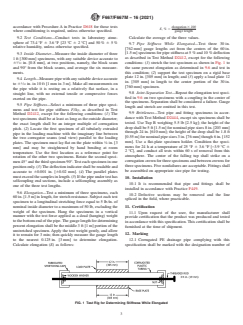
9.2 Test Conditions—Conduct tests in laboratory atmo- Calculate the average of the three values.
sphere of 73.4°F 6 3.6°F [23°C 6 2°C] and 50% 65%
9.7 Pipe Stiffness While Elongated—Test three 30 in.
relative humidity, unless otherwise specified.
[762mm] gauge lengths cut from the centers of the 60in.
[1.5m]specimensforpipestiffnessat5%and10%deflection
9.3 Inside
...