

ASTM F1426-20
(Practice)Standard Practice for Identifying Tire Tread Surface Irregular Wear Patterns Resulting from Tire Use
General Information
- Abstract
SIGNIFICANCE AND USE
3.1 This practice fulfills the need for a standardized system for identifying and describing the tread pattern features of tires that are characteristic of intermediate states of treadwear short of total wear out. This descriptive capability is especially important in testing programs devoted to the development of improved performance tires. It is also important in assessing and evaluating tires after periods of typical tire usage.
SCOPE
1.1 This practice provides the instructions and nomenclature to evaluate the wear features of the tread pattern on a tire for some intermediate state prior to wear out.
1.2 A tire may be characterized by certain worn tread pattern conditions that are collectively referred to as “irregular wear” features. Definitions for these features are given in a special logical and conceptual sequence. First, basic tread pattern definitions are given. Then, additional tread pattern definitions directly related to the basic tread pattern definitions are given. Understanding these secondary definitions requires the knowledge of the basic definitions.
1.3 Based on the terms of this developed system of tread pattern definitions or descriptions, a set of treadwear descriptions is presented that encompasses both regular wear and irregular wear features.
1.4 This hierarchical arrangement produces the accurate and concise definitions needed to evaluate the complex irregular wear conditions of tires.
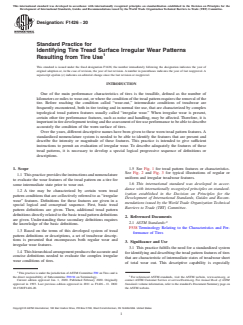
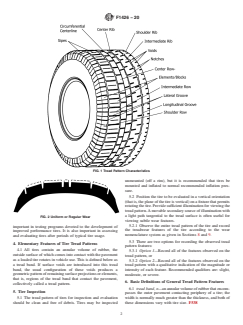
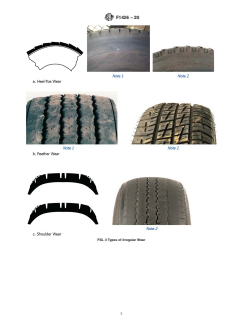
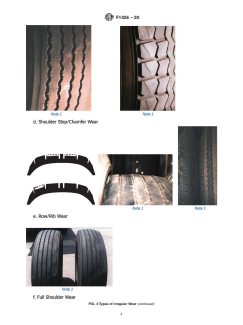
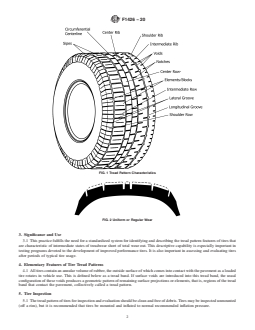
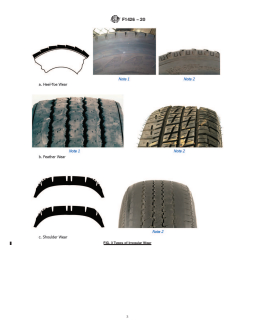
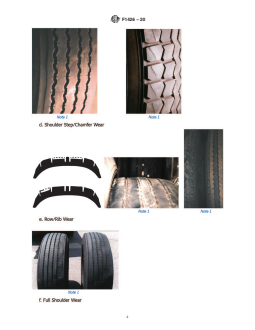
1.5 See Fig. 1 for tread pattern features or characteristics. See Fig. 2 and Fig. 3 for typical illustrations of regular or uniform and irregular treadwear features.
FIG. 1 Tread Pattern Characteristics
FIG. 2 Uniform or Regular Wear
FIG. 3 Types of Irregular Wear
FIG. 3 Types of Irregular Wear (continued)
FIG. 3 Types of Irregular Wear (continued)
FIG. 3 Types of Irregular Wear (continued)
FIG. 3 Types of Irregular Wear (continued)
Note 1: Images courtesy of The Technology & Maintenance Council of the American Trucking Associations, reference Radial Tire Conditions Analysis Guide, Item # T0121. For more information, contact TMC: (703) 838-1763; tmc@trucking.org; http://tmc.trucking.org.
Note 2: Images courtesy of the Tire Industry Association, reference Passenger and Light Truck Tire Conditions Manual, www.tireindustry.org.
Note 3: In illustrations (h), (l), and (m), the ‘light’ or ‘featureless’ areas indicate high wear rate zones.
Note 4: Images courtesy of the U.S. Tire Manufacturers Association, reference Care and Service of Passenger and Light Truck Tires Manual, www.ustires.org.
1.6 This international standard was developed in accordance with internationally recognized principles on standardization established in the Decision on Principles for the Development of International Standards, Guides and Recommendations issued by the World Trade Organization Technical Barriers to Trade (TBT) Committee.
- Status
- Published
- Publication Date
- 31-Dec-2019
- Technical Committee
- F09 - Tires
- Drafting Committee
- F09.94 - Terminology
Buy Documents
ASTM F1426-20 - Standard Practice for Identifying Tire Tread Surface Irregular Wear Patterns Resulting from Tire Use
REDLINE ASTM F1426-20 - Standard Practice for Identifying Tire Tread Surface Irregular Wear Patterns Resulting from Tire Use
Overview
ASTM F1426-20 sets forth a standardized practice for identifying and describing tire tread surface irregular wear patterns that develop during use, before a tire reaches complete wear-out. By establishing clear instructions and effective terminology, this standard improves the consistency and accuracy of evaluations of tire tread conditions in both product testing and real-world performance assessments.
Designed for use by tire professionals, manufacturers, testing laboratories, and fleet operators, ASTM F1426-20 facilitates the communication and documentation of both regular and irregular tire wear features. The practice not only aids in advancing tire technology through targeted testing but also provides valuable insights into tire maintenance and replacement decisions.
Key Topics
- Tread Pattern Nomenclature: The standard introduces a logical, hierarchical system of terms that begins with fundamental tread pattern features (like grooves, ribs, voids, and projections) and builds toward more specific irregular wear descriptors.
- Identification of Irregular Wear: Clear definitions are provided for various types of tire tread surface irregular wear, including:
- Intra-projection wear (differences within a single tread element)
- Inter-projection wear (variations between adjacent tread elements)
- Independent wear features (patterns like diagonal wear, cupping, or chip and tear)
- Wear Evaluation Process: Guidelines are included for inspecting tires-ideally when mounted and inflated-to accurately identify and document treadwear features. Recommendations encompass the use of appropriate illumination and recording all observed wear types with optional qualitative grading (slight, moderate, or severe).
- Uniform vs. Irregular Wear: The standard distinguishes between uniformly worn treads (with even wear across the pattern) and irregular wear, characterized by localized tread loss and often associated with performance issues such as increased noise or reduced handling.
Applications
The standardized system prescribed in ASTM F1426-20 is essential for various stakeholders and practical contexts:
- Tire Development and Testing: Ensures uniform reporting and analysis of treadwear during the development of new tire designs and materials, contributing to performance improvements.
- Quality Control and Manufacturing: Provides manufacturers with a robust vocabulary for monitoring production quality and diagnosing wear anomalies.
- Fleet Maintenance and Safety Assessment: Enables fleet managers and inspectors to reliably identify problematic wear patterns, optimize tire life, and uphold transit safety standards.
- Tire Service and Aftermarket Evaluation: Assists service professionals in assessing tire condition, advising customers, and making informed replacement recommendations.
- Research and Regulatory Reporting: Facilitates data-driven studies and compliance documentation addressing tire wear and vehicle safety.
Related Standards
- ASTM F538: Terminology Relating to the Characteristics and Performance of Tires - establishes foundational terms for tire analysis used throughout ASTM F1426.
- ISO and Other International Tire Standards: ASTM F1426-20 aligns with global principles for standardization, ensuring relevance in international regulatory, testing, and commercial contexts.
- Industry Reference Guides:
- The Technology & Maintenance Council’s Radial Tire Conditions Analysis Guide
- The Tire Industry Association’s Passenger and Light Truck Tire Conditions Manual
- U.S. Tire Manufacturers Association’s Care and Service of Passenger and Light Truck Tires Manual
By adopting ASTM F1426-20, professionals gain a proven framework for accurately identifying, recording, and communicating tire tread surface irregular wear patterns, driving advancements in tire safety, performance, and lifecycle management.
Relations
- Effective Date
- 01-Jan-2020
- Effective Date
- 15-Jun-2009
- Effective Date
- 01-Dec-2003
- Effective Date
- 10-Apr-1999
- Referred By
ASTM F421-15(2021) - Standard Test Method for Measuring Groove and Void Depth in Passenger Car Tires - Effective Date
- 01-Jan-2020
Buy Documents
ASTM F1426-20 - Standard Practice for Identifying Tire Tread Surface Irregular Wear Patterns Resulting from Tire Use
REDLINE ASTM F1426-20 - Standard Practice for Identifying Tire Tread Surface Irregular Wear Patterns Resulting from Tire Use
Get Certified
Connect with accredited certification bodies for this standard

DIN CERTCO
DIN Group product certification.

Smithers Quality Assessments
US management systems and product certification.
Sponsored listings
Frequently Asked Questions
ASTM F1426-20 is a standard published by ASTM International. Its full title is "Standard Practice for Identifying Tire Tread Surface Irregular Wear Patterns Resulting from Tire Use". This standard covers: SIGNIFICANCE AND USE 3.1 This practice fulfills the need for a standardized system for identifying and describing the tread pattern features of tires that are characteristic of intermediate states of treadwear short of total wear out. This descriptive capability is especially important in testing programs devoted to the development of improved performance tires. It is also important in assessing and evaluating tires after periods of typical tire usage. SCOPE 1.1 This practice provides the instructions and nomenclature to evaluate the wear features of the tread pattern on a tire for some intermediate state prior to wear out. 1.2 A tire may be characterized by certain worn tread pattern conditions that are collectively referred to as “irregular wear” features. Definitions for these features are given in a special logical and conceptual sequence. First, basic tread pattern definitions are given. Then, additional tread pattern definitions directly related to the basic tread pattern definitions are given. Understanding these secondary definitions requires the knowledge of the basic definitions. 1.3 Based on the terms of this developed system of tread pattern definitions or descriptions, a set of treadwear descriptions is presented that encompasses both regular wear and irregular wear features. 1.4 This hierarchical arrangement produces the accurate and concise definitions needed to evaluate the complex irregular wear conditions of tires. 1.5 See Fig. 1 for tread pattern features or characteristics. See Fig. 2 and Fig. 3 for typical illustrations of regular or uniform and irregular treadwear features. FIG. 1 Tread Pattern Characteristics FIG. 2 Uniform or Regular Wear FIG. 3 Types of Irregular Wear FIG. 3 Types of Irregular Wear (continued) FIG. 3 Types of Irregular Wear (continued) FIG. 3 Types of Irregular Wear (continued) FIG. 3 Types of Irregular Wear (continued) Note 1: Images courtesy of The Technology & Maintenance Council of the American Trucking Associations, reference Radial Tire Conditions Analysis Guide, Item # T0121. For more information, contact TMC: (703) 838-1763; tmc@trucking.org; http://tmc.trucking.org. Note 2: Images courtesy of the Tire Industry Association, reference Passenger and Light Truck Tire Conditions Manual, www.tireindustry.org. Note 3: In illustrations (h), (l), and (m), the ‘light’ or ‘featureless’ areas indicate high wear rate zones. Note 4: Images courtesy of the U.S. Tire Manufacturers Association, reference Care and Service of Passenger and Light Truck Tires Manual, www.ustires.org. 1.6 This international standard was developed in accordance with internationally recognized principles on standardization established in the Decision on Principles for the Development of International Standards, Guides and Recommendations issued by the World Trade Organization Technical Barriers to Trade (TBT) Committee.
SIGNIFICANCE AND USE 3.1 This practice fulfills the need for a standardized system for identifying and describing the tread pattern features of tires that are characteristic of intermediate states of treadwear short of total wear out. This descriptive capability is especially important in testing programs devoted to the development of improved performance tires. It is also important in assessing and evaluating tires after periods of typical tire usage. SCOPE 1.1 This practice provides the instructions and nomenclature to evaluate the wear features of the tread pattern on a tire for some intermediate state prior to wear out. 1.2 A tire may be characterized by certain worn tread pattern conditions that are collectively referred to as “irregular wear” features. Definitions for these features are given in a special logical and conceptual sequence. First, basic tread pattern definitions are given. Then, additional tread pattern definitions directly related to the basic tread pattern definitions are given. Understanding these secondary definitions requires the knowledge of the basic definitions. 1.3 Based on the terms of this developed system of tread pattern definitions or descriptions, a set of treadwear descriptions is presented that encompasses both regular wear and irregular wear features. 1.4 This hierarchical arrangement produces the accurate and concise definitions needed to evaluate the complex irregular wear conditions of tires. 1.5 See Fig. 1 for tread pattern features or characteristics. See Fig. 2 and Fig. 3 for typical illustrations of regular or uniform and irregular treadwear features. FIG. 1 Tread Pattern Characteristics FIG. 2 Uniform or Regular Wear FIG. 3 Types of Irregular Wear FIG. 3 Types of Irregular Wear (continued) FIG. 3 Types of Irregular Wear (continued) FIG. 3 Types of Irregular Wear (continued) FIG. 3 Types of Irregular Wear (continued) Note 1: Images courtesy of The Technology & Maintenance Council of the American Trucking Associations, reference Radial Tire Conditions Analysis Guide, Item # T0121. For more information, contact TMC: (703) 838-1763; tmc@trucking.org; http://tmc.trucking.org. Note 2: Images courtesy of the Tire Industry Association, reference Passenger and Light Truck Tire Conditions Manual, www.tireindustry.org. Note 3: In illustrations (h), (l), and (m), the ‘light’ or ‘featureless’ areas indicate high wear rate zones. Note 4: Images courtesy of the U.S. Tire Manufacturers Association, reference Care and Service of Passenger and Light Truck Tires Manual, www.ustires.org. 1.6 This international standard was developed in accordance with internationally recognized principles on standardization established in the Decision on Principles for the Development of International Standards, Guides and Recommendations issued by the World Trade Organization Technical Barriers to Trade (TBT) Committee.
ASTM F1426-20 is classified under the following ICS (International Classification for Standards) categories: 83.160.10 - Road vehicle tyres. The ICS classification helps identify the subject area and facilitates finding related standards.
ASTM F1426-20 has the following relationships with other standards: It is inter standard links to ASTM F1426-11, ASTM F538-09, ASTM F538-03, ASTM F538-99, ASTM F421-15(2021). Understanding these relationships helps ensure you are using the most current and applicable version of the standard.
ASTM F1426-20 is available in PDF format for immediate download after purchase. The document can be added to your cart and obtained through the secure checkout process. Digital delivery ensures instant access to the complete standard document.
Standards Content (Sample)
This international standard was developed in accordance with internationally recognized principles on standardization established in the Decision on Principles for the
Development of International Standards, Guides and Recommendations issued by the World Trade Organization Technical Barriers to Trade (TBT) Committee.
Designation: F1426 − 20
Standard Practice for
Identifying Tire Tread Surface Irregular Wear Patterns
Resulting from Tire Use
This standard is issued under the fixed designation F1426; the number immediately following the designation indicates the year of
original adoption or, in the case of revision, the year of last revision. A number in parentheses indicates the year of last reapproval. A
superscript epsilon (´) indicates an editorial change since the last revision or reapproval.
INTRODUCTION
One of the main performance characteristics of tires is the treadlife, defined as the number of
kilometers or miles to wear-out, or where the condition of the tread pattern requires the removal of the
tire. Before reaching the condition called “wear-out,” intermediate conditions of treadwear are
frequently encountered, both in tire testing and in normal tire use, that are characterized by complex
topological tread pattern features usually called “irregular wear.” When irregular wear is present,
certain other tire performance features, such as noise and handling, may be affected. Therefore, it is
important in tire development testing and the assessment of tire use performance to be able to describe
accurately the condition of the worn surface of tires.
Over the years, different descriptive names have been given to these worn tread pattern features.A
standardized nomenclature system is needed to be able to identify the features that are present and
describe the intensity or magnitude of these features. This practice is intended to give sufficient
instructions to permit an evaluation of irregular wear. To describe adequately the features of these
tread patterns, it is necessary to develop a special logical progressive sequence of definitions or
descriptions.
1. Scope 1.5 See Fig. 1 for tread pattern features or characteristics.
See Fig. 2 and Fig. 3 for typical illustrations of regular or
1.1 Thispracticeprovidestheinstructionsandnomenclature
uniform and irregular treadwear features.
to evaluate the wear features of the tread pattern on a tire for
1.6 This international standard was developed in accor-
some intermediate state prior to wear out.
dance with internationally recognized principles on standard-
1.2 A tire may be characterized by certain worn tread
ization established in the Decision on Principles for the
pattern conditions that are collectively referred to as “irregular
Development of International Standards, Guides and Recom-
wear” features. Definitions for these features are given in a
mendations issued by the World Trade Organization Technical
special logical and conceptual sequence. First, basic tread
Barriers to Trade (TBT) Committee.
pattern definitions are given. Then, additional tread pattern
definitions directly related to the basic tread pattern definitions
2. Referenced Documents
are given. Understanding these secondary definitions requires
2.1 ASTM Standards:
the knowledge of the basic definitions.
F538 Terminology Relating to the Characteristics and Per-
1.3 Based on the terms of this developed system of tread
formance of Tires
pattern definitions or descriptions, a set of treadwear descrip-
tions is presented that encompasses both regular wear and
3. Significance and Use
irregular wear features.
3.1 This practice fulfills the need for a standardized system
1.4 Thishierarchicalarrangementproducestheaccurateand
for identifying and describing the tread pattern features of tires
concise definitions needed to evaluate the complex irregular
that are characteristic of intermediate states of treadwear short
wear conditions of tires.
of total wear out. This descriptive capability is especially
This practice is under the jurisdiction ofASTM Committee F09 on Tires and is
the direct responsibility of Subcommittee F09.94 on Terminology. For referenced ASTM standards, visit the ASTM website, www.astm.org, or
Current edition approved Jan. 1, 2020. Published February 2020. Originally contact ASTM Customer Service at service@astm.org. For Annual Book of ASTM
approved in 1993. Last previous edition approved in 2011 as F1426 – 11. DOI: Standards volume information, refer to the standard’s Document Summary page on
10.1520/F1426-20. the ASTM website.
Copyright © ASTM International, 100 Barr Harbor Drive, PO Box C700, West Conshohocken, PA 19428-2959. United States
F1426 − 20
FIG. 1 Tread Pattern Characteristics
unmounted (off a rim), but it is recommended that tires be
mounted and inflated to normal recommended inflation pres-
sure.
5.2 Position the tire to be evaluated in a vertical orientation
(that is, the plane of the tire is vertical) on a fixture that permits
rotating the tire. Provide sufficient illumination for viewing the
tread pattern.Amovable secondary source of illumination with
a light path tangential to the tread surface is often useful for
FIG. 2 Uniform or Regular Wear
viewing subtle wear features.
5.2.1 Observe the entire tread pattern of the tire and record
important in testing programs devoted to the development of
the treadwear features of the tire according to the wear
improved performance tires. It is also important in assessing
nomenclature system as given in Sections 8 and 9.
and evaluating tires after periods of typical tire usage.
5.3 There are two options for recording the observed tread
4. Elementary Features of Tire Tread Patterns
pattern features:
4.1 All tires contain an annular volume of rubber, the
5.3.1 Option 1—Record all of the features observed on the
outside surface of which comes into contact with the pavement
tread pattern, or
as a loaded tire rotates in vehicle use. This is defined below as
5.3.2 Option 2—Record all of the features observed on the
a tread band. If surface voids are introduced into this tread
tread pattern with a qualitative indication of the magnitude or
band, the usual configuration of these voids produces a
intensity of each feature. Recommended qualifiers are: slight,
geometricpatternofremainingsurfaceprojectionsorelements,
moderate, or severe.
that is, regions of the tread band that contact the pavement,
6. Basic Definitions of General Tread Pattern Features
collectively called a tread pattern.
6.1 tread band, n—an annular volume of rubber that encom-
5. Tire Inspection
passes the outer pavement contacting periphery of a tire; the
5.1 The tread pattern of tires for inspection and evaluation width is normally much greater than the thickness, and both of
should be clean and free of debris. Tires may be inspected these dimensions vary with tire size. F538
F1426 − 20
FIG. 3 Types of Irregular Wear
F1426 − 20
FIG. 3 Types of Irregular Wear (continued)
F1426 − 20
FIG. 3 Types of Irregular Wear (continued)
F1426 − 20
FIG. 3 Types of Irregular Wear (continued)
F1426 − 20
NOTE 1—Images courtesy of The Technology & Maintenance Council of the American Trucking Associations, reference Radial Tire Conditions
Analysis Guide, Item # T0121. For more information, contact TMC: (703) 838-1763; tmc@trucking.org; http://tmc.trucking.org.
NOTE 2—Images courtesy of the Tire Industry Association, reference Passenger and Light Truck Tire Conditions Manual, www.tireindustry.org.
NOTE 3—In illustrations (h), (l), and (m), the ‘light’ or ‘featureless’ areas indicate high wear rate zones.
NOTE 4—Images courtesy of the U.S. Tire Manufacturers Association, reference Care and Service of Passenger and Light Truck Tires Manual,
www.ustires.org.
FIG. 3 Types of Irregular Wear (continued)
F1426 − 20
6.2 void, n—avolume(inthetreadband)definedbythelack 8.3 irregular wear, n—a type of treadwear characterized by
of rubber; the depth dimension of this volume may vary from substantial variations of tread loss both from projection to
point to point in (on) the tread band. F538 projection and frequently from point to point on a given
projection. F538
6.3 groove, n—a void that is relatively narrow
...
This document is not an ASTM standard and is intended only to provide the user of an ASTM standard an indication of what changes have been made to the previous version. Because
it may not be technically possible to adequately depict all changes accurately, ASTM recommends that users consult prior editions as appropriate. In all cases only the current version
of the standard as published by ASTM is to be considered the official document.
Designation: F1426 − 11 F1426 − 20
Standard Practice for
Identifying Tire Tread Surface Irregular Wear Patterns
Resulting from Tire Use
This standard is issued under the fixed designation F1426; the number immediately following the designation indicates the year of
original adoption or, in the case of revision, the year of last revision. A number in parentheses indicates the year of last reapproval. A
superscript epsilon (´) indicates an editorial change since the last revision or reapproval.
INTRODUCTION
One of the main performance characteristics of tires is the treadlife, defined as the number of
kilometreskilometers or miles to wear-out, or where the condition of the tread pattern requires the
removal of the tire. Before reaching the condition called “wear-out,” intermediate conditions of
treadwear are frequently encountered, both in tire testing and in normal tire use, that are characterized
by complex topological tread pattern features usually called “irregular wear.” When irregular wear is
present, certain other tire performance features, such as noise and handling, may fall below acceptable
norms. be affected. Therefore, it is important in tire development testing and the assessment of tire use
performance to be able to describe accurately the condition of the worn surface of tires.
Over the years, different descriptive names have been given to these worn tread pattern features. A
standardized nomenclature system is needed to be able to identify the features that are present and
describe the intensity or magnitude of these features. This practice is intended to give sufficient
instructions to permit an evaluation of irregular wear. To describe adequately the features of these
tread patterns, it is necessary to develop a special logical progressive sequence of definitions or
descriptions.
1. Scope
1.1 This practice provides the instructions and nomenclature to evaluate the wear features of the tread pattern on a tire for some
intermediate state short of total prior to wear out.
1.2 A tire may be characterized by certain worn tread pattern conditions that are collectively referred to as “irregular wear”
features. Definitions for these features are given in a special logical and conceptual sequence. First, basic tread pattern definitions
are given. Then, additional tread pattern definitions directly related to the basic tread pattern definitions are given. Understanding
these secondary definitions requires the knowledge of the basic definitions.
1.3 Based on the terms of this developed system of tread pattern definitions or descriptions, a set of treadwear descriptions is
presented that encompasses both regular wear and irregular wear features.
1.4 This hierarchical arrangement produces the accurate and concise definitions needed to evaluate the complex irregular wear
conditions of tires.
1.5 See Fig. 1 for tread pattern features or characteristics. See Fig. 2 and Fig. 3 for typical illustrations of regular or uniform
and irregular treadwear features.
1.6 This international standard was developed in accordance with internationally recognized principles on standardization
established in the Decision on Principles for the Development of International Standards, Guides and Recommendations issued
by the World Trade Organization Technical Barriers to Trade (TBT) Committee.
2. Referenced Documents
2.1 ASTM Standards:
F538 Terminology Relating to the Characteristics and Performance of Tires
This practice is under the jurisdiction of ASTM Committee F09 on Tires and is the direct responsibility of Subcommittee F09.94 on Terminology.
Current edition approved Nov. 1, 2011Jan. 1, 2020. Published November 2011February 2020. Originally approved in 1993. Last previous edition approved in 20032011
as F1426 – 94 (2003).F1426 – 11. DOI: 10.1520/F1426-11.10.1520/F1426-20.
For referenced ASTM standards, visit the ASTM website, www.astm.org, or contact ASTM Customer Service at service@astm.org. For Annual Book of ASTM Standards
volume information, refer to the standard’s Document Summary page on the ASTM website.
Copyright © ASTM International, 100 Barr Harbor Drive, PO Box C700, West Conshohocken, PA 19428-2959. United States
F1426 − 20
FIG. 1 Tread Pattern Characteristics
FIG. 2 Uniform or Regular Wear
3. Significance and Use
3.1 This practice fulfills the need for a standardized system for identifying and describing the tread pattern features of tires that
are characteristic of intermediate states of treadwear short of total wear out. This descriptive capability is especially important in
testing programs devoted to the development of improved performance tires. It is also important in assessing and evaluating tires
after periods of typical tire usage.
4. Elementary Features of Tire Tread Patterns
4.1 All tires contain an annular volume of rubber, the outside surface of which comes into contact with the pavement as a loaded
tire rotates in vehicle use. This is defined below as a tread band. If surface voids are introduced into this tread band, the usual
configuration of these voids produces a geometric pattern of remaining surface projections or elements, that is, regions of the tread
band that contact the pavement, collectively called a tread pattern.
5. Tire Inspection
5.1 The tread pattern of tires for inspection and evaluation should be clean and free of debris. Tires may be inspected unmounted
(off a rim), but it is recommended that tires be mounted and inflated to normal recommended inflation pressure.
F1426 − 20
FIG. 3 Types of Irregular Wear
F1426 − 20
F1426 − 20
FIG. 3 Types of Irregular Wear (continued)
5.2 Position the tire to be evaluated in a vertical orientation (that is, the plane of the tire is vertical) on a fixture that permits
rotating the tire. Provide sufficient illumination for viewing the tread pattern. A movable secondary source of illumination with a
light path tangential to the tread surface is often useful for viewing subtle wear features.
5.2.1 Observe the entire tread pattern of the tire and record the treadwear features of the tire according to the wear nomenclature
system as given in Sections 78 and 89.
5.3 There are two options for recording the observed tread pattern features:
5.3.1 Option 1—Record all of the features observed on the tread pattern, or
5.3.2 Option 2—Record all of the features observed on the tread pattern with a qualitative indication of the magnitude or
intensity of each feature. Recommended qualifiers are: slight, moderate, or severe.
6. Basic Definitions of General Tread Pattern Features
6.1 tread band, n—an annular volume of rubber that encompasses the outer pavement contacting periphery of a tire; the width
is normally much greater than the thickness, and both of these dimensions vary with tire size. F538
6.2 void, n—a volume (in the tread band) defined by the lack of rubber; the depth dimension of this volume may vary from point
to point in (on) the tread band. F538
6.3 groove, n—a void that is relatively narrow compared to its length. F538
6.4 projection, n—a pavement contacting area of the tread band bounded by void. F538
7. Definitions of Subclassifications of Basic Tread Pattern Features
7.1 Grooves are major features that may be characterized as follows:
7.1.1 longitudinal (circumferential) groove, n—an endless groove that has its major (long) dimension substantially parallel to
the tire circumferential centerline; the walls of the groove may not be perfectly parallel planes, but may have short alternating
sections of the wall at angles to the tire circumferential centerline. F538
7.1.2 lateral groove, n—a groove that has its long dimension oriented at a direction nonparallel to the tire circumferential
centerline; it most frequently opens into a void at both ends. F538
7.2 Secondary groove-like features are defined as follows:
7.2.1 notch, n—a groove smaller in both width and length than a lateral groove that contains one closed end. F538
7.2.2 sipe, n—a molded or cut rectangular void that is substantially narrower than the major grooves or voids. F538
7.3 Projections are major pavement contacting tread band regions, defined as follows:
7.3.1 rib, n—a continuou
...