

ASTM D1322-24
(Test Method)Standard Test Method for Smoke Point of Kerosene and Aviation Turbine Fuel
General Information
- Abstract
SIGNIFICANCE AND USE
5.1 This test method provides an indication of the relative smoke producing properties of kerosenes and aviation turbine fuels in a diffusion flame. The smoke point is related to the hydrocarbon type composition of such fuels. Generally the more aromatic the fuel the smokier the flame. A high smoke point indicates a fuel of low smoke producing tendency.
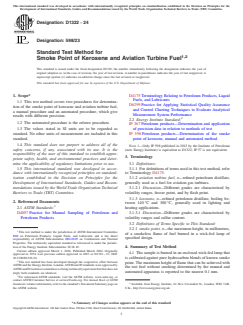
5.2 The smoke point is quantitatively related to the potential radiant heat transfer from the combustion products of the fuel. Because radiant heat transfer exerts a strong influence on the metal temperature of combustor liners and other hot section parts of gas turbines, the smoke point provides a basis for correlation of fuel characteristics with the life of these components.
SCOPE
1.1 This test method covers two procedures for determination of the smoke point of kerosene and aviation turbine fuel, a manual procedure and an automated procedure, which give results with different precision.
1.2 The automated procedure is the referee procedure.
1.3 The values stated in SI units are to be regarded as standard. No other units of measurement are included in this standard.
1.4 This standard does not purport to address all of the safety concerns, if any, associated with its use. It is the responsibility of the user of this standard to establish appropriate safety, health, and environmental practices and determine the applicability of regulatory limitations prior to use.
1.5 This international standard was developed in accordance with internationally recognized principles on standardization established in the Decision on Principles for the Development of International Standards, Guides and Recommendations issued by the World Trade Organization Technical Barriers to Trade (TBT) Committee.
- Status
- Published
- Publication Date
- 29-Feb-2024
- Technical Committee
- D02 - Petroleum Products, Liquid Fuels, and Lubricants
- Drafting Committee
- D02.J0.03 - Combustion and Thermal Properties
Overview
ASTM D1322-24: Standard Test Method for Smoke Point of Kerosene and Aviation Turbine Fuel outlines procedures to determine the smoke point of kerosene and aviation turbine fuels. The smoke point is a key indicator of a fuel's tendency to produce smoke in a diffusion flame-a critical parameter linked to its composition and combustion characteristics. This standard includes both manual and automated test methods, with the automated method designated as the referee procedure for improved precision and consistency. The test results are reported in SI units, supporting standardization across international applications.
Key Topics
- Smoke Point Definition: The smoke point refers to the maximum height, measured in millimetres, of a smokeless flame produced by burning the test fuel in a specified lamp. It is primarily influenced by the aromatic content of the fuel-the higher the aromatic content, the lower the smoke point.
- Test Procedures: The standard covers both manual and automated testing:
- Manual Procedure: Utilizes a calibrated lamp and involves operator observation of flame characteristics.
- Automated Procedure: Employs a digital camera system for flame analysis, improving measurement precision and reducing observer error.
- Significance: Smoke point measurement is directly related to the combustion properties of fuels. Higher smoke points indicate fuels with lower smoke-producing tendencies, which translates to reduced particulate emissions and less radiant heat transfer in gas turbines.
- Calibration and Quality Control: Both methods require regular calibration using reference fuel blends. Quality control protocols ensure consistent performance, especially for laboratories routinely testing aviation fuels.
Applications
ASTM D1322-24 is vital for several industries and applications where precise combustion characteristics are critical:
- Aviation Industry: Assures the quality of aviation turbine fuel, contributing to the safety, performance, and maintenance life of aircraft gas turbines by minimizing soot formation and radiant heat impacts on engine components.
- Petroleum Industry: Supports product development, specification, and quality assurance for kerosene and related fuels. Regular smoke point testing helps producers manage hydrocarbon composition and control emissions.
- Regulatory Compliance: Provides standard methods required by international, national, and military agencies for fuel certification and performance validation.
- Environmental Impact Assessment: Lower smoke point fuels tend to generate more particulates and radiant heat, both of which affect environmental compliance and operational efficiency. This method supports emissions management strategies.
Related Standards
Several standards and guidelines interface with ASTM D1322-24 for a comprehensive approach to fuel testing and characterization:
- ASTM D4057: Practice for Manual Sampling of Petroleum and Petroleum Products, referenced for proper sample collection procedures.
- ASTM D4175: Terminology relating to petroleum products, liquid fuels, and lubricants, providing definitions and context.
- ASTM D6299: Practice for Applying Statistical Quality Assurance and Control Charting Techniques to Evaluate Analytical Measurement System Performance.
- EI IP 598: Petroleum products-Determination of the smoke point of kerosene, manual and automated method, deemed technically equivalent to ASTM D1322.
- EI IP 367: Methods for determining and applying precision data to fuel tests.
Conclusion
The ASTM D1322-24 standard ensures reliable, repeatable measurement of the smoke point of kerosene and aviation turbine fuels-a critical quality and safety parameter for the aviation and petroleum sectors. Adoption of this standard helps organizations maintain consistent fuel quality, meet regulatory requirements, and optimize the operational performance and longevity of combustion equipment. For complete compliance and best practices, users should follow referenced standards and maintain rigorous calibration and safety protocols.
Relations
- Effective Date
- 01-Mar-2024
- Effective Date
- 01-Mar-2024
- Effective Date
- 01-Mar-2024
- Effective Date
- 01-Mar-2024
- Effective Date
- 01-Mar-2024
- Effective Date
- 01-Mar-2024
- Effective Date
- 01-Mar-2024
- Effective Date
- 01-Mar-2024
- Effective Date
- 01-Mar-2024
Get Certified
Connect with accredited certification bodies for this standard

Element Materials Technology
Materials testing and product certification.

ABS Group Brazil
ABS Group certification services in Brazil.

ABS Quality Evaluations Inc.
American Bureau of Shipping quality certification.
Sponsored listings
Frequently Asked Questions
ASTM D1322-24 is a standard published by ASTM International. Its full title is "Standard Test Method for Smoke Point of Kerosene and Aviation Turbine Fuel". This standard covers: SIGNIFICANCE AND USE 5.1 This test method provides an indication of the relative smoke producing properties of kerosenes and aviation turbine fuels in a diffusion flame. The smoke point is related to the hydrocarbon type composition of such fuels. Generally the more aromatic the fuel the smokier the flame. A high smoke point indicates a fuel of low smoke producing tendency. 5.2 The smoke point is quantitatively related to the potential radiant heat transfer from the combustion products of the fuel. Because radiant heat transfer exerts a strong influence on the metal temperature of combustor liners and other hot section parts of gas turbines, the smoke point provides a basis for correlation of fuel characteristics with the life of these components. SCOPE 1.1 This test method covers two procedures for determination of the smoke point of kerosene and aviation turbine fuel, a manual procedure and an automated procedure, which give results with different precision. 1.2 The automated procedure is the referee procedure. 1.3 The values stated in SI units are to be regarded as standard. No other units of measurement are included in this standard. 1.4 This standard does not purport to address all of the safety concerns, if any, associated with its use. It is the responsibility of the user of this standard to establish appropriate safety, health, and environmental practices and determine the applicability of regulatory limitations prior to use. 1.5 This international standard was developed in accordance with internationally recognized principles on standardization established in the Decision on Principles for the Development of International Standards, Guides and Recommendations issued by the World Trade Organization Technical Barriers to Trade (TBT) Committee.
SIGNIFICANCE AND USE 5.1 This test method provides an indication of the relative smoke producing properties of kerosenes and aviation turbine fuels in a diffusion flame. The smoke point is related to the hydrocarbon type composition of such fuels. Generally the more aromatic the fuel the smokier the flame. A high smoke point indicates a fuel of low smoke producing tendency. 5.2 The smoke point is quantitatively related to the potential radiant heat transfer from the combustion products of the fuel. Because radiant heat transfer exerts a strong influence on the metal temperature of combustor liners and other hot section parts of gas turbines, the smoke point provides a basis for correlation of fuel characteristics with the life of these components. SCOPE 1.1 This test method covers two procedures for determination of the smoke point of kerosene and aviation turbine fuel, a manual procedure and an automated procedure, which give results with different precision. 1.2 The automated procedure is the referee procedure. 1.3 The values stated in SI units are to be regarded as standard. No other units of measurement are included in this standard. 1.4 This standard does not purport to address all of the safety concerns, if any, associated with its use. It is the responsibility of the user of this standard to establish appropriate safety, health, and environmental practices and determine the applicability of regulatory limitations prior to use. 1.5 This international standard was developed in accordance with internationally recognized principles on standardization established in the Decision on Principles for the Development of International Standards, Guides and Recommendations issued by the World Trade Organization Technical Barriers to Trade (TBT) Committee.
ASTM D1322-24 is classified under the following ICS (International Classification for Standards) categories: 75.160.20 - Liquid fuels. The ICS classification helps identify the subject area and facilitates finding related standards.
ASTM D1322-24 has the following relationships with other standards: It is inter standard links to ASTM D1322-23, ASTM D7566-23b, ASTM D6615-22, ASTM D1655-23a, ASTM D1655-24, ASTM D8147-17(2023), ASTM D7223-21, ASTM D8147-24, ASTM D3701-23. Understanding these relationships helps ensure you are using the most current and applicable version of the standard.
ASTM D1322-24 is available in PDF format for immediate download after purchase. The document can be added to your cart and obtained through the secure checkout process. Digital delivery ensures instant access to the complete standard document.
Standards Content (Sample)
This international standard was developed in accordance with internationally recognized principles on standardization established in the Decision on Principles for the
Development of International Standards, Guides and Recommendations issued by the World Trade Organization Technical Barriers to Trade (TBT) Committee.
Designation: D1322 − 24
Designation: 598/23
Standard Test Method for
1,2
Smoke Point of Kerosene and Aviation Turbine Fuel
This standard is issued under the fixed designation D1322; the number immediately following the designation indicates the year of
original adoption or, in the case of revision, the year of last revision. A number in parentheses indicates the year of last reapproval. A
superscript epsilon (´) indicates an editorial change since the last revision or reapproval.
This standard has been approved for use by agencies of the U.S. Department of Defense.
1. Scope* D4175 Terminology Relating to Petroleum Products, Liquid
Fuels, and Lubricants
1.1 This test method covers two procedures for determina-
D6299 Practice for Applying Statistical Quality Assurance
tion of the smoke point of kerosene and aviation turbine fuel,
and Control Charting Techniques to Evaluate Analytical
a manual procedure and an automated procedure, which give
Measurement System Performance
results with different precision.
2.2 Energy Institute Standard:
1.2 The automated procedure is the referee procedure.
IP 367 Petroleum products—Determination and application
1.3 The values stated in SI units are to be regarded as of precision data in relation to methods of test
standard. No other units of measurement are included in this IP 598 Petroleum products—Determination of the smoke
standard. point of kerosene, manual and automated method
1.4 This standard does not purport to address all of the
NOTE 1—Only IP 598 published in 2012 by the Institute of Petroleum
safety concerns, if any, associated with its use. It is the (now Energy Institute) is equivalent to D1322; IP 57 is not equivalent.
responsibility of the user of this standard to establish appro-
3. Terminology
priate safety, health, and environmental practices and deter-
mine the applicability of regulatory limitations prior to use. 3.1 Definitions:
1.5 This international standard was developed in accor- 3.1.1 For definitions of terms used in this test method, refer
dance with internationally recognized principles on standard- to Terminology D4175.
ization established in the Decision on Principles for the 3.1.2 aviation turbine fuel, n—refined petroleum distillate,
Development of International Standards, Guides and Recom- generally used as a fuel for aviation gas turbines.
mendations issued by the World Trade Organization Technical 3.1.2.1 Discussion—Different grades are characterized by
Barriers to Trade (TBT) Committee. volatility ranges, freeze point, and by flash point.
3.1.3 kerosene, n—refined petroleum distillate, boiling be-
2. Referenced Documents
tween 140 °C and 300 °C, generally used in lighting and
2.1 ASTM Standards: heating applications.
D4057 Practice for Manual Sampling of Petroleum and 3.1.3.1 Discussion—Different grades are characterized by
Petroleum Products volatility ranges and sulfur content.
3.2 Definitions of Terms Specific to This Standard:
3.2.1 smoke point, n—the maximum height, in millimetres,
This test method is under the jurisdiction of ASTM International Committee
of a smokeless flame of fuel burned in a wick-fed lamp of
D02 on Petroleum Products, Liquid Fuels, and Lubricants and is the direct
specified design.
responsibility of ASTM Subcommittee D02.J0.03 on Combustion and Thermal
Properties. The technically equivalent standard as referenced is under the jurisdic-
tion of the Energy Institute Subcommittee SC-B-10. 4. Summary of Test Method
Current edition approved March 1, 2024. Published March 2024. Originally
4.1 The sample is burned in an enclosed wick-fed lamp that
approved in 1954. Last previous edition approved in 2023 as D1322 – 23. DOI:
10.1520/D1322-24. is calibrated against pure hydrocarbon blends of known smoke
This test method has been developed through the cooperative effort between
point. The maximum height of flame that can be achieved with
ASTM and the Energy Institute, London. ASTM and IP standards were approved by
the test fuel without smoking determined by the manual and
ASTM and EI technical committees as being technically equivalent but that does not
automated apparatus is reported to the nearest 0.1 mm.
imply both standards are identical.
For referenced ASTM standards, visit the ASTM website, www.astm.org, or
contact ASTM Customer Service at service@astm.org. For Annual Book of ASTM
Standards volume information, refer to the standard’s Document Summary page on Available from Energy Institute, 61 New Cavendish St., London, WIG 7AR,
the ASTM website. U.K., http://www.energyinst.org.uk.
*A Summary of Changes section appears at the end of this standard
Copyright © ASTM International, 100 Barr Harbor Drive, PO Box C700, West Conshohocken, PA 19428-2959. United States
D1322 − 24
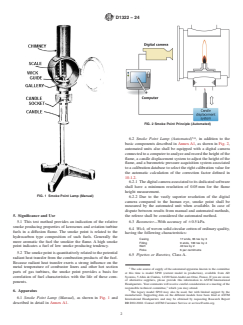
FIG. 2 Smoke Point Principle (Automated)
5,6
6.2 Smoke Point Lamp (Automated) , in addition to the
basic components described in Annex A1, as shown in Fig. 2,
automated units also shall be equipped with a digital camera
connected to a computer to analyze and record the height of the
flame, a candle displacement system to adjust the height of the
flame, and a barometric pressure acquisition system associated
to a calibration database to select the right calibration value for
the automatic calculation of the correction factor defined in
10.1.2.
6.2.1 The digital camera associated to its dedicated software
shall have a minimum resolution of 0.05 mm for the flame
height measurement.
FIG. 1 Smoke Point Lamp (Manual)
6.2.2 Due to the vastly superior resolution of the digital
camera compared to the human eye, smoke point shall be
measured by the automated unit when available. In case of
dispute between results from manual and automated methods,
5. Significance and Use the referee shall be considered the automated method.
5.1 This test method provides an indication of the relative 6.3 Barometer—With accuracy of 60.5 kPa.
smoke producing properties of kerosenes and aviation turbine
6.4 Wick, of woven solid circular cotton of ordinary quality,
fuels in a diffusion flame. The smoke point is related to the
having the following characteristics:
hydrocarbon type composition of such fuels. Generally the
Casing 17 ends, 66 tex by 3
more aromatic the fuel the smokier the flame. A high smoke
Filling 9 ends, 100 tex by 4
point indicates a fuel of low smoke producing tendency. Weft 40 tex by 2
Picks 6 per centimetre
5.2 The smoke point is quantitatively related to the potential
6.5 Pipettes or Burettes, Class A.
radiant heat transfer from the combustion products of the fuel.
Because radiant heat transfer exerts a strong influence on the
metal temperature of combustor liners and other hot section
The sole source of supply of the automated apparatus known to the committee
parts of gas turbines, the smoke point provides a basis for
at this time is model SP20 (current model in production), available from AD
Systems, 5 Allée de Cindais, 14320 Saint-André-sur-Orne, France. If you are aware
correlation of fuel characteristics with the life of these com-
of alternative suppliers, please provide this information to ASTM International
ponents.
Headquarters. Your comments will receive careful consideration at a meeting of the
responsible technical committee, which you may attend.
6. Apparatus The legacy model SP10 may also be used, but with limited support by the
manufacturer. Supporting data on the different models have been filed at ASTM
6.1 Smoke Point Lamp (Manual), as shown in Fig. 1 and
International Headquarters and may be obtained by requesting Research Report
described in detail in Annex A1. RR:D02-2060. Contact ASTM Customer Service at service@astm.org.
D1322 − 24
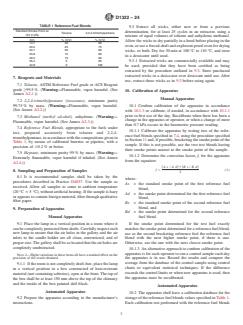
TABLE 1 Reference Fuel Blends
9.3 Extract all wicks, either new or from a previous
Standard Smoke Point at determination, for at least 25 cycles in an extractor, using a
Toluene 2,2,4-trimethylpentane
101.3 kPa
mixture of equal volumes of toluene and anhydrous methanol.
mm % (V/V) % (V/V)
Allow the wicks to dry partially in a hood before placing in the
14.7 40 60
oven, or use a forced-draft and explosion-proof oven for drying
20.2 25 75
22.7 20 80
wicks, or both. Dry for 30 min at 100 °C to 110 °C, and store
25.8 15 85
in a dessicator until used.
30.2 10 90
35.4 5 95
9.3.1 Extracted wicks are commercially available and may
42.8 0 100
be used, provided that they have been certified as being
extracted by the procedure outlined in 9.3. Store purchased
extracted wicks in a desiccator over desiccant until use. After
7. Reagents and Materials
use, extract these wicks as in 9.3 before using again.
7.1 Toluene, ASTM Reference Fuel grade or ACS Reagent
grade ≥99.5 %. (Warning—Flammable, vapor harmful. (See
10. Calibration of Apparatus
Annex A2.1.))
Manual Apparatus
7.2 2,2,4-trimethylpentane (isooctane), minimum purity
99.75 % by mass. (Warning—Flammable, vapor harmful.
10.1 Confirm calibration of the apparatus in accordance
(See Annex A2.2.))
with 10.1.3 or calibrate, if needed, in accordance with 10.1.1
prior to first use of the day. Recalibrate when there has been a
7.3 Methanol (methyl alcohol), anhydrous. (Warning—
change in the apparatus or operator, or when a change of more
Flammable, vapor harmful. (See Annex A2.3.))
than 0.7 kPa occurs in the barometric pressure reading.
7.4 Reference Fuel Blends, appropriate to the fuels under
10.1.1 Calibrate the apparatus by testing two of the refer-
test, prepared accurately from toluene and 2,2,4-
ence fuel blends specified in 7.4, using the procedure specified
trimethylpentane, in accordance with the compositions given in
in Section 11 and, if possible, bracketing the smoke point of the
Table 1, by means of calibrated burettes or pipettes, with a
sample. If this is not possible, use the two test blends having
precision of 60.2 % or better.
their smoke points nearest to the smoke point of the sample.
7.5 Heptane, minimum purity 99 % by mass. (Warning—
10.1.2 Determine the correction factor, f, for the apparatus
Extremely flammable, vapor harmful if inhaled. (See Annex
from the equation:
A2.4.))
A s ⁄ A d 1 B s ⁄ B d
~ ! ~ !
f 5 (1)
8. Sampling and Preparation of Samples
8.1 It is recommended samples shall be taken by the
where:
procedures described in Practice D4057. Use the sample as
As = the standard smoke point of the first reference fuel
received. Allow all samples to come to ambient temperature
blend,
(20 °C 6 5 °C), without artificial heating. If the sample is hazy
Ad = the smoke point determined for the first reference fuel
or appears to contain foreign material, filter through qualitative
blend,
filter paper.
Bs = the standard smoke point of the second reference fuel
blend, and
9. Preparation of Apparatus
Bd = the smoke point determined for the second reference
fuel blend.
Manual Apparatus
9.1 Place the lamp in a vertical position in a room where it If the smoke point determined for the test fuel exactly
can be completely protected from drafts. Carefully inspect each matches the smoke point determined for a reference fuel blend,
new lamp to ensure that the air holes in the gallery and the air
use as the second bracketing reference fuel the reference fuel
inlets to the candle holder are all clean, unrestricted, and of blend with the next higher smoke point, if there is one.
proper size. The gallery shall be so located that the air holes are
Otherwise, use the one with the next closest smoke point.
completely unobstructed.
10.1.3 An alternative approach to confirm calibration of the
apparatus is for each operator to run a control sample each day
NOTE 2—Slight variations in these items all have a marked effect on the
precision of the result obtained. the apparatus is in use. Record the results and compare the
average from the database of the control sample using control
9.1.1 If the room is not completely draft-free, place the lamp
charts or equivalent statistical techniques. If the difference
in a vertical position in a box constructed of heat-resistant
exceeds the control limits or when new apparatus is used, then
material (not containing asbestos), open at the front. The top of
the apparatus must be recalibrated.
the box shall be at least 150 mm above the top of the chimney
and the inside of the box painted dull black.
Automated Apparatus
Automated Apparatus
10.2 The apparatus shall have a calibration database for the
storage of the reference fuel blends values specified in Table 1.
9.2 Prepare the apparatus according to the manufacturer’s
instructions. Each calibration test performed with the reference fuel blends
D1322 − 24
shall be stored in this database in addition with the barometric
pressure observed at the moment the calibration was per-
formed.
10.2.1 The apparatus shall have the capability to automati-
cally calculate the correction factor f according to Eq 1 by
automatically selecting in its calibration database the reference
fuel blends values specified in Table 1, using the procedure
specified in Section 11 and the calculation specified in Section
12 and, if possible, bracketing the smoke point of the sample.
If this is not possible, it shall use the two test blend results
having their smoke points nearest to the smoke point of the
sample.
NOTE 3—The digital camera and the associated software replace the
operator eyes for the observation of the flame. Consequently it is not
necessary to recalibrate the apparatus when there has been a change in the
operator.
10.2.2 Calibrate the apparatus by testing the seven reference
fuel blends specified in 7.4, using the procedure specified in
Section 11. For more details, refer to the instruction manual of
the apparatus manufacturer.
10.2.3 At regular intervals of not more than seven days or
when there has been a change in the apparatus, verify that the
apparatus is performing properly by using a quality control
(QC) sample that is representative of the fuel(s) routinely
tested by the laboratory to confirm that the apparatus is in
statistical control following the guidelines given in Practice
D6299. If the difference exceeds the control limits, recalibrate
the apparatus.
11. Procedure
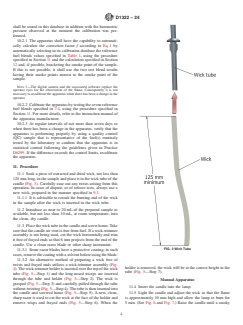
11.1 Soak a piece of extracted and dried wick, not less than
125 mm long, in the sample and place it in the wick tube of the
candle (Fig. 3). Carefully ease out any twists arising from this
operation. In cases of dispute, or of referee tests, always use a
new wick, prepared in the manner specified in 9.3.
11.1.1 It is advisable to resoak the burning-end of the wick
in the sample after the wick is inserted in the wick tube.
11.2 Introduce as near to 20 mL of the prepared sample as
available, but not less than 10 mL, at room temperature, into
the clean, dry candle.
11.3 Place the wick tube in the candle and screw home. Take
care that the candle air vent is free from fuel. If a wick-trimmer
assembly is not being used, cut the wick horizontally and trim
it free of frayed ends so that 6 mm projects from the end of the
candle. Use a clean razor blade or other sharp instrument.
FIG. 3 Wick Tube
11.3.1 Some razor blades have a protective coating; in such
cases, remove the coating with a solvent before using the blade.
11.3.2 An alternative method of preparing a wick free of
twists and frayed ends utilizes a wick-trimmer
...
This document is not an ASTM standard and is intended only to provide the user of an ASTM standard an indication of what changes have been made to the previous version. Because
it may not be technically possible to adequately depict all changes accurately, ASTM recommends that users consult prior editions as appropriate. In all cases only the current version
of the standard as published by ASTM is to be considered the official document.
Designation: D1322 − 23 D1322 − 24
Designation: 598/23
Standard Test Method for
1,2
Smoke Point of Kerosene and Aviation Turbine Fuel
This standard is issued under the fixed designation D1322; the number immediately following the designation indicates the year of
original adoption or, in the case of revision, the year of last revision. A number in parentheses indicates the year of last reapproval. A
superscript epsilon (´) indicates an editorial change since the last revision or reapproval.
This standard has been approved for use by agencies of the U.S. Department of Defense.
1. Scope*
1.1 This test method covers two procedures for determination of the smoke point of kerosene and aviation turbine fuel, a manual
procedure and an automated procedure, which give results with different precision.
1.2 The automated procedure is the referee procedure.
1.3 The values stated in SI units are to be regarded as standard. No other units of measurement are included in this standard.
1.4 This standard does not purport to address all of the safety concerns, if any, associated with its use. It is the responsibility
of the user of this standard to establish appropriate safety, health, and environmental practices and determine the applicability of
regulatory limitations prior to use.
1.5 This international standard was developed in accordance with internationally recognized principles on standardization
established in the Decision on Principles for the Development of International Standards, Guides and Recommendations issued
by the World Trade Organization Technical Barriers to Trade (TBT) Committee.
2. Referenced Documents
2.1 ASTM Standards:
D4057 Practice for Manual Sampling of Petroleum and Petroleum Products
D4175 Terminology Relating to Petroleum Products, Liquid Fuels, and Lubricants
D6299 Practice for Applying Statistical Quality Assurance and Control Charting Techniques to Evaluate Analytical Measure-
ment System Performance
2.2 Energy Institute Standard:
IP 367 Petroleum products—Determination and application of precision data in relation to methods of test
IP 598 Petroleum products—Determination of the smoke point of kerosene, manual and automated method
This test method is under the jurisdiction of ASTM International Committee D02 on Petroleum Products, Liquid Fuels, and Lubricants and is the direct responsibility
of ASTM Subcommittee D02.J0.03 on Combustion and Thermal Properties. The technically equivalent standard as referenced is under the jurisdiction of the Energy Institute
Subcommittee SC-B-10.
Current edition approved Dec. 1, 2023March 1, 2024. Published January 2024March 2024. Originally approved in 1954. Last previous edition approved in 20222023 as
D1322 – 22.D1322 – 23. DOI: 10.1520/D1322-23.10.1520/D1322-24.
This test method has been developed through the cooperative effort between ASTM and the Energy Institute, London. ASTM and IP standards were approved by ASTM
and EI technical committees as being technically equivalent but that does not imply both standards are identical.
For referenced ASTM standards, visit the ASTM website, www.astm.org, or contact ASTM Customer Service at service@astm.org. For Annual Book of ASTM Standards
volume information, refer to the standard’s Document Summary page on the ASTM website.
Available from Energy Institute, 61 New Cavendish St., London, WIG 7AR, U.K., http://www.energyinst.org.uk.
*A Summary of Changes section appears at the end of this standard
Copyright © ASTM International, 100 Barr Harbor Drive, PO Box C700, West Conshohocken, PA 19428-2959. United States
D1322 − 24
NOTE 1—Only IP 598 published in 2012 by the Institute of Petroleum (now Energy Institute) is equivalent to D1322; IP 57 is not equivalent.
3. Terminology
3.1 Definitions:
3.1.1 For definitions of terms used in this test method, refer to Terminology D4175.
3.1.2 aviation turbine fuel, n—refined petroleum distillate, generally used as a fuel for aviation gas turbines.
3.1.2.1 Discussion—
Different grades are characterized by volatility ranges, freeze point, and by flash point.
3.1.3 kerosene, n—refined petroleum distillate, boiling between 140 °C and 300 °C, generally used in lighting and heating
applications.
3.1.3.1 Discussion—
Different grades are characterized by volatility ranges and sulfur content.
3.2 Definitions of Terms Specific to This Standard:
3.2.1 smoke point, n—the maximum height, in millimetres, of a smokeless flame of fuel burned in a wick-fed lamp of specified
design.
4. Summary of Test Method
4.1 The sample is burned in an enclosed wick-fed lamp that is calibrated against pure hydrocarbon blends of known smoke point.
The maximum height of flame that can be achieved with the test fuel without smoking determined by the manual and automated
apparatus is reported to the nearest 0.1 mm.
5. Significance and Use
5.1 This test method provides an indication of the relative smoke producing properties of kerosenes and aviation turbine fuels in
a diffusion flame. The smoke point is related to the hydrocarbon type composition of such fuels. Generally the more aromatic the
fuel the smokier the flame. A high smoke point indicates a fuel of low smoke producing tendency.
5.2 The smoke point is quantitatively related to the potential radiant heat transfer from the combustion products of the fuel.
Because radiant heat transfer exerts a strong influence on the metal temperature of combustor liners and other hot section parts of
gas turbines, the smoke point provides a basis for correlation of fuel characteristics with the life of these components.
6. Apparatus
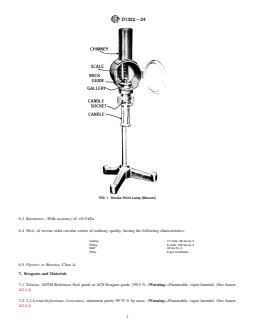
6.1 Smoke Point Lamp (Manual), as shown in Fig. 1 and described in detail in Annex A1.
5,6
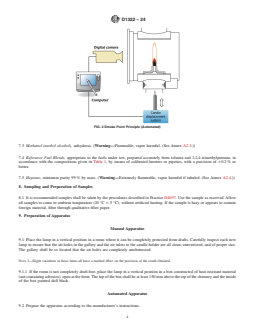
6.2 Smoke Point Lamp (Automated) , in addition to the basic components described in Annex A1, as shown in Fig. 2, automated
units also shall be equipped with a digital camera connected to a computer to analyze and record the height of the flame, a candle
displacement system to adjust the height of the flame, and a barometric pressure acquisition system associated to a calibration
database to select the right calibration value for the automatic calculation of the correction factor defined in 10.1.2.
6.2.1 The digital camera associated to its dedicated software shall have a minimum resolution of 0.05 mm for the flame height
measurement.
6.2.2 Due to the vastly superior resolution of the digital camera compared to the human eye, smoke point shall be measured by
the automated unit when available. In case of dispute between results from manual and automated methods, the referee shall be
considered the automated method.
The sole source of supply of the automated apparatus known to the committee at this time is model SP20 (current model in production), available from AD Systems,
5 Allée de Cindais, 14320 Saint-André-sur-Orne, France. If you are aware of alternative suppliers, please provide this information to ASTM International Headquarters. Your
comments will receive careful consideration at a meeting of the responsible technical committee, which you may attend.
The legacy model SP10 may also be used, but with limited support by the manufacturer. Supporting data on the different models have been filed at ASTM International
Headquarters and may be obtained by requesting Research Report RR:D02-2060. Contact ASTM Customer Service at service@astm.org.
D1322 − 24
FIG. 1 Smoke Point Lamp (Manual)
6.3 Barometer—With accuracy of 60.5 kPa.
6.4 Wick, of woven solid circular cotton of ordinary quality, having the following characteristics:
Casing 17 ends, 66 tex by 3
Filling 9 ends, 100 tex by 4
Weft 40 tex by 2
Picks 6 per centimetre
6.5 Pipettes or Burettes, Class A.
7. Reagents and Materials
7.1 Toluene, ASTM Reference Fuel grade or ACS Reagent grade ≥99.5 %. (Warning—Flammable, vapor harmful. (See Annex
A2.1.))
7.2 2,2,4-trimethylpentane (isooctane), minimum purity 99.75 % by mass. (Warning—Flammable, vapor harmful. (See Annex
A2.2.))
D1322 − 24
FIG. 2 Smoke Point Principle (Automated)
7.3 Methanol (methyl alcohol), anhydrous. (Warning—Flammable, vapor harmful. (See Annex A2.3.))
7.4 Reference Fuel Blends, appropriate to the fuels under test, prepared accurately from toluene and 2,2,4-trimethylpentane, in
accordance with the compositions given in Table 1, by means of calibrated burettes or pipettes, with a precision of 60.2 % or
better.
7.5 Heptane, minimum purity 99 % by mass. (Warning—Extremely flammable, vapor harmful if inhaled. (See Annex A2.4.))
8. Sampling and Preparation of Samples
8.1 It is recommended samples shall be taken by the procedures described in Practice D4057. Use the sample as received. Allow
all samples to come to ambient temperature (20 °C 6 5 °C), without artificial heating. If the sample is hazy or appears to contain
foreign material, filter through qualitative filter paper.
9. Preparation of Apparatus
Manual Apparatus
9.1 Place the lamp in a vertical position in a room where it can be completely protected from drafts. Carefully inspect each new
lamp to ensure that the air holes in the gallery and the air inlets to the candle holder are all clean, unrestricted, and of proper size.
The gallery shall be so located that the air holes are completely unobstructed.
NOTE 2—Slight variations in these items all have a marked effect on the precision of the result obtained.
9.1.1 If the room is not completely draft-free, place the lamp in a vertical position in a box constructed of heat-resistant material
(not containing asbestos), open at the front. The top of the box shall be at least 150 mm above the top of the chimney and the inside
of the box painted dull black.
Automated Apparatus
9.2 Prepare the apparatus according to the manufacturer’s instructions.
D1322 − 24
TABLE 1 Reference Fuel Blends
Standard Smoke Point at
Toluene 2,2,4-trimethylpentane
101.3 kPa
mm % (V/V) % (V/V)
14.7 40 60
20.2 25 75
22.7 20 80
25.8 15 85
30.2 10 90
35.4 5 95
42.8 0 100
9.3 Extract all wicks, either new or from a previous determination, for at least 25 cycles in an extractor, using a mixture of equal
volumes of toluene and anhydrous methanol. Allow the wicks to dry partially in a hood before placing in the oven, or use a
forced-draft and explosion-proof oven for drying wicks, or both. Dry for 30 min at 100 °C to 110 °C, and store in a dessicator until
used.
9.3.1 Extracted wicks are commercially available and may be used, provided that they have been certified as being extracted by
the procedure outlined in 9.3. Store purchased extracted wicks in a desiccator over desiccant until use. After use, extract these
wicks as in 9.3 before using again.
10. Calibration of Apparatus
Manual Apparatus
10.1 Confirm calibration of the apparatus in accordance with 10.1.3 or calibrate, if needed, in accordance with 10.1.1 prior to first
use of the day. Recalibrate when there has been a change in the apparatus or operator, or when a change of more than 0.7 kPa
occurs in the barometric pressure reading.
10.1.1 Calibrate the apparatus by testing two of the reference fuel blends specified in 7.4, using the procedure specified in Section
11 and, if possible, bracketing the smoke point of the sample. If this is not possible, use the two test blends having their smoke
points nearest to the smoke point of the sample.
10.1.2 Determine the correction factor, f, for the apparatus from the equation:
~A s ⁄ A d!1~B s ⁄ B d!
f 5 (1)
where:
As = the standard smoke point of the first reference fuel blend,
Ad = the smoke point determined for the first reference fuel blend,
Bs = the standard smoke point of the second reference fuel blend, and
Bd = the smoke point determined for the second reference fuel blend.
If the smoke point determined for the test fuel exactly matches the smoke point determined for a reference fuel blend, use as
the second bracketing reference fuel the reference fuel blend with the next higher smoke point, if there is one. Otherwise, use the
one with the next closest smoke point.
10.1.3 An alternative approach to confirm calibration of the apparatus is for each operator to run a control sample each day the
apparatus is in use. Record the results and compare the average from the database of the control sample using control charts or
equivalent statistical techniques. If the difference exceeds the control limits or when new apparatus is used, then the apparatus must
be recalibrated.
Automated Apparatus
10.2 The apparatus shall have a calibration database for the storage of the reference fuel blends values specified in Table 1. Each
D1322 − 24
calibration test performed with the reference fuel blends shall be stored in this database in addition with the barometric pressure
observed at the moment the calibration was performed.
10.2.1 The apparatus shall have the capability to automatically calculate the correction factor f according to Eq 1 by automatically
selecting in its calibration database the reference fuel blends values specified in Table 1, using the procedure specified in Section
11 and the calculation specified in Section 12 and, if possible, bracketing the smoke point of the sample. If this is not possible,
it shall use the two test blend results having their smoke points nearest to the smoke point of the sample.
NOTE 3—The digital camera and the associated software replace the operator eyes for the observation of the flame. Consequently it is not necessary to
recalibrate the apparatus when there has been a change in the operator.
10.2.2 Calibrate the apparatus by testing the seven reference fuel blends specified in 7.4, using the procedure specified in Section
11. For more details, refer to the instruction manual of the apparatus manufacturer.
10.2.3 At regular intervals of not more than seven days or when there has been a change in the apparatus, verify that the apparatus
is performing properly by using a quality control (QC) sample that is representative of the fuel(s) routinely tested by the laboratory
to confirm that the apparatus is in statistical control following the guidelines given in Practice D6299. If the difference exceeds
the control limits, recalibrate the apparatus.
11. Procedure
11.1 Soak a piece of extracted and dried wick, not less than 125 mm long, in the sample and place it in the wick tube of the candle
(Fig. 3). Carefully ease out any twists arising from this operation. In cases of dispute, or of referee tests, always use a new wick,
prepared in the manner specified in 9.3.
11.1.1 It is advisable to resoak the burning-end of the wick in the sample after the wick is inserted in the wick tube.
11.2 Introduce as near to 20 mL of the prepared sample as available, but not less than 10 mL, at room temperature, into the clean,
dry candle.
11.3 Place the wick tube in the candle and screw home. Take care that the candle air vent is free from fuel. If a wick-trimmer
assembly is not being used, cut the wick horizontally and trim it free of frayed ends so that 6 mm projects from the end of the
candle. Use a clean razor blade or other sharp instrument.
11.3.1 Some razor blades have a protective coating; in such cases, remove the coating with a solvent before using the blade.
11.3.2 An alternative method of preparing a wick free of twists and frayed ends utilizes a wick-trimmer assembly (Fig. 4). The
wick-trimmer
...