

ASTM E2135-22
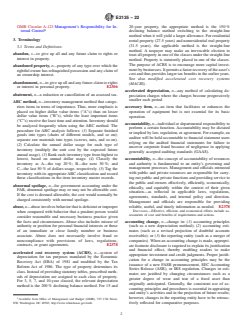
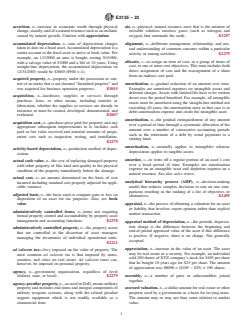
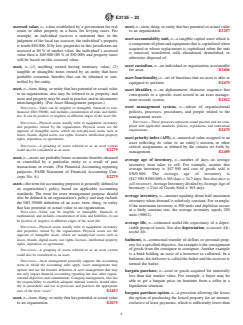
(Terminology)Standard Terminology for Property and Asset Management
General Information
- Abstract
SCOPE
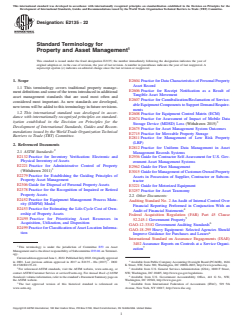
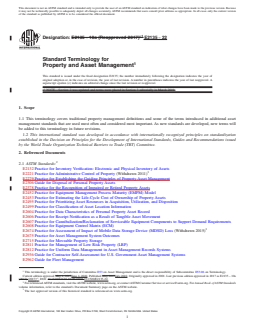
1.1 This terminology covers traditional property management definitions and some of the terms introduced in additional asset management standards that are used most often and considered most important. As new standards are developed, new terms will be added to this terminology in future revisions.
1.2 This international standard was developed in accordance with internationally recognized principles on standardization established in the Decision on Principles for the Development of International Standards, Guides and Recommendations issued by the World Trade Organization Technical Barriers to Trade (TBT) Committee.
- Status
- Published
- Publication Date
- 31-May-2022
- Technical Committee
- E53 - Asset Management
- Drafting Committee
- E53.06 - Terminology
Overview
ASTM E2135-22: Standard Terminology for Property and Asset Management is a foundational international standard developed by ASTM Committee E53.06 on Terminology. This standard provides a comprehensive glossary of key terms and definitions commonly used in property management and asset management, covering both traditional practices and new terminology introduced by evolving related standards. By establishing a common language, ASTM E2135-22 supports better communication, transparency, and compliance across industries and organizations globally.
This terminology standard is maintained in line with the World Trade Organization (WTO) principles for international standardization, ensuring broad applicability and alignment with best practices worldwide.
Key Topics
- Core Definitions: The standard defines essential terms such as asset, property, accountability, acquisition, amortization, depreciation, book value, and more, serving as a reference point for professionals in property and asset management.
- Financial Concepts: Coverage includes definitions related to asset valuation, depreciation methods, amortization, capital investments, acquisition costs, and tax-related terminology.
- Inventory and Control: Includes terminology on inventory management (e.g., ABC method, average age of inventory), asset tracking, classification, and accountability processes.
- Asset Types: Defines various types of property and assets, including tangible assets (equipment, real estate), intangible assets (intellectual property, licenses), and specialized categories such as administratively controlled items and agency-peculiar property.
- Lifecycle and Management Principles: Offers terminology for the full lifecycle of assets-from acquisition and classification to depreciation, disposal, and betterment-promoting clarity in reporting and decision-making.
Applications
ASTM E2135-22 is valuable for:
- Asset Management Professionals: Ensures consistent use of terminology when developing policies, procedures, and asset management strategies, improving internal controls and external communications.
- Property Managers and Auditors: Facilitates clear understanding for property managers and audit teams when assessing controls, conducting inventories, or producing asset management reports.
- Government and Regulatory Compliance: Assists public sector organizations and contractors in aligning their documentation and operational practices with legal, regulatory, and contractual requirements.
- Standardization in Documentation: Supports organizations in maintaining uniformity in contracts, asset registers, and compliance documentation, thereby reducing errors and misinterpretations.
- Interdepartmental Communication: Promotes effective collaboration among procurement, finance, operations, and compliance teams by providing a shared reference for asset- and property-related terms.
Related Standards
ASTM E2135-22 references and aligns with several interconnected standards, including:
- ASTM E2132: Practice for Inventory Verification: Electronic and Physical Inventory of Assets
- ASTM E2279: Practice for Establishing the Guiding Principles of Property Asset Management
- ASTM E2452: Practice for Equipment Management Process Maturity Model
- ASTM E2453: Practice for Estimating the Life-Cycle Cost of Ownership of Property Assets
- ASTM E2812: Practice for Uniform Data Management in Asset Management Records Systems
- ASTM E2962: Guide for Fleet Management
- ASTM E2604: Practice for Data Characteristics of Personal Property Asset Record
These standards provide guidance and best practices for key activities in property and asset management, including data management, lifecycle cost estimation, inventory control, and disposal processes. ASTM E2135-22 serves as the terminology backbone for consistent application and interpretation of these related documents.
By standardizing terminology, ASTM E2135-22 enhances the effectiveness and reliability of property and asset management systems across private and public sectors, helping organizations achieve operational excellence and regulatory compliance.
Relations
- Effective Date
- 01-Jul-2020
- Effective Date
- 01-Jul-2020
- Effective Date
- 01-Jul-2020
- Effective Date
- 01-Jul-2020
- Effective Date
- 15-Sep-2019
- Refers
ASTM E2452-12(2019) - Standard Practice for Equipment Management Process Maturity (EMPM) Model - Effective Date
- 01-May-2019
- Effective Date
- 01-May-2019
- Refers
ASTM E2453-19 - Standard Practice for Estimating the Life-Cycle Cost of Ownership of Property Assets - Effective Date
- 01-May-2019
- Effective Date
- 01-Jul-2018
- Effective Date
- 01-Jul-2018
- Effective Date
- 01-Jul-2018
- Effective Date
- 01-Nov-2017
- Effective Date
- 01-Nov-2017
- Refers
ASTM E2812-17 - Standard Practice for Uniform Data Management in Asset Management Records Systems - Effective Date
- 15-Jan-2017
- Effective Date
- 01-Jan-2017
Frequently Asked Questions
ASTM E2135-22 is a standard published by ASTM International. Its full title is "Standard Terminology for Property and Asset Management". This standard covers: SCOPE 1.1 This terminology covers traditional property management definitions and some of the terms introduced in additional asset management standards that are used most often and considered most important. As new standards are developed, new terms will be added to this terminology in future revisions. 1.2 This international standard was developed in accordance with internationally recognized principles on standardization established in the Decision on Principles for the Development of International Standards, Guides and Recommendations issued by the World Trade Organization Technical Barriers to Trade (TBT) Committee.
SCOPE 1.1 This terminology covers traditional property management definitions and some of the terms introduced in additional asset management standards that are used most often and considered most important. As new standards are developed, new terms will be added to this terminology in future revisions. 1.2 This international standard was developed in accordance with internationally recognized principles on standardization established in the Decision on Principles for the Development of International Standards, Guides and Recommendations issued by the World Trade Organization Technical Barriers to Trade (TBT) Committee.
ASTM E2135-22 is classified under the following ICS (International Classification for Standards) categories: 01.040.97 - Domestic and commercial equipment. Entertainment. Sports (Vocabularies). The ICS classification helps identify the subject area and facilitates finding related standards.
ASTM E2135-22 has the following relationships with other standards: It is inter standard links to ASTM E2962-14(2020), ASTM E3015-15(2020), ASTM E2608-20, ASTM E2279-20, ASTM E3221-19, ASTM E2452-12(2019), ASTM E2378-19, ASTM E2453-19, ASTM E2306-18, ASTM E2495-18, ASTM E2499-18, ASTM E2715-17, ASTM E2811-17, ASTM E2812-17, ASTM E2132-17. Understanding these relationships helps ensure you are using the most current and applicable version of the standard.
ASTM E2135-22 is available in PDF format for immediate download after purchase. The document can be added to your cart and obtained through the secure checkout process. Digital delivery ensures instant access to the complete standard document.
Standards Content (Sample)
This international standard was developed in accordance with internationally recognized principles on standardization established in the Decision on Principles for the
Development of International Standards, Guides and Recommendations issued by the World Trade Organization Technical Barriers to Trade (TBT) Committee.
Designation: E2135 − 22
Standard Terminology for
Property and Asset Management
This standard is issued under the fixed designation E2135; the number immediately following the designation indicates the year of
original adoption or, in the case of revision, the year of last revision.Anumber in parentheses indicates the year of last reapproval.A
superscript epsilon (´) indicates an editorial change since the last revision or reapproval.
1. Scope E2604PracticeforDataCharacteristicsofPersonalProperty
Asset Record
1.1 This terminology covers traditional property manage-
E2606Practice for Receipt Notification as a Result of
mentdefinitionsandsomeofthetermsintroducedinadditional
Tangible Asset Movement
asset management standards that are used most often and
E2607Practice for Cannibalization/Reclamation of Service-
considered most important. As new standards are developed,
ableEquipmentComponentstoSupportDemandRequire-
newtermswillbeaddedtothisterminologyinfuturerevisions.
ments
1.2 This international standard was developed in accor-
E2608Practice for Equipment Control Matrix (ECM)
dance with internationally recognized principles on standard-
E2674Practice for Assessment of Impact of Mobile Data
ization established in the Decision on Principles for the 3
Storage Device (MDSD) Loss (Withdrawn 2015)
Development of International Standards, Guides and Recom-
E2675Practice for Asset Management System Outcomes
mendations issued by the World Trade Organization Technical
E2715Practice for Moveable Property Storage
Barriers to Trade (TBT) Committee.
E2811Practice for Management of Low Risk Property
(LRP)
2. Referenced Documents
E2812Practice for Uniform Data Management in Asset
2.1 ASTM Standards:
Management Records Systems
E2132Practice for Inventory Verification: Electronic and
E2936Guide for Contractor Self-Assessment for U.S. Gov-
Physical Inventory of Assets
ernment Asset Management Systems
E2221Practice for Administrative Control of Property
E2962Guide for Fleet Management
(Withdrawn 2011)
E3015GuideforManagementofCustomer-OwnedProperty
E2279Practice for Establishing the Guiding Principles of
Assets in Possession of Supplier, Contractor or Subcon-
Property Asset Management
tractor
E2306Guide for Disposal of Personal Property Assets
E3221Guide for Motorized Equipment
E2378Practice for the Recognition of Impaired or Retired
E3257Practice for Asset Taxonomy
Property Assets
2.2 Other Documents:
E2452Practice for Equipment Management Process Matu-
Auditing Standard No. 2AnAudit of Internal Control Over
rity (EMPM) Model
Financial Reporting Performed in Conjunction With an
E2453Practice for Estimating the Life-Cycle Cost of Own-
Audit of Financial Statements
ership of Property Assets
Federal Acquisition Regulation (FAR) Part 45 Clause
E2495 Practice for Prioritizing Asset Resources in
52.245-1Government Property
Acquisition, Utilization, and Disposition
GAO-12-331GGovernment Auditing Standards
E2499PracticeforClassificationofAssetLocationInforma-
GAO-18-295Heavy Equipment: Selected Agencies Should
tion
Improve Guidance for Purchases and Leases
International Standard on Assurance Engagements (ISAE)
3402Assurance Reports on Controls at a Service Organi-
This terminology is under the jurisdiction of Committee E53 on Asset
zation
Management and is the direct responsibility of Subcommittee E53.06 on Terminol-
ogy.
CurrenteditionapprovedJune1,2022.PublishedJuly2022.Originallyapproved
ɛ1
in 2001. Last previous edition approved in 2017 as E2135–10a (2017) . DOI: Available from Public CompanyAccounting Oversight Board (PCAOB), 1666
10.1520/E2135-22. K Street, NW, Suite 300, Washington, DC 20006-2803, http://www.pcaobus.org.
2 5
For referenced ASTM standards, visit the ASTM website, www.astm.org, or Available from U.S. General Services Administration (GSA), 1800 F Street,
contact ASTM Customer Service at service@astm.org. For Annual Book of ASTM NW, Washington, DC 20405, http://www.gsa.gov/regulations.
Standards volume information, refer to the standard’s Document Summary page on Available from U.S. Government Accountability Office, 441 G St., NW,
the ASTM website. Washington, DC 20548, http://www.gao.gov.
3 7
The last approved version of this historical standard is referenced on Available from International Federation of Accountants (IFAC), 529 5th
www.astm.org. Avenue, New York, NY 10017, http://www.ifac.org.
Copyright © ASTM International, 100 Barr Harbor Drive, PO Box C700, West Conshohocken, PA 19428-2959. United States
E2135 − 22
OMB Circular A-123Management’s Responsibility for In- 20-year property, the appropriate method is the 150%
ternal Control declining balance method switching to the straight-line
methodwhenitwillyieldalargerallowance.Forresidential
3. Terminology
rental property (27.5 years) and nonresidential real property
(31.5 years), the applicable method is the straight-line
3.1 Terms and Definitions:
method. A taxpayer may make an irrevocable election to
abandon, v—to give up all and any future claim to rights or
treat all property in one of the classes under the straight-line
interest in property.
method. Property is statutorily placed in one of the classes.
The purpose of ACRS is to encourage more capital invest-
abandoned property, n—property of any type over which the
mentbybusinesses.Itpermitsafasterrecoveryoftheasset’s
rightful owner has relinquished possession and any claim of
costandthusprovideslargertaxbenefitsintheearlieryears.
an ownership interest.
See also modified accelerated cost recovery systems
abandonment, n—togiveupallandanyfutureclaimtorights
(MACRS).
or interest in personal property. E2306
accelerated depreciation, n—any method of calculating de-
abatement, n—a reduction or cancellation of an assessed tax.
preciation charges where the charges become progressively
smaller each period
ABC method, n—inventory management method that catego-
rizes items in terms of importance. Thus, more emphasis is
accessory item, n—an item that facilitates or enhances the
placed on higher dollar value items (“A”s) than on lesser
operation of equipment but is not essential for its basic
dollar value items (“B”s), while the least important items
operation.
(“C”s) receive the least time and attention. Inventory should
accountability, n—individualordepartmentalresponsibilityto
be analyzed frequently when using the ABC method. The
perform a certain function. Accountability may be dictated
procedure for ABC analysis follows: (1) Separate finished
orimpliedbylaw,regulation,oragreement.Forexample,an
goods into types (chairs of different models, and so on);
auditor will be held accountable to financial statement users
separate raw materials into types (screws, nuts, and so on).
relying on the audited financial statements for failure to
(2) Calculate the annual dollar usage for each type of
uncover corporate fraud because of negligence in applying
inventory (multiply the unit cost by the expected future
generally accepted auditing standards (GAAS).
annual usage). (3) Rank each inventory type from highest to
accountability, n—the concept of accountability of resources
lowest, based on annual dollar usage. (4) Classify the
and authority is fundamental to an entity’s governing and
inventory as A—the top 20%; B—the next 30%; and
management processes. Management and officials entrusted
C—the last 50% of dollars usage, respectively. (5) Tag the
inventory with its appropriateABC classification and record with public and private resources are responsible for carry-
ingoutpublicandprivatefunctionsandprovidingserviceto
those classifications in the item inventory master records.
the public and owners effectively, efficiently, economically,
abnormal spoilage, n—for government accounting under the
ethically, and equitably within the context of their given
FAR, abnormal spoilage may or may not be allowable cost.
situation—as reflected in applicable laws, regulations,
If the cost is deemed allowable, the cost would normally be
agreements, standards, and internal policy and direction.
charged consistently with normal spoilage.
Management and officials are responsible for providing
reliable, useful, and timely information as needed. E2378
abuse, n—abuseinvolvesbehaviorthatisdeficientorimproper
DISCUSSION—Effective, efficient, and economical efforts include as-
when compared with behavior that a prudent person would
sessments of cost and benefits of requirements and actions.
consider reasonable and necessary business practice given
the facts and circumstances. Abuse also includes misuse of accounting change, n—change in: (1) accounting principles
authority or position for personal financial interests or those
(such as a new depreciation method); (2) accounting esti-
of an immediate or close family member or business mates (such as a revised projection of doubtful accounts
associate. Abuse does not necessarily involve fraud or
receivable); or (3) the reporting entity (such as a merger of
noncompliance with provisions of laws, regulations, companies). When an accounting change is made, appropri-
contracts, or grant agreements. E2378
ate footnote disclosure is required to explain its justification
and financial effect, thereby enabling readers to make
accelerated cost recovery system (ACRS), n—system of
appropriate investment and credit judgments. Proper justifi-
depreciation for tax purposes mandated by the Economic
cation for a change in accounting principles may be the
Recovery Act (ERA) of 1981 and modified by the Tax
issuance of a new FASB pronouncement, SEC Accounting
Reform Act of 1986. The type of property determines its
Series Release (ASR), or IRS regulation. Changes in esti-
class. Instead of providing statutory tables, prescribed meth-
mates are justified by changing circumstances such as a
ods of depreciation are assigned to each class of property.
greater degree of wear and tear of a fixed asset than
For 3, 5, 7, and 10-year classed, the relevant depreciation
originally anticipated. Generally, the consistent use of ac-
method is the 200% declining balance method. For 15 and
counting principles and procedures is essential in appraising
and entity’s activities and in the projection of future results;
however, changes in the reporting entity have to be retroac-
Available from Office of Management and Budget (OMB), 725 17th Street,
NW, Washington, DC 20503, http://www.whitehouse.gov/omb. tively reflected for comparative purposes.
E2135 − 22
accretion, n—increase in economic worth through physical air, n—physical, natural resource asset that is the mixture of
change,usuallysaidofanaturalresourcesuchasanorchard, invisible odorless tasteless gases (such as nitrogen and
caused by natural growth. Contrast with appreciation. oxygen) that surrounds the earth. E3257
accumulated depreciation, n—sum of depreciation charges
alignment, n—deliberate arrangement, relationship, and mu-
taken to date on a fixed asset.Accumulated depreciation is a
tual understanding of common concerns within a particular
contra account to the fixed asset to arrive at book value. For
activity or among activities. E2279
example, on 1/1/2000 an auto is bought costing $10000,
allocate, v—to assign an item of cost, or a group of items of
with a salvage value of $1000 and a life of 10 years. Using
cost, to one or more cost objectives.This term includes both
straight-line depreciation, the accumulated depreciation on
direct assignment of cost and the reassignment of a share
12/31/2003 would be $3600 ($900 × 4).
from an indirect cost pool.
acquired property, n—property under the possession or con-
amortization, n—gradual reduction of an amount over time.
trol of an entity that is not deemed “furnished property” and
Examples are amortized expenses on intangible assets and
was acquired for business operation purposes. E3015
deferred charges.Assets with limited life have to be written
acquisition, n—hardware, supplies or services through
down over the period benefited. For example, all intangible
purchase, lease, or other means, including transfer or
assets must be amortized using the straight-line method not
fabrication, whether the supplies or services are already in
exceeding 40 years; the amortization entry in that case is to
existence or must be created, developed, demonstrated, and
debit amortization expense and credit the intangible asset.
evaluated. E2607
amortization, n—the gradual extinguishment of any amount
acquisition cost, n—purchase price paid for property and any
over a period of time through a systematic allocation of the
appropriate subsequent improvements to it; includes cash
amount over a number of consecutive accounting periods
paid or fair value received and material amounts of prepa-
such as the retirement of a debt by serial payments to a
ration cost such as inspection, testing, and installation.
sinking fund.
E2279
amortization, n—normally applies to intangibles whereas
activity-based depreciation, n—production method of depre-
depreciation applies to tangible assets.
ciation.
amortize, v—to write off a regular portion of an asset’s cost
actual cash value, n—the cost of replacing damaged property
over a fixed period of time. Examples are amortization
with other property of like kind and quality in the physical
expense on an intangible asset and depletion expense on a
condition of the property immediately before the damage.
natural resource. See also sales return.
actual cost, n—an amount determined on the basis of cost
analytical hierarchy process (AHP), n—decision-making
incurred including standard cost properly adjusted for appli-
model that reduces complex decisions to one on one com-
cable variance.
parisons resulting in the ranking of a list of objectives or
adjusted basis, n—the basis used to compute gain or loss on
alternatives. E2495
disposition of an asset for tax purposes. Also, see book
value. appraisal, n—the process of obtaining a valuation for an asset
or liability that involves expert opinion rather than explicit
administratively controlled items, n—items not requiring
market transaction.
formal property control and accountability by property asset
management and accounting functions. E2378
appraisal method of depreciation, n—the periodic deprecia-
tion charge is the difference between the beginning and
administratively controlled property, n—the property assets
end-of-period appraised value of the asset if that difference
that are controlled at the discretion of asset managers
is positive. If negative, there is no charge. Not generally
managing the inventories of individual operational units.
accepted.
E2221
appreciation, n—increase in the value of an asset. The asset
ad valorem tax—levy imposed on the value of property. The
may be real estate or a security. For example, an individual
most common ad valorem tax is that imposed by states,
sold100sharesofXYZcompany’sstockfor$105pershare
counties, and cities on real estate. Ad valorem taxes can,
that he bought 10 years ago for $25 per share. The amount
however, be imposed on personal property.
of appreciation was $8000 = ($105 − $25) × 100 shares.
agency, n—government organization, regardless of level
assembly, n—a number of parts or subassemblies joined
(federal, state, or local). E2279
together.
agency-peculiar property, n—asusedinDoD,meansmilitary
property and includes end items and integral components of assessed valuation, n—a dollar amount for real estate or other
military weapons systems, along with the related peculiar property used by a government as a basis for levying taxes.
support equipment which is not readily available as a The amount may or may not bear some relation to market
commercial item. value.
E2135 − 22
assessed value, n—value established by a government for real asset, n—item,thing,orentitythathaspotentialoractualvalue
estate or other property as a basis for levying taxes. For to an organization. E3257
example, an individual receives a statement that, in the
asset accountability unit, n—a tangible capital asset which is
judgment of the local tax assessor, the individual’s property
acomponentofplantandequipmentthatiscapitalizedwhen
isworth$50000.Ifbylaw,propertiesinthisjurisdictionare
acquired or whose replacement is capitalized when the unit
assessed at 80% of market value, the individual’s assessed
is removed, transferred, sold, abandoned, demolished, or
value then is $40000 (80% of $50000) and property taxes
otherwise disposed of.
will be based on this assessed value.
asset custodian, n—an individual or organization accountable
asset, n—(1) anything owned having monetary value; (2)
for asset. E2606
tangible or intangible items owned by an entity that have
probable economic benefits that can be obtained or con-
asset functionality, n—set of functions that an asset is able or
trolled by the entity.
equipped to perform. E2675
asset, n—item,thing,orentitythathaspotentialoractualvalue
asset identifier, n—an alphanumeric character sequence that
to an organization; also may be referred to as property, and
corresponds to a specific asset record in an asset manage-
assetandpropertymaybeusedinpracticeandindocuments
ment records system. E2812
interchangeably. (For Asset Management purposes.)
asset management system, n—subset of organizational
DISCUSSION—Value can be tangible or intangible, financial or non-
financial (ISO 55000), and includes consideration of risks and liabili-
policies, processes, procedures, and people related to the
ties. It can be positive or negative at different stages of the asset life.
management assets.
DISCUSSION—These processes represent sound practice and are com-
DISCUSSION—Physical assets usually refer to equipment, inventory,
pliant with applicable standards, policies, regulations, and contractual
and properties owned by the organization. Physical assets are the
requirements. E2675
opposite of intangible assets, which are non-physical assets such as
leases, brands, digital assets, use rights, licenses, intellectual property
asset priority index (API), n—numerical value assigned to an
rights, reputation, or agreements.
asset reflecting its value to an entity’s mission or other
DISCUSSION—A grouping of assets referred to as an asset system
critical assignments as defined by the criteria set forth by
could also be considered as an asset. E2279
management. E2495
asset, n—assetsareprobablefutureeconomicbenefitsobtained
average age of inventory, n—number of days an average
or controlled by a particular entity as a result of past
inventory item takes to sell: For example, assume that
transactions or events. (For Financial Accounting reporting
average inventory is $47500 and cost of goods sold is
purposes. FASB Statement of Financial Accounting Con-
$500 000. The average age of inventory is
cepts No. 6.) E2279
($47500⁄$500000)×365days=34.7days.Seealso days to
sell inventory.AverageInventorydividedbyAverageAgeof
asset—thetermforaccountingpurposesisgenerallydefinedin
Inventory = Cost of Goods Sold × 365 days.
an organization’s policy based on applicable accounting
standards. The term for asset management purpose should
average inventory, n—amount equaling about half maximum
also be defined in an organization’s policy and may include
inventory when demand is relatively constant. For example,
the ISO 55000 definition of an asset: item, thing, or entity
if the maximum inventory is 500 units and depletion occurs
that has potential or actual value to an organization.
at a fairly constant rate, the average inventory equals 250
DISCUSSION—Value can be tangible or intangible, financial or
units (500/2).
nonfinancial, and includes consideration of risks and liabilities. It can
be positive or negative at different stages of the asset life.
average life, n—estimated useful-life expectancy of a depre-
DISCUSSION—Physical assets usually refer to equipment, inventory,
ciablegroupofassets.Seealso depreciation; economic life;
and properties owned by the organization. Physical assets are the
useful life.
opposite of intangible assets, which are nonphysical assets such as
leases, brands, digital assets, use rights, licenses, intellectual property
bailment, n—contractual transfer of dollars or personal prop-
rights, reputation, or agreements.
ertyforaspecifiedobjective.Anexampleistheconsignment
of goods from the consignor to consignee.Another example
DISCUSSION—A grouping of assets referred to as an asset system
is a bank holding an asset of a borrower as collateral. In a
could also be considered as an asset.
bailment,thedelivereriscalledthebailorandthereceiveris
DISCUSSION—Asset management generally supports the accounting
termed the bailee.
arena in which the accounting rules apply. Asset management may
operate and use the broader definition of asset management that may
bargain purchase, n—asset or goods acquired for materially
not only impact financial accounting reporting but also other organi-
less than fair market value. For example, a buyer may be
zational objectives and commitments. Company management, who has
able to get a bargain price on furniture from a seller in a
the responsibility to establish adequate internal controls, should iden-
liquidation situation.
tify in procedures and use in processes and practices the appropriate
uses of the term “asset.” E2453
bargain purchase option, n—a provision allowing the lessee
asset, n—item,thing,orentitythathaspotentialoractualvalue the option of purchasing the leased property for an amount,
to an organization. E2675 exclusiveofleasepayments,whichissufficientlylowerthan
E2135 − 22
the expected fair value of the property at the date the option blanket insurance, n—policy covering several items of prop-
become exercisable. Exercise of the option must appear erty. The insurance policy is allocated to the property items
reasonably assured at the inception of the lease. GAAPdoes
based on their fair market values.
notofferadditionalguidancedefining“sufficientlylower,”in
book inventory, n—inventory shown on the financial records.
whichmanyfactorssuchastimevalueofmoney,usage,and
Itisabookvalueasopposedtoaphysicalcountofinventory
technological changes influence whether the option fulfills
and is computed from the initial inventory plus purchases
the criteria for a bargain.
less requisitions or withdrawals. Book inventory typically
bargain renewal option, n—a provision allowing the lessee
differsfromthephysicalinventoryonhandduetoshrinkage
theoptiontorenewtheleaseagreementforarentalpayment
(that is, loss caused by such factors as evaporation and
sufficiently lower than the expected fair rental of the
thefts).
propertyatthedatetheoptionbecomesexercisable.Exercise
oftheoptionmustappearreasonablyassuredattheinception
book value, n—the net amount at which an asset or liability is
of the lease.
carried on the books of account.
basic research, n—researchdirectedtowardincreasingknowl-
building location, n—asset physical location information rep-
edgeinscience.Theprimaryaimofbasicresearchisafuller
resenting the building position of the item within the site
knowledge or understanding of the subject under study,
location. E2499
rather than any practical application of that knowledge.
business unit, n—any segment of an organization, or an entire
basis, n—acquisition cost, or some substitute therefore of an
business organization which is not divided into segments.
asset used in computing gain or loss on disposition or
retirement.
calibration, n—the act of standardizing or determining the
deviation from a standard so as to ascertain the proper
bench stock, n—low cost, high usage, non-sensitive consum-
correction factors.
able material issued to work areas. Quantities of such stock
do not normally exceed an amount that would normally be
cannibalization, n—removal of serviceable components from
consumed within a 30-day period or as established in the
one item of equipment in order to install them on another
property control system.
item of equipment. The removal of components from one
best value, n—expected outcome of an action, in the entity’s
item of equipment for the purpose of repairing other similar
estimation, which provides the greatest overall benefit.
equipment. E2607
E2279
capacity, n—ability to produce during a given time period,
best value, n—expected outcome of an acquisition that pro-
with an upper limit imposed by the availability of space,
vides the greatest overall benefit in response to the
machinery, labor, materials, or capital. Capacity may be
requirement. E2675
expressed in units, weights, size, dollars, man-hours, labor
betterment, n—an expenditure having the effect of extending
cost, etc. Typically, there are five different concepts of
the useful life of an existing asset, increasing its normal rate capacity. (1) Ideal Capacity—volume of activity that could
of output, lowering its operating cost, increasing rather than
be attained under ideal operating conditions, with minimum
merely maintaining its efficiency or otherwise adding to the
allowance for inefficiency. It is the largest volume of output
worth of benefits it can yield. A betterment is distinguished
possible. Also called theoretical capacity, engineered
from repair or maintenance in that the latter have the effect
capacity,or maximum capacity.(2) Practical Capacity—
of merely keeping the asset in its customary state of
highest activity level at which the factory can operate with
operating efficiency without the expectation of added future
an acceptable degree of efficiency, taking into consideration
benefits.
unavoidable losses of productive time (that is, vacations,
holidays, repairs to equipment).Also called maximum prac-
bid and proposal cost, n—the cost incurred in preparing,
tical capacity.(3) Normal Capacity—average level of oper-
submitting,orsupportinganybidorproposalwhicheffortis
ating activity that is sufficient to fill the demand for the
neither sponsored by a grant, nor required in the perfor-
company’s products or services for a span of several years,
mance of a contract.
taking into consideration seasonal and cyclical demands and
bill of materials (BOM), n—listing of all the assemblies,
increasing or decreasing trends in demand. (4) Expected
subassemblies, parts, and raw materials that are needed to
Actual Capacity—similar to normal capacity, except it is a
produce one unit of a finished product. Thus, each finished
short-run level based on demand, it minimizes under- or
producthasitsownbillofmaterials.Thelistinginthebillof
over-applied overhead but does not provide a consistent
materials file is hierarchical; it shows the quantity of each
basis for assigning overhead cost. Per-unit overhead will
itemneededtocompleteoneunitofthenext-highestlevelof
fluctuatebecauseofshort-termchangesintheexpectedlevel
assembly.
of output. Also called planned capacity.(5) Operating
bill of sale, n—written document that transfers goods, title, or Capacity—similar to planned capacity except the time pe-
riod is within a small slice of a single year (that is, daily,
otherinterestsfromasellertoabuyerandspecifiestheterms
and conditions of the transaction. monthly, quarterly).
E2135 − 22
capital, n—long-termassetsthatarenotboughtandsoldinthe preserving, and transporting excess and surplus property,
ordinary course of business.The term usually refers to fixed and, in the case of property.
assets such as machinery, equipment, building, and land.
care and handling, n—includes the costs of completing,
capital addition—(1) new (as opposed to replacement) part
repairing, converting, rehabilitating, operating, preparing,
added to an existing noncurrent productive asset (for
preserving, protecting, insuring, packing, storing,
example, equipment) used for business purposes that in-
conserving,andtransportingofproperty,and—inthecaseof
creases the useful life and service potential of the asset. (2)
property that is dangerous to public health, safety, and
In taxation, cost of capital improvements and betterments
security—destroyingorrenderingthepropertyuselessforits
made to the property by a taxpayer. (3) Anything added to
original purpose. E2279
long-term productive assets.
carrying costs, n—expenses incurred because a firm keeps
capital asset, n—asset purchased for use in production over
inventories, also called holding costs. They include interest
long periods of time rather than for resale. It includes (a)
forgone on money invested in inventory, storage cost, taxes,
land, buildings, plant and equipment, mineral deposits, and
andinsurance.Thegreatertheinventorylevel,thehigherthe
timber reserves; (b) patents, goodwill, trademarks, and
carrying costs.
leaseholds; and (c) investments in affiliated companies.
carrying value, n—amount shown on an entity’s books for
capital expenditure, n—outlay charged to a long-term asset
assets, liabilities, or owner’s equity, net of reductions or
account.Acapital expenditure either adds a fixed asset unit
offsets such as for accumulated depreciation, allowance for
or increases the value of an existing fixed asset.An example
baddebts,andbonddiscount;alsocalled book value.Itmay
is a new motor for a truck.
refer to the entire firm’s excess of total assets over total
liabilities.
capital expenditure budget, n—plan prepared for individual
capital expenditure projects. The time span of this budget
category of material,n—aparticularkindofgoods,comprised
depend upon the project. Capital expenditures to be bud-
of identical or interchangeable units, acquired or produced
geted include replacement, acquisition, or construction of
by a contractor, which are intended to be sold, or consumed
plants and major equipment. See also capital budgeting.
or used in the performance of either direct or indirect
functions.
capital gain, n—tax term involved with selling or exchanging
a capital asset. Individual: Maximum tax rate on capital
charge off, v—to treat as a loss or expense an amount
gainsis20%comparedtothemaximumtaxrateonordinary
originallyrecordedasanasset;usuallythetermisusedwhen
income of 39.6% for those having taxable incomes exceed-
the charge is not in accord with original expectations.
ing $250000. Corporation: Capital gains are taxed at 20%.
See also capital loss. city/township/county location, n—asset physical location in-
formationrepresentingthecity,township,orcountyposition
capital investment decisions, n—managementdecisionsabout
of the item within the state/province location. E2499
when and how much to spend on capital facilities for the
organization.
classification, n—the third level of the asset taxonomy, it
includes major subdivision of the domain level. E3257
capitalization of interest, n—process of deferring interest as
an asset rather than an expense. Interest charges can be
classification of assets, n—process of grouping economic
deferred interest as an asset rather than an expense. Interest
resources under appropriate categories. Asset categories
charges can be deferred only for interest incurred on bor-
include current assets, fixed assets, intangible assets,
rowed funds for the self-construction of an asset or for
investments, and deferred costs. Assets are classified into
discrete projects (for example, real estate). The amount of
majorgroupingstofacilitateanalysisoftheentity’sfinancial
interest capitalized is based on the company’s or entity
health. For instance, a company’s liquidity can be appraised
actualborrowingsandinterestpayments.Theinterestrateto
by concentrating on the current assets less prepaid expenses
be used is the rate on the specific borrowing associated with
which are available to meet short-term debt.
that self-constructed asset. If this cannot be achieved, the
classification of defects, n—the enumeration of possible de-
weighted-average interest rate on corporate debt is used.
fects of the assessment sample classified according to their
capitalize, v—to record and carry forward into one or more
seriousness, that is, critical, major or minor defect. E2936
future periods any expenditure the benefits or process from
cleanup costs, n—the costs of removing, containing, or
which will then be realized.
disposing, or any combination thereof, of (1) hazardous
capital loss, n—federal tax term for the loss on the sale or
wastefromproperty,or(2)materialorproperty,orboth,that
exchange of a capital asset. Individual: Capital losses are
consists of hazardous waste at permanent or temporary
fully deductible to offset capital gains and can offset $3000
closure or shutdown of associated PP&E.
of ordinary income. Corporation: Capital losses are deduct-
closing inventory, n—ending inventory.
ible only to the extent of capital gains.
care and handling, n—the term “care and handling” includes coding, n—generating detailed instructions in a computer
completing, repairing, converting, rehabilitating, operating, languagetocarryouttherequirementsdescribedinthedetail
E2135 − 22
program design.The coding of a computer software product regulations, or other relevant internal or external guidance
may being prior to, concurrent with, or subsequent to the that does not rise to the level of an operational impact.
completion of the detail program design. E2608
compliance impact, n—consequence of loss of control char-
commercial item, n—(1) Any item, other than real property,
acterized by negative compliance with applicable laws,
that is of a type customarily used for nongovernmental
regulations, or other relevant internal or external guidance
purposes and that has been sold, leased, or licensed to the
that does not rise to the level of an operational impact.
generalpublic;or,hasbeenofferedforsale,lease,orlicense
E2674
tothegeneralpublic;(2)Anyitemthatevolvedfromanitem
describedinparagraph(1)ofthisdefinitionthoughadvances
component, n—a part of a mechanical or electrical complex.
intechnologyorperformanceandthatisnotyetavailablein
E2607
the commercial marketplace, but will be available in the
component (financial), n—a tangible part or portion of PP&E
commercial marketplace in time to satisfy the delivery
that (1) can be separately identified as an asset and depreci-
requirements under a government solicitation; (3)Any item
ated or amortized over its own separate expected useful life
that would satisfy a criterion expressed in paragraphs (1)or
and (2) is expected to provide economic benefit for more
(2) of this definition, but for (i) Modifications of a type
than one year.
customarily available in the commercial marketplace; or (ii)
Minor modifications of a type customarily available in the
composite depreciation, n—group depreciation of dissimilar
commercial marketplace made to meet federal government
assets with different service lives. Depreciation on all assets
requirements. Minor modifications means modifications that
isdeterminedbyusingthestraight-line-depreciationmethod.
do not significantly alter the nongovernmental function or
Then,acompositedepreciationrateisarrivedatbasedonthe
essentialphysicalcharacteristicsofanitemorcomponent,or
ratioofdepreciationperyeartotheoriginalcost.Composite
change the purpose of a process. Factors to be considered in
life equals the depreciable cost divided by the depreciation
determining whether a modification is minor include the
per year. In any given year, depreciation expense equals the
valueandsizeofthemodificationandthecomparativevalue
composite depreciation rate times the gross cost balance in
and size of the final product. Dollar values and percentages
the asset account.The entry is to debit depreciation expense
may be used as guideposts, but are not conclusive evidence
and credit accumulated depreciation. Under the method,
that a modification is minor; (4) Any combination of items
when a particular asset is sold, the entry is to debit cash for
meetingtherequirementsofparagraphs(1),(2),(3),or(5)of
the amount received and credit the asset for its original cost.
this definition that are of a type customarily combined and
The difference between the two is debited to accumulated
sold in combination to the general public; (5) Installation
depreciation. No gain or loss on the sale of a fixed asset is
services, maintenance services, repair services, training
recognized under the composite method.
services, and other services if such services are procured for
support of an item referred to in paragraphs (1), (2), (3), or computer software, n—computer programs, computer data
(4) of this definition, and if the source of such services (i) bases, and related documentation.
Offers such services to the general public and the federal
conceptual assets, n—non-physical pertaining to concepts or
governmentcontemporaneouslyandundersimilartermsand
to the forming of concepts, including management control
conditions; and (ii) offers to use the same work force for
systems, perceptions, and knowledge. E3257
providing the federal government with such services as the
sourceusesforprovidingsuchservicestothegeneralpublic;
condition, n—the physical state of an asset. The condition of
(6) Services of a type offered and sold competitively in
anassetisbasedonanevaluationofthephysicalstatus/state
substantial quantities in the commercial marketplace based
of an asset, its ability to perform as planned, and its
on established catalog or market prices for specific tasks
continued usefulness. Evaluating an asset’s condition re-
performed under standard commercial terms and conditions.
quires knowledge of the asset, its performance capacity and
This does not include services that are sold based on hourly
its actual ability to perform, and expectations for its contin-
rates without an established catalog or market price for a
ued performance. The condition of a long-lived asset is
specific service performed; (7) Any item, combination of
affected by its durability, the quality of its design and
items, or service referred to in paragraphs (1) through (6)of
construction, its use, the adequacy of maintenance that has
this definition, notwithstanding the fact that the item, com-
been performed, and many other factors, including: acci-
binationofitems,orserviceistransferredbetweenoramong
dents (an unforeseen and unplanned or unexpected event or
separate divisions, subsidiaries, or affiliates of a contractor;
circumstance), catastrophes (a tragic event), disasters (a
or (8) A nondevelopmental item, if the procuring agency
sudden calamitous event bringing great damage, loss, or
determines the item was developed exclusively at private
destruction), and obsolescence.
expense and sold in substantial quantities, on a competitive
condition assessment surveys, n—periodic inspections of
basis, to multiple state and local governments.
PP&E to determine their current condition and estimated
company, n—a for-profit organization. E2279
cost to correct any deficiencies.
compliance impact, n—a consequence of loss of control condition code, n—a symbol that signifies the physical oper-
characterized by negative compliance with applicable laws, ating condition of property.
E2135 − 22
condoned, v—a responsible individual “condoned” an act the leased property or for increases in some measure of cost
non-compliantwithinternalcontrolsestablishedbyanentity during the construction or pre-construction period should be
if the individual knew of the non-compliant act or wrong- excluded from contingent rentals. Also, provisions that are
doing and did not take required or reasonable steps to dependentonlyuponthepassageoftimeshouldbeexcluded
prevent or terminate the action. E2279 from contingent rentals.Alease payment that is based upon
anexistingindexorrate,suchastheconsumerpriceindexor
confidence level, n—a statistical measure of the amount of
theprimerate,isacontingentpayment,andthecomputation
reliability that a random statistical sample represents the
of the minimum lease payments should be based upon the
entire population. E2936
index or rate applicable at the inception of the lease.
consequence, n—theeffectofactions(somethingthatlogically
continuous control, n—real time tracking and control with
or naturally follows from an action or condition). E2674
eitherhumanorelectronicmonitoringandsurveillanceatall
consignment, n—specialized way of marketing certain types times. E2608
ofgoods.Theconsignordeliversgoodstotheconsigneewho
continuous control while mobile, n—real time tracking and
acts as the consignor’s agent in selling the merchandise to a
control with either human or electronic monitoring and
third party. The consignee accepts the goods without any
surveillance at any time the equipment is not stationary in a
liabilityexcepttoreasonablyprotectthemfromdamage.The
secure, fixed location. E2608
consignee receives a commission when the merchandise is
sold. Goods on consignment are included in the consignor’s continuous inventory method, n—the perpetual inventory
inventoryandexcludedfromtheconsignee’sinventorysince method.
the consignor has legal title.
contra account, n—(1) reduction to the gross cost of an asset
constructed assets, n—physical assets that exist as a result of to arrive at its net cost; also called valuation allowance. For
actions of humankind. E3257 example,accumulateddepreciationisacontraaccounttothe
original cost of a fixed asset to arrive at book value. (2)
construction in progress, n—an inventory account used to
Reduction of a liability to arrive at its carrying value. An
accumulatetheconstructioncostsofthecontractproject.For
example is bond discount, which is a reduction of bonds
the percentage-of-completion method, the CIP account also
payable.
includes the gross profit earned to date.
contract, n—agreement creating obligations enforceable by
constructive custody, n—legal possession of property by
law. [http://www.law.cornell.edu/wex/contract]
federal government personnel through a non-federal agent,
such as a commercial contractor or state or local official, contracting, n—purchasing, renting, leasing, or otherwise
under a legal agreement or court order that the agent
obtaining supplies or services from non-federal sources.
maintainsphysicalpossessionandcontrolofthepropertyon Contracting includes description (but not determination) of
behalf of, and subject to the orders of, the federal govern-
supplies and services required, selection and solicitation of
ment personnel. sources, preparation and award of contracts, and all phases
ofcontractadministration.Itdoesnotincludemakinggrants
consumed, n—the loss of identity of an item by incorporation
or cooperative agreements.
into a higher assembly or through use and ultimate disap-
pearance as a known item or substance.
contractor inventory, n—(1) any property acquired by and in
the possession of a contractor or subcontractor under a
consumption—(1) the process of incorporating material into
contract pursuant to the terms of which title is vested in the
an end item or otherwise using it in the performance of a
government, and in excess of the amounts needed to com-
documented business objective. (2) The measurement of
plete full performance under the entire contract; and (2) any
actual use of consumable items against planned use.
propertywhichthegovernmentisobligatedorhastheoption
consumption method, n—a method of accounting for goods, to take over under any type of contract as a result either of
such as materials and supplies, where the goods are recog- any changes in the specifications or plans thereunder or of
the termination of such contract (or subcontract thereunder),
nizedasassetsuponacquisitionandareexpensedastheyare
consumed. priortocompletionofthework,fortheconvenienceoratthe
option of the government.
containment, n—the level of control characterized by process
or electronic methods of assuring equipment items are contractor self assessment (CSA), n—an auditing,
contained within a designated area. E2608 assessment,revieworsurveillanceprogramimplementedby
a contractor to identify, evaluate and take corrective action
contingent rentals, n—rentals that represent allowing the
on compliance and operational risks resulting from business
lessee the option to renew the lease agreement for a rental
practices for government property management. E2936
payment sufficiently lower than the expected fair rental of
the property at the date the option becomes exercisable. controllability, n—extent to which a manager can influence
Exerciseoftheoptionmustappearreasonablyassuredatthe activities. Managerial performance theoretically should be
inception of the lease. However, changes due
...
This document is not an ASTM standard and is intended only to provide the user of an ASTM standard an indication of what changes have been made to the previous version. Because
it may not be technically possible to adequately depict all changes accurately, ASTM recommends that users consult prior editions as appropriate. In all cases only the current version
of the standard as published by ASTM is to be considered the official document.
´1
Designation: E2135 − 10a (Reapproved 2017) E2135 − 22
Standard Terminology for
Property and Asset Management
This standard is issued under the fixed designation E2135; the number immediately following the designation indicates the year of
original adoption or, in the case of revision, the year of last revision. A number in parentheses indicates the year of last reapproval. A
superscript epsilon (´) indicates an editorial change since the last revision or reapproval.
ε NOTE—Section 2 was updated and terms were placed in Section 3 editorially in March 2019.
1. Scope
1.1 This terminology covers traditional property management definitions and some of the terms introduced in additional asset
management standards that are used most often and considered most important. As new standards are developed, new terms will
be added to this terminology in future revisions.
1.2 This international standard was developed in accordance with internationally recognized principles on standardization
established in the Decision on Principles for the Development of International Standards, Guides and Recommendations issued
by the World Trade Organization Technical Barriers to Trade (TBT) Committee.
2. Referenced Documents
2.1 ASTM Standards:
E2132 Practice for Inventory Verification: Electronic and Physical Inventory of Assets
E2221 Practice for Administrative Control of Property (Withdrawn 2011)
E2279 Practice for Establishing the Guiding Principles of Property Asset Management
E2306 Guide for Disposal of Personal Property Assets
E2378 Practice for the Recognition of Impaired or Retired Property Assets
E2452 Practice for Equipment Management Process Maturity (EMPM) Model
E2453 Practice for Estimating the Life-Cycle Cost of Ownership of Property Assets
E2495 Practice for Prioritizing Asset Resources in Acquisition, Utilization, and Disposition
E2499 Practice for Classification of Asset Location Information
E2604 Practice for Data Characteristics of Personal Property Asset Record
E2606 Practice for Receipt Notification as a Result of Tangible Asset Movement
E2607 Practice for Cannibalization/Reclamation of Serviceable Equipment Components to Support Demand Requirements
E2608 Practice for Equipment Control Matrix (ECM)
E2674 Practice for Assessment of Impact of Mobile Data Storage Device (MDSD) Loss (Withdrawn 2015)
E2675 Practice for Asset Management System Outcomes
E2715 Practice for Moveable Property Storage
E2811 Practice for Management of Low Risk Property (LRP)
E2812 Practice for Uniform Data Management in Asset Management Records Systems
E2936 Guide for Contractor Self-Assessment for U.S. Government Asset Management Systems
E2962 Guide for Fleet Management
This terminology is under the jurisdiction of Committee E53 on Asset Management and is the direct responsibility of Subcommittee E53.06 on Terminology.
Current edition approved May 1, 2017June 1, 2022. Published May 2017July 2022. Originally approved in 2001. Last previous edition approved in 2017 as E2135 – 10a
ɛ1
(2017).(2017) . DOI: 10.1520/E2135-10AR17E01.10.1520/E2135-22.
For referenced ASTM standards, visit the ASTM website, www.astm.org, or contact ASTM Customer Service at service@astm.org. For Annual Book of ASTM Standards
volume information, refer to the standard’s Document Summary page on the ASTM website.
The last approved version of this historical standard is referenced on www.astm.org.
Copyright © ASTM International, 100 Barr Harbor Drive, PO Box C700, West Conshohocken, PA 19428-2959. United States
E2135 − 22
E3015 Guide for Management of Customer-Owned Property Assets in Possession of Supplier, Contractor or Subcontractor
E3221 Guide for Motorized Equipment
E3257 Practice for Asset Taxonomy
2.2 Other Documents:
Auditing Standard No. 2 An Audit of Internal Control Over Financial Reporting Performed in Conjunction With an Audit of
Financial Statements
Federal Acquisition Regulation (FAR) Part 45 Clause 52.245-1 Government Property
GAO-12-331G Government Auditing Standards
GAO-18-295 Heavy Equipment: Selected Agencies Should Improve Guidance for Purchases and Leases
International Standard on Assurance Engagements (ISAE) 3402 Assurance Reports on Controls at a Service Organization
OMB Circular A-123 Management’s Responsibility for Internal Control
3. Terminology
3.1 Terms and Definitions:
abandon, v—to give up all and any future claim to rights or interest in property.
abandoned property, n—property of any type over which the rightful owner has relinquished possession and any claim of an
ownership interest.
abandonment, n—to give up all and any future claim to rights or interest in personal property. E2306
abatement, n—a reduction or cancellation of an assessed tax.
ABC method, n—inventory management method that categorizes items in terms of importance. Thus, more emphasis is placed
on higher dollar value items (“A”s) than on lesser dollar value items (“B”s), while the least important items (“C”s) receive the
least time and attention. Inventory should be analyzed frequently when using the ABC method. The procedure for ABC analysis
follows: (1) Separate finished goods into types (chairs of different models, and so on); separate raw materials into types (screws,
nuts, and so on). (2) Calculate the annual dollar usage for each type of inventory (multiply the unit cost by the expected future
annual usage). (3) Rank each inventory type from highest to lowest, based on annual dollar usage. (4) Classify the inventory
as A—the top 20 %; B—the next 30 %; and C—the last 50 % of dollars usage, respectively. (5) Tag the inventory with its
appropriate ABC classification and record those classifications in the item inventory master records.
abnormal spoilage, n—for government accounting under the FAR, abnormal spoilage may or may not be allowable cost. If the
cost is deemed allowable, the cost would normally be charged consistently with normal spoilage.
abuse, n—abuse involves behavior that is deficient or improper when compared with behavior that a prudent person would
consider reasonable and necessary business practice given the facts and circumstances. Abuse also includes misuse of authority
or position for personal financial interests or those of an immediate or close family member or business associate. Abuse does
not necessarily involve fraud or noncompliance with provisions of laws, regulations, contracts, or grant agreements. E2378
accelerated cost recovery system (ACRS), n—system of depreciation for tax purposes mandated by the Economic Recovery
Act (ERA) of 1981 and modified by the Tax Reform Act of 1986. The type of property determines its class. Instead of providing
statutory tables, prescribed methods of depreciation are assigned to each class of property. For 3, 5, 7, and 10-year classed, the
relevant depreciation method is the 200 % declining balance method. For 15 and 20-year property, the appropriate method is the
150 % declining balance method switching to the straight-line method when it will yield a larger allowance. For residential rental
property (27.5 years) and nonresidential real property (31.5 years), the applicable method is the straight-line method. A taxpayer
Available from Public Company Accounting Oversight Board (PCAOB), 1666 K Street, NW, Suite 300, Washington, DC 20006-2803, http://www.pcaobus.org.
Available from U.S. General Services Administration (GSA), 1800 F Street, NW, Washington, DC 20405, http://www.gsa.gov/regulations.
Available from U.S. Government Publishing Office (GPO), 732 N. Capitol Accountability Office, 441 G St., NW, Washington, DC 20401, http://www.gpo.gov.20548,
http://www.gao.gov.
Available from International Federation of Accountants (IFAC), 529 5th Avenue, New York, NY 10017, http://www.ifac.org.
Available from Office of Management and Budget (OMB), 725 17th Street, NW, Washington, DC 20503, http://www.whitehouse.gov/omb.
E2135 − 22
may make an irrevocable election to treat all property in one of the classes under the straight-line method. Property is statutorily
placed in one of the classes. The purpose of ACRS is to encourage more capital investment by businesses. It permits a faster
recovery of the asset’s cost and thus provides larger tax benefits in the earlier years. See also modified accelerated cost recovery
systems (MACRS).
accelerated depreciation, n—any method of calculating depreciation charges where the charges become progressively smaller
each period
accessory item, n—an item that facilitates or enhances the operation of equipment but is not essential for its basic operation.
accountability, n—individual or departmental responsibility to perform a certain function. Accountability may be dictated or
implied by law, regulation, or agreement. For example, an auditor will be held accountable to financial statement users relying
on the audited financial statements for failure to uncover corporate fraud because of negligence in applying generally accepted
auditing standards (GAAS).
accountability, n—the concept of accountability of resources and authority is fundamental to an entity’s governing and
management processes. Management and officials entrusted with public and private resources are responsible for carrying out
public and private functions and providing service to the public and owners effectively, efficiently, economically, ethically, and
equitably within the context of their given situation—as reflected in applicable laws, regulations, agreements, standards, and
internal policy and direction. Management and officials are responsible for providing reliable, useful, and timely information as
needed. E2378
DISCUSSION—
Effective, efficient, and economical efforts include assessments of cost and benefits of requirements and actions.
accounting change, n—change in: (1) accounting principles (such as a new depreciation method); (2) accounting estimates
(such as a revised projection of doubtful accounts receivable); or (3) the reporting entity (such as a merger of companies). When
an accounting change is made, appropriate footnote disclosure is required to explain its justification and financial effect, thereby
enabling readers to make appropriate investment and credit judgments. Proper justification for a change in accounting principles
may be the issuance of a new FASB pronouncement, SEC Accounting Series Release (ASR), or IRS regulation. Changes in
estimates are justified by changing circumstances such as a greater degree of wear and tear of a fixed asset than originally
anticipated. Generally, the consistent use of accounting principles and procedures is essential in appraising and entity’s activities
and in the projection of future results; however, changes in the reporting entity have to be retroactively reflected for comparative
purposes.
accretion, n—increase in economic worth through physical change, usually said of a natural resource such as an orchard, caused
by natural growth. Contrast with appreciation.
accumulated depreciation, n—sum of depreciation charges taken to date on a fixed asset. Accumulated depreciation is a contra
account to the fixed asset to arrive at book value. For example, on 1/1/2000 an auto is bought costing $10 000, with a salvage
value of $1000 and a life of 10 years. Using straight-line depreciation, the accumulated depreciation on 12/31/2003 would be
$3600 ($900 × 4).
acquired property, n—property under the possession or control of an entity that is not deemed “furnished property” and was
acquired for business operation purposes. E3015
acquisition, n—hardware, supplies or services through purchase, lease, or other means, including transfer or fabrication, whether
the supplies or services are already in existence or must be created, developed, demonstrated, and evaluated. E2607
acquisition cost, n—purchase price paid for property and any appropriate subsequent improvements to it; includes cash paid or
fair value received and material amounts of preparation cost such as inspection, testing, and installation. E2279
activity-based depreciation, n—production method of depreciation.
E2135 − 22
actual cash value, n—the cost of replacing damaged property with other property of like kind and quality in the physical
condition of the property immediately before the damage.
actual cost, n—an amount determined on the basis of cost incurred including standard cost properly adjusted for applicable
variance.
adjusted basis, n—the basis used to compute gain or loss on disposition of an asset for tax purposes. Also, see book value.
administratively controlled items, n—items not requiring formal property control and accountability by property asset
management and accounting functions. E2378
administratively controlled property, n—the property assets that are controlled at the discretion of asset managers managing
the inventories of individual operational units. E2221
ad valorem tax—levy imposed on the value of property. The most common ad valorem tax is that imposed by states, counties,
and cities on real estate. Ad valorem taxes can, however, be imposed on personal property.
agency, n—government organization, regardless of level (federal, state, or local). E2279
agency-peculiar property, n—as used in DoD, means military property and includes end items and integral components of
military weapons systems, along with the related peculiar support equipment which is not readily available as a commercial item.
air, n—physical, natural resource asset that is the mixture of invisible odorless tasteless gases (such as nitrogen and oxygen) that
surrounds the earth. E3257
alignment, n—deliberate arrangement, relationship, and mutual understanding of common concerns within a particular activity
or among activities. E2279
allocate, v—to assign an item of cost, or a group of items of cost, to one or more cost objectives. This term includes both direct
assignment of cost and the reassignment of a share from an indirect cost pool.
amortization, n—gradual reduction of an amount over time. Examples are amortized expenses on intangible assets and deferred
charges. Assets with limited life have to be written down over the period benefited. For example, all intangible assets must be
amortized using the straight-line method not exceeding 40 years; the amortization entry in that case is to debit amortization
expense and credit the intangible asset.
amortization, n—the gradual extinguishment of any amount over a period of time through a systematic allocation of the amount
over a number of consecutive accounting periods such as the retirement of a debt by serial payments to a sinking fund.
amortization, n—normally applies to intangibles whereas depreciation applies to tangible assets.
amortize, v—to write off a regular portion of an asset’s cost over a fixed period of time. Examples are amortization expense on
an intangible asset and depletion expense on a natural resource. See also sales return.
analytical hierarchy process (AHP), n—decision-making model that reduces complex decisions to one on one comparisons
resulting in the ranking of a list of objectives or alternatives. E2495
E2135 − 22
appraisal, n—the process of obtaining a valuation for an asset or liability that involves expert opinion rather than explicit market
transaction.
appraisal method of depreciation, n—the periodic depreciation charge is the difference between the beginning and
end-of-period appraised value of the asset if that difference is positive. If negative, there is no charge. Not generally accepted.
appreciation, n—increase in the value of an asset. The asset may be real estate or a security. For example, an individual sold
100 shares of XYZ company’s stock for $105 per share that he bought 10 years ago for $25 per share. The amount of
appreciation was $8000 = ($105 − $25) × 100 shares.
assembly, n—a number of parts or subassemblies joined together.
assessed valuation, n—a dollar amount for real estate or other property used by a government as a basis for levying taxes. The
amount may or may not bear some relation to market value.
assessed value, n—value established by a government for real estate or other property as a basis for levying taxes. For example,
an individual receives a statement that, in the judgment of the local tax assessor, the individual’s property is worth $50 000. If
by law, properties in this jurisdiction are assessed at 80 % of market value, the individual’s assessed value then is $40 000 (80 %
of $50 000) and property taxes will be based on this assessed value.
asset, n—(1) anything owned having monetary value; (2) tangible or intangible items owned by an entity that have probable
economic benefits that can be obtained or controlled by the entity.
asset, n—item, thing, or entity that has potential or actual value to an organization; also may be referred to as property, and asset
and property may be used in practice and in documents interchangeably. (For Asset Management purposes.)
DISCUSSION—
Value can be tangible or intangible, financial or non-financial (ISO 55000), and includes consideration of risks and liabilities. It can be positive or
negative at different stages of the asset life.
DISCUSSION—
Physical assets usually refer to equipment, inventory, and properties owned by the organization. Physical assets are the opposite of intangible assets,
which are non-physical assets such as leases, brands, digital assets, use rights, licenses, intellectual property rights, reputation, or agreements.
DISCUSSION—
A grouping of assets referred to as an asset system could also be considered as an asset. E2279
asset, n—assets are probable future economic benefits obtained or controlled by a particular entity as a result of past transactions
or events. (For Financial Accounting reporting purposes. FASB Statement of Financial Accounting Concepts No. 6.) E2279
asset—the term for accounting purposes is generally defined in an organization’s policy based on applicable accounting
standards. The term for asset management purpose should also be defined in an organization’s policy and may include the ISO
55000 definition of an asset: item, thing, or entity that has potential or actual value to an organization.
DISCUSSION—
Value can be tangible or intangible, financial or nonfinancial, and includes consideration of risks and liabilities. It can be positive or negative at different
stages of the asset life.
DISCUSSION—
Physical assets usually refer to equipment, inventory, and properties owned by the organization. Physical assets are the opposite of intangible assets,
which are nonphysical assets such as leases, brands, digital assets, use rights, licenses, intellectual property rights, reputation, or agreements.
DISCUSSION—
A grouping of assets referred to as an asset system could also be considered as an asset.
DISCUSSION—
Asset management generally supports the accounting arena in which the accounting rules apply. Asset management may operate and use the broader
definition of asset management that may not only impact financial accounting reporting but also other organizational objectives and commitments.
Company management, who has the responsibility to establish adequate internal controls, should identify in procedures and use in processes and
practices the appropriate uses of the term “asset.” E2453
E2135 − 22
asset, n—item, thing, or entity that has potential or actual value to an organization. E2675
asset, n—item, thing, or entity that has potential or actual value to an organization. E3257
asset accountability unit, n—a tangible capital asset which is a component of plant and equipment that is capitalized when
acquired or whose replacement is capitalized when the unit is removed, transferred, sold, abandoned, demolished, or otherwise
disposed of.
asset custodian, n—an individual or organization accountable for asset. E2606
asset functionality, n—set of functions that an asset is able or equipped to perform. E2675
asset identifier, n—an alphanumeric character sequence that corresponds to a specific asset record in an asset management
records system. E2812
asset management system, n—subset of organizational policies, processes, procedures, and people related to the management
assets.
DISCUSSION—
These processes represent sound practice and are compliant with applicable standards, policies, regulations, and contractual requirements. E2675
asset priority index (API), n—numerical value assigned to an asset reflecting its value to an entity’s mission or other critical
assignments as defined by the criteria set forth by management. E2495
average age of inventory, n—number of days an average inventory item takes to sell: For example, assume that average
inventory is $47 500 and cost of goods sold is $500 000. The average age of inventory is ($47 500 ⁄$500 000) × 365 days = 34.7
days. See also days to sell inventory. Average Inventory divided by Average Age of Inventory = Cost of Goods Sold × 365 days.
average inventory, n—amount equaling about half maximum inventory when demand is relatively constant. For example, if the
maximum inventory is 500 units and depletion occurs at a fairly constant rate, the average inventory equals 250 units (500/2).
average life, n—estimated useful-life expectancy of a depreciable group of assets. See also depreciation; economic life; useful
life.
bailment, n—contractual transfer of dollars or personal property for a specified objective. An example is the consignment of
goods from the consignor to consignee. Another example is a bank holding an asset of a borrower as collateral. In a bailment,
the deliverer is called the bailor and the receiver is termed the bailee.
bargain purchase, n—asset or goods acquired for materially less than fair market value. For example, a buyer may be able to
get a bargain price on furniture from a seller in a liquidation situation.
bargain purchase option, n—a provision allowing the lessee the option of purchasing the leased property for an amount,
exclusive of lease payments, which is sufficiently lower than the expected fair value of the property at the date the option become
exercisable. Exercise of the option must appear reasonably assured at the inception of the lease. GAAP does not offer additional
guidance defining “sufficiently lower,” in which many factors such as time value of money, usage, and technological changes
influence whether the option fulfills the criteria for a bargain.
bargain renewal option, n—a provision allowing the lessee the option to renew the lease agreement for a rental payment
sufficiently lower than the expected fair rental of the property at the date the option becomes exercisable. Exercise of the option
must appear reasonably assured at the inception of the lease.
E2135 − 22
basic research, n—research directed toward increasing knowledge in science. The primary aim of basic research is a fuller
knowledge or understanding of the subject under study, rather than any practical application of that knowledge.
basis, n—acquisition cost, or some substitute therefore of an asset used in computing gain or loss on disposition or retirement.
bench stock, n—low cost, high usage, non-sensitive consumable material issued to work areas. Quantities of such stock do not
normally exceed an amount that would normally be consumed within a 30-day period or as established in the property control
system.
best value, n—expected outcome of an action, in the entity’s estimation, which provides the greatest overall benefit. E2279
best value, n—expected outcome of an acquisition that provides the greatest overall benefit in response to the requirement.
E2675
betterment, n—an expenditure having the effect of extending the useful life of an existing asset, increasing its normal rate of
output, lowering its operating cost, increasing rather than merely maintaining its efficiency or otherwise adding to the worth of
benefits it can yield. A betterment is distinguished from repair or maintenance in that the latter have the effect of merely keeping
the asset in its customary state of operating efficiency without the expectation of added future benefits.
bid and proposal cost, n—the cost incurred in preparing, submitting, or supporting any bid or proposal which effort is neither
sponsored by a grant, nor required in the performance of a contract.
bill of materials (BOM), n—listing of all the assemblies, subassemblies, parts, and raw materials that are needed to produce
one unit of a finished product. Thus, each finished product has its own bill of materials. The listing in the bill of materials file
is hierarchical; it shows the quantity of each item needed to complete one unit of the next-highest level of assembly.
bill of sale, n—written document that transfers goods, title, or other interests from a seller to a buyer and specifies the terms and
conditions of the transaction.
blanket insurance, n—policy covering several items of property. The insurance policy is allocated to the property items based
on their fair market values.
book inventory, n—inventory shown on the financial records. It is a book value as opposed to a physical count of inventory
and is computed from the initial inventory plus purchases less requisitions or withdrawals. Book inventory typically differs from
the physical inventory on hand due to shrinkage (that is, loss caused by such factors as evaporation and thefts).
book value, n—the net amount at which an asset or liability is carried on the books of account.
building location, n—asset physical location information representing the building position of the item within the site location.
E2499
business unit, n—any segment of an organization, or an entire business organization which is not divided into segments.
calibration, n—the act of standardizing or determining the deviation from a standard so as to ascertain the proper correction
factors.
cannibalization, n—removal of serviceable components from one item of equipment in order to install them on another item
of equipment. The removal of components from one item of equipment for the purpose of repairing other similar equipment.
E2607
E2135 − 22
capacity, n—ability to produce during a given time period, with an upper limit imposed by the availability of space, machinery,
labor, materials, or capital. Capacity may be expressed in units, weights, size, dollars, man-hours, labor cost, etc. Typically, there
are five different concepts of capacity. (1) Ideal Capacity—volume of activity that could be attained under ideal operating
conditions, with minimum allowance for inefficiency. It is the largest volume of output possible. Also called theoretical
capacity,engineered capacity, or maximum capacity. (2) Practical Capacity—highest activity level at which the factory can
operate with an acceptable degree of efficiency, taking into consideration unavoidable losses of productive time (that is,
vacations, holidays, repairs to equipment). Also called maximum practical capacity. (3) Normal Capacity—average level of
operating activity that is sufficient to fill the demand for the company’s products or services for a span of several years, taking
into consideration seasonal and cyclical demands and increasing or decreasing trends in demand. (4) Expected Actual
Capacity—similar to normal capacity, except it is a short-run level based on demand, it minimizes under- or over-applied
overhead but does not provide a consistent basis for assigning overhead cost. Per-unit overhead will fluctuate because of
short-term changes in the expected level of output. Also called planned capacity. (5) Operating Capacity—similar to planned
capacity except the time period is within a small slice of a single year (that is, daily, monthly, quarterly).
capital, n—long-term assets that are not bought and sold in the ordinary course of business. The term usually refers to fixed
assets such as machinery, equipment, building, and land.
capital addition—(1) new (as opposed to replacement) part added to an existing noncurrent productive asset (for example,
equipment) used for business purposes that increases the useful life and service potential of the asset. (2) In taxation, cost of
capital improvements and betterments made to the property by a taxpayer. (3) Anything added to long-term productive assets.
capital asset, n—asset purchased for use in production over long periods of time rather than for resale. It includes (a) land,
buildings, plant and equipment, mineral deposits, and timber reserves; (b) patents, goodwill, trademarks, and leaseholds; and (c)
investments in affiliated companies.
capital expenditure, n—outlay charged to a long-term asset account. A capital expenditure either adds a fixed asset unit or
increases the value of an existing fixed asset. An example is a new motor for a truck.
capital expenditure budget, n—plan prepared for individual capital expenditure projects. The time span of this budget depend
upon the project. Capital expenditures to be budgeted include replacement, acquisition, or construction of plants and major
equipment. See also capital budgeting.
capital gain, n—tax term involved with selling or exchanging a capital asset. Individual: Maximum tax rate on capital gains is
20 % compared to the maximum tax rate on ordinary income of 39.6 % for those having taxable incomes exceeding $250 000.
Corporation: Capital gains are taxed at 20 %. See also capital loss.
capital investment decisions, n—management decisions about when and how much to spend on capital facilities for the
organization.
capitalization of interest, n—process of deferring interest as an asset rather than an expense. Interest charges can be deferred
interest as an asset rather than an expense. Interest charges can be deferred only for interest incurred on borrowed funds for the
self-construction of an asset or for discrete projects (for example, real estate). The amount of interest capitalized is based on the
company’s or entity actual borrowings and interest payments. The interest rate to be used is the rate on the specific borrowing
associated with that self-constructed asset. If this cannot be achieved, the weighted-average interest rate on corporate debt is
used.
capitalize, v—to record and carry forward into one or more future periods any expenditure the benefits or process from which
will then be realized.
capital loss, n—federal tax term for the loss on the sale or exchange of a capital asset. Individual: Capital losses are fully
deductible to offset capital gains and can offset $3000 of ordinary income. Corporation: Capital losses are deductible only to the
extent of capital gains.
E2135 − 22
care and handling, n—the term “care and handling” includes completing, repairing, converting, rehabilitating, operating,
preserving, and transporting excess and surplus property, and, in the case of property.
care and handling, n—includes the costs of completing, repairing, converting, rehabilitating, operating, preparing, preserving,
protecting, insuring, packing, storing, conserving, and transporting of property, and—in the case of property that is dangerous
to public health, safety, and security—destroying or rendering the property useless for its original purpose. E2279
carrying costs, n—expenses incurred because a firm keeps inventories, also called holding costs. They include interest forgone
on money invested in inventory, storage cost, taxes, and insurance. The greater the inventory level, the higher the carrying costs.
carrying value, n—amount shown on an entity’s books for assets, liabilities, or owner’s equity, net of reductions or offsets such
as for accumulated depreciation, allowance for bad debts, and bond discount; also called book value. It may refer to the entire
firm’s excess of total assets over total liabilities.
category of material, n—a particular kind of goods, comprised of identical or interchangeable units, acquired or produced by
a contractor, which are intended to be sold, or consumed or used in the performance of either direct or indirect functions.
charge off, v—to treat as a loss or expense an amount originally recorded as an asset; usually the term is used when the charge
is not in accord with original expectations.
city/township/county location, n—asset physical location information representing the city, township, or county position of the
item within the state/province location. E2499
classification, n—the third level of the asset taxonomy, it includes major subdivision of the domain level. E3257
classification of assets, n—process of grouping economic resources under appropriate categories. Asset categories include
current assets, fixed assets, intangible assets, investments, and deferred costs. Assets are classified into major groupings to
facilitate analysis of the entity’s financial health. For instance, a company’s liquidity can be appraised by concentrating on the
current assets less prepaid expenses which are available to meet short-term debt.
classification of defects, n—the enumeration of possible defects of the assessment sample classified according to their
seriousness, that is, critical, major or minor defect. E2936
cleanup costs, n—the costs of removing, containing, or disposing, or any combination thereof, of (1) hazardous waste from
property, or (2) material or property, or both, that consists of hazardous waste at permanent or temporary closure or shutdown
of associated PP&E.
closing inventory, n—ending inventory.
coding, n—generating detailed instructions in a computer language to carry out the requirements described in the detail program
design. The coding of a computer software product may being prior to, concurrent with, or subsequent to the completion of the
detail program design.
E2135 − 22
commercial item, n—(1) Any item, other than real property, that is of a type customarily used for nongovernmental purposes
and that has been sold, leased, or licensed to the general public; or, has been offered for sale, lease, or license to the general
public; (2) Any item that evolved from an item described in paragraph (1) of this definition though advances in technology or
performance and that is not yet available in the commercial marketplace, but will be available in the commercial marketplace
in time to satisfy the delivery requirements under a government solicitation; (3) Any item that would satisfy a criterion expressed
in paragraphs (1) or (2) of this definition, but for (i) Modifications of a type customarily available in the commercial marketplace;
or (ii) Minor modifications of a type customarily available in the commercial marketplace made to meet federal government
requirements. Minor modifications means modifications that do not significantly alter the nongovernmental function or essential
physical characteristics of an item or component, or change the purpose of a process. Factors to be considered in determining
whether a modification is minor include the value and size of the modification and the comparative value and size of the final
product. Dollar values and percentages may be used as guideposts, but are not conclusive evidence that a modification is minor;
(4) Any combination of items meeting the requirements of paragraphs (1), (2), (3), or (5) of this definition that are of a type
customarily combined and sold in combination to the general public; (5) Installation services, maintenance services, repair
services, training services, and other services if such services are procured for support of an item referred to in paragraphs (1),
(2), (3), or (4) of this definition, and if the source of such services (i) Offers such services to the general public and the federal
government contemporaneously and under similar terms and conditions; and (ii) offers to use the same work force for providing
the federal government with such services as the source uses for providing such services to the general public; (6) Services of
a type offered and sold competitively in substantial quantities in the commercial marketplace based on established catalog or
market prices for specific tasks performed under standard commercial terms and conditions. This does not include services that
are sold based on hourly rates without an established catalog or market price for a specific service performed; (7) Any item,
combination of items, or service referred to in paragraphs (1) through (6) of this definition, notwithstanding the fact that the item,
combination of items, or service is transferred between or among separate divisions, subsidiaries, or affiliates of a contractor;
or (8) A nondevelopmental item, if the procuring agency determines the item was developed exclusively at private expense and
sold in substantial quantities, on a competitive basis, to multiple state and local governments.
company, n—a for-profit organization. E2279
compliance impact, n—a consequence of loss of control characterized by negative compliance with applicable laws,
regulations, or other relevant internal or external guidance that does not rise to the level of an operational impact. E2608
compliance impact, n—consequence of loss of control characterized by negative compliance with applicable laws, regulations,
or other relevant internal or external guidance that does not rise to the level of an operational impact. E2674
component, n—a part of a mechanical or electrical complex. E2607
component (financial), n—a tangible part or portion of PP&E that (1) can be separately identified as an asset and depreciated
or amortized over its own separate expected useful life and (2) is expected to provide economic benefit for more than one year.
composite depreciation, n—group depreciation of dissimilar assets with different service lives. Depreciation on all assets is
determined by using the straight-line-depreciation method. Then, a composite depreciation rate is arrived at based on the ratio
of depreciation per year to the original cost. Composite life equals the depreciable cost divided by the depreciation per year. In
any given year, depreciation expense equals the composite depreciation rate times the gross cost balance in the asset account.
The entry is to debit depreciation expense and credit accumulated depreciation. Under the method, when a particular asset is
sold, the entry is to debit cash for the amount received and credit the asset for its original cost. The difference between the two
is debited to accumulated depreciation. No gain or loss on the sale of a fixed asset is recognized under the composite method.
computer software, n—computer programs, computer data bases, and related documentation.
conceptual assets, n—non-physical pertaining to concepts or to the forming of concepts, including management control
systems, perceptions, and knowledge. E3257
condition, n—the physical state of an asset. The condition of an asset is based on an evaluation of the physical status/state of
E2135 − 22
an asset, its ability to perform as planned, and its continued usefulness. Evaluating an asset’s condition requires knowledge of
the asset, its performance capacity and its actual ability to perform, and expectations for its continued performance. The
condition of a long-lived asset is affected by its durability, the quality of its design and construction, its use, the adequacy of
maintenance that has been performed, and many other factors, including: accidents (an unforeseen and unplanned or unexpected
event or circumstance), catastrophes (a tragic event), disasters (a sudden calamitous event bringing great damage, loss, or
destruction), and obsolescence.
condition assessment surveys, n—periodic inspections of PP&E to determine their current condition and estimated cost to
correct any deficiencies.
condition code, n—a symbol that signifies the physical operating condition of property.
condoned, v—a responsible individual “condoned” an act non-compliant with internal controls established by an entity if the
individual knew of the non-compliant act or wrongdoing and did not take required or reasonable steps to prevent or terminate
the action. E2279
confidence level, n—a statistical measure of the amount of reliability that a random statistical sample represents the entire
population. E2936
consequence, n—the effect of actions (something that logically or naturally follows from an action or condition). E2674
consignment, n—specialized way of marketing certain types of goods. The consignor delivers goods to the consignee who acts
as the consignor’s agent in selling the merchandise to a third party. The consignee accepts the goods without any liability except
to reasonably protect them from damage. The consignee receives a commission when the merchandise is sold. Goods on
consignment are included in the consignor’s inventory and excluded from the consignee’s inventory since the consignor has
legal title.
constructed assets, n—physical assets that exist as a result of actions of humankind. E3257
construction in progress, n—an inventory account used to accumulate the construction costs of the contract project. For the
percentage-of-completion method, the CIP account also includes the gross profit earned to date.
constructive custody, n—legal possession of property by federal government personnel through a non-federal agent, such as a
commercial contractor or state or local official, under a legal agreement or court order that the agent maintains physical
possession and control of the property on behalf of, and subject to the orders of, the federal government personnel.
consumed, n—the loss of identity of an item by incorporation into a higher assembly or through use and ultimate disappearance
as a known item or substance.
consumption—(1) the process of incorporating material into an end item or otherwise using it in the performance of a
documented business objective. (2) The measurement of actual use of consumable items against planned use.
consumption method, n—a method of accounting for goods, such as materials and supplies, where the goods are recognized
as assets upon acquisition and are expensed as they are consumed.
containment, n—the level of control characterized by process or electronic methods of assuring equipment items are contained
within a designated area. E2608
contingent rentals, n—rentals that represent allowing the lessee the option to renew the lease agreement for a rental payment
sufficiently lower than the expected fair rental of the property at the date the option becomes exercisable. Exercise of the option
must appear reasonably assured at the inception of the lease. However, changes due to the pass-through of increases in the
E2135 − 22
construction or acquisition cost of the leased property or for increases in some measure of cost during the construction or
pre-construction period should be excluded from contingent rentals. Also, provisions that are dependent only upon the passage
of time should be excluded from contingent rentals. A lease payment that is based upon an existing index or rate, such as the
consumer price index or the prime rate, is a contingent payment, and the computation of the minimum lease payments should
be based upon the index or rate applicable at the inception of the lease.
continuous control, n—real time tracking and control with either human or electronic monitoring and surveillance at all times.
E2608
continuous control while mobile, n—real time tracking and control with either human or electronic monitoring and surveillance
at any time the equipment is not stationary in a secure, fixed location. E2608
continuous inventory method, n—the perpetual inventory method.
contra account, n—(1) reduction to the gross cost of an asset to arrive at its net cost; also called valuation allowance. For
example, accumulated depreciation is a contra account to the original cost of a fixed asset to arrive at book value. (2) Reduction
of a liability to arrive at its carrying value. An example is bond discount, which is a reduction of bonds payable.
contract, n—agreement creating obligations enforceable by law. [http
...