

ASTM D6375-09(2019)
(Test Method)Standard Test Method for Evaporation Loss of Lubricating Oils by Thermogravimetric Analyzer (TGA) Noack Method
General Information
- Abstract
SIGNIFICANCE AND USE
5.1 This test method is a safe and fast alternative for determination of the Noack evaporation loss of a lubricant.
5.2 The evaporation loss of a lubricant is important in the hot zones of equipment where evaporation of part of the lubricant may increase lubricant consumption.
5.3 Some lubricant specifications cite a maximum allowable evaporative loss.
SCOPE
1.1 This test method covers the procedure for determining the Noack evaporation loss of lubricating oils using a thermogravimetric analyzer test (TGA). The test method is applicable to base stocks and fully formulated lubricant oils having a Noack evaporative loss ranging from 0 % to 30 % by mass. This procedure requires much smaller specimens, and is faster when multiple samples are sequentially analyzed, and safer than the standard Noack method using Wood's metal.
1.2 The evaporative loss determined by this test method is the same as that determined using the standard Noack test methods.
1.3 The values stated in SI units are to be regarded as standard. No other units of measurement are included in this standard.
1.4 This standard does not purport to address all of the safety concerns, if any, associated with its use. It is the responsibility of the user of this standard to establish appropriate safety, health, and environmental practices and determine the applicability of regulatory limitations prior to use.
1.5 This international standard was developed in accordance with internationally recognized principles on standardization established in the Decision on Principles for the Development of International Standards, Guides and Recommendations issued by the World Trade Organization Technical Barriers to Trade (TBT) Committee.
- Status
- Published
- Publication Date
- 30-Nov-2019
- Technical Committee
- D02 - Petroleum Products, Liquid Fuels, and Lubricants
- Drafting Committee
- D02.06 - Analysis of Liquid Fuels and Lubricants
Overview
ASTM D6375-09(2019), titled Standard Test Method for Evaporation Loss of Lubricating Oils by Thermogravimetric Analyzer (TGA) Noack Method, is an internationally recognized standard developed by ASTM International. This standard outlines a safe, rapid, and efficient method for determining the evaporation loss (also known as Noack volatility) of lubricating oils using a thermogravimetric analyzer (TGA). By measuring the mass loss of samples exposed to specific thermal conditions, ASTM D6375-09(2019) provides vital information for formulating and quality-controlling lubricants used in high-temperature environments.
Key Topics
- Noack Evaporation Loss Measurement: The standard details a procedure for evaluating the evaporation loss of lubricating oils, addressing both base stocks and fully formulated oils with volatility values ranging from 0% to 30% by mass.
- Thermogravimetric Analyzer (TGA) Use: Describes the use of a TGA for this analysis, which offers operational advantages over traditional Noack methods, such as requiring smaller sample sizes, faster analytical throughput, and enhanced safety by eliminating the need for hazardous materials like Wood’s metal.
- Calibration and Quality Control: Emphasizes regular calibration of the TGA equipment and encourages quality control using reference oils and statistically valid quality assurance procedures.
- Relevance to Lubricant Performance: Highlights that evaporation loss can impact lubricant consumption, especially in high-temperature zones, and that many lubricant specifications require compliance with maximum allowable evaporative loss limits.
Applications
- Engine Oil Development and Quality Assurance: Lubricant manufacturers use ASTM D6375-09(2019) to evaluate and control the volatility of engine oils, ensuring their products meet regulatory and performance requirements related to evaporation loss.
- Base Oil Formulation: Applicable to both base stocks and fully formulated lubricants, making it valuable for base oil producers to monitor and optimize feedstock quality.
- Product Specification Compliance: Many OEMs and industry standards specify a maximum permissible Noack volatility, making this test method crucial for demonstrating compliance.
- Research and Development: Widely used in R&D laboratories to compare the performance of different lubricant formulations under simulated operating conditions.
By adopting this TGA-based Noack method, organizations benefit from increased safety (reduction of toxic substances), operational efficiency due to quicker testing cycles, and enhanced data reliability through precise mass loss measurements.
Related Standards
- ASTM D5800 - Standard Test Method for Evaporation Loss of Lubricating Oils by the Noack Method, which uses a traditional evaporation loss approach and serves as a reference for the TGA-based method.
- ASTM D6299 - Practice for Applying Statistical Quality Assurance and Control Charting Techniques to Evaluate Analytical Measurement System Performance, supporting robust QC protocols.
- ASTM D6792 - Practice for Quality Management Systems in Petroleum Products, Liquid Fuels, and Lubricants Testing Laboratories, guiding the broader quality framework for labs.
- ASTM E1582 - Test Method for Temperature Calibration of Thermogravimetric Analyzers, ensuring accurate thermal profiling in TGA equipment.
Practical Value
- Enhanced Lab Safety: Reduces risks associated with hazardous substances like Wood’s metal.
- Operational Efficiency: Supports faster, high-throughput testing compared to traditional methods.
- Industry Relevance: Directly supports compliance with OEM and regulatory volatility requirements, vital for lubricant manufacturers globally.
- Consistency and Reproducibility: Promotes high precision and reliable results across laboratories.
Keywords
evaporation loss of lubricants, Noack volatility by TGA, lubricant quality testing, thermogravimetric analysis, ASTM D6375, TGA Noack method, lubricant evaporation standards, oil volatility measurement, quality control lubricants, petroleum product testing
Relations
- Effective Date
- 01-Dec-2019
- Effective Date
- 01-Dec-2023
- Effective Date
- 01-Nov-2023
- Effective Date
- 01-Oct-2023
- Effective Date
- 15-Dec-2017
- Effective Date
- 15-Nov-2017
- Effective Date
- 01-Jan-2017
- Refers
ASTM D5800-15 - Standard Test Method for Evaporation Loss of Lubricating Oils by the Noack Method - Effective Date
- 01-Apr-2015
- Refers
ASTM D5800-14e2 - Standard Test Method for Evaporation Loss of Lubricating Oils by the Noack Method - Effective Date
- 01-Oct-2014
- Refers
ASTM D5800-14e1 - Standard Test Method for Evaporation Loss of Lubricating Oils by the Noack Method - Effective Date
- 01-Oct-2014
- Effective Date
- 01-Oct-2013
- Refers
ASTM D5800-10 - Standard Test Method for Evaporation Loss of Lubricating Oils by the Noack Method - Effective Date
- 01-Aug-2010
- Effective Date
- 01-Apr-2010
- Effective Date
- 01-Mar-2010
- Effective Date
- 01-Mar-2010
Get Certified
Connect with accredited certification bodies for this standard

Element Materials Technology
Materials testing and product certification.

ABS Group Brazil
ABS Group certification services in Brazil.

ABS Quality Evaluations Inc.
American Bureau of Shipping quality certification.
Sponsored listings
Frequently Asked Questions
ASTM D6375-09(2019) is a standard published by ASTM International. Its full title is "Standard Test Method for Evaporation Loss of Lubricating Oils by Thermogravimetric Analyzer (TGA) Noack Method". This standard covers: SIGNIFICANCE AND USE 5.1 This test method is a safe and fast alternative for determination of the Noack evaporation loss of a lubricant. 5.2 The evaporation loss of a lubricant is important in the hot zones of equipment where evaporation of part of the lubricant may increase lubricant consumption. 5.3 Some lubricant specifications cite a maximum allowable evaporative loss. SCOPE 1.1 This test method covers the procedure for determining the Noack evaporation loss of lubricating oils using a thermogravimetric analyzer test (TGA). The test method is applicable to base stocks and fully formulated lubricant oils having a Noack evaporative loss ranging from 0 % to 30 % by mass. This procedure requires much smaller specimens, and is faster when multiple samples are sequentially analyzed, and safer than the standard Noack method using Wood's metal. 1.2 The evaporative loss determined by this test method is the same as that determined using the standard Noack test methods. 1.3 The values stated in SI units are to be regarded as standard. No other units of measurement are included in this standard. 1.4 This standard does not purport to address all of the safety concerns, if any, associated with its use. It is the responsibility of the user of this standard to establish appropriate safety, health, and environmental practices and determine the applicability of regulatory limitations prior to use. 1.5 This international standard was developed in accordance with internationally recognized principles on standardization established in the Decision on Principles for the Development of International Standards, Guides and Recommendations issued by the World Trade Organization Technical Barriers to Trade (TBT) Committee.
SIGNIFICANCE AND USE 5.1 This test method is a safe and fast alternative for determination of the Noack evaporation loss of a lubricant. 5.2 The evaporation loss of a lubricant is important in the hot zones of equipment where evaporation of part of the lubricant may increase lubricant consumption. 5.3 Some lubricant specifications cite a maximum allowable evaporative loss. SCOPE 1.1 This test method covers the procedure for determining the Noack evaporation loss of lubricating oils using a thermogravimetric analyzer test (TGA). The test method is applicable to base stocks and fully formulated lubricant oils having a Noack evaporative loss ranging from 0 % to 30 % by mass. This procedure requires much smaller specimens, and is faster when multiple samples are sequentially analyzed, and safer than the standard Noack method using Wood's metal. 1.2 The evaporative loss determined by this test method is the same as that determined using the standard Noack test methods. 1.3 The values stated in SI units are to be regarded as standard. No other units of measurement are included in this standard. 1.4 This standard does not purport to address all of the safety concerns, if any, associated with its use. It is the responsibility of the user of this standard to establish appropriate safety, health, and environmental practices and determine the applicability of regulatory limitations prior to use. 1.5 This international standard was developed in accordance with internationally recognized principles on standardization established in the Decision on Principles for the Development of International Standards, Guides and Recommendations issued by the World Trade Organization Technical Barriers to Trade (TBT) Committee.
ASTM D6375-09(2019) is classified under the following ICS (International Classification for Standards) categories: 75.100 - Lubricants, industrial oils and related products. The ICS classification helps identify the subject area and facilitates finding related standards.
ASTM D6375-09(2019) has the following relationships with other standards: It is inter standard links to ASTM D6375-09(2014), ASTM D6299-23a, ASTM D6792-23c, ASTM D6792-23b, ASTM D6299-17b, ASTM D6299-17a, ASTM D6299-17, ASTM D5800-15, ASTM D5800-14e2, ASTM D5800-14e1, ASTM D6299-13e1, ASTM D5800-10, ASTM E1582-10, ASTM D6299-10e2, ASTM D6299-10. Understanding these relationships helps ensure you are using the most current and applicable version of the standard.
ASTM D6375-09(2019) is available in PDF format for immediate download after purchase. The document can be added to your cart and obtained through the secure checkout process. Digital delivery ensures instant access to the complete standard document.
Standards Content (Sample)
This international standard was developed in accordance with internationally recognized principles on standardization established in the Decision on Principles for the
Development of International Standards, Guides and Recommendations issued by the World Trade Organization Technical Barriers to Trade (TBT) Committee.
Designation: D6375 − 09 (Reapproved 2019)
Standard Test Method for
Evaporation Loss of Lubricating Oils by Thermogravimetric
Analyzer (TGA) Noack Method
This standard is issued under the fixed designation D6375; the number immediately following the designation indicates the year of
original adoption or, in the case of revision, the year of last revision. A number in parentheses indicates the year of last reapproval. A
superscript epsilon (´) indicates an editorial change since the last revision or reapproval.
1. Scope D6299 Practice for Applying Statistical Quality Assurance
and Control Charting Techniques to Evaluate Analytical
1.1 This test method covers the procedure for determining
Measurement System Performance
the Noack evaporation loss of lubricating oils using a thermo-
D6792 Practice for Quality Management Systems in Petro-
gravimetric analyzer test (TGA). The test method is applicable
leum Products, Liquid Fuels, and Lubricants Testing
to base stocks and fully formulated lubricant oils having a
Laboratories
Noack evaporative loss ranging from 0 % to 30 % by mass.
E1582 Test Method for Temperature Calibration of Thermo-
This procedure requires much smaller specimens, and is faster
gravimetric Analyzers
when multiple samples are sequentially analyzed, and safer
than the standard Noack method using Wood’s metal.
3. Terminology
1.2 The evaporative loss determined by this test method is
3.1 Definitions of Terms Specific to This Standard:
the same as that determined using the standard Noack test
3.1.1 Noackreferenceoil—theoilprovidedbyNoackequip-
methods.
ment manufacturers to check proper operation of the Noack
1.3 The values stated in SI units are to be regarded as
evaporation tester.
standard. No other units of measurement are included in this
3.1.2 Noack reference time—the time (in minutes) required
standard.
for the Noack reference oil to reach its known Noack evapo-
1.4 This standard does not purport to address all of the
rative loss under the conditions used in this test method.
safety concerns, if any, associated with its use. It is the
3.1.3 TGA Noack volatility—the evaporative loss (in mass
responsibility of the user of this standard to establish appro-
percent) of a lubricant as determined in this test method.
priate safety, health, and environmental practices and deter-
mine the applicability of regulatory limitations prior to use.
4. Summary of Test Method
1.5 This international standard was developed in accor-
dance with internationally recognized principles on standard-
4.1 A lubricant specimen is placed in an appropriate TGA
ization established in the Decision on Principles for the
specimen pan. The pan is placed on the TGA pan holder and
Development of International Standards, Guides and Recom-
quickly heated to between 247 °C and 249 °C under a stream
mendations issued by the World Trade Organization Technical
of air, and then held isothermal for an appropriate time.
Barriers to Trade (TBT) Committee.
Throughout this process, the TGA monitors and records the
masslossexperiencedbythespecimenduetoevaporation.The
2. Referenced Documents
Noack evaporation loss is subsequently determined from the
2.1 ASTM Standards: specimen weight percent loss versus time curve (TG curve) as
the mass percent lost by the specimen at the Noack reference
D5800 Test Method for Evaporation Loss of Lubricating
Oils by the Noack Method time determined under the same TGA conditions.
5. Significance and Use
This test method is under the jurisdiction of ASTM Committee D02 on
5.1 This test method is a safe and fast alternative for
Petroleum Products, Liquid Fuels, and Lubricants and is the direct responsibility of
determination of the Noack evaporation loss of a lubricant.
Subcommittee D02.06 on Analysis of Liquid Fuels and Lubricants.
Current edition approved Dec. 1, 2019. Published December 2019. Originally
5.2 The evaporation loss of a lubricant is important in the
approved in 1999. Last previous edition approved in 2014 as D6375 – 09 (2014).
hot zones of equipment where evaporation of part of the
DOI: 10.1520/D6375-09R19.
lubricant may increase lubricant consumption.
For referenced ASTM standards, visit the ASTM website, www.astm.org, or
contact ASTM Customer Service at service@astm.org. For Annual Book of ASTM
5.3 Somelubricantspecificationsciteamaximumallowable
Standards volume information, refer to the standard’s Document Summary page on
the ASTM website. evaporative loss.
Copyright © ASTM International, 100 Barr Harbor Drive, PO Box C700, West Conshohocken, PA 19428-2959. United States
D6375 − 09 (2019)
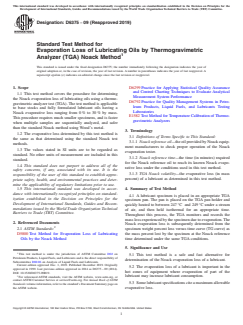
FIG. 1 Examples Showing Adaptation of Alternative Sample Pans
6. Apparatus air purge from 200 mL⁄min to 500 mL⁄min, and by maintain-
ing it at this high temperature until no smoke is detected from
6.1 ThermogravimetricAnalyzer,withthecapabilitytomeet
the TGAgas exhaust tube. Normally 15 min to 20 min at these
all the conditions required for this test method, along with the
conditions are enough to remove most deposits.
software necessary to complete the required analyses.
(Warning—Do not place a specimen pan in the TGA during
6.2 Aluminum Specimen Pan—This shall be cylindrical, and
this operation. It will melt and may damage the balance or
have a minimum inside diameter/height ratio of 0.45 and a
furnace mechanisms.)
volume of 50 µL 6 3 µL. If the pans provided by the particular
8.3 Check operation of TGA balance and adjust when
TGA manufacturer do not meet these criteria, alternative pans
necessary. Follow manufacturer’s procedure and recommenda-
may be used and adapted to fit the pan holder of the TGA.
tions.
Examples of some of the adaptations used during the evalua-
tion of this test method are shown in Fig. 1.
9. Procedure
6.3 Pressure Regulator, capable of maintaining air delivery
9.1 Determination of Specimen Mass:
pressure at the level required by the TGA instrument.
9.1.1 Determine the nominal internal diameter (in centime-
6.4 Flowmeter, with a flow control valve capable of setting
tres) of the specimen pans by measuring the internal diameter
and measuring the air throughput required by the TGA instru-
of10differentpansandaveragingtheresults.Acalipershallbe
ment.
used to make this measurement.
9.1.2 Calculate the specimen mass using following equa-
7. Reagents and Materials
tion:
7.1 TGA Temperature Calibration Standards—These mate- 3
M 5 350 ID (1)
~ !
s
rials will depend on the particular TGA apparatus and its
M = Specimen mass, mg (round to closest whole mg.)
capabilities. The TGA manufacturer typically provides them
s
ID = Nominal inside diameter of specimen pan, cm (see
and describes their use in the operating manual for the
9.1.1).
instrument.
9.2 Air Flowrate—Set air flowrate to that recommended by
7.2 Compressed air at a pressure suitable for operation of
the TGA manufacturer or higher if during the initial tests with
the TGA instrument. Reagent grade air is not necessary but
the Noack reference oil there appears to be condensation on
may be used if there are concerns over possible contamination
of the internal parts of the TGA. any part of the TGA balance mechanism or furnace lining.
Repeat 8.1 with the new flow rate.
7.3 Noack Reference Oil—Oil having a known Noack
9.3 Temperature Program (see Note 2):
evaporative loss, the value of which is provided by the
manufacturer.
NOTE 2—This section only needs to be done during the initial set up of
the method in the TGA.
8. TGA Preparation and Calibration (see Note 1)
9.3.1 Using the correlation from 8.1, determine the final
NOTE 1—This section only needs to be done if TGA has been idle for
an extended period of time, has had significant repairs made to it, or has program temperature required to obtain a final specimen
been mishandled or its location changed.
temperature of 249 °C.
9.3.2 Program the TGAto heat the specimen from 50 °C to
8.1 Check the temperature correlation between the speci-
the final program temperature determined in 9.3.1 at heating
men and control temperatures in accordance with TGA manu-
rate(s) that will simulate the specimen heating rate of the
facturer’s recommendations or Practice E1582. Use calibration
standard Noack methods (;100 °C⁄min to 220 °C and
standards that will bracket 250°C.When necessary, recalibrate,
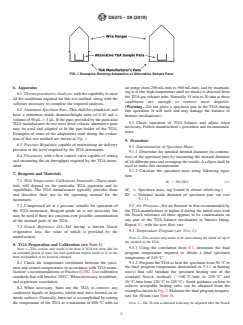
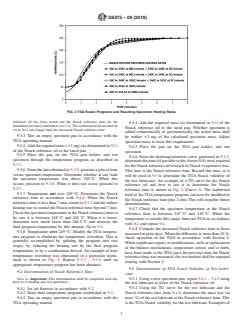
10 °C⁄min from 220 °C to 249 °C). Some guidance on how to
and regenerate correlation.
achieve acceptable heating rates can be obtained from the
8.2 When necessary, burn out the TGA to remove any
examples shown in Fig. 2. Maintain the final program tempera-
condensed liquids or deposits, which may have formed on its
ture for 30 min (see Note 3).
inside surfaces. Generally, burn out is accomplished by raising
the temperature of the TGA to a minimum of 800 °C with an NOTE 3—The 30 min isothermal hold may be adjusted after the Noack
D6375 − 09 (2019)
FIG. 2 TGA Noack Programs and Resulting Specimen Heating Rates
reference oil has been tested and the Noack reference time for the
9.4.4 Add the required mass (as determined in 9.1)ofthe
instrument has been established (see 9.4).The isothermal hold can then be
Noack reference oil to the tared pan. Whether specimen is
set to be 2 min longer than the measured Noack reference time.
added volumetrically or gravimetrically, the actual mass shall
9.3.3 Tare an empty specimen pan in accordance with the
be within 63 mg of the calculated specimen mass. Adjust
TGA operating manual.
specimen mass to meet this requirement.
9.3.4 A
...