

ASTM D1751-23
(Specification)Standard Specification for Preformed Expansion Joint Filler for Concrete Paving and Structural Construction (Nonextruding and Resilient Asphalt Types)
General Information
- Abstract
SCOPE
1.1 This specification covers preformed expansion joint filler having relatively little extrusion and substantial recovery after release from compression.
1.2 The values stated in inch-pound units are to be regarded as standard. The values given in parentheses are mathematical conversions to SI units that are provided for information only and are not considered standard.
Note 1: Attention is called to Specifications D1752 and D994/D994M.
1.3 The text of this standard references notes and footnotes which provide explanatory material. These notes and footnotes (excluding those in tables and figures) shall not be considered as requirements of the standard.
1.4 This international standard was developed in accordance with internationally recognized principles on standardization established in the Decision on Principles for the Development of International Standards, Guides and Recommendations issued by the World Trade Organization Technical Barriers to Trade (TBT) Committee.
- Status
- Published
- Publication Date
- 30-Nov-2023
- Technical Committee
- D04 - Road and Paving Materials
- Drafting Committee
- D04.34 - Preformed Joint Fillers, Sealers and Sealing Systems
Buy Documents
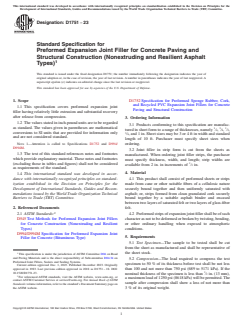


ASTM D1751-23 - Standard Specification for Preformed Expansion Joint Filler for Concrete Paving and Structural Construction (Nonextruding and Resilient Asphalt Types)
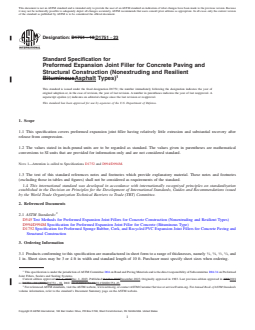
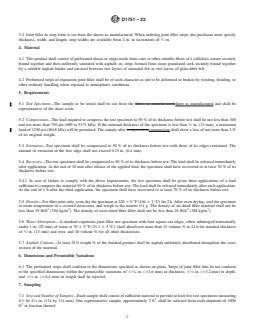


REDLINE ASTM D1751-23 - Standard Specification for Preformed Expansion Joint Filler for Concrete Paving and Structural Construction (Nonextruding and Resilient Asphalt Types)
Overview
ASTM D1751-23, titled “Standard Specification for Preformed Expansion Joint Filler for Concrete Paving and Structural Construction (Nonextruding and Resilient Asphalt Types),” defines the requirements and characteristics for preformed expansion joint fillers used in concrete paving and structural applications. Developed by ASTM International, this specification ensures that materials provide durability, resilience, and performance under various compressive stresses common in concrete construction. This standard is widely referenced in the construction of roads, highways, sidewalks, and structural slabs, ensuring high-quality and long-lasting expansion joints in concrete infrastructure.
Key Topics
Material Requirements:
The standard specifies that the joint filler must be constructed from preformed sheets or strips made from cellulosic fibers, granulated cork, or other suitable materials securely bound with asphalt, with certain configurations including felt or glass-fiber felt facings. The binder must ensure cohesion and durability without significant deformation during handling or installation.Performance Criteria:
- Compression and Recovery: The filler must show substantial recovery (at least 70% recovery ten minutes after compression) and limited extrusion when subjected to compressive forces, ensuring it retains its shape and function over time.
- Density and Water Absorption: Minimum density requirements and maximum water absorption limits are set to ensure material integrity in various environments.
- Asphalt Content: The filler must contain at least 35% asphalt by weight, ensuring uniform asphalt distribution throughout the material for resilience and longevity.
- Dimensional Tolerances: Thickness, width, and length must adhere to the permissible variations to guarantee compatibility with project specifications.
Testing and Quality Control:
Sampling and test methods are referenced (notably, ASTM D545) to verify compliance with the standard’s physical and mechanical requirements. Provisions for rejection and retesting help maintain product quality and consistency across batches.
Applications
Preformed asphalt expansion joint fillers specified by ASTM D1751-23 are essential components in:
- Concrete Pavements: Used between slabs to accommodate thermal expansion and contraction, reducing the risk of cracking and extending pavement life.
- Structural Construction: Applied in bridge decks, garages, airport runways, and other concrete works requiring controlled movement without structural damage.
- Sidewalks and Curbs: Maintains joint integrity in pedestrian and light-traffic infrastructure, resisting water and debris infiltration.
- Industrial Flooring: Offers durability in warehouse and factory slabs subjected to heavy loads and frequent mechanical movements.
The use of compliant fillers prevents premature joint failure, improves load transfer, restricts moisture intrusion, and ensures the safe movement of concrete sections throughout service life.
Related Standards
Several other ASTM specifications are referenced and related to concrete expansion joint fillers, including:
- ASTM D994/D994M: Specification for Preformed Expansion Joint Filler for Concrete (Bituminous Type)
- ASTM D1752: Specification for Preformed Sponge Rubber, Cork, and Recycled PVC Expansion Joint Fillers for Concrete Paving and Structural Construction
- ASTM D545: Test Methods for Preformed Expansion Joint Fillers for Concrete Construction (Nonextruding and Resilient Types)
ASTM D1751-23 works in conjunction with these standards to provide a comprehensive framework for quality assurance and material compatibility in concrete expansion joint design and installation.
Keywords: ASTM D1751, preformed expansion joint filler, nonextruding, resilient asphalt, concrete paving, structural construction, joint filler, bituminous expansion joint, construction standards.
Relations
- Effective Date
- 01-Dec-2023
- Effective Date
- 01-Dec-2023
- Effective Date
- 01-Nov-2019
- Effective Date
- 01-Dec-2023
- Effective Date
- 01-Dec-2023
- Effective Date
- 01-Dec-2023
Buy Documents
ASTM D1751-23 - Standard Specification for Preformed Expansion Joint Filler for Concrete Paving and Structural Construction (Nonextruding and Resilient Asphalt Types)
REDLINE ASTM D1751-23 - Standard Specification for Preformed Expansion Joint Filler for Concrete Paving and Structural Construction (Nonextruding and Resilient Asphalt Types)
Get Certified
Connect with accredited certification bodies for this standard

Zavod za gradbeništvo Slovenije (ZAG) - Inšpekcija
ZAG inspection body for construction products, structures, and materials.
Sponsored listings
Frequently Asked Questions
ASTM D1751-23 is a technical specification published by ASTM International. Its full title is "Standard Specification for Preformed Expansion Joint Filler for Concrete Paving and Structural Construction (Nonextruding and Resilient Asphalt Types)". This standard covers: SCOPE 1.1 This specification covers preformed expansion joint filler having relatively little extrusion and substantial recovery after release from compression. 1.2 The values stated in inch-pound units are to be regarded as standard. The values given in parentheses are mathematical conversions to SI units that are provided for information only and are not considered standard. Note 1: Attention is called to Specifications D1752 and D994/D994M. 1.3 The text of this standard references notes and footnotes which provide explanatory material. These notes and footnotes (excluding those in tables and figures) shall not be considered as requirements of the standard. 1.4 This international standard was developed in accordance with internationally recognized principles on standardization established in the Decision on Principles for the Development of International Standards, Guides and Recommendations issued by the World Trade Organization Technical Barriers to Trade (TBT) Committee.
SCOPE 1.1 This specification covers preformed expansion joint filler having relatively little extrusion and substantial recovery after release from compression. 1.2 The values stated in inch-pound units are to be regarded as standard. The values given in parentheses are mathematical conversions to SI units that are provided for information only and are not considered standard. Note 1: Attention is called to Specifications D1752 and D994/D994M. 1.3 The text of this standard references notes and footnotes which provide explanatory material. These notes and footnotes (excluding those in tables and figures) shall not be considered as requirements of the standard. 1.4 This international standard was developed in accordance with internationally recognized principles on standardization established in the Decision on Principles for the Development of International Standards, Guides and Recommendations issued by the World Trade Organization Technical Barriers to Trade (TBT) Committee.
ASTM D1751-23 is classified under the following ICS (International Classification for Standards) categories: 93.080.10 - Road construction. The ICS classification helps identify the subject area and facilitates finding related standards.
ASTM D1751-23 has the following relationships with other standards: It is inter standard links to ASTM D1751-18, ASTM D545-23, ASTM D545-19, ASTM C898/C898M-09(2017), ASTM D1752-18(2023), ASTM D994/D994M-11(2022). Understanding these relationships helps ensure you are using the most current and applicable version of the standard.
ASTM D1751-23 is available in PDF format for immediate download after purchase. The document can be added to your cart and obtained through the secure checkout process. Digital delivery ensures instant access to the complete standard document.
Standards Content (Sample)
This international standard was developed in accordance with internationally recognized principles on standardization established in the Decision on Principles for the
Development of International Standards, Guides and Recommendations issued by the World Trade Organization Technical Barriers to Trade (TBT) Committee.
Designation: D1751 − 23
Standard Specification for
Preformed Expansion Joint Filler for Concrete Paving and
Structural Construction (Nonextruding and Resilient Asphalt
Types)
This standard is issued under the fixed designation D1751; the number immediately following the designation indicates the year of
original adoption or, in the case of revision, the year of last revision. A number in parentheses indicates the year of last reapproval. A
superscript epsilon (´) indicates an editorial change since the last revision or reapproval.
This standard has been approved for use by agencies of the U.S. Department of Defense.
1. Scope D1752 Specification for Preformed Sponge Rubber, Cork,
and Recycled PVC Expansion Joint Fillers for Concrete
1.1 This specification covers preformed expansion joint
Paving and Structural Construction
filler having relatively little extrusion and substantial recovery
after release from compression.
3. Ordering Information
1.2 The values stated in inch-pound units are to be regarded
3.1 Products conforming to this specification are manufac-
as standard. The values given in parentheses are mathematical
1 3 1
tured in sheet form to a range of thicknesses, namely ⁄4, ⁄8, ⁄2,
conversions to SI units that are provided for information only
⁄4, and 1 in. Sheet sizes may be 3 or 4 ft in width and standard
and are not considered standard.
length of 10 ft. Purchaser must specify sheet sizes when
ordering.
NOTE 1—Attention is called to Specifications D1752 and D994/
D994M.
3.2 Joint filler in strip form is cut from the sheets as
1.3 The text of this standard references notes and footnotes
manufactured. When ordering joint filler strips, the purchaser
which provide explanatory material. These notes and footnotes
must specify thickness, width, and length; strip widths are
(excluding those in tables and figures) shall not be considered
available from 2 in. in increments of ⁄2 in.
as requirements of the standard.
4. Material
1.4 This international standard was developed in accor-
dance with internationally recognized principles on standard- 4.1 This product shall consist of preformed sheets or strips
made from cane or other suitable fibers of a cellulosic nature
ization established in the Decision on Principles for the
Development of International Standards, Guides and Recom- securely bound together and then uniformly saturated with
mendations issued by the World Trade Organization Technical asphalt; or, strips formed from clean granulated cork securely
Barriers to Trade (TBT) Committee. bound together by a suitable asphalt binder and encased
between two layers of saturated felt or two layers of glass-fiber
2. Referenced Documents felt.
4.2 Preformed strips of expansion joint filler shall be of such
2.1 ASTM Standards:
D545 Test Methods for Preformed Expansion Joint Fillers character as not to be deformed or broken by twisting, bending,
or other ordinary handling when exposed to atmospheric
for Concrete Construction (Nonextruding and Resilient
Types) conditions.
D994/D994M Specification for Preformed Expansion Joint
5. Requirements
Filler for Concrete (Bituminous Type)
5.1 Test Specimen—The sample to be tested shall be cut
from the sheet as manufactured and shall be representative of
the sheet stock.
This specification is under the jurisdiction of ASTM Committee D04 on Road
and Paving Materials and is the direct responsibility of Subcommittee D04.34 on
5.2 Compression—The load required to compress the test
Preformed Joint Fillers, Sealers and Sealing Systems.
specimen to 50 % of its thickness before test shall be not less
Current edition approved Dec. 1, 2023. Published December 2023. Originally
than 100 and not more than 750 psi (689 to 5171 kPa). If the
approved in 1983. Last previous edition approved in 2018 as D1751 – 18. DOI:
10.1520/D1751-23.
nominal thickness of the specimen is less than ⁄2 in. (13 mm),
For referenced ASTM standards, visit the ASTM website, www.astm.org, or
a maximum load of 1250 psi (8618 kPa) will be permitted. The
contact ASTM Customer Service at service@astm.org. For Annual Book of ASTM
sample after compression shall show a loss of not more than
Standards volume information, refer to the standard’s Document Summary page on
the ASTM website. 3 % of its original weight.
Copyright © ASTM International, 100 Barr Harbor Drive, PO Box C700, West Conshohocken, PA 19428-2959. United States
D1751 − 23
5.3 Extrusion—Test specimen shall be
...
This document is not an ASTM standard and is intended only to provide the user of an ASTM standard an indication of what changes have been made to the previous version. Because
it may not be technically possible to adequately depict all changes accurately, ASTM recommends that users consult prior editions as appropriate. In all cases only the current version
of the standard as published by ASTM is to be considered the official document.
Designation: D1751 − 18 D1751 − 23
Standard Specification for
Preformed Expansion Joint Filler for Concrete Paving and
Structural Construction (Nonextruding and Resilient
BituminousAsphalt Types)
This standard is issued under the fixed designation D1751; the number immediately following the designation indicates the year of
original adoption or, in the case of revision, the year of last revision. A number in parentheses indicates the year of last reapproval. A
superscript epsilon (´) indicates an editorial change since the last revision or reapproval.
This standard has been approved for use by agencies of the U.S. Department of Defense.
1. Scope
1.1 This specification covers preformed expansion joint filler having relatively little extrusion and substantial recovery after
release from compression.
1.2 The values stated in inch-pound units are to be regarded as standard. The values given in parentheses are mathematical
conversions to SI units that are provided for information only and are not considered standard.
NOTE 1—Attention is called to Specifications D1752 and D994/D994M.
1.3 The text of this standard references notes and footnotes which provide explanatory material. These notes and footnotes
(excluding those in tables and figures) shall not be considered as requirements of the standard.
1.4 This international standard was developed in accordance with internationally recognized principles on standardization
established in the Decision on Principles for the Development of International Standards, Guides and Recommendations issued
by the World Trade Organization Technical Barriers to Trade (TBT) Committee.
2. Referenced Documents
2.1 ASTM Standards:
D545 Test Methods for Preformed Expansion Joint Fillers for Concrete Construction (Nonextruding and Resilient Types)
D994/D994M Specification for Preformed Expansion Joint Filler for Concrete (Bituminous Type)
D1752 Specification for Preformed Sponge Rubber, Cork, and Recycled PVC Expansion Joint Fillers for Concrete Paving and
Structural Construction
3. Ordering Information
1 3 1 3
3.1 Products conforming to this specification are manufactured in sheet form to a range of thicknesses, namely ⁄4, ⁄8, ⁄2, ⁄4, and
1 in. Sheet sizes may be 3 or 4 ft in width and standard length of 10 ft. Purchaser must specify sheet sizes when ordering.
This specification is under the jurisdiction of ASTM Committee D04 on Road and Paving Materials and is the direct responsibility of Subcommittee D04.34 on Preformed
Joint Fillers, Sealers and Sealing Systems.
Current edition approved Oct. 1, 2018Dec. 1, 2023. Published October 2018December 2023. Originally approved in 1983. Last previous edition approved in 20082018
as D1751 – 04 (2008).D1751 – 18. DOI: 10.1520/D1751-18.10.1520/D1751-23.
For referenced ASTM standards, visit the ASTM website, www.astm.org, or contact ASTM Customer Service at service@astm.org. For Annual Book of ASTM Standards
volume information, refer to the standard’s Document Summary page on the ASTM website.
Copyright © ASTM International, 100 Barr Harbor Drive, PO Box C700, West Conshohocken, PA 19428-2959. United States
D1751 − 23
3.2 Joint filler in strip form is cut from the sheets as manufactured. When ordering joint filler strips, the purchaser must specify
thickness, width, and length; strip widths are available from 2 in. in increments of ⁄2 in.
4. Material
4.1 This product shall consist of preformed sheets or strips made from cane or other suitable fibers of a cellulosic nature securely
bound together and then uniformly saturated with asphalt; or, strips formed from clean granulated cork securely bound together
by a suitable asphalt binder and encased between two layers of saturated felt or two layers of glass-fiber felt.
4.2 Preformed strips of expansion joint filler shall be of such character as not to be deformed or broken by twisting, bending, or
other ordinary handling when exposed to atmospheric conditions.
5. Requirements
5.1 Test Specimen—The sample to be tested shall be cut from the sheet, as manufactured,sheet as manufactured and shall be
representative of the sheet stock.
5.2 Compression—The load required to compress the test specimen to 50 % of its thickness before test shall be not less than 100
and not more than 750 psi (689 to 5171 kPa). If the nominal thickness of the specimen is less than ⁄2 in. (13 mm), a maximum
load of 1250 psi (8618 kPa) will be permitted. The sample after compression,compression shall show a loss of no
...