


ASTM E159-17
(Test Method)Standard Test Method for Loss of Mass in a Reducing Gas Atmosphere for Cobalt, Copper, Tungsten, and Iron Powders (Hydrogen Loss)
Standard Test Method for Loss of Mass in a Reducing Gas Atmosphere for Cobalt, Copper, Tungsten, and Iron Powders (Hydrogen Loss)
SIGNIFICANCE AND USE
5.1 The oxygen content of a powder affects both its green and sintered properties.
5.2 Hydrogen loss is a term widely used in the powder metallurgy industry even though the measurement represents an approximate oxygen content of the powder.
5.3 Oxygen is the most common hydrogen-reducible constituent of metal powders, and this procedure may be used as a measure of oxygen, reducible under the test conditions, if other interfering elements are absent.
SCOPE
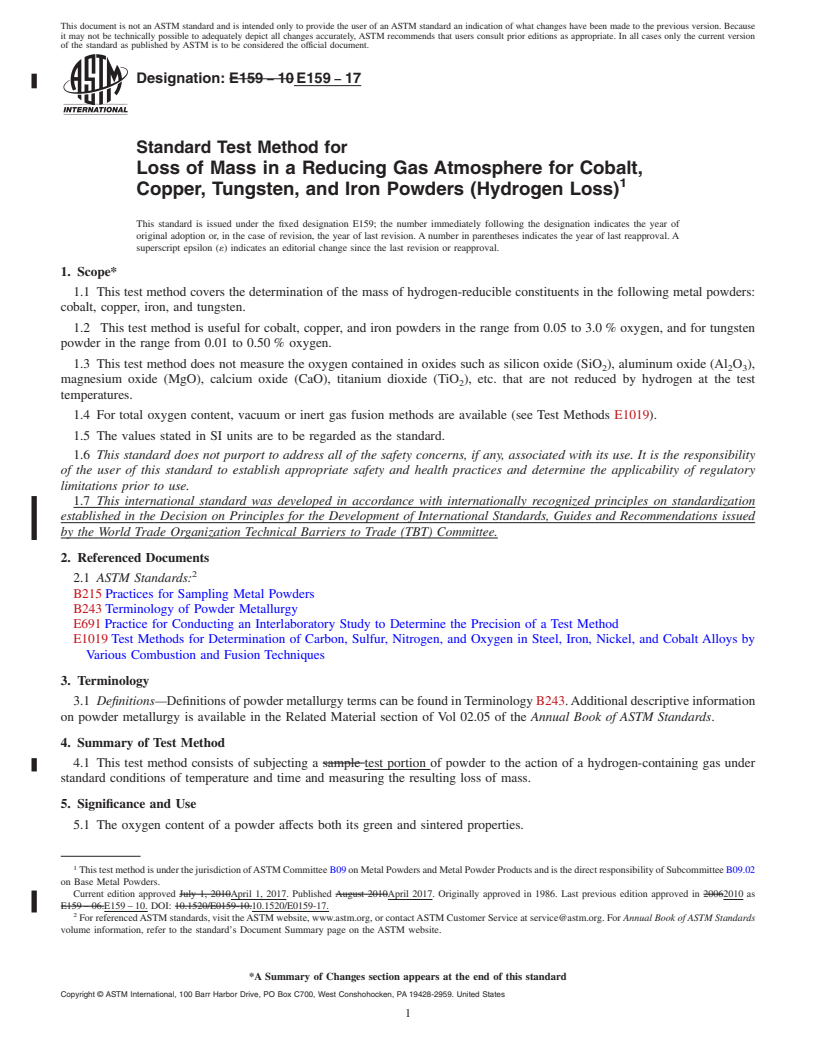
1.1 This test method covers the determination of the mass of hydrogen-reducible constituents in the following metal powders: cobalt, copper, iron, and tungsten.
1.2 This test method is useful for cobalt, copper, and iron powders in the range from 0.05 to 3.0 % oxygen, and for tungsten powder in the range from 0.01 to 0.50 % oxygen.
1.3 This test method does not measure the oxygen contained in oxides such as silicon oxide (SiO2), aluminum oxide (Al2O3), magnesium oxide (MgO), calcium oxide (CaO), titanium dioxide (TiO2), etc. that are not reduced by hydrogen at the test temperatures.
1.4 For total oxygen content, vacuum or inert gas fusion methods are available (see Test Methods E1019).
1.5 The values stated in SI units are to be regarded as the standard.
1.6 This standard does not purport to address all of the safety concerns, if any, associated with its use. It is the responsibility of the user of this standard to establish appropriate safety and health practices and determine the applicability of regulatory limitations prior to use.
1.7 This international standard was developed in accordance with internationally recognized principles on standardization established in the Decision on Principles for the Development of International Standards, Guides and Recommendations issued by the World Trade Organization Technical Barriers to Trade (TBT) Committee.
General Information
Buy Standard


Standards Content (Sample)
NOTICE: This standard has either been superseded and replaced by a new version or withdrawn.
Contact ASTM International (www.astm.org) for the latest information
Designation: E159 − 17
Standard Test Method for
Loss of Mass in a Reducing Gas Atmosphere for Cobalt,
1
Copper, Tungsten, and Iron Powders (Hydrogen Loss)
This standard is issued under the fixed designation E159; the number immediately following the designation indicates the year of
original adoption or, in the case of revision, the year of last revision.Anumber in parentheses indicates the year of last reapproval.A
superscript epsilon (´) indicates an editorial change since the last revision or reapproval.
1. Scope* B243Terminology of Powder Metallurgy
E691Practice for Conducting an Interlaboratory Study to
1.1 Thistestmethodcoversthedeterminationofthemassof
Determine the Precision of a Test Method
hydrogen-reducible constituents in the following metal pow-
E1019Test Methods for Determination of Carbon, Sulfur,
ders: cobalt, copper, iron, and tungsten.
Nitrogen, and Oxygen in Steel, Iron, Nickel, and Cobalt
1.2 This test method is useful for cobalt, copper, and iron
Alloys by Various Combustion and Fusion Techniques
powders in the range from 0.05 to 3.0% oxygen, and for
tungsten powder in the range from 0.01 to 0.50% oxygen.
3. Terminology
1.3 Thistestmethoddoesnotmeasuretheoxygencontained
3.1 Definitions—Definitions of powder metallurgy terms
in oxides such as silicon oxide (SiO ), aluminum oxide
2
can be found in Terminology B243. Additional descriptive
(Al O ), magnesium oxide (MgO), calcium oxide (CaO),
2 3
information on powder metallurgy is available in the Related
titanium dioxide (TiO ), etc. that are not reduced by hydrogen
2
Material section of Vol 02.05 of the Annual Book of ASTM
at the test temperatures.
Standards.
1.4 For total oxygen content, vacuum or inert gas fusion
methods are available (see Test Methods E1019).
4. Summary of Test Method
1.5 The values stated in SI units are to be regarded as the
4.1 This test method consists of subjecting a test portion of
standard.
powder to the action of a hydrogen-containing gas under
standardconditionsoftemperatureandtimeandmeasuringthe
1.6 This standard does not purport to address all of the
resulting loss of mass.
safety concerns, if any, associated with its use. It is the
responsibility of the user of this standard to establish appro-
5. Significance and Use
priate safety and health practices and determine the applica-
bility of regulatory limitations prior to use.
5.1 The oxygen content of a powder affects both its green
1.7 This international standard was developed in accor-
and sintered properties.
dance with internationally recognized principles on standard-
5.2 Hydrogen loss is a term widely used in the powder
ization established in the Decision on Principles for the
metallurgy industry even though the measurement represents
Development of International Standards, Guides and Recom-
an approximate oxygen content of the powder.
mendations issued by the World Trade Organization Technical
Barriers to Trade (TBT) Committee.
5.3 Oxygen is the most common hydrogen-reducible con-
stituent of metal powders, and this procedure may be used as a
2. Referenced Documents
measureofoxygen,reducibleunderthetestconditions,ifother
2
interfering elements are absent.
2.1 ASTM Standards:
B215Practices for Sampling Metal Powders
6. Interferences
6.1 If carbon or sulfur is present, or both, are present, they
1
This test method is under the jurisdiction of ASTM Committee B09 on Metal
will be largely removed in the test. Their loss in mass is
Powders and Metal Powder Products and is the direct responsibility of Subcom-
mittee B09.02 on Base Metal Powders.
included in the total loss in mass measurement and must be
Current edition approved April 1, 2017. Published April 2017. Originally
subtracted from the total mass loss.
approved in 1986. Last previous edition approved in 2010 as E159–10. DOI:
10.1520/E0159-17.
6.2 If metals or compounds are present that vaporize at the
2
For referenced ASTM standards, visit the ASTM website, www.astm.org, or
testtemperature(suchascadmium,lead,zinc,etc.),theireffect
contact ASTM Customer Service at service@astm.org. For Annual Book of ASTM
is included in the loss of mass measurement and must be
Standards volume information, refer to the standard’s Document Summary page on
the ASTM website. subtracted from the total mass loss.
*A Summary of Changes section appears at the end of this standard
Copyright © ASTM International, 100 Barr Harbor Drive, PO Box C700, West Conshohocken, PA 19428-2959. United States
1
---------------------- Page: 1 ----------------------
E159 − 17
6.3 If some components are present that are oxidized or 10.2 Pass the nitrogen through the combustion tube for a
hydrided during the test, there is a gain in mass that must be periodofatleast1minbeforeinsertingthecombustionboatat
added to the total mass loss. the center of the zone of uniform temperature of th
...
This document is not an ASTM standard and is intended only to provide the user of an ASTM standard an indication of what changes have been made to the previous version. Because
it may not be technically possible to adequately depict all changes accurately, ASTM recommends that users consult prior editions as appropriate. In all cases only the current version
of the standard as published by ASTM is to be considered the official document.
Designation: E159 − 10 E159 − 17
Standard Test Method for
Loss of Mass in a Reducing Gas Atmosphere for Cobalt,
1
Copper, Tungsten, and Iron Powders (Hydrogen Loss)
This standard is issued under the fixed designation E159; the number immediately following the designation indicates the year of
original adoption or, in the case of revision, the year of last revision. A number in parentheses indicates the year of last reapproval. A
superscript epsilon (´) indicates an editorial change since the last revision or reapproval.
1. Scope*
1.1 This test method covers the determination of the mass of hydrogen-reducible constituents in the following metal powders:
cobalt, copper, iron, and tungsten.
1.2 This test method is useful for cobalt, copper, and iron powders in the range from 0.05 to 3.0 % oxygen, and for tungsten
powder in the range from 0.01 to 0.50 % oxygen.
1.3 This test method does not measure the oxygen contained in oxides such as silicon oxide (SiO ), aluminum oxide (Al O ),
2 2 3
magnesium oxide (MgO), calcium oxide (CaO), titanium dioxide (TiO ), etc. that are not reduced by hydrogen at the test
2
temperatures.
1.4 For total oxygen content, vacuum or inert gas fusion methods are available (see Test Methods E1019).
1.5 The values stated in SI units are to be regarded as the standard.
1.6 This standard does not purport to address all of the safety concerns, if any, associated with its use. It is the responsibility
of the user of this standard to establish appropriate safety and health practices and determine the applicability of regulatory
limitations prior to use.
1.7 This international standard was developed in accordance with internationally recognized principles on standardization
established in the Decision on Principles for the Development of International Standards, Guides and Recommendations issued
by the World Trade Organization Technical Barriers to Trade (TBT) Committee.
2. Referenced Documents
2
2.1 ASTM Standards:
B215 Practices for Sampling Metal Powders
B243 Terminology of Powder Metallurgy
E691 Practice for Conducting an Interlaboratory Study to Determine the Precision of a Test Method
E1019 Test Methods for Determination of Carbon, Sulfur, Nitrogen, and Oxygen in Steel, Iron, Nickel, and Cobalt Alloys by
Various Combustion and Fusion Techniques
3. Terminology
3.1 Definitions—Definitions of powder metallurgy terms can be found in Terminology B243. Additional descriptive information
on powder metallurgy is available in the Related Material section of Vol 02.05 of the Annual Book of ASTM Standards.
4. Summary of Test Method
4.1 This test method consists of subjecting a sample test portion of powder to the action of a hydrogen-containing gas under
standard conditions of temperature and time and measuring the resulting loss of mass.
5. Significance and Use
5.1 The oxygen content of a powder affects both its green and sintered properties.
1
This test method is under the jurisdiction of ASTM Committee B09 on Metal Powders and Metal Powder Products and is the direct responsibility of Subcommittee B09.02
on Base Metal Powders.
Current edition approved July 1, 2010April 1, 2017. Published August 2010April 2017. Originally approved in 1986. Last previous edition approved in 20062010 as
E159 – 06.E159 – 10. DOI: 10.1520/E0159-10.10.1520/E0159-17.
2
For referenced ASTM standards, visit the ASTM website, www.astm.org, or contact ASTM Customer Service at service@astm.org. For Annual Book of ASTM Standards
volume information, refer to the standard’s Document Summary page on the ASTM website.
*A Summary of Changes section appears at the end of this standard
Copyright © ASTM International, 100 Barr Harbor Drive, PO Box C700, West Conshohocken, PA 19428-2959. United States
1
---------------------- Page: 1 ----------------------
E159 − 17
5.2 Hydrogen loss is a term widely used in the powder metallurgy industry even though the measurement represents an
approximate oxygen content of the powder.
5.3 Oxygen is the most common hydrogen-reducible constituent of metal powders, and this procedure may be used as a measure
of oxygen, reducible under the test conditions, if other interfering elements are absent.
6. Interferences
6.1 If carbon or sulfur is present, or both, are present, they will be largely removed in the test. Their loss in mass is included
in the total loss in mass measurement and must be subtracted from the total mass loss.
6.2 If metals or compounds are present that vaporize at the test temperature (such as cadmium, lead, zinc, etc.), their effect is
included in t
...
Questions, Comments and Discussion
Ask us and Technical Secretary will try to provide an answer. You can facilitate discussion about the standard in here.