

ASTM F2767-18(2023)
(Specification)Standard Specification for Electrofusion Type Polyamide-12 Fittings for Outside Diameter Controlled Polyamide-12 Pipe and Tubing for Gas Distribution
General Information
- Abstract
ABSTRACT
This specification covers polyamide-12 electrofusion fittings for use with outside diameter-controlled polyamide-12 pipe and tubing for gas distribution. The materials are classified according to grade designations: Group 4, Class 2, and Grade 3. Minimum hydraulic burst pressure test, sustained pressure test, tensile strength test, joint integrity test, and voids evaluation shall be performed to conform to the specified requirements.
SCOPE
1.1 This specification covers polyamide- 12 electrofusion fittings for use with outside diameter-controlled polyamide- 12 pipe, covered by Specification F2785. Requirements for materials, workmanship, and testing performance are included. Where applicable in this specification “pipe” shall mean “pipe” or “tubing.”
1.2 Polyamide 12 electrofusion fittings are intended for use in polyamide 12 systems only. As per the manufacturer’s recommendations, no cross fusion between PA12, PA11 and PE is permitted.
1.3 The values stated in inch-pound units are to be regarded as standard. The values given in parentheses are mathematical conversions to SI units that are provided for information only and are not considered standard.
1.4 The following safety hazards caveat pertains only to the test method portion, Section 9, of this specification: This standard does not purport to address all of the safety concerns, if any, associated with its use. It is the responsibility of the user of this standard to establish appropriate safety, health, and environmental practices and determine the applicability of regulatory limitations prior to use.
1.5 This international standard was developed in accordance with internationally recognized principles on standardization established in the Decision on Principles for the Development of International Standards, Guides and Recommendations issued by the World Trade Organization Technical Barriers to Trade (TBT) Committee.
- Status
- Published
- Publication Date
- 31-Oct-2023
- Technical Committee
- F17 - Plastic Piping Systems
- Drafting Committee
- F17.60 - Gas
Overview
ASTM F2767-18(2023) provides a comprehensive specification for electrofusion type polyamide-12 (PA12) fittings designed for use with outside diameter-controlled PA12 pipe and tubing in gas distribution applications. The standard, developed by ASTM, outlines the requirements for materials, workmanship, dimensions, testing, and quality assurance for PA12 electrofusion fittings, helping ensure safety and consistency in the installation and operation of gas distribution systems.
ASTM F2767-18(2023) is intended solely for use with PA12 piping systems and does not permit cross fusion with other materials such as PA11 or polyethylene (PE). The document specifies minimum performance tests, including hydraulic burst pressure, tensile strength, sustained pressure, joint integrity, and assessment for voids, providing essential quality criteria for both manufacturers and end users.
Key Topics
- Material Requirements: The standard mandates that all fittings be made from PA12 meeting specific group, class, and grade requirements as detailed in related ASTM specifications.
- Manufacturing Practices: Good commercial practice must be followed to ensure the release of homogeneous, defect-free fittings.
- Performance Testing: Each electrofusion fitting design must meet minimum thresholds for hydraulic burst pressure, tensile strength (for coupling joints), impact resistance (for saddle joints), and joint integrity.
- Dimension and Tolerance Control: All fitting dimensions and tolerances are to be measured and maintained per ASTM Test Methods, ensuring compatibility and performance in PA12 systems.
- Marking and Identification: Fittings must be clearly marked with manufacturer information, material designation, applicability for gas service, size, and ASTM reference, supporting traceability and correct application.
- Safety and Compliance: The standard includes guidelines to help users establish necessary safety, health, and environmental controls during testing and use.
Applications
ASTM F2767-18(2023) is critical for:
- Natural Gas and LPG Distribution: Used as a reference for specifying, procuring, and installing PA12 electrofusion fittings in municipal and utility gas networks.
- Pipeline Construction and Maintenance: Guiding contractors and utilities on the selection and qualification of fittings to ensure safe, leak-free installations.
- Quality Assurance in Manufacturing: Providing benchmarks for in-plant quality control, including dimensional checks, void inspection, tensile, impact, and pressure tests.
- Safety Validation and Regulatory Compliance: Supporting adherence to industry codes and regulatory requirements related to plastic gas piping systems.
By complying with ASTM F2767, manufacturers and users can ensure reliable joint performance in high-stress gas distribution environments, thereby minimizing risks related to leaks and failures.
Related Standards
ASTM F2767-18(2023) frequently references other essential plastic piping and testing standards, including:
- ASTM F2785: Specification for Polyamide 12 Gas Pressure Pipe, Tubing, and Fittings.
- ASTM D1598 & D1599: Test methods for sustained pressure and hydraulic burst resistance of plastic pipes and fittings.
- ASTM D6779 & D4066: Classification systems for nylon and polyamide molding/extrusion materials.
- ASTM D638: Tensile properties of plastics.
- ASTM F905: Practice for qualification of polyethylene saddle-fused joints.
- ASTM D2122: Method for determining dimensions of thermoplastic pipes and fittings.
- ASTM F412 & D1600: Terminology and abbreviations relevant to plastic piping systems.
For professionals in gas distribution, referencing ASTM F2767 alongside these related standards ensures comprehensive coverage of technical and safety requirements in PA12 piping system design, installation, and maintenance.
Keywords: ASTM F2767-18, electrofusion fittings, polyamide-12 (PA12), outside diameter-controlled pipe, gas distribution, plastic pipe standards, joint integrity, gas pipeline safety, PA12 piping systems, standard specification.
Relations
- Effective Date
- 01-Nov-2023
- Refers
ASTM D1600-18 - Standard Terminology for Abbreviated Terms Relating to Plastics (Withdrawn 2024) - Effective Date
- 01-Jan-2018
- Effective Date
- 01-Nov-2023
- Referred By
ASTM F2785-21 - Standard Specification for Polyamide 12 Gas Pressure Pipe, Tubing, and Fittings - Effective Date
- 01-Nov-2023
Get Certified
Connect with accredited certification bodies for this standard

Institut za varilstvo d.o.o. (Welding Institute)
Slovenia's leading welding institute since 1952. ISO 3834, EN 1090, pressure equipment certification, NDT personnel, welder qualification. Only IIW Au
Sponsored listings
Frequently Asked Questions
ASTM F2767-18(2023) is a technical specification published by ASTM International. Its full title is "Standard Specification for Electrofusion Type Polyamide-12 Fittings for Outside Diameter Controlled Polyamide-12 Pipe and Tubing for Gas Distribution". This standard covers: ABSTRACT This specification covers polyamide-12 electrofusion fittings for use with outside diameter-controlled polyamide-12 pipe and tubing for gas distribution. The materials are classified according to grade designations: Group 4, Class 2, and Grade 3. Minimum hydraulic burst pressure test, sustained pressure test, tensile strength test, joint integrity test, and voids evaluation shall be performed to conform to the specified requirements. SCOPE 1.1 This specification covers polyamide- 12 electrofusion fittings for use with outside diameter-controlled polyamide- 12 pipe, covered by Specification F2785. Requirements for materials, workmanship, and testing performance are included. Where applicable in this specification “pipe” shall mean “pipe” or “tubing.” 1.2 Polyamide 12 electrofusion fittings are intended for use in polyamide 12 systems only. As per the manufacturer’s recommendations, no cross fusion between PA12, PA11 and PE is permitted. 1.3 The values stated in inch-pound units are to be regarded as standard. The values given in parentheses are mathematical conversions to SI units that are provided for information only and are not considered standard. 1.4 The following safety hazards caveat pertains only to the test method portion, Section 9, of this specification: This standard does not purport to address all of the safety concerns, if any, associated with its use. It is the responsibility of the user of this standard to establish appropriate safety, health, and environmental practices and determine the applicability of regulatory limitations prior to use. 1.5 This international standard was developed in accordance with internationally recognized principles on standardization established in the Decision on Principles for the Development of International Standards, Guides and Recommendations issued by the World Trade Organization Technical Barriers to Trade (TBT) Committee.
ABSTRACT This specification covers polyamide-12 electrofusion fittings for use with outside diameter-controlled polyamide-12 pipe and tubing for gas distribution. The materials are classified according to grade designations: Group 4, Class 2, and Grade 3. Minimum hydraulic burst pressure test, sustained pressure test, tensile strength test, joint integrity test, and voids evaluation shall be performed to conform to the specified requirements. SCOPE 1.1 This specification covers polyamide- 12 electrofusion fittings for use with outside diameter-controlled polyamide- 12 pipe, covered by Specification F2785. Requirements for materials, workmanship, and testing performance are included. Where applicable in this specification “pipe” shall mean “pipe” or “tubing.” 1.2 Polyamide 12 electrofusion fittings are intended for use in polyamide 12 systems only. As per the manufacturer’s recommendations, no cross fusion between PA12, PA11 and PE is permitted. 1.3 The values stated in inch-pound units are to be regarded as standard. The values given in parentheses are mathematical conversions to SI units that are provided for information only and are not considered standard. 1.4 The following safety hazards caveat pertains only to the test method portion, Section 9, of this specification: This standard does not purport to address all of the safety concerns, if any, associated with its use. It is the responsibility of the user of this standard to establish appropriate safety, health, and environmental practices and determine the applicability of regulatory limitations prior to use. 1.5 This international standard was developed in accordance with internationally recognized principles on standardization established in the Decision on Principles for the Development of International Standards, Guides and Recommendations issued by the World Trade Organization Technical Barriers to Trade (TBT) Committee.
ASTM F2767-18(2023) is classified under the following ICS (International Classification for Standards) categories: 23.040.45 - Plastics fittings. The ICS classification helps identify the subject area and facilitates finding related standards.
ASTM F2767-18(2023) has the following relationships with other standards: It is inter standard links to ASTM F2767-18, ASTM D1600-18, ASTM F3524/F3524M-23, ASTM F2785-21. Understanding these relationships helps ensure you are using the most current and applicable version of the standard.
ASTM F2767-18(2023) is available in PDF format for immediate download after purchase. The document can be added to your cart and obtained through the secure checkout process. Digital delivery ensures instant access to the complete standard document.
Standards Content (Sample)
This international standard was developed in accordance with internationally recognized principles on standardization established in the Decision on Principles for the
Development of International Standards, Guides and Recommendations issued by the World Trade Organization Technical Barriers to Trade (TBT) Committee.
Designation: F2767 − 18 (Reapproved 2023) An American National Standard
Standard Specification for
Electrofusion Type Polyamide-12 Fittings for Outside
Diameter Controlled Polyamide-12 Pipe and Tubing for Gas
Distribution
This standard is issued under the fixed designation F2767; the number immediately following the designation indicates the year of
original adoption or, in the case of revision, the year of last revision. A number in parentheses indicates the year of last reapproval. A
superscript epsilon (´) indicates an editorial change since the last revision or reapproval.
1. Scope* D1598 Test Method for Time-to-Failure of Plastic Pipe
Under Constant Internal Pressure
1.1 This specification covers polyamide- 12 electrofusion
D1599 Test Method for Resistance to Short-Time Hydraulic
fittings for use with outside diameter-controlled polyamide- 12
Pressure of Plastic Pipe, Tubing, and Fittings
pipe, covered by Specification F2785. Requirements for
D1600 Terminology for Abbreviated Terms Relating to Plas-
materials, workmanship, and testing performance are included.
tics
Where applicable in this specification “pipe” shall mean “pipe”
D2122 Test Method for Determining Dimensions of Ther-
or “tubing.”
moplastic Pipe and Fittings
1.2 Polyamide 12 electrofusion fittings are intended for use
D4066 Classification System for Nylon Injection and Extru-
in polyamide 12 systems only. As per the manufacturer’s
sion Materials (PA)
recommendations, no cross fusion between PA12, PA11 and PE
D6779 Classification System for and Basis of Specification
is permitted.
for Polyamide Molding and Extrusion Materials (PA)
1.3 The values stated in inch-pound units are to be regarded F412 Terminology Relating to Plastic Piping Systems
F905 Practice for Qualification of Polyethylene Saddle-
as standard. The values given in parentheses are mathematical
conversions to SI units that are provided for information only Fused Joints
F2785 Specification for Polyamide 12 Gas Pressure Pipe,
and are not considered standard.
Tubing, and Fittings
1.4 The following safety hazards caveat pertains only to the
test method portion, Section 9, of this specification: This
3. Terminology
standard does not purport to address all of the safety concerns,
3.1 Definitions are in accordance with Terminology F412,
if any, associated with its use. It is the responsibility of the user
and abbreviations are in accordance with Terminology D1600,
of this standard to establish appropriate safety, health, and
unless otherwise specified.
environmental practices and determine the applicability of
regulatory limitations prior to use.
3.2 Definitions of Terms Specific to This Standard:
1.5 This international standard was developed in accor-
3.2.1 electrofusion—a heat fusion joining process where the
dance with internationally recognized principles on standard-
heat source is an integral part of the fitting, such that when
ization established in the Decision on Principles for the
electric current is applied, heat is produced that melts and joins
Development of International Standards, Guides and Recom-
the plastics.
mendations issued by the World Trade Organization Technical
3.2.2 fusion interface—surface in the heat fusion process
Barriers to Trade (TBT) Committee.
where the plastic materials of the products being joined bond
together.
2. Referenced Documents
3.2.3 fusion zone length—total length of the melted material
2.1 ASTM Standards:
in the fitting cross-section under evaluation.
D638 Test Method for Tensile Properties of Plastics
4. Materials and Manufacture
This specification is under the jurisdiction of ASTM Committee F17 on Plastic
Piping Systems and is the direct responsibility of Subcommittee F17.60 on Gas.
4.1 This specification covers fittings made from polyamide
Current edition approved Nov. 1, 2023. Published November 2023. Originally
12 (PA12) meeting the requirements for Group 4, Class 2, and
approved in 2009. Last previous edition approved in 2018 as F2767–18. DOI:
Grade 3, (PA423 16) as prescribed in Specification D6779 and
10.1520/F2767-18R23.
For referenced ASTM standards, visit the ASTM website, www.astm.org, or D4066.
contact ASTM Customer Service at service@astm.org. For Annual Book of ASTM
4.2 Rework Material—Clean rework polyamide- 12 mate-
Standards volume information, refer to the standard’s Document Summary page on
the ASTM website. rial of the same resin, free of any wire or contaminants
*A Summary of Changes section appears at the end of this standard
Copyright © ASTM International, 100 Barr Harbor Drive, PO Box C700, West Conshohocken, PA 19428-2959. United States
F2767 − 18 (2023)
generated from the fitting manufacturer’s own production, may 6. Dimensions, Mass, and Permissible Variations
be used by the same manufacturer, as long as the fittings
6.1 Dimension shall be measured using Test Method D2122.
produced conform to the requirements of this specification.
Dimensions and tolerances of electrofusion fittings must be
4.3 Heating Mechanism—The heat mechanism shall be of
such that heat fusion is possible to outside diameter (OD)
materials not detrimental to the performance of the fitting or
controlled PA-12 pipes such as those listed in Specification
the pipe to which it is intended to be joined.
F2785, such that the joints will satisfy the performance
requirements in Section 5.
5. Performance Requirements
NOTE 2—Because of the varying designs for electrofusion fittings, the
5.1 The following requirements are for electrofusion joints
actual spread of dimensions may be quite different from manufacturer to
manufacturer. A table of dimensions and tolerances encompassing these
that have been joined using the manufacturer’s recommended
differences would be meaningless and without value and, therefore, is
joining procedures. These requirements must be met by each
omitted from this specification.
electrofusion joint design, on each size and type of pipe
material for which the manufacturer recommends use of their 6.2 The manufacturer shall furnish to the user the electrical
fitting. Any revisions to the electrofusion joint design or resistance, critical dimensions, and tolerances of his fittings.
processing by the manufacturer after the initial testing requires This information must include at least the following dimen-
retesting to ensure these requirements can still be met. Fittings sions and tolerances:
intended for use in the distribution of natural gas or liquid
6.2.1 Coupling inside diameter,
petroleum gas shall also meet the requirements of Specification
6.2.2 Temperature joining limits, and
F2785.
6.2.3 Operating pressure of the fitting.
5.1.1 It is not required that each configuration of a fitting be
NOTE 3—There are other items that fall beyond the scope of this
tested to meet all of these qualifications (that is, 2 in. main
specification which would be of interest to the user for proper application
saddle joint with multiple outlet configurations offered) as long
of the fittings and is recommended as additional information to be
as the electrofusion joint design is not altered in the configu-
furnished. A few of these are: (1) maximum pipe out of round allowed at
ration differences.
joint area; (2) minimum/maximum pipe SDR capability of the fitting, and
(3) for saddles intended for use on a live main, the maximum allowable
NOTE 1—It is permissible when accomplishing these tests, to do so on
line pressure when making the joint.
the highest and lowest dimension ratio of the same pipe material. If in
those tests all performance requirements are met, all dimension ratios
7. Workmanship, Finish and Appearance
between those tested may be considered as having met the requirements.
These tests do not have to cover the full range of dimension ratios
7.1 The manufacture of these fittings shall be in accordance
available, only the dimension ratio range on which the manufacturer
with good commercial practice so as to produce fittings
recommends his fitting be used.
meeting the requirements of this specification.
5.2 Pressure Requirements:
5.2.1 Minimum Hydraulic Burst Pressure—The minimum
7.2 The fittings shall be homogeneous throughout, except
hydraulic burst pressure of the test specimen shall not be less
where a heating coil or electrical connectors are incorporated,
than that required to produce 3900psi (26.9MPa) fiber stress in
and free of cracks, holes, foreign inclusions, or injurious
the pipe being used in the test when tested in accordance with
defects such as gouges, dents, cuts, etc. The fittings shall be as
9.1. The test equipment, procedures, and failures definitions
uniform as commercially practicable in opacity, density, and
shall be as specified in Test Method D1599.
other physical properties. Any heating coils, connecting cables,
5.2.2 Sustained Pressure—The fitting and fused joint shall
connectors, and related electrical power source shall be de-
not fail when tested in accordance with 9.2.
signed to prevent electrical shock to the user.
5.3 Tensile Strength Requirements (Coupling Type Joints
8. Specimen Preparation
Only)—The fitting or the pipe to fitting joint made on pipe shall
not fail when tested in accordance with 9.3. Specimens shall be
8.1 Conditioning:
subjected to a tensile stress that causes the pipe to yield or
8.1.1 Unless otherwise specified, condition the specimens
causes the pipe to break outside the joint area. Tensile tests
(pipe and fittings) prior to joining at the minimum pipe
must be made on specimens as joined, not on straps cut from
temperature allowable for fusion as recommended by the
the specimen. Yielding must be measured only in the pipe,
manufacturer, for not less than 16 h and make the fusion joint
independent of the fitting or joint.
at that temperature for those tests where conditioning is
5.4 Impact Resistance (Saddle Type Joints Only)—The joint
required.
made on the specimen shall not fail when impacted with a force
8.1.2 Unless otherwise specified, condition the specimens
sufficient to break the body or other portion of the specimen.
(pipe and fittings) prior to joining at the maximum pipe
Tests of 500 ft-lb or higher impact with no failures noted shall
temperature allowable for fusion as recommended by the
be considered as a “pass” impact test. The device for testing
manufacturer, for not less than 16 h and make the fusion joint
and the methods shall be as defined in Practice F905.
at that temperature for those tests where conditioning is
required.
5.5 Joint Integrity Tests—(Couplings and Saddle Type
Joints)—The joint made on the specimen shall meet the 8.1.3 Unless otherwise specified, condition the fittings prior
requirements in 9.4 and 9.5 of this specification, when tested in to joining at ambient temperature and the pipe at the minimum
accordance with 9.4. temperature allowable for fusion as recommended by the
F2767 − 18 (2023)
manufacturer, for not less than 16 h and make the fusion joint failures occur, reduce the pressure of the test and repeat until
at the minimum pipe temperature for those tests where condi- 170-h results or pipe brittle failures are achieved.
tioning is required
9.2.3 Failure of the fitting or joint shall constitute specimen
failure.
8.2 Test Conditions—Conduct the tests at the Standard
9.2.4 Failure of one of the four specimens tested is cause for
Laboratory Temperature of 23 °C 6 2 °C (73.4 °F 6 3.6 °F)
retest of four additional specimens, joined at the failed-
unless otherwise specified.
specimens-joining temperature. Failure of any of these four
8.3 Preparation of Specimens for Testing:
additional specimens shall constitute a failure of the test.
8.3.1 Prepare test specimens so that the minimum length of
9.3 Tensile Strength Test:
unreinforced pipe on one side of any fitting is equal to three
9.3.1 Select four fittings at random and prepare specimens
times the diameter of the pipe, but in no case less than 12 in.
in accordance with Section 8. If the limits of tensile machine
(304 mm). It is permissible to test multiple fittings together
will not allow 25 % elongation with pipe specimens of
provided they are separated by a minimum distance equal to
three-pipe diameters on pipe sizes above 4 in. (102 mm) IPS
three times the diameter of the pipe, but in no case less than 12
than the minimum free pipe length can of 20 in. (304 mm).
in. (304 mm).
From the four specimens, condition two specimens each in
8.3.2 Fuse all fitting outlets with the appropriate size pipe
accordance with 8.1.1 and 8.1.2.
in accordance with the manufacturer’s recommended proce-
9.3.2 Test the specimens using the apparatus of Test Method
dures.
D638. Test at a pull rate of 0.20 in. (5.0 mm) per min, 625 %.
8.3.3 All saddle fusion joint specimens conditioned as in
8.1.2 and destined for quick burst testing as in 9.1 and 9.3.3 Failure of the fitting or joint as defined in 5.3, shall
constitute specimen failure. Failure of one of the four speci-
sustained pressure testing as in 9.2, are to be joined with the
pipe at no less than maximum allowable operating pressure of mens tested is cause for retest of four additional specimens,
joined at the failed specimens joining temperature. Failure of
the pipe system or fitting, whichever is lowest, when being
prepared for those tests. The pipe should be left under pressure any of these four additional specimens shall constitute a failure
of the test.
for a time period not less than recommended by the manufac-
turer for cooling in the field prior to disturbing the joint. Saddle
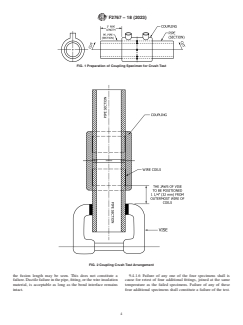
9.4 Joint Integrity Tests—Illustrations of joint crush tests for
joint specimens destined for mechanical/destructive type tests
socket type joints and saddles are offered in 9.4.1 and 9.4.2 as
such as impact as in 5.4 or crush tests as in 9.4, or specimens
test methods that are useful as an evaluation of bonding
conditioned for cold temperature joining as in 8.1.1, may be
strength between the pipe and fitting. Alternately, the fusion
made on unpressured pipe specimens.
evaluation test (FET) offered in 9.4.3 and 9.4.4 may be used in
lieu of the crush test. Similar test evaluations as specified in the
9. Test Methods
contract or purchase order and as agreed upon by the purchaser
9.1 Minimum Hydraulic Burst Pressure Test: and manufacturer are of equal value in performing such
evaluations and may be substituted with such agreement.
9.1.1 Select four fittings at random and prepare specimens
9.4.1 Joint Crush Test:
in accordance with Section 8. From the four specimens,
condition two specimens each in accordance with 8.1.1 and
9.4.1.1 Select four fittings at random and prepare specimens
8.1.2. in accordance with Section 8. From the four specimens,
9.1.2 Test the specimens in accordance with Test Method condition two specimens each in accordance with 8.1.1 and
D1599. 8.1.2 (Note 4).
9.1.3 Failure of the fitting or joint shall constitute specimen
NOTE 4—It is permissible to utilize in joint integrity testing, specimens
failure.
from the quick-burst tests conducted in 9.1 after visually determining that
9.1.4 Failure of any one of the four specimens shall consti-
neither the joint area nor the pipe segment t
...