

ASTM A829/A829M-17
(Specification)Standard Specification for Alloy Structural Steel Plates
General Information
- Abstract
ABSTRACT
This specification deals with alloy structural steel plates. Plate specimens addressed under this specification are available in four treatment conditions (as rolled or hot rolled; annealed; normalized; and normalized and tempered), three structural forms (rectangular; circular and semi-circular; and sketch, including rings), five edge categories (mill edge; universal mill edge; sheared edge; gas cut edge; and special cut edge), and seven finishes (as rolled or hot rolled; blast cleaned; blast cleaned and oiled; pickled; pickled and oiled; painted with one prime coat; and painted with one prime coat and one finish coat). Steel materials shall be manufactured and furnished in defined procedures unless specified otherwise in the purchase order. Heat analysis shall be performed wherein steel specimens shall conform to required chemical compositions of carbon, manganese, phosphorus, sulfur, silicon, nickel, chromium, molybdenum, vanadium, and copper. Specimens shall also undergo tensile tests and shall conform to required values of tensile strength.
SCOPE
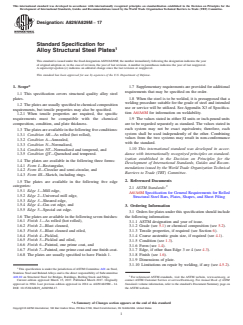
1.1 This specification covers structural quality alloy steel plates.
1.2 The plates are usually specified to chemical composition requirements, but tensile properties may also be specified.
1.2.1 When tensile properties are required, the specific requirements must be compatible with the chemical composition, condition, and plate thickness.
1.3 The plates are available in the following five conditions:
1.3.1 Condition AR—As rolled (hot rolled),
1.3.2 Condition A—Annealed,
1.3.3 Condition N—Normalized,
1.3.4 Condition NT—Normalized and tempered, and
1.3.5 Condition QT—Quenched and tempered.
1.4 The plates are available in the following three forms:
1.4.1 Form I—Rectangular,
1.4.2 Form II—Circular and semi-circular, and
1.4.3 Form III—Sketch, including rings.
1.5 The plates are available in the following five edge categories:
1.5.1 Edge 1—Mill edge,
1.5.2 Edge 2—Universal mill edge,
1.5.3 Edge 3—Sheared edge,
1.5.4 Edge 4—Gas cut edge, and
1.5.5 Edge 5—Special cut edge.
1.6 The plates are available in the following seven finishes:
1.6.1 Finish 1—As rolled (hot rolled),
1.6.2 Finish 2—Blast cleaned,
1.6.3 Finish 3—Blast cleaned and oiled,
1.6.4 Finish 4—Pickled,
1.6.5 Finish 5—Pickled and oiled,
1.6.6 Finish 6—Painted, one prime coat, and
1.6.7 Finish 7—Painted, one prime coat and one finish coat.
1.6.8 The plates are usually specified to have Finish 1.
1.7 Supplementary requirements are provided for additional requirements that may be specified on the order.
1.8 When the steel is to be welded, it is presupposed that a welding procedure suitable for the grade of steel and intended use or service will be utilized. See Appendix X3 of Specification A6/A6M for information on weldability.
1.9 The values stated in either SI units or inch-pound units are to be regarded separately as standard. The values stated in each system may not be exact equivalents; therefore, each system shall be used independently of the other. Combining values from the two systems may result in non-conformance with the standard.
1.10 This international standard was developed in accordance with internationally recognized principles on standardization established in the Decision on Principles for the Development of International Standards, Guides and Recommendations issued by the World Trade Organization Technical Barriers to Trade (TBT) Committee.
- Status
- Published
- Publication Date
- 14-Mar-2017
- Technical Committee
- A01 - Steel, Stainless Steel and Related Alloys

Overview
ASTM A829/A829M-17 is the standard specification developed by ASTM International for alloy structural steel plates used in construction, heavy machinery, transportation equipment, and various industrial applications. This standard outlines the requirements for chemical composition, mechanical properties, manufacturing methods, and delivery conditions to ensure the consistent quality and performance of alloy steel plates. The document is recognized internationally and supports compliance with global trade and engineering practices.
Key Topics
Material Conditions and Forms
- Plates are available in five different treatment conditions:
- As rolled (hot rolled)
- Annealed
- Normalized
- Normalized and tempered
- Quenched and tempered
- Plates can be supplied in three structural forms:
- Rectangular
- Circular and semi-circular
- Sketch (including rings)
Edge and Finish Options
- Five edge categories:
- Mill edge
- Universal mill edge
- Sheared edge
- Gas cut edge
- Special cut edge
- Seven surface finishes:
- As rolled (hot rolled)
- Blast cleaned
- Blast cleaned and oiled
- Pickled
- Pickled and oiled
- Painted with one prime coat
- Painted with one prime coat and one finish coat
Chemical Composition and Mechanical Properties
- The standard specifies the chemical composition requirements for key alloying elements including carbon, manganese, phosphorus, sulfur, silicon, nickel, chromium, molybdenum, vanadium, and copper.
- Plates may also be ordered to meet specific tensile requirements compatible with their composition, treatment, and thickness.
Testing and Certification
- Requirements for heat analysis and mechanical testing to verify compliance with specified grades.
- Certification of composition and mechanical test results must be provided to purchasers.
Supplementary Requirements
- Purchasers may specify additional requirements such as vacuum treatment, product analysis, and ultrasonic examination as needed for critical applications.
Applications
Structural alloy steel plates conforming to ASTM A829/A829M-17 are widely used in:
- Bridge and building construction: Supports load-bearing frameworks requiring high strength and toughness.
- Industrial equipment manufacturing: Machinery parts, gears, and heavy-duty components.
- Rolling stock and shipbuilding: Chassis, frames, and structural assemblies exposed to dynamic loads.
- Pressure vessels and tanks: Plates are selected for their mechanical reliability under varying stress conditions.
- Transport infrastructure: Suitable for automotive, rail, and heavy transport vehicle frames.
The wide range of available conditions, surface finishes, and edge treatments allow engineers to choose plates tailored to specific project requirements, ensuring optimal performance, durability, and fabrication compatibility.
Related Standards
Plates supplied under ASTM A829/A829M-17 must also comply with general delivery and testing requirements outlined in:
- ASTM A6/A6M: General Requirements for Rolled Structural Steel Bars, Plates, Shapes, and Sheet Piling
For welding and fabrication guidance, consult:
- Specification A6/A6M Appendix X3: Information on weldability and recommended welding procedures for various steel grades
Other relevant standards may include those specifying requirements for structural steel applications in specific industries, such as bridge construction (ASTM A709), pressure vessel plates (ASTM A537), and requirements for testing methods.
Keywords: ASTM A829, alloy structural steel plates, steel plate specification, chemical composition, mechanical properties, structural applications, industrial alloy steel, ASTM standards, steel plate finishes, edge categories, plate testing, certification
Relations
- Effective Date
- 15-Mar-2017
- Effective Date
- 01-Mar-2024
- Effective Date
- 01-Nov-2023
- Effective Date
- 01-Nov-2017
- Effective Date
- 15-Nov-2016
- Effective Date
- 01-May-2016
- Effective Date
- 01-May-2014
- Effective Date
- 01-Oct-2013
- Effective Date
- 01-May-2013
- Effective Date
- 01-Nov-2012
- Effective Date
- 01-Mar-2012
- Effective Date
- 01-Apr-2011
- Effective Date
- 01-Oct-2010
- Effective Date
- 01-Apr-2010
- Effective Date
- 01-Apr-2009
Get Certified
Connect with accredited certification bodies for this standard

Element Materials Technology
Materials testing and product certification.

Inštitut za kovinske materiale in tehnologije
Institute of Metals and Technology. Materials testing, metallurgical analysis, NDT.
Sponsored listings
Frequently Asked Questions
ASTM A829/A829M-17 is a technical specification published by ASTM International. Its full title is "Standard Specification for Alloy Structural Steel Plates". This standard covers: ABSTRACT This specification deals with alloy structural steel plates. Plate specimens addressed under this specification are available in four treatment conditions (as rolled or hot rolled; annealed; normalized; and normalized and tempered), three structural forms (rectangular; circular and semi-circular; and sketch, including rings), five edge categories (mill edge; universal mill edge; sheared edge; gas cut edge; and special cut edge), and seven finishes (as rolled or hot rolled; blast cleaned; blast cleaned and oiled; pickled; pickled and oiled; painted with one prime coat; and painted with one prime coat and one finish coat). Steel materials shall be manufactured and furnished in defined procedures unless specified otherwise in the purchase order. Heat analysis shall be performed wherein steel specimens shall conform to required chemical compositions of carbon, manganese, phosphorus, sulfur, silicon, nickel, chromium, molybdenum, vanadium, and copper. Specimens shall also undergo tensile tests and shall conform to required values of tensile strength. SCOPE 1.1 This specification covers structural quality alloy steel plates. 1.2 The plates are usually specified to chemical composition requirements, but tensile properties may also be specified. 1.2.1 When tensile properties are required, the specific requirements must be compatible with the chemical composition, condition, and plate thickness. 1.3 The plates are available in the following five conditions: 1.3.1 Condition AR—As rolled (hot rolled), 1.3.2 Condition A—Annealed, 1.3.3 Condition N—Normalized, 1.3.4 Condition NT—Normalized and tempered, and 1.3.5 Condition QT—Quenched and tempered. 1.4 The plates are available in the following three forms: 1.4.1 Form I—Rectangular, 1.4.2 Form II—Circular and semi-circular, and 1.4.3 Form III—Sketch, including rings. 1.5 The plates are available in the following five edge categories: 1.5.1 Edge 1—Mill edge, 1.5.2 Edge 2—Universal mill edge, 1.5.3 Edge 3—Sheared edge, 1.5.4 Edge 4—Gas cut edge, and 1.5.5 Edge 5—Special cut edge. 1.6 The plates are available in the following seven finishes: 1.6.1 Finish 1—As rolled (hot rolled), 1.6.2 Finish 2—Blast cleaned, 1.6.3 Finish 3—Blast cleaned and oiled, 1.6.4 Finish 4—Pickled, 1.6.5 Finish 5—Pickled and oiled, 1.6.6 Finish 6—Painted, one prime coat, and 1.6.7 Finish 7—Painted, one prime coat and one finish coat. 1.6.8 The plates are usually specified to have Finish 1. 1.7 Supplementary requirements are provided for additional requirements that may be specified on the order. 1.8 When the steel is to be welded, it is presupposed that a welding procedure suitable for the grade of steel and intended use or service will be utilized. See Appendix X3 of Specification A6/A6M for information on weldability. 1.9 The values stated in either SI units or inch-pound units are to be regarded separately as standard. The values stated in each system may not be exact equivalents; therefore, each system shall be used independently of the other. Combining values from the two systems may result in non-conformance with the standard. 1.10 This international standard was developed in accordance with internationally recognized principles on standardization established in the Decision on Principles for the Development of International Standards, Guides and Recommendations issued by the World Trade Organization Technical Barriers to Trade (TBT) Committee.
ABSTRACT This specification deals with alloy structural steel plates. Plate specimens addressed under this specification are available in four treatment conditions (as rolled or hot rolled; annealed; normalized; and normalized and tempered), three structural forms (rectangular; circular and semi-circular; and sketch, including rings), five edge categories (mill edge; universal mill edge; sheared edge; gas cut edge; and special cut edge), and seven finishes (as rolled or hot rolled; blast cleaned; blast cleaned and oiled; pickled; pickled and oiled; painted with one prime coat; and painted with one prime coat and one finish coat). Steel materials shall be manufactured and furnished in defined procedures unless specified otherwise in the purchase order. Heat analysis shall be performed wherein steel specimens shall conform to required chemical compositions of carbon, manganese, phosphorus, sulfur, silicon, nickel, chromium, molybdenum, vanadium, and copper. Specimens shall also undergo tensile tests and shall conform to required values of tensile strength. SCOPE 1.1 This specification covers structural quality alloy steel plates. 1.2 The plates are usually specified to chemical composition requirements, but tensile properties may also be specified. 1.2.1 When tensile properties are required, the specific requirements must be compatible with the chemical composition, condition, and plate thickness. 1.3 The plates are available in the following five conditions: 1.3.1 Condition AR—As rolled (hot rolled), 1.3.2 Condition A—Annealed, 1.3.3 Condition N—Normalized, 1.3.4 Condition NT—Normalized and tempered, and 1.3.5 Condition QT—Quenched and tempered. 1.4 The plates are available in the following three forms: 1.4.1 Form I—Rectangular, 1.4.2 Form II—Circular and semi-circular, and 1.4.3 Form III—Sketch, including rings. 1.5 The plates are available in the following five edge categories: 1.5.1 Edge 1—Mill edge, 1.5.2 Edge 2—Universal mill edge, 1.5.3 Edge 3—Sheared edge, 1.5.4 Edge 4—Gas cut edge, and 1.5.5 Edge 5—Special cut edge. 1.6 The plates are available in the following seven finishes: 1.6.1 Finish 1—As rolled (hot rolled), 1.6.2 Finish 2—Blast cleaned, 1.6.3 Finish 3—Blast cleaned and oiled, 1.6.4 Finish 4—Pickled, 1.6.5 Finish 5—Pickled and oiled, 1.6.6 Finish 6—Painted, one prime coat, and 1.6.7 Finish 7—Painted, one prime coat and one finish coat. 1.6.8 The plates are usually specified to have Finish 1. 1.7 Supplementary requirements are provided for additional requirements that may be specified on the order. 1.8 When the steel is to be welded, it is presupposed that a welding procedure suitable for the grade of steel and intended use or service will be utilized. See Appendix X3 of Specification A6/A6M for information on weldability. 1.9 The values stated in either SI units or inch-pound units are to be regarded separately as standard. The values stated in each system may not be exact equivalents; therefore, each system shall be used independently of the other. Combining values from the two systems may result in non-conformance with the standard. 1.10 This international standard was developed in accordance with internationally recognized principles on standardization established in the Decision on Principles for the Development of International Standards, Guides and Recommendations issued by the World Trade Organization Technical Barriers to Trade (TBT) Committee.
ASTM A829/A829M-17 is classified under the following ICS (International Classification for Standards) categories: 77.140.50 - Flat steel products and semi-products. The ICS classification helps identify the subject area and facilitates finding related standards.
ASTM A829/A829M-17 has the following relationships with other standards: It is inter standard links to ASTM A829/A829M-14, ASTM A6/A6M-24, ASTM A6/A6M-23, ASTM A6/A6M-17a, ASTM A6/A6M-16a, ASTM A6/A6M-16, ASTM A6/A6M-14, ASTM A6/A6M-13a, ASTM A6/A6M-13, ASTM A6/A6M-12a, ASTM A6/A6M-12, ASTM A6/A6M-11, ASTM A6/A6M-10a, ASTM A6/A6M-10, ASTM A6/A6M-09. Understanding these relationships helps ensure you are using the most current and applicable version of the standard.
ASTM A829/A829M-17 is available in PDF format for immediate download after purchase. The document can be added to your cart and obtained through the secure checkout process. Digital delivery ensures instant access to the complete standard document.
Standards Content (Sample)
This international standard was developed in accordance with internationally recognized principles on standardization established in the Decision on Principles for the
Development of International Standards, Guides and Recommendations issued by the World Trade Organization Technical Barriers to Trade (TBT) Committee.
Designation:A829/A829M −17
Standard Specification for
Alloy Structural Steel Plates
This standard is issued under the fixed designationA829/A829M; the number immediately following the designation indicates the year
of original adoption or, in the case of revision, the year of last revision. A number in parentheses indicates the year of last reapproval.
A superscript epsilon (´) indicates an editorial change since the last revision or reapproval.
This standard has been approved for use by agencies of the U.S. Department of Defense.
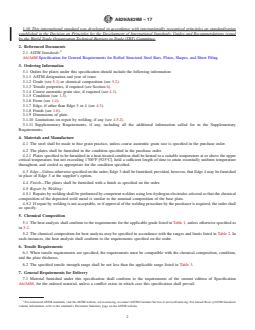
1. Scope* 1.7 Supplementary requirements are provided for additional
requirements that may be specified on the order.
1.1 This specification covers structural quality alloy steel
plates. 1.8 When the steel is to be welded, it is presupposed that a
welding procedure suitable for the grade of steel and intended
1.2 Theplatesareusuallyspecifiedtochemicalcomposition
use or service will be utilized. See Appendix X3 of Specifica-
requirements, but tensile properties may also be specified.
tion A6/A6M for information on weldability.
1.2.1 When tensile properties are required, the specific
requirements must be compatible with the chemical 1.9 The values stated in either SI units or inch-pound units
composition, condition, and plate thickness. are to be regarded separately as standard. The values stated in
each system may not be exact equivalents; therefore, each
1.3 The plates are available in the following five conditions:
system shall be used independently of the other. Combining
1.3.1 Condition AR—As rolled (hot rolled),
values from the two systems may result in non-conformance
1.3.2 Condition A—Annealed,
with the standard.
1.3.3 Condition N—Normalized,
1.10 This international standard was developed in accor-
1.3.4 Condition NT—Normalized and tempered, and
dance with internationally recognized principles on standard-
1.3.5 Condition QT—Quenched and tempered.
ization established in the Decision on Principles for the
1.4 The plates are available in the following three forms:
Development of International Standards, Guides and Recom-
1.4.1 Form I—Rectangular,
mendations issued by the World Trade Organization Technical
1.4.2 Form II—Circular and semi-circular, and
Barriers to Trade (TBT) Committee.
1.4.3 Form III—Sketch, including rings.
2. Referenced Documents
1.5 The plates are available in the following five edge
categories:
2.1 ASTM Standards:
1.5.1 Edge 1—Mill edge,
A6/A6M Specification for General Requirements for Rolled
1.5.2 Edge 2—Universal mill edge,
Structural Steel Bars, Plates, Shapes, and Sheet Piling
1.5.3 Edge 3—Sheared edge,
1.5.4 Edge 4—Gas cut edge, and
3. Ordering Information
1.5.5 Edge 5—Special cut edge.
3.1 Orders for plates under this specification should include
1.6 The plates are available in the following seven finishes:
the following information:
1.6.1 Finish 1—As rolled (hot rolled),
3.1.1 ASTM designation and year of issue.
1.6.2 Finish 2—Blast cleaned, 3.1.2 Grade (see 5.1) or chemical composition (see 5.2).
1.6.3 Finish 3—Blast cleaned and oiled,
3.1.3 Tensile properties, if required (see Section 6).
1.6.4 Finish 4—Pickled, 3.1.4 Coarse austenitic grain size, if required (see 4.1).
1.6.5 Finish 5—Pickled and oiled,
3.1.5 Condition (see 1.3).
1.6.6 Finish 6—Painted, one prime coat, and 3.1.6 Form (see 1.4).
1.6.7 Finish 7—Painted, one prime coat and one finish coat.
3.1.7 Edge, if other than Edge 3 or 4 (see 4.3).
1.6.8 The plates are usually specified to have Finish 1. 3.1.8 Finish (see 1.6).
3.1.9 Dimensions of plate.
3.1.10 Limitations on repair by welding, if any (see 4.5.2).
This specification is under the jurisdiction of ASTM Committee A01 on Steel,
Stainless Steel and Related Alloys and is the direct responsibility of Subcommittee
A01.02 on Structural Steel for Bridges, Buildings, Rolling Stock and Ships. For referenced ASTM standards, visit the ASTM website, www.astm.org, or
Current edition approved March 15, 2017. Published March 2017. Originally contact ASTM Customer Service at service@astm.org. For Annual Book of ASTM
approved in 1984. Last previous edition approved in 2014 as A829/A829M – 14. Standards volume information, refer to the standard’s Document Summary page on
DOI: 10.1520/A0829_A0829M-17. the ASTM website.
*A Summary of Changes section appears at the end of this standard
Copyright © ASTM International, 100 Barr Harbor Drive, PO Box C700, West Conshohocken, PA 19428-2959. United States
A829/A829M−17
3.1.11 Supplementary Requirements, if any, including all 4.5 Repair by Welding:
the additional information called for in the Supplementary 4.5.1 Repairs by welding shall be performed by competent
Requirements. welders using low-hydrogen electrodes selected so that the
chemical composition of the deposited weld metal is similar to
4. Materials and Manufacture
the nominal composition of the base plate.
4.1 The steel shall be made to fine grain practice, unless 4.5.2 Ifrepairbyweldingisnotacceptable,orifapprovalof
coarse austenitic grain size is specified in the purchase order. the welding procedure by the purchaser is required, the order
shall so specify.
4.2 The plates shall be furnished in the condition specified
in the purchase order.
5. Chemical Composition
4.2.1 Plates specified to be furnished in a heat-treated
condition shall be heated to a suitable temperature at or above 5.1 The heat analysis shall conform to the requirements for
the upper critical temperature, but not exceeding 1700°F
the applicable grade listed in Table 1, unless otherwise speci-
[925°C], held a sufficient length of time to attain essentially fied as in 5.2.
uniform temperature throughout, and cooled as appropriate for
5.2 The chemical composition for heat analysis may be
the condition specified.
specified in accordance with the ranges and limits listed in
4.3 Edge—Unless otherwise specified on the order, Edge 3
Table 2. In such instances, the heat analysis shall conform to
shall be furnished; provided, however, that Edge 4 may be
the requirements specified on the order.
furnished in place of Edge 3 at the supplier’s option.
6. Tensile Requirements
4.4 Finish—The plates shall be furnished with a finish as
specified on the order.
6.1 When tensile requirements are specified, the require-
ments must be compatible with the chemical composition,
condition, and the plate thickness.
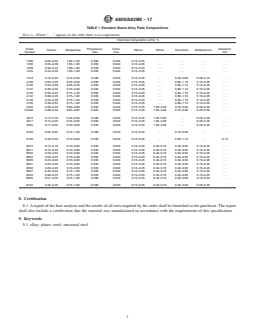
TABLE 1 Standard Steels Alloy Plate Compositions
NOTE 1—Where “. . .” appears in this table there is no requirement.
Chemical Composition Limits, %
Grade Phosphorus, Sulfur, Vanadium,
Carbon Manganese Silicon Nickel Chromium Molybdenum
Number max max min
1330 0.28–0.33 1.60–1.90 0.030 0.040 0.15–0.35 . . . . .
...
This document is not an ASTM standard and is intended only to provide the user of an ASTM standard an indication of what changes have been made to the previous version. Because
it may not be technically possible to adequately depict all changes accurately, ASTM recommends that users consult prior editions as appropriate. In all cases only the current version
of the standard as published by ASTM is to be considered the official document.
Designation: A829/A829M − 14 A829/A829M − 17
Standard Specification for
Alloy Structural Steel Plates
This standard is issued under the fixed designation A829/A829M; the number immediately following the designation indicates the year
of original adoption or, in the case of revision, the year of last revision. A number in parentheses indicates the year of last reapproval.
A superscript epsilon (´) indicates an editorial change since the last revision or reapproval.
This standard has been approved for use by agencies of the U.S. Department of Defense.
1. Scope*
1.1 This specification covers structural quality alloy steel plates.
1.2 The plates are usually specified to chemical composition requirements, but tensile properties may also be specified.
1.2.1 When tensile properties are required, the specific requirements must be compatible with the chemical composition,
condition, and plate thickness.
1.3 The plates are available in the following fourfive conditions:
1.3.1 Condition AR—As rolled (hot rolled),
1.3.2 Condition A—Annealed,
1.3.3 Condition N—Normalized, and
1.3.4 Condition NT—Normalized and tempered. tempered, and
1.3.5 Condition QT—Quenched and tempered.
1.4 The plates are available in the following three forms:
1.4.1 Form I—Rectangular,
1.4.2 Form II—Circular and semi-circular, and
1.4.3 Form III—Sketch, including rings.
1.5 The plates are available in the following five edge categories:
1.5.1 Edge 1—Mill edge,
1.5.2 Edge 2—Universal mill edge,
1.5.3 Edge 3—Sheared edge,
1.5.4 Edge 4—Gas cut edge, and
1.5.5 Edge 5—Special cut edge.
1.6 The plates are available in the following seven finishes:
1.6.1 Finish 1—As rolled (hot rolled),
1.6.2 Finish 2—Blast cleaned,
1.6.3 Finish 3—Blast cleaned and oiled,
1.6.4 Finish 4—Pickled,
1.6.5 Finish 5—Pickled and oiled,
1.6.6 Finish 6—Painted, one prime coat, and
1.6.7 Finish 7—Painted, one prime coat and one finish coat.
1.6.8 The plates are usually specified to have Finish 1.
1.7 Supplementary requirements are provided for additional requirements that may be specified on the order.
1.8 When the steel is to be welded, it is presupposed that a welding procedure suitable for the grade of steel and intended use
or service will be utilized. See Appendix X3 of Specification A6/A6M for information on weldability.
1.9 The values stated in either SI units or inch-pound units are to be regarded separately as standard. The values stated in each
system may not be exact equivalents; therefore, each system shall be used independently of the other. Combining values from the
two systems may result in non-conformance with the standard.
This specification is under the jurisdiction of ASTM Committee A01 on Steel, Stainless Steel and Related Alloys and is the direct responsibility of Subcommittee A01.02
on Structural Steel for Bridges, Buildings, Rolling Stock and Ships.
Current edition approved May 1, 2014March 15, 2017. Published May 2014March 2017. Originally approved in 1984. Last previous edition approved in 20112014 as
A829/A829M – 11.A829/A829M – 14. DOI: 10.1520/A0829_A0829M-14. 10.1520/A0829_A0829M-17.
*A Summary of Changes section appears at the end of this standard
Copyright © ASTM International, 100 Barr Harbor Drive, PO Box C700, West Conshohocken, PA 19428-2959. United States
A829/A829M − 17
1.10 This international standard was developed in accordance with internationally recognized principles on standardization
established in the Decision on Principles for the Development of International Standards, Guides and Recommendations issued
by the World Trade Organization Technical Barriers to Trade (TBT) Committee.
2. Referenced Documents
2.1 ASTM Standards:
A6/A6M Specification for General Requirements for Rolled Structural Steel Bars, Plates, Shapes, and Sheet Piling
3. Ordering Information
3.1 Orders for plates under this specification should include the following information:
3.1.1 ASTM designation and year of issue.
3.1.2 Grade (see 5.1) or chemical composition (see 5.2).
3.1.3 Tensile properties, if required (see Section 6).
3.1.4 Coarse austenitic grain size, if required (see 4.1).
3.1.5 Condition (see 1.3).
3.1.6 Form (see 1.4).
3.1.7 Edge, if other than Edge 3 or 4 (see 4.3).
3.1.8 Finish (see 1.6).
3.1.9 Dimensions of plate.
3.1.10 Limitations on repair by welding, if any (see 4.5.2).
3.1.11 Supplementary Requirements, if any, including all the additional information called for in the Supplementary
Requirements.
4. Materials and Manufacture
4.1 The steel shall be made to fine grain practice, unless coarse austenitic grain size is specified in the purchase order.
4.2 The plates shall be furnished in the condition specified in the purchase order.
4.2.1 Plates specified to be furnished in a heat-treated condition shall be heated to a suitable temperature at or above the upper
critical temperature, but not exceeding 1700°F [925°C], held a sufficient length of time to attain essentially uniform temperature
throughout, and cooled as appropriate for the condition specified.
4.3 Edge—Unless otherwise specified on the order, Edge 3 shall be furnished; provided, however, that Edge 4 may be furnished
in place of Edge 3 at the supplier’s option.
4.4 Finish—The plates shall be furnished with a finish as specified on the order.
4.5 Repair by Welding:
4.5.1 Repairs by welding shall be performed by competent welders using low-hydrogen electrodes selected so that the chemical
composition of the deposited weld metal is similar to the nominal composition of the base plate.
4.5.2 If repair by welding is not acceptable, or if approval of the welding procedure by the purchaser is required, the order shall
so specify.
5. Chemical Composition
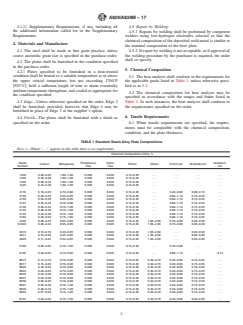
5.1 The heat analysis shall conform to the requirements for the applicable grade listed in Table 1, unless otherwise specified as
in 5.2.
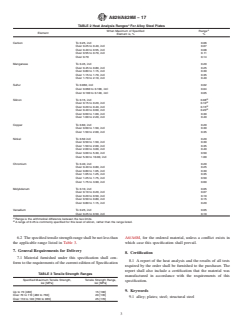
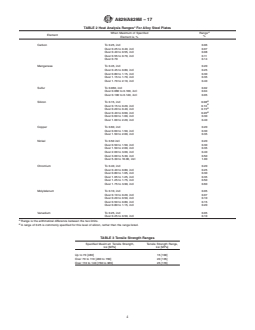
5.2 The chemical composition for heat analysis may be specified in accordance with the ranges and limits listed in Table 2. In
such instances, the heat analysis shall conform to the requirements specified on the order.
6. Tensile Requirements
6.1 When tensile requirements are specified, the requirements must be compatible with the chemical composition, condition,
and the plate thickness.
6.2 The specified tensile strength range shall be not less than the applicable range listed in Table 3.
7. General Requirements for Delivery
7.1 Material furnished under this specification shall conform to the requirements of the current edition of Specification
A6/A6M, for the ordered material, unless a conflict exists in which case this specification shall prevail.
For referenced ASTM standards, visit the ASTM website, www.astm.org, or contact ASTM Customer Service at service@astm.org. For Annual Book of ASTM Standards
volum
...