

ASTM E136-24a
(Test Method)Standard Test Method for Assessing Combustibility of Materials Using a Vertical Tube Furnace at 750 °C
General Information
- Abstract
SIGNIFICANCE AND USE
5.1 Materials that pass this test by complying with the criteria in Section 15 are typically classified as noncombustible materials.
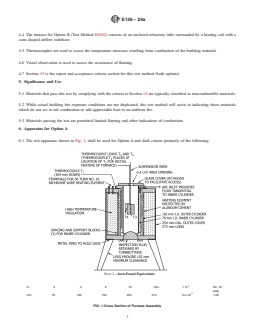
5.2 While actual building fire exposure conditions are not duplicated, this test method will assist in indicating those materials which do not act to aid combustion or add appreciable heat to an ambient fire.
5.3 Materials passing the test are permitted limited flaming and other indications of combustion.
SCOPE
1.1 This fire-test-response test method covers the determination under specified laboratory conditions of the combustibility of building materials. Materials passing this test are typically classified as noncombustible materials.
1.2 Limitations of this fire-test response test method are shown below.
1.2.1 This test method does not apply to laminated or coated materials.
1.2.2 This test method is not suitable or satisfactory for materials that flow, melt, or intumesce.
1.2.3 This test method does not provide a measure of an intrinsic property.
1.2.4 This test method does not provide a quantitative measure of heat generation or combustibility; it simply serves as a test method with selected (end point) measures of combustibility.
1.2.5 The test method does not measure the self-heating tendencies of materials.
1.2.6 In this test method materials are not being tested in the nature and form used in building applications. The test specimen consists of a small, specified volume that is either (1) cut from a thick sheet; (2) assembled from multiple thicknesses of thin sheets; or (3) placed in a container if composed of granular powder or loose-fiber materials.
1.2.7 Results from this test method apply to the specific test apparatus and test conditions and are likely to vary when changes are made to one or more of the following: (1) the size, shape, and arrangement of the specimen; (2) the distribution of organic content; (3) the exposure temperature; (4) the air supply; (5) the location of thermocouples.
1.3 This test method includes two options, both of which use a furnace to expose test specimens of building materials to a temperature of 750 °C (1382 °F).
1.3.1 The furnace for the apparatus for Option A consists of a ceramic tube containing an electric heating coil, and two concentric vertical refractory tubes.
1.3.2 The furnace for the apparatus for Option B (Test Method E2652) consists of an enclosed refractory tube surrounded by a heating coil with a cone-shaped airflow stabilizer.
1.4 This test method references notes and footnotes that provide explanatory information. These notes and footnotes, excluding those in tables and figures, shall not be considered as requirements of this test method.
1.5 The values stated in SI units are to be regarded as standard. The values given in parentheses are for information only.
1.6 This standard is used to measure and describe the response of materials, products, or assemblies to heat and flame under controlled conditions, but does not by itself incorporate all factors required for fire-hazard or fire-risk assessment of the materials, products, or assemblies under actual fire conditions.
1.7 Fire testing is inherently hazardous. Adequate safeguards for personnel and property shall be employed in conducting these tests.
1.8 This standard does not purport to address all of the safety concerns, if any, associated with its use. It is the responsibility of the user of this standard to establish appropriate safety, health, and environmental practices and determine the applicability of regulatory limitations prior to use.
1.9 This international standard was developed in accordance with internationally recognized principles on standardization established in the Decision on Principles for the Development of International Standards, Guides and Recommendations issued by the World Trade Organization Technical Barriers to Trade (TBT) Committee.
- Status
- Published
- Publication Date
- 29-Feb-2024
- Technical Committee
- E05 - Fire Standards
- Drafting Committee
- E05.23 - Combustibility
Buy Documents
ASTM E136-24a - Standard Test Method for Assessing Combustibility of Materials Using a Vertical Tube Furnace at 750 °C
REDLINE ASTM E136-24a - Standard Test Method for Assessing Combustibility of Materials Using a Vertical Tube Furnace at 750 °C
Overview
ASTM E136-24a: Standard Test Method for Assessing Combustibility of Materials Using a Vertical Tube Furnace at 750°C is an internationally recognized fire-test-response standard developed by ASTM International. This test method determines the combustibility of building materials by exposing them to a controlled temperature of 750°C (1382°F) in a vertical tube furnace. Materials passing this standard are typically classified as noncombustible, supporting safer building practices and regulatory compliance in construction and materials manufacturing worldwide.
ASTM E136-24a offers two furnace options for testing and provides clear acceptance criteria, ensuring uniform evaluation across industries. The standard is crucial for organizations seeking to verify that their materials do not significantly contribute to fire growth or increase fire hazards.
Key Topics
Combustibility Testing
ASTM E136-24a defines a laboratory procedure for measuring the combustibility of building materials under standardized conditions. The process involves heating small samples in a vertical tube furnace and observing key indicators such as temperature rise, flaming duration, and weight loss.Classification of Materials
Materials that meet the acceptance criteria specified in Section 15 of the standard are typically classified as noncombustible. However, limited flaming and other indications of combustion are permitted within strict thresholds.Test Method Options
- Option A: Uses a ceramic tube furnace with concentric vertical refractory tubes, exposing the specimen to a stable 750°C environment.
- Option B: Involves a refractory tube with a cone-shaped airflow stabilizer (as defined in ASTM E2652), providing an alternative testing configuration.
Limitations
- The test does not apply to laminated or coated materials.
- It is unsuitable for materials that flow, melt, or intumesce.
- Results are not a quantitative measure of intrinsic material properties or heat release.
- Testing is conducted on a small specimen, which may differ from material performance in real-life building applications.
Safety Precautions
Fire testing inherently poses risks; thus, personnel and property safeguards must be employed during the execution of ASTM E136-24a.
Applications
ASTM E136-24a is widely used in the construction, building materials, and fire safety industries for:
- Product Certification: Verifying and certifying that building products, such as insulation, wallboard, and structural materials, do not significantly aid combustion in a fire.
- Regulatory Compliance: Meeting the requirements of building codes, fire safety regulations, and insurance guidelines that often reference ASTM E136 standards for noncombustibility.
- Material Development: Assisting manufacturers in developing and marketing materials that meet stringent fire safety criteria.
- Fire Hazard Assessment: Supporting the evaluation of fire risks by identifying materials that contribute minimally to fire growth and heat release under controlled conditions.
- Global Trade: Facilitating international market access through alignment with World Trade Organization Technical Barriers to Trade (TBT) principles.
Related Standards
Several standards are referenced or associated with ASTM E136-24a, including:
- ASTM E84: Test Method for Surface Burning Characteristics of Building Materials
- ASTM E176: Terminology of Fire Standards
- ASTM E2652: Test Method for Assessing Combustibility of Materials Using a Tube Furnace with a Cone-Shaped Airflow Stabilizer at 750°C
- ISO 1182: Noncombustibility Test for Building Materials
- ISO 871: Plastics – Determination of Ignition Temperature using a Hot-Air Furnace
- BS 476: Combustibility Test of Materials
Adopting ASTM E136-24a in fire safety test protocols ensures robust, repeatable evaluation of material combustibility, supporting safer built environments and harmonizing global fire standards.
Relations
- Effective Date
- 01-Mar-2024
- Effective Date
- 01-Mar-2024
- Effective Date
- 01-Mar-2024
- Effective Date
- 01-Mar-2024
- Effective Date
- 01-Mar-2024
- Effective Date
- 01-Mar-2024
- Effective Date
- 01-Mar-2024
- Effective Date
- 01-Mar-2024
- Referred By
ASTM F1972-19 - Standard Guide for Terminology Relating to Candles and Associated Accessory Items - Effective Date
- 01-Mar-2024
- Effective Date
- 01-Mar-2024
- Referred By
ASTM D4851-07(2019)e1 - Standard Test Methods for Coated and Laminated Fabrics for Architectural Use - Effective Date
- 01-Mar-2024
- Effective Date
- 01-Mar-2024
- Referred By
ASTM E2257-22 - Standard Test Method for Room Fire Test of Wall and Ceiling Materials and Assemblies - Effective Date
- 01-Mar-2024
- Effective Date
- 01-Mar-2024
- Effective Date
- 01-Mar-2024
Buy Documents
ASTM E136-24a - Standard Test Method for Assessing Combustibility of Materials Using a Vertical Tube Furnace at 750 °C
REDLINE ASTM E136-24a - Standard Test Method for Assessing Combustibility of Materials Using a Vertical Tube Furnace at 750 °C
Get Certified
Connect with accredited certification bodies for this standard

DIBt (Deutsches Institut für Bautechnik)
German Institute for Building Technology.
DIN CERTCO
DIN Group product certification.

Kiwa BDA Testing
Building and construction product certification.
Sponsored listings
Frequently Asked Questions
ASTM E136-24a is a standard published by ASTM International. Its full title is "Standard Test Method for Assessing Combustibility of Materials Using a Vertical Tube Furnace at 750 °C". This standard covers: SIGNIFICANCE AND USE 5.1 Materials that pass this test by complying with the criteria in Section 15 are typically classified as noncombustible materials. 5.2 While actual building fire exposure conditions are not duplicated, this test method will assist in indicating those materials which do not act to aid combustion or add appreciable heat to an ambient fire. 5.3 Materials passing the test are permitted limited flaming and other indications of combustion. SCOPE 1.1 This fire-test-response test method covers the determination under specified laboratory conditions of the combustibility of building materials. Materials passing this test are typically classified as noncombustible materials. 1.2 Limitations of this fire-test response test method are shown below. 1.2.1 This test method does not apply to laminated or coated materials. 1.2.2 This test method is not suitable or satisfactory for materials that flow, melt, or intumesce. 1.2.3 This test method does not provide a measure of an intrinsic property. 1.2.4 This test method does not provide a quantitative measure of heat generation or combustibility; it simply serves as a test method with selected (end point) measures of combustibility. 1.2.5 The test method does not measure the self-heating tendencies of materials. 1.2.6 In this test method materials are not being tested in the nature and form used in building applications. The test specimen consists of a small, specified volume that is either (1) cut from a thick sheet; (2) assembled from multiple thicknesses of thin sheets; or (3) placed in a container if composed of granular powder or loose-fiber materials. 1.2.7 Results from this test method apply to the specific test apparatus and test conditions and are likely to vary when changes are made to one or more of the following: (1) the size, shape, and arrangement of the specimen; (2) the distribution of organic content; (3) the exposure temperature; (4) the air supply; (5) the location of thermocouples. 1.3 This test method includes two options, both of which use a furnace to expose test specimens of building materials to a temperature of 750 °C (1382 °F). 1.3.1 The furnace for the apparatus for Option A consists of a ceramic tube containing an electric heating coil, and two concentric vertical refractory tubes. 1.3.2 The furnace for the apparatus for Option B (Test Method E2652) consists of an enclosed refractory tube surrounded by a heating coil with a cone-shaped airflow stabilizer. 1.4 This test method references notes and footnotes that provide explanatory information. These notes and footnotes, excluding those in tables and figures, shall not be considered as requirements of this test method. 1.5 The values stated in SI units are to be regarded as standard. The values given in parentheses are for information only. 1.6 This standard is used to measure and describe the response of materials, products, or assemblies to heat and flame under controlled conditions, but does not by itself incorporate all factors required for fire-hazard or fire-risk assessment of the materials, products, or assemblies under actual fire conditions. 1.7 Fire testing is inherently hazardous. Adequate safeguards for personnel and property shall be employed in conducting these tests. 1.8 This standard does not purport to address all of the safety concerns, if any, associated with its use. It is the responsibility of the user of this standard to establish appropriate safety, health, and environmental practices and determine the applicability of regulatory limitations prior to use. 1.9 This international standard was developed in accordance with internationally recognized principles on standardization established in the Decision on Principles for the Development of International Standards, Guides and Recommendations issued by the World Trade Organization Technical Barriers to Trade (TBT) Committee.
SIGNIFICANCE AND USE 5.1 Materials that pass this test by complying with the criteria in Section 15 are typically classified as noncombustible materials. 5.2 While actual building fire exposure conditions are not duplicated, this test method will assist in indicating those materials which do not act to aid combustion or add appreciable heat to an ambient fire. 5.3 Materials passing the test are permitted limited flaming and other indications of combustion. SCOPE 1.1 This fire-test-response test method covers the determination under specified laboratory conditions of the combustibility of building materials. Materials passing this test are typically classified as noncombustible materials. 1.2 Limitations of this fire-test response test method are shown below. 1.2.1 This test method does not apply to laminated or coated materials. 1.2.2 This test method is not suitable or satisfactory for materials that flow, melt, or intumesce. 1.2.3 This test method does not provide a measure of an intrinsic property. 1.2.4 This test method does not provide a quantitative measure of heat generation or combustibility; it simply serves as a test method with selected (end point) measures of combustibility. 1.2.5 The test method does not measure the self-heating tendencies of materials. 1.2.6 In this test method materials are not being tested in the nature and form used in building applications. The test specimen consists of a small, specified volume that is either (1) cut from a thick sheet; (2) assembled from multiple thicknesses of thin sheets; or (3) placed in a container if composed of granular powder or loose-fiber materials. 1.2.7 Results from this test method apply to the specific test apparatus and test conditions and are likely to vary when changes are made to one or more of the following: (1) the size, shape, and arrangement of the specimen; (2) the distribution of organic content; (3) the exposure temperature; (4) the air supply; (5) the location of thermocouples. 1.3 This test method includes two options, both of which use a furnace to expose test specimens of building materials to a temperature of 750 °C (1382 °F). 1.3.1 The furnace for the apparatus for Option A consists of a ceramic tube containing an electric heating coil, and two concentric vertical refractory tubes. 1.3.2 The furnace for the apparatus for Option B (Test Method E2652) consists of an enclosed refractory tube surrounded by a heating coil with a cone-shaped airflow stabilizer. 1.4 This test method references notes and footnotes that provide explanatory information. These notes and footnotes, excluding those in tables and figures, shall not be considered as requirements of this test method. 1.5 The values stated in SI units are to be regarded as standard. The values given in parentheses are for information only. 1.6 This standard is used to measure and describe the response of materials, products, or assemblies to heat and flame under controlled conditions, but does not by itself incorporate all factors required for fire-hazard or fire-risk assessment of the materials, products, or assemblies under actual fire conditions. 1.7 Fire testing is inherently hazardous. Adequate safeguards for personnel and property shall be employed in conducting these tests. 1.8 This standard does not purport to address all of the safety concerns, if any, associated with its use. It is the responsibility of the user of this standard to establish appropriate safety, health, and environmental practices and determine the applicability of regulatory limitations prior to use. 1.9 This international standard was developed in accordance with internationally recognized principles on standardization established in the Decision on Principles for the Development of International Standards, Guides and Recommendations issued by the World Trade Organization Technical Barriers to Trade (TBT) Committee.
ASTM E136-24a is classified under the following ICS (International Classification for Standards) categories: 13.220.50 - Fire-resistance of building materials and elements; 91.100.01 - Construction materials in general. The ICS classification helps identify the subject area and facilitates finding related standards.
ASTM E136-24a has the following relationships with other standards: It is inter standard links to ASTM E136-24, ASTM F3214-23, ASTM E3157-23, ASTM C1705/C1705M-09(2023), ASTM C195-07(2019), ASTM F3319-20, ASTM C610-17(2023), ASTM C1685-15(2021), ASTM F1972-19, ASTM C1902-22a, ASTM D4851-07(2019)e1, ASTM C1696-20, ASTM E2257-22, ASTM C549-23, ASTM C764-19. Understanding these relationships helps ensure you are using the most current and applicable version of the standard.
ASTM E136-24a is available in PDF format for immediate download after purchase. The document can be added to your cart and obtained through the secure checkout process. Digital delivery ensures instant access to the complete standard document.
Standards Content (Sample)
This international standard was developed in accordance with internationally recognized principles on standardization established in the Decision on Principles for the
Development of International Standards, Guides and Recommendations issued by the World Trade Organization Technical Barriers to Trade (TBT) Committee.
Designation: E136 − 24a An American National Standard
Standard Test Method for
Assessing Combustibility of Materials Using a Vertical Tube
Furnace at 750 °C
This standard is issued under the fixed designation E136; the number immediately following the designation indicates the year of
original adoption or, in the case of revision, the year of last revision. A number in parentheses indicates the year of last reapproval. A
superscript epsilon (´) indicates an editorial change since the last revision or reapproval.
This standard has been approved for use by agencies of the U.S. Department of Defense.
1. Scope* 1.3 This test method includes two options, both of which
use a furnace to expose test specimens of building materials to
1.1 This fire-test-response test method covers the determi-
a temperature of 750 °C (1382 °F).
nation under specified laboratory conditions of the combusti-
1.3.1 The furnace for the apparatus for Option A consists of
bility of building materials. Materials passing this test are
a ceramic tube containing an electric heating coil, and two
typically classified as noncombustible materials.
concentric vertical refractory tubes.
1.2 Limitations of this fire-test response test method are
1.3.2 The furnace for the apparatus for Option B (Test
shown below.
Method E2652) consists of an enclosed refractory tube sur-
1.2.1 This test method does not apply to laminated or coated
rounded by a heating coil with a cone-shaped airflow stabilizer.
materials.
1.4 This test method references notes and footnotes that
1.2.2 This test method is not suitable or satisfactory for
provide explanatory information. These notes and footnotes,
materials that flow, melt, or intumesce.
excluding those in tables and figures, shall not be considered as
1.2.3 This test method does not provide a measure of an
requirements of this test method.
intrinsic property.
1.2.4 This test method does not provide a quantitative
1.5 The values stated in SI units are to be regarded as
measure of heat generation or combustibility; it simply serves
standard. The values given in parentheses are for information
as a test method with selected (end point) measures of
only.
combustibility.
1.6 This standard is used to measure and describe the
1.2.5 The test method does not measure the self-heating
response of materials, products, or assemblies to heat and
tendencies of materials.
flame under controlled conditions, but does not by itself
1.2.6 In this test method materials are not being tested in the
incorporate all factors required for fire-hazard or fire-risk
nature and form used in building applications. The test speci-
assessment of the materials, products, or assemblies under
men consists of a small, specified volume that is either (1) cut
actual fire conditions.
from a thick sheet; (2) assembled from multiple thicknesses of
1.7 Fire testing is inherently hazardous. Adequate safe-
thin sheets; or (3) placed in a container if composed of granular
guards for personnel and property shall be employed in
powder or loose-fiber materials.
conducting these tests.
1.2.7 Results from this test method apply to the specific test
apparatus and test conditions and are likely to vary when
1.8 This standard does not purport to address all of the
changes are made to one or more of the following: (1) the size,
safety concerns, if any, associated with its use. It is the
shape, and arrangement of the specimen; (2) the distribution of
responsibility of the user of this standard to establish appro-
organic content; (3) the exposure temperature; (4) the air
priate safety, health, and environmental practices and deter-
supply; (5) the location of thermocouples.
mine the applicability of regulatory limitations prior to use.
1.9 This international standard was developed in accor-
dance with internationally recognized principles on standard-
This test method is under the jurisdiction of ASTM Committee E05 on Fire
Standards and is the direct responsibility of Subcommittee E05.23 on Combustibil-
ization established in the Decision on Principles for the
ity.
Development of International Standards, Guides and Recom-
Current edition approved March 1, 2024. Published March 2024. Originally
mendations issued by the World Trade Organization Technical
approved in 1958. Last previous edition approved in 2024 as E136 – 24. DOI:
10.1520/E0136-24A. Barriers to Trade (TBT) Committee.
*A Summary of Changes section appears at the end of this standard
Copyright © ASTM International, 100 Barr Harbor Drive, PO Box C700, West Conshohocken, PA 19428-2959. United States
E136 − 24a
2. Referenced Documents 5.2 While actual building fire exposure conditions are not
2 duplicated, this test method will assist in indicating those
2.1 ASTM Standards:
materials which do not act to aid combustion or add appre-
D1929 Test Method for Determining Ignition Temperature
ciable heat to an ambient fire.
of Plastics
D3174 Test Method for Ash in the Analysis Sample of Coal
5.3 Materials passing the test are permitted limited flaming
and Coke from Coal and other indications of combustion.
E84 Test Method for Surface Burning Characteristics of
Building Materials
6. Apparatus for Option A
E176 Terminology of Fire Standards
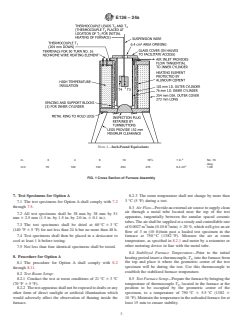
6.1 The test apparatus shown in Fig. 1, shall be used for
E2652 Test Method for Assessing Combustibility of Mate-
Option A and shall consist primarily of the following:
rials Using a Tube Furnace with a Cone-shaped Airflow
6.1.1 Refractory Tubes—Two concentric, refractory tubes,
Stabilizer, at 750 °C
76 mm and 102 mm (3 in. and 4 in.) in inside diameter and 210
2.2 ISO Standard:
mm to 250 mm (8 ⁄2 in. to 10 in.) in length, with axes vertical,
ISO 871 Plastics – Determination of ignition temperature
and with heat applied by electric heating coils outside of the
using a hot-air furnace
larger tube. A controlled flow of air is admitted tangentially
ISO 1182 Noncombustibility Test for Building Materials
near the top of the annular space between the tubes and passes
ISO 13943 Fire Safety – Vocabulary
to the bottom of the inner tube. The outer tube rests on a
2.3 Other Standard:
refractory bottom and the inner tube rests on three spacer
BS 476 Combustibility Test of Materials
blocks so as to afford a total opening under the inner tube equal
to or greater than that of the annular space. The refractory
3. Terminology
bottom plate has a removable plug for cleaning.
3.1 Definitions—For definitions of terms found in this test
6.1.2 Transparent Cover—A transparent cover of heat-
method, refer to Terminology E176 and ISO 13943. In case of
resistant glass or other transparent material shall be provided
conflict, the definitions given in Terminology E176 shall
over the top of the inner tubes. The cover shall have a circular
1 1
prevail.
opening 28.7 mm 6 0.8 mm (1 ⁄8 in. 6 ⁄32 in.) centered over
the axis of the tubes. This opening has an area of 645 mm in.
4. Summary of Test Method 2
(1.0 in. ). The cover shall be in two equally-sized, movable
parts.
4.1 This test method uses a furnace to expose building
materials to a temperature of 750 °C (1382 °F) until failure 6.1.3 Thermocouples and an automatically recording device
occurs or for at least 30 min. shall be provided. The thermocouples shall be located as
follows:
4.2 This test method offers the choice of two options:
6.1.3.1 Thermocouple T is located in the center of the air
Option A (Sections 6 through 9) and Option B (Test Method
space between the two concentric, refractory tubes; approxi-
E2652).
mately 204 mm (8 in.) down from the top of the 102 mm (4 in.)
4.3 The furnace for Option A consists of two concentric
diameter tube (Note 1).
vertical refractory tubes.
6.1.3.2 Thermocouple T is located at the approximate
4.4 The furnace for Option B (Test Method E2652) consists geometric center of the specimen.
of an enclosed refractory tube surrounded by a heating coil
6.1.3.3 Thermocouple T is located on the surface, in
with a cone-shaped airflow stabilizer.
contact with the test specimen; in the same horizontal plane as
T .
4.5 Thermocouples are used to assess the temperature in-
6.1.3.4 Thermocouples T , T and T shall have a time
1 3 4
creases resulting from combustion of the building material.
constant (time to reach 63.2 % of the furnace air temperature of
4.6 Visual observation is used to assess the occurrence of
750 °C (1382 °F)) of 5 to 10 s (Note 2).
flaming.
NOTE 1—Thermocouple T is used for better regulation of the tempera-
4.7 Section 15 is the report and acceptance criteria section
ture of the air in the furnace space.
for this test method (both options).
NOTE 2—Ungrounded, metallic-sheathed thermocouples of 1-mm di-
ameter have been found to meet the time constant requirements.
5. Significance and Use
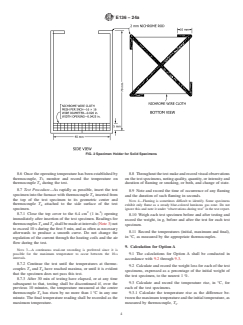
6.2 Specimen Holder—The specimen holder for solid test
5.1 Materials that pass this test by complying with the
specimens shall be as shown in Fig. 2.
criteria in Section 15 are typically classified as noncombustible
6.2.1 Test specimens in granular or powder form shall be
materials.
contained in thin-wall, open-top vessels of inert materials
whose outside dimensions conform to the test specimen shape
and maximum size specified in 7.2. These vessels shall have
For referenced ASTM standards, visit the ASTM website, www.astm.org, or
walls of either solid or mesh construction.
contact ASTM Customer Service at service@astm.org. For Annual Book of ASTM
Standards volume information, refer to the standard’s Document Summary page on
6.3 Test Specimen Location—During the test, the geometric
the ASTM website.
center of the test specimen shall be located at the geometric
Available from American National Standards Institute (ANSI), 25 W. 43rd St.,
4th Floor, New York, NY 10036, http://www.ansi.org. center 63 mm (6 ⁄8 in.) of the 76 mm (3 in.) diameter tube.
E136 − 24a
NOTE 1—Inch-Pound Equivalents
in. 3 4 6 10 10 ⁄4 1 in. No. 16
Awg
mm 76 102 152 254 273 6.4 cm 1.29
FIG. 1 Cross Section of Furnace Assembly
7. Test Specimens for Option A 8.2.3 The room temperature shall not change by more than
3 °C (5 °F) during a test.
7.1 The test specimens for Option A shall comply with 7.2
through 7.5.
8.3 Air Flow—Provide an external air source to supply clean
air through a metal tube located near the top of the test
7.2 All test specimens shall be 38 mm by 38 mm by 51
apparatus, tangentially between the annular spaced ceramic
mm 6 2.5 mm (1.5 in. by 1.5 in. by 2.0 in. 6 0.1 in.).
tubes. The air shall be supplied at a steady and controllable rate
7.3 The test specimens shall be dried at 60 °C 6 3 °C
3 3
of 0.0027 m /min (0.10 ft /min) 6 20 %, which will give an air
(140 °F 6 5 °F) for not less than 24 h but no more than 48 h.
flow of 3 m (10 ft)/min past a loaded test specimen in the
7.4 Test specimens shall then be placed in a desiccator to
furnace at 750 °C (1382 °F). Measure the air at room
cool at least 1 h before testing.
temperature, as specified in 8.2.1 and meter by a rotameter or
other metering device in line with the metal tube.
7.5 Not less than four identical specimens shall be tested.
8.4 Stabilized Furnace Temperature—Prior to the initial
8. Procedure for Option A
heating period insert a thermocouple, T , into the furnace from
the top and place it where the geometric center of the test
8.1 The procedure for Option A shall comply with 8.2
specimen will be during the test. Use this thermocouple to
through 8.11.
establish the stabilized furnace temperature.
8.2 Test Room Setup:
8.2.1 Conduct the test at room conditions of 21 °C 6 3 °C 8.5 Test Furnace Setup—Prepare the furnace by bringing the
(70 °F 6 5 °F). temperature of thermocouple T , located in the furnace at the
8.2.2 The test apparatus shall not be exposed to drafts or any position to be occupied by the geometric center of the
other form of direct sunlight or artificial illumination which specimen, to a temperature of 750 °C 6 5.5 °C (1382 6
would adversely affect the observation of flaming inside the 10 °F). Maintain the temperature in the unloaded furnace for at
furnace. least 15 min to ensure stability.
E136 − 24a
FIG. 2 Specimen Holder for Solid Specimens
8.6 Once the operating temperature has been established by 8.8 Throughout the test make and record visual observations
thermocouple, T , monitor and record the temperature on on the test specimens, noting quality, quantity, or intensity and
thermocouple T during the test. duration of flaming or smoking, or both, and change of state.
8.7 Test Procedure—As rapidly as possible, insert the test
8.9 Note and record the time of occurrence of any flaming
specimen into the furnace with thermocouple T inserted from
and the duration of such flaming in seconds.
the top of the test specimen to its geometric center and
NOTE 4—Flaming is sometimes difficult to identify. Some specimens
thermocouple T attached to the side surface of the test
exhibit only flame as a steady blue-colored luminous gas zone. Do not
ignore this and note it under “observations during test” in the test report.
specimen.
2 2
8.7.1 Close the top cover to the 6.4 cm (1 in. ) opening
8.10 Weigh each test specimen before and after testing and
immediately after insertion of the test specimen. Readings for
record the weight, in g, before and after the test for each test
thermocouples T and T shall be made at intervals (Note 3) not
3 4
specimen.
to exceed 10 s during the first 5 min, and as often as necessary
8.11 Record the temperatures (initial, maximum and final),
afterwards to produce a smooth curve. Do not change the
in °C, as measured by the appropriate thermocouples.
regulation of the current through the heating coils and the air
flow during the test.
9. Calculation for Option A
NOTE 3—A continuous read-out recording is preferred since it is
possible for the maximum temperature to occur between the 10-s 9.1 The calculations for Option A shall be conducted in
intervals.
accordance with 9.2 through 9.3.
8.7.2 Continue the test until the temperatures at thermo-
9.2 Calculate and record the weight loss for each of the test
couples T and T have reached maxima, or until it is evident
3 4
specimens, expressed as a percentage of the initial weight of
that the specimen does not pass this test.
the test specimen, to the nearest 1 %.
8.7.3 After 30 min of testing have elapsed, or at any time
9.3 Calculate and record the temperature rise, in °C, for
subsequent to that, testing shall be discontinued if, over the
each of the test specimens.
previous 10 minutes, the temperature measured at the center
thermocouple T has risen by no more than 1 °C in any one 9.3.1 Calculate the temperature rise as the difference be-
minute. The final temperature reading shall be recorded as the tween the maximum temperature and the initial temperature, as
maximum temperature. measured by thermocouple, T .
E136 − 24a
10. Apparatus for Option B 15.2.1 For the duration of the test, the recorded temperature
of the surface thermocouple does not rise more than 30 °C
10.1 The apparatus used for Option B shall be in accordance
(54 °F) above the stabilized furnace temperature established at
with Section 6 of Test Method E2652.
T2 prior to the test.
10.2 When the apparatus of Test Method E2652 is used to
15.2.2 For the duration of the test, the recorded temperature
assess the behavior of building materials in accordance with
of the interior thermocouple does not rise more than 30 °C
Test Method E136, measurements shall be made using both the
(54 °F) above the stabilized furnace temperature established at
test specimen center thermocouple specified in 6.4.5.1 of Test
T2 prior to the test.
Method E2652 and the test specimen surface thermocouple
15.2.3 There is no flaming from the test specimen after the
specified in 6.4.5.2 of Test Method E2652. The values shall be
first 30 s.
reported as required in Section 15 of Test Method E136 (see
15.3 If the weight loss of an individual test specimen
also Appendix X1.8).
exceeds 50 %, that test specimen is considered as having met
the individual test specimen criteria when all the criteria in
11. Test Specimens for Option B
15.3.1 through 15.3.3 are met:
11.1 The test specimens used for Option B shall be in
15.3.1 For the duration of the test, the recorded temperature
accordance with Section 7 of Test Method E2652.
of the surface thermocouple does not rise above the stabilized
furnace temperature established at T2 prior to the test.
12. Test Setup and Calibration for Option B
15.3.2 For the duration of the test, the recorded temperature
12.1 The test specimens for Option B shall be in accordance
of the interior thermocouple does not rise above the stabilized
with Section 8 of Test Method E2652.
furnace temperature established at T2 prior to the test.
15.3.3 There is no flaming from the test specimen at any
13. Test Procedure for Option B
time during the test.
13.1 The test procedure for Option B shall be in accordance
15.4 Report whether the apparatus for Option A or the
with Section 9 of Test Method E2652.
apparatus for Option B was used.
14. Calculations for Option B
16. Precision and Bias
14.1 The calculations for Option B shall be in accordance
16.1 No information is presented about the precision and
with Section 10 of E2652.
bias of this test method for measuring combustion character-
15. Report
istics since the test results are nonquantitative and are reported
as pass or fail. (See X1.6.)
15.1 Report the material as passing the test if at least three
of the four test specimens tested meet the individual test
16.2 There have been attempts to determine precision and
specimen criteria detailed either in 15.2 or in 15.3. The three
bias for some of the numerical results for this test method but
individual test specimens do not need to meet the same
the results have not been made public.
individual test specimen criteria.
17. Keywords
15.2 If the weight loss of an individual test specimen is
50 % or less, that test specimen is considered as having met the 17.1 building materials; combustion; heated tube; limited
individual test specimen criteria when all the criteria in 15.2.1 combustion; Setchkin furnace; tube furnace; vertical tube
through 15.2.3 are met: furnace
APPENDIX
(Nonmandatory Information)
X1. COMMENTARY
X1.1 Introduction X1.2 Definition
X1.1.1 The difference in fire risk between a combustible
X1.2.1 Most dictionaries have defined noncombustible in
building material and a noncombustible (or incombustible) one
simple terms, such as that used in the 1920 edition of the
is generally obvious. However, some materials may contain
National Building Code promulgated by the National Board of
only a limited amount of combustible content and may not
Fire Underwriters (NBFU): Incombustible materials or con-
contribute appreciably to an ambient fire. The term
struction are those that “will not ignite or burn when subjected
noncombustible, while in recognized use as indicating a
to fire.” In 1943 the same code redefined incombustible
material that will not ignite or burn, is indefinite in its
construction as “assemblies which do not involve materials of
application unless referenced to a well defined testing proce-
dure.
E136 − 24a
such kind or quantity or so contained as to burn during X1.2.5 After Test Method E136 was promulgated, (initially
exposure in a test fire or continue flaming or ignite after the as a tentative in 1958, then as a full standard in 1965), many
furnace is shut off.” building codes replaced either part (a) of the NBFU definition
or the entire definition with the specification that materials
X1.2.2 About this same time Committee C05 (now E05)
shall have been successfully tested in accordance with Test
and the New York City Building Code suggested adding a
Method E136. In 1973, the American Insurance Association
reference of 649 °C (1200 °F) as the fire exposure temperature.
(successor to NBFU) introduced a definition of a limited-
By 1949 the term incombustible was changed to noncombus-
combustible material and redefined a noncombustible material
tible in the National Building Code without definition. The first
as one that, in the form in which it is used and under the
edition of the BOCA Basic Building Code (1950) defined a
conditions anticipated, will not ignite, burn, support
noncombustible material as “any material which will neither
combustion, or release flammable vapors, when subjected to
ignite or actively support combustion in air at a temperature of
fire or heat.
649 °C [1200 °F] during an exposure of five minutes in a
vented tube or vented crucible furnace.” X1.2.6 To avoid misinterpretation in the use of the term
noncombustible, Committee E05 decided, in 1979, to limit the
X1.2.3 The 1955 edition of the NBFU National Building
4 use of this term, and it was eliminated from the title and text of
Code established a definition for noncombustible material (1)
Test Method E136. The revised title was considered, at the
that was subsequently adopted by other model codes, the Life
time, to provide a more specific description of the restricted
Safety Code (2), and most local codes. The adopted definition
nature of the test method.
was as follows:
X1.2.6.1 In 2018, the title of Test Method E136 was revised
Noncombustible as applied to a building construction mate-
from “Standard Test Method for Assessing Behavior of Mate-
rial means a material that, in the form in which it is used, falls
rials In a Vertical Tube Furnace at 750°C” to “Standard Test
in one of the following groups (a) through (c). It does not apply
Method for Assessing Combustibility of Materials Using a
to surface finish materials nor to the determination of whether
Vertical Tube Furnace at 750 °C.” This was accompanied by
a material is noncombustible from the standpoint of clearances
associated changes in the scope section and in the significance
to heating appliances, flues or other sources of high tempera-
and use section. The changes state that materials that pass this
ture. No material shall be classed as noncombustible which is
test by complying with the acceptance criteria are typically
subject to increase in combustibility or flame spread rating
classified as noncombustible materials.
beyond the limits herein established, through the effects of age,
moisture or other atmospheric condition. Flame spread rating
X1.3 Origin and Early History of Test Method E136
as used herein refers to ratings obtained in accordance with
X1.3.1 In 1912 R. E. Prince developed a furnace apparatus
Test Method E84.
to study the ignitability of various wood species and investigate
a) Materials no part of which will ignite and burn when
the effect of fire-retardant chemical treatments on their ignition
subjected to fire. Any material that liberates flammable gas
characteristics (3, 4). This apparatus is shown in Fig. X1.1; it
when heated to a temperature of 750 °C (1382 °F), for 5 min
was called an “inflammability” apparatus and was originally
shall not be considered noncombustible within the meaning of
described as the “Inflammability Apparatus No. 1.” It consisted
this paragraph.
essentially of a quartz cylinder 76 mm [3 in.] in diameter and
b) Materials having a structural base of noncombustible
1 254 mm [10 in.] long, which was wound with a high electrical
material, as defined in (a), with a surfacing not over ⁄8-in. thick
resistance nichrome ribbon. The cylinder was heavily insulated
that has a flame spread rating not higher than 50.
with asbestos. A lower chamber of about 89 mm (3.5 in.) in
c) Materials, other than as described in (a) or (b), having a
diameter and 203 mm (8 in.) deep formed a continuation of the
surface flame spread rating not higher than 25 without evidence
upper chamber. A natural draft was used. No attempt was made
of continued progressive combustion and of such composition
to control the temperature or humidity of the air passing
that surfaces that would be exposed by cutting through the
through the apparatus. The test temperature was 200 °C
material in any way would not have a flame spread rating
1 1
(392 °F). The 32 mm by 32 mm by 102 mm (1 ⁄4 in. by 1 ⁄4 in.
higher than 25 without evidence of continued progressive
by 4 in.) specimen was first weighted and then lowered in the
combustion.
hot quartz cylinder where it remained until it ignited or for 40
X1.2.4 In adopting this definition, NBFU stated that it was
min. Ignition time, if it occurred, was recorded and the
based on a determination of which materials “could be properly
specimen was then moved into the lower cooler chamber and
classed as noncombustible and then fixing the qualifying
allowed to burn for not more than 3 min. Loss of weight was
conditions in the definition to include these materials.” The
then determined. A property defined as “intensity of burning”
definition was considered to apply to materials used for the
was also measured.
walls, roofs, or other structural parts of buildings, but not to
X1.3.2 An apparatus quite similar to the Prince-FPL appa-
surfa
...
This document is not an ASTM standard and is intended only to provide the user of an ASTM standard an indication of what changes have been made to the previous version. Because
it may not be technically possible to adequately depict all changes accurately, ASTM recommends that users consult prior editions as appropriate. In all cases only the current version
of the standard as published by ASTM is to be considered the official document.
Designation: E136 − 24 E136 − 24a An American National Standard
Standard Test Method for
Assessing Combustibility of Materials Using a Vertical Tube
Furnace at 750 °C
This standard is issued under the fixed designation E136; the number immediately following the designation indicates the year of
original adoption or, in the case of revision, the year of last revision. A number in parentheses indicates the year of last reapproval. A
superscript epsilon (´) indicates an editorial change since the last revision or reapproval.
This standard has been approved for use by agencies of the U.S. Department of Defense.
1. Scope*
1.1 This fire-test-response test method covers the determination under specified laboratory conditions of the combustibility of
building materials. Materials passing this test are typically classified as noncombustible materials.
1.2 Limitations of this fire-test response test method are shown below.
1.2.1 This test method does not apply to laminated or coated materials.
1.2.2 This test method is not suitable or satisfactory for materials that soften, flow, melt, intumesce or otherwise separate from the
measuring thermocouple.or intumesce.
1.2.3 This test method does not provide a measure of an intrinsic property.
1.2.4 This test method does not provide a quantitative measure of heat generation or combustibility; it simply serves as a test
method with selected (end point) measures of combustibility.
1.2.5 The test method does not measure the self-heating tendencies of materials.
1.2.6 In this test method materials are not being tested in the nature and form used in building applications. The test specimen
consists of a small, specified volume that is either (1) cut from a thick sheet; (2) assembled from multiple thicknesses of thin sheets;
or (3) placed in a container if composed of granular powder or loose-fiber materials.
1.2.7 Results from this test method apply to the specific test apparatus and test conditions and are likely to vary when changes
are made to one or more of the following: (1) the size, shape, and arrangement of the specimen; (2) the distribution of organic
content; (3) the exposure temperature; (4) the air supply; (5) the location of thermocouples.
1.3 This test method includes two options, both of which use a furnace to expose test specimens of building materials to a
temperature of 750 °C (1382 °F).
1.3.1 The furnace for the apparatus for Option A consists of a ceramic tube containing an electric heating coil, and two concentric
vertical refractory tubes.
This test method is under the jurisdiction of ASTM Committee E05 on Fire Standards and is the direct responsibility of Subcommittee E05.23 on Combustibility.
Current edition approved Feb. 1, 2024March 1, 2024. Published February 2024March 2024. Originally approved in 1958. Last previous edition approved in 20222024
as E136 – 22.E136 – 24. DOI: 10.1520/E0136-24.10.1520/E0136-24A.
*A Summary of Changes section appears at the end of this standard
Copyright © ASTM International, 100 Barr Harbor Drive, PO Box C700, West Conshohocken, PA 19428-2959. United States
E136 − 24a
1.3.2 The furnace for the apparatus for Option B (Test Method E2652) consists of an enclosed refractory tube surrounded by a
heating coil with a cone-shaped airflow stabilizer.
1.4 This test method references notes and footnotes that provide explanatory information. These notes and footnotes, excluding
those in tables and figures, shall not be considered as requirements of this test method.
1.5 The values stated in SI units are to be regarded as standard. The values given in parentheses are for information only.
1.6 This standard is used to measure and describe the response of materials, products, or assemblies to heat and flame under
controlled conditions, but does not by itself incorporate all factors required for fire-hazard or fire-risk assessment of the materials,
products, or assemblies under actual fire conditions.
1.7 Fire testing is inherently hazardous. Adequate safeguards for personnel and property shall be employed in conducting these
tests.
1.8 This standard does not purport to address all of the safety concerns, if any, associated with its use. It is the responsibility
of the user of this standard to establish appropriate safety, health, and environmental practices and determine the applicability of
regulatory limitations prior to use.
1.9 This international standard was developed in accordance with internationally recognized principles on standardization
established in the Decision on Principles for the Development of International Standards, Guides and Recommendations issued
by the World Trade Organization Technical Barriers to Trade (TBT) Committee.
2. Referenced Documents
2.1 ASTM Standards:
D1929 Test Method for Determining Ignition Temperature of Plastics
D3174 Test Method for Ash in the Analysis Sample of Coal and Coke from Coal
E84 Test Method for Surface Burning Characteristics of Building Materials
E176 Terminology of Fire Standards
E2652 Test Method for Assessing Combustibility of Materials Using a Tube Furnace with a Cone-shaped Airflow Stabilizer, at
750 °C
2.2 ISO Standard:
ISO 871 Plastics – Determination of ignition temperature using a hot-air furnace
ISO 1182 Noncombustibility Test for Building Materials
ISO 13943 Fire Safety – Vocabulary
2.3 Other Standard:
BS 476 Combustibility Test of Materials
3. Terminology
3.1 Definitions—For definitions of terms found in this test method, refer to Terminology E176 and ISO 13943. In case of conflict,
the definitions given in Terminology E176 shall prevail.
4. Summary of Test Method
4.1 This test method uses a furnace to expose building materials to a temperature of 750 °C (1382 °F) until failure occurs or for
at least 30 min.
4.2 This test method offers the choice of two options: Option A (Sections 6 through 9) and Option B (Test Method E2652).
4.3 The furnace for Option A consists of two concentric vertical refractory tubes.
For referenced ASTM standards, visit the ASTM website, www.astm.org, or contact ASTM Customer Service at service@astm.org. For Annual Book of ASTM Standards
volume information, refer to the standard’s Document Summary page on the ASTM website.
Available from American National Standards Institute (ANSI), 25 W. 43rd St., 4th Floor, New York, NY 10036, http://www.ansi.org.
E136 − 24a
4.4 The furnace for Option B (Test Method E2652) consists of an enclosed refractory tube surrounded by a heating coil with a
cone-shaped airflow stabilizer.
4.5 Thermocouples are used to assess the temperature increases resulting from combustion of the building material.
4.6 Visual observation is used to assess the occurrence of flaming.
4.7 Section 15 is the report and acceptance criteria section for this test method (both options).
5. Significance and Use
5.1 Materials that pass this test by complying with the criteria in Section 15 are typically classified as noncombustible materials.
5.2 While actual building fire exposure conditions are not duplicated, this test method will assist in indicating those materials
which do not act to aid combustion or add appreciable heat to an ambient fire.
5.3 Materials passing the test are permitted limited flaming and other indications of combustion.
6. Apparatus for Option A
6.1 The test apparatus shown in Fig. 1, shall be used for Option A and shall consist primarily of the following:
NOTE 1—Inch-Pound Equivalents
in. 3 4 6 10 10 ⁄4 1 in. No. 16
Awg
mm 76 102 152 254 273 6.4 cm 1.29
FIG. 1 Cross Section of Furnace Assembly
E136 − 24a
6.1.1 Refractory Tubes—Two concentric, refractory tubes, 76 mm and 102 mm (3 in. and 4 in.) in inside diameter and 210 mm
to 250 mm (8 ⁄2 in. to 10 in.) in length, with axes vertical, and with heat applied by electric heating coils outside of the larger tube.
A controlled flow of air is admitted tangentially near the top of the annular space between the tubes and passes to the bottom of
the inner tube. The outer tube rests on a refractory bottom and the inner tube rests on three spacer blocks so as to afford a total
opening under the inner tube equal to or greater than that of the annular space. The refractory bottom plate has a removable plug
for cleaning.
6.1.2 Transparent Cover—A transparent cover of heat-resistant glass or other transparent material shall be provided over the top
1 1
of the inner tubes. The cover shall have a circular opening 28.7 mm 6 0.8 mm (1 ⁄8 in. 6 ⁄32 in.) centered over the axis of the
2 2
tubes. This opening has an area of 645 mm in. (1.0 in. ). The cover shall be in two equally-sized, movable parts.
6.1.3 Thermocouples and an automatically recording device shall be provided. The thermocouples shall be located as follows:
6.1.3.1 Thermocouple T is located in the center of the air space between the two concentric, refractory tubes; approximately 204
mm (8 in.) down from the top of the 102 mm (4 in.) diameter tube (Note 1).
6.1.3.2 Thermocouple T is located at the approximate geometric center of the specimen.
6.1.3.3 Thermocouple T is located on the surface, in contact with the test specimen; in the same horizontal plane as T .
4 3
6.1.3.4 Thermocouples T , T and T shall have a time constant (time to reach 63.2 % of the furnace air temperature of 750 °C
1 3 4
(1382 °F)) of 5 to 10 s (Note 2).
NOTE 1—Thermocouple T is used for better regulation of the temperature of the air in the furnace space.
NOTE 2—Ungrounded, metallic-sheathed thermocouples of 1-mm diameter have been found to meet the time constant requirements.
6.2 Specimen Holder—The specimen holder for solid test specimens shall be as shown in Fig. 2.
FIG. 2 Specimen Holder for Solid Specimens
E136 − 24a
6.2.1 Test specimens in granular or powder form shall be contained in thin-wall, open-top vessels of inert materials whose outside
dimensions conform to the test specimen shape and maximum size specified in 7.2. These vessels shall have walls of either solid
or mesh construction.
6.3 Test Specimen Location—During the test, the geometric center of the test specimen shall be located at the geometric center
63 mm (6 ⁄8 in.) of the 76 mm (3 in.) diameter tube.
7. Test Specimens for Option A
7.1 The test specimens for Option A shall comply with 7.2 through 7.5.
7.2 All test specimens shall be 38 mm by 38 mm by 51 mm 6 2.5 mm (1.5 in. by 1.5 in. by 2.0 in. 6 0.1 in.).
7.3 The test specimens shall be dried at 60 °C 6 3 °C (140 °F 6 5 °F) for not less than 24 h but no more than 48 h.
7.4 Test specimens shall then be placed in a desiccator to cool at least 1 h before testing.
7.5 Not less than four identical specimens shall be tested.
8. Procedure for Option A
8.1 The procedure for Option A shall comply with 8.2 through 8.11.
8.2 Test Room Setup:
8.2.1 Conduct the test at room conditions of 21 °C 6 3 °C (70 °F 6 5 °F).
8.2.2 The test apparatus shall not be exposed to drafts or any other form of direct sunlight or artificial illumination which would
adversely affect the observation of flaming inside the furnace.
8.2.3 The room temperature shall not change by more than 3 °C (5 °F) during a test.
8.3 Air Flow—Provide an external air source to supply clean air through a metal tube located near the top of the test apparatus,
tangentially between the annular spaced ceramic tubes. The air shall be supplied at a steady and controllable rate of 0.0027 m /min
(0.10 ft /min) 6 20 %, which will give an air flow of 3 m (10 ft)/min past a loaded test specimen in the furnace at 750 °C
(1382 °F). Measure the air at room temperature, as specified in 8.2.1 and meter by a rotameter or other metering device in line with
the metal tube.
8.4 Stabilized Furnace Temperature—Prior to the initial heating period insert a thermocouple, T , into the furnace from the top
and place it where the geometric center of the test specimen will be during the test. Use this thermocouple to establish the stabilized
furnace temperature.
8.5 Test Furnace Setup—Prepare the furnace by bringing the temperature of thermocouple T , located in the furnace at the position
to be occupied by the geometric center of the specimen, to a temperature of 750 °C 6 5.5 °C (1382 6 10 °F). Maintain the
temperature in the unloaded furnace for at least 15 min to ensure stability.
8.6 Once the operating temperature has been established by thermocouple, T , monitor and record the temperature on
thermocouple T during the test.
8.7 Test Procedure—As rapidly as possible, insert the test specimen into the furnace with thermocouple T inserted from the top
of the test specimen to its geometric center and thermocouple T attached to the side surface of the test specimen.
2 2
8.7.1 Close the top cover to the 6.4 cm (1 in. ) opening immediately after insertion of the test specimen. Readings for
E136 − 24a
thermocouples T and T shall be made at intervals (Note 3) not to exceed 10 s during the first 5 min, and as often as necessary
3 4
afterwards to produce a smooth curve. Do not change the regulation of the current through the heating coils and the air flow during
the test.
NOTE 3—A continuous read-out recording is preferred since it is possible for the maximum temperature to occur between the 10-s intervals.
8.7.2 Continue the test until the temperatures at thermocouples T and T have reached maxima, or until it is evident that the
3 4
specimen does not pass this test.
8.7.3 After 30 min of testing have elapsed, or at any time subsequent to that, testing shall be discontinued if, over the previous
10 minutes, the temperature measured at the center thermocouple T has risen by no more than 1 °C in any one minute. The final
temperature reading shall be recorded as the maximum temperature.
8.8 Throughout the test make and record visual observations on the test specimens, noting quality, quantity, or intensity and
duration of flaming or smoking, or both, and change of state.
8.9 Note and record the time of occurrence of any flaming and the duration of such flaming in seconds.
NOTE 4—Flaming is sometimes difficult to identify. Some specimens exhibit only flame as a steady blue-colored luminous gas zone. Do not ignore this
and note it under “observations during test” in the test report.
8.10 Weigh each test specimen before and after testing and record the weight, in g, before and after the test for each test specimen.
8.11 Record the temperatures (initial, maximum and final), in °C, as measured by the appropriate thermocouples.
9. Calculation for Option A
9.1 The calculations for Option A shall be conducted in accordance with 9.2 through 9.3.
9.2 Calculate and record the weight loss for each of the test specimens, expressed as a percentage of the initial weight of the test
specimen, to the nearest 1 %.
9.3 Calculate and record the temperature rise, in °C, for each of the test specimens.
9.3.1 Calculate the temperature rise as the difference between the maximum temperature and the initial temperature, as measured
by thermocouple, T .
10. Apparatus for Option B
10.1 The apparatus used for Option B shall be in accordance with Section 6 of Test Method E2652.
10.2 When the apparatus of Test Method E2652 is used to assess the behavior of building materials in accordance with Test
Method E136, measurements shall be made using both the test specimen center thermocouple specified in 6.4.5.1 of Test Method
E2652 and the test specimen surface thermocouple specified in 6.4.5.2 of Test Method E2652. The values shall be reported as
required in Section 15 of Test Method E136 (see also Appendix X1.8).
11. Test Specimens for Option B
11.1 The test specimens used for Option B shall be in accordance with Section 7 of Test Method E2652.
12. Test Setup and Calibration for Option B
12.1 The test specimens for Option B shall be in accordance with Section 8 of Test Method E2652.
E136 − 24a
13. Test Procedure for Option B
13.1 The test procedure for Option B shall be in accordance with Section 9 of Test Method E2652.
14. Calculations for Option B
14.1 The calculations for Option B shall be in accordance with Section 10 of E2652.
15. Report
15.1 Report the material as passing the test if at least three of the four test specimens tested meet the individual test specimen
criteria detailed either in 15.2 or in 15.3. The three individual test specimens do not need to meet the same individual test specimen
criteria.
15.2 If the weight loss of an individual test specimen is 50 % or less, that test specimen is considered as having met the individual
test specimen criteria when all the criteria in 15.2.1 through 15.2.3 are met:
15.2.1 For the duration of the test, the recorded temperature of the surface thermocouple does not rise more than 30 °C (54 °F)
above the stabilized furnace temperature established at T2 prior to the test.
15.2.2 For the duration of the test, the recorded temperature of the interior thermocouple does not rise more than 30 °C (54 °F)
above the stabilized furnace temperature established at T2 prior to the test.
15.2.3 There is no flaming from the test specimen after the first 30 s.
15.3 If the weight loss of an individual test specimen exceeds 50 %, that test specimen is considered as having met the individual
test specimen criteria when all the criteria in 15.3.1 through 15.3.3 are met:
15.3.1 For the duration of the test, the recorded temperature of the surface thermocouple does not rise above the stabilized furnace
temperature established at T2 prior to the test.
15.3.2 For the duration of the test, the recorded temperature of the interior thermocouple does not rise above the stabilized furnace
temperature established at T2 prior to the test.
15.3.3 There is no flaming from the test specimen at any time during the test.
15.4 Report whether the apparatus for Option A or the apparatus for Option B was used.
16. Precision and Bias
16.1 No information is presented about the precision and bias of this test method for measuring combustion characteristics since
the test results are nonquantitative and are reported as pass or fail. (See X1.6.)
16.2 There have been attempts to determine precision and bias for some of the numerical results for this test method but the results
have not been made public.
17. Keywords
17.1 building materials; combustion; heated tube; limited combustion; Setchkin furnace; tube furnace; vertical tube furnace
E136 − 24a
APPENDIX
(Nonmandatory Information)
X1. COMMENTARY
X1.1 Introduction
X1.1.1 The difference in fire risk between a combustible building material and a noncombustible (or incombustible) one is
generally obvious. However, some materials may contain only a limited amount of combustible content and may not contribute
appreciably to an ambient fire. The term noncombustible, while in recognized use as indicating a material that will not ignite or
burn, is indefinite in its application unless referenced to a well defined testing procedure.
X1.2 Definition
X1.2.1 Most dictionaries have defined noncombustible in simple terms, such as that used in the 1920 edition of the National
Building Code promulgated by the National Board of Fire Underwriters (NBFU): Incombustible materials or construction are those
that “will not ignite or burn when subjected to fire.” In 1943 the same code redefined incombustible construction as “assemblies
which do not involve materials of such kind or quantity or so contained as to burn during exposure in a test fire or continue flaming
or ignite after the furnace is shut off.”
X1.2.2 About this same time Committee C05 (now E05) and the New York City Building Code suggested adding a reference of
649 °C (1200 °F) as the fire exposure temperature. By 1949 the term incombustible was changed to noncombustible in the National
Building Code without definition. The first edition of the BOCA Basic Building Code (1950) defined a noncombustible material
as “any material which will neither ignite or actively support combustion in air at a temperature of 649 °C [1200 °F] during an
exposure of five minutes in a vented tube or vented crucible furnace.”
X1.2.3 The 1955 edition of the NBFU National Building Code established a definition for noncombustible material (1) that was
subsequently adopted by other model codes, the Life Safety Code (2), and most local codes. The adopted definition was as follows:
Noncombustible as applied to a building construction material means a material that, in the form in which it is used, falls in one
of the following groups (a) through (c). It does not apply to surface finish materials nor to the determination of whether a material
is noncombustible from the standpoint of clearances to heating appliances, flues or other sources of high temperature. No material
shall be classed as noncombustible which is subject to increase in combustibility or flame spread rating beyond the limits herein
established, through the effects of age, moisture or other atmospheric condition. Flame spread rating as used herein refers to ratings
obtained in accordance with Test Method E84.
a) Materials no part of which will ignite and burn when subjected to fire. Any material that liberates flammable gas when heated
to a temperature of 750 °C (1382 °F), for 5 min shall not be considered noncombustible within the meaning of this paragraph.
b) Materials having a structural base of noncombustible material, as defined in (a), with a surfacing not over ⁄8-in. thick that
has a flame spread rating not higher than 50.
c) Materials, other than as described in (a) or (b), having a surface flame spread rating not higher than 25 without evidence of
continued progressive combustion and of such composition that surfaces that would be exposed by cutting through the material
in any way would not have a flame spread rating higher than 25 without evidence of continued progressive combustion.
X1.2.4 In adopting this definition, NBFU stated that it was based on a determination of which materials “could be properly classed
as noncombustible and then fixing the qualifying conditions in the definition to include these materials.” The definition was
The boldface numbers in parentheses refer to the list of references appended to this method.
E136 − 24a
considered to apply to materials used for the walls, roofs, or other structural parts of buildings, but not to surface finish materials
and not to the determination of whether a material is noncombustible from the standpoint of clearances to heating appliances, flues,
or other sources of high temperature.
X1.2.5 After Test Method E136 was promulgated, (initially as a tentative in 1958, then as a full standard in 1965), many building
codes replaced either part (a) of the NBFU definition or the entire definition with the specification that materials shall have been
successfully tested in accordance with Test Method E136. In 1973, the American Insurance Association (successor to NBFU)
introduced a definition of a limited-combustible material and redefined a noncombustible material as one that, in the form in which
it is used and under the conditions anticipated, will not ignite, burn, support combustion, or release flammable vapors, when
subjected to fire or heat.
X1.2.6 To avoid misinterpretation in the use of the term noncombustible, Committee E05 decided, in 1979, to limit the use of this
term, and it was eliminated from the title and text of Test Method E136. The revised title was considered, at the time, to provide
a more specific description of the restricted nature of the test method.
X1.2.6.1 In 2018, the title of Test Method E136 was revised from “Standard Test Method for Assessing Behavior of Materials In
a Vertical Tube Furnace at 750°C” to “Standard Test Method for Assessing Combustibility of Materials Using a Vertical Tube
Furnace at 750 °C.” This was accompanied by associated changes in the scope section and in the significance and use section. The
changes state that materials that pass this test by complying with the acceptance criteria are typically classified as noncombustible
materials.
X1.3 Origin and Early History of Test Method E136
X1.3.1 In 1912 R. E. Prince developed a furnace apparatus to study the ignitability of various wood species and investigate the
effect of fire-retardant chemical treatments on their ignition characteristics (3, 4). This apparatus is shown in Fig. X1.1; it was
called an “inflammability” apparatus and was originally described as the “Inflammability Apparatus No. 1.” It consisted essentially
of a quartz cylinder 76 mm [3 in.] in diameter and 254 mm [10 in.] long, which was wound with a high electrical resistance
nichrome ribbon. The cylinder was heavily insulated with asbestos. A lower chamber of about 89 mm (3.5 in.) in diameter and 203
mm (8 in.) deep formed a continuation of the upper chamber. A natural draft was used. No attempt was made to control the
temperature or humidity of the air passing through the apparatus. The test temperature was 200 °C (392 °F). The 32 mm by 32 mm
1 1
by 102 mm (1 ⁄4 in. by 1 ⁄4 in. by 4 in.) specimen was first weig
...