

ASTM F3319-20
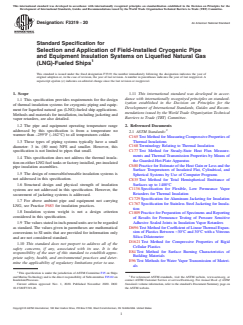
(Specification)Standard Specification for Selection and Application of Field-Installed Cryogenic Pipe and Equipment Insulation Systems on Liquefied Natural Gas (LNG)-Fueled Ships
General Information
- Abstract
SCOPE
1.1 This specification provides requirements for the design of thermal insulation systems for cryogenic piping and equipment for liquefied natural gas (LNG)-fueled ship applications. Methods and materials for installation, including jacketing and vapor retarders, are also detailed.
1.2 The pipe and equipment operating temperature range addressed by this specification is from a temperature no warmer than –259°F (–162°C) to all temperatures colder.
1.3 These types of piping systems typically have a small diameter: 3 in. (80 mm) NPS and smaller. However, this specification is not limited to pipes that small.
1.4 This specification does not address the thermal insulation on either LNG fuel tanks or factory installed, pre-insulated pipe insulation assemblies.
1.5 The design of removable/reusable insulation systems is not addressed in this specification.
1.6 Structural design and physical strength of insulation systems are not addressed in this specification. However, the securement of jacketing systems is addressed.
1.7 For above ambient pipe and equipment not carrying LNG, see Practice F683 for insulation practices.
1.8 Insulation system weight is not a design criterion considered in this specification.
1.9 The values stated in inch-pound units are to be regarded as standard. The values given in parentheses are mathematical conversions to SI units that are provided for information only and are not considered standard.
1.10 This standard does not purport to address all of the safety concerns, if any, associated with its use. It is the responsibility of the user of this standard to establish appropriate safety, health, and environmental practices and determine the applicability of regulatory limitations prior to use.
1.11 This international standard was developed in accordance with internationally recognized principles on standardization established in the Decision on Principles for the Development of International Standards, Guides and Recommendations issued by the World Trade Organization Technical Barriers to Trade (TBT) Committee.
- Status
- Published
- Publication Date
- 31-Oct-2020
- Technical Committee
- F25 - Ships and Marine Technology
- Drafting Committee
- F25.02 - Insulation/Processes
Overview
ASTM F3319-20 is the internationally recognized standard developed by ASTM International for the selection and application of field-installed cryogenic pipe and equipment insulation systems on liquefied natural gas (LNG)-fueled ships. This specification provides comprehensive requirements for the design and installation of thermal insulation to ensure operational safety, efficiency, and compliance with marine regulations.
The standard specifically addresses insulation systems for cryogenic piping and equipment operating at temperatures no warmer than –259°F (–162°C) and is applicable to small-diameter piping often found in LNG ship applications. It outlines methods and materials for installation, including essential details related to jacketing and vapor retarders, ensuring robust performance against condensation, mechanical stress, and environmental exposure.
Key Topics
- Thermal Insulation Design: Guidance on selecting appropriate insulation thickness considering shipboard constraints, operational temperatures, and performance requirements.
- Materials Specification: Requirements for insulation and jacketing materials validated for cryogenic use, including performance at low temperatures and verified compliance with relevant tests.
- Vapor Retarders: Essential for preventing moisture intrusion. The standard details acceptable vapor retarder types, installation protocols, and permeance criteria to minimize condensation and corrosion risks.
- Protective Jacketing: Specifications for aluminum and stainless steel jacketing, including coating, emittance, and securement methods, are provided to protect insulation from mechanical and corrosive impacts.
- System Integrity: Mandates the use of vapor stops, expansion joints, and proper sealing techniques to maintain insulation effectiveness over time.
- Compliance with Safety Codes: Integrates requirements from international maritime codes such as SOLAS and IGF Code, ensuring the insulation system meets stringent marine fire safety and performance criteria.
Applications
- LNG-Fueled Ships: The primary application is in LNG-fueled vessels, where maintaining pipe and equipment temperatures within designated cryogenic ranges is critical for fuel efficiency and safety.
- Cryogenic Piping Systems: The standard is suitable for onboard field-installed piping that transports LNG at extremely low temperatures, typically in systems up to 3 inches in diameter but not limited to this size.
- Shipboard Equipment: Insulates valves, flanges, and fittings connected to LNG systems, excluding factory-installed pre-insulated products or LNG fuel tanks.
- Corrosion and Condensation Control: Key for climate conditions encountered at sea, as effective insulation prevents hazardous condensation and corrosion of piping from harsh marine environments.
- Compliance and Best Practice: Facilitates adherence to international marine standards, supports ship design and retrofitting, and assists shipowners, designers, and contractors in meeting regulatory and operational requirements.
Related Standards
- ASTM C680 - Practice for estimate of heat gain or loss and surface temperatures of insulated systems.
- ASTM C168, C165, C177 - Terminology and test methods for thermal insulation.
- ASTM C1729, C1767 - Specifications for aluminum and stainless steel jacketing.
- ASTM C1136 - Specification for flexible, low-permeance vapor retarders.
- ASTM F683 - Practice for thermal insulation in piping and machinery, referenced for above-ambient, non-LNG systems.
- IMO IGF Code & SOLAS - International safety standards for ships using low-flashpoint fuels, integrated into this specification.
- ISO 8497 - Determination of steady-state thermal transmission in pipe insulation.
Practical Value
Adopting ASTM F3319-20 ensures safe, efficient, and compliant LNG operations on ships. The standard assists shipbuilders, owners, and operators to:
- Select appropriate materials and insulation designs for extreme cryogenic service.
- Protect shipboard LNG piping from condensation, fire, and mechanical damage.
- Meet international safety and performance standards efficiently.
- Implement best practices in marine insulation system installation and maintenance, reducing the risk of failure and operational downtime.
Keywords: LNG ship insulation, cryogenic pipe insulation, vapor retarder, thermal insulation, protective jacketing, ASTM F3319-20, marine standards, condensation control, field-installed insulation, LNG-fueled ships.
Relations
- Effective Date
- 15-Apr-2024
- Effective Date
- 01-Mar-2024
- Effective Date
- 01-Feb-2024
- Effective Date
- 01-Dec-2023
- Effective Date
- 01-Dec-2023
- Effective Date
- 01-Nov-2023
- Effective Date
- 01-Sep-2023
- Effective Date
- 01-Mar-2020
- Effective Date
- 01-Mar-2020
- Effective Date
- 01-Sep-2019
- Effective Date
- 01-Jul-2019
- Effective Date
- 15-Apr-2019
- Effective Date
- 01-Apr-2019
- Effective Date
- 01-Mar-2019
- Effective Date
- 01-Feb-2019
Get Certified
Connect with accredited certification bodies for this standard

DNV
DNV is an independent assurance and risk management provider.

Lloyd's Register
Lloyd's Register is a global professional services organisation specialising in engineering and technology.
DNV Energy Systems
Energy and renewable energy certification.
Sponsored listings
Frequently Asked Questions
ASTM F3319-20 is a technical specification published by ASTM International. Its full title is "Standard Specification for Selection and Application of Field-Installed Cryogenic Pipe and Equipment Insulation Systems on Liquefied Natural Gas (LNG)-Fueled Ships". This standard covers: SCOPE 1.1 This specification provides requirements for the design of thermal insulation systems for cryogenic piping and equipment for liquefied natural gas (LNG)-fueled ship applications. Methods and materials for installation, including jacketing and vapor retarders, are also detailed. 1.2 The pipe and equipment operating temperature range addressed by this specification is from a temperature no warmer than –259°F (–162°C) to all temperatures colder. 1.3 These types of piping systems typically have a small diameter: 3 in. (80 mm) NPS and smaller. However, this specification is not limited to pipes that small. 1.4 This specification does not address the thermal insulation on either LNG fuel tanks or factory installed, pre-insulated pipe insulation assemblies. 1.5 The design of removable/reusable insulation systems is not addressed in this specification. 1.6 Structural design and physical strength of insulation systems are not addressed in this specification. However, the securement of jacketing systems is addressed. 1.7 For above ambient pipe and equipment not carrying LNG, see Practice F683 for insulation practices. 1.8 Insulation system weight is not a design criterion considered in this specification. 1.9 The values stated in inch-pound units are to be regarded as standard. The values given in parentheses are mathematical conversions to SI units that are provided for information only and are not considered standard. 1.10 This standard does not purport to address all of the safety concerns, if any, associated with its use. It is the responsibility of the user of this standard to establish appropriate safety, health, and environmental practices and determine the applicability of regulatory limitations prior to use. 1.11 This international standard was developed in accordance with internationally recognized principles on standardization established in the Decision on Principles for the Development of International Standards, Guides and Recommendations issued by the World Trade Organization Technical Barriers to Trade (TBT) Committee.
SCOPE 1.1 This specification provides requirements for the design of thermal insulation systems for cryogenic piping and equipment for liquefied natural gas (LNG)-fueled ship applications. Methods and materials for installation, including jacketing and vapor retarders, are also detailed. 1.2 The pipe and equipment operating temperature range addressed by this specification is from a temperature no warmer than –259°F (–162°C) to all temperatures colder. 1.3 These types of piping systems typically have a small diameter: 3 in. (80 mm) NPS and smaller. However, this specification is not limited to pipes that small. 1.4 This specification does not address the thermal insulation on either LNG fuel tanks or factory installed, pre-insulated pipe insulation assemblies. 1.5 The design of removable/reusable insulation systems is not addressed in this specification. 1.6 Structural design and physical strength of insulation systems are not addressed in this specification. However, the securement of jacketing systems is addressed. 1.7 For above ambient pipe and equipment not carrying LNG, see Practice F683 for insulation practices. 1.8 Insulation system weight is not a design criterion considered in this specification. 1.9 The values stated in inch-pound units are to be regarded as standard. The values given in parentheses are mathematical conversions to SI units that are provided for information only and are not considered standard. 1.10 This standard does not purport to address all of the safety concerns, if any, associated with its use. It is the responsibility of the user of this standard to establish appropriate safety, health, and environmental practices and determine the applicability of regulatory limitations prior to use. 1.11 This international standard was developed in accordance with internationally recognized principles on standardization established in the Decision on Principles for the Development of International Standards, Guides and Recommendations issued by the World Trade Organization Technical Barriers to Trade (TBT) Committee.
ASTM F3319-20 is classified under the following ICS (International Classification for Standards) categories: 27.220 - Heat recovery. Thermal insulation. The ICS classification helps identify the subject area and facilitates finding related standards.
ASTM F3319-20 has the following relationships with other standards: It is inter standard links to ASTM C168-24, ASTM E136-24a, ASTM E136-24, ASTM F683-23a, ASTM E84-23d, ASTM C680-23a, ASTM E84-23c, ASTM C1809-20, ASTM C835-06(2020), ASTM C1809-19, ASTM E84-19b, ASTM E84-19a, ASTM E831-19, ASTM E84-19, ASTM E136-19. Understanding these relationships helps ensure you are using the most current and applicable version of the standard.
ASTM F3319-20 is available in PDF format for immediate download after purchase. The document can be added to your cart and obtained through the secure checkout process. Digital delivery ensures instant access to the complete standard document.
Standards Content (Sample)
This international standard was developed in accordance with internationally recognized principles on standardization established in the Decision on Principles for the
Development of International Standards, Guides and Recommendations issued by the World Trade Organization Technical Barriers to Trade (TBT) Committee.
Designation: F3319 −20 An American National Standard
Standard Specification for
Selection and Application of Field-Installed Cryogenic Pipe
and Equipment Insulation Systems on Liquefied Natural Gas
(LNG)-Fueled Ships
This standard is issued under the fixed designation F3319; the number immediately following the designation indicates the year of
original adoption or, in the case of revision, the year of last revision.Anumber in parentheses indicates the year of last reapproval.A
superscript epsilon (´) indicates an editorial change since the last revision or reapproval.
1. Scope 1.11 This international standard was developed in accor-
dance with internationally recognized principles on standard-
1.1 This specification provides requirements for the design
ization established in the Decision on Principles for the
of thermal insulation systems for cryogenic piping and equip-
Development of International Standards, Guides and Recom-
ment for liquefied natural gas (LNG)-fueled ship applications.
mendations issued by the World Trade Organization Technical
Methodsandmaterialsforinstallation,includingjacketingand
Barriers to Trade (TBT) Committee.
vapor retarders, are also detailed.
2. Referenced Documents
1.2 The pipe and equipment operating temperature range
addressed by this specification is from a temperature no 2
2.1 ASTM Standards:
warmer than –259°F (–162°C) to all temperatures colder.
C165TestMethodforMeasuringCompressivePropertiesof
1.3 These types of piping systems typically have a small Thermal Insulations
C168Terminology Relating to Thermal Insulation
diameter: 3 in. (80 mm) NPS and smaller. However, this
specification is not limited to pipes that small. C177Test Method for Steady-State Heat Flux Measure-
ments and Thermal Transmission Properties by Means of
1.4 This specification does not address the thermal insula-
the Guarded-Hot-Plate Apparatus
tiononeitherLNGfueltanksorfactoryinstalled,pre-insulated
C680Practice for Estimate of the Heat Gain or Loss and the
pipe insulation assemblies.
Surface Temperatures of Insulated Flat, Cylindrical, and
1.5 The design of removable/reusable insulation systems is
Spherical Systems by Use of Computer Programs
not addressed in this specification.
C835Test Method for Total Hemispherical Emittance of
Surfaces up to 1400°C
1.6 Structural design and physical strength of insulation
systems are not addressed in this specification. However, the C1136Specification for Flexible, Low Permeance Vapor
Retarders for Thermal Insulation
securement of jacketing systems is addressed.
C1729Specification for Aluminum Jacketing for Insulation
1.7 For above ambient pipe and equipment not carrying
C1767Specification for Stainless Steel Jacketing for Insula-
LNG, see Practice F683 for insulation practices.
tion
1.8 Insulation system weight is not a design criterion
C1809Practice for Preparation of Specimens and Reporting
considered in this specification.
of Results for Permeance Testing of Pressure Sensitive
Adhesive Sealed Joints in Insulation Vapor Retarders
1.9 Thevaluesstatedininch-poundunitsaretoberegarded
D696TestMethodforCoefficientofLinearThermalExpan-
as standard. The values given in parentheses are mathematical
sion of Plastics Between −30°C and 30°C with aVitreous
conversions to SI units that are provided for information only
Silica Dilatometer
and are not considered standard.
D1621Test Method for Compressive Properties of Rigid
1.10 This standard does not purport to address all of the
Cellular Plastics
safety concerns, if any, associated with its use. It is the
E84Test Method for Surface Burning Characteristics of
responsibility of the user of this standard to establish appro-
Building Materials
priate safety, health, and environmental practices and deter-
E96Test Methods for Water Vapor Transmission of Materi-
mine the applicability of regulatory limitations prior to use.
als
This specification is under the jurisdiction ofASTM Committee F25 on Ships
and Marine Technology and is the direct responsibility of Subcommittee F25.02 on For referenced ASTM standards, visit the ASTM website, www.astm.org, or
Insulation/Processes. contact ASTM Customer Service at service@astm.org. For Annual Book of ASTM
Current edition approved Nov. 1, 2020. Published November 2020. DOI: Standards volume information, refer to the standard’s Document Summary page on
10.1520/F3319-20. the ASTM website.
Copyright © ASTM International, 100 Barr Harbor Drive, PO Box C700, West Conshohocken, PA 19428-2959. United States
F3319 − 20
115°F (46°C) (see 46 CFR 38.05-2) and this design condition is being
E136TestMethodforAssessingCombustibilityofMaterials
adopted in this specification for the LNG piping.
Using a Vertical Tube Furnace at 750°C
NOTE 3—Nitrogen gas at high flow rates, pressures, and temperatures
E228Test Method for Linear Thermal Expansion of Solid
will substantially reduce plant and pipelines downtime by providing
Materials With a Push-Rod Dilatometer
efficient purging/blanketing, drying, pressure testing, leak testing, and
E831Test Method for Linear Thermal Expansion of Solid
product displacement solutions in a safe, inert manner. Heated nitrogen
gasforpurgingorcleaningLNGpipingandequipmentistobemaintained
Materials by Thermomechanical Analysis
intemperaturesequaltoorlowerthanthemaximumtemperatureof115°F
F683Practice for Selection and Application of Thermal
(46°C) (see 46 CFR 38.05-2).
Insulation for Piping and Machinery
2.2 Other Standards: 5. General Requirements
IGF CodeInternational Code of Safety for Ships using
5.1 All safety requirements as applicable to ships such as
Gases or Other Low-Flashpoint Fuels
those from the relevant flag administration, the International
Fire Test Procedures CodeIMO Resolution MSC 307 (88)
ConventionfortheSafetyofLifeatSea(SOLAS),andtheIGF
Annex 1 Part 1 and Part 5 and Annex 2
Code are applicable to the insulation materials and systems
IMO SOLAS1974 as amended through 2014, Chapter II-2
described in this specification.
Regulations 5 and 6
5.2 LNG fuel piping shall be considered a cold service
ISO 8497Determination of steady-state thermal transmis-
system for both open deck and enclosed spaces. Insulation and
sion properties of thermal insulation for circular pipes
the associated vapor retarders, adhesives, as well as insulation
MSC 1-Circ 1558Unified Interpretations of The IGF Code
pipe fittings shall comply with one of the following flamma-
Title 46 CFR Part 38Subpart 38.05-2 Design and Construc-
bility requirements:
tion of Cargo Tanks
5.2.1 Be non-combustible by virtue of complying with the
Title 46 CFR Part 164Subpart 164.109 Non-Combustible
criteriaofoneofthefollowingthree:(1)TestMethodE136,(2)
Materials (SOLAS)
Part 1 of the MO Fire Test Procedures (FTP) Code, or (3)46
3. Terminology CFR 164.109.
5.2.2 Have a low-flame spread characteristic as determined
3.1 Definitions:
byIMOFTPCode,Annex1,Part5,byexhibitingacriticalflux
3.1.1 Fordefinitionsoftermsrelatingtoinsulatingmaterials
at extinguishment (CFE) not less than 20 kW/m , a heat of
used in this specification, refer to Terminology C168.
sustained burning (Qsb) not less than 1.5 MJ/m , a total heat
3.2 Definitions of Terms Specific to This Standard:
released (Qt) not exceeding 0.7 MJ, a peak heat release rate
3.2.1 rubber membrane vapor retarder, n—relatively thick,
(Qp) not exceeding 4.0 kW, and not generating burning
flexible material acting as a vapor retarder, the primary
droplets.
component of which is a rubber or rubberized material such as
5.2.3 Exhibit a flame spread index not exceeding 25 as
rubberized asphalt, nitrile rubber, or butyl rubber, combined
determined by Test Method E84.
with one or more secondary components such as aluminum
5.3 All piping and fittings, such as elbows and tees, which
foil, plastic film, and mesh or nonwoven reinforcement.
carry LNG, shall be insulated and protected by an abuse-
resistant protective jacketing or protective finish with an
4. Materials and Manufacture
emittance determined by Test Method C835; for use in design
4.1 Insulation and jacketing material specifications describe
calculations, see 5.7.1. Unless otherwise specified, all associ-
those materials that are intended for use in the indicated
atedflangesandvalvesshallalsobeinsulatedandjacketed.For
temperature ranges. The specifications and requirements out-
more detailed information, see Section 8.
lined herein are not intended to prevent the use of materials
5.4 All insulation systems shall be sealed against water
provided that sufficient technical data are submitted to demon-
vapor intrusion resulting from sustained high vapor pressure
strate that the proposed material is comparable in quality,
differences between the cold surfaces and the ambient air with
effectiveness, durability, and safety to that prescribed by this
a vapor retarder system (details addressed in this specification
specification.
are found in Section 7). Vapor retarder systems shall have a
4.2 Allmaterialsandmaterialpropertiesshallbeverifiedfor
permeance ≤0.01 perm (0.575 ng/(s-m -Pa).
applicability for use at cryogenic temperatures.
NOTE 4—The designer is to consider the heat gain into the insulated
NOTE 1—The metal materials used for construction of the pipe and
pipesbetweentheLNGfueltankandthemastergasvalves(MGVs)when
equipment are usually austenitic stainless steel (see IGF Code).
designingthesafetysystemfortheLNGfueltank(seeMSC1-Circ1558).
NOTE 2—The heat transmission studies for a liquefied natural gas
(LNG) cargo tank includes a maximum ambient still air temperature of 5.5 The mechanical insulation system designer shall deter-
mine and state whether pipe and equipment insulation are
necessary for personnel protection, condensation control, or
Available from International Maritime Organization (IMO), 4, Albert
other design criteria. For design purposes, the warmest LNG
Embankment, London SE1 7SR, United Kingdom, http://www.imo.org.
temperature shall be –259°F (–162°C).
Available fromAmerican National Standards Institute (ANSI), 25 W. 43rd St.,
4th Floor, New York, NY 10036, http://www.ansi.org.
5.5.1 Forpersonnelprotection,theinsulationthicknessshall
Available from ics.org.ir.
be designed to maintain the outer surface of the insulation
Available from U.S. Government Printing Office, Superintendent of
system above 0°F (–17.7°C) at a chosen set of harsh ambient
Documents, 732 N. Capitol St., NW, Washington, DC 20401-0001, http://
www.access.gpo.gov. conditions. For other personnel protection design criteria,
F3319 − 20
select the climatic conditions for a geographic location based 5.9 Single-layered insulation construction is permitted on
on the coldest dry bulb temperature expected and a low wind all surfaces operating when recommended by the insulation
speed such as a maximum of 5 mph (8.05 km/h). manufacturer; however, the manufacturer shall provide a
means of minimizing condensation at the joints and seams.
5.5.2 For surface condensation control, the insulation thick-
When double-layered insulation construction is recommended
nessesshallbedesignedtomaintainthesurfacetemperaturesat
bytheinsulationmanufacturer,itshallhavestaggeredjointson
orabovethedesignambientdewpointtemperatureforachosen
all surfaces and the inner layer shall not have its joints sealed
set of harsh ambient conditions (see 5.6 for details) so as to
to allow for thermal expansion/contraction. When more than
prevent surface condensation most of the time.
double-layered construction is specified, there shall be a
5.5.3 Foranyotherdesigncriterion,theinsulationthickness
secondary vapor retarder consisting of either a low-permeance
shall be designed to achieve this criterion at a chosen set of
insulation material with all joints sealed or a second vapor
harsh ambient conditions (see 5.6.3). The actual pipe or flat
retarder membrane located between the second and third (that
surface orientation and pipe size shall also be used in the
is, outer) insulation layers. See Section 7 for more details.
insulation thickness calculations.
5.6 For surface condensation control, design to the follow-
6. Insulation Materials
ing ambient conditions:
6.1 The manufacturer of the insulation material(s) shall
5.6.1 For above deck condensation control, ambient condi-
havetechnicaldatashowingappropriateperformanceforuseat
tions are as follows: an air temperature of 80°F (26.7°C), an
the cryogenic temperature ranges addressed by this specifica-
85% relative humidity (RH), and a 5 mph (8.05 km/h) wind
tion. The insulation material(s) selected shall demonstrate
speed.
acceptabilityforthiscryogenictemperatureusebybeingtested
5.6.2 For enclosed space condensation control, ambient
as follows.
conditionsareasfollows:anairtemperatureof90°F(32°C),an
6.1.1 This provided technical data shall include mean
85% RH, and a maximum wind speed associated with the
temperature-thermal conductivity data in accordance withTest
required air changes per hour.
MethodC177orISO8497toaminimummeantemperatureof
NOTE 5—At the design conditions in 5.6.1 and 5.6.2, surface conden-
–200°F (–129°C).
sationwillstilloccursomeofthetime,butitwillbeminimized.Notethat
6.1.2 Insulation material(s) shall be tested and the test
there are complex interrelationships among all of these specified design
results reported for the following two properties: (1) for
conditions and the insulation thickness necessary to prevent or at least
designing differential thermal expansion/contraction, coeffi-
minimize condensation. More information on this subject is found in the
Young paper.
cient of linear thermal expansion in the temperature range of
70° 6 10°F (21° 6 5.6°C) to –259° 6 10°F (–162° 6 5.6°C)
5.6.3 Ifthedefaultambientconditionsin5.6.1and5.6.2are
using either of the Test Methods D696 or E831 and (2) for
not used as minimum design criteria for the prevention of
designing pipe supports, for insulation materials used within
surface condensation, then, as an alternative, harsh ambient
pipe supports, compressive resistance at a temperature of
conditionschosenforuseininsulationsystemdesignshall
...