


ASTM D4611-16
(Test Method)Standard Test Method for Specific Heat of Rock and Soil
Standard Test Method for Specific Heat of Rock and Soil
SIGNIFICANCE AND USE
5.1 Specific heat is a basic thermodynamic property of all substances. The value of specific heat depends upon chemical or mineralogical composition and temperature. The rate of temperature diffusion through a material, thermal diffusivity, is a function of specific heat; therefore, specific heat is an essential property of rock and soil when these materials are used under conditions of unsteady or transient heat flow.
Note 1: The quality of the result produced by this standard is dependent on the competence of the personnel performing it, and the suitability of the equipment and facilities used. Agencies that meet the criteria of Practice D3740 are generally considered capable of competent and objective testing/sampling/inspection/etctesting. Users of this standard are cautioned that compliance with Practice D3740 does not in itself assure reliable results. Reliable results depend on many factors; Practice D3740 provides a means of evaluating some of those factors.
SCOPE
1.1 This test method covers the determination of instantaneous and mean values of the specific heat of rock and soil.
1.2 This test method employs the classical method of mixtures, which involve procedures and an apparatus that are simpler than those generally used in scientific calorimetry, but with an accuracy that is adequate for most rocks and soils. While this test method was developed for testing rock and soil, it can be adapted to measure the specific heat of other materials.
1.3 The testing procedure provides an instantaneous specific heat over temperatures ranging from 25 to 300°C or a mean specific heat in that temperature range.
1.4 The test procedure is limited to dry specimens of soil and rock.
1.5 Units—The values stated in SI units are to be regarded as the standard. No other units of measurements are included in this standard.
1.6 All observed and calculated values shall conform to the guidelines for significant digits and rounding established in Practice D6026.
1.6.1 The procedure used to specify how data are collected/recorded or calculated in this standard are regarded as the industry standard. In addition, they are representative of the significant digits that generally should be retained. The procedures used do not consider material variation, purpose for obtaining the data, special purpose studies, or any considerations for the user’s objectives; and it is common practice to increase or reduce significant digits of reported data to be commensurate with these considerations. It is beyond the scope of this standard to consider significant digits used in analytical methods for engineering design
1.7 This standard does not purport to address all of the safety concerns, if any, associated with its use. It is the responsibility of the user of this standard to establish appropriate safety and health practices and determine the applicability of regulatory limitations prior to use.
General Information
- Status
- Published
- Publication Date
- 30-Apr-2016
- Technical Committee
- D18 - Soil and Rock
- Drafting Committee
- D18.12 - Rock Mechanics
Relations
- Effective Date
- 01-May-2016
- Effective Date
- 01-Nov-2023
- Effective Date
- 01-Oct-2019
- Effective Date
- 01-Aug-2014
- Effective Date
- 01-May-2012
- Effective Date
- 01-Mar-2012
- Effective Date
- 01-Sep-2011
- Effective Date
- 01-Sep-2011
- Effective Date
- 01-Aug-2011
- Effective Date
- 01-Mar-2010
- Effective Date
- 01-Aug-2009
- Effective Date
- 01-Jan-2009
- Effective Date
- 01-Dec-2008
- Effective Date
- 01-Nov-2008
- Effective Date
- 01-Nov-2008
Overview
ASTM D4611-16: Standard Test Method for Specific Heat of Rock and Soil specifies procedures for determining the instantaneous and mean specific heat of dry rock and soil specimens. Developed by ASTM International, this standard provides a reliable method for quantifying an essential thermodynamic property that is fundamental to geotechnical, civil engineering, and thermal analysis applications. Determining the specific heat of rock and soil is crucial for evaluating how these materials respond to transient or unsteady heat flow, impacting areas such as foundation design, underground energy storage, and geothermal engineering.
Key Topics
- Specific Heat Measurement: The method details how to determine both instantaneous and mean specific heat values in dry rock and soil between 25°C and 300°C.
- Method of Mixtures: Utilizes a classical mixtures technique, balancing simplicity and sufficient accuracy for most engineering applications, using accessible laboratory equipment.
- Applicability: Directly applicable to rock and soil; the technique can be adapted for other solid materials under similar conditions.
- Thermal Characterization: Supports calculations for related parameters such as thermal diffusivity, thermal capacity, and enthalpy change.
- Calibration and Accuracy: Stresses the importance of systematic calibration, including use of traceable reference materials and regular verification of equipment.
- Data Handling: Emphasizes compliance with established guidelines for significant digits, rounding, and data recording as per ASTM D6026.
- Specimen Preparation: Requires specimens to be dry and, for highest accuracy, machined to maximize mass within the capsule used for testing.
Applications
- Geotechnical Engineering: Provides essential data for heat flow modeling in soil and rock, influencing the design of underground structures, tunnels, and foundations.
- Thermal Analysis: Used to assess the thermal performance of materials in geothermal systems, thermal energy storage, and environmental simulation studies.
- Civil Construction: Enables accurate engineering assessments in projects where rocks and soils are exposed to significant temperature variations.
- Research & Quality Control: Supports laboratories and agencies involved in the evaluation and development of construction materials, and in environmental geoscience.
- Material Adaptation: Although targeted for soil and rock, this method is adaptable for testing the specific heat of other dry granular or solid materials.
- Safety & Regulatory Compliance: Stresses the responsibility of laboratories to implement appropriate safety and health practices according to their specific context.
Related Standards
- ASTM D3740: Guidelines for the minimum requirements for agencies that test or inspect soil and rock.
- ASTM D653: Standard terminology relating to soils, rocks, and contained fluids.
- ASTM D618: Procedures for conditioning plastics, referenced for specimen preparation.
- ASTM D6026: Guidance on significant digits and rounding in geotechnical data recording.
- ASTM E122: Calculation of sample sizes for statistically reliable data collection.
- ASTM E230: Specifications for temperature-electromotive force (EMF) tables for thermocouples, relevant to precise temperature measurement during testing.
Practical Value
Following ASTM D4611-16 ensures accurate, repeatable measurement of specific heat in soil and rock specimens, increasing confidence in thermal property data essential for engineering calculations. Adherence to this standard aids in conforming to best practices within geotechnical laboratories, facilitating regulatory compliance, consistency in thermal testing, and improved comparability of results across projects and organizations. The standard’s adaptability and focus on practical laboratory procedures make it a valuable resource for professionals conducting material characterization in civil engineering and earth sciences.
Keywords: ASTM D4611, specific heat, rock, soil, thermal properties, geotechnical engineering, method of mixtures, thermal analysis, laboratory testing, ASTM standards
Buy Documents
ASTM D4611-16 - Standard Test Method for Specific Heat of Rock and Soil
REDLINE ASTM D4611-16 - Standard Test Method for Specific Heat of Rock and Soil
Get Certified
Connect with accredited certification bodies for this standard

Zavod za gradbeništvo Slovenije (ZAG) - Inšpekcija
ZAG inspection body for construction products, structures, and materials.
Sponsored listings
Frequently Asked Questions
ASTM D4611-16 is a standard published by ASTM International. Its full title is "Standard Test Method for Specific Heat of Rock and Soil". This standard covers: SIGNIFICANCE AND USE 5.1 Specific heat is a basic thermodynamic property of all substances. The value of specific heat depends upon chemical or mineralogical composition and temperature. The rate of temperature diffusion through a material, thermal diffusivity, is a function of specific heat; therefore, specific heat is an essential property of rock and soil when these materials are used under conditions of unsteady or transient heat flow. Note 1: The quality of the result produced by this standard is dependent on the competence of the personnel performing it, and the suitability of the equipment and facilities used. Agencies that meet the criteria of Practice D3740 are generally considered capable of competent and objective testing/sampling/inspection/etctesting. Users of this standard are cautioned that compliance with Practice D3740 does not in itself assure reliable results. Reliable results depend on many factors; Practice D3740 provides a means of evaluating some of those factors. SCOPE 1.1 This test method covers the determination of instantaneous and mean values of the specific heat of rock and soil. 1.2 This test method employs the classical method of mixtures, which involve procedures and an apparatus that are simpler than those generally used in scientific calorimetry, but with an accuracy that is adequate for most rocks and soils. While this test method was developed for testing rock and soil, it can be adapted to measure the specific heat of other materials. 1.3 The testing procedure provides an instantaneous specific heat over temperatures ranging from 25 to 300°C or a mean specific heat in that temperature range. 1.4 The test procedure is limited to dry specimens of soil and rock. 1.5 Units—The values stated in SI units are to be regarded as the standard. No other units of measurements are included in this standard. 1.6 All observed and calculated values shall conform to the guidelines for significant digits and rounding established in Practice D6026. 1.6.1 The procedure used to specify how data are collected/recorded or calculated in this standard are regarded as the industry standard. In addition, they are representative of the significant digits that generally should be retained. The procedures used do not consider material variation, purpose for obtaining the data, special purpose studies, or any considerations for the user’s objectives; and it is common practice to increase or reduce significant digits of reported data to be commensurate with these considerations. It is beyond the scope of this standard to consider significant digits used in analytical methods for engineering design 1.7 This standard does not purport to address all of the safety concerns, if any, associated with its use. It is the responsibility of the user of this standard to establish appropriate safety and health practices and determine the applicability of regulatory limitations prior to use.
SIGNIFICANCE AND USE 5.1 Specific heat is a basic thermodynamic property of all substances. The value of specific heat depends upon chemical or mineralogical composition and temperature. The rate of temperature diffusion through a material, thermal diffusivity, is a function of specific heat; therefore, specific heat is an essential property of rock and soil when these materials are used under conditions of unsteady or transient heat flow. Note 1: The quality of the result produced by this standard is dependent on the competence of the personnel performing it, and the suitability of the equipment and facilities used. Agencies that meet the criteria of Practice D3740 are generally considered capable of competent and objective testing/sampling/inspection/etctesting. Users of this standard are cautioned that compliance with Practice D3740 does not in itself assure reliable results. Reliable results depend on many factors; Practice D3740 provides a means of evaluating some of those factors. SCOPE 1.1 This test method covers the determination of instantaneous and mean values of the specific heat of rock and soil. 1.2 This test method employs the classical method of mixtures, which involve procedures and an apparatus that are simpler than those generally used in scientific calorimetry, but with an accuracy that is adequate for most rocks and soils. While this test method was developed for testing rock and soil, it can be adapted to measure the specific heat of other materials. 1.3 The testing procedure provides an instantaneous specific heat over temperatures ranging from 25 to 300°C or a mean specific heat in that temperature range. 1.4 The test procedure is limited to dry specimens of soil and rock. 1.5 Units—The values stated in SI units are to be regarded as the standard. No other units of measurements are included in this standard. 1.6 All observed and calculated values shall conform to the guidelines for significant digits and rounding established in Practice D6026. 1.6.1 The procedure used to specify how data are collected/recorded or calculated in this standard are regarded as the industry standard. In addition, they are representative of the significant digits that generally should be retained. The procedures used do not consider material variation, purpose for obtaining the data, special purpose studies, or any considerations for the user’s objectives; and it is common practice to increase or reduce significant digits of reported data to be commensurate with these considerations. It is beyond the scope of this standard to consider significant digits used in analytical methods for engineering design 1.7 This standard does not purport to address all of the safety concerns, if any, associated with its use. It is the responsibility of the user of this standard to establish appropriate safety and health practices and determine the applicability of regulatory limitations prior to use.
ASTM D4611-16 is classified under the following ICS (International Classification for Standards) categories: 93.020 - Earthworks. Excavations. Foundation construction. Underground works. The ICS classification helps identify the subject area and facilitates finding related standards.
ASTM D4611-16 has the following relationships with other standards: It is inter standard links to ASTM D4611-08, ASTM D3740-23, ASTM D3740-19, ASTM D653-14, ASTM D3740-12a, ASTM D3740-12, ASTM D653-11, ASTM D3740-11, ASTM E122-09e1, ASTM D3740-10, ASTM E122-09, ASTM D653-09, ASTM D653-08a, ASTM D618-08, ASTM D653-08. Understanding these relationships helps ensure you are using the most current and applicable version of the standard.
ASTM D4611-16 is available in PDF format for immediate download after purchase. The document can be added to your cart and obtained through the secure checkout process. Digital delivery ensures instant access to the complete standard document.
Standards Content (Sample)
This international standard was developed in accordance with internationally recognized principles on standardization established in the Decision on Principles for the
Development of International Standards, Guides and Recommendations issued by the World Trade Organization Technical Barriers to Trade (TBT) Committee.
Designation:D4611 −16
Standard Test Method for
Specific Heat of Rock and Soil
This standard is issued under the fixed designation D4611; the number immediately following the designation indicates the year of
original adoption or, in the case of revision, the year of last revision. A number in parentheses indicates the year of last reapproval. A
superscript epsilon (´) indicates an editorial change since the last revision or reapproval.
1. Scope* priate safety and health practices and determine the applica-
bility of regulatory limitations prior to use.
1.1 This test method covers the determination of instanta-
neous and mean values of the specific heat of rock and soil.
2. Referenced Documents
1.2 This test method employs the classical method of
2.1 ASTM Standards:
mixtures, which involve procedures and an apparatus that are
D618 Practice for Conditioning Plastics for Testing
simpler than those generally used in scientific calorimetry, but
D653 Terminology Relating to Soil, Rock, and Contained
with an accuracy that is adequate for most rocks and soils.
Fluids
While this test method was developed for testing rock and soil,
D3740 Practice for Minimum Requirements for Agencies
it can be adapted to measure the specific heat of other
Engaged in Testing and/or Inspection of Soil and Rock as
materials.
Used in Engineering Design and Construction
D6026 Practice for Using Significant Digits in Geotechnical
1.3 Thetestingprocedureprovidesaninstantaneousspecific
Data
heat over temperatures ranging from 25 to 300°C or a mean
E122 Practice for Calculating Sample Size to Estimate,With
specific heat in that temperature range.
Specified Precision, the Average for a Characteristic of a
1.4 The test procedure is limited to dry specimens of soil
Lot or Process
and rock.
E230 Specification and Temperature-Electromotive Force
1.5 Units—The values stated in SI units are to be regarded
(EMF) Tables for Standardized Thermocouples
asthestandard.Nootherunitsofmeasurementsareincludedin
3. Terminology
this standard.
3.1 For definitions of common technical terms used in this
1.6 All observed and calculated values shall conform to the
standard, refer to Terminology D653.
guidelines for significant digits and rounding established in
Practice D6026.
3.2 Definitions:
3.2.1 instantaneous specific heat—the rate of change of
1.6.1 The procedure used to specify how data are collected/
recorded or calculated in this standard are regarded as the sample enthalpy, h, per unit mass with respect to temperature,
industry standard. In addition, they are representative of the T, at constant pressure, p, (J/kgK).
significant digits that generally should be retained. The proce-
3.2.2 mean specific heat—the quantity of heat required to
dures used do not consider material variation, purpose for
change the temperature of a unit mass of a substance one
obtaining the data, special purpose studies, or any consider-
degree, measured as the average quantity over the temperature
ations for the user’s objectives; and it is common practice to
range specified (J/kgK).
increase or reduce significant digits of reported data to be
3.2.3 thermal capacity—the amount of heat necessary to
commensuratewiththeseconsiderations.Itisbeyondthescope
change the temperature of the body one degree, equal to the
of this standard to consider significant digits used in analytical
product of the mass of the body and its specific heat (J/K).
methods for engineering design
3.2.4 thermal diffusivity—the ratio of thermal conductivity
1.7 This standard does not purport to address all of the
of a substance to the product of its density and specific heat
safety concerns, if any, associated with its use. It is the
(m /s).
responsibility of the user of this standard to establish appro-
3.3 Symbols:
3.3.1 ∆H—enthalpy change (J/kg).
ThistestmethodisunderthejurisdictionofASTMCommitteeD18onSoiland
Rock and is the direct responsibility of Subcommittee D18.12 on Rock Mechanics. For referenced ASTM standards, visit the ASTM website, www.astm.org, or
Current edition approved May 1, 2016. Published May 2016. Originally contact ASTM Customer Service at service@astm.org. For Annual Book of ASTM
approved in 1986. Last previous edition approved in 2008 as D4611 – 08. DOI: Standardsvolume information, refer to the standard’s Document Summary page on
10.1520/D4611-16. the ASTM website.
*A Summary of Changes section appears at the end of this standard
Copyright © ASTM International, 100 Barr Harbor Drive, PO Box C700, West Conshohocken, PA 19428-2959. United States
D4611−16
3.3.2 (∆H) —enthalpy change of the calorimeter (J/kg). average sample size used during testing (Note 2). The flask
cal
shall have an insulated cover or stopper.
3.3.3 m—mass (kg).
NOTE 2—Typical volumes of vacuum flasks used for this type of
3.3.4 m —mass of calorimeter (kg).
cal
measurement are approximately 500 to 750 mLfor rock or soil samples of
3.3.5 m —mass of capsule (kg).
cap
50 g in thin-wall copper or stainless steel capsules.
3.3.6 m —mass of the specimen (kg).
spec
6.2 Magnetic stirrer equipped with a speed regulating de-
3.3.7 mc —thermal capacity (J/K). vice.
p
3.3.8 T —final temperature of the mixture (K).
m 6.3 Calorimeter Temperature-Sensing Device—A
temperature-sensing device with a minimum resolution of
3.3.9 T —temperature of the calorimeter immediately prior
c
0.0025Kandanaccuracyof 60.5 %andcapableofmeasuring
to drop (K).
a change in temperature of at least 5 K shall be used.
3.3.10 T —temperature of capsule and specimen in the
h
heater prior to drop (K).
NOTE 3—A suitable temperature sensor is a multijunction thermopile
typically referenced to an ice bath.
3.3.11 ∆T—temperature difference (K).
6.4 Calorimeter Fluid—Thecalorimeterfluidshallbeahigh
3.3.12 (∆T) —temperature change of the calorimeter (K).
cal
specific heat fluid, stable to 520 to 570 K and having a low
3.3.13 (c¯ ) —mean specific heat of the specimen (J/kgK).
p spec
vapor pressure.
3.3.14 (c ) —instantaneous specific heat of the specimen
p spec
NOTE 4—Silicone based fluids have been found to meet this require-
(J/kgK).
ment.
3.3.15 (c ) —instantaneous specific heat of the calorimeter
p cal
6.5 Heater—The heater shall be designed to provide a
(J/kgK).
uniform heating zone. A maximum variation of 61%ofthe
3.3.16 (c ) —instantaneous specific heat of the capsule
mean heater temperature along the heater length corresponding
p cap
(J/kgK).
to the sample is permitted.
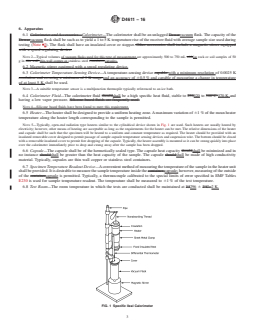
NOTE 5—Typically, open-end radiation type heaters similar to the
4. Summary of Test Method
cylindrical device shown in Fig. 1 are used. Such heaters are usually
heated by electricity; however, other means of heating are acceptable as
4.1 The method of mixtures consists essentially of adding a
long as the requirements for the heater can be met. The relative
known mass of material at a known temperature to a known
dimensions of the heater and capsule shall be such that the specimen will
mass of calorimetric fluid at a known lower temperature and
be heated to a uniform and constant temperature as required. The heater
determining the equilibrium temperature that results. The heat
should be provided with an insulated removable cover designed to permit
passage of sample capsule temperature sensing devices and suspension
absorbed by the fluid and containing vessel can be calculated
wire. The bottom should be closed with a removable insulated cover to
from calibrations and this value equated to the expression for
permit free dropping of the capsule. Typically, the heater assembly is
the heat given up by the hot material. From this equation, the
mounted so it can be swung quickly into place over the calorimeter
unknown specific heat can be calculated. If only one drop from
immediately prior to drop and swung away after the sample has been
a single temperature is performed, then only the mean specific dropped.
heat can be calculated. If several drops are performed, the
instantaneous specific heat can be calculated.
5. Significance and Use
5.1 Specific heat is a basic thermodynamic property of all
substances. The value of specific heat depends upon chemical
or mineralogical composition and temperature. The rate of
temperature diffusion through a material, thermal diffusivity, is
a function of specific heat; therefore, specific heat is an
essential property of rock and soil when these materials are
used under conditions of unsteady or transient heat flow.
NOTE 1—The quality of the result produced by this standard is
dependent on the competence of the personnel performing it, and the
suitability of the equipment and facilities used. Agencies that meet the
criteria of Practice D3740 are generally considered capable of competent
and objective testing/sampling/inspection/etctesting. Users of this stan-
dard are cautioned that compliance with Practice D3740 does not in itself
assure reliable results. Reliable results depend on many factors; Practice
D3740 provides a means of evaluating some of those factors.
6. Apparatus
6.1 Calorimeter—The calorimeter shall be an unlagged
vacuum flask. The capacity of the vacuum flask shall be such
as to yielda1to5K temperature rise of the receiver fluid with FIG. 1 Specific Ileal Calorimeter
D4611−16
6.6 Capsule—The capsule shall be of the hermetically 8.2 Calculation of the Heat Capacity of the Receiver—After
sealed type. The capsule heat capacity shall be minimized and the 15 drops have been performed according to the procedures
in no instance shall be greater than the heat capacity of the described in Section 9, calculate the mc of the receiver for
p
sample. The capsule shall be made of high conductivity each drop (see 3.3). Plot the results as a function of drop
material. Typically, capsules are thin wall copper or stainless temperature. The results (at each drop temperature) shall be
steel containers. within 61.5 %.Plotastraightlinethroughtheaveragedresults
at each temperature. This is the calibration curve to be used in
6.7 Specimen Temperature Readout Device—A convenient
data reduction. To allow for minor loss in calibration fluid, the
method of measuring the temperature of the sample in the
mc can be adjusted each time for mass loss. Maximum total
p
heater unit shall be provided. It is desirable to measure the
mass loss shall be less than 5 %.
sample temperature inside the capsule; however, measuring of
the outside of the capsule is permitted. Typically, a thermo- 8.3 System Verification—Every 10 drops or every 24 h,
couple calibrated to the special limits of error specified in EMF check the calibration of the receiver by dropping one capsule
Tables E230 is used for sample temperature readout. The from 473 K. The result must be within 61.5 % of the
temperatureshallbemeasuredto 61 %ofthetesttemperature. calibration curve determined in 8.2. If this is not the case, then
the receiver fluid must be recalibrated or changed and the new
6.8 Test Room—Theroomtemperatureinwhichthetestsare
fluid calibrated.
conducted shall be maintained at 296 62K.
8.4 Capsule Calibration—Th
...
This document is not an ASTM standard and is intended only to provide the user of an ASTM standard an indication of what changes have been made to the previous version. Because
it may not be technically possible to adequately depict all changes accurately, ASTM recommends that users consult prior editions as appropriate. In all cases only the current version
of the standard as published by ASTM is to be considered the official document.
Designation: D4611 − 08 D4611 − 16
Standard Test Method for
Specific Heat of Rock and Soil
This standard is issued under the fixed designation D4611; the number immediately following the designation indicates the year of
original adoption or, in the case of revision, the year of last revision. A number in parentheses indicates the year of last reapproval. A
superscript epsilon (´) indicates an editorial change since the last revision or reapproval.
1. Scope Scope*
1.1 This test method covers the determination of instantaneous and mean values of the specific heat of rock and soil.
1.2 This test method employs the classical method of mixtures. This providesmixtures, which involve procedures and an
apparatus that are simpler than those generally used in scientific calorimetry, but with an accuracy that is adequate for most rocks
and soils, and a degree of precision that is reproducible by laboratory technicians of average skill. soils. While this test method
was developed for testing rock and soil, it is easily adaptable to measuringcan be adapted to measure the specific heat of other
materials.
1.3 The testing procedure provides an instantaneous specific heat over the temperature temperatures ranging from 25 to 300°C
or a mean specific heat in that temperature range.
1.4 The test procedure is limited to dry samples.specimens of soil and rock.
1.5 Units—The values stated in SI units are to be regarded as the standard. The values given in parentheses are mathematical
conversions to inch-pound units that are provided for information only and are not considered No other units of measurements are
included in this standard.
1.6 All observed and calculated values shall conform to the guidelines for significant digits and rounding established in Practice
D6026.
1.6.1 The procedure used to specify how data are collected/recorded or calculated in this standard are regarded as the industry
standard. In addition, they are representative of the significant digits that generally should be retained. The procedures used do not
consider material variation, purpose for obtaining the data, special purpose studies, or any considerations for the user’s objectives;
and it is common practice to increase or reduce significant digits of reported data to be commensurate with these considerations.
It is beyond the scope of this standard to consider significant digits used in analytical methods for engineering design
1.7 This standard does not purport to address all of the safety concerns, if any, associated with its use. It is the responsibility
of the user of this standard to establish appropriate safety and health practices and determine the applicability of regulatory
limitations prior to use.
2. Referenced Documents
2.1 ASTM Standards:
C303 Test Method for Dimensions and Density of Preformed Block and Board–Type Thermal Insulation
C351 Test Method for Mean Specific Heat of Thermal Insulation (Withdrawn 2008)
D618 Practice for Conditioning Plastics for Testing
D653 Terminology Relating to Soil, Rock, and Contained Fluids
D2766D3740 Test Method for Specific Heat of Liquids and SolidsPractice for Minimum Requirements for Agencies Engaged
in Testing and/or Inspection of Soil and Rock as Used in Engineering Design and Construction
D6026 Practice for Using Significant Digits in Geotechnical Data
E122 Practice for Calculating Sample Size to Estimate, With Specified Precision, the Average for a Characteristic of a Lot or
Process
E230 Specification and Temperature-Electromotive Force (EMF) Tables for Standardized Thermocouples
E344 Terminology Relating to Thermometry and Hydrometry
This test method is under the jurisdiction of ASTM Committee D18 on Soil and Rock and is the direct responsibility of Subcommittee D18.12 on Rock Mechanics.
Current edition approved July 1, 2008May 1, 2016. Published July 2008May 2016. Originally approved in 1986. Last previous edition approved in 20042008 as
D4611 – 86 (2004).D4611 – 08. DOI: 10.1520/D4611-08.10.1520/D4611-16.
For referenced ASTM standards, visit the ASTM website, www.astm.org, or contact ASTM Customer Service at service@astm.org. For Annual Book of ASTM
Standardsvolume information, refer to the standard’s Document Summary page on the ASTM website.
*A Summary of Changes section appears at the end of this standard
Copyright © ASTM International, 100 Barr Harbor Drive, PO Box C700, West Conshohocken, PA 19428-2959. United States
D4611 − 16
3. Terminology
3.1 For definitions of common technical terms used in this standard, refer to Terminology D653.
3.2 Definitions:
3.2.1 instantaneous specific heat—the rate of change of sample enthalpy, h, per unit mass with respect to temperature, T, at
constant pressure, p,
c 5 ~δh/δT! (1)
p p
(J/kgK).
3.2.2 mean specific heat—the quantity of heat required to change the temperature of a unit mass of a substance one degree,
measured as the average quantity over the temperature range specified. (It is distinguished from true specific heat by being an
average rather than a point value. The unit of measurement is joule per kilogram kelvin, J/kgK). specified (J/kgK).
3.2.3 thermal capacity—the amount of heat necessary to change the temperature of the body one degree. For a homogeneous
body, it is degree, equal to the product of mass and specific heat. For a nonhomogeneous body, it is the sum of the products of
mass and specific heat of the individual constituents. Thermal capacity has the units of joule per kelvin, J/K.the mass of the body
and its specific heat (J/K).
3.2.4 thermal diffusivity—the ratio of thermal conductivity of a substance to the product of its density and specific heat.
Common unit for this property is mheat (m /s./s).
3.3 Symbols:
3.3.1 ΔH—enthalpy change (J/kg).
3.3.2 (ΔH) —enthalpy change of the calorimeter (J/kg).
cal
3.3.3 m—mass (kg).
3.3.4 m —mass of calorimeter (kg).
cal
3.3.5 m —mass of capsule (kg).
cap
3.3.6 m —mass of the specimen (kg).
spec
3.3.7 mc —thermal capacity (J/K).
p
3.3.8 T —final temperature of the mixture obtained by extrapolation (K).
m
3.3.9 T —temperature of the calorimeter immediately prior to drop obtained by extrapolation. (K).
c
3.3.10 T —temperature of capsule and sample, capsule or standard specimen in the heater prior to drop (K).
h
3.2.6 ΔT—temperature difference.
3.3.11 ΔT—temperature difference (K).
3.3.12 (ΔT) —temperature change of the calorimeter (K).
cal
3.3.13 c¯(c¯ ) —mean specific heat of the specimen (J/kgK).
p spec
3.3.14 c(c ) —instantaneous specific heat of the specimen (J/kgK).
p spec
3.3.15 (c ) —instantaneous specific heat of the calorimeter (J/kgK).
p cal
3.3.16 (c ) —instantaneous specific heat of the capsule (J/kgK).
p cap
4. Summary of Test Method
4.1 The method of mixtures consists essentially of adding a known mass of material at a known temperature to a known mass
of calorimetric fluid at a known lower temperature and determining the equilibrium temperature that results. The heat absorbed
by the fluid and containing vessel can be calculated from calibrations and this value equated to the expression for the heat given
up by the hot material. From this equation, the unknown specific heat can be calculated. If only one drop from a single temperature
is performed, then only the mean specific heat can be calculated. If several drops are performed, the instantaneous specific heat
can be calculated.
5. Significance and Use
5.1 Specific heat is a basic thermodynamic property of all substances. The value of specific heat depends upon chemical or
mineralogical composition and temperature. The rate of temperature diffusion through a material, thermal diffusivity, is a function
of specific heat; therefore, specific heat is an essential property of rock and soil when these materials are used under conditions
of unsteady or transient heat flow.
NOTE 1—The quality of the result produced by this standard is dependent on the competence of the personnel performing it, and the suitability of the
equipment and facilities used. Agencies that meet the criteria of Practice D3740 are generally considered capable of competent and objective
testing/sampling/inspection/etctesting. Users of this standard are cautioned that compliance with Practice D3740 does not in itself assure reliable results.
Reliable results depend on many factors; Practice D3740 provides a means of evaluating some of those factors.
D4611 − 16
6. Apparatus
6.1 Calorimeter and Accessories—Calorimeter—The calorimeter shall be an unlagged Dewarvacuum flask. The capacity of the
Dewarvacuum flask shall be such as to yield a 1 to 5 K temperature rise of the receiver fluid with average sample size used during
testing (Note 12). The flask shall have an insulated cover or stopper. Other accessories shall include a magnetic stirrer equipped
with a speed regulating device.
NOTE 2—Typical volumes of vacuum flasks used for this type of measurement are approximately 500 to 750 mL withfor rock or soil samples of 50
g in thin wall thin-wall copper or stainless steel containers.capsules.
6.2 Magnetic stirrer equipped with a speed regulating device.
6.3 Calorimeter Temperature-Sensing Device—A temperature-sensing device capable with a minimum resolution of 0.0025 K
resolution and covering a minimum of 5 K range and an accuracy of 60.5 % and capable of measuring a change in temperature
of at least 5 K shall be used.
NOTE 3—A suitable temperature sensor is a multijunction thermopile typically referenced to an ice bath.
6.4 Calorimeter Fluid—The calorimeter fluid shouldshall be a high specific heat fluid, stable to 250520 to 300°C 570 K and
having a low vapor pressure. Silicone based fluids are frequently used.
NOTE 4—Silicone based fluids have been found to meet this requirement.
6.5 Heater—The heater shall be designed to provide a uniform heating zone. A maximum variation of 61 % of the mean heater
temperature along the heater length corresponding to the sample is permitted.
NOTE 5—Typically, open-end radiation type heaters similar to the cylindrical device shown in Fig. 1 are used. Such heaters are usually heated by
electricity; however, other means of heating are acceptable as long as the requirements for the heater can be met. The relative dimensions of the heater
and capsule shall be such that the specimen will be heated to a uniform and constant temperature as required. The heater should be provided with an
insulated removable cover designed to permit passage of sample capsule temperature sensing devices and suspension wire. The bottom should be closed
with a removable insulated cover to permit free dropping of the capsule. Typically, the heater assembly is mounted so it can be swung quickly into place
over the calorimeter immediately prior to drop and swung away after the sample has been dropped.
6.6 Capsule—The capsule shall be of the hermetically sealed type. The capsule heat capacity shouldshall be minimized and in
no instance shouldshall be greater than the heat capacity of the sample. The capsule shouldshall be made of high conductivity
material. Typically, capsules are thin wall copper or stainless steel containers.
6.7 Specimen Temperature Readout Device—A convenient method of measuring the temperature of the sample in the heater unit
shall be provided. It is desirable to measure the sample temperature inside the container;capsule; however, measuring of the outside
of the containercapsule is permitted. Typically, a thermocouple calibrated to the special limits of error specified in EMF Tables
E230 is used for sample temperature readout. The temperature shall be measured to 61 % of the test temperature.
6.8 Test Room—The room temperature in which the tests are conducted shall be maintained at 23296 6 2°C. 2 K.
FIG. 1 Specific Ileal Calorimeter
D4611 − 16
6.9 Calibration Standards—Specimens—A minimum of three traceable calibration standards are required. The standards must
be traceable to the National Institute of Standards and Technology (NIST) or other National Metrology Institute.specimens are
required.
NOTE 6—Commonly used calibration specimens are sapphire or platinum.
7. Test Specimen
7.1 Form—In order to increase the accuracy of this test method, the samplespecimen mass shouldshall be maximized for a given
capsule volume. This usually means, for dense rocks, that the sample shouldspecimen shall be machined to fit the containercapsule
tightly. However, crushed rocks in powder form or soils can be tested with a decrease in accuracy due to the lower contribution
of the sample to the total measured heat capacity of the sample/containerspecimen/capsule combination. Porous rocks are usually
tested in powder form.
7.2 Sample Size and Number of Samples—Statistical Requirements—The sample shall be representative of the type of rock or
soil tested. In cases where inhomogeneity is a problem, multiple samples of the same rock or soil shall be tested. In case of doubt,
multiple samples shall be
...
Questions, Comments and Discussion
Ask us and Technical Secretary will try to provide an answer. You can facilitate discussion about the standard in here.
Loading comments...