

ASTM D4404-18
(Test Method)Standard Test Method for Determination of Pore Volume and Pore Volume Distribution of Soil and Rock by Mercury Intrusion Porosimetry
General Information
- Abstract
SIGNIFICANCE AND USE
5.1 This test method is intended for use in determining the volume and the volume distribution of pores in soil and rock with respect to the apparent diameter of the entrances of the pores. In general, both the size and volume of the pores affects the performance of soil and rock. Thus, the pore volume distribution is useful in understanding soil and rock performance and in identifying a material that can be expected to perform in a particular manner (1, 2).3
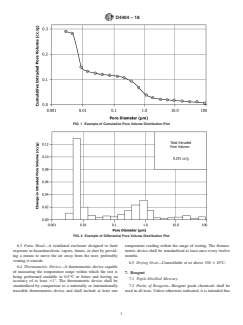
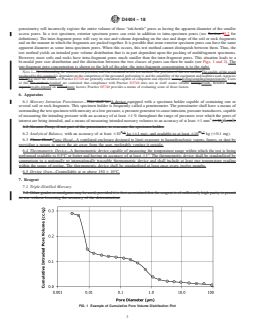
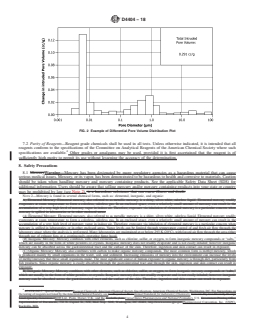
5.2 The intrusion process to determine the volume of a pore proceeds from the outside of a specimen toward its center. Comparatively large interior pores can exist that have smaller outside openings as the only means of access. Mercury intrusion porosimetry will incorrectly register the entire volume of these “ink-bottle” pores as having the apparent diameter of the smaller access pores. In a test specimen, exterior specimen pores can exist in addition to intra-specimen pores (see 3.2 for definitions). The inter-fragment pores will vary in size and volume depending on the size and shape of the soil or rock fragments and on the manner in which the fragments are packed together. It is possible that some exterior specimen pores can have the same apparent diameter as some intra-specimen pores. When this occurs, this test method cannot distinguish between them. Thus, the test method yields an intruded pore volume distribution that is in part dependent upon the packing of multifragment specimens. However, most soils and rocks have intra-fragment pores much smaller than the inter-fragment pores. This situation leads to a bi-modal pore size distribution and the distinction between the two classes of pores can then be made (see Figs. 1 and 2). The intr-fragment pore concentration is shown to the left of the plot; the inter-fragment concentration is to the right.
FIG. 1 Example of Cumulative Pore Volume Distribution Plot
FIG. 2 Example of Differential Pore Volume Distribution Plot
Note 1: The quality of the re...
SCOPE
1.1 This test method covers the determination of the pore volume and the pore volume distributions of soil and rock by the mercury intrusion porosimetry method. The range of apparent diameters of pores for which this test method is applicable is fixed by the operating pressure range of the testing instrument. This range is typically between apparent pore entrance diameters of about 400 μm and 2.5 nm (0.0025 μm). Larger pores must be measured by another method.
1.2 Mercury intrusion porosimetry is useful only for measuring pores open to the outside of a soil or rock fragment; mercury intrusion porosimetry will not give the volume of any pores completely enclosed by surrounding solids. This test method will give only the volume of intrudable pores that have an apparent diameter corresponding to a pressure within the pressurizing range of the testing instrument.
1.3 Mercury intrusion may involve the application of high pressures to the specimen. This may result in a temporary or permanent alteration or both in the pore geometry. Generally, soils and rocks are composed of comparatively strong solids and are less subject to these alterations than certain other materials. However, the possibility remains that the use of this test method may alter the natural pore volume distribution that is being measured.
1.4 Warning—Mercury has been designated by EPA and many state agencies as a hazardous material that can cause central nervous system, kidney and liver damage. Mercury, or its vapor, may be hazardous to health and corrosive to materials. Caution should be taken when handling mercury and mercury-containing products. See the applicable product Material Safety Data Sheet (MSDS) for details and EPA’s website (http://www.epa.gov/mercury/faq.htm) for additional information. Users should be aware that selling mercury or mercury-containing products or both into your state may be prohibited by state law.
1.5 Units—The valu...
- Status
- Published
- Publication Date
- 31-Jan-2018
- Technical Committee
- D18 - Soil and Rock
- Drafting Committee
- D18.06 - Physical-Chemical Interactions of Soil and Rock
Buy Documents
ASTM D4404-18 - Standard Test Method for Determination of Pore Volume and Pore Volume Distribution of Soil and Rock by Mercury Intrusion Porosimetry
REDLINE ASTM D4404-18 - Standard Test Method for Determination of Pore Volume and Pore Volume Distribution of Soil and Rock by Mercury Intrusion Porosimetry
Overview
ASTM D4404-18: Standard Test Method for Determination of Pore Volume and Pore Volume Distribution of Soil and Rock by Mercury Intrusion Porosimetry is an internationally recognized method developed by ASTM for analyzing pore volume characteristics in soils and rocks. This test method utilizes mercury intrusion porosimetry-a process that determines both the total volume and size distribution of pores open to the exterior of soil or rock fragments. The ability to accurately assess pore structure is critical for understanding the performance, permeability, and mechanical behavior of geotechnical and earth materials in applications ranging from civil engineering to environmental science.
Key Topics
Mercury Intrusion Porosimetry: The standard details procedures for forcing non-wetting mercury into pores of soil and rock samples under controlled pressure conditions. As pressure increases, smaller pores are intruded, allowing for characterization across pore sizes typically ranging from 400 μm to 2.5 nm.
Classification of Pores:
- Inter-specimen (or inter-fragment) pores: Spaces between soil or rock fragments.
- Intra-specimen (or intra-fragment) pores: Pores within individual fragments.
Apparent Pore Diameter: The entrance diameter to a pore, interpreted assuming cylindrical geometry. Intruded volume is related to pressure using defined equations involving the contact angle and surface tension of mercury.
Preparation and Sampling: Recommendations are provided for proper specimen outgassing or drying to ensure removal of external fluids without altering pore structure. Guidelines emphasize minimizing errors by using representative sample sizes and performing multiple measurements.
Reporting: Requirements include detailed specimen information, mass, preparation procedure, cumulative and differential pore volume distribution plots, and clear identification of test conditions.
Health and Safety: The standard highlights the significant hazards associated with the use of mercury, including its toxicity to the central nervous system and risks of exposure. Comprehensive safety precautions for laboratory handling, storage, and disposal are mandatory.
Applications
ASTM D4404-18 is widely used across various industries and research domains, especially where understanding the pore structure of soils and rocks is vital to performance or failure analysis. Typical applications include:
- Geotechnical Engineering: Evaluation of soil and rock suitability for construction, embankments, foundations, and earthworks by quantifying permeability, compressibility, and strength as functions of pore structure.
- Environmental Engineering: Characterization of contaminant migration or retention in subsurface materials, supporting design and assessment of waste containment and remediation projects.
- Petroleum and Reservoir Engineering: Assessment of porosity and pore distribution in reservoir rocks, which informs estimates of oil and gas storage capacity and extraction efficiency.
- Material Science and Mining: Determining the physical characteristics of mined materials to predict behavior during processing, storage, and end-use.
This test method is invaluable for identifying materials with bi-modal pore distributions (commonly found in soils and rocks), enhancing the predictability of material behavior in engineering applications.
Related Standards
The following ASTM standards are referenced or commonly used in conjunction with ASTM D4404-18:
- ASTM D653: Terminology Relating to Soil, Rock, and Contained Fluids
- ASTM D3740: Practice for Minimum Requirements for Agencies Engaged in Testing and/or Inspection of Soil and Rock
- ASTM D6026: Practice for Using Significant Digits in Geotechnical Data
Compliance with these related standards ensures accuracy, consistency, and reliability in testing and reporting pore volume and distribution.
By adhering to ASTM D4404-18, laboratories and engineers can ensure standardized, reproducible measurements of pore volume characteristics in soils and rocks, yielding critical data for material assessment and design in geotechnical, environmental, and energy resource applications.
Relations
- Effective Date
- 01-Feb-2018
- Effective Date
- 01-Nov-2023
- Effective Date
- 01-Oct-2019
- Effective Date
- 01-Aug-2014
- Effective Date
- 01-May-2012
- Effective Date
- 01-Mar-2012
- Effective Date
- 01-Sep-2011
- Effective Date
- 01-Sep-2011
- Effective Date
- 01-Mar-2010
- Effective Date
- 01-Jan-2009
- Effective Date
- 01-Dec-2008
- Effective Date
- 01-Nov-2008
- Effective Date
- 01-Mar-2008
- Effective Date
- 15-Dec-2007
- Effective Date
- 01-Nov-2007
Buy Documents
ASTM D4404-18 - Standard Test Method for Determination of Pore Volume and Pore Volume Distribution of Soil and Rock by Mercury Intrusion Porosimetry
REDLINE ASTM D4404-18 - Standard Test Method for Determination of Pore Volume and Pore Volume Distribution of Soil and Rock by Mercury Intrusion Porosimetry
Get Certified
Connect with accredited certification bodies for this standard

Zavod za gradbeništvo Slovenije (ZAG) - Inšpekcija
ZAG inspection body for construction products, structures, and materials.
Sponsored listings
Frequently Asked Questions
ASTM D4404-18 is a standard published by ASTM International. Its full title is "Standard Test Method for Determination of Pore Volume and Pore Volume Distribution of Soil and Rock by Mercury Intrusion Porosimetry". This standard covers: SIGNIFICANCE AND USE 5.1 This test method is intended for use in determining the volume and the volume distribution of pores in soil and rock with respect to the apparent diameter of the entrances of the pores. In general, both the size and volume of the pores affects the performance of soil and rock. Thus, the pore volume distribution is useful in understanding soil and rock performance and in identifying a material that can be expected to perform in a particular manner (1, 2).3 5.2 The intrusion process to determine the volume of a pore proceeds from the outside of a specimen toward its center. Comparatively large interior pores can exist that have smaller outside openings as the only means of access. Mercury intrusion porosimetry will incorrectly register the entire volume of these “ink-bottle” pores as having the apparent diameter of the smaller access pores. In a test specimen, exterior specimen pores can exist in addition to intra-specimen pores (see 3.2 for definitions). The inter-fragment pores will vary in size and volume depending on the size and shape of the soil or rock fragments and on the manner in which the fragments are packed together. It is possible that some exterior specimen pores can have the same apparent diameter as some intra-specimen pores. When this occurs, this test method cannot distinguish between them. Thus, the test method yields an intruded pore volume distribution that is in part dependent upon the packing of multifragment specimens. However, most soils and rocks have intra-fragment pores much smaller than the inter-fragment pores. This situation leads to a bi-modal pore size distribution and the distinction between the two classes of pores can then be made (see Figs. 1 and 2). The intr-fragment pore concentration is shown to the left of the plot; the inter-fragment concentration is to the right. FIG. 1 Example of Cumulative Pore Volume Distribution Plot FIG. 2 Example of Differential Pore Volume Distribution Plot Note 1: The quality of the re... SCOPE 1.1 This test method covers the determination of the pore volume and the pore volume distributions of soil and rock by the mercury intrusion porosimetry method. The range of apparent diameters of pores for which this test method is applicable is fixed by the operating pressure range of the testing instrument. This range is typically between apparent pore entrance diameters of about 400 μm and 2.5 nm (0.0025 μm). Larger pores must be measured by another method. 1.2 Mercury intrusion porosimetry is useful only for measuring pores open to the outside of a soil or rock fragment; mercury intrusion porosimetry will not give the volume of any pores completely enclosed by surrounding solids. This test method will give only the volume of intrudable pores that have an apparent diameter corresponding to a pressure within the pressurizing range of the testing instrument. 1.3 Mercury intrusion may involve the application of high pressures to the specimen. This may result in a temporary or permanent alteration or both in the pore geometry. Generally, soils and rocks are composed of comparatively strong solids and are less subject to these alterations than certain other materials. However, the possibility remains that the use of this test method may alter the natural pore volume distribution that is being measured. 1.4 Warning—Mercury has been designated by EPA and many state agencies as a hazardous material that can cause central nervous system, kidney and liver damage. Mercury, or its vapor, may be hazardous to health and corrosive to materials. Caution should be taken when handling mercury and mercury-containing products. See the applicable product Material Safety Data Sheet (MSDS) for details and EPA’s website (http://www.epa.gov/mercury/faq.htm) for additional information. Users should be aware that selling mercury or mercury-containing products or both into your state may be prohibited by state law. 1.5 Units—The valu...
SIGNIFICANCE AND USE 5.1 This test method is intended for use in determining the volume and the volume distribution of pores in soil and rock with respect to the apparent diameter of the entrances of the pores. In general, both the size and volume of the pores affects the performance of soil and rock. Thus, the pore volume distribution is useful in understanding soil and rock performance and in identifying a material that can be expected to perform in a particular manner (1, 2).3 5.2 The intrusion process to determine the volume of a pore proceeds from the outside of a specimen toward its center. Comparatively large interior pores can exist that have smaller outside openings as the only means of access. Mercury intrusion porosimetry will incorrectly register the entire volume of these “ink-bottle” pores as having the apparent diameter of the smaller access pores. In a test specimen, exterior specimen pores can exist in addition to intra-specimen pores (see 3.2 for definitions). The inter-fragment pores will vary in size and volume depending on the size and shape of the soil or rock fragments and on the manner in which the fragments are packed together. It is possible that some exterior specimen pores can have the same apparent diameter as some intra-specimen pores. When this occurs, this test method cannot distinguish between them. Thus, the test method yields an intruded pore volume distribution that is in part dependent upon the packing of multifragment specimens. However, most soils and rocks have intra-fragment pores much smaller than the inter-fragment pores. This situation leads to a bi-modal pore size distribution and the distinction between the two classes of pores can then be made (see Figs. 1 and 2). The intr-fragment pore concentration is shown to the left of the plot; the inter-fragment concentration is to the right. FIG. 1 Example of Cumulative Pore Volume Distribution Plot FIG. 2 Example of Differential Pore Volume Distribution Plot Note 1: The quality of the re... SCOPE 1.1 This test method covers the determination of the pore volume and the pore volume distributions of soil and rock by the mercury intrusion porosimetry method. The range of apparent diameters of pores for which this test method is applicable is fixed by the operating pressure range of the testing instrument. This range is typically between apparent pore entrance diameters of about 400 μm and 2.5 nm (0.0025 μm). Larger pores must be measured by another method. 1.2 Mercury intrusion porosimetry is useful only for measuring pores open to the outside of a soil or rock fragment; mercury intrusion porosimetry will not give the volume of any pores completely enclosed by surrounding solids. This test method will give only the volume of intrudable pores that have an apparent diameter corresponding to a pressure within the pressurizing range of the testing instrument. 1.3 Mercury intrusion may involve the application of high pressures to the specimen. This may result in a temporary or permanent alteration or both in the pore geometry. Generally, soils and rocks are composed of comparatively strong solids and are less subject to these alterations than certain other materials. However, the possibility remains that the use of this test method may alter the natural pore volume distribution that is being measured. 1.4 Warning—Mercury has been designated by EPA and many state agencies as a hazardous material that can cause central nervous system, kidney and liver damage. Mercury, or its vapor, may be hazardous to health and corrosive to materials. Caution should be taken when handling mercury and mercury-containing products. See the applicable product Material Safety Data Sheet (MSDS) for details and EPA’s website (http://www.epa.gov/mercury/faq.htm) for additional information. Users should be aware that selling mercury or mercury-containing products or both into your state may be prohibited by state law. 1.5 Units—The valu...
ASTM D4404-18 is classified under the following ICS (International Classification for Standards) categories: 93.020 - Earthworks. Excavations. Foundation construction. Underground works. The ICS classification helps identify the subject area and facilitates finding related standards.
ASTM D4404-18 has the following relationships with other standards: It is inter standard links to ASTM D4404-10, ASTM D3740-23, ASTM D3740-19, ASTM D653-14, ASTM D3740-12a, ASTM D3740-12, ASTM D653-11, ASTM D3740-11, ASTM D3740-10, ASTM D653-09, ASTM D653-08a, ASTM D653-08, ASTM D3740-08, ASTM D653-07f, ASTM D653-07e. Understanding these relationships helps ensure you are using the most current and applicable version of the standard.
ASTM D4404-18 is available in PDF format for immediate download after purchase. The document can be added to your cart and obtained through the secure checkout process. Digital delivery ensures instant access to the complete standard document.
Standards Content (Sample)
This international standard was developed in accordance with internationally recognized principles on standardization established in the Decision on Principles for the
Development of International Standards, Guides and Recommendations issued by the World Trade Organization Technical Barriers to Trade (TBT) Committee.
Designation: D4404 − 18
Standard Test Method for
Determination of Pore Volume and Pore Volume Distribution
of Soil and Rock by Mercury Intrusion Porosimetry
This standard is issued under the fixed designation D4404; the number immediately following the designation indicates the year of
original adoption or, in the case of revision, the year of last revision.Anumber in parentheses indicates the year of last reapproval.A
superscript epsilon (´) indicates an editorial change since the last revision or reapproval.
1. Scope* 1.5 Units—The values stated in SI units are to be regarded
asstandard.Nootherunitsofmeasurementareincludedinthis
1.1 This test method covers the determination of the pore
standard. Reporting of test results in units other than SI, such
volume and the pore volume distributions of soil and rock by
as cgs, shall not be regarded as nonconformance with this test
the mercury intrusion porosimetry method. The range of
method.
apparent diameters of pores for which this test method is
applicable is fixed by the operating pressure range of the 1.6 All observed and calculated values shall conform to the
testing instrument. This range is typically between apparent guidelines for significant digits and rounding established in
pore entrance diameters of about 400 µm and 2.5 nm (0.0025 Practice D6026.
µm). Larger pores must be measured by another method. 1.6.1 Theproceduresusedtospecifyhowdataarecollected/
recorded and calculated in this standard are regarded as the
1.2 Mercury intrusion porosimetry is useful only for mea-
industry standard. In addition, they are representative of the
suring pores open to the outside of a soil or rock fragment;
significant digits that generally should be retained. The proce-
mercury intrusion porosimetry will not give the volume of any
dures used do not consider material variation, purpose for
pores completely enclosed by surrounding solids. This test
obtaining the data, special purpose studies, or any consider-
methodwillgiveonlythevolumeofintrudableporesthathave
ations for the user’s objectives; and it is common practice to
an apparent diameter corresponding to a pressure within the
increase or reduce significant digits of reported data to be
pressurizing range of the testing instrument.
commensuratewiththeseconsiderations.Itisbeyondthescope
1.3 Mercury intrusion may involve the application of high
of these test methods to consider significant digits used in
pressures to the specimen. This may result in a temporary or
analysis methods for engineering data.
permanent alteration or both in the pore geometry. Generally,
1.7 This standard does not purport to address all of the
soils and rocks are composed of comparatively strong solids
safety concerns, if any, associated with its use. It is the
and are less subject to these alterations than certain other
responsibility of the user of this standard to establish appro-
materials. However, the possibility remains that the use of this
priate safety, health, and environmental practices and deter-
test method may alter the natural pore volume distribution that
mine the applicability of regulatory limitations prior to use.
is being measured.
For specific precaution statements, see Section 8.
1.4 Warning—Mercury has been designated by EPA and
1.8 This international standard was developed in accor-
many state agencies as a hazardous material that can cause
dance with internationally recognized principles on standard-
central nervous system, kidney and liver damage. Mercury, or
ization established in the Decision on Principles for the
its vapor, may be hazardous to health and corrosive to
Development of International Standards, Guides and Recom-
materials.Cautionshouldbetakenwhenhandlingmercuryand
mendations issued by the World Trade Organization Technical
mercury-containing products. See the applicable product Ma-
Barriers to Trade (TBT) Committee.
terial Safety Data Sheet (MSDS) for details and EPA’s website
(http://www.epa.gov/mercury/faq.htm) for additional informa- 2. Referenced Documents
tion. Users should be aware that selling mercury or mercury-
2.1 ASTM Standards:
containing products or both into your state may be prohibited
D653Terminology Relating to Soil, Rock, and Contained
by state law.
Fluids
D3740Practice for Minimum Requirements for Agencies
ThistestmethodisunderthejurisdictionofASTMCommitteeD18onSoiland
RockandisthedirectresponsibilityofSubcommitteeD18.06onPhysical-Chemical
Interactions of Soil and Rock. For referenced ASTM standards, visit the ASTM website, www.astm.org, or
Current edition approved Feb. 1, 2018. Published March 2018. Originally contact ASTM Customer Service at service@astm.org. For Annual Book of ASTM
approved in 1984. Last previous edition approved in 2010 as D4404–10. DOI: Standards volume information, refer to the standard’s Document Summary page on
10.1520/D4404-18. the ASTM website.
*A Summary of Changes section appears at the end of this standard
Copyright © ASTM International, 100 Barr Harbor Drive, PO Box C700, West Conshohocken, PA 19428-2959. United States
D4404 − 18
Engaged in Testing and/or Inspection of Soil and Rock as 5. Significance and Use
Used in Engineering Design and Construction
5.1 This test method is intended for use in determining the
D6026Practice for Using Significant Digits in Geotechnical
volume and the volume distribution of pores in soil and rock
Data
with respect to the apparent diameter of the entrances of the
pores. In general, both the size and volume of the pores affects
3. Terminology
the performance of soil and rock. Thus, the pore volume
distribution is useful in understanding soil and rock perfor-
3.1 For definitions of common technical terms used in this
mance and in identifying a material that can be expected to
standard, refer to Terminology D653.
perform in a particular manner (1, 2).
3.2 Definitions of Terms Specific to This Standard:
5.2 Theintrusionprocesstodeterminethevolumeofapore
3.2.1 apparent pore diameter—thediameterofaporethatis
proceeds from the outside of a specimen toward its center.
assumed to be cylindrical and that is intruded at a pressure, P,
Comparatively large interior pores can exist that have smaller
given by the equation in 13.1.
outside openings as the only means of access. Mercury
3.2.2 inter-specimen pores—those pores between particles
intrusion porosimetry will incorrectly register the entire vol-
when they are packed together and that are intruded during the
ume of these “ink-bottle” pores as having the apparent diam-
test.
eter of the smaller access pores. In a test specimen, exterior
3.2.3 intra-specimen pores—those pores lying within the
specimen pores can exist in addition to intra-specimen pores
exterior outlines of the individual soil and rock fragments.
(see 3.2 for definitions). The inter-fragment pores will vary in
size and volume depending on the size and shape of the soil or
3.2.4 intruded pore volume—the corrected volume of mer-
rock fragments and on the manner in which the fragments are
cury intruded during the test.
packed together. It is possible that some exterior specimen
pores can have the same apparent diameter as some intra-
4. Summary of Test Method
specimen pores. When this occurs, this test method cannot
4.1 When a liquid does not wet a porous solid, it will not
distinguish between them. Thus, the test method yields an
entertheporesinthesolidbycapillaryaction.Thenon-wetting
intruded pore volume distribution that is in part dependent
liquid(mercuryinthistestmethod)canbeforcedintothepores
upon the packing of multifragment specimens. However, most
by the application of external pressure. The size of the pores
soils and rocks have intra-fragment pores much smaller than
that are intruded is inversely proportional to the applied
the inter-fragment pores. This situation leads to a bi-modal
pressure. The diameter of the pores filled can be calculated
pore size distribution and the distinction between the two
from this applied pressure as described in Section 13, Calcu-
classes of pores can then be made (see Figs. 1 and 2). The
lations.
intr-fragment pore concentration is shown to the left of the
plot; the inter-fragment concentration is to the right.
4.2 The volume of the intruded pores is determined by
NOTE 1—The quality of the result produced by this standard is
measuring the volume of mercury forced into them at various
dependent on the competence of the personnel performing it, and the
pressures. A single determination involves increasing the
suitability of the equipment and facilities used. Agencies that meet the
pressure, either continuously or step-wise, and recording the
criteria of Practice D3740 are generally considered capable of competent
measured intruded volume at various pressures. and objective testing/sampling/inspection/etc. Users of this standard are
cautioned that compliance with Practice D3740 does not in itself assure
4.2.1 The sample is contained in a sample cell frequently
reliable results. Reliable results depend on many factors; Practice D3740
called a penetrometer.The sample is contained within a sealed
provides a means of evaluating some of those factors.
bowl to which a small capillary is attached. The space in the
penetrometernotoccupiedbythesampleisfirstevacuatedand
6. Apparatus
then filled with mercury. One end of the penetrometer is open
6.1 Mercury Intrusion Porosimeter—A device equipped
and sealed to the pressure system of the instrument. Pressure
with a specimen holder capable of containing one or several
applied to the open end of the penetrometer capillary is then
soil or rock fragments. This specimen holder is frequently
used to force the mercury into the pores, with larger pores
called a penetrometer. The porosimeter shall have a means of
filling at lower applied pressures, and smaller pores filling at
surrounding the test specimen with mercury at a low pressure,
higher applied pressures.
a pressure generator to cause intrusion, pressure transducers,
4.3 Additional information about the pore structure of the
capable of measuring the intruding pressure with an accuracy
material may be determined by recording of the extrusion
of at least 61% throughout the range of pressures over which
profile for the sample. This is performed by recording the
the pores of interest are being intruded, and a means of
cumulativequantityofmercurycontainedwithinthesampleas
measuringintrudedmercuryvolumestoanaccuracyofatleast
pressure is reduced, again either continuously or step-wise.
61mm .
−6
4.4 Commercially available instruments include software
6.2 Analytical Balance, with an accuracy of at least 610
−7
for controlling sample evacuation, filling of sample penetrom-
kg (61 mg), and readable to at least 610 kg (60.1 mg).
eter with mercury, pressurization of the sample according to a
programmed scheme, allowance for equilibration of the
pressure, recording of the pressure and amount of mercury
The boldface numbers in parentheses refer to the list of references appended to
intruded into the sample, and calculation of summary results. this standard.
D4404 − 18
FIG. 1 Example of Cumulative Pore Volume Distribution Plot
FIG. 2 Example of Differential Pore Volume Distribution Plot
6.3 Fume Hood—A ventilated enclosure designed to limit temperature reading within the range of testing. The thermo-
exposure to hazardous/toxic vapors, fumes, or dust by provid- metric device shall be standardized at least once every twelve
ing a means to move the air away from the user, preferably months.
venting it outside.
6.5 Drying Oven—Controllable at or above 150 610°C.
6.4 Thermometric Device—A thermometric device capable
of measuring the temperature range within which the test is
7. Reagent
being performed readable to 0.5°C or better and having an
7.1 Triple-Distilled Mercury.
accuracy of at least 61°. The thermometric device shall be
standardized by comparison to a nationally or internationally 7.2 Purity of Reagents—Reagent grade chemicals shall be
traceable thermometric device and shall include at least one used in all tests. Unless otherwise indicated, it is intended that
D4404 − 18
all reagents conform to the specifications of the Committee on 8.5 Handle intruded specimens with great care and dispose
Analytical Reagents of theAmerican Chemical Society where of in a safe and environmentally acceptable manner immedi-
such specifications are available. Other grades or amalgams ately after completion of the test (See Note 3).
NOTE 3—USEPA conditionally exempts small quantity generators
may be used, provided it is first ascertained that the reagent is
(CESQG).Smallquantitygeneratorsgenerate100kgorlesspermonthof
of sufficiently high purity to permit its use without lessening
hazardous waste, or 1 kg or less per month of acutely hazardous waste.
the accuracy of the determination.
See 40 CFR 261.5 for the eligibility requirements for CESQG’s.
8. Safety Precautions
9. Sampling and Test Specimens
8.1 Warning—Mercuryhasbeendesignatedbymanyregu-
9.1 Thesamplefromwhichthetestspecimenisdrawnshall
latory agencies as a hazardous material that can cause serious
be representative of the soil or rock of interest. The test
medicalissues.Mercury,oritsvapor,hasbeendemonstratedto
specimen shall be as large as practicable considering the test
be hazardous to health and corrosive to materials. Caution
apparatus. Blank errors, discussed in Section 12, System
should be taken when handling mercury and mercury contain-
Corrections, can be minimized when the volume of the sample
ing products. See the applicable Safety Data Sheet (SDS) for
under test occupies the majority of the sample cell space,
additional information. Users should be aware that selling
minimizing the amount of mercury required to surround the
mercury and/or mercury containing products into your state or
sample. When adequate sample material is available, a mini-
country may be prohibited by law (see Note 2).
mum of 3 specimens should be run on samples from similar
NOTE 2—Mercury is found in several chemical forms, such as:
material. If a statistical analysis of the results is desired, a
elemental, inorganic, and organic:
minimum of 10 specimens is necessary.
(A)ElementalMercury:Elementalmercury,alsoreferredtoasmetallic
mercury, is a shiny, silver-white, odorless liquid. Elemental mercury
9.2 Specimensizeislimitedbythepore-measuringcapacity
readily evaporates at room temperature to form a colorless, odorless gas.
ofthepenetrometer(seeNote4).Thesmallspecimensizemay
Inanenclosedspace,evenarelativelysmallamountofmercurycanresult
prevent the measurement of porosity represented by relatively
in the accumulation of a very high level of mercury vapor in indoor air.
Therefore, exposure via inhalation of elemental mercury is a particular largecracksandfissuresinthematerial.Judgementisrequired
concernwhenmercuryisspilledinlaboratoriesorinotherenclosedareas.
intheapplicationofthesemeasurementstothecharacterization
Vapor levels can be limited through temperature control of and fresh air
of the soil or rock masses.
flow through the laboratory space where the analysis is performed. Many
laboratoriesaremaintainedatorbelow293K(20°C),withforcedairflow
NOTE 4—Currently the specimen size limited by the pore-measuring
through the area either through use of exhaust fans or a continuously-
capacity of the penetrometer is slightly more than 16,387 mm .
operating fume hood.
(B)InorganicMercury:Mercurycombineswithotherelements,suchas 10. Preparation of Test Specimens
chlorine, sulfur, or oxygen, to form inorganic mercury compounds or
10.1 The ideal preconditioning for the test specimen is an
“salts,” which are usually in the form of white powders or crystals.
outgassingordryingproceduresuchasfreezedryingorcritical
Inorganic mercury does not readily evaporate and is not easily inhaled;
however inorganic mercury can be absorbed across the gastrointestinal region drying that removes foreign fluids from the pores and
tractandthesurfaceoftheskin.Therefore,ingestionandskincontactcan
porewallsofthesoilorrockanddoesnotalterthesoilorrock
result in exposure.
in any way. If possible, the appropriate combination of
(C)Organic Mercury: Mercury also combines with carbon to make
temperature and pressure and the necessary time of condition-
organic mercury compounds. The most common form is methyl mercury,
ing shall be experimentally determined for the specific soil or
which is produced mainly by small organisms in the water, soil, and
sediment. Increasing emissions of mercury into the environment can
rock under test.This outgassing or drying technique shall then
increase the levels of methyl mercury that these small organisms make.
be the one specified and used.
The most significant source of human exposure to organic mercury is
through diet, particularly from fish products. Since organic mercury is 10.2 Rock or coarse-grained soil without fines shall be
easily absorbed through the gastrointestinal tract and through the skin,
outgassed in a vacuum at or below 1.3 Pa (10 µmHg) and at a
ingestion and skin contact can result in exposure.
temperature of 150 610 °C for a minimum of 24 h. Soil
8.2 Store mercury in closed containers to control its evapo-
containing plastic fines needs special drying procedures to
ration and use only in conjunction with a fume hood in a
avoid alteration of pore structure. Freeze drying has been
well-ventilated room.
successfullyemployed (3, 4)andisasimpleprocedure.Critical
region drying may also be used (5), but is more complex and
8.3 Mercurycanalsobeabsorbedthroughtheskin,soavoid
expensive than freeze drying.
direct contact. Wash hands immediately after any operation
involving mercury; the use of mercury approved gloves is
10.3 After preconditioning, work quickly as the test speci-
advocated.
men is exposed to the laboratory atmosphere where it can
reabsorb vapors.
8.4 Exercise extreme care to avoid spilling mercury. Clean
up any spills immediately using procedures recommended
11. Procedure
explicitly for mercury.
11.1 Determine and record the mass of the preconditioned
testspecimentothenearest0.0001gandthenquicklyplacethe
Reagent Chemicals, American Chemical Society Specifications, American
test specimen in the penetrometer.
Chemical Society, Washington, DC. For Suggestions on the testing of reagents not
listed by the American Chemical Society, see Annual Standards for Laboratory
11.2 Place the penetrometer containing the specimen in the
Chemicals, BDH Ltd., Poole, Dorset, U.K., and the United States Pharmacopeia
pressurevesseloftheporosimeterandevacuatetoapressureto
and National Formulary, U.S. Pharmacopeial Convention, Inc. (USPC), Rockville,
MD. 1.3 Pa (10 µmHg) or below.
D4404 − 18
11.3 Fill the penetrometer with mercury by pressurizing to compressibilities and volume changes due to expansion/
1.4 KPa or more such that it will promote filling. contraction because of temperature changes.
12.2 Selectanonporousmaterialthathasapproximatelythe
NOTE5—Thepressureusedtofillthepenetrometerwithmercuryisalso
capable of intruding sufficiently large pores of both the inter- and
same compressibility and bulk volume as the soil or rock
intra-fragment classes. Thus, the process can intrude into some pores and
specimen that is to be tested.
thevolumedistributionoftheseporescannotsubsequentlybedetermined.
12.3 Test the nonporous specimen in exactly the same
This fact should be recognized, and where possible, a filling pressure
should be selected that will not intrude pores in the diameter range of
manner as outlined in Se
...
This document is not an ASTM standard and is intended only to provide the user of an ASTM standard an indication of what changes have been made to the previous version. Because
it may not be technically possible to adequately depict all changes accurately, ASTM recommends that users consult prior editions as appropriate. In all cases only the current version
of the standard as published by ASTM is to be considered the official document.
Designation: D4404 − 10 D4404 − 18
Standard Test Method for
Determination of Pore Volume and Pore Volume Distribution
of Soil and Rock by Mercury Intrusion Porosimetry
This standard is issued under the fixed designation D4404; the number immediately following the designation indicates the year of
original adoption or, in the case of revision, the year of last revision. A number in parentheses indicates the year of last reapproval. A
superscript epsilon (´) indicates an editorial change since the last revision or reapproval.
1. Scope*
1.1 This test method covers the determination of the pore volume and the pore volume distributions of soil and rock by the
mercury intrusion porosimetry method. The range of apparent diameters of pores for which this test method is applicable is fixed
by the operating pressure range of the testing instrument. This range is typically between apparent pore entrance diameters of about
100400 μm and 2.5 nm (0.0025 μm). Larger pores must be measured by another method.
1.2 Mercury intrusion porosimetry is useful only for measuring pores open to the outside of a soil or rock fragment; mercury
intrusion porosimetry will not give the volume of any pores completely enclosed by surrounding solids. This test method will give
only the volume of intrudable pores that have an apparent diameter corresponding to a pressure within the pressurizing range of
the testing instrument.
1.3 Mercury intrusion may involve the application of high pressures to the specimen. This may result in a temporary or
permanent alteration or both in the pore geometry. Generally, soils and rocks are composed of comparatively strong solids and are
less subject to these alterations than certain other materials. However, the possibility remains that the use of this test method may
alter the natural pore volume distribution that is being measured.
1.4 All observed and calculated values shall conform to the guidelines for significant digits and rounding established in Practice
D6026.
1.4 Warning—Mercury has been designated by EPA and many state agencies as a hazardous material that can cause central
nervous system, kidney and liver damage. Mercury, or its vapor, may be hazardous to health and corrosive to materials. Caution
should be taken when handling mercury and mercury-containing products. See the applicable product Material Safety Data Sheet
(MSDS) for details and EPA’s website (http://www.epa.gov/mercury/faq.htm) for additional information. Users should be aware
that selling mercury or mercury-containing products or both into your state may be prohibited by state law.
1.5 Units—The values stated in SI units are to be regarded as standard. No other units of measurement are included in this
standard. Reporting of test results in units other than SI, such as cgs, shall not be regarded as nonconformance with this test
method.
1.6 All observed and calculated values shall conform to the guidelines for significant digits and rounding established in Practice
D6026.
1.6.1 The procedures used to specify how data are collected/recorded and calculated in this standard are regarded as the industry
standard. In addition, they are representative of the significant digits that generally should be retained. The procedures used do not
consider material variation, purpose for obtaining the data, special purpose studies, or any considerations for the user’s objectives;
and it is common practice to increase or reduce significant digits of reported data to be commensurate with these considerations.
It is beyond the scope of these test methods to consider significant digits used in analysis methods for engineering data.
1.7 This standard does not purport to address all of the safety concerns, if any, associated with its use. It is the responsibility
of the user of this standard to consult and establish appropriate safety safety, health, and healthenvironmental practices and
determine the applicability of regulatory limitations prior to use. For specific precaution statements, see Section 8.
1.8 This international standard was developed in accordance with internationally recognized principles on standardization
established in the Decision on Principles for the Development of International Standards, Guides and Recommendations issued
by the World Trade Organization Technical Barriers to Trade (TBT) Committee.
This test method is under the jurisdiction of ASTM Committee D18 on Soil and Rock and is the direct responsibility of Subcommittee D18.06 on Physical-Chemical
Interactions of Soil and Rock.
Current edition approved May 1, 2010Feb. 1, 2018. Published June 2010March 2018. Originally approved in 1984. Last previous edition approved in 19982010 as
D4404–84(2004).D4404–10. DOI: 10.1520/D4404-10.10.1520/D4404-18.
*A Summary of Changes section appears at the end of this standard
Copyright © ASTM International, 100 Barr Harbor Drive, PO Box C700, West Conshohocken, PA 19428-2959. United States
D4404 − 18
2. Referenced Documents
2.1 ASTM Standards:
D653 Terminology Relating to Soil, Rock, and Contained Fluids
D3740 Practice for Minimum Requirements for Agencies Engaged in Testing and/or Inspection of Soil and Rock as Used in
Engineering Design and Construction
D6026 Practice for Using Significant Digits in Geotechnical Data
3. Terminology
3.1 For definitions of common technical terms used in the test method, this standard, refer to Terminology D653.
3.2 Definitions of Terms Specific to This Standard:
3.2.1 apparent pore diameter—the diameter of a pore that is assumed to be cylindrical and that is intruded at a pressure, P, given
by the equation in 13.1.
3.2.2 inter-specimen pores—those pores between particles when they are packed together and that are intruded during the test.
3.2.3 intra-specimen pores—those pores lying within the exterior outlines of the individual soil and rock fragments.
3.2.4 intruded pore volume—the corrected volume of mercury intruded during the test.
4. Summary of Test Method
4.1 When a liquid does not wet a porous solid, it will not enter the pores in the solid by capillary action. The non-wetting liquid
(mercury in this test method) can be forced into the pores by the application of external pressure. The size of the pores that are
intruded is inversely proportional to the applied pressure. When a cylindrical pore model is assumed, the relationship between
pressure and size is given as follows:The diameter of the pores filled can be calculated from this applied pressure as described
d 524γ cos θ /P (1)
~ !
in Section 13, Calculations.
where:
d = apparent pore diameter being intruded,
γ = surface tension of the mercury,
θ = contact angle between the mercury and the pore wall, and
P = absolute pressure causing the intrusion.
Any set of convenient and compatible units may be used.
4.2 The volume of the intruded pores is determined by measuring the volume of mercury forced into them at various pressures.
A single determination involves increasing the pressure, either continuously or step-wise, and recording the measured intruded
volume at various pressures.
4.2.1 The sample is contained in a sample cell frequently called a penetrometer. The sample is contained within a sealed bowl
to which a small capillary is attached. The space in the penetrometer not occupied by the sample is first evacuated and then filled
with mercury. One end of the penetrometer is open and sealed to the pressure system of the instrument. Pressure applied to the
open end of the penetrometer capillary is then used to force the mercury into the pores, with larger pores filling at lower applied
pressures, and smaller pores filling at higher applied pressures.
4.3 Additional information about the pore structure of the material may be determined by recording of the extrusion profile for
the sample. This is performed by recording the cumulative quantity of mercury contained within the sample as pressure is reduced,
again either continuously or step-wise.
4.4 Commercially available instruments include software for controlling sample evacuation, filling of sample penetrometer with
mercury, pressurization of the sample according to a programmed scheme, allowance for equilibration of the pressure, recording
of the pressure and amount of mercury intruded into the sample, and calculation of summary results.
5. Significance and Use
5.1 This test method is intended for use in determining the volume and the volume distribution of pores in soil and rock with
respect to the apparent diameter of the entrances of the pores. In general, both the size and volume of the pores affects the
performance of soil and rock. Thus, the pore volume distribution is useful in understanding soil and rock performance and in
identifying a material that can be expected to perform in a particular manner (1, 2).
5.2 The intrusion process to determine the volume of a pore proceeds from the outside of a specimen toward its center.
Comparatively large interior pores can exist that have smaller outside openings as the only means of access. Mercury intrusion
For referenced ASTM standards, visit the ASTM website, www.astm.org, or contact ASTM Customer Service at service@astm.org. For Annual Book of ASTM Standards
volume information, refer to the standard’s Document Summary page on the ASTM website.
The boldface numbers in parentheses refer to the list of references appended to this standard.
D4404 − 18
porosimetry will incorrectly register the entire volume of these “ink-bottle” pores as having the apparent diameter of the smaller
access pores. In a test specimen, exterior specimen pores can exist in addition to intra-specimen pores (see Section 33.2 for
definitions). The inter-fragment pores will vary in size and volume depending on the size and shape of the soil or rock fragments
and on the manner in which the fragments are packed together. It is possible that some exterior specimen pores can have the same
apparent diameter as some intra-specimen pores. When this occurs, this test method cannot distinguish between them. Thus, the
test method yields an intruded pore volume distribution that is in part dependent upon the packing of multifragment specimens.
However, most soils and rocks have intra-fragment pores much smaller than the inter-fragment pores. This situation leads to a
bi-modal pore size distribution and the distinction between the two classes of pores can then be made (see Figs. 1 and 2). The
intr-fragment pore concentration is shown to the left of the plot; the inter-fragment concentration is to the right.
NOTE 1—Notwithstanding the statement on precision and bias contained in this test method: The precision of this test method The quality of the result
produced by this standard is dependent on the competence of the personnel performing it, and the suitability of the equipment and facilities used. Agencies
whichthat meet the criteria of Practice D3740 are generally considered capable of competent and objective testing.testing/sampling/inspection/etc. Users
of this test method standard are cautioned that compliance with Practice D3740 does not in itself assure reliable testing.results. Reliable testing
dependsresults depend on severalmany factors; Practice D3740 provides a means of evaluating some of those factors.
6. Apparatus
6.1 Mercury Intrusion Porosimeter—This shall be A device equipped with a specimen holder capable of containing one or
several soil or rock fragments. This specimen holder is frequently called a penetrometer. The porosimeter shall have a means of
surrounding the test specimen with mercury at a low pressure, a pressure generator to cause intrusion, pressure transducers, capable
of measuring the intruding pressure with an accuracy of at least 61 % throughout the range of pressures over which the pores of
3 −3 3
interest are being intruded, and a means of measuring intruded mercury volumes to an accuracy of at least 61 mm (610. cm ).
6.2 Vacuum Pump, if not part of the porosimeter, to evacuate the specimen holder.
−−6 7 −7
6.2 Analytical Balance, with an accuracy of at least 610 kg (61 mg), and readable to at least 610 kg (60.1 mg).
6.3 Flume Hood Fume Hood—A ventilated enclosure designed to limit exposure to hazardous/toxic vapors, fumes, or dust by
providing a means to move the air away from the user, preferably venting it outside.
6.4 Thermometric Device—A thermometric device capable of measuring the temperature range within which the test is being
performed readable to 0.5°C or better and having an accuracy of at least 61°. The thermometric device shall be standardized by
comparison to a nationally or internationally traceable thermometric device and shall include at least one temperature reading
within the range of testing. The thermometric device shall be standardized at least once every twelve months.
6.5 Drying Oven—Controllable at or above 150 6 10°C.
7. Reagent
7.1 Triple-Distilled Mercury.
7.2 Other grades or amalgams may be used, provided it is first ascertained that the reagent is of sufficiently high purity to permit
its use without lessening the accuracy of the determination.
FIG. 1 Example of Cumulative Pore Volume Distribution Plot
D4404 − 18
FIG. 2 Example of Differential Pore Volume Distribution Plot
7.2 Purity of Reagents—Reagent grade chemicals shall be used in all tests. Unless otherwise indicated, it is intended that all
reagents conform to the specifications of the Committee on Analytical Reagents of the American Chemical Society where such
specifications are available. Other grades or amalgams may be used, provided it is first ascertained that the reagent is of
sufficiently high purity to permit its use without lessening the accuracy of the determination.
8. Safety Precautions
8.1 MercuryWarning—Mercury has been designated by many regulatory agencies as a hazardous material that can cause
serious medical issues. Mercury, or its vapor, has been demonstrated to be hazardous to health and corrosive to materials. Caution
should be taken when handling mercury and mercury containing products. See the applicable Safety Data Sheet (SDS) for
additional information. Users should be aware that selling mercury and/or mercury containing products into your state or country
may be prohibited by law (see Note 2). is a hazardous substance that can cause illness and death.
NOTE 2—Mercury is found in several chemical forms, such as: elemental, inorganic, and organic:
A) Elemental Mercury: Elemental mercury, also referred to as metallic mercury, is a shiny, silver-white, odorless liquid. Elemental mercury readily
evaporates at room temperature to form a colorless, odorless gas. In an enclosed space, even a relatively small amount of mercury can result in the
accumulation of a very high level of mercury vapor in indoor air. Therefore, exposure via inhalation of elemental mercury is a particular concern when
mercury is spilled in laboratories or in other enclosed areas.
(A) Elemental Mercury: Elemental mercury, also referred to as metallic mercury, is a shiny, silver-white, odorless liquid. Elemental mercury readily
evaporates at room temperature to form a colorless, odorless gas. In an enclosed space, even a relatively small amount of mercury can result in the
accumulation of a very high level of mercury vapor in indoor air. Therefore, exposure via inhalation of elemental mercury is a particular concern when
mercury is spilled in laboratories or in other enclosed areas. Vapor levels can be limited through temperature control of and fresh air flow through the
laboratory space where the analysis is performed. Many laboratories are maintained at or below 293 K (20°C), with forced air flow through the area either
through use of exhaust fans or a continuously-operating fume hood.
(B) Inorganic Mercury: Mercury combines with other elements, such as chlorine, sulfur, or oxygen, to form inorganic mercury compounds or “salts,”
which are usually in the form of white powders or crystals. Inorganic mercury does not readily evaporate and is not easily inhaled; however inorganic
mercury can be absorbed across the gastrointestinal tract and the surface of the skin. Therefore, ingestion and skin contact can result in exposure.
(C) Organic Mercury: Mercury also combines with carbon to make organic mercury compounds. The most common form is methyl mercury, which
is produced mainly by small organisms in the water, soil, and sediment. Increasing emissions of mercury into the environment can increase the levels
of methyl mercury that these small organisms make. The most significant source of human exposure to organic mercury is through diet, particularly from
fish products. Since organic mercury is easily absorbed through the gastrointestinal tract and through the skin, ingestion and skin contact can result in
exposure.
B) Inorganic Mercury: Mercury combines with other elements, such as chlorine, sulfur, or oxygen, to form inorganic mercury compounds or “salts,”
which are usually in the form of white powders or crystals. Inorganic mercury does not readily evaporate and is not easily inhaled; however inorganic
mercury can be absorbed across the gastrointestinal tract and the surface of the skin. Therefore, ingestion and skin contact can result in exposure.
40 CFR 261.5 “Special Requirements Reagent Chemicals, American Chemical Society Specifications, American Chemical Society, Washington, DC. For Suggestions on
the testing of reagents not listed by the American Chemical Society, see for Hazardous WasteAnnual Standards for Laboratory Chemicals, Generated by Conditionally Exempt
Small Quantity Generators.”BDH Ltd., Poole, Dorset, U.K., and the Available from United States Pharmacopeia and National Formulary, U.S. Government Printing Office
Superintendent of Documents, 732 N. Capitol St., NW, Mail Stop: SDE, Washington, DC 20401, http://www.access.gpo.gov.Pharmacopeial Convention, Inc. (USPC),
Rockville, MD.
D4404 − 18
C) Organic Mercury: Mercury also combines with carbon to make organic mercury compounds. The most common form is methyl mercury, which
is produced mainly by small organisms in the water, soil, and sediment. Increasing emissions of mercury into the environment can increase the levels
of methyl mercury that these small organisms make. The most significant source of human exposure to organic mercury is through diet, particularly from
fish products. Since organic mercury is easily absorbed through the gastrointestinal tract and through the skin, ingestion and skin contact can result in
exposure.
8.2 Store mercury in closed containers to control its evaporation and use only in conjunction with a flumefume hood in a
well-ventilated room.
8.3 Mercury can also be absorbed through the skin, so avoid direct contact. Wash hands immediately after any operation
involving mercury; the use of mercury approved gloves is advocated.
8.4 Exercise extreme care to avoid spilling mercury. Clean up any spills immediately using procedures recommended explicitly
for mercury.
8.5 Handle intruded specimens with great care and dispose of in a safe and environmentally acceptable manner immediately
after completion of the test (See Note 3).
NOTE 3—USEPA conditionally exempts small quantity generators (CESQC).(CESQG). Small quantity generators (CESQC) generate 100 kg or less
per month of hazardous waste, or 1 kg or less per month of acutely hazardous waste. Requirements for CESQGs include (see also See 40 CFR 261.5
):for the eligibility requirements for CESQG’s.
CESQGs must identify all the hazardous waste.
CESQGs must identify all the hazardous waste generated.
CESQGs may not accumulate more than 1 000 kg of hazardous waste at any time.
CESQGs must ensure that hazardous waste is delivered to a person or facility that is authorized to manage it.
9. Sampling, Test Specimens, Sampling and Test UnitsSpecimens
9.1 The sample from which the test specimen is drawn shall be representative of the soil or rock. rock of interest. The test
specimen shall be as large as practicable considering the test apparatus. Blank errors, discussed in Section 12, System Corrections,
can be minimized when the volume of the sample under test occupies the majority of the sample cell space, minimizing the amount
of mercury required to surround the sample. When adequate sample material is available, a minimum of 3 specimens should be
run on samples from similar material. If a statistical analysis of the results is desired, a minimum of 10 specimens is necessary.
NOTE 4—A minimum of 3 specimens should be run on samples from similar material. If a statistical analysis of the results is desired, a minimum of
10 specimens is required.
NOTE 5—Specimen size is limited by the pore-measuring capacity of the penetrometer, which is currently (1984) slightly more than 16 387 mm. The
small specimen size may prevent the measurement of porosity represented by relatively large cracks and fissures in the material. Judgement is required
in the application of these measurements to the characterization of the soil or rock masses.
9.2 Specimen size is limited by the pore-measuring capacity of the penetrometer (see Note 4). The small specimen size may
prevent the measurement of porosity represented by relatively large cracks and fissures in the material. Judgement is required in
the application of these measurements to the characterization of the soil or rock masses.
NOTE 4—Currently the specimen size limited by the pore-measuring capacity of the penetrometer is slightly more than 16,387 mm .
10. ConditioningPreparation of Test Specimens
10.1 The ideal preconditioning for the test specimen is an outgassing or drying procedure such as freeze drying andor critical
region drying that removes all foreign fluids from the pores and pore walls of the soil or rock and does not alter the soil or rock
in any way. If possible, the appropriate combination of temperature and pressure and the requirednecessary time of conditioning
shall be experimentally determined for the specific soil or rock under test. This outgassing or drying technique shall then be the
one specified and used.
10.2 Rock or coarse-grained soil without fines shall be outgassed in a vacuum at least or below 1.3 Pa (10 μmHg) and at a
temperature of 150150 6 10 °C for at least a minimum of 24 h. Soil containing any plastic fines requiresneeds special drying
procedures to avoid alteration of pore structure. Freeze drying has been successfully employed (3, 4) and is a simple procedure.
Critical region drying may also be used (5), but is more complex and expensive than freeze drying.
10.3 After preconditioning, work quickly as the test specimen is exposed to the laboratory atmosphere where it can reabsorb
vapors.
11. Procedure
11.1 Outgas or dry the test specimen in accordance with 10.1 or 10.2.
11.2 Weigh the outgassed or dried specimen and record this weight.
11.1 Place the outgassed or dried material Determine and record the mass of the preconditioned test specimen to the nearest
0.0001 g and then quickly place the test specimen in the penetrometer.
NOTE 6—When performing the operation described in 11.2 and 11.3, the outgassed or dried material is exposed to the laboratory atmosphere and can
readsorb vapors. Thus, this operation should be carried out as rapidly as possible.
D4404 − 18
11.2 Place the penetrometer containing the specimen in the pressure vessel of the porosimeter and evacuate to a pressure of at
least to 1.3 Pa (10 μmHg). μmHg) or below.
11.3 Fill the penetrometer with mercury by pressurizing to the minimum pressure greater than 1.3 Pa (10 μmHg) that 1.4 KPa
or more such that it will promote filling.
NOTE 5—The pressure requiredused to fill the penetrometer with mercury is also capable of intruding sufficiently large pores of both the inter- and
intra-fragment classes. Thus, the process can intrude into some pores and the volume distribution of these pores cannot subsequently be determined. This
fact should be recognized, and where possible, a filling pressure should be selected that will not intrude pores in the diameter range of interest.
11.4 Place the filled penetrometer in the pressure vessel of the porosimeter, close and porosimeter if not done so in order to fill
the penetrometer with mercury (commercially available instruments have different mercury filling means), then prepare the
instrument for pressurization and intrusion readings. Information should be recorded in accordance with PracticeRecord the initial
pressure used for mercury filling and base value corresponding to initial amount of mercury in the penetrometer. Most
commercially available instruments use capacitance change to monitor mercury remaining in the penetrometer and not yet filling
the sample pores, and thus the initial capacitance value must be recorded. Many of these commercially D6026. available
instruments record the capacitance and pressure values automatically.
11.5 Raise the pressure, either continuously or incrementally, and record both the absolute pressure and the volume of intruded
3 3
mercury to the nearest 0.1 mm (0.0001 cm ) until the maximum pressure of interest is reached. When raising the pressure
incrementally, the pressure shall be maintained during the pause and not allowed to decrease. When testing some materials, the
time needed to achieve intrusion equilibrium will not be the same at all pressures. Often the equilibrium time is appreciably longer
at pre
...