

ASTM A660/A660M-21
(Specification)Standard Specification for Centrifugally Cast Carbon Steel Pipe for High-Temperature Service
General Information
- Abstract
ABSTRACT
This specification covers carbon steel pipe made by the centrifugal casting process intended for use in high-temperature, high-pressure service. This pipe shall be suitable for fusion welding, bending, and other forming operations. Grades for carbon steels shall conform to the required chemical composition for carbon, manganese, phosphorous, sulfur, and silicon. Manufacturing of the material shall be done by machining and heat treatment. Pyrometers shall be used to control the furnace temperatures. Tensile properties shall conform to the required values for tensile strength, elongation, and reduction of area. Mechanical properties shall conform to the following: transverse or longitudinal tension test; flattening test; and hydrostatic test.
SCOPE
1.1 This specification2 covers carbon steel pipe made by the centrifugal casting process intended for use in high-temperature, high-pressure service. Pipe ordered under this specification shall be suitable for fusion welding, bending, and other forming operations.
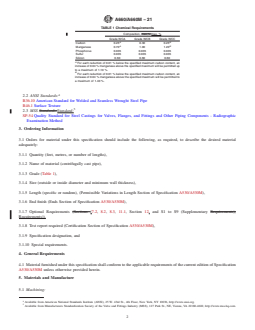
1.2 Several grades of carbon steels are covered. Their compositions are given in Table 1.
1.3 Supplementary requirements (S1 to S9) of an optional nature are provided. The supplementary requirements call for additional tests to be made, and when desired shall be so stated in the order, together with the number of such tests required.
1.4 The values stated in either inch-pound units or SI units are to be regarded separately as standard. Within the text, the SI units are shown in brackets. The values stated in each system are not exact equivalents; therefore, each system must be used independently of each other. Combining values from the two systems may result in nonconformance with the specification.
1.5 This international standard was developed in accordance with internationally recognized principles on standardization established in the Decision on Principles for the Development of International Standards, Guides and Recommendations issued by the World Trade Organization Technical Barriers to Trade (TBT) Committee.
- Status
- Published
- Publication Date
- 30-Apr-2021
- Technical Committee
- A01 - Steel, Stainless Steel and Related Alloys
- Drafting Committee
- A01.18 - Castings
Buy Documents

ASTM A660/A660M-21 - Standard Specification for Centrifugally Cast Carbon Steel Pipe for High-Temperature Service
REDLINE ASTM A660/A660M-21 - Standard Specification for Centrifugally Cast Carbon Steel Pipe for High-Temperature Service
Overview
ASTM A660/A660M-21 is the international standard specification for centrifugally cast carbon steel pipe intended for use in high-temperature and high-pressure applications. Published by ASTM International, this standard provides detailed requirements regarding the manufacturing, chemical composition, mechanical properties, and testing of carbon steel pipe made by the centrifugal casting process. ASTM A660/A660M-21 ensures that the produced pipe exhibits robust performance, reliability, and suitability for demanding applications, including fusion welding, bending, and forming operations in various industries.
Key Topics
Scope of the Standard
- Covers carbon steel pipe made by centrifugal casting for high-temperature, high-pressure services.
- Suitable for fusion welding, bending, and other forming operations.
- Includes several grades of carbon steel, each with specific chemical composition requirements.
Chemical and Mechanical Requirements
- Specifies limits for elements such as carbon, manganese, phosphorus, sulfur, and silicon.
- Requires conformance to tensile strength, yield strength, elongation, and reduction of area.
- Includes mandatory tests: tension (transverse or longitudinal), flattening, and hydrostatic testing.
Manufacturing and Heat Treatment
- Both internal and external surfaces must be machined.
- Pipe material is heat-treated post-casting, with temperature control ensured by pyrometers.
- Surface texture must meet specific roughness values as per ANSI B46.1.
Testing and Inspection
- Supplementary tests available: additional tension and flattening tests, etching, photomicrographs, radiographic, ultrasonic, and magnetic particle/penetrant testing.
- Chemical analysis and mechanical testing must be documented and reported as required.
Product Marking and Documentation
- Requirements for wall thickness, length, piece marking, supplementary requirement notation, and heat identification.
- Bar coding is allowed as supplemental identification.
Applications
The ASTM A660/A660M-21 standard is highly relevant for industries requiring reliable, durable pipe solutions under extreme service conditions. Practical applications include:
Power Generation
Carbon steel pipes are commonly used in boilers, heat exchangers, and superheaters operating at elevated temperatures and pressures.Petrochemical and Refinery
Suitable for critical piping systems transporting fluids in refining and chemical process plants, where high mechanical integrity is crucial.Oil and Gas Transmission
Employed for high-pressure pipelines conveying hydrocarbons, ensuring long-term performance and resistance to mechanical and thermal stress.Industrial Plants
Used in environments with fluctuating thermal and pressure demands, supporting safe and efficient material transport.
The pipe’s ability to undergo various forming operations and welding processes broadens its utility in custom installations and repairs.
Related Standards
Professionals working with ASTM A660/A660M-21 may also reference the following standards for additional requirements and guidance:
- ASTM A530/A530M: General requirements for specialized carbon and alloy steel pipe.
- ANSI B36.10: Standard for welded and seamless wrought steel pipe dimensions.
- ANSI B46.1: Surface texture for engineering applications.
- MSS SP-54: Quality standard for radiographic examination of steel castings for valves, flanges, and fittings.
- ASTM E114: Ultrasonic pulse-echo, straight-beam contact testing.
- ASTM E381: Macroetch testing of steel bars, billets, blooms, and forgings.
- ASTM E446/E186: Reference radiographs for steel castings of varying thickness.
Utilizing these related standards alongside ASTM A660/A660M-21 ensures comprehensive quality assurance, safety, and compliance in the manufacturing and application of centrifugally cast carbon steel pipe for high-temperature service.
Relations
- Effective Date
- 01-May-2012
- Effective Date
- 15-Jun-2010
- Effective Date
- 01-Apr-2010
- Refers
ASTM E446-10 - Standard Reference Radiographs for Steel Castings Up to 2 in. (50.8 mm) in Thickness - Effective Date
- 01-Jan-2010
- Effective Date
- 15-Dec-2008
- Refers
ASTM E381-01(2006) - Standard Method of Macroetch Testing Steel Bars, Billets, Blooms, and Forgings - Effective Date
- 01-Oct-2006
- Effective Date
- 01-Dec-2005
- Effective Date
- 01-Oct-2004
- Effective Date
- 01-Mar-2004
- Effective Date
- 01-Jan-2004
- Effective Date
- 01-Jan-2004
- Effective Date
- 10-Sep-2003
- Effective Date
- 10-Jul-2003
- Effective Date
- 10-Sep-2002
- Effective Date
- 10-Apr-2001
Buy Documents
ASTM A660/A660M-21 - Standard Specification for Centrifugally Cast Carbon Steel Pipe for High-Temperature Service
REDLINE ASTM A660/A660M-21 - Standard Specification for Centrifugally Cast Carbon Steel Pipe for High-Temperature Service
Get Certified
Connect with accredited certification bodies for this standard

Institut za varilstvo d.o.o. (Welding Institute)
Slovenia's leading welding institute since 1952. ISO 3834, EN 1090, pressure equipment certification, NDT personnel, welder qualification. Only IIW Au
Sponsored listings
Frequently Asked Questions
ASTM A660/A660M-21 is a technical specification published by ASTM International. Its full title is "Standard Specification for Centrifugally Cast Carbon Steel Pipe for High-Temperature Service". This standard covers: ABSTRACT This specification covers carbon steel pipe made by the centrifugal casting process intended for use in high-temperature, high-pressure service. This pipe shall be suitable for fusion welding, bending, and other forming operations. Grades for carbon steels shall conform to the required chemical composition for carbon, manganese, phosphorous, sulfur, and silicon. Manufacturing of the material shall be done by machining and heat treatment. Pyrometers shall be used to control the furnace temperatures. Tensile properties shall conform to the required values for tensile strength, elongation, and reduction of area. Mechanical properties shall conform to the following: transverse or longitudinal tension test; flattening test; and hydrostatic test. SCOPE 1.1 This specification2 covers carbon steel pipe made by the centrifugal casting process intended for use in high-temperature, high-pressure service. Pipe ordered under this specification shall be suitable for fusion welding, bending, and other forming operations. 1.2 Several grades of carbon steels are covered. Their compositions are given in Table 1. 1.3 Supplementary requirements (S1 to S9) of an optional nature are provided. The supplementary requirements call for additional tests to be made, and when desired shall be so stated in the order, together with the number of such tests required. 1.4 The values stated in either inch-pound units or SI units are to be regarded separately as standard. Within the text, the SI units are shown in brackets. The values stated in each system are not exact equivalents; therefore, each system must be used independently of each other. Combining values from the two systems may result in nonconformance with the specification. 1.5 This international standard was developed in accordance with internationally recognized principles on standardization established in the Decision on Principles for the Development of International Standards, Guides and Recommendations issued by the World Trade Organization Technical Barriers to Trade (TBT) Committee.
ABSTRACT This specification covers carbon steel pipe made by the centrifugal casting process intended for use in high-temperature, high-pressure service. This pipe shall be suitable for fusion welding, bending, and other forming operations. Grades for carbon steels shall conform to the required chemical composition for carbon, manganese, phosphorous, sulfur, and silicon. Manufacturing of the material shall be done by machining and heat treatment. Pyrometers shall be used to control the furnace temperatures. Tensile properties shall conform to the required values for tensile strength, elongation, and reduction of area. Mechanical properties shall conform to the following: transverse or longitudinal tension test; flattening test; and hydrostatic test. SCOPE 1.1 This specification2 covers carbon steel pipe made by the centrifugal casting process intended for use in high-temperature, high-pressure service. Pipe ordered under this specification shall be suitable for fusion welding, bending, and other forming operations. 1.2 Several grades of carbon steels are covered. Their compositions are given in Table 1. 1.3 Supplementary requirements (S1 to S9) of an optional nature are provided. The supplementary requirements call for additional tests to be made, and when desired shall be so stated in the order, together with the number of such tests required. 1.4 The values stated in either inch-pound units or SI units are to be regarded separately as standard. Within the text, the SI units are shown in brackets. The values stated in each system are not exact equivalents; therefore, each system must be used independently of each other. Combining values from the two systems may result in nonconformance with the specification. 1.5 This international standard was developed in accordance with internationally recognized principles on standardization established in the Decision on Principles for the Development of International Standards, Guides and Recommendations issued by the World Trade Organization Technical Barriers to Trade (TBT) Committee.
ASTM A660/A660M-21 is classified under the following ICS (International Classification for Standards) categories: 23.040.10 - Iron and steel pipes. The ICS classification helps identify the subject area and facilitates finding related standards.
ASTM A660/A660M-21 has the following relationships with other standards: It is inter standard links to ASTM A530/A530M-12, ASTM E114-10, ASTM A530/A530M-04a(2010), ASTM E446-10, ASTM E125-63(2008), ASTM E381-01(2006), ASTM E114-95(2005), ASTM A530/A530M-04a, ASTM A530/A530M-04, ASTM E446-98(2004)e1, ASTM E186-98(2004)e1, ASTM A530/A530M-03, ASTM E125-63(2003), ASTM A530/A530M-02, ASTM E381-01. Understanding these relationships helps ensure you are using the most current and applicable version of the standard.
ASTM A660/A660M-21 is available in PDF format for immediate download after purchase. The document can be added to your cart and obtained through the secure checkout process. Digital delivery ensures instant access to the complete standard document.
Standards Content (Sample)
This international standard was developed in accordance with internationally recognized principles on standardization established in the Decision on Principles for the
Development of International Standards, Guides and Recommendations issued by the World Trade Organization Technical Barriers to Trade (TBT) Committee.
Designation:A660/A660M −21
Standard Specification for
Centrifugally Cast Carbon Steel Pipe for High-Temperature
Service
This standard is issued under the fixed designationA660/A660M; the number immediately following the designation indicates the year
of original adoption or, in the case of revision, the year of last revision. A number in parentheses indicates the year of last reapproval.
A superscript epsilon (´) indicates an editorial change since the last revision or reapproval.
1. Scope* E94/E94M Guide for Radiographic Examination Using In-
2 dustrial Radiographic Film
1.1 This specification covers carbon steel pipe made by the
E114 Practice for Ultrasonic Pulse-Echo Straight-Beam
centrifugal casting process intended for use in high-
Contact Testing
temperature, high-pressure service. Pipe ordered under this
E125 Reference Photographs for Magnetic Particle Indica-
specification shall be suitable for fusion welding, bending, and
tions on Ferrous Castings
other forming operations.
E186 Reference Radiographs for Heavy-Walled (2 to 4 ⁄2 in.
1.2 Several grades of carbon steels are covered. Their
(50.8 to 114 mm)) Steel Castings
compositions are given in Table 1.
E381 Method of Macroetch Testing Steel Bars, Billets,
Blooms, and Forgings
1.3 Supplementary requirements (S1 to S9) of an optional
nature are provided. The supplementary requirements call for E446 Reference Radiographs for Steel Castings Up to 2 in.
(50.8 mm) in Thickness
additional tests to be made, and when desired shall be so stated
in the order, together with the number of such tests required.
2.2 ANSI Standards:
B36.10 American Standard for Welded and Seamless
1.4 The values stated in either inch-pound units or SI units
Wrought Steel Pipe
are to be regarded separately as standard. Within the text, the
B46.1 Surface Texture
SI units are shown in brackets. The values stated in each
system are not exact equivalents; therefore, each system must
2.3 MSS Standard:
be used independently of each other. Combining values from SP-54 Quality Standard for Steel Castings for Valves,
the two systems may result in nonconformance with the
Flanges, and Fittings and Other Piping Components -
specification. Radiographic Examination Method
1.5 This international standard was developed in accor-
3. Ordering Information
dance with internationally recognized principles on standard-
ization established in the Decision on Principles for the
3.1 Orders for material under this specification should
Development of International Standards, Guides and Recom-
include the following, as required, to describe the desired
mendations issued by the World Trade Organization Technical
material adequately:
Barriers to Trade (TBT) Committee.
3.1.1 Quantity (feet, metres, or number of lengths),
3.1.2 Name of material (centrifugally cast pipe),
2. Referenced Documents
3.1.3 Grade (Table 1),
2.1 ASTM Standards: 3.1.4 Size (outside or inside diameter and minimum wall
thickness),
A530/A530M Specification for General Requirements for
Specialized Carbon and Alloy Steel Pipe 3.1.5 Length (specific or random), (Permissible Variations
in Length Section of Specification A530/A530M),
3.1.6 End finish (Ends Section of Specification A530/
This specification is under the jurisdiction ofASTM Committee A01 on Steel,
A530M),
Stainless Steel and Related Alloys and is the direct responsibility of Subcommittee
3.1.7 OptionalRequirements(7.2,8.2,8.3,11.1,Section12,
A01.18 on Castings.
Current edition approved May 1, 2021. Published May 2021. Originally
and S1 to S9 (Supplementary Requirements)),
approved in 1972. Last previous edition approved in 2016 as A660/A660M – 11
(2016). DOI: 10.1520/A0660_A0660M-21.
For ASME Boiler and Vessel Code applications, see related Specification
SA-660 in Section II of that Code. Available fromAmerican National Standards Institute (ANSI), 25 W. 43rd St.,
For referenced ASTM standards, visit the ASTM website, www.astm.org, or 4th Floor, New York, NY 10036, http://www.ansi.org.
contact ASTM Customer Service at service@astm.org. For Annual Book of ASTM AvailablefromManufacturersStandardizationSocietyoftheValveandFittings
Standards volume information, refer to the standard’s Document Summary page on Industry (MSS), 127 Park St., NE, Vienna, VA 22180-4602, http://www.mss-
the ASTM website. hq.com.
*A Summary of Changes section appears at the end of this standard
Copyright © ASTM International, 100 Barr Harbor Drive, PO Box C700, West Conshohocken, PA 19428-2959. United States
A660/A660M−21
TABLE 1 Chemical Requirements
8.1.1 The material shall conform to the requirements as to
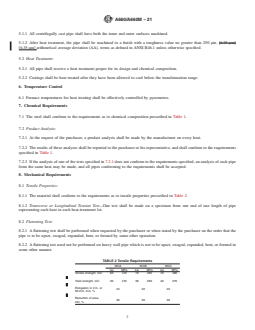
Composition, max, % tensile properties prescribed in Table 2.
Grade WCA Grade WCB Grade WCC 8.1.2 Transverse or Longitudinal Tension Test—One test
A B
Carbon 0.25 0.30 0.25 shall be made on a specimen from one end of one length of
A B
Manganese 0.70 1.00 1.20
pipe representing each heat in each heat-treatment lot.
Phosphorus 0.035 0.035 0.035
Sulfur 0.035 0.035 0.035
8.2 Flattening Test:
Silicon 0.60 0.60 0.60
8.2.1 Aflattening test shall be performed when requested by
A
For each reduction of 0.01 % below the specified maximum carbon content, an
the purchaser or when stated by the purchaser on the order that
increase of 0.04 % manganese above the specified maximum will be permitted up
the pipe is to be upset, swaged, expanded, bent, or formed by
to a maximum of 1.10 %.
B
For each reduction of 0.01 % below the specified maximum carbon content, an
some other operation.
increase of 0.04 % manganese above the specified maximum will be permitted to
8.2.2 Aflattening test need not be performed on heavy wall
a maximum of 1.40 %.
pipe which is not to be upset, swaged, expanded, bent, or
formed in some other manner.
8.2.3 When required by 8.2, a test shall be made on
3.1.8 Test report required (Certification Section of Specifi-
specimens cut from one end of each length of pipe.
cation A530/A530M),
8.2.4 Aflattening test, when required, shall be performed in
3.1.9 Specification designation, and
accordance with the requirements for seamless and centrifu-
3.1.10 Special requirements.
gally cast pipe in the Flattening Test Requirements Section of
Specification A530/A530M.
4. General Requirements
NOTE 1—In heavy-walled small-diameter tubing, the flattening test
4.1 Material furnished under this specification shall con-
specimenmaybeboredoutsothattheOD/tratiowillbegreaterthan11.0.
form to the applicable requirements of the current edition of
8.3 Hydrostatic Test:
Specification A530/A530M unless otherwise provided herein.
8.3.1 Each length of pipe shall be hydrostatically tested in
5. Materials and Manufacture
accordance with the Hydrostatic Test Requirements Section of
Specification A530/A530M when requested by the purchaser
5.1 Machining:
and stated on the order. If performance of the hydrostatic test
5.1.1 All centrifugally cast pipe shall have both the inner
is not required by the purchaser, the manufacturer shall
and outer surfaces machined.
guarantee pipe to pass the test and mark each length of pipe
5.1.2 After heat treatment, the pipe shall be machined to a
with the letters “NH” immediately following the specification
finish with a roughness value no greater than 250 µin.
number, indicating that the pipe has not been hydrostatically
[6.35 µm] arithmetical average deviation (AA), terms as de-
tested.
fined in ANSI B46.1 unless otherwise specified.
8.3.2 When required by 8.3, each length of pipe shall be
5.2 Heat Treatment:
subjected to the hydrostatic test. The test pressure shall be
5.2.1 All pipe shall receive a heat treatment proper for its
maintained for not less than 5 min.
design and chemical composition.
5.2.2 Castings shall be heat treated after they have been
9. Permissible Variation in Wall Thickness
allowed to cool below the transformation range.
9.1 The wall thickness shall not vary over the specified
minimum wall thickness by more than 10 %. There shall be no
6. Temperature Control
variation under the specified minimum wall thickness.
6.1 Furnace temperatures for heat treating shall be effec-
tively controlled by pyrometers. NOTE 2—A system of standard pipe sizes has been approved by the
American National Standards Institute asANSI B36.10. This system may
7. Chemical Requirements be used for obtaining pipe under this specification.
7.1 The steel shall conform to the requirements as to
10. Workmanship and Finish
chemical composition prescribed in Table 1.
10.1 The pipe shall have a finish as provided in 5.2 and it
7.2 Product Analysis:
shall be reasonably straight and free from injurious defects.
7.2.1 At the request of the purchaser, a product analysis
shall be made by the manufacturer on every heat.
TABLE 2 Tensile Requirements
7.2.2 The results of these analyses shall be reported to the
WCA WCB WCC
purchaser or his representative, and shall conform to the
ksi MPa ksi MPa ksi MPa
requirements specified in Table 1.
Tensile strength,
...
This document is not an ASTM standard and is intended only to provide the user of an ASTM standard an indication of what changes have been made to the previous version. Because
it may not be technically possible to adequately depict all changes accurately, ASTM recommends that users consult prior editions as appropriate. In all cases only the current version
of the standard as published by ASTM is to be considered the official document.
Designation: A660/A660M − 11 (Reapproved 2016) A660/A660M − 21
Standard Specification for
Centrifugally Cast Carbon Steel Pipe for High-Temperature
Service
This standard is issued under the fixed designation A660/A660M; the number immediately following the designation indicates the year
of original adoption or, in the case of revision, the year of last revision. A number in parentheses indicates the year of last reapproval.
A superscript epsilon (´) indicates an editorial change since the last revision or reapproval.
1. Scope*
1.1 This specification covers carbon steel pipe made by the centrifugal casting process intended for use in high-temperature,
high-pressure service. Pipe ordered under this specification shall be suitable for fusion welding, bending, and other forming
operations.
1.2 Several grades of carbon steels are covered. Their compositions are given in Table 1.
1.3 Supplementary requirements (S1 to S9) of an optional nature are provided. The supplementary requirements call for additional
tests to be made, and when desired shall be so stated in the order, together with the number of such tests required.
1.4 The values stated in either inch-pound units or SI units are to be regarded separately as standard. Within the text, the SI units
are shown in brackets. The values stated in each system are not exact equivalents; therefore, each system must be used
independently of each other. Combining values from the two systems may result in nonconformance with the specification.
1.5 This international standard was developed in accordance with internationally recognized principles on standardization
established in the Decision on Principles for the Development of International Standards, Guides and Recommendations issued
by the World Trade Organization Technical Barriers to Trade (TBT) Committee.
2. Referenced Documents
2.1 ASTM Standards:
A530/A530M Specification for General Requirements for Specialized Carbon and Alloy Steel Pipe
E94E94/E94M Guide for Radiographic Examination Using Industrial Radiographic Film
E114 Practice for Ultrasonic Pulse-Echo Straight-Beam Contact Testing
E125 Reference Photographs for Magnetic Particle Indications on Ferrous Castings
E142 Method for Controlling Quality of Radiographic Testing (Withdrawn 2000)
E186 Reference Radiographs for Heavy-Walled (2 to 4 ⁄2 in. (50.8 to 114 mm)) Steel Castings
E381 Method of Macroetch Testing Steel Bars, Billets, Blooms, and Forgings
E446 Reference Radiographs for Steel Castings Up to 2 in. (50.8 mm) in Thickness
This specification is under the jurisdiction of ASTM Committee A01 on Steel, Stainless Steel and Related Alloys and is the direct responsibility of Subcommittee A01.18
on Castings.
Current edition approved Sept. 1, 2016May 1, 2021. Published September 2016May 2021. Originally approved in 1972. Last previous edition approved in 20112016 as
A660/A660M – 11.A660/A660M – 11 (2016). DOI: 10.1520/A0660_A0660M-11R16.10.1520/A0660_A0660M-21.
For ASME Boiler and Vessel Code applications, see related Specification SA-660 in Section II of that Code.
For referenced ASTM standards, visit the ASTM website, www.astm.org, or contact ASTM Customer Service at service@astm.org. For Annual Book of ASTM Standards
volume information, refer to the standard’s Document Summary page on the ASTM website.
*A Summary of Changes section appears at the end of this standard
Copyright © ASTM International, 100 Barr Harbor Drive, PO Box C700, West Conshohocken, PA 19428-2959. United States
A660/A660M − 21
TABLE 1 Chemical Requirements
Composition, max,% max, %
Grade WCA Grade WCB Grade WCC
A B
Carbon 0.25 0.30 0.25
A B
Manganese 0.70 1.00 1.20
Phosphorus 0.035 0.035 0.035
Sulfur 0.035 0.035 0.035
Silicon 0.60 0.60 0.60
A
For each reduction of 0.01 % below the specified maximum carbon content, an
increase of 0.04 % manganese above the specified maximum will be permitted up
to a maximum of 1.10 %.
B
For each reduction of 0.01 % below the specified maximum carbon content, an
increase of 0.04 % manganese above the specified maximum will be permitted to
a maximum of 1.40 %.
2.2 ANSI Standards:
B36.10 American Standard for Welded and Seamless Wrought Steel Pipe
B46.1 Surface Texture
2.3 MSS Standards:Standard:
SP-54 Quality Standard for Steel Castings for Valves, Flanges, and Fittings and Other Piping Components - Radiographic
Examination Method
3. Ordering Information
3.1 Orders for material under this specification should include the following, as required, to describe the desired material
adequately:
3.1.1 Quantity (feet, metres, or number of lengths),
3.1.2 Name of material (centrifugally cast pipe),
3.1.3 Grade (Table 1),
3.1.4 Size (outside or inside diameter and minimum wall thickness),
3.1.5 Length (specific or random), (Permissible Variations in Length Section of Specification A530/A530M),
3.1.6 End finish (Ends Section of Specification A530/A530M),
3.1.7 Optional Requirements (Sections (7.2, 8.2, 8.3, 11.1, Section 12, and S1 to S9 (Supplementary Requirements),
Requirements)),
3.1.8 Test report required (Certification Section of Specification A530/A530M),
3.1.9 Specification designation, and
3.1.10 Special requirements.
4. General Requirements
4.1 Material furnished under this specification shall conform to the applicable requirements of the current edition of Specification
A530/A530M unless otherwise provided herein.
5. Materials and Manufacture
5.1 Machining:
Available from American National Standards Institute (ANSI), 25 W. 43rd St., 4th Floor, New York, NY 10036, http://www.ansi.org.
Available from Manufacturers Standardization Society of the Valve and Fittings Industry (MSS), 127 Park St., NE, Vienna, VA 22180-4602, http://www.mss-hq.com.
A660/A660M − 21
5.1.1 All centrifugally cast pipe shall have both the inner and outer surfaces machined.
5.1.2 After heat treatment, the pipe shall be machined to a finish with a roughness value no greater than 250 μin. [6.35 μm]
[6.35 μm] arithmetical average deviation (AA), terms as defined in ANSI B46.1 unless otherwise specified.
5.2 Heat Treatment:
5.2.1 All pipe shall receive a heat treatment proper for its design and chemical composition.
5.2.2 Castings shall be heat treated after they have been allowed to cool below the transformation range.
6. Temperature Control
6.1 Furnace temperatures for heat treating shall be effectively controlled by pyrometers.
7. Chemical Requirements
7.1 The steel shall conform to the requirements as to chemical composition prescribed in Table 1.
7.2 Product Analysis:
7.2.1 At the request of the purchaser, a product analysis shall be made by the manufacturer on every heat.
7.2.2 The results of these analyses shall be reported to the purchaser or his representative, and shall conform to the requirements
specified in Table 1.
7.2.3 If the analysis of one of the tests specified in 7.2.1 does not conform to the requirements specified, an analysis of each pipe
from the same heat may be made, and all pipes conforming to the requirements shall be accepted.
8. Mechanical Requirements
8.1 Tensile Properties:
8.1.1 The material shall conform to the requirements as to tensile properties prescribed in Table 2.
8.1.2 Transverse or Longitudinal Tension Test—One test shall be made on a specimen from one end of one length of pipe
representing each heat in each heat-treatment lot.
8.2 Flattening Test:
8.2.1 A flattening test shall be performed when requested by the purchaser or when stated by the purchaser on the order that the
pipe is to be upset, swaged, expanded, bent, or formed by some other operation.
8.2.2 A flattening test need not be performed on heavy wall pipe which is not to be upset, swaged, expanded, bent, or formed in
some other manner.
TABLE 2 Tensile Requirements
WCA WCB WCC
ksi MPa ksi MPa ksi MPa
Tensile strength, min 60 415 70 485 70 485
Yield strength, min 30 210 36 250 40 275
Elongation in 2 in. or
24 22 22
50 mm, min, %
Reduction of area,
35 35 35
min, %
A660/A660M − 21
8.2.3 When required by 8.2, a test shall be made on specimens cut from one end of each length of pipe.
8.2.4 A flattening test, when required, shall be performed in accordance with the requirements for seamless and centrifugally cast
pipe in the Flattening Test Requirements Section of Specification A530/A530M.
NOTE 1—In heavy-walled small-diameter tubing, the flattening test specimen may be bored out so that the OD/t ratio will be greater than 11.0.
8.3 Hydrostatic Test:
8.3.1 Each length of pipe shall be hydrostatically tested in accordance with the Hydrostatic Test Requirements Section of
Specification A530/A530M when requested by the purchaser and stated on the order. If performance of the hydrostatic test is not
required by the purchaser, the manufacturer shall guarantee pipe to pass the test and mark each length of pipe with the letters “NH”
immediately following the specification number, indicating that the pipe has not been hydrostatically tested.
8.3.2 When required by 8.3, each length of pipe shall be subjected to the hydrostatic test. The test pressure shall be maintained
for not less than 5 min.
9. Permissible Variation in Wall Thickness
9.1 The wall thickness shall not vary over the spe
...