

ASTM C165-23
(Test Method)Standard Test Method for Measuring Compressive Properties of Thermal Insulations
General Information
- Abstract
SIGNIFICANCE AND USE
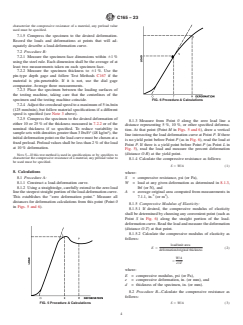
4.1 In providing Procedures A and B, it is recognized that different types of thermal insulation will exhibit significantly different behavior under compressive load. Data must usually be obtained from a complete load-deformation curve, and the useful working range normally corresponds to only a portion of the curve. The user is cautioned against use of the product in the range beyond which the product is permanently damaged or properties are adversely affected.
4.2 Load-deformation curves provide useful data for research and development, quality control, specification acceptance or rejection, and for other special purposes. Standard loading rates shall not be used arbitrarily for all purposes; the effects of impact, creep, fatigue, and repeated cycling must be considered. All load-deformation data shall be reviewed carefully for applicability prior to acceptance for use in engineering designs differing widely in load, load application rate, and material dimensions involved.
SCOPE
1.1 This test method covers two procedures for determining the compressive resistance of thermal insulations.
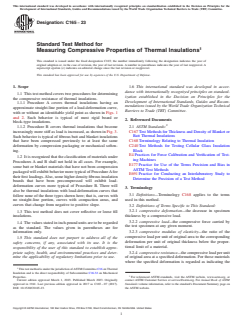
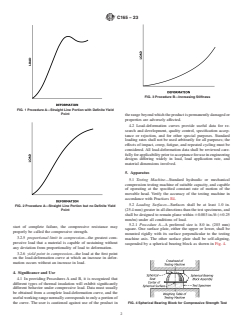
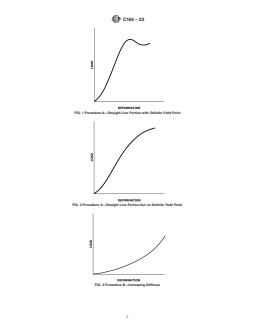
1.1.1 Procedure A covers thermal insulations having an approximate straight-line portion of a load-deformation curve, with or without an identifiable yield point as shown in Figs. 1 and 2. Such behavior is typical of most rigid board or block-type insulations.
FIG. 1 Procedure A—Straight Line Portion with Definite Yield Point
FIG. 2 Procedure A—Straight Line Portion but no Definite Yield Point
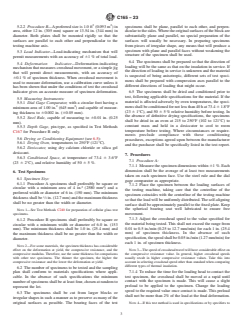
1.1.2 Procedure B covers thermal insulations that become increasingly more stiff as load is increased, as shown in Fig. 3. Such behavior is typical of fibrous batt and blanket insulations that have been compressed previously to at least the same deformation by compression packaging or mechanical softening.
FIG. 3 Procedure B—Increasing Stiffness
1.2 It is recognized that the classification of materials under Procedures A and B shall not hold in all cases. For example, some batt or blanket materials that have not been compression packaged will exhibit behavior more typical of Procedure A for their first loadings. Also, some higher density fibrous insulation boards that have been precompressed will exhibit load-deformation curves more typical of Procedure B. There will also be thermal insulations with load-deformation curves that follow none of the three types shown here; that is, curves with no straight-line portion, curves with compaction areas, and curves that change from negative to positive slope.
1.3 This test method does not cover reflective or loose fill insulations.
1.4 The values stated in inch-pound units are to be regarded as the standard. The values given in parentheses are for information only.
1.5 This standard does not purport to address all of the safety concerns, if any, associated with its use. It is the responsibility of the user of this standard to establish appropriate safety, health, and environmental practices and determine the applicability of regulatory limitations prior to use.
1.6 This international standard was developed in accordance with internationally recognized principles on standardization established in the Decision on Principles for the Development of International Standards, Guides and Recommendations issued by the World Trade Organization Technical Barriers to Trade (TBT) Committee.
- Status
- Published
- Publication Date
- 28-Feb-2023
- Technical Committee
- C16 - Thermal Insulation
- Drafting Committee
- C16.32 - Mechanical Properties
Buy Documents
ASTM C165-23 - Standard Test Method for Measuring Compressive Properties of Thermal Insulations
REDLINE ASTM C165-23 - Standard Test Method for Measuring Compressive Properties of Thermal Insulations
Overview
ASTM C165-23 is the internationally recognized standard test method for measuring the compressive properties of thermal insulations. Developed by ASTM International, this standard outlines rigorous methods to determine how various thermal insulation materials respond to compressive loads. Accurate assessment of compressive properties is essential for ensuring product quality, structural performance, and safe application of insulation materials in the construction and industrial sectors. This standard applies primarily to rigid board, block, batt, and blanket thermal insulations, but excludes reflective and loose fill materials.
Key Topics
Compressive Resistance and Modulus
ASTM C165-23 details two distinct test procedures for measuring compressive resistance and modulus:- Procedure A: Applies to insulation materials exhibiting an approximately straight-line load-deformation curve, with or without a yield point. This generally includes rigid board or block-type insulations.
- Procedure B: Designed for materials that stiffen as load increases, typical of fibrous batt and blanket insulations previously compressed by packaging or mechanical softening.
Load-Deformation Curves
Load-deformation data obtained during testing provides critical information about the material's structural integrity and working range. These curves are fundamental for:- Product development and research
- Quality control and batch acceptance or rejection
- Engineering design and material specification
Applicability
The test method highlights that certain materials may demonstrate characteristics of both procedures or exhibit unique behaviors not fully described by either. Users are cautioned to interpret results within the context of the tested material's nature and intended use.Test Precision and Reporting
The standard emphasizes the importance of repeatability and reproducibility in results, provides guidelines for specimen preparation and conditioning, and specifies detailed reporting requirements to ensure transparency and comparability.
Applications
ASTM C165-23 is widely used in several practical contexts:
Quality Assurance:
Manufacturers of thermal insulation products apply this standard to verify the compressive strength and durability of their materials before market release or certification.Material Specification and Selection:
Designers, engineers, and building code officials rely on results from ASTM C165-23 to select suitable insulation materials for projects, ensuring that compressive performance meets safety and longevity requirements.Product Development:
R&D teams utilize compressive data to improve product formulations and enhance material properties, adapting to new market demands or regulatory standards.Regulatory Compliance:
Compliance with ASTM C165-23 is often mandated in construction specifications and referenced in government, military, and industrial procurement documents.
Related Standards
For comprehensive testing and terminology, the following ASTM standards are commonly used alongside or referenced by ASTM C165-23:
- ASTM C167: Test Methods for Thickness and Density of Blanket or Batt Thermal Insulations
- ASTM C168: Terminology Relating to Thermal Insulation
- ASTM C240: Test Methods for Testing Cellular Glass Insulation Block
- ASTM E4: Practices for Force Calibration and Verification of Testing Machines
- ASTM E177: Practice for Use of the Terms Precision and Bias in ASTM Test Methods
- ASTM E691: Practice for Conducting an Interlaboratory Study to Determine the Precision of a Test Method
Keywords: compressive properties, thermal insulation, ASTM C165-23, compressive resistance, load-deformation curve, insulation testing, quality control, building materials standard, board insulation, batt insulation, modulus of elasticity, ASTM International, construction standards.
Relations
- Effective Date
- 15-Apr-2024
- Effective Date
- 01-Apr-2019
- Effective Date
- 15-Apr-2018
- Effective Date
- 01-Apr-2018
- Effective Date
- 01-Jun-2017
- Effective Date
- 01-Sep-2016
- Effective Date
- 15-Oct-2015
- Effective Date
- 01-Sep-2015
- Effective Date
- 01-Jun-2015
- Effective Date
- 01-Jun-2014
- Effective Date
- 01-May-2014
- Effective Date
- 01-May-2013
- Effective Date
- 01-May-2013
- Effective Date
- 01-Apr-2013
- Effective Date
- 01-Sep-2012
Buy Documents
ASTM C165-23 - Standard Test Method for Measuring Compressive Properties of Thermal Insulations
REDLINE ASTM C165-23 - Standard Test Method for Measuring Compressive Properties of Thermal Insulations
Get Certified
Connect with accredited certification bodies for this standard

DIBt (Deutsches Institut für Bautechnik)
German Institute for Building Technology.
DIN CERTCO
DIN Group product certification.

Aboma Certification B.V.
Specialized in construction, metal, and transport sectors.
Sponsored listings
Frequently Asked Questions
ASTM C165-23 is a standard published by ASTM International. Its full title is "Standard Test Method for Measuring Compressive Properties of Thermal Insulations". This standard covers: SIGNIFICANCE AND USE 4.1 In providing Procedures A and B, it is recognized that different types of thermal insulation will exhibit significantly different behavior under compressive load. Data must usually be obtained from a complete load-deformation curve, and the useful working range normally corresponds to only a portion of the curve. The user is cautioned against use of the product in the range beyond which the product is permanently damaged or properties are adversely affected. 4.2 Load-deformation curves provide useful data for research and development, quality control, specification acceptance or rejection, and for other special purposes. Standard loading rates shall not be used arbitrarily for all purposes; the effects of impact, creep, fatigue, and repeated cycling must be considered. All load-deformation data shall be reviewed carefully for applicability prior to acceptance for use in engineering designs differing widely in load, load application rate, and material dimensions involved. SCOPE 1.1 This test method covers two procedures for determining the compressive resistance of thermal insulations. 1.1.1 Procedure A covers thermal insulations having an approximate straight-line portion of a load-deformation curve, with or without an identifiable yield point as shown in Figs. 1 and 2. Such behavior is typical of most rigid board or block-type insulations. FIG. 1 Procedure A—Straight Line Portion with Definite Yield Point FIG. 2 Procedure A—Straight Line Portion but no Definite Yield Point 1.1.2 Procedure B covers thermal insulations that become increasingly more stiff as load is increased, as shown in Fig. 3. Such behavior is typical of fibrous batt and blanket insulations that have been compressed previously to at least the same deformation by compression packaging or mechanical softening. FIG. 3 Procedure B—Increasing Stiffness 1.2 It is recognized that the classification of materials under Procedures A and B shall not hold in all cases. For example, some batt or blanket materials that have not been compression packaged will exhibit behavior more typical of Procedure A for their first loadings. Also, some higher density fibrous insulation boards that have been precompressed will exhibit load-deformation curves more typical of Procedure B. There will also be thermal insulations with load-deformation curves that follow none of the three types shown here; that is, curves with no straight-line portion, curves with compaction areas, and curves that change from negative to positive slope. 1.3 This test method does not cover reflective or loose fill insulations. 1.4 The values stated in inch-pound units are to be regarded as the standard. The values given in parentheses are for information only. 1.5 This standard does not purport to address all of the safety concerns, if any, associated with its use. It is the responsibility of the user of this standard to establish appropriate safety, health, and environmental practices and determine the applicability of regulatory limitations prior to use. 1.6 This international standard was developed in accordance with internationally recognized principles on standardization established in the Decision on Principles for the Development of International Standards, Guides and Recommendations issued by the World Trade Organization Technical Barriers to Trade (TBT) Committee.
SIGNIFICANCE AND USE 4.1 In providing Procedures A and B, it is recognized that different types of thermal insulation will exhibit significantly different behavior under compressive load. Data must usually be obtained from a complete load-deformation curve, and the useful working range normally corresponds to only a portion of the curve. The user is cautioned against use of the product in the range beyond which the product is permanently damaged or properties are adversely affected. 4.2 Load-deformation curves provide useful data for research and development, quality control, specification acceptance or rejection, and for other special purposes. Standard loading rates shall not be used arbitrarily for all purposes; the effects of impact, creep, fatigue, and repeated cycling must be considered. All load-deformation data shall be reviewed carefully for applicability prior to acceptance for use in engineering designs differing widely in load, load application rate, and material dimensions involved. SCOPE 1.1 This test method covers two procedures for determining the compressive resistance of thermal insulations. 1.1.1 Procedure A covers thermal insulations having an approximate straight-line portion of a load-deformation curve, with or without an identifiable yield point as shown in Figs. 1 and 2. Such behavior is typical of most rigid board or block-type insulations. FIG. 1 Procedure A—Straight Line Portion with Definite Yield Point FIG. 2 Procedure A—Straight Line Portion but no Definite Yield Point 1.1.2 Procedure B covers thermal insulations that become increasingly more stiff as load is increased, as shown in Fig. 3. Such behavior is typical of fibrous batt and blanket insulations that have been compressed previously to at least the same deformation by compression packaging or mechanical softening. FIG. 3 Procedure B—Increasing Stiffness 1.2 It is recognized that the classification of materials under Procedures A and B shall not hold in all cases. For example, some batt or blanket materials that have not been compression packaged will exhibit behavior more typical of Procedure A for their first loadings. Also, some higher density fibrous insulation boards that have been precompressed will exhibit load-deformation curves more typical of Procedure B. There will also be thermal insulations with load-deformation curves that follow none of the three types shown here; that is, curves with no straight-line portion, curves with compaction areas, and curves that change from negative to positive slope. 1.3 This test method does not cover reflective or loose fill insulations. 1.4 The values stated in inch-pound units are to be regarded as the standard. The values given in parentheses are for information only. 1.5 This standard does not purport to address all of the safety concerns, if any, associated with its use. It is the responsibility of the user of this standard to establish appropriate safety, health, and environmental practices and determine the applicability of regulatory limitations prior to use. 1.6 This international standard was developed in accordance with internationally recognized principles on standardization established in the Decision on Principles for the Development of International Standards, Guides and Recommendations issued by the World Trade Organization Technical Barriers to Trade (TBT) Committee.
ASTM C165-23 is classified under the following ICS (International Classification for Standards) categories: 91.100.60 - Thermal and sound insulating materials. The ICS classification helps identify the subject area and facilitates finding related standards.
ASTM C165-23 has the following relationships with other standards: It is inter standard links to ASTM C168-24, ASTM C240-19, ASTM C168-18, ASTM C240-18, ASTM C168-17, ASTM C240-16, ASTM C168-15a, ASTM C167-15, ASTM C168-15, ASTM E4-14, ASTM E177-14, ASTM E691-13, ASTM E177-13, ASTM C168-13, ASTM C240-08(2012). Understanding these relationships helps ensure you are using the most current and applicable version of the standard.
ASTM C165-23 is available in PDF format for immediate download after purchase. The document can be added to your cart and obtained through the secure checkout process. Digital delivery ensures instant access to the complete standard document.
Standards Content (Sample)
This international standard was developed in accordance with internationally recognized principles on standardization established in the Decision on Principles for the
Development of International Standards, Guides and Recommendations issued by the World Trade Organization Technical Barriers to Trade (TBT) Committee.
Designation: C165 − 23
Standard Test Method for
Measuring Compressive Properties of Thermal Insulations
This standard is issued under the fixed designation C165; the number immediately following the designation indicates the year of
original adoption or, in the case of revision, the year of last revision. A number in parentheses indicates the year of last reapproval. A
superscript epsilon (´) indicates an editorial change since the last revision or reapproval.
This standard has been approved for use by agencies of the U.S. Department of Defense.
1. Scope 1.6 This international standard was developed in accor-
dance with internationally recognized principles on standard-
1.1 This test method covers two procedures for determining
ization established in the Decision on Principles for the
the compressive resistance of thermal insulations.
Development of International Standards, Guides and Recom-
1.1.1 Procedure A covers thermal insulations having an
mendations issued by the World Trade Organization Technical
approximate straight-line portion of a load-deformation curve,
Barriers to Trade (TBT) Committee.
with or without an identifiable yield point as shown in Figs. 1
and 2. Such behavior is typical of most rigid board or
2. Referenced Documents
block-type insulations.
2.1 ASTM Standards:
1.1.2 Procedure B covers thermal insulations that become
C167 Test Methods for Thickness and Density of Blanket or
increasingly more stiff as load is increased, as shown in Fig. 3.
Batt Thermal Insulations
Such behavior is typical of fibrous batt and blanket insulations
C168 Terminology Relating to Thermal Insulation
that have been compressed previously to at least the same
C240 Test Methods for Testing Cellular Glass Insulation
deformation by compression packaging or mechanical soften-
Block
ing.
E4 Practices for Force Calibration and Verification of Test-
1.2 It is recognized that the classification of materials under
ing Machines
Procedures A and B shall not hold in all cases. For example,
E177 Practice for Use of the Terms Precision and Bias in
some batt or blanket materials that have not been compression
ASTM Test Methods
packaged will exhibit behavior more typical of Procedure A for
E691 Practice for Conducting an Interlaboratory Study to
their first loadings. Also, some higher density fibrous insulation
Determine the Precision of a Test Method
boards that have been precompressed will exhibit load-
deformation curves more typical of Procedure B. There will
3. Terminology
also be thermal insulations with load-deformation curves that
3.1 Definitions—Terminology C168 applies to the terms
follow none of the three types shown here; that is, curves with
used in this method.
no straight-line portion, curves with compaction areas, and
curves that change from negative to positive slope.
3.2 Definitions of Terms Specific to This Standard:
3.2.1 compressive deformation—the decrease in specimen
1.3 This test method does not cover reflective or loose fill
thickness by a compressive load.
insulations.
3.2.2 compressive load—the compressive force carried by
1.4 The values stated in inch-pound units are to be regarded
the test specimen at any given moment.
as the standard. The values given in parentheses are for
information only. 3.2.3 compressive modulus of elasticity—the ratio of the
compressive load per unit of original area to the corresponding
1.5 This standard does not purport to address all of the
deformation per unit of original thickness below the propor-
safety concerns, if any, associated with its use. It is the
tional limit of a material.
responsibility of the user of this standard to establish appro-
priate safety, health, and environmental practices and deter- 3.2.4 compressive resistance—the compressive load per unit
mine the applicability of regulatory limitations prior to use. of original area at a specified deformation. For those materials
where the specified deformation is regarded as indicating the
This test method is under the jurisdiction of ASTM Committee C16 on Thermal
Insulation and is the direct responsibility of Subcommittee C16.32 on Mechanical
Properties. For referenced ASTM standards, visit the ASTM website, www.astm.org, or
Current edition approved March 1, 2023. Published March 2023. Originally contact ASTM Customer Service at service@astm.org. For Annual Book of ASTM
approved in 1941. Last previous edition approved in 2017 as C165 – 07 (2017). Standards volume information, refer to the standard’s Document Summary page on
DOI: 10.1520/C0165-23. the ASTM website.
Copyright © ASTM International, 100 Barr Harbor Drive, PO Box C700, West Conshohocken, PA 19428-2959. United States
C165 − 23
FIG. 3 Procedure B—Increasing Stiffness
FIG. 1 Procedure A—Straight Line Portion with Definite Yield
Point
the range beyond which the product is permanently damaged or
properties are adversely affected.
4.2 Load-deformation curves provide useful data for re-
search and development, quality control, specification accep-
tance or rejection, and for other special purposes. Standard
loading rates shall not be used arbitrarily for all purposes; the
effects of impact, creep, fatigue, and repeated cycling must be
considered. All load-deformation data shall be reviewed care-
fully for applicability prior to acceptance for use in engineering
designs differing widely in load, load application rate, and
material dimensions involved.
5. Apparatus
5.1 Testing Machine—Standard hydraulic or mechanical
compression testing machine of suitable capacity, and capable
of operating at the specified constant rate of motion of the
movable head. Verify the accuracy of the testing machine in
accordance with Practices E4.
5.2 Loading Surfaces—Surfaces shall be at least 1.0 in.
FIG. 2 Procedure A—Straight Line Portion but no Definite Yield
Point (25.4 mm) greater in all directions than the test specimens, and
shall be designed to remain plane within 60.003 in./ft (60.25
mm/m) under all conditions of load.
5.2.1 Procedure A—A preferred size is 8.0 in. (203 mm)
start of complete failure, the compressive resistance may
square. One surface plate, either the upper or lower, shall be
properly be called the compressive strength.
mounted rigidly with its surface perpendicular to the testing
3.2.5 proportional limit in compression—the greatest com-
machine axis. The other surface plate shall be self-aligning,
pressive load that a material is capable of sustaining without
suspended by a spherical bearing block as shown in Fig. 4.
any deviation from proportionality of load to deformation.
3.2.6 yield point in compression—the load at the first point
on the load-deformation curve at which an increase in defor-
mation occurs without an increase in load.
4. Significance and Use
4.1 In providing Procedures A and B, it is recognized that
different types of thermal insulation will exhibit significantly
different behavior under compressive load. Data must usually
be obtained from a complete load-deformation curve, and the
useful working range normally corresponds to only a portion of
the curve. The user is cautioned against use of the product in FIG. 4 Spherical Bearing Block for Compressive Strength Test
C165 − 23
2 2
5.2.2 Procedure B—A preferred size is 1.0 ft (0.093 m ) in specimens shall be plane, parallel to each other, and perpen-
area, either 12 in. (305 mm) square or 13.54 in. (344 mm) in dicular to the sides. Where the original surfaces of the block are
diameter. Both plates shall be mounted rigidly so that the substantially plane and parallel, no special preparation of the
surfaces are parallel to each other and perpendicular to the surfaces will usually be necessary. In preparing specimens
testing machine axis. from pieces of irregular shape, any means that will produce a
specimen with plane and parallel faces without weakening the
5.3 Load Indicator—Load-indicating mechanism that will
structure of the specimen shall be used.
permit measurements with an accuracy of 61 % of total load.
6.4 The specimens shall be prepared so that the direction of
5.4 Deformation Indicator—Deformation-indicating
loading will be the same as that on the insulation in service. If
mechanism that measures crosshead movement, or a simple jig
the direction of loading in service is unknown and the material
that will permit direct measurements, with an accuracy of
is suspected of being anisotropic, different sets of test speci-
60.1 % of specimen thickness. When crosshead movement is
mens shall be prepared with compression axes parallel to the
used to measure deformation, use a calibration curve unless it
different directions of loading that might occur.
has been shown that under the conditions of test the crosshead
indicator gives an accurate measure of specimen deformation. 6.5 The specimens shall be dried and conditioned prior to
test, following applicable specifications for the material. If the
5.5 Measuring Instruments:
material is affected adversely by oven temperatures, the speci-
5.5.1 Dial Gage Comparator, with a circular foot having a
2 2
mens shall be conditioned for not less than 40 h at 73.4 6 1.8°F
minimum area of 1.00 in. (645 mm ) and capable of measur-
(23 6 1°C), and 50 6 5 % relative humidity before testing. In
ing thickness to 60.002 in. (60.05 mm).
the absence of definitive drying specifications, the specimens
5.5.2 Steel Rule, capable of measuring to 60.01 in. (0.25
shall be dried in an oven at 215 to 250°F (102 to 121°C) to
mm).
constant mass and held in a desiccator to cool to room
5.5.3 Depth Gage, pin-type, as specified in Test Methods
temperature before testing. Where circumstances or require-
C167 for Procedure B only.
ments preclude compliance with these conditioning
5.6 Drying or Conditioning Equipment (see 6.5):
procedures, exceptions agreed upon between the manufacturer
5.6.1 Drying Oven, temperatures to 250°F (121°C).
and the purchaser shall be specifically listed in the test report.
5.6.2 Desiccator, using dry calcium chloride or silica gel
desiccant.
7. Procedures
5.6.3 Conditioned Space, at temperature of 73.4 6 3.6°F
7.1 Procedure A:
(23 6 2°C), and relative humidity of 50 6 5 %.
7.1.1 Measure the specimen dimensions within 61 %. Each
dimension shall be the average of at least two measurements
6. Test Specimens
taken on each specimen face. Use the steel rule and the dial
6.1 Specimen Size:
gage comparator as appropriate.
6.1.1 Procedure A specimens shall preferably be square or
7.1.2 Place the specimen between the loading surfaces of
2 2
circular with a minimum area of 4 in. (2580 mm ) and a
the test
...
This document is not an ASTM standard and is intended only to provide the user of an ASTM standard an indication of what changes have been made to the previous version. Because
it may not be technically possible to adequately depict all changes accurately, ASTM recommends that users consult prior editions as appropriate. In all cases only the current version
of the standard as published by ASTM is to be considered the official document.
Designation: C165 − 07 (Reapproved 2017) C165 − 23
Standard Test Method for
Measuring Compressive Properties of Thermal Insulations
This standard is issued under the fixed designation C165; the number immediately following the designation indicates the year of
original adoption or, in the case of revision, the year of last revision. A number in parentheses indicates the year of last reapproval. A
superscript epsilon (´) indicates an editorial change since the last revision or reapproval.
This standard has been approved for use by agencies of the U.S. Department of Defense.
1. Scope
1.1 This test method covers two procedures for determining the compressive resistance of thermal insulations.
1.1.1 Procedure A covers thermal insulations having an approximate straight-line portion of a load-deformation curve, with or
without an identifiable yield point as shown in Figs. 1 and 2. Such behavior is typical of most rigid board or block-type insulations.
1.1.2 Procedure B covers thermal insulations that become increasingly more stiff as load is increased, as shown in Fig. 3. Such
behavior is typical of fibrous batt and blanket insulations that have been compressed previously to at least the same deformation
by compression packaging or mechanical softening.
1.2 It is recognized that the classification of materials under Procedures A and B shall not hold in all cases. For example, some
batt or blanket materials that have not been compression packaged will exhibit behavior more typical of Procedure A for their first
loadings. Also, some higher density fibrous insulation boards that have been precompressed will exhibit load-deformation curves
more typical of Procedure B. There will also be thermal insulations with load-deformation curves that follow none of the three
types shown here; that is, curves with no straight-line portion, curves with compaction areas, and curves that change from negative
to positive slope.
1.3 This test method does not cover reflective or loose fill insulations.
1.4 The values stated in inch-pound units are to be regarded as the standard. The values given in parentheses are for information
only.
1.5 This standard does not purport to address all of the safety concerns, if any, associated with its use. It is the responsibility
of the user of this standard to establish appropriate safety, health, and environmental practices and determine the applicability of
regulatory limitations prior to use.
1.6 This international standard was developed in accordance with internationally recognized principles on standardization
established in the Decision on Principles for the Development of International Standards, Guides and Recommendations issued
by the World Trade Organization Technical Barriers to Trade (TBT) Committee.
This test method is under the jurisdiction of ASTM Committee C16 on Thermal Insulation and is the direct responsibility of Subcommittee C16.32 on Mechanical
Properties.
Current edition approved Sept. 1, 2017March 1, 2023. Published December 2017March 2023. Originally approved in 1941. Last previous edition approved in 20122017
as C165 – 07 (2012).(2017). DOI: 10.1520/C0165-07R17.10.1520/C0165-23.
Copyright © ASTM International, 100 Barr Harbor Drive, PO Box C700, West Conshohocken, PA 19428-2959. United States
C165 − 23
FIG. 1 Procedure A—Straight Line Portion with Definite Yield Point
FIG. 2 Procedure A—Straight Line Portion but no Definite Yield Point
FIG. 3 Procedure B—Increasing Stiffness
C165 − 23
2. Referenced Documents
2.1 ASTM Standards:
C167 Test Methods for Thickness and Density of Blanket or Batt Thermal Insulations
C168 Terminology Relating to Thermal Insulation
C240 Test Methods for Testing Cellular Glass Insulation Block
E4 Practices for Force Calibration and Verification of Testing Machines
E177 Practice for Use of the Terms Precision and Bias in ASTM Test Methods
E691 Practice for Conducting an Interlaboratory Study to Determine the Precision of a Test Method
3. Terminology
3.1 Definitions:
3.1.1 Terminology C168 applies to the terms used in this method.
3.1 Definitions—AdditionalTerminology C168terms are defined as follows: applies to the terms used in this method.
3.3 compressive deformation—the decrease in specimen thickness by a compressive load.
3.2 Definitions of Terms Specific to This Standard:
3.2.1 compressive deformation—the decrease in specimen thickness by a compressive load.
3.2.2 compressive load—the compressive force carried by the test specimen at any given moment.
3.2.3 compressive modulus of elasticity—the ratio of the compressive load per unit of original area to the corresponding
deformation per unit of original thickness below the proportional limit of a material.
3.2.4 compressive resistance—the compressive load per unit of original area at a specified deformation. For those materials where
the specified deformation is regarded as indicating the start of complete failure, the compressive resistance may properly be called
the compressive strength.
3.2.5 proportional limit in compression—the greatest compressive load that a material is capable of sustaining without any
deviation from proportionality of load to deformation.
3.2.6 yield point in compression—the load at the first point on the load-deformation curve at which an increase in deformation
occurs without an increase in load.
3.4 compressive load—the compressive force carried by the test specimen at any given moment.
3.5 compressive modulus of elasticity—the ratio of the compressive load per unit of original area to the corresponding deformation
per unit of original thickness below the proportional limit of a material.
3.6 compressive resistance—the compressive load per unit of original area at a specified deformation. For those materials where
the specified deformation is regarded as indicating the start of complete failure, the compressive resistance may properly be called
the compressive strength.
3.7 proportional limit in compression—the greatest compressive load that a material is capable of sustaining without any deviation
from proportionality of load to deformation.
3.8 yield point in compression—the load at the first point on the load-deformation curve at which an increase in deformation occurs
without an increase in load.
For referenced ASTM standards, visit the ASTM website, www.astm.org, or contact ASTM Customer Service at service@astm.org. For Annual Book of ASTM Standards
volume information, refer to the standard’s Document Summary page on the ASTM website.
C165 − 23
4. Significance and Use
4.1 In providing Procedures A and B, it is recognized that different types of thermal insulation will exhibit significantly different
behavior under compressive load. Data must usually be obtained from a complete load-deformation curve, and the useful working
range normally corresponds to only a portion of the curve. The user is cautioned against use of the product in the range beyond
which the product is permanently damaged or properties are adversely affected.
4.2 Load-deformation curves provide useful data for research and development, quality control, specification acceptance or
rejection, and for other special purposes. Standard loading rates shall not be used arbitrarily for all purposes; the effects of impact,
creep, fatigue, and repeated cycling must be considered. All load-deformation data shall be reviewed carefully for applicability
prior to acceptance for use in engineering designs differing widely in load, load application rate, and material dimensions involved.
5. Apparatus
5.1 Testing Machine—Standard hydraulic or mechanical compression testing machine of suitable capacity, and capable of
operating at the specified constant rate of motion of the movable head. Verify the accuracy of the testing machine in accordance
with Practices E4.
5.2 Loading Surfaces—Surfaces shall be at least 1.0 in. (25.4 mm) greater in all directions than the test specimens, and shall be
designed to remain plane within 60.003 in./ft (60.25 mm/m) under all conditions of load.
5.2.1 Procedure A—A preferred size is 8.0 in. (203 mm) square. One surface plate, either the upper or lower, shall be mounted
rigidly with its surface perpendicular to the testing machine axis. The other surface plate shall be self-aligning, suspended by a
spherical bearing block as shown in Fig. 4.
2 2
5.2.2 Procedure B—A preferred size is 1.0 ft (0.093 m ) in area, either 12 in. (305 mm) square or 13.54 in. (344 mm) in diameter.
Both plates shall be mounted rigidly so that the surfaces are parallel to each other and perpendicular to the testing machine axis.
5.3 Load Indicator—Load-indicating mechanism that will permit measurements with an accuracy of 61 % of total load.
5.4 Deformation Indicator—Deformation-indicating mechanism that measures crosshead movement, or a simple jig that will
permit direct measurements, with an accuracy of 60.1 % of specimen thickness. When crosshead movement is used to measure
deformation, use a calibration curve unless it has been shown that under the conditions of test the crosshead indicator gives an
accurate measure of specimen deformation.
5.5 Measuring Instruments:
2 2
5.5.1 Dial Gage Comparator, with a circular foot having a minimum area of 1.00 in. (645 mm ) and capable of measuring
thickness to 60.002 in. (60.05 mm).
5.5.2 Steel Rule, capable of measuring to 60.01 in. (0.25 mm).
5.5.3 Depth Gage, pin-type, as specified in Test Methods C167 for Procedure B only.
5.6 Drying or Conditioning Equipment (see 6.5):
FIG. 4 Spherical Bearing Block for Compressive Strength Test
C165 − 23
5.6.1 Drying Oven, temperatures to 250°F (121°C).
5.6.2 Desiccator, using dry calcium chloride or silica gel desiccant.
5.6.3 Conditioned Space, at temperature of 73.4 6 3.6°F (23 6 2°C), and relative humidity of 50 6 5 %.
6. Test Specimens
6.1 Specimen Size:
2 2
6.1.1 Procedure A specimens shall preferably be square or circular with a minimum area of 4 in. (2580 mm ) and a preferred
width or diameter of 6 in. (150 mm). The minimum thickness shall be ⁄2 in. (12.7 mm) and the maximum thickness shall be no
greater than the width or diameter.
NOTE 1—See Test Methods C240 for preparation of cellular glass test specimens.
6.1.2 Procedure B specimens shall preferably be square or circular with a minimum width or diameter of 6.0 in. (153 mm). The
minimum thickness shall be 1.0 in. (25.4 mm) and the maximum thickness shall be no greater than the width or diameter.
NOTE 2—For some materials, the specimen thickness has considerable effect on the deformation at yield, the compressive resistance, and the compressive
modulus. Therefore, use the same thickness for comparisons with other test specimens. The thinner the specimen, the higher the compressive resistance
and the lower the deformation at yield.
6.2 The number of specimens to be tested and the sampling plan shall conform to materials specifications where applicable. In
the absence of such specifications the minimum number of specimens shall be at least four, chosen at random to represent the lot.
6.3 The specimens shall be cut from larger blocks or irregula
...