


ASTM D1776/D1776M-20
(Practice)Standard Practice for Conditioning and Testing Textiles
Standard Practice for Conditioning and Testing Textiles
ABSTRACT
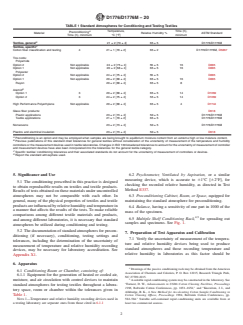
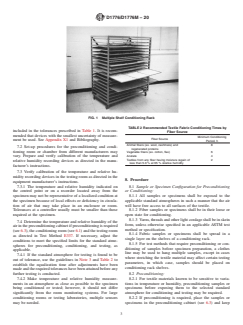
This practice covers the conditioning and testing of textiles in those instances where such conditioning is specified in a test method. Because prior exposure of textiles to high or low humidity may affect the equilibrium moisture pick-up, a procedure also is given for preconditioning the material when specified. The equipments to be used in the conditioning and testing of textiles shall include conditioning room or chamber, psychrometer ventilated by aspiration, preconditioning cabinet, room, or suitable container, balance, and multiple shelf conditioning rack. The conditioning room or chamber shall consist of equipment for maintaining the standard atmosphere for testing textiles throughout the room or chamber within the tolerances given and including facilities for circulating air over all surfaces of the exposed sample or specimen and equipment for recording the temperature and relative humidity of the air in the conditioning room or chamber. Samples or specimens requiring preconditioning shall be brought to a relatively low moisture content in a specified atmosphere. Samples or specimens requiring conditioning shall be brought to moisture equilibrium for testing in the standard atmosphere for testing textiles, or when required.
SCOPE
1.1 This practice covers the conditioning and testing of textiles when conditioning is specified in a test method. Because prior exposure of textiles to high or low humidity may affect moisture pick-up equilibrium, a procedure also is given for preconditioning the material when required.
1.2 The values stated in either SI units or inch-pound units are to be regarded separately as standard. The values stated in each system are not necessarily exact equivalents; therefore, to ensure conformance with the standard, each system shall be used independently of the other, and values from the two systems shall not be combined.
1.3 This standard does not purport to address all of the safety concerns, if any, associated with its use. It is the responsibility of the user of this standard to establish appropriate safety, health, and environmental practices and determine the applicability of regulatory limitations prior to use.
1.4 This international standard was developed in accordance with internationally recognized principles on standardization established in the Decision on Principles for the Development of International Standards, Guides and Recommendations issued by the World Trade Organization Technical Barriers to Trade (TBT) Committee.
General Information
- Status
- Published
- Publication Date
- 31-Jan-2020
- Technical Committee
- D13 - Textiles
- Drafting Committee
- D13.51 - Conditioning, Chemical and Thermal Properties
Relations
- Effective Date
- 01-Feb-2020
- Effective Date
- 01-Jul-2020
- Effective Date
- 01-Mar-2017
- Effective Date
- 15-Sep-2015
- Effective Date
- 01-Sep-2015
- Effective Date
- 01-Apr-2015
- Effective Date
- 15-Jun-2013
- Effective Date
- 15-Jun-2013
- Effective Date
- 15-May-2013
- Effective Date
- 01-Jul-2012
- Effective Date
- 01-Feb-2012
- Effective Date
- 01-Feb-2012
- Effective Date
- 15-Jan-2009
- Effective Date
- 15-Jan-2009
- Effective Date
- 15-Jan-2009
Overview
ASTM D1776/D1776M-20: Standard Practice for Conditioning and Testing Textiles provides standardized procedures for conditioning and testing textile materials. Adopted by ASTM International, this standard is essential for ensuring accurate, reproducible test results and supports uniformity across various laboratories. Proper sample conditioning is critical because moisture, temperature, and handling can significantly influence the physical properties and test outcomes of textiles. This standard specifies both preconditioning, when required, and conditioning procedures for textile samples and provides guidance on maintaining standard atmospheric conditions during testing.
Key Topics
- Standard Atmospheres for Conditioning: The standard defines atmospheric conditions-mainly temperature and relative humidity-that must be maintained for conditioning and testing textiles, ensuring consistent results worldwide.
- Preconditioning Procedures: For materials previously exposed to extreme humidity or temperature, preconditioning steps guide users in bringing specimens to a stable, low moisture content before final conditioning.
- Equipment and Set-Up: Guidance includes requirements for conditioning rooms or chambers, psychrometers for humidity measurement, preconditioning cabinets, balances, and conditioning racks. Calibration and uncertainty in measurement are also addressed.
- Sample Preparation: Specifies how various textile forms-fibers, yarns, fabrics, and packages-should be prepared and arranged to ensure optimal exposure during conditioning and testing.
- Measurement Uncertainty: The document underscores the importance of accounting for measurement uncertainty in both temperature and relative humidity, impacting laboratory accreditation and data reliability.
- Safety and Compliance: Emphasizes user responsibility for safety, health, and environmental practices during implementation.
Applications
The procedures prescribed by ASTM D1776/D1776M-20 are widely used in the textile industry and related sectors to enhance the reliability and consistency of test results. Typical applications include:
- Textile Manufacturing and Quality Control: Ensuring fabrics, fibers, and yarns meet industry standards by testing under controlled humidity and temperature conditions.
- Research and Product Development: Supporting comparative studies, new material assessments, and process optimizations in laboratory environments.
- Laboratory Accreditation: Furnishing required practices and documentation for laboratories seeking accreditation, especially where precise measurement of conditioning parameters is mandatory.
- Comparative Testing Across Facilities: Enabling consistent, repeatable results for inter-laboratory tests and between different geographical locations.
- Testing for Regulatory Compliance: Assists manufacturers and labs in meeting international requirements for textile testing, especially those observed by organizations such as the U.S. Department of Defense and international trade groups.
Related Standards
Several standards are referenced or closely associated with ASTM D1776/D1776M-20, helping to provide a comprehensive approach to textile testing and terminology:
- ASTM D123: Terminology Relating to Textiles
- ASTM D618: Practice for Conditioning Plastics for Testing
- ASTM D4920: Terminology Relating to Conditioning, Chemical, and Thermal Properties
- ASTM D5867: Test Methods for the Measurement of Physical Properties of Raw Cotton
- ASTM D7269 & D7744: Test Methods for Tensile Testing of Industrial Yarns and Tapes
- ASTM E337: Test Method for Measuring Humidity with a Psychrometer
- ISO 139: Textiles-Standard Atmosphere for Conditioning and Testing
Practical Value
Implementing ASTM D1776/D1776M-20 ensures the reliability, comparability, and repeatability of textile testing results, regardless of location or operator. This standard helps textile manufacturers, quality control professionals, and laboratories maintain the integrity of their testing processes by minimizing environmental variables and providing clear guidelines. Laboratories that follow the procedures outlined in ASTM D1776/D1776M-20 can confidently support compliance claims, achieve accreditation objectives, and drive product consistency in global markets.
Keywords: textile conditioning, textile testing, standard atmosphere, moisture equilibrium, humidity control, ASTM D1776, textile laboratories, quality assurance, measurement uncertainty, textile industry standards.
Buy Documents
ASTM D1776/D1776M-20 - Standard Practice for Conditioning and Testing Textiles
REDLINE ASTM D1776/D1776M-20 - Standard Practice for Conditioning and Testing Textiles
Get Certified
Connect with accredited certification bodies for this standard

Control Union Certifications
Global certification for agriculture and sustainability.

Bureau Veritas Bangladesh
Bureau Veritas certification services in Bangladesh.

ECOCERT France
Leader in organic and sustainability certification worldwide.
Sponsored listings
Frequently Asked Questions
ASTM D1776/D1776M-20 is a standard published by ASTM International. Its full title is "Standard Practice for Conditioning and Testing Textiles". This standard covers: ABSTRACT This practice covers the conditioning and testing of textiles in those instances where such conditioning is specified in a test method. Because prior exposure of textiles to high or low humidity may affect the equilibrium moisture pick-up, a procedure also is given for preconditioning the material when specified. The equipments to be used in the conditioning and testing of textiles shall include conditioning room or chamber, psychrometer ventilated by aspiration, preconditioning cabinet, room, or suitable container, balance, and multiple shelf conditioning rack. The conditioning room or chamber shall consist of equipment for maintaining the standard atmosphere for testing textiles throughout the room or chamber within the tolerances given and including facilities for circulating air over all surfaces of the exposed sample or specimen and equipment for recording the temperature and relative humidity of the air in the conditioning room or chamber. Samples or specimens requiring preconditioning shall be brought to a relatively low moisture content in a specified atmosphere. Samples or specimens requiring conditioning shall be brought to moisture equilibrium for testing in the standard atmosphere for testing textiles, or when required. SCOPE 1.1 This practice covers the conditioning and testing of textiles when conditioning is specified in a test method. Because prior exposure of textiles to high or low humidity may affect moisture pick-up equilibrium, a procedure also is given for preconditioning the material when required. 1.2 The values stated in either SI units or inch-pound units are to be regarded separately as standard. The values stated in each system are not necessarily exact equivalents; therefore, to ensure conformance with the standard, each system shall be used independently of the other, and values from the two systems shall not be combined. 1.3 This standard does not purport to address all of the safety concerns, if any, associated with its use. It is the responsibility of the user of this standard to establish appropriate safety, health, and environmental practices and determine the applicability of regulatory limitations prior to use. 1.4 This international standard was developed in accordance with internationally recognized principles on standardization established in the Decision on Principles for the Development of International Standards, Guides and Recommendations issued by the World Trade Organization Technical Barriers to Trade (TBT) Committee.
ABSTRACT This practice covers the conditioning and testing of textiles in those instances where such conditioning is specified in a test method. Because prior exposure of textiles to high or low humidity may affect the equilibrium moisture pick-up, a procedure also is given for preconditioning the material when specified. The equipments to be used in the conditioning and testing of textiles shall include conditioning room or chamber, psychrometer ventilated by aspiration, preconditioning cabinet, room, or suitable container, balance, and multiple shelf conditioning rack. The conditioning room or chamber shall consist of equipment for maintaining the standard atmosphere for testing textiles throughout the room or chamber within the tolerances given and including facilities for circulating air over all surfaces of the exposed sample or specimen and equipment for recording the temperature and relative humidity of the air in the conditioning room or chamber. Samples or specimens requiring preconditioning shall be brought to a relatively low moisture content in a specified atmosphere. Samples or specimens requiring conditioning shall be brought to moisture equilibrium for testing in the standard atmosphere for testing textiles, or when required. SCOPE 1.1 This practice covers the conditioning and testing of textiles when conditioning is specified in a test method. Because prior exposure of textiles to high or low humidity may affect moisture pick-up equilibrium, a procedure also is given for preconditioning the material when required. 1.2 The values stated in either SI units or inch-pound units are to be regarded separately as standard. The values stated in each system are not necessarily exact equivalents; therefore, to ensure conformance with the standard, each system shall be used independently of the other, and values from the two systems shall not be combined. 1.3 This standard does not purport to address all of the safety concerns, if any, associated with its use. It is the responsibility of the user of this standard to establish appropriate safety, health, and environmental practices and determine the applicability of regulatory limitations prior to use. 1.4 This international standard was developed in accordance with internationally recognized principles on standardization established in the Decision on Principles for the Development of International Standards, Guides and Recommendations issued by the World Trade Organization Technical Barriers to Trade (TBT) Committee.
ASTM D1776/D1776M-20 is classified under the following ICS (International Classification for Standards) categories: 59.080.30 - Textile fabrics. The ICS classification helps identify the subject area and facilitates finding related standards.
ASTM D1776/D1776M-20 has the following relationships with other standards: It is inter standard links to ASTM D1776/D1776M-16, ASTM D5867-12(2020), ASTM D123-17, ASTM D123-15b, ASTM D123-15a, ASTM D123-15, ASTM D123-13a, ASTM D123-13ae1, ASTM D123-13, ASTM D5867-12, ASTM D123-12e1, ASTM D123-12, ASTM D123-09e1, ASTM D123-09e2, ASTM D123-09. Understanding these relationships helps ensure you are using the most current and applicable version of the standard.
ASTM D1776/D1776M-20 is available in PDF format for immediate download after purchase. The document can be added to your cart and obtained through the secure checkout process. Digital delivery ensures instant access to the complete standard document.
Standards Content (Sample)
This international standard was developed in accordance with internationally recognized principles on standardization established in the Decision on Principles for the
Development of International Standards, Guides and Recommendations issued by the World Trade Organization Technical Barriers to Trade (TBT) Committee.
Designation: D1776/D1776M −20
Standard Practice for
Conditioning and Testing Textiles
This standard is issued under the fixed designation D1776/D1776M; the number immediately following the designation indicates the
year of original adoption or, in the case of revision, the year of last revision. A number in parentheses indicates the year of last
reapproval. A superscript epsilon (´) indicates an editorial change since the last revision or reapproval.
This standard has been approved for use by agencies of the U.S. Department of Defense.
1. Scope and Thermal Properties
D5867 Test Methods for Measurement of Physical Proper-
1.1 This practice covers the conditioning and testing of
ties of Raw Cotton by Cotton Classification Instruments
textiles when conditioning is specified in a test method.
D7269 Test Methods for Tensile Testing of Aramid Yarns
Becausepriorexposureoftextilestohighorlowhumiditymay
D7744 Test Methods for Tensile Testing of High Perfor-
affect moisture pick-up equilibrium, a procedure also is given
mance Polyethylene Tapes
for preconditioning the material when required.
E337 Test Method for Measuring Humidity with a Psy-
1.2 The values stated in either SI units or inch-pound units
chrometer (the Measurement of Wet- and Dry-Bulb Tem-
are to be regarded separately as standard. The values stated in
peratures)
each system are not necessarily exact equivalents; therefore, to
2.2 ISO Standard:
ensure conformance with the standard, each system shall be
ISO 139 Textiles StandardAtmosphere for Conditioning and
used independently of the other, and values from the two 3
Testing
systems shall not be combined.
3. Terminology
1.3 This standard does not purport to address all of the
safety concerns, if any, associated with its use. It is the
3.1 For terminology related to conditioning see Terminol-
responsibility of the user of this standard to establish appro-
ogy D4920.
priate safety, health, and environmental practices and deter-
3.2 The following terms are relevant to this standard:
mine the applicability of regulatory limitations prior to use.
accelerated conditioning, moisture content, moisture
1.4 This international standard was developed in accor-
equilibrium, moisture equilibrium for preconditioning, mois-
dance with internationally recognized principles on standard-
ture equilibrium for testing, precondition, standard atmosphere
ization established in the Decision on Principles for the
for preconditioning textiles, standard atmosphere for testing
Development of International Standards, Guides and Recom-
textiles, uncertainty of (in) measurement.
mendations issued by the World Trade Organization Technical
Barriers to Trade (TBT) Committee.
3.3 For definitions of other textile terms used in this
standard see Terminology D123.
2. Referenced Documents
2 4. Summary of Practice
2.1 ASTM Standards:
D123 Terminology Relating to Textiles 4.1 Samples or specimens requiring preconditioning are
D618 Practice for Conditioning Plastics for Testing brought to relatively low moisture content in a specified
D885 Test Methods for Tire Cords, Tire Cord Fabrics, and atmosphere. Samples or specimens not requiring pre-
Industrial Filament Yarns Made from Manufactured conditioning are brought to moisture equilibrium (specific to
Organic-Base Fibers fiber-content)accordingtothestandardatmospheresfortesting
D4920 Terminology Relating to Conditioning, Chemical, textiles as shown in Table 1.
4.2 Understanding of tolerance and uncertainty of measure-
ment has evolved since the creation of the original version of
ThispracticeisunderthejurisdictionofASTMCommitteeD13onTextilesand
this standard. Due to this new understanding, uncertainty of
is the direct responsibility of Subcommittee D13.51 on Conditioning, Chemical and
Thermal Properties. measurement has been taken into account in determining
Current edition approved Feb. 1, 2020. Published March 2020. Originally
acceptable tolerances for the standard atmospheres for testing
approved in 1960. Last previous edition approved in 2016 as D1776/D1776M–16.
textiles as shown in Table 1.
DOI: 10.1520/D1776_D1776M-20.
For referenced ASTM standards, visit the ASTM website, www.astm.org, or
contact ASTM Customer Service at service@astm.org. For Annual Book of ASTM
Standards volume information, refer tot he standard’s Document summary page on Available fromAmerican National Standards Institute, 11 W. 42nd Street, 13th
the ASTM website. Floor, New York, NY 10036.
Copyright © ASTM International, 100 Barr Harbor Drive, PO Box C700, West Conshohocken, PA 19428-2959. United States
D1776/D1776M − 20
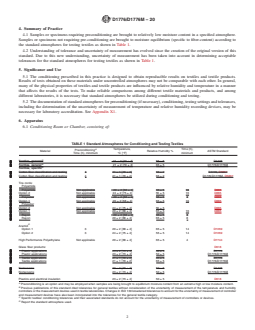
TABLE 1 Standard Atmospheres for Conditioning and Testing Textiles
A
Temperature, Time (h),
Preconditioning
Material Relative Humidity % ASTM Standard
Time (h), minimum °C [°F] minimum
B
Textiles, general 21±2[70±4] 65±5 D1776/D1776M
C
Textiles, specific
Cotton fiber classification and testing 4 21±1[70±2] 65±2 D1776/D1776M, D5867
Tire cords:
Polyamide
Option 2 Not applicable 24±2[75±4] 55±5 16 D885
Option 1 Not applicable 20±2[68±4] 65±5 16 D885
Polyester
Option 2 Not applicable 24±2[75±4] 55±5 D885
Option 1 Not applicable 20±2[68±4] 65±5 16 D885
Rayon 20±2[68±4] 65±5 8
D
Aramid
Option1 3 20±2[68±4] 65±5 14 D7269
Option2 3 24±2[75±4] 55±5 14 D7269
High Performance Polyethylene Not applicable 20±2[68±4] 65±5 4 D7744
Glass fiber products: D618
Plastic applications 23±2[73±4] 50±5 D1776/D1776M
Textile applications 21±1[70±2] 65±5 D1776/D1776M
Nonwovens 23±2[73±4] 50±5 D1776/D1776M
Plastics and electrical insulation 23±2[73±4] 50±5 D618
A
Preconditioning is an option and may be employed when samples are being brought to equilibrium moisture content from an extreme high or low moisture content.
B
Previous publications of this standard cited tolerances for general textiles without consideration of the uncertainty of measurement of the temperature and humidity
controllers or the measurement devices used in textile laboratories. Changes in ISO 139 broadened tolerances to account for the uncertainty of measurement of controller
and measurement devices have also been incorporated into the tolerances for the general textile category.
C
Specific textiles’ conditioning tolerances and their associated standards do not account for the uncertainty of measurement of controllers or devices.
D
Report the standard atmosphere used.
5. Significance and Use 6.2 Psychrometer, Ventilated by Aspiration, or a similar
measuring device, which is accurate to 61°C [62°F], for
5.1 The conditioning prescribed in this practice is designed
checking the recorded relative humidity, as directed in Test
to obtain reproducible results on textiles and textile products.
Method E337.
Results of tests obtained on these materials under uncontrolled
atmospheres may not be comparable with each other. In 6.3 Preconditioning Cabinet, Room, or Space, equipped for
general, many of the physical properties of textiles and textile maintaining the standard atmosphere for preconditioning.
productsareinfluencedbyrelativehumidityandtemperaturein
6.4 Balance, having a sensitivity of one part in 1000 of the
a manner that affects the results of the tests. To make reliable
mass of the specimen.
comparisons among different textile materials and products,
4,5
6.5 Multiple Shelf Conditioning Rack, for spreading out
and among different laboratories, it is necessary that standard
samples and specimens. See Fig. 1.
atmospheres be utilized during conditioning and testing.
5.2 The documentation of standard atmospheres for precon-
7. Preparation of Test Apparatus and Calibration
ditioning (if necessary), conditioning, testing settings and
7.1 Verify the uncertainty of measurement of the tempera-
tolerances, including the determination of the uncertainty of
ture and relative humidity devices being used to produce
measurement of temperature and relative humidity recording
standard atmospheres and those recording temperature and
devices, may be necessary for laboratory accreditation. See
relative humidity in laboratories as this factor should be
Appendix X1.
6. Apparatus
Drawings of the passive conditioning rack may be obtained from theAmerican
6.1 Conditioning Room or Chamber, consisting of:
Association of Chemists and Colorists, P. O. Box 12215, Research Triangle Park,
6.1.1 Equipment for the generation of heated or cooled air,
NC 27709-2215.
moisture, and air circulation with control devices to maintain Asuitable rapid conditioning system may be constructed in the laboratory. See
“Earnest, D. W., Advancements in USDA Cotton Classing Facilities, Proceedings
standard atmospheres for testing textiles throughout a labora-
1996, Beltwide Cotton Conferences, pp. 1651–1654,” and “Knowiton, J. I., and
tory space, room or chamber within the tolerances given in
Alldredge, R. K., A New Method for Accelerating Cotton Sample Conditioning in
Table 1.
Cotton Classing Offıces, Proceedings 1994, Beltwide Cotton Conferences, pp.
NOTE 1—Temperature and relative humidity recording devices used in 582–584.” Suitable self-contained rapid conditioning units are available from at
a testing laboratory are separate ones from those cited in 6.1.1 least two commercial sources.
D1776/D1776M − 20
FIG. 1 Multiple Shelf Conditioning Rack
TABLE 2 Recommended Textile Fabric Conditioning Times by
included in the tolerances prescribed in Table 1. It is recom-
Fiber Source
mended that devices with the smallest uncertainty of measure-
Minimum Conditioning
Fiber Source
ment be used. See Appendix X1 and Bibliography.
Period, h
Animal fibers (ex. wool, cashmere) and 8
7.2 Set-up procedures for the preconditioning and condi-
regenerated proteins
tioning room or chamber from different manufacturers may
Vegetable fibers (ex. cotton, flax) 6
Acetate 4
vary. Prepare and verify calibration of the temperature and
Textiles from any fiber having moisture regain of 2
relative humidity recording devices as directed in the manu-
less than 5.0 % at 65 % relative humidity
facturer’s instructions.
7.3 Verify calibration of the temperature and relative hu-
midity recording devices in the testing room as directed in the
8. Procedure
equipment manufacturer’s instructions.
7.3.1 The temperature and relative humidity indic
...
This document is not an ASTM standard and is intended only to provide the user of an ASTM standard an indication of what changes have been made to the previous version. Because
it may not be technically possible to adequately depict all changes accurately, ASTM recommends that users consult prior editions as appropriate. In all cases only the current version
of the standard as published by ASTM is to be considered the official document.
Designation: D1776/D1776M − 16 D1776/D1776M − 20
Standard Practice for
Conditioning and Testing Textiles
This standard is issued under the fixed designation D1776/D1776M; the number immediately following the designation indicates the
year of original adoption or, in the case of revision, the year of last revision. A number in parentheses indicates the year of last
reapproval. A superscript epsilon (´) indicates an editorial change since the last revision or reapproval.
This standard has been approved for use by agencies of the U.S. Department of Defense.
1. Scope
1.1 This practice covers the conditioning and testing of textiles when conditioning is specified in a test method. Because prior
exposure of textiles to high or low humidity may affect moisture pick-up equilibrium, a procedure also is given for preconditioning
the material when required.
1.2 The values stated in either SI units or inch-pound units are to be regarded separately as standard. The values stated in each
system are not necessarily exact equivalents; therefore, to ensure conformance with the standard, each system shall be used
independently of the other, and values from the two systems shall not be combined.
1.3 This standard does not purport to address all of the safety concerns, if any, associated with its use. It is the responsibility
of the user of this standard to establish appropriate safety safety, health, and healthenvironmental practices and determine the
applicability of regulatory limitations prior to use.
1.4 This international standard was developed in accordance with internationally recognized principles on standardization
established in the Decision on Principles for the Development of International Standards, Guides and Recommendations issued
by the World Trade Organization Technical Barriers to Trade (TBT) Committee.
2. Referenced Documents
2.1 ASTM Standards:
D123 Terminology Relating to Textiles
D618 Practice for Conditioning Plastics for Testing
D885 Test Methods for Tire Cords, Tire Cord Fabrics, and Industrial Filament Yarns Made from Manufactured Organic-Base
Fibers
D4920 Terminology Relating to Conditioning, Chemical, and Thermal Properties
D5867 Test Methods for Measurement of Physical Properties of Raw Cotton by Cotton Classification Instruments
D7269 Test Methods for Tensile Testing of Aramid Yarns
D7744 Test Methods for Tensile Testing of High Performance Polyethylene Tapes
E337 Test Method for Measuring Humidity with a Psychrometer (the Measurement of Wet- and Dry-Bulb Temperatures)
2.2 ISO Standard:
ISO 139 Textiles Standard Atmosphere for Conditioning and Testing
3. Terminology
3.1 For terminology related to conditioning see Terminology D4920.
3.2 The following terms are relevant to this standard: accelerated conditioning, moisture content, moisture equilibrium, moisture
equilibrium for preconditioning, moisture equilibrium for testing, precondition, standard atmosphere for preconditioning textiles,
standard atmosphere for testing textiles, uncertainty of (in) measurement.
3.3 For definitions of other textile terms used in this standard see Terminology D123.
This practice is under the jurisdiction of ASTM Committee D13 on Textiles and is the direct responsibility of Subcommittee D13.51 on Conditioning, Chemical and
Thermal Properties.
Current edition approved Jan. 1, 2016Feb. 1, 2020. Published January 2016March 2020. Originally approved in 1960. Last previous edition approved in 20152016 as
D1776/D1776MD1776–15.–16. DOI: 10.1520/D1776_D1776M-16.10.1520/D1776_D1776M-20.
For referenced ASTM standards, visit the ASTM website, www.astm.org, or contact ASTM Customer Service at service@astm.org. For Annual Book of ASTM Standards
volume information, refer tot he standard’s Document summary page on the ASTM website.
Available from American National Standards Institute, 11 W. 42nd Street, 13th Floor, New York, NY 10036.
Copyright © ASTM International, 100 Barr Harbor Drive, PO Box C700, West Conshohocken, PA 19428-2959. United States
D1776/D1776M − 20
4. Summary of Practice
4.1 Samples or specimens requiring preconditioning are brought to relatively low moisture content in a specified atmosphere.
Samples or specimens not requiring pre-conditioning are brought to moisture equilibrium (specific to fiber-content) according to
the standard atmospheres for testing textiles as shown in Table 1.
4.2 Understanding of tolerance and uncertainty of measurement has evolved since the creation of the original version of this
standard. Due to this new understanding, uncertainty of measurement has been taken into account in determining acceptable
tolerances for the standard atmospheres for testing textiles as shown in Table 1.
5. Significance and Use
5.1 The conditioning prescribed in this practice is designed to obtain reproducible results on textiles and textile products.
Results of tests obtained on these materials under uncontrolled atmospheres may not be comparable with each other. In general,
many of the physical properties of textiles and textile products are influenced by relative humidity and temperature in a manner
that affects the results of the tests. To make reliable comparisons among different textile materials and products, and among
different laboratories, it is necessary that standard atmospheres be utilized during conditioning and testing.
5.2 The documentation of standard atmospheres for preconditioning (if necessary), conditioning, testing settings and tolerances,
including the determination of the uncertainty of measurement of temperature and relative humidity recording devices, may be
necessary for laboratory accreditation. See Appendix X1.
6. Apparatus
6.1 Conditioning Room or Chamber, consisting of:
TABLE 1 Standard Atmospheres for Conditioning and Testing Textiles
A
Preconditioning Temperature, Time (h),
Material Relative Humidity % ASTM Standard
Time (h), minimum
°C [°F] minimum
B
Textiles, general 21 ± 2 [70 ± 4] 65 ± 5 D1776
B
Textiles, general 21 ± 2 [70 ± 4] 65 ± 5 D1776/D1776M
C
Textiles, specific
Cotton fiber classification and testing 4 21 ± 1 [70 ± 2] 65 ± 2 D1776, D5867
Cotton fiber classification and testing 4 21 ± 1 [70 ± 2] 65 ± 2 D1776/D1776M, D5867
Tire cords:
Polyamide
Polyamide Not applicable 20 ± 2 [68 ± 4] 65 ± 5 16 D885
Option 2 Not applicable 24 ± 2 [75 ± 4] 55 ± 5 16 D885
Polyester Not applicable 20 ± 2 [68 ± 4] 65 ± 5 2 D885
Option 1 Not applicable 20 ± 2 [68 ± 4] 65 ± 5 16 D885
Polyester
Option 2 Not applicable 24 ± 2 [75 ± 4] 55 ± 5 D885
Option 1 Not applicable 20 ± 2 [68 ± 4] 65 ± 5 16 D885
Rayon 20 ± 2 [68 ± 4] 65 ± 5 8
Rayon 20 ± 2 [68 ± 4] 65 ± 5 8
D
Aramid
Option 1 3 20 ± 2 [68 ± 4] 65 ± 5 14 D7269
Option 2 3 24 ± 2 [75 ± 4] 55 ± 5 14 D7269
High Performance Polyethylene Not applicable 20 ± 2 [68 ± 4] 65 ± 5 4 D7744
Glass fiber products: D618
Plastic applications 23 ± 2 [73 ± 4] 50 ± 5 D1776
Plastic applications 23 ± 2 [73 ± 4] 50 ± 5 D1776/D1776M
Textile applications 21 ± 1 [70 ± 2] 65 ± 5 D1776
Textile applications 21 ± 1 [70 ± 2] 65 ± 5 D1776/D1776M
Nonwovens 23 ± 2 [73 ± 4] 50 ± 5 D1776
Nonwovens 23 ± 2 [73 ± 4] 50 ± 5 D1776/D1776M
Plastics and electrical insulation 23 ± 2 [73 ± 4] 50 ± 5 D618
A
Preconditioning is an option and may be employed when samples are being brought to equilibrium moisture content from an extreme high or low moisture content.
B
Previous publications of this standard cited tolerances for general textiles without consideration of the uncertainty of measurement of the temperature and humidity
controllers or the measurement devices used in textile laboratories. Changes in ISO 139 broadened tolerances to account for the uncertainty of measurement of controller
and measurement devices have also been incorporated into the tolerances for the general textile category.
C
Specific textiles’ conditioning tolerances and their associated standards do not account for the uncertainty of measurement of controllers or devices.
D
Report the standard atmosphere used.
D1776/D1776M − 20
6.1.1 Equipment for the generation of heated or cooled air, moisture, and air circulation with control devices to maintain
standard atmospheres for testing textiles throughout a laboratory space, room or chamber within the tolerances given in Table 1.
NOTE 1—Temperature and relative humidity recording devices used in a testing laboratory are separate ones from those cited in 6.1.1
6.2 Psychrometer, Ventilated by Aspiration, or a similar measuring device, which is accurate to 61°C [62°F], for checking the
recorded relative humidity, as directed in Test Method E337.
6.3 Preconditioning Cabinet, Room, or Space, equipped for maintaining the standard atmosphere for preconditioning.
6.4 Balance, having a sensitivity of one part in 1000 of the mass of the specimen.
4,5
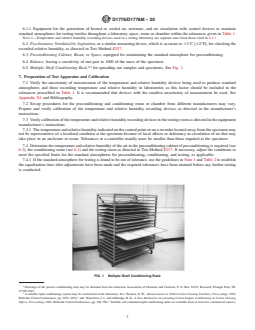
6.5 Multiple Shelf Conditioning Rack, for spreading out samples and specimens. See Fig. 1.
7. Preparation of Test Apparatus and Calibration
7.1 Verify the uncertainty of measurement of the temperature and relative humidity devices being used to produce standard
atmospheres and those recording temperature and relative humidity in laboratories as this factor should be included in the
tolerances prescribed in Table 1. It is recommended that devices with the smallest uncertainty of measurement be used. See
Appendix X1 and Bibliography.
7.2 Set-up procedures for the preconditioning and conditioning room or chamber from different manufacturers may vary.
Prepare and verify calibration of the temperature and relative humidity recording devices as directed in the manufacturer’s
instructions.
7.3 Verify calibration of the temperature and relative humidity recording devices in the testing room as directed in the equipment
manufacturer’s instructions.
7.3.1 The temperature and relative humidity indicated on the control point or on a recorder located away from the specimen may
not be representative of a localized condition at the specimen because of local effects or deficiency in circulation of air that may
take place in an enclosure or room. Tolerances at a controller usually must be smaller than those required at the specimen.
7.4 Determine the temperature and relative humidity of the air in the preconditioning cabinet if preconditioning is required (see
6.3), the conditioning room (see 6.1) and the testing room as directed in Test Method E337. If necessary, adjust the conditions to
meet the specified limits for the standard atmospheres for preconditioning, conditioning, and testing, as applicable.
7.4.1 If the standard atmosphere for testing is f
...
Questions, Comments and Discussion
Ask us and Technical Secretary will try to provide an answer. You can facilitate discussion about the standard in here.
Loading comments...