

ASTM C1922-23
(Test Method)Standard Test Method for Water Retention of Hydraulic Cement-Based Mortars and Plasters by Way of Water Loss
General Information
- Abstract
SIGNIFICANCE AND USE
5.1 This test method provides a means for determining the ability of mortars and plasters to retain water when applied to specific substrates based on the intended use of the tested mortar.
5.2 The results obtained using this test method may be used to compare the relative ability of mortars and plasters to retain water when applied to different substrates or in comparison to other mortars or plasters applied to the same substrate.
5.2.1 If applied to the same substrate, water retention values of different mortar can be compared.
5.2.2 One mortar may be applied to different substrates to understand the impact of varying substrates on water retention of the mortar.
5.3 The results obtained using this test method do not necessarily indicate the degree of water retention when used with substrates found in the field. This is because the amount of water absorbed by the substrate depends not only on the ability of the mortar to retain water but also on the particular absorption of the substrate and environmental conditions. Environmental conditions are not taken into account in this test method.
5.4 The results obtained using this test method for plasters (stucco) do not necessarily indicate the degree of water retention when the plaster is applied as a second coat on the surface of a previously applied plaster base coat, since the amount of water absorbed from the second coat of plaster depends on the rate of absorption of the base coat. This is also true when a plaster is applied as a coating on masonry units.
SCOPE
1.1 This test method provides for the determination of water retention of hydraulic cement based mortars and plasters. Water Retention is directly measured through the absorption of water from the mortar by the substrate. Various substrates may be chosen by the user based on the intended use of the tested mortar. This test method defines such substrates. Comparisons can be made between different mortars on the same substrate or the same mortar on different substrates.
1.2 This test method provides a water retention value via direct water loss, while Test Method C1506 provides a water retention value via mortar flow.
1.3 Units—The values stated in SI units are to be regarded as standard. No other units of measurement are included in this standard. When combined standards are cited, the selection of the measurement systems is at the user’s discretion subject to the requirements of the referenced standard.
1.4 The text of this test method references notes and footnotes that provide explanatory material. These notes and footnotes, excluding those in tables and figures, shall not be considered as requirements of this standard.
1.5 This standard does not purport to address all of the safety concerns, if any, associated with its use. It is the responsibility of the user of this standard to establish appropriate safety, health, and environmental practices and determine the applicability of regulatory limitations prior to use. See the Safety Data Sheet for safety information regarding the materials being tested.
1.6 This international standard was developed in accordance with internationally recognized principles on standardization established in the Decision on Principles for the Development of International Standards, Guides and Recommendations issued by the World Trade Organization Technical Barriers to Trade (TBT) Committee.
- Status
- Published
- Publication Date
- 31-May-2023
- Technical Committee
- C01 - Cement
- Drafting Committee
- C01.22 - Workability
Overview
ASTM C1922-23: Standard Test Method for Water Retention of Hydraulic Cement-Based Mortars and Plasters by Way of Water Loss provides a precise and uniform method for measuring the water retention capacity of hydraulic cement-based mortars and plasters. Developed by ASTM International, this standard is crucial for evaluating how effectively such materials retain water when applied to different substrates, which has significant implications for their performance, durability, and application in building construction.
This test method directly assesses water retention by quantifying the amount of water lost from the mortar or plaster to the substrate, allowing users to make relative comparisons between different materials and substrate types. The procedure is established in accordance with international principles for standardization, ensuring its broad acceptance and reliability.
Key Topics
- Water Retention Measurement: The standard defines a laboratory test for determining the percentage of water retained by mortar or plaster after application to a chosen substrate.
- Comparative Evaluation: Results can be used to compare the water retention abilities of various mortars and plasters on the same substrate, or to assess how a single material performs across different substrates.
- Impact of Substrate and Environment: The substrate’s absorption capacity influences test outcomes, and environmental factors in real-world conditions may result in different field performance.
- Test Setup: The procedure utilizes controlled laboratory equipment, including a balance, nonabsorbent frame, substrate, and filter paper, ensuring repeatability and accuracy.
- Applicability: The method applies to mortars and plasters used in masonry, tiling, and stucco applications, with specific guidance on choosing appropriate substrates for meaningful results.
- Limitations: While offering valuable comparative data, the test does not directly predict actual water retention on field substrates given variable environmental conditions and substrate absorption rates.
Applications
ASTM C1922-23 supports a wide range of practical uses in the construction and building materials industry:
- Product Development: Manufacturers of hydraulic cement mortars, plasters, or stucco use this standard to optimize formulations for improved water retention, which contributes to reduced cracking and better adhesion during application.
- Quality Control: Regular testing according to ASTM C1922-23 enables producers to maintain consistent material performance and meet industry specifications.
- Substrate Compatibility Assessment: Contractors and specifiers use water retention data to select the right mortar or plaster for specific substrates, facilitating compatibility and durable installation.
- Comparative Material Evaluation: The method provides a basis for comparing new products against established benchmarks or competing materials under controlled conditions.
- Research: Academic and industrial laboratories utilize the test for studying the impact of mix design, additives, and substrate properties on water retention characteristics.
Related Standards
To ensure comprehensive evaluation and compatibility with industry best practices, ASTM C1922-23 references and aligns with a series of related standards:
- ASTM C1506: Standard Test Method for Water Retention of Hydraulic Cement-Based Mortars and Plasters (using mortar flow).
- ASTM C305: Practice for Mechanical Mixing of Hydraulic Cement Pastes and Mortars of Plastic Consistency.
- ASTM C1375: Guide for Substrates Used in Testing Building Seals and Sealants.
- ASTM C1396: Specification for Gypsum Board.
- ASTM C1325: Specification for Fiber-Mat Reinforced Cementitious Backer Units.
- ASTM C1623: Specification for Manufactured Concrete Masonry Lintels.
- ASTM C1585: Test Method for Measurement of Rate of Absorption of Water by Hydraulic-Cement Concretes.
- ASTM C373: Test Methods for Determination of Water Absorption for Ceramic Tiles.
- ANSI A118: Specifications for Installation of Ceramic Tile.
- ISO 13007-2: Ceramic tiles - Adhesives - Test methods.
Keywords: ASTM C1922, water retention, hydraulic cement mortar, plaster, stucco, substrate absorption, cement-based materials, building materials testing, mortar performance, material comparison.
Relations
- Effective Date
- 01-Apr-2024
- Effective Date
- 01-Dec-2023
- Effective Date
- 01-Aug-2020
- Effective Date
- 15-Jul-2020
- Effective Date
- 01-Apr-2020
- Refers
ASTM C1375-00(2020) - Standard Guide for Substrates Used in Testing Building Seals and Sealants - Effective Date
- 01-Jan-2020
- Effective Date
- 15-Nov-2019
- Effective Date
- 01-Jun-2019
- Effective Date
- 01-Sep-2017
- Effective Date
- 01-Aug-2017
- Effective Date
- 01-Jan-2017
- Effective Date
- 15-Dec-2016
- Effective Date
- 01-Dec-2016
- Effective Date
- 01-Aug-2016
- Effective Date
- 01-Aug-2016
Get Certified
Connect with accredited certification bodies for this standard

DIBt (Deutsches Institut für Bautechnik)
German Institute for Building Technology.
DIN CERTCO
DIN Group product certification.

Aboma Certification B.V.
Specialized in construction, metal, and transport sectors.
Sponsored listings
Frequently Asked Questions
ASTM C1922-23 is a standard published by ASTM International. Its full title is "Standard Test Method for Water Retention of Hydraulic Cement-Based Mortars and Plasters by Way of Water Loss". This standard covers: SIGNIFICANCE AND USE 5.1 This test method provides a means for determining the ability of mortars and plasters to retain water when applied to specific substrates based on the intended use of the tested mortar. 5.2 The results obtained using this test method may be used to compare the relative ability of mortars and plasters to retain water when applied to different substrates or in comparison to other mortars or plasters applied to the same substrate. 5.2.1 If applied to the same substrate, water retention values of different mortar can be compared. 5.2.2 One mortar may be applied to different substrates to understand the impact of varying substrates on water retention of the mortar. 5.3 The results obtained using this test method do not necessarily indicate the degree of water retention when used with substrates found in the field. This is because the amount of water absorbed by the substrate depends not only on the ability of the mortar to retain water but also on the particular absorption of the substrate and environmental conditions. Environmental conditions are not taken into account in this test method. 5.4 The results obtained using this test method for plasters (stucco) do not necessarily indicate the degree of water retention when the plaster is applied as a second coat on the surface of a previously applied plaster base coat, since the amount of water absorbed from the second coat of plaster depends on the rate of absorption of the base coat. This is also true when a plaster is applied as a coating on masonry units. SCOPE 1.1 This test method provides for the determination of water retention of hydraulic cement based mortars and plasters. Water Retention is directly measured through the absorption of water from the mortar by the substrate. Various substrates may be chosen by the user based on the intended use of the tested mortar. This test method defines such substrates. Comparisons can be made between different mortars on the same substrate or the same mortar on different substrates. 1.2 This test method provides a water retention value via direct water loss, while Test Method C1506 provides a water retention value via mortar flow. 1.3 Units—The values stated in SI units are to be regarded as standard. No other units of measurement are included in this standard. When combined standards are cited, the selection of the measurement systems is at the user’s discretion subject to the requirements of the referenced standard. 1.4 The text of this test method references notes and footnotes that provide explanatory material. These notes and footnotes, excluding those in tables and figures, shall not be considered as requirements of this standard. 1.5 This standard does not purport to address all of the safety concerns, if any, associated with its use. It is the responsibility of the user of this standard to establish appropriate safety, health, and environmental practices and determine the applicability of regulatory limitations prior to use. See the Safety Data Sheet for safety information regarding the materials being tested. 1.6 This international standard was developed in accordance with internationally recognized principles on standardization established in the Decision on Principles for the Development of International Standards, Guides and Recommendations issued by the World Trade Organization Technical Barriers to Trade (TBT) Committee.
SIGNIFICANCE AND USE 5.1 This test method provides a means for determining the ability of mortars and plasters to retain water when applied to specific substrates based on the intended use of the tested mortar. 5.2 The results obtained using this test method may be used to compare the relative ability of mortars and plasters to retain water when applied to different substrates or in comparison to other mortars or plasters applied to the same substrate. 5.2.1 If applied to the same substrate, water retention values of different mortar can be compared. 5.2.2 One mortar may be applied to different substrates to understand the impact of varying substrates on water retention of the mortar. 5.3 The results obtained using this test method do not necessarily indicate the degree of water retention when used with substrates found in the field. This is because the amount of water absorbed by the substrate depends not only on the ability of the mortar to retain water but also on the particular absorption of the substrate and environmental conditions. Environmental conditions are not taken into account in this test method. 5.4 The results obtained using this test method for plasters (stucco) do not necessarily indicate the degree of water retention when the plaster is applied as a second coat on the surface of a previously applied plaster base coat, since the amount of water absorbed from the second coat of plaster depends on the rate of absorption of the base coat. This is also true when a plaster is applied as a coating on masonry units. SCOPE 1.1 This test method provides for the determination of water retention of hydraulic cement based mortars and plasters. Water Retention is directly measured through the absorption of water from the mortar by the substrate. Various substrates may be chosen by the user based on the intended use of the tested mortar. This test method defines such substrates. Comparisons can be made between different mortars on the same substrate or the same mortar on different substrates. 1.2 This test method provides a water retention value via direct water loss, while Test Method C1506 provides a water retention value via mortar flow. 1.3 Units—The values stated in SI units are to be regarded as standard. No other units of measurement are included in this standard. When combined standards are cited, the selection of the measurement systems is at the user’s discretion subject to the requirements of the referenced standard. 1.4 The text of this test method references notes and footnotes that provide explanatory material. These notes and footnotes, excluding those in tables and figures, shall not be considered as requirements of this standard. 1.5 This standard does not purport to address all of the safety concerns, if any, associated with its use. It is the responsibility of the user of this standard to establish appropriate safety, health, and environmental practices and determine the applicability of regulatory limitations prior to use. See the Safety Data Sheet for safety information regarding the materials being tested. 1.6 This international standard was developed in accordance with internationally recognized principles on standardization established in the Decision on Principles for the Development of International Standards, Guides and Recommendations issued by the World Trade Organization Technical Barriers to Trade (TBT) Committee.
ASTM C1922-23 is classified under the following ICS (International Classification for Standards) categories: 91.100.10 - Cement. Gypsum. Lime. Mortar. The ICS classification helps identify the subject area and facilitates finding related standards.
ASTM C1922-23 has the following relationships with other standards: It is inter standard links to ASTM C219-24, ASTM C1623-23, ASTM C219-20a, ASTM C305-20, ASTM C219-20, ASTM C1375-00(2020), ASTM C219-19a, ASTM C219-19, ASTM C373-17, ASTM C1506-17, ASTM C1623-17, ASTM C1623-16, ASTM C1506-16b, ASTM C373-16e1, ASTM C373-16. Understanding these relationships helps ensure you are using the most current and applicable version of the standard.
ASTM C1922-23 is available in PDF format for immediate download after purchase. The document can be added to your cart and obtained through the secure checkout process. Digital delivery ensures instant access to the complete standard document.
Standards Content (Sample)
This international standard was developed in accordance with internationally recognized principles on standardization established in the Decision on Principles for the
Development of International Standards, Guides and Recommendations issued by the World Trade Organization Technical Barriers to Trade (TBT) Committee.
Designation: C1922 − 23
Standard Test Method for
Water Retention of Hydraulic Cement-Based Mortars and
Plasters by Way of Water Loss
This standard is issued under the fixed designation C1922; the number immediately following the designation indicates the year of
original adoption or, in the case of revision, the year of last revision. A number in parentheses indicates the year of last reapproval. A
superscript epsilon (´) indicates an editorial change since the last revision or reapproval.
1. Scope 2. Referenced Documents
2.1 ASTM Standards:
1.1 This test method provides for the determination of water
C219 Terminology Relating to Hydraulic and Other Inor-
retention of hydraulic cement based mortars and plasters.
ganic Cements
Water Retention is directly measured through the absorption of
C305 Practice for Mechanical Mixing of Hydraulic Cement
water from the mortar by the substrate. Various substrates may
Pastes and Mortars of Plastic Consistency
be chosen by the user based on the intended use of the tested
C373 Test Methods for Determination of Water Absorption
mortar. This test method defines such substrates. Comparisons
and Associated Properties by Vacuum Method for Pressed
can be made between different mortars on the same substrate or
Ceramic Tiles and Glass Tiles and Boil Method for
the same mortar on different substrates.
Extruded Ceramic Tiles and Non-tile Fired Ceramic
1.2 This test method provides a water retention value via
Whiteware Products
direct water loss, while Test Method C1506 provides a water
C1325 Specification for Fiber-Mat Reinforced Cementitious
retention value via mortar flow.
Backer Units
C1375 Guide for Substrates Used in Testing Building Seals
1.3 Units—The values stated in SI units are to be regarded
and Sealants
as standard. No other units of measurement are included in this
C1396 Specification for Gypsum Board
standard. When combined standards are cited, the selection of
C1506 Test Method for Water Retention of Hydraulic
the measurement systems is at the user’s discretion subject to
Cement-Based Mortars and Plasters
the requirements of the referenced standard.
C1585 Test Method for Measurement of Rate of Absorption
1.4 The text of this test method references notes and of Water by Hydraulic-Cement Concretes
C1623 Specification for Manufactured Concrete Masonry
footnotes that provide explanatory material. These notes and
Lintels
footnotes, excluding those in tables and figures, shall not be
considered as requirements of this standard.
2.2 ANSI Standards:
A118 American National Standard Specifications for the
1.5 This standard does not purport to address all of the
Installation of Ceramic Tile
safety concerns, if any, associated with its use. It is the
responsibility of the user of this standard to establish appro-
2.3 ISO Standards:
priate safety, health, and environmental practices and deter-
13007-2 Ceramic Tiles: Products for Installation Part 2
mine the applicability of regulatory limitations prior to use. Adhesives – Test Methods
See the Safety Data Sheet for safety information regarding the
materials being tested. 3. Terminology
1.6 This international standard was developed in accor-
3.1 Definitions—For definitions of terms used in this
dance with internationally recognized principles on standard-
specification, refer to Terminology C219.
ization established in the Decision on Principles for the
Development of International Standards, Guides and Recom-
mendations issued by the World Trade Organization Technical
For referenced ASTM standards, visit the ASTM website, www.astm.org, or
Barriers to Trade (TBT) Committee.
contact ASTM Customer Service at service@astm.org. For Annual Book of ASTM
Standards volume information, refer to the standard’s Document Summary page on
the ASTM website.
Available from American National Standards Institute (ANSI), 25 W. 43rd St.,
This test method is under the jurisdiction of ASTM Committee C01 on Cement 4th Floor, New York, NY 10036, http://www.ansi.org.
and is the direct responsibility of Subcommittee C01.22 on Workability. Available from International Organization for Standardization (ISO), ISO
Current edition approved June 1, 2023. Published July 2023. DOI: 10.1520/ Central Secretariat, Chemin de Blandonnet 8, CP 401, 1214 Vernier, Geneva,
C1922-23. Switzerland, https://www.iso.org.
Copyright © ASTM International, 100 Barr Harbor Drive, PO Box C700, West Conshohocken, PA 19428-2959. United States
C1922 − 23
4. Summary of Test Method thickness (see Note 1). The edges when placed on a plane
surface shall not depart from straightness by more than 1 mm.
4.1 The mortar or plaster is mixed with a known amount of
water according to the manufacturer’s recommendation. A
NOTE 1—A trowel may be used for this purpose.
substrate is selected based on the mortar or plaster’s intended
7.2 Mixing Apparatus—conforming to the requirements in
use. The mortar or plaster is then applied to a specified surface
Practice C305.
area of a substrate within the test frame using the necessary
7.3 Balance—A balance or scale accurate within 0.1 % of
volume of material to fill the frame and allowed to stand for
the test load at any point within the range of use, graduated to
5 minutes. Upon completion of the 5 minute standing period,
at least 0.1 g. The range of use shall extend from 0 g to the
the material is removed and the substrate with the absorbed
mass of the substrate and apparatus plus 200 g.
water is immediately weighed. The water retention is calcu-
lated from the amount of water that is lost from the mortar to
7.4 Test Apparatus—The apparatus consists of a nonabsor-
the substrate expressed as a percentage.
bent frame and nonabsorbent plate with a nonwoven filter
paper. The nonabsorbent frame and nonabsorbent plate shall be
4.2 If desired, the procedure is repeated using different
substrates so that the mortar’s or plaster’s relative ability to made of plastic or metal that does not react with cementitious
materials. If plastic, the nonabsorbent plate shall have a
retain water when applied to different substrates can be
compared, or the procedure is repeated using different mortars thickness of at least 2.0 mm. If metal, the nonabsorbent plate
shall have a thickness of at least 1.0 mm. The frame shall
or plasters so that different mortars’ or plasters’ relative ability
2 2
to retain water can be compared. provide an internal surface area of 169 cm 6 1.3 cm and
3 3
internal volume of 255 cm 6 36 cm .
5. Significance and Use
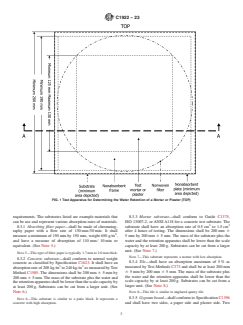
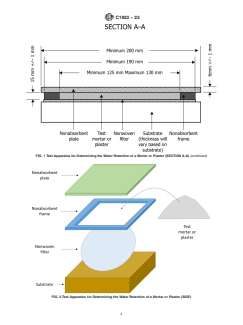
NOTE 2—An example of the test apparatus is depicted in Fig. 1.
5.1 This test method provides a means for determining the
7.5 Timer—Calibrated timer capable of measuring to the
ability of mortars and plasters to retain water when applied to
nearest second.
specific substrates based on the intended use of the tested
mortar.
7.6 Tamper—A nonabsorptive, nonabrasive, nonbrittle ma-
terial such as a rubber compound having a Shore A durometer
5.2 The results obtained using this test method may be used
hardness of 80 6 10, shall have a cross section of 13 mm 6
to compare the relative ability of mortars and plasters to retain
1.6 mm by 25 mm 6 1.6 mm and a length of 120 mm to
water when applied to different substrates or in comparison to
150 mm. The tamping face shall be flat and at right angles to
other mortars or plasters applied to the same substrate.
the length of the tamper. Tampers shall be checked for
5.2.1 If applied to the same substrate, water retention values
conformance to the design and dimensional requirements of
of different mortar can be compared.
this test method at least every six months. (See Note 3.)
5.2.2 One mortar may be applied to different substrates to
understand the impact of varying substrates on water retention
NOTE 3—Each day that the tamper is used, a visual inspection should
of the mortar.
confirm that the end is flat and at a right angle to the long axis of the
tamper. Rounded or peeling tampers should not be allowed for use.
5.3 The results obtained using this test method do not
7.7 Mortar Assembly—The test apparatus components with
necessarily indicate the degree of water retention when used
substrate and mortar are depicted in Fig. 1.
with substrates found in the field. This is because the amount
of water absorbed by the substrate depends not only on the
NOTE 4—The nonwoven filter is depicted as round but could be cut to
ability of the mortar to retain water but also on the particular
any shape larger than the inner area of the nonabsorbent frame.
absorption of the substrate and environmental conditions.
Environmental conditions are not taken into account in this test
8. Materials
method.
8.1 The composition of the mortar or plaster to be tested for
5.4 The results obtained using this test method for plasters
water retention shall be that described in the specification of
(stucco) do not necessarily indicate the degree of water
the material being considered, or that desired.
retention when the plaster is applied as a second coat on the
8.2 Nonwoven filter—nonwoven filter paper Grade 2601
surface of a previously applied plaster base coat, since the
with diameter of at least 190 mm made of a material similar to
amount of water absorbed from the second coat of plaster
rayon (viscose). The filter may be round or square.
depends on the rate of absorption of the base coat. This is also
true when a plaster is applied as a coating on masonry units.
8.3 Substrates—The piece of material the mortar will be
applied to. The substrate shall be free of defects. Use a
6. Interferences
substrate which matches in absorption to that of the substrate in
6.1 Substrate water absorption—Absorption of the substrate the intended application of the mortar or use different sub-
will have an impact on the test results. The substrate that is
strates to compare the behavior of the testing mortar or plaster
chosen for the test shall be reported with the results. sample when applied to various materials. Examples of pos-
sible substrates for the test include absorbing filter paper,
7. Apparatus
concrete substrates, tile, gypsum board, and cement board.
7.1 Straightedge—A steel straightedge not less than 200 mm Other substrates can be used based on the application of the
long and not less than 1.5 mm nor more than 3.5 mm in mortar. Job-specific substrates can be use if they fit the size
C1922 − 23
FIG. 1 Test Apparatus for Determining the Water Retention of a Mortar or Plaster (TOP)
requirements. The substrates lis
...