

ASTM C651-20
(Test Method)Standard Test Method for Flexural Strength of Manufactured Carbon and Graphite Articles Using Four-Point Loading at Room Temperature
General Information
- Abstract
ABSTRACT
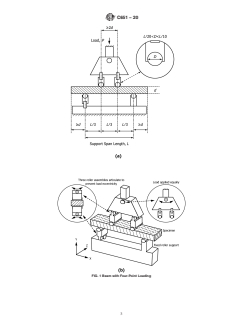
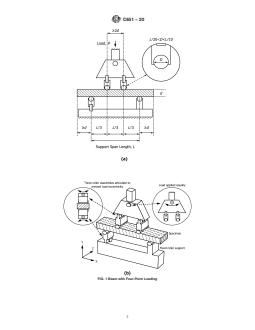
This test method details the standard procedures for determining the flexural strength of manufactured carbon and graphite articles using a simple beam in four-point loading at room temperature. The four-point loading fixture shall consist of spherical bearing blocks of hardened steel or its equivalent to ensure that forces applied to the beam are normal only and without eccentricity, and distortion of the loading member is prevented. Judicious use of linkages, rocker bearings, and flexure plates may maintain the parallel direction of loads and reactions. The test specimens shall be prepared to yield a parallelepiped with cross sections that are rectangular, faces that are parallel and flat, and edges that are free from visible flaws and chips.
SIGNIFICANCE AND USE
4.1 This test method may be used for material development, quality control, characterization, and design data generation purposes.
4.2 This test method determines the maximum loading on a graphite specimen with simple beam geometry in 4-point bending, and it provides a means for the calculation of flexural strength at ambient temperature and environmental conditions.
SCOPE
1.1 This test method covers determination of the flexural strength of manufactured carbon and graphite articles using a simple beam in four-point loading at room temperature.
1.2 The values stated in SI units are to be regarded as standard. No other units of measurement are included in this standard.
1.3 This standard does not purport to address all of the safety concerns, if any, associated with its use. It is the responsibility of the user of this standard to establish appropriate safety, health, and environmental practices and determine the applicability of regulatory limitations prior to use.
1.4 This international standard was developed in accordance with internationally recognized principles on standardization established in the Decision on Principles for the Development of International Standards, Guides and Recommendations issued by the World Trade Organization Technical Barriers to Trade (TBT) Committee.
- Status
- Published
- Publication Date
- 30-Apr-2020
- Technical Committee
- D02 - Petroleum Products, Liquid Fuels, and Lubricants
- Drafting Committee
- D02.F0 - Manufactured Carbon and Graphite Products
Buy Documents

ASTM C651-20 - Standard Test Method for Flexural Strength of Manufactured Carbon and Graphite Articles Using Four-Point Loading at Room Temperature
REDLINE ASTM C651-20 - Standard Test Method for Flexural Strength of Manufactured Carbon and Graphite Articles Using Four-Point Loading at Room Temperature
Overview
ASTM C651-20 defines the standard test method for determining the flexural strength of manufactured carbon and graphite articles using four-point loading at room temperature. This widely recognized ASTM International standard outlines the apparatus, specimen preparation, test procedures, and data reporting requirements to ensure consistent, accurate measurement of mechanical properties critical to the design, quality control, and characterization of carbon and graphite products. The method is essential for manufacturers, researchers, and quality assurance teams working with graphite and carbon materials where structural performance and reliability are key.
Key Topics
- Four-Point Loading: Measurement is performed with a simple beam supported at two points and loaded at two additional points, providing a uniform bending moment and minimizing shear effects. Test fixtures must prevent eccentricity and distortion, relying on spherical bearing blocks or equivalent roller assemblies.
- Specimen Preparation:
- Test specimens are parallelepipeds with a rectangular cross-section
- Surfaces must be flat and parallel, with edges free from visible flaws and chips
- Surface roughness and dimensional requirements are specified for precision
- Testing Conditions:
- Tests are conducted at room temperature
- The loading rate and span dimensions are tightly controlled
- Moisture control is necessary, as absorbed water can impact results
- Data Reporting: All relevant test information, including load at failure, specimen geometry, orientation, and observed defects, must be meticulously recorded for accurate interpretation and standardization.
Applications
Organizations and laboratories utilize ASTM C651-20 to:
- Material Development: Assess the mechanical performance of new carbon and graphite materials, providing essential flexural strength data for R&D.
- Quality Control: Monitor production consistency by ensuring manufactured articles meet required strength criteria, reducing the risk of failure in service.
- Product Characterization: Generate material property data for technical datasheets or compliance with regulatory and industry requirements.
- Design and Engineering: Inform design calculations and simulations for graphite and carbon components in industries such as:
- Electrical (e.g., electrodes, brushes)
- Industrial furnaces and refractories
- Aerospace and automotive applications where lightweight, high-strength carbon materials are used
This standard test method supports engineers and material scientists in making informed decisions based on reliable, comparable physical property data.
Related Standards
ASTM C651-20 references several related standards for flexural strength testing and apparatus calibration, including:
- ASTM C78 - Test Method for Flexural Strength of Concrete (Using Simple Beam with Third-Point Loading)
- ASTM C1161 - Test Method for Flexural Strength of Advanced Ceramics at Ambient Temperature
- ASTM E4 - Practices for Force Verification of Testing Machines
- ASTM E177 - Practice for Use of the Terms Precision and Bias in ASTM Test Methods
- ASTM E691 - Practice for Conducting an Interlaboratory Study to Determine the Precision of a Test Method
These standards establish a robust framework for mechanical testing, ensuring the reliability, repeatability, and reproducibility of flexural strength measurements across laboratories and applications globally.
Keywords: ASTM C651, flexural strength, carbon, graphite, four-point loading, mechanical testing, material characterization, quality control, standard test method
Relations
- Effective Date
- 01-May-2020
- Effective Date
- 01-Jun-2014
- Effective Date
- 01-May-2014
- Effective Date
- 01-Aug-2013
- Effective Date
- 01-May-2013
- Effective Date
- 01-May-2013
- Effective Date
- 01-Nov-2011
- Effective Date
- 01-Oct-2010
- Effective Date
- 01-Jun-2010
- Effective Date
- 01-Nov-2009
- Effective Date
- 01-Jul-2009
- Effective Date
- 01-Apr-2009
- Effective Date
- 01-Dec-2008
- Effective Date
- 01-Oct-2008
- Effective Date
- 01-Oct-2008
Buy Documents
ASTM C651-20 - Standard Test Method for Flexural Strength of Manufactured Carbon and Graphite Articles Using Four-Point Loading at Room Temperature
REDLINE ASTM C651-20 - Standard Test Method for Flexural Strength of Manufactured Carbon and Graphite Articles Using Four-Point Loading at Room Temperature
Get Certified
Connect with accredited certification bodies for this standard

ECOCERT
Organic and sustainability certification.

Eurofins Food Testing Global
Global leader in food, environment, and pharmaceutical product testing.

Intertek Bangladesh
Intertek certification and testing services in Bangladesh.
Sponsored listings
Frequently Asked Questions
ASTM C651-20 is a standard published by ASTM International. Its full title is "Standard Test Method for Flexural Strength of Manufactured Carbon and Graphite Articles Using Four-Point Loading at Room Temperature". This standard covers: ABSTRACT This test method details the standard procedures for determining the flexural strength of manufactured carbon and graphite articles using a simple beam in four-point loading at room temperature. The four-point loading fixture shall consist of spherical bearing blocks of hardened steel or its equivalent to ensure that forces applied to the beam are normal only and without eccentricity, and distortion of the loading member is prevented. Judicious use of linkages, rocker bearings, and flexure plates may maintain the parallel direction of loads and reactions. The test specimens shall be prepared to yield a parallelepiped with cross sections that are rectangular, faces that are parallel and flat, and edges that are free from visible flaws and chips. SIGNIFICANCE AND USE 4.1 This test method may be used for material development, quality control, characterization, and design data generation purposes. 4.2 This test method determines the maximum loading on a graphite specimen with simple beam geometry in 4-point bending, and it provides a means for the calculation of flexural strength at ambient temperature and environmental conditions. SCOPE 1.1 This test method covers determination of the flexural strength of manufactured carbon and graphite articles using a simple beam in four-point loading at room temperature. 1.2 The values stated in SI units are to be regarded as standard. No other units of measurement are included in this standard. 1.3 This standard does not purport to address all of the safety concerns, if any, associated with its use. It is the responsibility of the user of this standard to establish appropriate safety, health, and environmental practices and determine the applicability of regulatory limitations prior to use. 1.4 This international standard was developed in accordance with internationally recognized principles on standardization established in the Decision on Principles for the Development of International Standards, Guides and Recommendations issued by the World Trade Organization Technical Barriers to Trade (TBT) Committee.
ABSTRACT This test method details the standard procedures for determining the flexural strength of manufactured carbon and graphite articles using a simple beam in four-point loading at room temperature. The four-point loading fixture shall consist of spherical bearing blocks of hardened steel or its equivalent to ensure that forces applied to the beam are normal only and without eccentricity, and distortion of the loading member is prevented. Judicious use of linkages, rocker bearings, and flexure plates may maintain the parallel direction of loads and reactions. The test specimens shall be prepared to yield a parallelepiped with cross sections that are rectangular, faces that are parallel and flat, and edges that are free from visible flaws and chips. SIGNIFICANCE AND USE 4.1 This test method may be used for material development, quality control, characterization, and design data generation purposes. 4.2 This test method determines the maximum loading on a graphite specimen with simple beam geometry in 4-point bending, and it provides a means for the calculation of flexural strength at ambient temperature and environmental conditions. SCOPE 1.1 This test method covers determination of the flexural strength of manufactured carbon and graphite articles using a simple beam in four-point loading at room temperature. 1.2 The values stated in SI units are to be regarded as standard. No other units of measurement are included in this standard. 1.3 This standard does not purport to address all of the safety concerns, if any, associated with its use. It is the responsibility of the user of this standard to establish appropriate safety, health, and environmental practices and determine the applicability of regulatory limitations prior to use. 1.4 This international standard was developed in accordance with internationally recognized principles on standardization established in the Decision on Principles for the Development of International Standards, Guides and Recommendations issued by the World Trade Organization Technical Barriers to Trade (TBT) Committee.
ASTM C651-20 is classified under the following ICS (International Classification for Standards) categories: 71.100.99 - Other products of the chemical industry. The ICS classification helps identify the subject area and facilitates finding related standards.
ASTM C651-20 has the following relationships with other standards: It is inter standard links to ASTM C651-15, ASTM E4-14, ASTM E177-14, ASTM C1161-13, ASTM E177-13, ASTM E691-13, ASTM E691-11, ASTM E177-10, ASTM E4-10, ASTM E4-09a, ASTM C78-09, ASTM E4-09, ASTM E4-08, ASTM E691-08, ASTM E177-08. Understanding these relationships helps ensure you are using the most current and applicable version of the standard.
ASTM C651-20 is available in PDF format for immediate download after purchase. The document can be added to your cart and obtained through the secure checkout process. Digital delivery ensures instant access to the complete standard document.
Standards Content (Sample)
This international standard was developed in accordance with internationally recognized principles on standardization established in the Decision on Principles for the
Development of International Standards, Guides and Recommendations issued by the World Trade Organization Technical Barriers to Trade (TBT) Committee.
Designation: C651 − 20
Standard Test Method for
Flexural Strength of Manufactured Carbon and Graphite
Articles Using Four-Point Loading at Room Temperature
This standard is issued under the fixed designation C651; the number immediately following the designation indicates the year of
original adoption or, in the case of revision, the year of last revision. A number in parentheses indicates the year of last reapproval. A
superscript epsilon (´) indicates an editorial change since the last revision or reapproval.
This standard has been approved for use by agencies of the U.S. Department of Defense.
1. Scope* 3. Terminology
1.1 This test method covers determination of the flexural
3.1 Definitions:
strength of manufactured carbon and graphite articles using a
3.1.1 flexural strength, n—a measure of the ultimate load
simple beam in four-point loading at room temperature.
carrying capacity of a specified beam in bending.
1.2 The values stated in SI units are to be regarded as
standard. No other units of measurement are included in this 4. Significance and Use
standard.
4.1 This test method may be used for material development,
1.3 This standard does not purport to address all of the
quality control, characterization, and design data generation
safety concerns, if any, associated with its use. It is the
purposes.
responsibility of the user of this standard to establish appro-
4.2 This test method determines the maximum loading on a
priate safety, health, and environmental practices and deter-
graphite specimen with simple beam geometry in 4-point
mine the applicability of regulatory limitations prior to use.
bending, and it provides a means for the calculation of flexural
1.4 This international standard was developed in accor-
strength at ambient temperature and environmental conditions.
dance with internationally recognized principles on standard-
ization established in the Decision on Principles for the
Development of International Standards, Guides and Recom- 5. Apparatus
mendations issued by the World Trade Organization Technical
5.1 The testing machine shall conform to the requirements
Barriers to Trade (TBT) Committee.
of Practices E4.
2. Referenced Documents
5.2 The four-point loading fixture shall consist of bearing
blocks or cylindrical bearings spaced in a third-point loading
2.1 ASTM Standards:
configuration (see Test Method C78).
C78 Test Method for Flexural Strength of Concrete (Using
Simple Beam with Third-Point Loading)
5.3 The fixture shall ensure that forces applied to the beam
C1161 Test Method for Flexural Strength of Advanced
are normal only and without eccentricity through the use of
Ceramics at Ambient Temperature
spherical bearing blocks (see Test Method C78) or articulating
E4 Practices for Force Verification of Testing Machines
roller bearing assemblies (see Test Method C1161).
E177 Practice for Use of the Terms Precision and Bias in
5.3.1 The bearing block or roller bearing diameter shall be
ASTM Test Methods
1 1
between ⁄10 and ⁄20 of the specimen support span.Ahardened
E691 Practice for Conducting an Interlaboratory Study to
steel bearing block or its equivalent is necessary to prevent
Determine the Precision of a Test Method
distortion of the loading member. Support surfaces must be
free to pivot or rotate to relieve frictional constraints.
5.4 The directions of loads and reactions may be maintained
This test method is under the jurisdiction of ASTM Committee D02 on
Petroleum Products, Liquid Fuels, and Lubricants and is the direct responsibility of
parallel by judicious use of linkages, rocker bearings, and
Subcommittee D02.F0 on Manufactured Carbon and Graphite Products.
flexure plates. Eccentricity of loading can be avoided by the
Current edition approved May 1, 2020. Published May 2020. Originally
use of spherical bearing blocks or articulating roller bearings.
approved in 1970. Last previous edition approved in 2015 as C651 – 15.
DOI:10.1520/C0651-20.
Provision must be made in fixture design for the relief of
For referenced ASTM standards, visit the ASTM website, www.astm.org, or
torsional loading to less than 5 % of the nominal specimen
contact ASTM Customer Service at service@astm.org. For Annual Book of ASTM
strength. Refer to the attached figure for a suggested four-point
Standards volume information, refer to the standard’s Document Summary page on
the ASTM website. loading fixture.
*A Summary of Changes section appears at the end of this standard
Copyright © ASTM International, 100 Barr Harbor Drive, PO Box C700, West Conshohocken, PA 19428-2959. United States
C651 − 20
6. Test Specimen 9. Calculation
6.1 Preparation—The test specimen shall be prepared to
9.1 If the fracture occurs within the span length between the
yield a parallelepiped of rectangular cross section. The faces
load bearing surfaces (that is, within the load span), calculate
shall be parallel and flat within 0.025 mm⁄mm of length. In
the flexural strength as follows:
addition, the samples having a maximum particle size less than
S 5 PL/ bd
0.150 mm in diameter must be finished so that the surface
roughness is less than 3 µm Ra. Sample edges should be free
where:
from visible flaws and chips.
S = flexural strength, MPa,
P = maximumappliedloadindicatedbythetestingmachine,
NOTE 1—For ease of machining to conventional standards, 3 µm Ra is
N,
equivalent to 125 µin. AA. For finishing of specimens with maximum
L = support span length, mm,
particle sizes of greater than 0.150 mm, grain structure and porosity can
limit the accurate measurement of roughness. In these cases, the surface
b = average width of specimen, mm, and
roughness should be visually equivalent to 3 µm Ra as estimated based on
d = average thickness of specimen, mm.
the visible surface of the graphite
9.2 If the fracture occurs outside of the span length between
6.2 Size—The size of the test specimen shall be selected
load bearing blocks, the location of the fracture shall be
such that the minimum dimension of the specimen is greater
recorded as such, and the results of the test shall be reported.
than 5 times the largest particle dimension. The test specimen
Occasionalbreaksoutsidetheinnerloadspanin4-pointflexure
shall have a length to thickness ratio of at least 8, and a width
are not unusual, and can often be attributed to large natural
to thickness ratio not greater than 2.
flaws in the material.
6.3 Measurements—Alldimensionsshallbemeasuredtothe
NOTE 3—Angular fractures that effectively traverse the load roller
nearest 0.5 %.
contact point but are
...
This document is not an ASTM standard and is intended only to provide the user of an ASTM standard an indication of what changes have been made to the previous version. Because
it may not be technically possible to adequately depict all changes accurately, ASTM recommends that users consult prior editions as appropriate. In all cases only the current version
of the standard as published by ASTM is to be considered the official document.
Designation: C651 − 15 C651 − 20 An American National Standard
Standard Test Method for
Flexural Strength of Manufactured Carbon and Graphite
Articles Using Four-Point Loading at Room Temperature
This standard is issued under the fixed designation C651; the number immediately following the designation indicates the year of
original adoption or, in the case of revision, the year of last revision. A number in parentheses indicates the year of last reapproval. A
superscript epsilon (´) indicates an editorial change since the last revision or reapproval.
This standard has been approved for use by agencies of the U.S. Department of Defense.
1. Scope*
1.1 This test method covers determination of the flexural strength of manufactured carbon and graphite articles using a simple
beam in four-point loading at room temperature.
1.2 The values stated in SI units are to be regarded as standard. No other units of measurement are included in this standard.
1.3 This standard does not purport to address all of the safety concerns, if any, associated with its use. It is the responsibility
of the user of this standard to establish appropriate safety safety, health, and healthenvironmental practices and determine the
applicability of regulatory limitations prior to use.
1.4 This international standard was developed in accordance with internationally recognized principles on standardization
established in the Decision on Principles for the Development of International Standards, Guides and Recommendations issued
by the World Trade Organization Technical Barriers to Trade (TBT) Committee.
2. Referenced Documents
2.1 ASTM Standards:
C78 Test Method for Flexural Strength of Concrete (Using Simple Beam with Third-Point Loading)
C1161 Test Method for Flexural Strength of Advanced Ceramics at Ambient Temperature
E4 Practices for Force Verification of Testing Machines
E177 Practice for Use of the Terms Precision and Bias in ASTM Test Methods
E691 Practice for Conducting an Interlaboratory Study to Determine the Precision of a Test Method
3. Terminology
3.1 Definitions:
3.1.1 flexural strength, n—property of a solid material that indicates its ability to withstand a flexural or transverse load,
obtained through a measurement a measure of the ultimate load-carrying load carrying capacity of a specified beam in bending.
4. Significance and Use
4.1 This test method may be used for material development, quality control, characterization, and design data generation
purposes.
4.2 This test method determines the maximum loading on a graphite specimen with simple beam geometry in 4-point bending,
and it provides a means for the calculation of flexural strength at ambient temperature and environmental conditions.
5. Apparatus
5.1 The testing machine shall conform to the requirements of Practices E4.
5.2 The four-point loading fixture shall consist of bearing blocks or cylindrical bearings spaced in a third-point loading
configuration (see Test Method C78).
This test method is under the jurisdiction of ASTM Committee D02 on Petroleum Products, Liquid Fuels, and Lubricants and is the direct responsibility of Subcommittee
D02.F0 on Manufactured Carbon and Graphite Products.
Current edition approved Oct. 1, 2015May 1, 2020. Published November 2015May 2020. Originally approved in 1970. Last previous edition approved in 20132015 as
C651 – 13.C651 – 15. DOI:10.1520/C0651-15.DOI:10.1520/C0651-20.
For referenced ASTM standards, visit the ASTM website, www.astm.org, or contact ASTM Customer Service at service@astm.org. For Annual Book of ASTM Standards
volume information, refer to the standard’s Document Summary page on the ASTM website.
*A Summary of Changes section appears at the end of this standard
Copyright © ASTM International, 100 Barr Harbor Drive, PO Box C700, West Conshohocken, PA 19428-2959. United States
C651 − 20
5.3 The fixture shall ensure that forces applied to the beam are normal only and without eccentricity through the use of spherical
bearing blocks (see Test Method C78) or articulating roller bearing assemblies (see Test Method C1161).
1 1
5.3.1 The bearing block or roller bearing diameter shall be between ⁄10 and ⁄20 of the specimen support span. A hardened steel
bearing block or its equivalent is necessary to prevent distortion of the loading member. Support surfaces must be free to pivot
or rotate to relieve frictional constraints.
5.4 The directions of loads and reactions may be maintained parallel by judicious use of linkages, rocker bearings, and flexure
plates. Eccentricity of loading can be avoided by the use of spherical bearing blocks or articulating roller bearings. Provision must
be made in fixture design for the relief of torsional loading to less than 5 % of the nominal specimen strength. Refer to the attached
figure for a suggested four-point loading fixture.
6. Test Specimen
6.1 Preparation—The test specimen shall be prepared to yield a parallelepiped of rectangular cross section. The faces shall be
parallel and flat within 0.025 mm ⁄mm of length. In addition, the samples having a maximum particle size less than 0.150 mm in
diameter must be finished so that the surface roughness is less than 3 μm Ra. Sample edges should be free from visible flaws and
chips.
NOTE 1—For ease of machining to conventional standards, 3 μm Ra is equivalent to 125 μin. AA. For finishing of specimens with maximum particle
sizes of greater than 0.150 mm, grain structure and porosity can limit the accurate measurement of roughness. In these cases, the surface roughness should
be visually equivalent to 3 μm Ra as estimated based on the visible surface of the graphite
6.2 Size—The size of the test specimen shall be selected such that the minimum dimension of the specimen is greater than 5
times the largest particle dimension. The test specimen shall have a length to thickness ratio of at least 8, and a width to thickness
ratio not greater than 2.
6.3 Measurements—All dimensions shall be measured to the nearest 0.5 %.
6.4 Orientation—The specimen shall be marked or otherwise identified to denote its orientation with respect to the parent stock.
6.5 Drying—Each specimen must be dried in a vented oven at 120 °C to 150 °C for a period of 2 h. The sample must then be
stored in a dry environment or a desiccator and held there prior to testing.
NOTE 2—Water, either in the form of liquid or as humidity in air, can have an effect on flexural mechanical behavior. Excessive adsorbed water can
result in a reduced failure stress due to a decrease in fracture surface energy.
7. Procedure
7.1 Center the load applying bearing surfaces and the test specimen on the support bearing surfaces. The load span is at least
two times the sample thickne
...