

ASTM A696-17(2022)
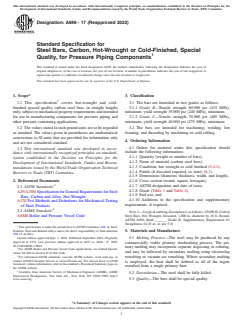
(Specification)Standard Specification for Steel Bars, Carbon, Hot-Wrought or Cold-Finished, Special Quality, for Pressure Piping Components
General Information
- Abstract
ABSTRACT
This specification covers hot-wrought and cold-finished special quality carbon steel bars, in straight lengths only, subject to mechanical property requirements and intended for use in manufacturing components for pressure piping and other pressure-containing applications. The steel bars are furnished in Grade B and Grade C and shall be made by melting, deoxidation, hot and cold working, heat treatment, and shall have special quality. Heat and product analyses shall be performed on the material and the chemical composition shall conform to the values required in carbon, manganese, phosphorus, sulfur, silicon, and lead. The carbon steel shall undergo tensile testing and conform to the required tensile strength, yield strength, and elongation.
SCOPE
1.1 This specification2 covers hot-wrought and cold-finished special quality carbon steel bars, in straight lengths only, subject to mechanical property requirements and intended for use in manufacturing components for pressure piping and other pressure-containing applications.
1.2 The values stated in inch-pound units are to be regarded as standard. The values given in parentheses are mathematical conversions to SI units that are provided for information only and are not considered standard.
1.3 This international standard was developed in accordance with internationally recognized principles on standardization established in the Decision on Principles for the Development of International Standards, Guides and Recommendations issued by the World Trade Organization Technical Barriers to Trade (TBT) Committee.
- Status
- Published
- Publication Date
- 31-Aug-2022
- Technical Committee
- A01 - Steel, Stainless Steel and Related Alloys
- Drafting Committee
- A01.15 - Bars


Overview
ASTM A696-17(2022) is the standard specification developed by ASTM International for steel bars, carbon, hot-wrought or cold-finished, special quality, intended specifically for use in manufacturing pressure piping components and other pressure-containing applications. This standard covers steel bars in straight lengths only and mandates specified mechanical properties, making it essential for industries that require reliability and performance in high-pressure environments. The specification defines requirements for chemical composition, mechanical properties, manufacturing processes, testing, and certification to ensure product quality and safety.
Key Topics
- Material Grades: The standard classifies bars in two grades based on mechanical strength:
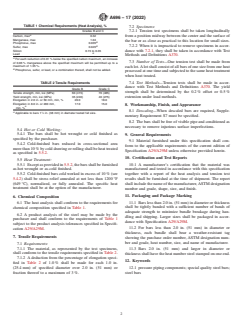
- Grade B: Minimum tensile strength 60,000 psi (415 MPa) and yield strength 35,000 psi (240 MPa)
- Grade C: Minimum tensile strength 70,000 psi (485 MPa) and yield strength 40,000 psi (275 MPa)
- Manufacturing Processes:
- Bars are produced by melting, deoxidation, hot or cold working, and may be heat treated.
- Cold-finished bars with more than 10% reduction in cross-sectional area must be stress relief annealed, normalized, or fully annealed.
- Full deoxidation (killed steel) is required.
- Chemical Composition:
- Limits for carbon (max 0.32%), manganese (max 1.04%), phosphorus (max 0.035%), sulfur (max 0.045%), and silicon (0.15%-0.35%). Lead may not be intentionally added.
- Both heat and product analyses are required to confirm chemistry.
- Mechanical Testing:
- Bars must meet minimum tensile and yield strength, as well as elongation requirements.
- Tensile tests are conducted using ASTM A370 test methods.
- Quality & Appearance:
- Bars must be free of injurious surface imperfections.
- Special requirements cover straightness, surface quality, internal soundness, size tolerances, and descaling if specified.
- Order Requirements:
- The standard outlines mandatory information for orders, including grade, condition, finish, dimensions, cross-section, and any supplementary requirements.
Applications
ASTM A696 steel bars are vital in the manufacture of components for pressure piping systems, including parts that handle high pressures in industrial and energy applications. Typical uses include:
- Boiler tubes and headers
- Piping system supports
- Flanges, fittings, and valves for pressure service
- Shafts and structural parts in power generation and oil & gas sectors
The specification ensures that materials used in these critical components have predictable performance, machinability, weldability, and strength, helping manufacturers meet industry requirements and ensure safety and reliability in operation.
Related Standards
When implementing or referencing ASTM A696-17(2022), the following relevant standards are commonly used:
- ASTM A29/A29M: General Requirements for Steel Bars, Carbon and Alloy, Hot-Wrought
- ASTM A370: Test Methods and Definitions for Mechanical Testing of Steel Products
- ASME Boiler and Pressure Vessel Code: Recognized for applications in pressure vessel construction (see related Specification SA-696)
ASTM A696-17(2022) adheres to internationally recognized principles for standardization, as outlined by the World Trade Organization (WTO) Technical Barriers to Trade (TBT) Committee, ensuring its suitability for global applications.
Keywords: ASTM A696, carbon steel bars, special quality, pressure piping components, hot-wrought, cold-finished, mechanical requirements, chemical composition, pressure-containing applications, steel bar standards.
Relations
- Effective Date
- 01-Mar-2024
- Effective Date
- 01-Jul-2019
- Refers
ASTM A370-17a - Standard Test Methods and Definitions for Mechanical Testing of Steel Products - Effective Date
- 15-Nov-2017
- Effective Date
- 01-Jan-2017
- Effective Date
- 01-Nov-2015
- Effective Date
- 01-Nov-2015
- Effective Date
- 15-May-2014
- Effective Date
- 15-Nov-2013
- Refers
ASTM A370-12a - Standard Test Methods and Definitions for Mechanical Testing of Steel Products - Effective Date
- 15-Oct-2012
- Effective Date
- 01-May-2012
- Effective Date
- 01-May-2012
- Effective Date
- 15-Mar-2012
- Refers
ASTM A370-11a - Standard Test Methods and Definitions for Mechanical Testing of Steel Products - Effective Date
- 15-Nov-2011
- Effective Date
- 01-Oct-2011
- Effective Date
- 01-Apr-2011
Get Certified
Connect with accredited certification bodies for this standard

Element Materials Technology
Materials testing and product certification.

Inštitut za kovinske materiale in tehnologije
Institute of Metals and Technology. Materials testing, metallurgical analysis, NDT.
Sponsored listings
Frequently Asked Questions
ASTM A696-17(2022) is a technical specification published by ASTM International. Its full title is "Standard Specification for Steel Bars, Carbon, Hot-Wrought or Cold-Finished, Special Quality, for Pressure Piping Components". This standard covers: ABSTRACT This specification covers hot-wrought and cold-finished special quality carbon steel bars, in straight lengths only, subject to mechanical property requirements and intended for use in manufacturing components for pressure piping and other pressure-containing applications. The steel bars are furnished in Grade B and Grade C and shall be made by melting, deoxidation, hot and cold working, heat treatment, and shall have special quality. Heat and product analyses shall be performed on the material and the chemical composition shall conform to the values required in carbon, manganese, phosphorus, sulfur, silicon, and lead. The carbon steel shall undergo tensile testing and conform to the required tensile strength, yield strength, and elongation. SCOPE 1.1 This specification2 covers hot-wrought and cold-finished special quality carbon steel bars, in straight lengths only, subject to mechanical property requirements and intended for use in manufacturing components for pressure piping and other pressure-containing applications. 1.2 The values stated in inch-pound units are to be regarded as standard. The values given in parentheses are mathematical conversions to SI units that are provided for information only and are not considered standard. 1.3 This international standard was developed in accordance with internationally recognized principles on standardization established in the Decision on Principles for the Development of International Standards, Guides and Recommendations issued by the World Trade Organization Technical Barriers to Trade (TBT) Committee.
ABSTRACT This specification covers hot-wrought and cold-finished special quality carbon steel bars, in straight lengths only, subject to mechanical property requirements and intended for use in manufacturing components for pressure piping and other pressure-containing applications. The steel bars are furnished in Grade B and Grade C and shall be made by melting, deoxidation, hot and cold working, heat treatment, and shall have special quality. Heat and product analyses shall be performed on the material and the chemical composition shall conform to the values required in carbon, manganese, phosphorus, sulfur, silicon, and lead. The carbon steel shall undergo tensile testing and conform to the required tensile strength, yield strength, and elongation. SCOPE 1.1 This specification2 covers hot-wrought and cold-finished special quality carbon steel bars, in straight lengths only, subject to mechanical property requirements and intended for use in manufacturing components for pressure piping and other pressure-containing applications. 1.2 The values stated in inch-pound units are to be regarded as standard. The values given in parentheses are mathematical conversions to SI units that are provided for information only and are not considered standard. 1.3 This international standard was developed in accordance with internationally recognized principles on standardization established in the Decision on Principles for the Development of International Standards, Guides and Recommendations issued by the World Trade Organization Technical Barriers to Trade (TBT) Committee.
ASTM A696-17(2022) is classified under the following ICS (International Classification for Standards) categories: 77.140.60 - Steel bars and rods. The ICS classification helps identify the subject area and facilitates finding related standards.
ASTM A696-17(2022) has the following relationships with other standards: It is inter standard links to ASTM A370-24, ASTM A370-19, ASTM A370-17a, ASTM A370-17, ASTM A370-15, ASTM A29/A29M-15, ASTM A370-14, ASTM A370-13, ASTM A370-12a, ASTM A29/A29M-12, ASTM A29/A29M-12e1, ASTM A370-12, ASTM A370-11a, ASTM A29/A29M-11a, ASTM A29/A29M-11. Understanding these relationships helps ensure you are using the most current and applicable version of the standard.
ASTM A696-17(2022) is available in PDF format for immediate download after purchase. The document can be added to your cart and obtained through the secure checkout process. Digital delivery ensures instant access to the complete standard document.
Standards Content (Sample)
This international standard was developed in accordance with internationally recognized principles on standardization established in the Decision on Principles for the
Development of International Standards, Guides and Recommendations issued by the World Trade Organization Technical Barriers to Trade (TBT) Committee.
Designation:A696 −17 (Reapproved 2022)
Standard Specification for
Steel Bars, Carbon, Hot-Wrought or Cold-Finished, Special
Quality, for Pressure Piping Components
This standard is issued under the fixed designation A696; the number immediately following the designation indicates the year of
original adoption or, in the case of revision, the year of last revision. A number in parentheses indicates the year of last reapproval. A
superscript epsilon (´) indicates an editorial change since the last revision or reapproval.
This standard has been approved for use by agencies of the U.S. Department of Defense.
1. Scope* 3. Classification
1.1 This specification covers hot-wrought and cold- 3.1 The bars are furnished in two grades as follows:
finished special quality carbon steel bars, in straight lengths 3.1.1 Grade B—Tensile strength 60 000 psi (415 MPa),
only,subjecttomechanicalpropertyrequirementsandintended minimum; yield strength 35 000 psi (240 MPa), minimum.
for use in manufacturing components for pressure piping and 3.1.2 Grade C—Tensile strength 70 000 psi (485 MPa),
other pressure-containing applications. minimum; yield strength 40 000 psi (275 MPa), minimum.
1.2 The values stated in inch-pound units are to be regarded 3.2 The bars are intended for machining, welding, hot
as standard. The values given in parentheses are mathematical forming, and threading by machining or cold rolling.
conversions to SI units that are provided for information only
4. Ordering Information
and are not considered standard.
4.1 Orders for material under this specification should
1.3 This international standard was developed in accor-
include the following information:
dance with internationally recognized principles on standard-
4.1.1 Quantity (weight or number of bars),
ization established in the Decision on Principles for the
4.1.2 Name of material (carbon steel bars),
Development of International Standards, Guides and Recom-
4.1.3 Condition: hot wrought or cold finished (5.4.1),
mendations issued by the World Trade Organization Technical
4.1.4 Finish (if descaled required, so state) (8.1),
Barriers to Trade (TBT) Committee.
4.1.5 Dimensions (diameter, thickness, width, and length),
2. Referenced Documents
4.1.6 Cross section (round, square, hexagon),
4.1.7 ASTM designation and date of issue,
2.1 ASTM Standards:
4.1.8 Grade (Table 1 and Table 2),
A29/A29M SpecificationforGeneralRequirementsforSteel
4.1.9 End use, and
Bars, Carbon and Alloy, Hot-Wrought
4.1.10 Additions to the specification and supplementary
A370 Test Methods and Definitions for Mechanical Testing
requirements, if required.
of Steel Products
2.2 ASME Standard:
NOTE1—Atypicalorderingdescriptionisasfollows:10 000lb,Carbon
ASME Boiler and Pressure Vessel Code Steel Bars, Hot Wrought, Descaled, 1.000 in. diameter by 10 ft, Round,
ASTM A696 dated ______, Grade B; Supplementary Requirement S1
Straightness 0.125 in. in any 5 ft.
This specification is under the jurisdiction ofASTM Committee A01 on Steel,
Stainless Steel and Related Alloys and is the direct responsibility of Subcommittee
5. Materials and Manufacture
A01.15 on Bars.
5.1 Melting Practice—The steel may be produced by any
Current edition approved Sept. 1, 2022. Published September 2022. Originally
approved in 1974. Last previous edition approved in 2017 as A696 – 17. DOI:
commercially viable primary steelmaking process. The pri-
10.1520/A0696-17R22.
mary melting may incorporate separate degassing or refining,
For ASME Boiler and Pressure Vessel Code Applications, see related Specifi-
and may be followed by secondary melting using electroslag
cation SA-696 in Section II of that Code.
For referenced ASTM standards, visit the ASTM website, www.astm.org, or remelting or vacuum arc remelting. Where secondary melting
contact ASTM Customer Service at service@astm.org. For Annual Book of ASTM
is employed, the heat shall be defined as all of the ingots
Standards volume information, refer to the standard’s Document Summary page on
remelted from a single primary heat.
the ASTM website.
Available from American Society of Mechanical Engineers (ASME), ASME
5.2 Deoxidation—The steel shall be fully killed.
International Headquarters, Two Park Ave., New York, NY 10016-5990, http://
www.asme.org. 5.3 Quality—The bars shall be special quality.
*A Summary of Changes section appears at the end of this standard
Copyright © ASTM International, 100 Barr Harbor Drive, PO Box C700, West Conshohocken, PA 19428-2959. United States
A696−17 (2022)
TABLE 1 Chemical Requirements (Heat Analysis),%
7.2 Specimens:
Grades B and C 7.2.1 Tension test specimens shall be taken longitudinally
A
Carbon, max 0.32 from a position midway between the center and the surface of
Manganese, max 1.04
the bar or as close as practical to this location for small sizes.
B
Phosphorus, max 0.035
B 7.2.2 When it is impractical to remove specimens in accor-
Sulfur, max 0.045
Silicon 0.15 to 0.35 dance with 7.2.1, they shall be taken in accordance with Test
B
Lead
Methods and Definitions A370.
A
For each reduction of 0.01 % below the specified carbon maximum, an increase
7.3 Number of Tests—One tension test shall be made from
of 0.06 % manganese above the specified maximum will be permitted up to a
maximum of 1.35 %. each lot.Alot shall consist of all bars of one size from one heat
B
Phosphorus, sulfur, or lead, or a combination thereof, shall not be added.
processed at one time and subjected to the same heat treatment
when heat treated.
7.4 Test Methods—Tension tests shall be made in accor-
TABLE 2 Tensile Requirements
dance with Test Methods and Definitions A370. The yield
Grade B Grade C
strength shall be determined by the 0.2 % offset or 0.5 %
Tensile strength, min, ksi (MPa) 60 (415) 70 (485)
Yield strength, min, ksi (MPa) 35 (240) 40 (275) extension under load methods.
Elongation in 2.0 in. or 50 mm, min, % 20.0 18.0
Elongati
...