

ASTM D5211-19
(Specification)Standard Specification for Xylenes for p-Xylene Feedstock
General Information
- Abstract
ABSTRACT
This specification covers xylenes for p-xylene feedstock. Xylenes for p-xylene feedstock shall conform to the following requirements: p-xylene minimum weight percent, ethylbenzene maximum weight percent, toluene maximum weight percent, C9 and higher boiling aromatic hydrocarbons maximum weight percent, nonaromatic hydrocarbons maximum weight percent, nitrogen maximum weight percent if needed, sulfur maximum content, appearance, chloride if needed, color, and distillation range.
SCOPE
1.1 This specification covers xylenes for p-xylene feedstock. These xylenes typically are extracted from reformate.
1.2 The following applies to all specified limits in this specification: for purposes of determining conformance with this specification, an observed value or calculated value shall be rounded off “to the nearest unit” in the last right hand digit used in expressing the specification limit, in accordance with the rounding-off method of Practice E29.
1.3 The values stated in SI units are to be regarded as standard. The values given in parentheses are for information only.
1.4 Consult current OSHA regulations, suppliers’ Safety Data Sheets (SDS), and local regulations for all materials used in this specification.
1.5 This international standard was developed in accordance with internationally recognized principles on standardization established in the Decision on Principles for the Development of International Standards, Guides and Recommendations issued by the World Trade Organization Technical Barriers to Trade (TBT) Committee.
- Status
- Published
- Publication Date
- 31-Oct-2019
- Technical Committee
- D16 - Aromatic, Industrial, Specialty and Related Chemicals
- Drafting Committee
- D16.01 - Benzene, Toluene, Xylenes, Cyclohexane and Their Derivatives
Buy Documents
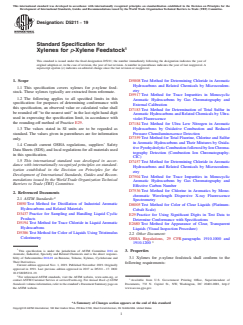


ASTM D5211-19 - Standard Specification for Xylenes for <emph type="ital">p</emph>-Xylene Feedstock
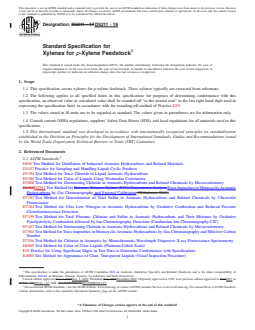

REDLINE ASTM D5211-19 - Standard Specification for Xylenes for <emph type="ital">p</emph>-Xylene Feedstock
Overview
ASTM D5211-19: Standard Specification for Xylenes for p-Xylene Feedstock establishes requirements for the quality and composition of xylenes used as feedstock material, specifically for the production of p-xylene. Developed by ASTM International, this specification plays a vital role in ensuring consistent quality and safe handling in petrochemical and industrial chemical manufacturing. The standard covers the minimum and maximum levels for various hydrocarbons and impurities, as well as physical attributes such as appearance, color, and distillation properties. It also outlines conformance criteria and references essential test methods for verifying compliance.
Key Topics
Specification Requirements:
ASTM D5211-19 details stringent quality criteria for xylenes designated as p-xylene feedstock, including:- Minimum p-xylene content
- Maximum permissible levels of ethylbenzene, toluene, C9 and higher boiling aromatic hydrocarbons, and nonaromatic hydrocarbons
- Limits for nitrogen, sulfur, chloride (if required), and appearance features (clarity, absence of suspended particles)
Test Methods and Measurement:
The document prescribes use of recognized ASTM test methods to assess physical and chemical properties. These include methods for distillation, impurity analysis, and color measurement to ensure quality and consistency.Units and Rounding:
All values are stated primarily in SI units to fulfill international standardization needs. Where applicable, measurements are rounded according to ASTM E29 to promote consistency in data reporting.Safety and Regulatory Guidance:
The standard recommends adherence to current OSHA regulations, Safety Data Sheets (SDS), and relevant local safety requirements in handling and testing materials covered under this specification.
Applications
ASTM D5211-19 is highly relevant for industries involved in:
- Petrochemical Production:
Used by manufacturers that produce, process, or use p-xylene as a precursor to terephthalic acid or other industrial chemicals. - Quality Assurance Laboratories:
Employed to standardize testing procedures and ensure quality control of feedstock materials used in large-scale manufacturing processes. - Purchasing and Supply Chain:
Utilized as a benchmark in procurement contracts between chemical suppliers and buyers, ensuring the feedstock meets agreed specifications. - Regulatory Compliance:
Supports organizations in demonstrating due diligence in product quality, safety, and compliance with industry regulations.
The clear criteria and referenced test methods facilitate reliable, repeatable, and internationally recognized assessment of xylene feedstock, minimizing risks associated with off-spec materials.
Related Standards
For comprehensive chemical analysis, sampling, and compliance, ASTM D5211-19 refers to several additional ASTM standards, including:
- D850: Test Method for Distillation of Industrial Aromatic Hydrocarbons and Related Materials
- D3437: Practice for Sampling and Handling Liquid Cyclic Products
- D5386: Test Method for Color of Liquids Using Tristimulus Colorimetry
- D5808, D7457: Methods for Determining Chloride Content
- D7183, D7184, D7359, D7536: Methods for Sulfur, Nitrogen, Chloride, and related impurities measurement
- E29: Practice for Determining Conformance with Specifications
Referencing these standards ensures thorough chemical characterization and standardized testing practices across global markets.
Keywords: ASTM D5211-19, xylenes for p-xylene feedstock, p-xylene specification, quality control, petrochemical standards, aromatic hydrocarbons, industrial chemicals, ASTM International.
Relations
- Replaces
ASTM D5211-17 - Standard Specification for Xylenes for <emph type="ital">p</emph>-Xylene Feedstock - Effective Date
- 01-Nov-2019
- Effective Date
- 01-Jan-2024
- Effective Date
- 01-Nov-2023
- Effective Date
- 01-Nov-2023
- Effective Date
- 15-Aug-2020
- Effective Date
- 01-Jun-2020
- Effective Date
- 01-Jun-2019
- Effective Date
- 01-Jun-2019
- Effective Date
- 01-Nov-2018
- Effective Date
- 01-Jun-2017
- Effective Date
- 01-Apr-2017
- Effective Date
- 01-Jul-2015
- Effective Date
- 01-Jul-2015
- Effective Date
- 01-Jun-2015
- Effective Date
- 01-Jun-2015
Buy Documents
ASTM D5211-19 - Standard Specification for Xylenes for <emph type="ital">p</emph>-Xylene Feedstock
REDLINE ASTM D5211-19 - Standard Specification for Xylenes for <emph type="ital">p</emph>-Xylene Feedstock
Get Certified
Connect with accredited certification bodies for this standard

ECOCERT
Organic and sustainability certification.

Eurofins Food Testing Global
Global leader in food, environment, and pharmaceutical product testing.

Intertek Bangladesh
Intertek certification and testing services in Bangladesh.
Sponsored listings
Frequently Asked Questions
ASTM D5211-19 is a technical specification published by ASTM International. Its full title is "Standard Specification for Xylenes for <emph type="ital">p</emph>-Xylene Feedstock". This standard covers: ABSTRACT This specification covers xylenes for p-xylene feedstock. Xylenes for p-xylene feedstock shall conform to the following requirements: p-xylene minimum weight percent, ethylbenzene maximum weight percent, toluene maximum weight percent, C9 and higher boiling aromatic hydrocarbons maximum weight percent, nonaromatic hydrocarbons maximum weight percent, nitrogen maximum weight percent if needed, sulfur maximum content, appearance, chloride if needed, color, and distillation range. SCOPE 1.1 This specification covers xylenes for p-xylene feedstock. These xylenes typically are extracted from reformate. 1.2 The following applies to all specified limits in this specification: for purposes of determining conformance with this specification, an observed value or calculated value shall be rounded off “to the nearest unit” in the last right hand digit used in expressing the specification limit, in accordance with the rounding-off method of Practice E29. 1.3 The values stated in SI units are to be regarded as standard. The values given in parentheses are for information only. 1.4 Consult current OSHA regulations, suppliers’ Safety Data Sheets (SDS), and local regulations for all materials used in this specification. 1.5 This international standard was developed in accordance with internationally recognized principles on standardization established in the Decision on Principles for the Development of International Standards, Guides and Recommendations issued by the World Trade Organization Technical Barriers to Trade (TBT) Committee.
ABSTRACT This specification covers xylenes for p-xylene feedstock. Xylenes for p-xylene feedstock shall conform to the following requirements: p-xylene minimum weight percent, ethylbenzene maximum weight percent, toluene maximum weight percent, C9 and higher boiling aromatic hydrocarbons maximum weight percent, nonaromatic hydrocarbons maximum weight percent, nitrogen maximum weight percent if needed, sulfur maximum content, appearance, chloride if needed, color, and distillation range. SCOPE 1.1 This specification covers xylenes for p-xylene feedstock. These xylenes typically are extracted from reformate. 1.2 The following applies to all specified limits in this specification: for purposes of determining conformance with this specification, an observed value or calculated value shall be rounded off “to the nearest unit” in the last right hand digit used in expressing the specification limit, in accordance with the rounding-off method of Practice E29. 1.3 The values stated in SI units are to be regarded as standard. The values given in parentheses are for information only. 1.4 Consult current OSHA regulations, suppliers’ Safety Data Sheets (SDS), and local regulations for all materials used in this specification. 1.5 This international standard was developed in accordance with internationally recognized principles on standardization established in the Decision on Principles for the Development of International Standards, Guides and Recommendations issued by the World Trade Organization Technical Barriers to Trade (TBT) Committee.
ASTM D5211-19 is classified under the following ICS (International Classification for Standards) categories: 71.080.15 - Aromatic hydrocarbons. The ICS classification helps identify the subject area and facilitates finding related standards.
ASTM D5211-19 has the following relationships with other standards: It is inter standard links to ASTM D5211-17, ASTM D5194-24, ASTM E2680-23, ASTM D5808-23, ASTM D7536-20, ASTM D7184-20, ASTM D5917-15(2019), ASTM D7184-15(2019)e1, ASTM D7183-18a, ASTM D7504-17a, ASTM D7504-17, ASTM D7504-15e1, ASTM D7504-15, ASTM D8005-15, ASTM D7183-15. Understanding these relationships helps ensure you are using the most current and applicable version of the standard.
ASTM D5211-19 is available in PDF format for immediate download after purchase. The document can be added to your cart and obtained through the secure checkout process. Digital delivery ensures instant access to the complete standard document.
Standards Content (Sample)
This international standard was developed in accordance with internationally recognized principles on standardization established in the Decision on Principles for the
Development of International Standards, Guides and Recommendations issued by the World Trade Organization Technical Barriers to Trade (TBT) Committee.
Designation: D5211 −19
Standard Specification for
Xylenes for p-Xylene Feedstock
This standard is issued under the fixed designation D5211; the number immediately following the designation indicates the year of
original adoption or, in the case of revision, the year of last revision. A number in parentheses indicates the year of last reapproval. A
superscript epsilon (´) indicates an editorial change since the last revision or reapproval.
1. Scope D5808 Test Method for Determining Chloride in Aromatic
Hydrocarbons and Related Chemicals by Microcoulom-
1.1 This specification covers xylenes for p-xylene feed-
etry
stock. These xylenes typically are extracted from reformate.
D5917 Test Method for Trace Impurities in Monocyclic
1.2 The following applies to all specified limits in this
Aromatic Hydrocarbons by Gas Chromatography and
specification: for purposes of determining conformance with
External Calibration
this specification, an observed value or calculated value shall
D7183 Test Method for Determination of Total Sulfur in
be rounded off “to the nearest unit” in the last right hand digit
Aromatic Hydrocarbons and Related Chemicals by Ultra-
used in expressing the specification limit, in accordance with
violet Fluorescence
the rounding-off method of Practice E29.
D7184 Test Method for Ultra Low Nitrogen in Aromatic
1.3 The values stated in SI units are to be regarded as Hydrocarbons by Oxidative Combustion and Reduced
Pressure Chemiluminescence Detection
standard. The values given in parentheses are for information
only. D7359 Test Method for Total Fluorine, Chlorine and Sulfur
in Aromatic Hydrocarbons and Their Mixtures by Oxida-
1.4 Consult current OSHA regulations, suppliers’ Safety
tive Pyrohydrolytic Combustion followed by Ion Chroma-
Data Sheets (SDS), and local regulations for all materials used
tography Detection (Combustion Ion Chromatography-
in this specification.
CIC)
1.5 This international standard was developed in accor-
D7457 Test Method for Determining Chloride in Aromatic
dance with internationally recognized principles on standard-
Hydrocarbons and Related Chemicals by Microcoulom-
ization established in the Decision on Principles for the
etry
Development of International Standards, Guides and Recom-
D7504 Test Method for Trace Impurities in Monocyclic
mendations issued by the World Trade Organization Technical
Aromatic Hydrocarbons by Gas Chromatography and
Barriers to Trade (TBT) Committee.
Effective Carbon Number
D7536 Test Method for Chlorine in Aromatics by Mono-
2. Referenced Documents
chromatic Wavelength Dispersive X-ray Fluorescence
2.1 ASTM Standards:
Spectrometry
D850 Test Method for Distillation of Industrial Aromatic
D8005 Test Method for Color of Clear Liquids (Platinum-
Hydrocarbons and Related Materials
Cobalt Scale)
D3437 Practice for Sampling and Handling Liquid Cyclic
E29 Practice for Using Significant Digits in Test Data to
Products
Determine Conformance with Specifications
D5194 Test Method for Trace Chloride in Liquid Aromatic
E2680 Test Method for Appearance of Clear, Transparent
Hydrocarbons
Liquids (Visual Inspection Procedure)
D5386 Test Method for Color of Liquids Using Tristimulus
2.2 Other Document:
Colorimetry
OSHA Regulations, 29 CFR paragraphs 1910.1000 and
1910.1200
This specification is under the jurisdiction of ASTM Committee D16 on
3. Properties
Aromatic, Industrial, Specialty and Related Chemicals and is the direct responsi-
bility of Subcommittee D16.01 on Benzene, Toluene, Xylenes, Cyclohexane and 3.1 Xylenes for p-xylene feedstock shall conform to the
Their Derivatives.
following requirements:
Current edition approved Nov. 1, 2019. Published November 2019. Originally
approved in 1991. Last previous edition
...
This document is not an ASTM standard and is intended only to provide the user of an ASTM standard an indication of what changes have been made to the previous version. Because
it may not be technically possible to adequately depict all changes accurately, ASTM recommends that users consult prior editions as appropriate. In all cases only the current version
of the standard as published by ASTM is to be considered the official document.
Designation: D5211 − 17 D5211 − 19
Standard Specification for
Xylenes for p-Xylene Feedstock
This standard is issued under the fixed designation D5211; the number immediately following the designation indicates the year of
original adoption or, in the case of revision, the year of last revision. A number in parentheses indicates the year of last reapproval. A
superscript epsilon (´) indicates an editorial change since the last revision or reapproval.
1. Scope
1.1 This specification covers xylenes for p-xylene feedstock. These xylenes typically are extracted from reformate.
1.2 The following applies to all specified limits in this specification: for purposes of determining conformance with this
specification, an observed value or calculated value shall be rounded off “to the nearest unit” in the last right hand digit used in
expressing the specification limit, in accordance with the rounding-off method of Practice E29.
1.3 The values stated in SI units are to be regarded as standard. The values given in parentheses are for information only.
1.4 Consult current OSHA regulations, suppliers’ Safety Data Sheets (SDS), and local regulations for all materials used in this
specification.
1.5 This international standard was developed in accordance with internationally recognized principles on standardization
established in the Decision on Principles for the Development of International Standards, Guides and Recommendations issued
by the World Trade Organization Technical Barriers to Trade (TBT) Committee.
2. Referenced Documents
2.1 ASTM Standards:
D850 Test Method for Distillation of Industrial Aromatic Hydrocarbons and Related Materials
D3437 Practice for Sampling and Handling Liquid Cyclic Products
D5194 Test Method for Trace Chloride in Liquid Aromatic Hydrocarbons
D5386 Test Method for Color of Liquids Using Tristimulus Colorimetry
D5808 Test Method for Determining Chloride in Aromatic Hydrocarbons and Related Chemicals by Microcoulometry
D6563D5917 Test Method for Benzene, Toluene, Xylene (BTX) Concentrates AnalysisTrace Impurities in Monocyclic Aromatic
Hydrocarbons by Gas Chromatography and External Calibration (Withdrawn 2018)
D7183 Test Method for Determination of Total Sulfur in Aromatic Hydrocarbons and Related Chemicals by Ultraviolet
Fluorescence
D7184 Test Method for Ultra Low Nitrogen in Aromatic Hydrocarbons by Oxidative Combustion and Reduced Pressure
Chemiluminescence Detection
D7359 Test Method for Total Fluorine, Chlorine and Sulfur in Aromatic Hydrocarbons and Their Mixtures by Oxidative
Pyrohydrolytic Combustion followed by Ion Chromatography Detection (Combustion Ion Chromatography-CIC)
D7457 Test Method for Determining Chloride in Aromatic Hydrocarbons and Related Chemicals by Microcoulometry
D7504 Test Method for Trace Impurities in Monocyclic Aromatic Hydrocarbons by Gas Chromatography and Effective Carbon
Number
D7536 Test Method for Chlorine in Aromatics by Monochromatic Wavelength Dispersive X-ray Fluorescence Spectrometry
D8005 Test Method for Color of Clear Liquids (Platinum-Cobalt Scale)
E29 Practice for Using Significant Digits in Test Data to Determine Conformance with Specifications
E2680 Test Method for Appearance of Clear, Transparent Liquids (Visual Inspection Procedure)
This specification is under the jurisdiction of ASTM Committee D16 on Aromatic, Industrial, Specialty and Related Chemicals and is the direct responsibility of
Subcommittee D16.01 on Benzene, Toluene, Xylenes, Cyclohexane and Their Derivatives.
Current edition approved June 1, 2017Nov. 1, 2019. Published June 2017November 2019. Originally approved in 1991. Last previous edition approved in 20162017 as
D5211 – 16.D5211 – 17. DOI: 10.1520/D5211-17.10.1520/D5211-19.
For referenced ASTM standards, visit the ASTM website, www.astm.org, or contact ASTM Customer Service at service@astm.org. For Annual Book of ASTM Standards
volume information, refer to the standard’s Document Summary page on the ASTM website.
*A Summary of Changes section appears at the end of this standard
Copyright © ASTM
...