

ASTM F3383-19a
(Test Method)Standard Test Method for Filament Bind of Single Fibers in Synthetic Turf
General Information
- Abstract
SIGNIFICANCE AND USE
5.1 Monofilament fibers in synthetic turf athletic fields need to be sufficiently bound to the synthetic turf fabric. The binding force must be sufficient to resist filament loss by expected forces applied to the turf during installation and anticipated activities on the installed synthetic turf field.
5.2 Loss of turf fiber filaments from the turf fabric affects the aesthetic appearance of the synthetic turf. There are also potential negative impacts on performance properties from excessive filament loss.
5.3 Filament bind provides a relative indication of the resistance to fiber loss.
SCOPE
1.1 This test method applies to tufted synthetic turf produced with at least one bundle of monofilament fibers.
1.2 This test method is applicable to laboratory testing (Method A), and for testing of installed turf (Method B).
1.3 The results from this test method provide an indication of the resistance to single fiber loss during installation or end use applications of the synthetic turf.
1.4 All values stated in inch-pound units are to be regarded as standard; the values in SI units are provided as information only and are not exact equivalents. In case of reference decisions, the inch-pound units shall prevail.
1.5 This standard does not purport to address all of the safety concerns, if any, associated with its use. It is the responsibility of the user of this standard to establish appropriate safety, health, and environmental practices and determine the applicability of regulatory limitations prior to use.
1.6 This international standard was developed in accordance with internationally recognized principles on standardization established in the Decision on Principles for the Development of International Standards, Guides and Recommendations issued by the World Trade Organization Technical Barriers to Trade (TBT) Committee.
- Status
- Published
- Publication Date
- 30-Nov-2019
- Technical Committee
- F08 - Sports Equipment, Playing Surfaces, and Facilities
- Drafting Committee
- F08.65 - Artificial Turf Surfaces and Systems
Overview
ASTM F3383-19a: Standard Test Method for Filament Bind of Single Fibers in Synthetic Turf is developed by ASTM International to assess the binding strength of monofilament fibers within synthetic turf systems. This standardized test method provides a consistent way to evaluate the resistance of individual turf fibers to being pulled from the turf fabric, which is critical for ensuring durability, maintaining aesthetic appearance, and supporting field performance. The standard applies to both laboratory and in situ testing, making it essential for manufacturers, installers, and facility managers involved with synthetic turf.
Key Topics
Purpose of Filament Bind Testing
- Ensures fibers are securely attached to the turf backing to resist loss during both installation and usage.
- Evaluates binding strength to prevent premature turf degradation, which can impact field appearance and performance.
Applicability
- Suitable for tufted synthetic turf using bundles of monofilament fibers.
- Includes procedures for laboratory testing (Method A) and field (installed turf) testing (Method B).
Significance
- Excessive fiber loss can negatively affect play characteristics and visual quality.
- Test results offer a relative measure of a turf system's resistance to fiber loss under real-life conditions.
Testing and Reporting
- Standardizes sample preparation, test areas, and reporting metrics including average, minimum, maximum, and standard deviation for filament bind.
- Ensures traceability and repeatability of results to support quality control.
Applications
ASTM F3383-19a is practical for a wide range of stakeholders within the synthetic turf industry, including:
- Manufacturers: Assists with product development, quality assurance, and compliance with industry standards by objectively measuring filament retention.
- Installers and Contractors: Ensures turf is sufficiently robust for installation processes and anticipated usage, helping to minimize risk of fiber loss post-installation.
- Facility Managers and Owners: Aids in field maintenance planning by providing data on turf integrity, which can help predict turf lifespan and plan for replacement.
- Laboratories and Inspectors: Offers a reproducible testing methodology to compare turf products and verify product claims regarding durability.
- Sports Facility Designers: Assists in specifying synthetic turf products that meet performance and longevity criteria critical for athletic facilities.
Related Standards
ASTM F3383-19a interacts with several other important standards in turf testing and textile evaluation:
- ASTM D76: Specification for Tensile Testing Machines for Textiles
- ASTM D1776: Practice for Conditioning and Testing Textiles
- ASTM D5684: Terminology for Pile Floor Coverings
- ASTM F1551: Test Methods for Comprehensive Characterization of Synthetic Turf Playing Surfaces and Materials
- ASTM F1936: Specification for Impact Attenuation of Turf Playing Systems
These related standards provide the necessary background for the apparatus, terminology, and environmental testing conditions required when conducting filament bind testing on synthetic turf.
Keywords: filament bind test, synthetic turf, monofilament fiber, turf durability, ASTM F3383-19a, turf testing standards, turf quality, field performance, tuft bind, laboratory turf testing, in situ turf testing
Relations
- Effective Date
- 01-Dec-2019
- Effective Date
- 01-Sep-2023
- Effective Date
- 01-Jul-2019
- Effective Date
- 01-Jul-2019
- Effective Date
- 15-May-2019
- Effective Date
- 01-Dec-2017
- Effective Date
- 01-Dec-2015
- Effective Date
- 01-Jul-2012
- Effective Date
- 01-Jun-2010
- Effective Date
- 01-May-2010
- Effective Date
- 01-May-2010
- Effective Date
- 01-Jul-2009
- Effective Date
- 01-Aug-2008
- Effective Date
- 01-Aug-2008
- Effective Date
- 01-Jul-2008
Frequently Asked Questions
ASTM F3383-19a is a standard published by ASTM International. Its full title is "Standard Test Method for Filament Bind of Single Fibers in Synthetic Turf". This standard covers: SIGNIFICANCE AND USE 5.1 Monofilament fibers in synthetic turf athletic fields need to be sufficiently bound to the synthetic turf fabric. The binding force must be sufficient to resist filament loss by expected forces applied to the turf during installation and anticipated activities on the installed synthetic turf field. 5.2 Loss of turf fiber filaments from the turf fabric affects the aesthetic appearance of the synthetic turf. There are also potential negative impacts on performance properties from excessive filament loss. 5.3 Filament bind provides a relative indication of the resistance to fiber loss. SCOPE 1.1 This test method applies to tufted synthetic turf produced with at least one bundle of monofilament fibers. 1.2 This test method is applicable to laboratory testing (Method A), and for testing of installed turf (Method B). 1.3 The results from this test method provide an indication of the resistance to single fiber loss during installation or end use applications of the synthetic turf. 1.4 All values stated in inch-pound units are to be regarded as standard; the values in SI units are provided as information only and are not exact equivalents. In case of reference decisions, the inch-pound units shall prevail. 1.5 This standard does not purport to address all of the safety concerns, if any, associated with its use. It is the responsibility of the user of this standard to establish appropriate safety, health, and environmental practices and determine the applicability of regulatory limitations prior to use. 1.6 This international standard was developed in accordance with internationally recognized principles on standardization established in the Decision on Principles for the Development of International Standards, Guides and Recommendations issued by the World Trade Organization Technical Barriers to Trade (TBT) Committee.
SIGNIFICANCE AND USE 5.1 Monofilament fibers in synthetic turf athletic fields need to be sufficiently bound to the synthetic turf fabric. The binding force must be sufficient to resist filament loss by expected forces applied to the turf during installation and anticipated activities on the installed synthetic turf field. 5.2 Loss of turf fiber filaments from the turf fabric affects the aesthetic appearance of the synthetic turf. There are also potential negative impacts on performance properties from excessive filament loss. 5.3 Filament bind provides a relative indication of the resistance to fiber loss. SCOPE 1.1 This test method applies to tufted synthetic turf produced with at least one bundle of monofilament fibers. 1.2 This test method is applicable to laboratory testing (Method A), and for testing of installed turf (Method B). 1.3 The results from this test method provide an indication of the resistance to single fiber loss during installation or end use applications of the synthetic turf. 1.4 All values stated in inch-pound units are to be regarded as standard; the values in SI units are provided as information only and are not exact equivalents. In case of reference decisions, the inch-pound units shall prevail. 1.5 This standard does not purport to address all of the safety concerns, if any, associated with its use. It is the responsibility of the user of this standard to establish appropriate safety, health, and environmental practices and determine the applicability of regulatory limitations prior to use. 1.6 This international standard was developed in accordance with internationally recognized principles on standardization established in the Decision on Principles for the Development of International Standards, Guides and Recommendations issued by the World Trade Organization Technical Barriers to Trade (TBT) Committee.
ASTM F3383-19a is classified under the following ICS (International Classification for Standards) categories: 97.220.10 - Sports facilities. The ICS classification helps identify the subject area and facilitates finding related standards.
ASTM F3383-19a has the following relationships with other standards: It is inter standard links to ASTM F3383-19, ASTM F1551-23, ASTM D5684-19a, ASTM F1936-19, ASTM D5684-19, ASTM F1551-09(2017), ASTM F1936-10(2015), ASTM D5684-12, ASTM D5684-10, ASTM F1936-10, ASTM F1936-10e1, ASTM F1551-09, ASTM D1776-08e1, ASTM D1776-08, ASTM D5684-08a. Understanding these relationships helps ensure you are using the most current and applicable version of the standard.
ASTM F3383-19a is available in PDF format for immediate download after purchase. The document can be added to your cart and obtained through the secure checkout process. Digital delivery ensures instant access to the complete standard document.
Standards Content (Sample)
This international standard was developed in accordance with internationally recognized principles on standardization established in the Decision on Principles for the
Development of International Standards, Guides and Recommendations issued by the World Trade Organization Technical Barriers to Trade (TBT) Committee.
Designation: F3383 − 19a
Standard Test Method for
Filament Bind of Single Fibers in Synthetic Turf
This standard is issued under the fixed designation F3383; the number immediately following the designation indicates the year of
original adoption or, in the case of revision, the year of last revision. A number in parentheses indicates the year of last reapproval. A
superscript epsilon (´) indicates an editorial change since the last revision or reapproval.
1. Scope 3. Terminology
1.1 This test method applies to tufted synthetic turf pro-
3.1 For terminology relating to Pile Floor Covering, refer to
duced with at least one bundle of monofilament fibers.
Terminology D5684.
3.1.1 The following terms are relevant to this standard:
1.2 This test method is applicable to laboratory testing
carpet, constant-rate-of-extension, cut pile floor covering, tuft,
(Method A), and for testing of installed turf (Method B).
tuft bind, tuft leg, tufted fabric, filament, slit tape, slit film, and
1.3 The results from this test method provide an indication
monofilament.
of the resistance to single fiber loss during installation or end
use applications of the synthetic turf. 3.2 For terminology relating to Synthetic Turf Materials,
refer to Test Methods F1551.
1.4 All values stated in inch-pound units are to be regarded
as standard; the values in SI units are provided as information 3.3 Definitions:
only and are not exact equivalents. In case of reference
3.3.1 bundle of monofilament fibers, n—group of two or
decisions, the inch-pound units shall prevail.
more (typically 4 to 12) monofilaments held together by wrap
yarn(s) (one or two) or by being twisted together to give a
1.5 This standard does not purport to address all of the
cohesive bundle.
safety concerns, if any, associated with its use. It is the
responsibility of the user of this standard to establish appro-
3.3.2 filament bind, n—the force required to pull one fila-
priate safety, health, and environmental practices and deter-
ment from one bundle of one tuft from the synthetic turf fabric
mine the applicability of regulatory limitations prior to use.
sample.
1.6 This international standard was developed in accor-
3.3.3 lab sample, n—a full width cut of the synthetic turf
dance with internationally recognized principles on standard-
rolltobetested,insuringsufficientmaterialforthetestsamples
ization established in the Decision on Principles for the
(Procedure A).
Development of International Standards, Guides and Recom-
3.3.4 test sample, n—a sample cut to a minimum of 6 by 6
mendations issued by the World Trade Organization Technical
Barriers to Trade (TBT) Committee. in. (150 by 150 mm), from the lab sample (Procedure A).
3.3.4.1 Discussion—For lab testing with Procedure B (6.4),
2. Referenced Documents
assure test sample size is a minimum of 3 in. greater, in length
and width, than the size of the portable device base.
2.1 ASTM Standards:
D76 Specification for Tensile Testing Machines for Textiles
3.3.5 test area, n—the synthetic turf exposed through the 3
D1776 Practice for Conditioning and Testing Textiles
in. (7.6 cm) opening in the clamp (ProcedureA), or base of the
D5684 Terminology Relating to Pile Floor Coverings
portable device (Procedure B).
F1551 Test Methods for Comprehensive Characterization of
3.3.6 test location, n—the specific area tested on a synthetic
Synthetic Turf Playing Surfaces and Materials
turf field (7.2.1), consisting of a 20 by 20 in. (51 by 51 cm)
F1936 Specification for Impact Attenuation of Turf Playing
square divided into four quadrants (Procedure B).
Systems as Measured in the Field
3.3.7 test specimens, n—a single filament from a single tuft
leg (Procedure A and B).
This test method is under the jurisdiction of ASTM Committee F08 on Sports
Equipment, Playing Surfaces, and Facilities and is the direct responsibility of
Subcommittee F08.65 on Artificial Turf Surfaces and Systems. 4. Summary of Test Method
Current edition approved Dec. 1, 2019. Published January 2020. Originally
4.1 A test sample is mounted in a clamping device (see
approved in 2019. Last previous edition approved in 2019 as F3383 – 19. DOI:
10.1520/F3383-19A.
Procedures A and B) associated with the constant rate of
For referenced ASTM standards, visit the ASTM website, www.astm.org, or
extension (CRE) force testing device. The force required to
contact ASTM Customer Service at service@astm.org. For Annual Book of ASTM
pull one filament from one bundle of one tuft from the
Standards volume information, refer to the standard’s Document Summary page on
the ASTM website. synthetic turf fabric sample is measured as the filament bind.
Copyright © ASTM International, 100 Barr Harbor Drive, PO Box C700, West Conshohocken, PA 19428-2959. United States
F3383 − 19a
5. Significance and Use 6.4 Procedure B – Laboratory or Field Testing:Apparatus –
Portable Force Testing Machine—Constant-rate-of-extension
5.1 Monofilament fibers in synthetic turf athletic fields need
(CRE) type, conforming to Specification D76, with the capac-
to be sufficiently bound to the synthetic turf fabric.The binding
ity selected so that forces as low as 1.0 lb (4.45 N) can
force must be sufficient to resist filament loss by expected
accuratelybemeasured.Therateofextensionshallbe12 60.5
forces applied to the turf during installation and anticipated
in./min (300 6 10 mm/min).
activities on the installed synthetic turf field.
6.5 The portable device consists of:
5.2 Loss of turf fiber filaments from the turf fabric affects
6.5.1 Portablestandthatsupportstheupperclampassembly,
the aesthetic appearance of the synthetic turf. There are also
and also keeps the test area stationary.
potential negative impacts on performance properties from
6.5.2 Linear actuator (CRE); a moveable linear shaft assem-
excessive filament loss.
bly capable of providing a constant rate of extension.
5.3 Filament bind provides a relative indication of the
6.5.3 A force measuring instrument capable of measuring
resistance to fiber loss.
maximum load while pulling the filament from the turf.
6.5.4 Aclamp (example shown in Fig. 8) capable of holding
6. Apparatus—Tensile Testing Machine
one filament without damaging the filament as to cause
6.1 Procedure A – Laboratory Testing: Apparatus – Tensile
breakage/damage at the filament clamping location. The clamp
TestingMachine—Constant-rate-of-extension(CRE)type,con-
shall hold the filament to assure no slippage occurs during the
formingtoSpecificationD76,withthecapacityselectedsothat
test.
forces as low as 1.0 lb (4.45 N) can accurately be measured.
6.5.5 The base of the portable device has a 3 in. (7.6 cm)
The rate of extension shall be 12 6 0.5 in./min (300 6 10
opening to provide access to the test area.
mm/min).
7. Sampling, Test Specimens, and Test Units
6.2 Flat Sample Holder—The test sample is held in place on
aflatplaten(Fig.1)usingarestrainingclamp(Fig.2)asshown
7.1 Laboratory Sample—For rolls of synthetic turf, cut a
in (Figs. 3 and 4). The clamp shall provide sufficient force to
laboratory sample the full width of the synthetic turf roll
prevent excessive movement of the test area during the test. A
insuring sufficient material for the test samples requested in
circular constrained area of turf having a diameter of 3 in. (7.6
7.1.1. Avoid areas with visible damage, and areas with
cm) provides the test area for selection of the singular test
excessive, or non representative coating amounts.
filament.
7.1.1 Test Sample—From each laboratory sample, cut three
6.3 Filament Clamp, consisting of a set of hemostats or test samples across the width of the laboratory sample. One of
tweezer like clamps (Fig. 5) that can grip a single filament the test samples is taken from the approximate center of the
tightlytoassureremovalofthefilamentwithoutslippageofthe roll. The other two samples are taken between the center and
filament in the tuft clamp, or damage to the fiber. The pull the two sides of the roll. The test sample shall be taken no
direction shall be 90° from the plane of the turf fabric at the nearer than5%ofthe synthetic turf roll width. Cut each test
binding site (Fig. 6). sample to a minimum of 6 by 6 in. (150 by 150 mm). For lab
FIG. 1 Example of Flat Platen
F3383 − 19a
FIG. 2 Example of Sample Clamp (Pneumatic)
testing with Procedure B (6.4), assure sample size is a filament from the approximate center of each quadrant, and at
minimum of 3 in. greater, in length and width, than the size of least 1.5 in. (3.8 cm) away from any cut edge.
the portable device base.
7.1.4 Test Result—The result for a laboratory sample is the
7.1.2 Exercise care in handling the sample to avoid damag-
average of the twelve specimen results from the three test
ing the back coating of the test sample.
samples.
7.1.3 Test Specimens—Test
...
This document is not an ASTM standard and is intended only to provide the user of an ASTM standard an indication of what changes have been made to the previous version. Because
it may not be technically possible to adequately depict all changes accurately, ASTM recommends that users consult prior editions as appropriate. In all cases only the current version
of the standard as published by ASTM is to be considered the official document.
Designation: F3383 − 19 F3383 − 19a
Standard Test Method for
Filament Bind of Single Fibers in Synthetic Turf
This standard is issued under the fixed designation F3383; the number immediately following the designation indicates the year of
original adoption or, in the case of revision, the year of last revision. A number in parentheses indicates the year of last reapproval. A
superscript epsilon (´) indicates an editorial change since the last revision or reapproval.
1. Scope
1.1 This test method applies to tufted synthetic turf produced with at least one bundle of monofilament fibers.
1.2 This test method is applicable to laboratory testing (Method A), and for testing of installed turf (Method B).
1.3 The results from this test method provide an indication of the resistance to single fiber loss during installation or end use
applications of the synthetic turf.
1.4 All values stated in inch-pound units are to be regarded as standard; the values in SI units are provided as information only
and are not exact equivalents. In case of reference decisions, the inch-pound units shall prevail.
1.5 This standard does not purport to address all of the safety concerns, if any, associated with its use. It is the responsibility
of the user of this standard to establish appropriate safety, health, and environmental practices and determine the applicability of
regulatory limitations prior to use.
1.6 This international standard was developed in accordance with internationally recognized principles on standardization
established in the Decision on Principles for the Development of International Standards, Guides and Recommendations issued
by the World Trade Organization Technical Barriers to Trade (TBT) Committee.
2. Referenced Documents
2.1 ASTM Standards:
D76 Specification for Tensile Testing Machines for Textiles
D1776 Practice for Conditioning and Testing Textiles
D5684 Terminology Relating to Pile Floor Coverings
F1551 Test Methods for Comprehensive Characterization of Synthetic Turf Playing Surfaces and Materials
F1936 Specification for Impact Attenuation of Turf Playing Systems as Measured in the Field
3. Terminology
3.1 For terminology relating to Pile Floor Covering, refer to Terminology D5684.
3.1.1 The following terms are relevant to this standard: carpet,constant-rate-of-extension,cut pile floor covering,tuft,tuft
bind,tuft leg,tufted fabric,filament,slit tape,slit film, and monofilament.
3.2 For terminology relating to Synthetic Turf Materials, refer to Test Methods F1551.
3.3 Definitions:
3.3.1 bundle of monofilament fibers, n—group of two or more (typically 4 to 12) monofilaments held together by wrap yarn(s)
(one or two) or by being twisted together to give a cohesive bundle.
3.3.2 filament bind, n—the force required to pull one filament from one bundle of one tuft from the synthetic turf fabric sample.
3.3.3 lab sample, n—a full width cut of the synthetic turf roll to be tested, insuring sufficient material for the test samples
(Procedure A).
3.3.4 test sample, n—a sample cut to a minimum of 6 by 6 in. (150 by 150 mm), from the lab sample (Procedure A).
This test method is under the jurisdiction of ASTM Committee F08 on Sports Equipment, Playing Surfaces, and Facilities and is the direct responsibility of Subcommittee
F08.65 on Artificial Turf Surfaces and Systems.
Current edition approved May 15, 2019Dec. 1, 2019. Published August 2019January 2020. Originally approved in 2019. Last previous edition approved in 2019 as
F3383 – 19. DOI: 10.1520/F3383-19.10.1520/F3383-19A.
For referenced ASTM standards, visit the ASTM website, www.astm.org, or contact ASTM Customer Service at service@astm.org. For Annual Book of ASTM Standards
volume information, refer to the standard’s Document Summary page on the ASTM website.
Copyright © ASTM International, 100 Barr Harbor Drive, PO Box C700, West Conshohocken, PA 19428-2959. United States
F3383 − 19a
3.3.4.1 Discussion—
For lab testing with Procedure B (6.4), assure test sample size is a minimum of 3 in. greater, in length and width, than the size
of the portable device base.
3.3.5 test area, n—the synthetic turf exposed through the 3 in. (7.6 cm) opening in the clamp (Procedure A), or base of the
portable device (Procedure B).
3.3.6 test location, n—the specific area tested on a synthetic turf field (7.2.1), consisting of a 20 by 20 in. (51 by 51 cm) square
divided into four quadrants (Procedure B).
3.3.7 test specimens, n—a single filament from a single tuft leg (Procedure A and B).
4. Summary of Test Method
4.1 A test sample is mounted in a clamping device (see Procedures A and B) associated with the constant rate of extension
(CRE) force testing device. The force required to pull one filament from one bundle of one tuft from the synthetic turf fabric sample
is measured as the filament bind.
5. Significance and Use
5.1 Monofilament fibers in synthetic turf athletic fields need to be sufficiently bound to the synthetic turf fabric. The binding
force must be sufficient to resist filament loss by expected forces applied to the turf during installation and anticipated activities
on the installed synthetic turf field.
5.2 Loss of turf fiber filaments from the turf fabric affects the aesthetic appearance of the synthetic turf. There are also potential
negative impacts on performance properties from excessive filament loss.
5.3 Filament bind provides a relative indication of the resistance to fiber loss.
6. Apparatus—Tensile Testing Machine
6.1 Procedure A – Laboratory Testing: Apparatus – Tensile Testing Machine—Constant-rate-of-extension (CRE) type,
conforming to Specification D76, with the capacity selected so that forces as low as 1.0 lb (4.45 N) can accurately be measured.
The rate of extension shall be 12 6 0.5 in./min (300 6 10 mm/min).
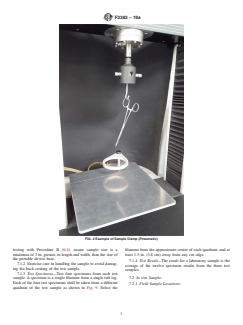
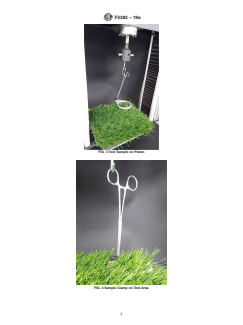
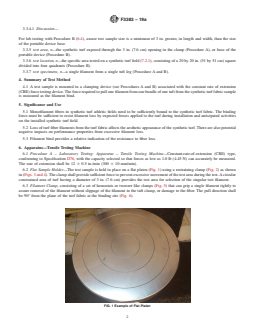
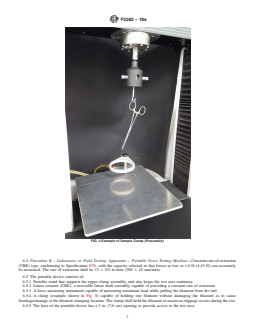
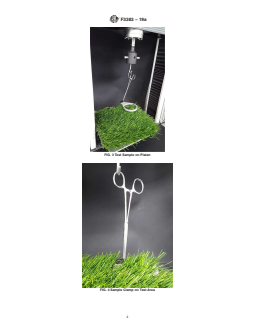
6.2 Flat Sample Holder—The test sample is held in place on a flat platen (Fig. 1) using a restraining clamp (Fig. 2) as shown
in (Figs. 3 and 4). The clamp shall provide sufficient force to prevent excessive movement of the test area during the test. A circular
constrained area of turf having a diameter of 3 in. (7.6 cm) provides the test area for selection of the singular test filament.
6.3 Filament Clamp, consisting of a set of hemostats or tweezer like clamps (Fig. 5) that can grip a single filament tightly to
assure removal of the filament without slippage of the filament in the tuft clamp, or damage to the fiber. The pull direction shall
be 90° from the plane of the turf fabric at the binding site (Fig. 6).
FIG. 1 Example of Flat Platen
F3383 − 19a
FIG. 2 Example of Sample Clamp (Pneumatic)
6.4 Procedure B – Laboratory or Field Testing: Apparatus – Portable Force Testing Machine—Constant-rate-of-extension
(CRE) type, conforming to Specification D76, with the capacity selected so that forces as low as 1.0 lb (4.45 N) can accurately
be measured. The rate of extension shall be 12 6 0.5 in./min (300 6 10 mm/min).
6.5 The portable device consists of:
6.5.1 Portable stand that supports the upper clamp assembly, and also keeps the test area stationary.
6.5.2 Linear actuator (CRE); a moveable linear shaft assembly capable of providing a constant rate of extension.
6.5.3 A force measuring instrument capable of measuring maximum load while pulling the filament from the turf.
6.5.4 A clamp (example shown in Fig. 8) capable of holding one filament without damaging the filament as to cause
breakage/damage at the filament clamping location. The clamp shall hold the filament to assure no slippage occurs during the test.
6.5.5 The base of the portable device has a 3 in. (7.6 cm) opening to provide access to the test area.
F3383 − 19a
FIG. 3 Test Sample on Platen
FIG. 4 Sample Clamp on Test Area
F3383 − 19a
FIG. 5 Single Filament in Filament Clamp
FIG. 6 Direction of Pull for Filament Bind
7. Sampling, Test Specimens, and Test Units
7.1 Laboratory Sample—For rolls of synthetic turf, cut a laboratory sample the full width of the synthetic turf roll insuring
sufficient material for the test samples requested in 7.1.1. Avoid areas with visible damage, and areas with excessive, or non
representative coating amounts.
7.1.1 Test Sample—From each laboratory sample, cut three test samples across the width of the laboratory sample. One of the
test samples is taken from the approximate center of the roll. The other two samples are taken between the center and the two sides
of the roll. The test sample shall be taken no nearer than 5 % of the synthetic turf roll width. Cut each test sample to a minimum
F3383 − 19a
FIG. 7 Example of Portable CRE Type Device
of 6 by 6 in. (150 by 150 mm). For lab test
...