

ASTM F3088-22
(Practice)Standard Practice for Use of a Centrifugation Method to Quantify/Study Cell-Material Adhesive Interactions
General Information
- Abstract
SIGNIFICANCE AND USE
4.1 This practice describes a cell adhesion method that can be used to provide a detachment percent at a given RCF for cells that have adhered to a substrate, typically for a short time. The information generated by this practice can be used to obtain a semi-quantitative measurement of the adhesion of cells to either an uncoated or pre-coated substrate, when compared to a reference (adherent) cell type on the same substrate. As described in Reyes and Garcia (2003), it is recommended that the 50 % point be used for either ligand concentration or RCF for the most robust measurement of adhesion strength. The adhesion may vary due to changes in the phenotype of the cells or as a result of the specific properties of the surface. The substrate may include tissue culture-treated polystyrene, biomaterials, or bioactive surfaces. If the substrate is a hydrogel, care must be taken to avoid cohesive failure in the hydrogel (that is, detached cells have pulled away fragments of gel). The coating may consist of (but is not limited to) the following: natural or synthetic biomaterials, hydrogels, components of extracellular matrix (ECM), ligands, adhesion or bioactive molecules, genes, or gene products. Cell concentration is also critical, as use of too high a concentration of cells may result in cells detaching as a sheet, rather than as individual cells. This centrifugation approach, once validated, may be applicable for quality control (QC) and product development. However, until the method is correlated to other measures of cell attachment, the current method should be run in parallel with other known measures of cell adhesion.
4.2 This practice does not cover methods to quantitate changes in gene expression, or changes in biomarkers, as identified by immunostaining. This practice additionally does not cover quantitative image analysis techniques. In some cases, the change in adhesive properties may reflect on the degree of differentiation or de-differentiation of the cells...
SCOPE
1.1 This practice covers a centrifugation cell adhesion assay that can be used to detect changes in adhesive characteristics of cells with passage or treatments. This approach measures the force required to detach cells from a substrate. Adhesion, among many variables, may vary due to changes in the phenotype of the cells.
1.2 This practice does not cover methods to verify the uniformity of coating of surfaces, nor does it cover methods for characterizing surfaces.
1.3 The cells may include adult, progenitor, or stem cells from any species. The types of cells may include chondrocytes, fibroblasts, osteoblast, islet cells, or other relevant adherent cell types.
1.4 This practice does not cover methods for isolating or harvesting of cells. This practice does not cover methods to quantitate changes in gene expression, or changes in biomarker type or concentration, as identified by immunostaining. Nor does this practice cover quantitative image analysis techniques.
1.5 This standard does not purport to address all of the safety concerns, if any, associated with its use. It is the responsibility of the user of this standard to establish appropriate safety, health, and environmental practices and determine the applicability of regulatory limitations prior to use.
1.6 This international standard was developed in accordance with internationally recognized principles on standardization established in the Decision on Principles for the Development of International Standards, Guides and Recommendations issued by the World Trade Organization Technical Barriers to Trade (TBT) Committee.
- Status
- Published
- Publication Date
- 31-Mar-2022
- Technical Committee
- F04 - Medical and Surgical Materials and Devices
- Drafting Committee
- F04.43 - Cells and Tissue Engineered Constructs for TEMPs
Buy Documents
ASTM F3088-22 - Standard Practice for Use of a Centrifugation Method to Quantify/Study Cell-Material Adhesive Interactions
REDLINE ASTM F3088-22 - Standard Practice for Use of a Centrifugation Method to Quantify/Study Cell-Material Adhesive Interactions
Overview
ASTM F3088-22 presents a standardized practice for quantifying and studying cell-material adhesive interactions using a centrifugation assay. This technique evaluates cell adhesion by measuring the force needed to detach cells from a substrate, delivering a semi-quantitative assessment of how strongly cells adhere under controlled conditions. The method has become significant for biomedical research, biomaterials development, and quality control, especially when comparing the adhesive properties of various cell types or surface treatments.
Key Topics
Centrifugation-Based Cell Adhesion Assay
The standard describes a protocol where cells, typically in a monolayer culture, are seeded onto substrates such as tissue culture-treated polystyrene, biomaterials, or bioactive surfaces. Following a short adhesion period, the samples undergo centrifugation at a known relative centrifugal force (RCF). The detachment percentage is measured by comparing the number of adherent cells before and after centrifugation.Substrate and Coating Versatility
The method is applicable to a wide variety of surfaces: uncoated, pre-coated with natural or synthetic biomaterials, hydrogels, components of the extracellular matrix (ECM), adhesion molecules, or bioactive agents. Proper care is required for hydrogels to avoid artifacts from the gel itself detaching alongside cells.Applicability to Various Cell Types
The practice supports testing with adult, progenitor, or stem cells from any species. Commonly analyzed cell types include chondrocytes, fibroblasts, osteoblasts, and islet cells, but any adherent cell can be assessed.Control and Standardization
The protocol encourages the use of positive and negative control cell lines on the same substrate to ensure robustness. Controls help interpret the adhesion measurement’s significance and provide benchmarks for comparison.Optimization and Limitations
Parameters such as coating concentration, incubation time, RCF, and cell density are optimized for each cell type and substrate combination. The practice does not address gene expression measurement, biomarker identification, or image analysis beyond the enumeration of adherent cells.
Applications
The ASTM F3088-22 centrifugation method is widely valuable in:
Material and Biomaterial Evaluation
Enables researchers to compare cell adhesion across different substrates, coatings, or material modifications, supporting the optimization of medical implants, scaffolds, and tissue engineering constructs.Cell Biology Research
Allows investigation of how cell adhesion properties change with phenotype, passage number, or experimental treatments, providing insights into cellular behavior and differentiation.Quality Control and Product Development
Facilitates routine assessment of cell-material interactions in manufacturing environments, aiding in the development and QC of biomaterials, cell-seeded products, and regenerative medicine components.Comparative Studies
Offers a standardized approach for inter-laboratory comparisons and high-throughput screening of biomaterial surfaces and adhesion-promoting agents.
Related Standards
For a comprehensive approach to the analysis of cell-material interactions, the following ASTM standards are also referenced within F3088-22:
- ASTM F2603 - Guide for Interpreting Images of Polymeric Tissue Scaffolds
- ASTM F2664 - Guide for Assessing Attachment of Cells to Biomaterial Surfaces by Physical Methods
- ASTM F2739 - Guide for Quantifying Cell Viability and Related Attributes within Biomaterial Scaffolds
- ASTM F2944 - Practice for Automated Colony Forming Unit (CFU) Assays – Image Acquisition and Analysis
- ASTM F2998 and F3294 - Guides for fluorescence microscopy and quantitative measurements in cell-based assays
Employing these standards alongside ASTM F3088-22 supports robust, reproducible evaluation of cell adhesion in biomedical research, device development, and tissue engineering applications.
Keywords: cell adhesion assay, centrifugation, biomaterials, cell-material interactions, tissue engineering, quality control, ASTM F3088-22
Relations
- Effective Date
- 01-Aug-2020
- Effective Date
- 01-Oct-2019
- Effective Date
- 01-Sep-2019
- Effective Date
- 01-Oct-2018
- Effective Date
- 01-Oct-2016
- Effective Date
- 01-Oct-2012
- Effective Date
- 01-Mar-2012
- Effective Date
- 01-Apr-2011
- Effective Date
- 01-Aug-2008
- Effective Date
- 01-Jun-2007
- Effective Date
- 01-Dec-2006
Buy Documents
ASTM F3088-22 - Standard Practice for Use of a Centrifugation Method to Quantify/Study Cell-Material Adhesive Interactions
REDLINE ASTM F3088-22 - Standard Practice for Use of a Centrifugation Method to Quantify/Study Cell-Material Adhesive Interactions
Get Certified
Connect with accredited certification bodies for this standard

BSI Group
BSI (British Standards Institution) is the business standards company that helps organizations make excellence a habit.

TÜV Rheinland
TÜV Rheinland is a leading international provider of technical services.

TÜV SÜD
TÜV SÜD is a trusted partner of choice for safety, security and sustainability solutions.
Sponsored listings
Frequently Asked Questions
ASTM F3088-22 is a standard published by ASTM International. Its full title is "Standard Practice for Use of a Centrifugation Method to Quantify/Study Cell-Material Adhesive Interactions". This standard covers: SIGNIFICANCE AND USE 4.1 This practice describes a cell adhesion method that can be used to provide a detachment percent at a given RCF for cells that have adhered to a substrate, typically for a short time. The information generated by this practice can be used to obtain a semi-quantitative measurement of the adhesion of cells to either an uncoated or pre-coated substrate, when compared to a reference (adherent) cell type on the same substrate. As described in Reyes and Garcia (2003), it is recommended that the 50 % point be used for either ligand concentration or RCF for the most robust measurement of adhesion strength. The adhesion may vary due to changes in the phenotype of the cells or as a result of the specific properties of the surface. The substrate may include tissue culture-treated polystyrene, biomaterials, or bioactive surfaces. If the substrate is a hydrogel, care must be taken to avoid cohesive failure in the hydrogel (that is, detached cells have pulled away fragments of gel). The coating may consist of (but is not limited to) the following: natural or synthetic biomaterials, hydrogels, components of extracellular matrix (ECM), ligands, adhesion or bioactive molecules, genes, or gene products. Cell concentration is also critical, as use of too high a concentration of cells may result in cells detaching as a sheet, rather than as individual cells. This centrifugation approach, once validated, may be applicable for quality control (QC) and product development. However, until the method is correlated to other measures of cell attachment, the current method should be run in parallel with other known measures of cell adhesion. 4.2 This practice does not cover methods to quantitate changes in gene expression, or changes in biomarkers, as identified by immunostaining. This practice additionally does not cover quantitative image analysis techniques. In some cases, the change in adhesive properties may reflect on the degree of differentiation or de-differentiation of the cells... SCOPE 1.1 This practice covers a centrifugation cell adhesion assay that can be used to detect changes in adhesive characteristics of cells with passage or treatments. This approach measures the force required to detach cells from a substrate. Adhesion, among many variables, may vary due to changes in the phenotype of the cells. 1.2 This practice does not cover methods to verify the uniformity of coating of surfaces, nor does it cover methods for characterizing surfaces. 1.3 The cells may include adult, progenitor, or stem cells from any species. The types of cells may include chondrocytes, fibroblasts, osteoblast, islet cells, or other relevant adherent cell types. 1.4 This practice does not cover methods for isolating or harvesting of cells. This practice does not cover methods to quantitate changes in gene expression, or changes in biomarker type or concentration, as identified by immunostaining. Nor does this practice cover quantitative image analysis techniques. 1.5 This standard does not purport to address all of the safety concerns, if any, associated with its use. It is the responsibility of the user of this standard to establish appropriate safety, health, and environmental practices and determine the applicability of regulatory limitations prior to use. 1.6 This international standard was developed in accordance with internationally recognized principles on standardization established in the Decision on Principles for the Development of International Standards, Guides and Recommendations issued by the World Trade Organization Technical Barriers to Trade (TBT) Committee.
SIGNIFICANCE AND USE 4.1 This practice describes a cell adhesion method that can be used to provide a detachment percent at a given RCF for cells that have adhered to a substrate, typically for a short time. The information generated by this practice can be used to obtain a semi-quantitative measurement of the adhesion of cells to either an uncoated or pre-coated substrate, when compared to a reference (adherent) cell type on the same substrate. As described in Reyes and Garcia (2003), it is recommended that the 50 % point be used for either ligand concentration or RCF for the most robust measurement of adhesion strength. The adhesion may vary due to changes in the phenotype of the cells or as a result of the specific properties of the surface. The substrate may include tissue culture-treated polystyrene, biomaterials, or bioactive surfaces. If the substrate is a hydrogel, care must be taken to avoid cohesive failure in the hydrogel (that is, detached cells have pulled away fragments of gel). The coating may consist of (but is not limited to) the following: natural or synthetic biomaterials, hydrogels, components of extracellular matrix (ECM), ligands, adhesion or bioactive molecules, genes, or gene products. Cell concentration is also critical, as use of too high a concentration of cells may result in cells detaching as a sheet, rather than as individual cells. This centrifugation approach, once validated, may be applicable for quality control (QC) and product development. However, until the method is correlated to other measures of cell attachment, the current method should be run in parallel with other known measures of cell adhesion. 4.2 This practice does not cover methods to quantitate changes in gene expression, or changes in biomarkers, as identified by immunostaining. This practice additionally does not cover quantitative image analysis techniques. In some cases, the change in adhesive properties may reflect on the degree of differentiation or de-differentiation of the cells... SCOPE 1.1 This practice covers a centrifugation cell adhesion assay that can be used to detect changes in adhesive characteristics of cells with passage or treatments. This approach measures the force required to detach cells from a substrate. Adhesion, among many variables, may vary due to changes in the phenotype of the cells. 1.2 This practice does not cover methods to verify the uniformity of coating of surfaces, nor does it cover methods for characterizing surfaces. 1.3 The cells may include adult, progenitor, or stem cells from any species. The types of cells may include chondrocytes, fibroblasts, osteoblast, islet cells, or other relevant adherent cell types. 1.4 This practice does not cover methods for isolating or harvesting of cells. This practice does not cover methods to quantitate changes in gene expression, or changes in biomarker type or concentration, as identified by immunostaining. Nor does this practice cover quantitative image analysis techniques. 1.5 This standard does not purport to address all of the safety concerns, if any, associated with its use. It is the responsibility of the user of this standard to establish appropriate safety, health, and environmental practices and determine the applicability of regulatory limitations prior to use. 1.6 This international standard was developed in accordance with internationally recognized principles on standardization established in the Decision on Principles for the Development of International Standards, Guides and Recommendations issued by the World Trade Organization Technical Barriers to Trade (TBT) Committee.
ASTM F3088-22 is classified under the following ICS (International Classification for Standards) categories: 11.100.99 - Other standards related to laboratory medicine. The ICS classification helps identify the subject area and facilitates finding related standards.
ASTM F3088-22 has the following relationships with other standards: It is inter standard links to ASTM F2603-06(2020), ASTM F2664-19, ASTM F2739-19, ASTM F3294-18, ASTM F2739-16, ASTM F2603-06(2012), ASTM F2944-12, ASTM F2664-11, ASTM F2739-08, ASTM F2664-07, ASTM F2603-06. Understanding these relationships helps ensure you are using the most current and applicable version of the standard.
ASTM F3088-22 is available in PDF format for immediate download after purchase. The document can be added to your cart and obtained through the secure checkout process. Digital delivery ensures instant access to the complete standard document.
Standards Content (Sample)
This international standard was developed in accordance with internationally recognized principles on standardization established in the Decision on Principles for the
Development of International Standards, Guides and Recommendations issued by the World Trade Organization Technical Barriers to Trade (TBT) Committee.
Designation: F3088 − 22
Standard Practice for
Use of a Centrifugation Method to Quantify/Study Cell-
Material Adhesive Interactions
This standard is issued under the fixed designation F3088; the number immediately following the designation indicates the year of
original adoption or, in the case of revision, the year of last revision.Anumber in parentheses indicates the year of last reapproval.A
superscript epsilon (´) indicates an editorial change since the last revision or reapproval.
1. Scope 2. Referenced Documents
1.1 Thispracticecoversacentrifugationcelladhesionassay 2.1 ASTM Standards:
thatcanbeusedtodetectchangesinadhesivecharacteristicsof F2603Guide for Interpreting Images of Polymeric Tissue
cells with passage or treatments. This approach measures the Scaffolds
force required to detach cells from a substrate. Adhesion, F2664Guide for Assessing the Attachment of Cells to
among many variables, may vary due to changes in the Biomaterial Surfaces by Physical Methods
phenotype of the cells. F2739Guide for Quantifying Cell Viability and Related
Attributes within Biomaterial Scaffolds
1.2 This practice does not cover methods to verify the
F2944Practice forAutomated Colony Forming Unit (CFU)
uniformityofcoatingofsurfaces,nordoesitcovermethodsfor
Assays—Image Acquisition and Analysis Method for
characterizing surfaces.
Enumerating and Characterizing Cells and Colonies in
1.3 The cells may include adult, progenitor, or stem cells
Culture
fromanyspecies.Thetypesofcellsmayincludechondrocytes,
F2998Guide for Using Fluorescence Microscopy to Quan-
fibroblasts,osteoblast,isletcells,orotherrelevantadherentcell
tify the Spread Area of Fixed Cells
types.
F3294Guide for Performing Quantitative Fluorescence In-
tensity Measurements in Cell-based Assays with Wide-
1.4 This practice does not cover methods for isolating or
harvesting of cells. This practice does not cover methods to field Epifluorescence Microscopy
quantitatechangesingeneexpression,orchangesinbiomarker
3. Summary of Practice
type or concentration, as identified by immunostaining. Nor
doesthispracticecoverquantitativeimageanalysistechniques. 3.1 Centrifugation Cell Assay on Cell Populations—Acon-
ventional centrifuge can be used to apply a normal or shear
1.5 This standard does not purport to address all of the
force to cells depending on the orientation of the cells with
safety concerns, if any, associated with its use. It is the
respect to the centrifugal force (1-3). The centrifugal force
responsibility of the user of this standard to establish appro-
that the cells are subject to can be calculated according to the
priate safety, health, and environmental practices and deter-
following formula assuming that the plates are 90° (normal) to
mine the applicability of regulatory limitations prior to use.
the spindle of the centrifuge.
1.6 This international standard was developed in accor-
dance with internationally recognized principles on standard-
F 5 ~p 2 p !V RCF (1)
D cell medium cell
ization established in the Decision on Principles for the
where:
Development of International Standards, Guides and Recom-
F = detachment force applied per cell,
D
mendations issued by the World Trade Organization Technical
V = cell volume,
cell
Barriers to Trade (TBT) Committee.
1 2
ThispracticeisunderthejurisdictionofASTMCommitteeF04onMedicaland For referenced ASTM standards, visit the ASTM website, www.astm.org, or
Surgical Materials and Devices and is the direct responsibility of Subcommittee contact ASTM Customer Service at service@astm.org. For Annual Book of ASTM
F04.43 on Cells and Tissue Engineered Constructs for TEMPs. Standards volume information, refer to the standard’s Document Summary page on
Current edition approved April 1, 2022. Published May 2022. Originally the ASTM website.
approved in 2014. Last previous edition approved in 2014 as F3088–14. DOI: Theboldfacenumbersinparenthesesrefertothelistofreferencesattheendof
10.1520/F3088-22. this standard.
Copyright © ASTM International, 100 Barr Harbor Drive, PO Box C700, West Conshohocken, PA 19428-2959. United States
F3088 − 22
biomaterials, hydrogels, components of extracellular matrix
p = density of the cell,
cell
(ECM), ligands, adhesion or bioactive molecules, genes, or
p = the density of the surrounding medium, and
medium
gene products. Cell concentration is also critical, as use of too
RCF = Relative Centrifugal Forces = rῳ , where r =
centrifugationradiusandῳ=centrifugationspeed. high a concentration of cells may result in cells detaching as a
sheet, rather than as individual cells. This centrifugation
See X1.6 for example of a calculation of “detachment force
approach,oncevalidated,maybeapplicableforqualitycontrol
per cell.”
(QC) and product development. However, until the method is
3.1.1 Suchtestsareeasytoconductandtheresultsrepresent
correlated to other measures of cell attachment, the current
a population average. The method can be performed in a
methodshouldberuninparallelwithotherknownmeasuresof
moderately outfitted cell biology lab with an inverted micro-
cell adhesion.
scopeorafluorescencemicroplatereaderandacentrifugewith
a microtiter plate holder. Three factors need to be considered 4.2 This practice does not cover methods to quantitate
whenusingthismethodology:thepotentialinfluencesofforces
changes in gene expression, or changes in biomarkers, as
applied during the period of spin-up time, the maximum spin
identified by immunostaining. This practice additionally does
speed, and the test duration. The method is only able to
not cover quantitative image analysis techniques. In some
correlatewithcelldetachmentwiththemaximumforceapplied
cases, the change in adhesive properties may reflect on the
afterthecentrifugehasreacheditssetspinspeed.Itshouldalso
degree of differentiation or de-differentiation of the cells.
be considered that the maximum force that can be applied is
However, it is worth noting that adhesive interactions do not
limited by the centrifuge, sample configuration (that is, con-
necessarily reflect the differentiation state of a particular cell
figuration and type of multi-well plate), and time of centrifu-
type, although in many instances they do. (See X1.3 for
gation. In some instances, the cell adhesion strength will be
application to the adhesion of chondrocytes.)
greaterthantheappliedforces.Therefore,forcertaincelltypes
that have attached for extended periods of time, the method
5. Interferences
may not be able to generate forces sufficient to detach these
NOTE 1—The following interferences may result in variable and
cells. inconsistent results from this method, and care should be taken to
minimize these conditions.
3.1.2 Cell attachment is a complex, time-dependent process
involving significant morphological and structural changes of
5.1 Cell concentration too high in multi-wells. If the cell
the cell and deposition of a bed of extracellular matrix and is
concentration is too high, then the cells may detach as a sheet,
a function of cellular and substrate parameters. Cell adhesion
instead of as individual cells.
to a surface depends on a range of biological factors that
5.2 Cells not evenly distributed in wells (that is, clumping).
include culture history, species, the source and origin of the
cells, embryological status of the cells (adult, progenitor,
5.3 Inconsistencyinthefluidlevelwithinmulti-wells.Wells
stem), histological types of cells (chondrocytes, fibroblasts,
must be completely filled with fluid (4).
osteoblast, islet cells, etc.), purity, passage number, population
5.4 Inconsistency in well coating and blocking protocols.
doublings, and time after trypsinization.The adhesive strength
Wherepossible,anegativesubstratecontrol(thatis,non-tissue
also depends on the chemistry, surface chemistry/topography,
culture-treated polystyrene, or similar control which has been
and morphology of the underlying surface and adsorbed
shown to limit cell adhesion) should be included.
proteins or engineered ligands and, most importantly, time of
adhesion. 5.5 Inconsistency in pipetting forces when washing wells.
5.6 Airbubblesinwellpriorto,orformingduring,centrifu-
4. Significance and Use
gation. The air bubbles can result from improper pipetting of
4.1 This practice describes a cell adhesion method that can
fluid within the wells, or an improper fluid level in the wells
be used to provide a detachment percent at a given RCF for
priortosealingthetopofthewellswithanadhesivecover(that
cellsthathaveadheredtoasubstrate,typicallyforashorttime.
is, “reverse meniscus” not formed in well prior to sealing with
The information generated by this practice can be used to
acetate sealing tape).
obtain a semi-quantitative measurement of the adhesion of
5.7 Incompletewashingofwellstoremovelooselyadherent
cells to either an uncoated or pre-coated substrate, when
or dead cells.
compared to a reference (adherent) cell type on the same
substrate. As described in Reyes and Garcia (2003), it is
5.8 Crossover of fluorescent signal between adjacent wells
recommended that the 50 % point be used for either ligand in clear or translucent multi-well plates.
concentration or RCF for the most robust measurement of
5.9 Centrifugation of multiple multi-well plates.Acomplex
adhesion strength. The adhesion may vary due to changes in
stress situation can result from spinning multiple multi-well
the phenotype of the cells or as a result of the specific
plates (that is, stacking plates within a plate holder on the
properties of the surface. The substrate may include tissue
centrifuge), depending on the orientation of cells with respect
culture-treatedpolystyrene,biomaterials,orbioactivesurfaces.
to the centripetal force.
If the substrate is a hydrogel, care must be taken to avoid
cohesive failure in the hydrogel (that is, detached cells have 5.10 Photobleaching of fluorescence stain. Photobleaching
pulledawayfragmentsofgel).Thecoatingmayconsistof(but maybereducedbylimitingtheexposureofthestainedcellsto
is not limited to) the following: natural or synthetic room light or ultraviolet light.
F3088 − 22
5.11 Long cell adhesion times and variations in adhesive 7.6 Dulbecco’s Phosphate Buffered Saline (without calcium
proteins. Use of long exposure times and/or specific ECM or and magnesium), (D-PBS).
proteinmayrequireadjustmentoftheprotocoltooptimizecell
7.7 Fluorescence Stain.
detachment conditions. Since detachment forces with this
7.8 Acetate Sealing Tape, or equivalent (to seal top of
methodarelow,wellspread,orstronglyattachedcellsmaynot
multi-well plate).
be detached by this method (5).
7.9 Aluminum Foil (to cover multi-well plate during incu-
6. Apparatus
bation).
6.1 Humidified CO Incubator.
8. Hazards
6.2 Rocker for Isolated Cells.
8.1 Hoechst33342fluorescencestain(possiblecarcinogen).
6.3 Hemocytometer.
8.2 Trypan blue dye (possible carcinogen).
6.4 Centrifuge.
6.5 Plate Adapters for Centrifuging Multi-Well Plates.
9. Calibration and Standardization
6.6 Multi-Well Pipetter.
9.1 Calibration of Image System—Anyinvertedmicroscope
system equipped with appropriate image capture device and
6.7 Inverted Microscope, equipped with bright field/phase
image analysis software may be used for the assay. For the
contrast, as well as fluorescence optics.
purposes of illustration in this standard, we refer to a Zeiss
6.8 Microplate Reader.
AxioVert inverted microscope equipped with an Axio Cam
6.9 Image Acquisition and Image Analysis Software(thatis,
digital camera for image capture and AxioVision software for
Zeiss AxioVision Software, Image J, or equivalent).
data collection/analysis.
9.1.1 Using an inverted microscope,5×5 digital tiled
7. Reagents and Materials 2
images(tiledoverlap10%,totaltiledimagearea=3.177mm )
7.1 Cell Type,foradhesionassay,aswellascontrolcelltype
are captured for each of the three wells prior to centrifugation
(if applicable).Apositive control cell type should consistently (pre-spin). Approximately 2400 to 3600 cells (800 to 1200
exhibit greater than 50 % adhesion on a given substrate, at a
cells/well × 3 wells) are counted per sample.
given RCF. Similarly, a negative control cell type should
consistently exhibit less than 50 % adhesion on a given
10. Procedure
substrate at a given RCF.
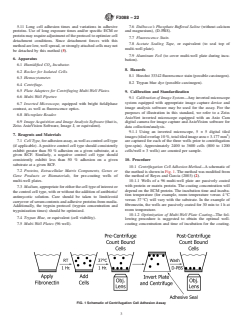
10.1 Centrifugation Cell Adhesion Method—Aschematicof
7.2 Proteins, Extracellular Matrix Components, Genes or
the method is shown in Fig. 1.The method was modified from
Gene Products or Biomaterials, for pre-coating wells of the method of Reyes and Garcia (2003) (2).
multi-well plates. 10.1.1 Wells of a 96 multi-well plate are passively coated
with protein or matrix protein. The coating concentration will
7.3 Medium,appropriateforeitherthecelltypeofinterestor
depend on the ECM protein. The incubation time and incuba-
the control cell type, with or without the addition of antibiotic/
tion temperature (for example, room temperature versus 4°C
antimycotic solution. Care should be taken to limit/avoid
versus 37°C) will vary with the substrate. In the example of
carryoverofserumcontentsandadhesiveproteinsfrommedia.
fibronectin, the wells are passively coated for 30 min to1hat
Additionally, the trypsin protocol (trypsin concentration and
room temperature.
trypsinization times) should be optimized.
10.1.2 Optimization of Multi-Well Plate Coating—The fol-
7.4 Trypan Blue, or equivalent (cell viability).
lowing procedure is suggested to obtain the optimal well-
7.5 Multi-Well Plates (96 well). coating concentration and time of incubation for the coating.
FIG. 1 Schematic of Centrifugation Cell Adhesion Assay
F3088 − 22
First, a series of test runs of the method should be performed additional information on assessing the attachment of cells to
where a broad concentration range (including a no-coating, biomaterial surfaces by physical methods, see Guide F2664.
zeroconcentration,control)ofthedesiredcoatingsubstrateare
10.1.7 It is recommended that an inverted microscope be
coated on separate wells of the multi-well plate for various usedtocaptureatleast5×5digitaltiledimages(fluorescence)
time periods at the appropriate temperature/relative humidity. for each of the wells prior to centrifugation (pre-spin).
Note that depending on the specific coating or intended Alternatively, the use of a fluorescence dye (that is, Calcein
outcome of the adhesion method, it may be appropriate to AM) and a microplate reader may be used before and after
compare multi-well plates with and without “tissue culture spinning instead of microscope imaging, followed by image
treatment.” A statistically significant number of replicates processing.Thisalternatemethodmayalsominimizeexposure
that could cause photobleaching (2). Microscope imaging may
should be run to allow appropriate statistical analysis of the
data. The data from the initial (broad concentration) test run still be required if further information on individual cell
morphology or patterns of cell adhesion on a particular
will provide data to re-run the adhesion method using a more
restrictive range for the coating concentration and for the time substrate is required.
of incubation. Appropriate statistical analyses should be per- 10.1.8 Determination of the Appropriate RCF for a Particu-
formed on the data. If an even more specific coating concen- lar Cell Type and Substrate—The following procedure is
trationisdesired,thentheprocedurecanberepeatedusingdata suggestedtoobtaintheoptimalrelativecentrifugalforce(RCF)
for a particular cell line seeded on a particular coating-
fromthesecondsetoftestruns.Ifdesired,incubationtimesfor
substrate. First, a series of test runs of the method should be
thecoatingmayalsobevaried.Theprocedureshallberepeated
performed using multiple replicate test multi-well plates,
for each new coating material to optimize the coating concen-
incorporatingarangeofRCFvalues,suchas10to50×g,100
tration and the time of incubation for the coating.
to250×g,and350×gor above; where g = acceleration due
10.1.3 Remove excess coating solution from the wells. A
to gravity. Data obtained from these test runs should be
blocking step, using heat-denatured serum albumin, is recom-
analyzed to determine the lowest RCF that results in approxi-
mended if sub-sat
...
This document is not an ASTM standard and is intended only to provide the user of an ASTM standard an indication of what changes have been made to the previous version. Because
it may not be technically possible to adequately depict all changes accurately, ASTM recommends that users consult prior editions as appropriate. In all cases only the current version
of the standard as published by ASTM is to be considered the official document.
Designation: F3088 − 14 F3088 − 22
Standard Test Method Practice for
Use of a Centrifugation Method to Quantify/Study Cell-
Material Adhesive Interactions
This standard is issued under the fixed designation F3088; the number immediately following the designation indicates the year of
original adoption or, in the case of revision, the year of last revision. A number in parentheses indicates the year of last reapproval. A
superscript epsilon (´) indicates an editorial change since the last revision or reapproval.
1. Scope
1.1 This test method covers a centrifugation cell adhesion assay that can be used to detect changes in adhesive characteristics of
cells with passage or treatments. This approach measures the force required to detach cells from a substrate. Adhesion, among
many variables, may vary due to changes in the phenotype of the cells.
1.2 This test method does not cover methods to verify the uniformity of coating of surfaces, nor does it cover methods for
characterizing surfaces.
1.3 The cells may include adult, progenitor or stem cells from any species. The types of cells may include chondrocytes,
fibroblasts, osteoblast, islet cells, or other relevant adherent cell types.
1.4 This test method does not cover methods for isolating or harvesting of cells. This test method does not cover test methods to
quantitate changes in gene expression, or changes in biomarker type or concentration, as identified by immunostaining. Nor does
this test method cover quantitative image analysis techniques.
1.5 This standard does not purport to address all of the safety concerns, if any, associated with its use. It is the responsibility
of the user of this standard to establish appropriate safety and health practices and determine the applicability of regulatory
limitations prior to use.
2. Referenced Documents
2.1 ASTM Standards:
F2603 Guide for Interpreting Images of Polymeric Tissue Scaffolds
F2664 Guide for Assessing the Attachment of Cells to Biomaterial Surfaces by Physical Methods
F2739 Guide for Quantifying Cell Viability and Related Attributes within Biomaterial Scaffolds
F2944 Practice for Automated Colony Forming Unit (CFU) Assays—Image Acquisition and Analysis Method for Enumerating
and Characterizing Cells and Colonies in Culture
3. Summary of Test Method
3.1 Centrifugation Cell Assay on Cell Populations—A conventional centrifuge can be used to apply a normal or shear force to cells
This test method practice is under the jurisdiction of ASTM Committee F04 on Medical and Surgical Materials and Devices and is the direct responsibility of
Subcommittee F04.43 on Cells and Tissue Engineered Constructs for TEMPs.
Current edition approved May 1, 2014April 1, 2022. Published June 2014May 2022. Originally approved in 2014. Last previous edition approved in 2014 as F3088 – 14.
DOI: 10.1520/F3088-14.10.1520/F3088-22.
For referenced ASTM standards, visit the ASTM website, www.astm.org, or contact ASTM Customer Service at service@astm.org. For Annual Book of ASTM Standards
volume information, refer to the standard’s Document Summary page on the ASTM website.
Copyright © ASTM International, 100 Barr Harbor Drive, PO Box C700, West Conshohocken, PA 19428-2959. United States
F3088 − 22
depending on the orientation of the cells with respect to the centrifugal force (1-3). The centrifugal force that the cells are subject
to can be calculated according to the following formula assuming that the plates are 90° (normal) to the spindle of the centrifuge.
F 5 p 2 p V RCF (1)
~ !
D cell medium cell
where:
F = detachment force applied per cell,
D
V = cell volume,
cell
p = density of the cell,
cell
p = the density of the surrounding medium, and
medium
RCF = Relative Centrifugal Forces = rῳ , where r = centrifugation radius and ῳ = centrifugation speed.
See X1.6 for example of a calculation of “detachment force per cell.”
3.1.1 Such tests are easy to conduct and the results represent a population average. The method can be performed in a moderately
outfitted cell biology lab with an inverted microscope or a fluorescence microplate reader and a centrifuge with a microtiter plate
holder. Three factors need to be considered when using this methodology: the potential influences of forces applied during the
period of spin up time, the maximum spin speed, and the test duration. The method is only able to correlate with cell detachment
with the maximum force applied after the centrifuge has reached its set spin speed. It should also be considered that the maximum
force that can be applied is limited by the centrifuge, sample configuration (that is, configuration and type of multiwell plate) and
time of centrifugation. In some instances, the cell adhesion strength will be greater than the applied forces. Therefore, for certain
cell types that have attached for extended periods of time, the method may not be able to generate forces sufficient to detach these
cells.
3.1.2 Cell attachment is a complex, time-dependent, process involving significant morphological and structural changes of the cell
and deposition of a bed of extracellular matrix and is a function of cellular and substrate parameters. Cell adhesion to a surface
depends on a range of biological factors that include culture history, species, the source and origin of the cells, embryological status
of the cells (adult, progenitor, stem), histological types of cells (chondrocytes, fibroblasts, osteoblast, islet cells, etc.), purity,
passage number, population doublings, and time after trypsinization. The adhesive strength also depends on the chemistry, surface
chemistry/topography, and morphology of the underlying surface and adsorbed proteins or engineered ligands and, most
importantly, time of adhesion.
4. Significance and Use
4.1 This test method describes a cell adhesion method that can be used to provide a detachment percent at a given RCF for cells
that have adhered to a substrate, typically for a short time. The information generated by this test method can be used to obtain
a semi-quantitative measurement of the adhesion of cells to either an uncoated or pre-coated substrate, when compared to a
reference (adherent) cell type on the same substrate. As described in Reyes and Garcia (2003), it is recommended that the 50 %
point be used for either ligand concentration or RCF for the most robust measurement of adhesion strength. The adhesion may vary
due to changes in the phenotype of the cells or as a result of the specific properties of the surface. The substrate may include tissue
culture-treated polystyrene, biomaterials or bioactive surfaces. If the substrate is a hydrogel, care must be taken to avoid cohesive
failure in the hydrogel (that is, detached cells have pulled away fragments of gel). The coating may consist of (but is not limited
to) the following: natural or synthetic biomaterials, hydrogels, components of extracellular matrix (ECM), ligands, adhesion or
bioactive molecules, genes or gene products. Cell concentration is also critical, as use of too high a concentration of cells may
result in cells detaching as a sheet, rather than as individual cells. This centrifugation approach, once validated, may be applicable
for quality control (QC) and product development. However, until the method is correlated to other measures of cell attachment,
the current method should be run in parallel with other known measures of cell adhesion.
4.2 This test method does not cover test methods to quantitate changes in gene expression, or changes in biomarkers, as identified
by immunostaining. This test method additionally does not cover quantitative image analysis techniques. In some cases the change
in adhesive properties may reflect on the degree of differentiation or de-differentiation of the cells. However, it is worth noting that
adhesive interactions do not necessarily reflect the differentiation state of a particular cell type, although in many instances they
do. (See X1.3 for application to the Adhesion of Chondrocytes.)
5. Interferences
NOTE 1—The following interferences may result in variable and inconsistent results from this method and care should be taken to minimize these
conditions.
The boldface numbers in parentheses refer to the list of references at the end of this standard.
F3088 − 22
5.1 Cell concentration too high in multi-wells—If the cell concentration is too high, then the cells may detach as a sheet, instead
of as individual cells.
5.2 Cells not evenly distributed in wells (that is, clumping).
5.3 Inconsistency in the fluid level within multi-wells—Wells must be completely filled with fluid (4).
5.4 Inconsistency in well coating and blocking protocols—Where possible, a negative substrate control (that is, non-tissue
culture-treated polystyrene, or similar control which has been shown to limit cell adhesion) should be included.
5.5 Inconsistency in pipetting forces when washing wells.
5.6 Air bubbles in well prior to, or forming during, centrifugation. The air bubbles can result from improper pipetting of fluid
within the wells, or an improper fluid level in the wells prior to sealing the top of the wells with an adhesive cover (that is, “reverse
meniscus” not formed in well prior to sealing with acetate sealing tape).
5.7 Incomplete washing of wells to remove loosely adherent or dead cells.
5.8 Cross-over of fluorescent signal between adjacent wells in clear or translucent multi-well plates.
5.9 Centrifugation of multiple multi-well plates. A complex stress situation can result from spinning multiple multi-well plates
(that is, stacking plates within a plate holder on the centrifuge), depending on the orientation of cells with respect to the centripetal
force.
5.10 Photobleaching of fluorescence stain. Photobleaching may be reduced by limiting the exposure of the stained cells to room
light or ultraviolet light.
5.11 Long cell adhesion times and variations in adhesive proteins—Use of long exposure times and/or specific ECM or protein
may require adjustment of the protocol to optimize cell detachment conditions. Since detachment forces with this method are low,
well spread, or strongly attached cells may not be detached by this method (5).
6. Apparatus
6.1 Humidified CO Incubator.
6.2 Rocker for Isolated Cells.
6.3 Hemocytometer.
6.4 Centrifuge.
6.5 Plate Adapters for Centrifuging Multi-well Plates.
6.6 Multi-well Pipetter.
6.7 Inverted Microscope equipped with bright field/phase, as well as fluorescence optics.
6.8 Microplate Reader.
6.9 Image Acquisition and Image AnalysisSsoftware (that is, Zeiss AxioVision Software, Image J or equivalent).
F3088 − 22
7. Reagents and Materials
7.1 Cell Type, for adhesion assay, as well as control cell type (if applicable). A positive control cell type should consistently exhibit
greater than 50 % adhesion on a given substrate, at a given RCF. Similarly, a negative control cell type should consistently exhibit
less than 50 % adhesion on a given substrate at a given RCF.
7.2 Proteins, Extracellular Matrix Ccomponents, Genes or Gene Products or Biomaterials for pre-coating wells of multi-well
plates.
7.3 Medium appropriate for either the cell type of interest or the control cell type, with or without the addition of
antibiotic/antimycotic solution. Care should be taken to limit/avoid carryover of serum contents and adhesive proteins from media.
Additionally, the trypsin protocol (trypsin concentration and trypsinization times) should be optimized.
7.4 Trypan Blue or equivalent (cell viability).
7.5 Multi-well Plates (96 well).
7.6 Dulbecco’s Phosphate Buffered Saline (without calcium and magnesium), (D-PBS).
7.7 Fluorescence Stain.
7.8 Acetate Sealing Tape, or equivalent (to seal top of multi-well plate).
7.9 Aluminum Foil (to cover multi-well plate during incubation).
8. Hazards
8.1 Hoechst 33342 fluorescence stain (possible carcinogen).
8.2 Trypan blue dye (possible carcinogen).
9. Calibration and Standardization
9.1 Calibration of Image System—Any inverted microscope system equipped with appropriate image capture device and image
analysis software may be used for the assay. For the purposes of illustration in this standard, we refer to a Zeiss AxioVert inverted
microscope equipped with an Axio Cam digital camera for image capture and AxioVision software for data collection/analysis.
9.1.1 Using an inverted microscope, 5 × 5 digital tiled images (tiled overlap 10 %, total tiled image area = 3.177 mm ) are captured
for each of the three wells prior to centrifugation (pre-spin). Approximately 2400 to 3600 cells (800 to 1200 cells/well × 3 wells)
are counted per sample.
10. Procedure
10.1 Centrifugation Cell Adhesion Method—A schematic of the method is shown in Fig. 1. The method was modified from the
method of Reyes and Garcia (2003) (2).
10.1.1 Wells of a 96 multi-well plate are passively coated with protein or matrix protein. The coating concentration will depend
on the ECM protein. The incubation time and incubation temperature (for example, room temperature versus 4°C versus 37°C)
will vary with the substrate. In the example of fibronectin, the wells are passively coated for 30 min. to 1 h at room temperature.
10.1.2 Optimization of Multi-Well Plate Coating—The following procedure is suggested to obtain the optimal well-coating
concentration and time of incubation for the coating. First, a series of test runs of the method should be performed where a broad
concentration range (including a no-coating, zero concentration, control) of the desired coating substrate are coated on separate
wells of the multi-well plate for various time periods at the appropriate temperature/relative humidity. Note that depending on the
specific coating or intended outcome of the adhesion method, it may be appropriate to compare multi-well plates with and without
F3088 − 22
FIG. 1 Schematic of Centrifugation Cell Adhesion Assay
“tissue culture treatment.” A statistically significant number of replicates should be run to allow appropriate statistical analysis of
the data. The data from the initial (broad concentration) test run will provide data to re-run the adhesion method using a more
restrictive range for the coating concentration and for the time of incubation. Appropriate statistical analyses should be performed
on the data. If an even more specific coating concentration is desired, then the procedure can then be repeated using data from the
second set of test runs. If desired, incubation times for the coating may also be varied. The procedure shall be repeated for each
new coating material to optimize the coating concentration and the time of incubation for the coating.
10.1.3 Remove excess coating solution from the wells. A blocking step, using heat-denatured serum albumin, is recommended if
sub-saturating protein densities are used. The blocking is usually performed prior to protein absorption. Follow by three washes
in D-PBS.
10.1.4 Harvest cells and assess for viability using an appropriate method, such as the trypan-blue dye exclusion method, and a
hemocytometer. As the harvesting procedure very likely influences the cell adhesive process, care should be taken when
performing procedures such as trypsinization to use the lowest concentration of trypsin/ethylenediamine tetra acetic acid (EDTA)
for the shortest time possible. In addition, to limit potential effects on cell attachment strength, care should be taken to minimize
the processing time, during which time the cells are outside of their optimum incubation/adhesion temperature/CO conditions. For
additional information on quantitating cell viability within biomaterial scaffolds and enumerating and characterizing cells and
colonies in culture, we recommend consulting Guide F2739 and Test Method F2944, respectively.
3 4
10.1.5 Dilute cells to a suggested cell concentration of 5 × 10 to 1 × 10 (per well in a 96 well plate) in appropriate medium for
test cells or control cells in medium which has been pre-mixed with the desired fluorescence stain. The desired stain concentration
(percentage stain to total volume) will vary with the specific stain employed. But as an example, with Hoechst stain, the
recommended mix is 10 % of the volume.
10.1.6 Add cells to the wells and incubate at 37°C at 95 % air/5 % CO /90 % R.H.(relative humidity), covered in aluminum foil
to prevent photobleaching. The time required for adhesion varies significantly across cell type, ECM, and surface. Also, cell
seeding in the presence of serum-containing medium affects adhesion time. Replicate samples in sufficient number of the 96 wells
should be run to obtain statistical significance. It is recommended that an additional well be used to adjust the microscope
parameters, such as exposure time, etc. Discard measurements from this additional well. For additional information on assessing
the attachment of cells to biomaterial surfaces by physical methods, see Guide F2664.
10.1.7 It is recommended that an inverted microscope be used to capture at least 5 × 5 digital tiled images (fluorescence) for each
of the wells prior to centrifugation (pre-spin). Alternatively, the use of a fluorescence dye (that is, Calcein AM) and a microplate
reader may be used before and after spinning, instead of microscope imaging, followed by image processing. This alternate method
may also minimize exposure that could cause photobleaching (2). Microscope imaging may still be required if further information
on individual cell morphology or patterns of cell adhesion on a particular substrate is required.
10.1.8 Determination of the Appropriate RCF for a Particular Cell Type and Substrate—The following procedure is suggested to
obtain the optimal relative centrifugal force (RCF) for a particular cell line seeded on a particular coating-substrate. First, a series
of test runs of the method should be performed using multiple replicate test multi-well plates, incorporating a range of RCF values,
such as 10 to 50 × g, 100 to 250 × g and 350 × g or above; where g = acceleration due to gravity. Data obtained from these test
runs should be analyzed to determine the lowest RCF that results in approximately 50 % detachment of the cells from the treated
F3088 − 22
surface. Appropriate viability, biochemical, histochemical, or mechanical testing should be performed on the cells following
centrifugation at the selected RCF to determine if the centrifugation adhesion method has resulted in adverse changes in these
properties for the cells. Note that the optimization of the RCF must be performed on each cell type, or cell line. Depending on the
cell type, the procedure may need to be repeated at different passages of the cells. Optimization of the RCF shall be performed
for each substrate-coating.
10.1.9 Before centrifugation, the wells are filled with D-PBS (at room temperature) to form a “reverse meniscus,” purged of air
bubbles and covered with acetate sealing tape and immediately centrifuged.
10.1.10 Centrifuge the plates (upside down) at the pre-optimized RCF for 5 min. at 22°C.
10.1.11 Following centrifugation, discard acetate sealing tape and remove the supernatant from the wells. Wash one time with
D-PBS. Fill wells with 100 μL D-PBS. If possible, it is recommended to use a motorized pipetter set at low speed to have
reproducible washing forces.
10.1.12 Capture fluorescent tiled digital images (suggested at least 5 × 5 matrices or appropriate for the cell line) for each of the
wells after centrifugation (post-spin).
10.1.13 Appendix X1.3 provides an example of the application of the protocol for the cell adhesion centrifugation assay with
primary bovine chondrocytes. The purpose of this application is to determine the increase in cell adhesion of chondrocytes with
serial passage number.
11. Calculation or Interpretation of Results
11.1 Determination of Cell Number Pre- and Post-Spin:
11.1.1 Tiled images for each of the wells are “stitched” together using the image analysis software. Subsequently, an automated
cell counting routine (such as Zeiss AxioVision, or any equivalent image analysis software) is used to count the number of
fluorescently labeled nuclei.
11.1.2 Divide the post-spin cell count by the pre-spin count and multiply by 100 to determine the percent adhesion. As described
in Reyes and Garcia (2003) (2), it is recommended to use the 50 % point for either ligand concentration or RCF for the most robust
measurement of adhesion strength. For additional information on interpreting images of polymeric tissue scaffolds, see Guide
F2603.
11.2 The centrifugation cell adhesion assay compares the adhesion of cells pre-centrifugation to the adhesion of the cells
post-centrifugation at known RCFs. Results of a typical centrifugation assay (for chondrocytes) run at both 120 g and 350 g are
shown in Fig. 2.
12. Precision and Bias
12.1 Quantitative precision and bias have not yet been determined for this standard.
13. Keywords
13.1 cell adhesion assay; centrifugation; chondrocytes; monolayer culture; serial passage; tissue culture-treated polystyrene
F3088 − 22
At each serial passage, passage of primary bovine chondrocytes, the centrifugation cell adhesion assay was used to obtain three replicate sample measurements.
Two-way Analysisanalysis of Variancevariance (ANOVA) with Tukey’s test for pairwise comparison indicated at ‘*’ p <0.001 < 0.001 that cell adhesion at Ps0 fi Ps 1-5,
L929; at p<0.05, p < 0.05, ‘#’ Ps1 fi Ps0, Ps 3-5, L929, ‘**’ Ps2 fi Ps 0, 4-5, L929; and Ps3 fi Ps0-1. Passage 3 shows a trend different form passage 2 (p = 0.090).
Abbreviation: RT = Room Temperature. Data were adapted from Kaplan et al. (5).
FIG. 2 Centrifugation Cell Adhesion Assay
APPENDIX
(Nonmandatory Information)
X1. PREPARATION OF PRIMARY BOVINE ARTICULAR CHONDROCYTES
X1.1 Source
X1.1.1 Articular chondrocytes are isolated from tibiofemoral joints of 2 to 4 week old calves or from immature steers less than
18 months old, or as appropriate for specific applications.
X1.2 Isolation of Chondrocytes
X1.2.1 Digest tissue with 11,000 U collagenase (Type II from C. histolyticum) suspended in 100 mL Dulbecco’s Minimum
Essential Media (DMEM)/F12 incomplete medium (no added Fetal Bovine Serum (FBS)).
X1.2.2 Incubate for 22 to 24 h at 37°C in a 5 % CO -95 % RH air incubator to obtain primary chondrocytes.
X1.2.3 Filter cells using a 40 μm nylon cell strainer and subsequently assess for viability and count cell numbers using an
appropriate method, such as the trypan-blue dye exclusion method, and a hemocytometer.
X1.2.4 Plate equal densities of cells per T-75 tissue culture flask and incubate for 5 to 7 days at 37°C in a 95 % air/5 % CO /90
% R.H. in DMEM/F12 complete medium.
F3088 − 22
X1.2.5 Serial passage, approximately every 3 to 5 days, when about 90 % confluent, for five passages (starting at passage 0).
X1.3 Adhesion Assay for Chondrocytes
X1.3.1 This test method describes a cell adhesion method that can be used to detach cells (chondrocytes) that have adhered to a
tissue culture-treated polystyrene substrate with an ECM absorbed onto it. Propagation of chondrocytes as monolayer cultures on
polystyrene surfaces are used extensively for amplifying cell numbers. However, chondrocytes undergo a phenotypic shift when
propagated in this manner and display characteristics of more adherent fibroblastic cells, including loss of Collagen Type II and
aggrecan production coupled with an increase in adhesive strength. The changes in the adhesion properties of the chondrocytes
as the chondrocytes de-differentiate in passage as monolayer cultures include changes in morphology, changes in gene expression
of Collagen Type I (Col I) and Collagen type II (Col II), as measured by quantitative reverse transcriptase polymerase chain
reaction (qRT-PCR) and by changes in biomarkers, as identified by immunostaining. This test method does not cover test methods
to quantitate changes in gene expression, or changes in biomarkers. The information generated by this test method can be used to
obtain a semi-quantitative measurement of the adhesion of chondrocytes to an uncoated or pre-coated tissue culture-treated
polystyrene surface (that is, fibronectin, etc.). It is worth noting that adhesive interactions do not necessarily reflect the
differentiation state of a particular cell type, although in many instances they do.
X1.3.2 Interferences:
X1.3.2.1 Photobleaching of Hoechst 33342 fluorescence stain.
X1.3.3 Reagents and Materials:
X1.3.3.1 Articular chondrocyte primary cells (freshly-isolated, passage 0 through passage 5).
X1.3.3.2 L929 fibroblast control.
X1.3.3.3 Fibronectin or appropriate extracellular matrix protein for pre-coating wells of multi-well plates.
X1.3.3.4 Complete DMEM/F12 medium (Chondrocytes): DMEM/F12 medium supplemented with 10 % fetal bovine serum
(FBS), 50 μg/ml L-ascorbic acid, 50 μg/m gentamicin and antibiotic-antimycotic solution (100 units/mL penicillin 100 μg/m,
streptomycin 0.25 μg/m, amphotericin B).
X1.3.3.5 RPMI-1640 medium with 10 % FBS and without antibiotics or antimycotics (L929 fibroblast).
X1.3.3.6 Trypan Blue.
X1.3.3.7 96 multi-well plates.
X1.3.3.8 Dulbecco’s phosphate buffered saline (without calcium and magnesium), D-PBS.
F3088 − 22
X1.3.3.9 Hoechst 33342 fluorescence stain.
X1.3.3.10 Acetate sealing tape to seal the top of the multi-well plate.
X1.3.3.11 Aluminum foil (to cover the multi-well plate during incubation).
X1.3.4 Procedure:
X1.3.4.1 Centrifugation Cell Adhesion Assay—A schematic of the assay is shown in Fig. 1. The assay was modified from the
method of Reyes and Garcia (2003) (2).
X1.3.4.2 Four wells of a 96-well plate are coated with protein or matrix protein (such as 100 μg/mL fibronectin) and, in the case
of fibronectin, incubated for 1 h at room temperature. The coating concentration will depend on the ECM protein.
X1.3.4.3 Remove excess coating solution from the wells.
X1.3.4.4 Chondrocytes that have been serially passaged approximately every 3 to 5 days for five passages (starting at passage 0)
are used in the cell adhesion assay.
X1.3.4.5 Harvest cells from each passage and assess for viability using the trypan-blue dye exclusion method and a
hemocytometer. As the harvesting procedure very likely influences the cell adhesive process, care should be taken when
performing procedures such as trypsinization to use the lowest concentration of trypsin/EDTA for the shortest time possible.
X1.3.4.6 Dilute cells to a suggested cell concentration of 5 × 10 bovine chondrocytes per mL in complete DMEM/F12 medium
or L292 (control) cells in RPMI-1640 medium that has been pre-mixed with Hoechst 33342 fluorescence stain (10 % of volume).
X1.3.4.7 Add cells to the wells and incubate for 1 h at 37°C at 95 % air/5 % CO /90 % R.H., covered in aluminum foil to prevent
photobleaching. For each serial passage, three replicate sample measurements are run. An additional fourth well is used to adjust
the microscope parameters, such as exposure. Discard measurements from this fourth well.
X1.3.4.8 It is recommended that an inverted microscope be used to capture at least 5 × 5 digital tiled images (fluorescence) for
each of the three wells prior to centrifugation (pre-spin).
X1.3.4.9 The wells are filled with D-PBS to form a “reverse meniscus,” purged of air bubbles and covered with acetate sealing
tape.
X1.3.4.10 Centrifuge the plates (upside down) at known relative centrifugal forces (RCF) for 5 min. at 22°C. A suggested starting
set of RCF are 120 g or 350 g.
X1.3.4.11 Following centrifugation, discard acetate sealing tape and remove the supernatant from the wells. Wash one time with
D-PBS. Fill the wells with 100 μL D-PBS. It is recommended that a motorized pipetter set at low speed be used, if possible, to
have reproducible washing forces.
F3088 − 22
X1.3.4.12 Capture a total of 25 fluorescent tiled digital images (suggested at least a 5 × 5 matrix, tile overlap 10 %) for each of
the three wells after centrifugation (post-spin).
X1.4 Calculations or Interpretation of Results
X1.4.1 Determination of cell number pre- and post-spin.
X1.4.2 Tile images for each of the wells are “stitched” together. Subsequently, an automated cell counting routine (AxioVision)
is used to count the number of fluorescently labeled nuclei.
X1.4.3 Divide the post-spin cell count by the pre-spin count and multiply by 100 to determine the percent adhesion. As described
in Reyes and Garcia (2003) (2), it is recommended that the 50 % point be used for either ligand concentration or RCF for the most
robust measurement of adhesion strength.
X1.5 Report
X1.5.1 The centrifugation cell adhesion assay compares the adhesion of chondrocytes serially passaged for passage 0 to passage
5 to the adhesion of a control L929 fibroblast cell line to determine if, over passage, there was any change in the adhesive
characteristics of the chondrocytes. Results of a typical centrifugation assay run at both 120 g and 350 g are shown in Fig. 2.
X1.6 Example of Calculation of “Detachment Force per Cell”
F 5 ρ 2 ρ 3V 3RCF (X1.1)
~ !
D cell medium cell
X1.6.1 Terms:
F = detachment force per cell,
D
ρ = cell density = 1.07 g/cm ,
cell
ρ = density of surrounding medium = 1.00 g/cm ,
medium
3 -9 3
V = cell volume = 1700 μm = 1.7 × 10 cm
cell
RCF = relative centrifugal force in G = (0.0000111824) × r × ῳ ,
G cm RPM
0.0000111824 = constant for conversion from standard units for frequency (rad/s), distance (m) and acceleration due to gravity
(G = 9.80665 m/s ) to rotor radius in cm and speed in rpm so that RCF is expressed in G,
r = centrifugation radius = 16.3 cm, and
cm
ῳ = centrifugation speed = 1000 rpm.
RPM
X1.6.2 Calculation:
F3088 − 22
F 5sρ 2 ρ dV 3RCF 3s9.80665 m⁄s d
D cell medium cell G
2 2
F 5sρ 2 ρ dV 3s0.0000111824d3r3ω 3s9.80665 m⁄s d
D cell medium cell
3 3 29 3 2 2
F 5s1.07 g⁄cm 2 1.00 g⁄cm d3s1.7 3 10 cm d3s0.0000111824d3s16.3 cmd3s1000 rpmd 3s980.665 cm⁄s d
D
25 2 25
F 52.13310 sg3cmd⁄s 52.13310 dynes5213 pN
D
REFERENCES
(1) Heneweer, C. et al., “Mechanisms in uterine epithelium during trophoblast binding: The role of small GTPase RhoA in human uterine Ishikawa cells,”
J. Exp Clin Assist Reprod., 2:4, 2005.
(2) Reyes, C. and Garcia, A. “A centrifugation cell adhesion assay for high-throughput screening of biomaterial surfaces,” J. Biomed. Mater. Res, 67A,
328, 2003.
(3) Garcia, A.J. and Gallant, N.D., “Stick and Grip: measurement systems and quantitative analyses of integrin-mediated cell adhesion strength,” Cell
Biochem. and Biophys. 39, 61, 2003.
(4) Lotz, M.M., et al., “Cell adhesion to fibronectin and tenascin: quantitative measurements of initial binding and subsequent strengthening response,”
J. Cell Biol, 109:1795-1805, 1989.
(5) Kaplan, D.S. et al., “Centrifugation assays for measuring adhesion of serially-passaged bovine chondrocytes to polystyrene surfaces,” Tissue
Engineering, Part C, 18(7), 537-544, 2012.
ASTM International takes no position respecting the validity of any patent rights asserted in connection with any item mentioned
in this standard. Users of this standard are expressly advised that determination of the validity of any such patent rights, and the risk
of infringement of such rights, are entirely their own responsibility.
This standard is subject to revision at any time by the responsible technical committee and must be reviewed every five years and
if not revised, either reapproved or withdrawn. Your comments are invited either for revision of this standard or for additional standards
and should be addressed to ASTM International Headquarters. Your comments will receive careful consideration at a meeting of the
responsible technical committee, which you may attend. If you feel that your comments have not received a fair he
...