

ASTM E736/E736M-19(2023)
(Test Method)Standard Test Method for Cohesion/Adhesion of Sprayed Fire-Resistive Materials Applied to Structural Members
General Information
- Abstract
SIGNIFICANCE AND USE
4.1 The intent of this test method is to determine a property of SFRM that may be used to provide an indication of its in-place serviceability. Satisfactory performance of SFRM applied to structural members and assemblies depends upon its ability to withstand the various influences that may occur during construction and during the life of the structure, as well as upon its satisfactory performance under fire conditions.
4.2 For cohesion/adhesion testing of installed asbestos-containing sprayed fire-resistive materials, refer to Practice E1494.
SCOPE
1.1 This test method covers a procedure for measuring the cohesion/adhesion or bond strength (tensile) perpendicular to the surface of sprayed fire-resistive material (SFRM) applied to rigid backing. These fire-resistive materials include sprayed fibrous and cementitious materials. The test method is applicable to both laboratory and field procedures as indicated in Section 7.
1.2 The values stated in either SI units or inch-pound units are to be regarded separately as standard. The values stated in each system are not necessarily exact equivalents; therefore, to ensure conformance with the standard, each system shall be used independently of the other, and values from the two systems shall not be combined.
1.3 This standard does not purport to address all of the safety concerns, if any, associated with its use. It is the responsibility of the user of this standard to establish appropriate safety, health, and environmental practices and determine the applicability of regulatory limitations prior to use.
1.4 This international standard was developed in accordance with internationally recognized principles on standardization established in the Decision on Principles for the Development of International Standards, Guides and Recommendations issued by the World Trade Organization Technical Barriers to Trade (TBT) Committee.
- Status
- Published
- Publication Date
- 14-Mar-2023
- Technical Committee
- E06 - Performance of Buildings
- Drafting Committee
- E06.21 - Serviceability


Overview
ASTM E736/E736M-19(2023) is the internationally recognized standard test method for evaluating the cohesion and adhesion (bond strength) of sprayed fire-resistive materials (SFRM) applied to structural members. Developed by ASTM, this standard outlines testing protocols designed to assess the integrity and in-place serviceability of SFRM such as fibrous and cementitious coatings. These materials are critical for protecting structural components in buildings, ensuring that they remain effective fire barriers throughout construction and the building’s life cycle.
The standard applies to both laboratory and field evaluations and supports compliance with safety, health, and environmental practices. The procedures detailed in ASTM E736/E736M help to verify that SFRMs maintain reliable attachment and performance under real-world conditions.
Key Topics
- Scope of Testing: The standard specifies methods for measuring tensile bond strength perpendicular to the SFRM surface applied to rigid backing.
- Specimen Preparation: Guidelines for specimen dimensions, application conditions, and curing processes are included to ensure consistency and relevance of test results.
- Testing Procedures: Involves adhering a metal or plastic cap to the SFRM with a suitable adhesive, and applying increasing load to measure the force at failure.
- Types of Failure: Distinguishes between cohesive failure (within the SFRM) and adhesive failure (at the interface with the substrate), as well as reporting thickness and density.
- Dual-Unit Compliance: Permits the use of both SI and inch-pound units, ensuring international applicability.
- Field and Laboratory Application: Procedures are suited for both in-situ (field) and controlled (lab) testing environments, reflecting actual SFRM performance.
Applications
- Fire-Resistance Verification: The standard is essential for verifying the effectiveness and durability of sprayed fire-resistive materials as protective barriers on structural steel and other structural members.
- Quality Control: Used by contractors, manufacturers, and building inspectors to ensure SFRM installations meet minimum bond strength and cohesion requirements.
- Building Safety Compliance: Supports building code compliance regarding fire protection, helping ensure that materials will perform as intended under fire conditions.
- Construction and Retrofitting: Applicable in both new construction and refurbishment projects needing fire-resistive coatings on structural components.
- Field Evaluation: Enables assessment of in-place fireproofing systems during and after construction, identifying potential issues with material adherence before an incident occurs.
Related Standards
- ASTM E84: Standard Test Method for Surface Burning Characteristics of Building Materials. Evaluates the flame spread and smoke development of building products.
- ASTM E119: Test Methods for Fire Tests of Building Construction and Materials. Used for fire-resistance evaluations of assemblies.
- ASTM E605/E605M: Methods for determining the thickness and density of SFRM applied to structural components.
- ASTM E1494: Practice for Testing Physical Properties of Friable Surfacing Materials; referred to for asbestos-containing SFRM.
These related ASTM standards support a comprehensive approach to fire safety in buildings by addressing various aspects of SFRM testing and performance requirements.
Keywords: ASTM E736, sprayed fire-resistive materials, SFRM bond strength, fireproofing adhesion testing, cohesion test, structural fireproofing, fire-resistance standards, building safety compliance.
Relations
- Effective Date
- 01-Dec-2023
- Effective Date
- 01-Sep-2023
- Effective Date
- 01-Oct-2019
- Effective Date
- 01-Jul-2019
- Effective Date
- 15-Apr-2019
- Effective Date
- 01-Mar-2019
- Effective Date
- 01-Nov-2018
- Effective Date
- 01-Nov-2018
- Effective Date
- 01-Oct-2018
- Effective Date
- 01-Sep-2018
- Refers
ASTM E1494-18 - Standard Practice for Testing Physical Properties of Friable Surfacing Materials - Effective Date
- 01-Jul-2018
- Effective Date
- 01-Jul-2018
- Effective Date
- 01-Jun-2018
- Effective Date
- 01-Mar-2018
- Effective Date
- 01-Mar-2018
Get Certified
Connect with accredited certification bodies for this standard

CIS Institut d.o.o.
Personal Protective Equipment (PPE) certification body. Notified Body NB-2890 for EU Regulation 2016/425 PPE.

Kiwa BDA Testing
Building and construction product certification.
Kmetijski inštitut Slovenije
Agricultural Institute of Slovenia. Soil testing, plant health, agricultural product analysis.
Sponsored listings
Frequently Asked Questions
ASTM E736/E736M-19(2023) is a standard published by ASTM International. Its full title is "Standard Test Method for Cohesion/Adhesion of Sprayed Fire-Resistive Materials Applied to Structural Members". This standard covers: SIGNIFICANCE AND USE 4.1 The intent of this test method is to determine a property of SFRM that may be used to provide an indication of its in-place serviceability. Satisfactory performance of SFRM applied to structural members and assemblies depends upon its ability to withstand the various influences that may occur during construction and during the life of the structure, as well as upon its satisfactory performance under fire conditions. 4.2 For cohesion/adhesion testing of installed asbestos-containing sprayed fire-resistive materials, refer to Practice E1494. SCOPE 1.1 This test method covers a procedure for measuring the cohesion/adhesion or bond strength (tensile) perpendicular to the surface of sprayed fire-resistive material (SFRM) applied to rigid backing. These fire-resistive materials include sprayed fibrous and cementitious materials. The test method is applicable to both laboratory and field procedures as indicated in Section 7. 1.2 The values stated in either SI units or inch-pound units are to be regarded separately as standard. The values stated in each system are not necessarily exact equivalents; therefore, to ensure conformance with the standard, each system shall be used independently of the other, and values from the two systems shall not be combined. 1.3 This standard does not purport to address all of the safety concerns, if any, associated with its use. It is the responsibility of the user of this standard to establish appropriate safety, health, and environmental practices and determine the applicability of regulatory limitations prior to use. 1.4 This international standard was developed in accordance with internationally recognized principles on standardization established in the Decision on Principles for the Development of International Standards, Guides and Recommendations issued by the World Trade Organization Technical Barriers to Trade (TBT) Committee.
SIGNIFICANCE AND USE 4.1 The intent of this test method is to determine a property of SFRM that may be used to provide an indication of its in-place serviceability. Satisfactory performance of SFRM applied to structural members and assemblies depends upon its ability to withstand the various influences that may occur during construction and during the life of the structure, as well as upon its satisfactory performance under fire conditions. 4.2 For cohesion/adhesion testing of installed asbestos-containing sprayed fire-resistive materials, refer to Practice E1494. SCOPE 1.1 This test method covers a procedure for measuring the cohesion/adhesion or bond strength (tensile) perpendicular to the surface of sprayed fire-resistive material (SFRM) applied to rigid backing. These fire-resistive materials include sprayed fibrous and cementitious materials. The test method is applicable to both laboratory and field procedures as indicated in Section 7. 1.2 The values stated in either SI units or inch-pound units are to be regarded separately as standard. The values stated in each system are not necessarily exact equivalents; therefore, to ensure conformance with the standard, each system shall be used independently of the other, and values from the two systems shall not be combined. 1.3 This standard does not purport to address all of the safety concerns, if any, associated with its use. It is the responsibility of the user of this standard to establish appropriate safety, health, and environmental practices and determine the applicability of regulatory limitations prior to use. 1.4 This international standard was developed in accordance with internationally recognized principles on standardization established in the Decision on Principles for the Development of International Standards, Guides and Recommendations issued by the World Trade Organization Technical Barriers to Trade (TBT) Committee.
ASTM E736/E736M-19(2023) is classified under the following ICS (International Classification for Standards) categories: 13.220.50 - Fire-resistance of building materials and elements. The ICS classification helps identify the subject area and facilitates finding related standards.
ASTM E736/E736M-19(2023) has the following relationships with other standards: It is inter standard links to ASTM E84-23d, ASTM E84-23c, ASTM E119-19, ASTM E84-19b, ASTM E84-19a, ASTM E84-19, ASTM E119-18c, ASTM E119-18ce1, ASTM E84-18b, ASTM E119-18b, ASTM E1494-18, ASTM E84-18a, ASTM E119-18a, ASTM E119-18, ASTM E84-18. Understanding these relationships helps ensure you are using the most current and applicable version of the standard.
ASTM E736/E736M-19(2023) is available in PDF format for immediate download after purchase. The document can be added to your cart and obtained through the secure checkout process. Digital delivery ensures instant access to the complete standard document.
Standards Content (Sample)
This international standard was developed in accordance with internationally recognized principles on standardization established in the Decision on Principles for the
Development of International Standards, Guides and Recommendations issued by the World Trade Organization Technical Barriers to Trade (TBT) Committee.
Designation: E736/E736M − 19 (Reapproved 2023)
Standard Test Method for
Cohesion/Adhesion of Sprayed Fire-Resistive Materials
Applied to Structural Members
This standard is issued under the fixed designation E736/E736M; the number immediately following the designation indicates the year
of original adoption or, in the case of revision, the year of last revision. A number in parentheses indicates the year of last reapproval.
A superscript epsilon (´) indicates an editorial change since the last revision or reapproval.
This standard has been approved for use by agencies of the U.S. Department of Defense.
1. Scope E119 Test Methods for Fire Tests of Building Construction
and Materials
1.1 This test method covers a procedure for measuring the
E605/E605M Test Methods for Thickness and Density of
cohesion/adhesion or bond strength (tensile) perpendicular to
Sprayed Fire-Resistive Material (SFRM) Applied to
the surface of sprayed fire-resistive material (SFRM) applied to
Structural Members
rigid backing. These fire-resistive materials include sprayed
E1494 Practice for Testing Physical Properties of Friable
fibrous and cementitious materials. The test method is appli-
Surfacing Materials
cable to both laboratory and field procedures as indicated in
Section 7.
3. Summary of Test Method
1.2 The values stated in either SI units or inch-pound units
are to be regarded separately as standard. The values stated in
3.1 The cohesion/adhesion is determined using a metal or
each system are not necessarily exact equivalents; therefore, to
plastic cap with a hook attached. The cap is attached to the
ensure conformance with the standard, each system shall be
SFRM with a suitable adhesive. An increasing load, measured
used independently of the other, and values from the two
by a scale, is applied manually until failure occurs.
systems shall not be combined.
4. Significance and Use
1.3 This standard does not purport to address all of the
safety concerns, if any, associated with its use. It is the
4.1 The intent of this test method is to determine a property
responsibility of the user of this standard to establish appro-
of SFRM that may be used to provide an indication of its
priate safety, health, and environmental practices and deter-
in-place serviceability. Satisfactory performance of SFRM
mine the applicability of regulatory limitations prior to use.
applied to structural members and assemblies depends upon its
1.4 This international standard was developed in accor-
ability to withstand the various influences that may occur
dance with internationally recognized principles on standard-
during construction and during the life of the structure, as well
ization established in the Decision on Principles for the
as upon its satisfactory performance under fire conditions.
Development of International Standards, Guides and Recom-
mendations issued by the World Trade Organization Technical
4.2 For cohesion/adhesion testing of installed asbestos-
Barriers to Trade (TBT) Committee.
containing sprayed fire-resistive materials, refer to Practice
E1494.
2. Referenced Documents
2.1 ASTM Standards: 5. Apparatus
E84 Test Method for Surface Burning Characteristics of
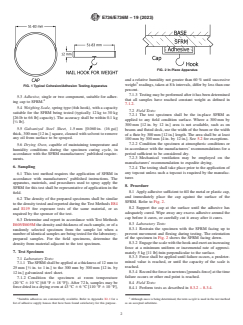
5.1 Fig. 1 illustrates a suitable apparatus.
Building Materials
5.2 Bottle Screw Cap, metal or rigid plastic 51 mm to
1 1
83 mm [2 in. to 3 ⁄4 in.] in inside diameter and 12 mm [ ⁄2 in.]
1 in nominal depth. A hook shall be attached at the center. Where
This test method is under the jurisdiction of ASTM Committee E06 on
Performance of Buildings and is the direct responsibility of Subcommittee E06.21
deck profile does not allow the use of an 83 mm [3 ⁄4 in.]
on Serviceability.
diameter cap due to area restriction, a minimum 51 mm [2 in.]
Current edition approved March 15, 2023. Published April 2023. Originally
diameter cap shall be used.
approved in 1980. Last previous edition approved in 2019 as E736/E736M – 19.
DOI: 10.1520/E0736_E0736M-19R23.
For referenced ASTM standards, visit the ASTM website, www.astm.org, or
contact ASTM Customer Service at service@astm.org. For Annual Book of ASTM
Standards volume information, refer to the standard’s Document Summary page on Refer to Appendix X1.2 for a list of bottle screw cap supply houses that have
the ASTM website. been found satisfactory for this purpose. Many local suppliers are also available.
Copyright © ASTM International, 100 Barr Harbor Drive, PO Box C700, West Conshohocken, PA 19428-2959. United States
E736/E736M − 19 (2023)
FIG. 2 In-Place Apparatus
and a relative humidity not greater than 60 % until successive
weight readings, taken at 8 h intervals, differ by less than one
FIG. 1 Typical Cohesion/Adhesion Testing Apparatus
percent.
7.1.3 Testing may be performed after it has been determined
5.3 Adhesive, single or two component, suitable for adher-
that all samples have reached constant weight as defined in
ing cap to SFRM.
7.1.2.
5.4 Weighing Scale, spring type (fish hook), with a capacity
7.2 Field Tests:
suitable for the SFRM being tested (typically 12 kg to 30 kg
7.2.1 The test specimen shall be the in-place SFRM as
[26 lb to 66 lb] capacity). The accuracy shall be within 0.1 kg
applied to any field condition surface. Where a 300 mm by
[ ⁄4 lb].
300 mm [12 in. by 12 in.] area is not available, such as on
5.5 Galvanized Steel Sheet, 1.5 mm [0.060 in. (16 ga)]
beams and fluted deck, use the width of the beam or the width
thick, 300 mm [12 in.] square, cleaned with solvent to remove
of a flute by 300 mm [12 in.] length. The area shall be at least
any oil from surface to be sprayed.
100 mm by 300 mm [4 in. by 12 in.]. See 5.2 for exceptions.
7.2.2 Condition the specimen at atmospheric conditions or
5.6 Drying Oven, capable of maintaining temperature and
in accordance with the manufacturers’ recommendations for a
humidity conditions during the specimen curing cycle, in
period sufficient to be considered dry.
accordance with the SFRM manufacturers’ published require-
7.2.3 Mechanical ventilation may be employed on the
ments.
manufacturers’ recommendation to expedite drying.
6. Sampling
7.2.4 The testing shall take place prior to the application of
any topcoat unless such a topcoat is required by the manufac-
6.1 This test method requires the application of SFRM in
turer.
accordance with manufacturers’ published instructions. The
apparatus, materials, and procedures us
...