


ASTM F1387-99(2012)
(Specification)Standard Specification for Performance of Piping and Tubing Mechanically Attached Fittings
Standard Specification for Performance of Piping and Tubing Mechanically Attached Fittings
ABSTRACT
This specification establishes the performance characteristics required for mechanically attached fittings (MAFs) for use in piping and tubing systems. These fittings directly attach to pipe or tube by mechanical deformation of the pipe or tube or fitting, or a combination thereof, creating a seal and a restrained joint. process. MAFs covered here are classified into the following design types: Type I—radially swaged MAF (permanent); Type II—flared MAF (separable); Type III—flareless (bite-type) MAF (separable); Type IV—grip-type MAF (separable); Type V—shape memory alloy (SMA) MAF (permanent); and Type VI—axially swaged MAF (permanent). Moreover, the MAFs shall be made from on or more of the following material grade: Grade A—carbon steel; Grade B—stainless steel; Grade C—nickel-copper; Grade D—copper-nickel; Grade E—brass; and Grade F—nickel titanium. The MAFs shall also be grouped into ten classes according to their pressure ratings. The standard qualification tests to which the MAFs shall perform satisfactorily are pneumatic proof test, hydrostatic proof test, impulse test, flexure fatigue test, tensile test, hydrostatic burst test, repeated assembly test, rotary flexure test, and mercurous nitrate test. Successful completion of the tests described constitutes completion of the technical portion of the qualification
SCOPE
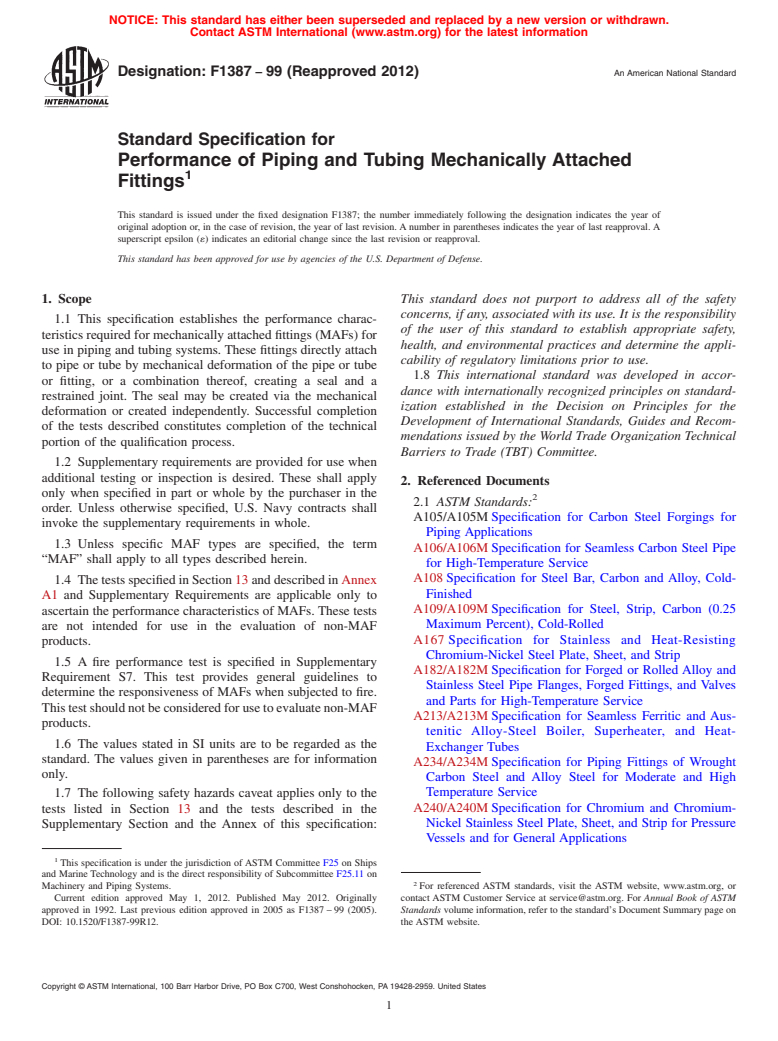
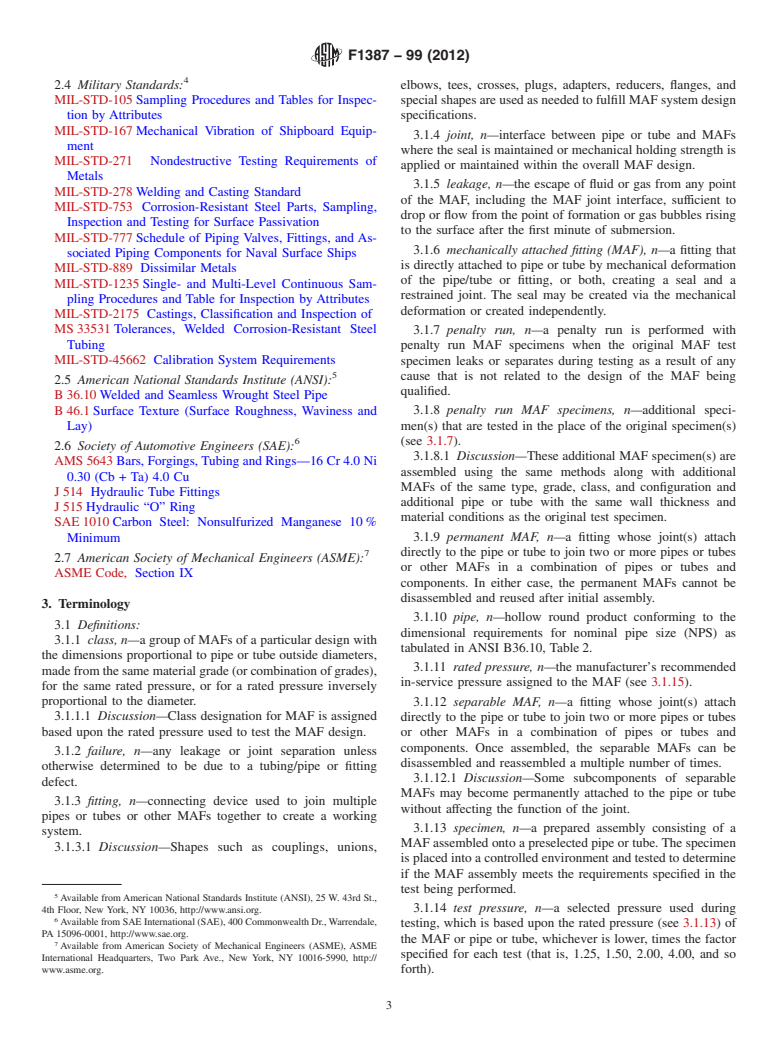
1.1 This specification establishes the performance characteristics required for mechanically attached fittings (MAFs) for use in piping and tubing systems. These fittings directly attach to pipe or tube by mechanical deformation of the pipe or tube or fitting, or a combination thereof, creating a seal and a restrained joint. The seal may be created via the mechanical deformation or created independently. Successful completion of the tests described constitutes completion of the technical portion of the qualification process.
1.2 Supplementary requirements are provided for use when additional testing or inspection is desired. These shall apply only when specified in part or whole by the purchaser in the order. Unless otherwise specified, U.S. Navy contracts shall invoke the supplementary requirements in whole.
1.3 Unless specific MAF types are specified, the term “MAF” shall apply to all types described herein.
1.4 The tests specified in Section 13 and described in Annex A1 and Supplementary Requirements are applicable only to ascertain the performance characteristics of MAFs. These tests are not intended for use in the evaluation of non-MAF products.
1.5 A fire performance test is specified in Supplementary Requirement S7. This test provides general guidelines to determine the responsiveness of MAFs when subjected to fire. This test should not be considered for use to evaluate non-MAF products.
1.6 The values stated in SI units are to be regarded as the standard. The values given in parentheses are for information only.
1.7 The following safety hazards caveat applies only to the tests listed in Section 13 and the tests described in the Supplementary Section and the Annex of this specification: This standard does not purport to address all of the safety concerns, if any, associated with its use. It is the responsibility of the user of this standard to establish appropriate safety and health practices and determine the applicability of regulatory limitations prior to use.
General Information
Relations
Standards Content (Sample)
NOTICE: This standard has either been superseded and replaced by a new version or withdrawn.
Contact ASTM International (www.astm.org) for the latest information
Designation:F1387 −99 (Reapproved 2012) An American National Standard
Standard Specification for
Performance of Piping and Tubing Mechanically Attached
1
Fittings
This standard is issued under the fixed designation F1387; the number immediately following the designation indicates the year of
original adoption or, in the case of revision, the year of last revision.Anumber in parentheses indicates the year of last reapproval.A
superscript epsilon (´) indicates an editorial change since the last revision or reapproval.
This standard has been approved for use by agencies of the U.S. Department of Defense.
1. Scope This standard does not purport to address all of the safety
concerns, if any, associated with its use. It is the responsibility
1.1 This specification establishes the performance charac-
of the user of this standard to establish appropriate safety,
teristicsrequiredformechanicallyattachedfittings(MAFs)for
health, and environmental practices and determine the appli-
use in piping and tubing systems. These fittings directly attach
cability of regulatory limitations prior to use.
to pipe or tube by mechanical deformation of the pipe or tube
1.8 This international standard was developed in accor-
or fitting, or a combination thereof, creating a seal and a
dance with internationally recognized principles on standard-
restrained joint. The seal may be created via the mechanical
ization established in the Decision on Principles for the
deformation or created independently. Successful completion
Development of International Standards, Guides and Recom-
of the tests described constitutes completion of the technical
mendations issued by the World Trade Organization Technical
portion of the qualification process.
Barriers to Trade (TBT) Committee.
1.2 Supplementary requirements are provided for use when
additional testing or inspection is desired. These shall apply
2. Referenced Documents
only when specified in part or whole by the purchaser in the
2
2.1 ASTM Standards:
order. Unless otherwise specified, U.S. Navy contracts shall
A105/A105MSpecification for Carbon Steel Forgings for
invoke the supplementary requirements in whole.
Piping Applications
1.3 Unless specific MAF types are specified, the term
A106/A106MSpecification for Seamless Carbon Steel Pipe
“MAF” shall apply to all types described herein.
for High-Temperature Service
A108Specification for Steel Bar, Carbon and Alloy, Cold-
1.4 ThetestsspecifiedinSection13anddescribedinAnnex
Finished
A1 and Supplementary Requirements are applicable only to
A109/A109MSpecification for Steel, Strip, Carbon (0.25
ascertain the performance characteristics of MAFs.These tests
Maximum Percent), Cold-Rolled
are not intended for use in the evaluation of non-MAF
A167 Specification for Stainless and Heat-Resisting
products.
Chromium-Nickel Steel Plate, Sheet, and Strip
1.5 A fire performance test is specified in Supplementary
A182/A182MSpecification for Forged or Rolled Alloy and
Requirement S7. This test provides general guidelines to
Stainless Steel Pipe Flanges, Forged Fittings, and Valves
determine the responsiveness of MAFs when subjected to fire.
and Parts for High-Temperature Service
Thistestshouldnotbeconsideredforusetoevaluatenon-MAF
A213/A213MSpecification for Seamless Ferritic and Aus-
products.
tenitic Alloy-Steel Boiler, Superheater, and Heat-
1.6 The values stated in SI units are to be regarded as the
Exchanger Tubes
standard. The values given in parentheses are for information
A234/A234MSpecification for Piping Fittings of Wrought
only.
Carbon Steel and Alloy Steel for Moderate and High
Temperature Service
1.7 The following safety hazards caveat applies only to the
A240/A240MSpecification for Chromium and Chromium-
tests listed in Section 13 and the tests described in the
Nickel Stainless Steel Plate, Sheet, and Strip for Pressure
Supplementary Section and the Annex of this specification:
Vessels and for General Applications
1
This specification is under the jurisdiction ofASTM Committee F25 on Ships
and Marine Technology and is the direct responsibility of Subcommittee F25.11 on
2
Machinery and Piping Systems. For referenced ASTM standards, visit the ASTM website, www.astm.org, or
Current edition approved May 1, 2012. Published May 2012. Originally contact ASTM Customer Service at service@astm.org. For Annual Book of ASTM
approved in 1992. Last previous edition approved in 2005 as F1387–99 (2005). Standards volume information, refer to the standard’s Document Summary page on
DOI: 10.1520/F1387-99R12. the ASTM website.
Copyright © ASTM International, 100 Barr Harbor Drive, PO Box C700, West Conshohocken, PA 19428-2959. United States
1
---------------------- Page: 1 ----------------------
F1387−99 (2012)
A249/A249MSpecification for Welded Austenitic Steel E511TestMethodforMeasuringHeatFluxUsingaCopper-
Boiler, Superheater,
...
Questions, Comments and Discussion
Ask us and Technical Secretary will try to provide an answer. You can facilitate discussion about the standard in here.